2050
The Effects Of Self-Efficacy And Expectations On
Knowledge Sharing Behavior
Mudaser Javaid, Nor Hazana Abdullah
Abstract: The aim of this study to investigate the influence of self-efficacy and expectations on Knowledge sharing behavior (KSB). The research strategy was cross sectional survey where questionnaires were voluntarily answered by 381 employees in several telecom companies located in Islamabad, Pakistan. The SEM-PLS was used for data analysis. The result of this study showed that self-efficacy and expectations had positive influence on the KSB. This study indicates the importance of employee’s selection. Employees with high self-efficacy and expectations are more willing to share knowledge which in turn could render Pakistani telecom industry’s competitive advantage. The value of this study lies on providing empirical evidence on the said relationships especially in the context of developing countries.
Index Terms: Self-efficacy, Expectations, Knowledge sharing behavior, Pakistan telecom industry
—————————— ◆ ——————————
1
INTRODUCTION
Knowledge is the main source of the organizational growth. It helps the organizations to build basic skills and creates more opportunities. Knowledge finds new strategies to increase improvement, innovation and business performance in order to create sustainable competitive advantages [1]. Knowledge sharing behavior (KSB) is not a new phenomenon. KSB among individual employees has been linked with an organization’s overall effectiveness [2]. The organization can be further improved if employees exchange useful knowledge with one another. Knowledge sharing is the best form of information that can be adjusted and distributed to the creation of the effectiveness of organization [3], [4]. In addition, every other resource diminishes when put to use, but knowledge sharing increases organizational competence [5]. This, therefore, means that knowledge sharing is beneficial to organizations
.
Previous studies have suggested that knowledge sharing behavior (KSB) is a process in which individuals shared their relevant expertise and job-related knowledge with other employees in the organizations, which led to organizational effectiveness [6]. Knowledge sharing is could foster new knowledge generation by exchanging views and integrating possibilities. Knowledge sharing behavior is considered to be a key factor for achieving sustained organizational success in the new era [7]. In the context of telecom industry in Pakistan, knowledge sharing becomes an important issue as the industry is facing myriad of challenges in terms of technological advancement and diversified markets. As such, telecom employees need to share knowledge to keep abreast to such changes and expedite organizational change [8]. However, empirical studies in Pakistan have attempted to examine the factors that determine, impede and encourage knowledge sharing (KS) in the education sector, pharmaceutical industries and banking industries [9], [10], [11]___________________________________
• Dr. Mudaser Javaid is recently graduated doctorate degree program in Technology Management and Business, University of Tun Hussein Oon Malaysia. E-mail: [email protected]
• Prof Dr Nor Hazana binti Abdullah is the deputy Dean in Technology Management and Business, University of Tun Hussein Oon Malaysia. E-mail: [email protected]
while none has been focusing on telecom industry. Also, other studies used variables such as collaborative culture, teams building, interpersonal trust, empowerment, diversity in organizations, and openness to individual expertise as the factors that affect knowledge sharing of workers in Pakistani organizations [12], [13]. The roles of self-efficacy and expectations have not been empirically investigated which lead to this present study
2
LITERATURE
REVIEW
2.1 Knowledge Sharing Behavior (KSB)
According to Cheema and Javed [14], KSB is the transformation process of learning from individual to other employees in the organization. Samadi [15] explores that strategies of the organizations and research are related to KSB contributed to rapid advancement. However, Wang, Luthans, Wang and Wu [16] argued that there is still a lack of study in the area of KSB at the organizational level. This lack of consistency in the literature regarding knowledge sharing is opening a way for the importance of KSB and also further research. The importance of knowledge sharing cannot be underestimated. Its benefits are enormous to the organization as it helps in new idea generation within the firm, which also creates new knowledge [17]. Knowledge sharing is the key resource in the current business environment to providing organizations with long-term success and sustainability [18], [19]. According to Kumar and Rose [20] emphasized that the importance of employees in the knowledge sharing process, and describe the knowledge sharing as employee behaviour which facilitates to the sharing of his/her knowledge to others. However, the lack of knowledge sharing seems to be one of the challenges to effective knowledge management in the organizations. Moreover, competing and effectively exploring knowledge sharing behavior (KSB) needs the pre-condition to development, create the abilities and knowledge that can strengthen desired knowledge sharing behaviour. Association of employee’s support, experience and self-efficacy is a necessary requirement for better sharing of knowledge among employees [21].
2.2 Self-efficacy and Knowledge Sharing Behavior
individual perception of self-confidence, external influences, and social interactions. Bandura [23] recommended that training, development and positive reinforcement provided by the organization is the gateway to enhance the employee’s sense of self-efficacy. So, Self-efficacy is personal confidence in capabilities which he or she has to perform the specific task. Furthermore, previous researches have consistently demonstrated that self-efficacy is positively related to knowledge sharing behaviour (KSB) ([24], [25], [26], [27]. In these studies, individual beliefs in their ability to perform certain task were seen as important factors to share knowledge. More studies suggest that the application of the concept of self-efficacy in knowledge management help to predict the influence of personal beliefs on KSB [28]. Self-efficacy plays the role of self-evaluation, which affects individual decision on tasks to be performed when facing obstacles, and it is defined as the beliefs of individuals in their valuable knowledge when discussing with others [28], [29], [30]. Self-efficacy refers to individual perceived capability and is better measured when it is related to an important task. According to Bandura [31] when people think of the impact of their actions, it encourages them to attempt or restrict certain behaviour. In addition, Endres, Chowdhury and Alam [32] postulate that the formulation of self-efficacy is influenced by the surrounding environment which eventually leads to knowledge sharing. The review of the literature informed that few studies explored self-efficacy impacts on knowledge sharing behaviour (KSB). However, no traced study was found to have explored the relationship between self-efficacy and KSB specifically in the Pakistani telecom industry. This is so because self-efficacy is related to the concept of human behaviour as stressed by Bandura [33] that individuals make decisions and act as a result of the interaction. People beliefs are developed through choosing and acting on certain experiences that highlight their capabilities in the domain of such experiences. Hence, when people have positive experiences, definitely it affects their choice of participating in any future action to have repeat of a similar experience. In contrast, when the experience is negative then the willingness and the choice of such participation were discouraging because of the challenges or failure encountered. Consequently, this is providing arguments that self-efficacy could positively influence knowledge sharing behaviour.
H1: There is a positive relationship between self-efficacy and knowledge sharing behaviour.
2.3 Expectations and Knowledge Sharing Behavior
For the first time, the concept of expectation was presented into organizational behaviour study by Porter and Steers [34]. He was considered this concept as a difference between what a person meets on this work in the path of negative and positive experiences and what he expected to meet. Expectations are beliefs that something will or is likely to happen [35], [36]. Importantly, expectations can greatly impact peoples’ lives, influencing behaviour, affect, experience, and perception [35], [36], [37]. People are evaluating the benefit that they can gain from knowledge sharing before they share [38]. Additionally, there are three types of expectations which are expected rewards, expected associations, expected contribution.
2.3.1 Expected Reward and Knowledge Sharing
Behaviour
According to Bock and Kim [39], “expected rewards” is one of the factors of individual beliefs that affect knowledge sharing attitude. They defined expected rewards as benefits that are extrinsic in nature, like rewards in monetary forms, promotion, or prospective educational development opportunity that an employee believes they will receive for their knowledge sharing. This belief, therefore, will contribute to developing a more positive attitude towards knowledge sharing. It is so because reward expectation is an imperative factor that affects knowledge sharing decision by employees [6]. According to Constant et al., [40] that knowledge sharing occurs when results exceeded costs or at par with expectation. Expected reward suggests that when employees foresee themselves gaining rewards of intrinsic nature, which involve money, promotion, and educational advancement if knowledge is shared then they would have an intention to share knowledge [41], [42]. This shows that reward expected can influence knowledge sharing behaviour (KSB) among employees of an organization. Therefore, the following hypothesis is being formulated.
H2: There is a positive relationship between expected reward and knowledge sharing behaviour.
2.3.2 Expected Reward and Knowledge Sharing Behaviour
Expected association is concerned with intrinsic benefits rather than extrinsic benefits. Intrinsic benefits are those benefits that do not have quantitative value in terms of price attached to them. Bock and Kim [39] affirmed that “if employee believes that their relationships with colleagues could be improved due to offering their knowledge, their attitude becomes positive towards knowledge sharing”. Employees of an organization who wish to improve the personal relationship and social support to their colleagues are likely to have a positive attitude towards knowledge sharing [43]. Thus, knowledge sharing is seen as a way of building the close and intimate relationship amongst employees of an organization. Therefore, the following hypothesis is being formulated.
H3: There is a positive relationship between expected association and knowledge sharing behaviour.
2.3.3 Expected Contribution and Knowledge Sharing Behaviour
2052 H4: There is a positive relationship between expected
contribution and knowledge sharing behaviour.
3 RESEARCH
METHODOLOGY
3.1 Measurement
This study used questionnaires as data collection method. The population of this study included employees working in the telecom companies located in Islamabad, Pakistan. A total of 381 were received with 84 percent response rate. According to rules, measurement is a process in which a researcher assigns numbers or other symbols to empirical properties or variables [44]. Questionnaire included 28 items enumerated in the 5-point Likert scale (Strongly Disagree toward strongly agree) was used to measure the all constructs. The construct was developed by the researcher and extant research related to the fields of knowledge sharing behaviours. Knowledge sharing behaviour were assessed base on the five-item scale developed by Bock et al., [45]. Self-efficacy was assessed base on the ten-item scale developed by Zhang and Schwarzer [46]. Expectations such as expected reward, association and contribution were accessed base on the three, five and five items scaled respectively developed by Bock & Kim, [47]. The questionnaire design was established based on the review of the existing literature. A short scale may be cognitively easy to get the response from the respondents as compared to long scaled [48].
4 FINDING
AND
DISCUSSION
The data were analyzed using PLS-SEM. The measurement model was assessed using construct validity, reliability and average variance extracted (AVE). AVE under each construct is greater than 0.5 which reflects the convergent validity of the measurement items. Furthermore, structural model was assessed using significance testing of the structural model relationships, assessment of R2, assessment of P-value, and assessment of beta.
TABLE1
COMPOSITE RELIABILITY AND AVE
Variable Name Composite Reliability
Average Variance Extracted (AVE)
Self-Efficacy 0.900 0.601
Exp Reward 0.819 0.608
Exp ASS 0.905 0.707
Exp Con 0.924 0.753
KSB 0.889 0.616
Table 1 shows the composite reliability and the AVEs of the constructs. As indicated by the result, the composite reliability values, which measures the extent to which the indicators depict the latent construct, all ed values higher than the recommended minimum threshold of 0.7. Similarly, an AVE value showed of ≥.50 that meet the greater part of the variance of its indicators [49] (Hair et al., 2014). Therefore, the requirement for convergent validity was achieved.
TABLE 2
DISCRIMINANT VALIDITY
SE E.R E.A E.C KSB
Self-efficacy 0.774
Exp reward 0.060 0.780 Exp ass 0.058 0.104 0.841 Exp con 0.148 0.025 0.082 0.868 KSB 0.204 -0.039 0.109 0.044 0.785
Table 2 shows about result of Fornell-Larcker criterion to verify the discriminant validity result. Fornell & Larcker, [50] and Gefen, Straub, & Boudreau, [51] both justified that discriminant validity is measured by considering the correlation among the construct. Based on this criterion discriminant validity is said to be achieved when the square root of the AVE of the construct of interest is greater than any correlation between the construct and other constructs in the model [52]. As shown in the Table above, the diagonal values which represent the square root of the AVE of each construct are higher than the inter-correlations between other constructs in the model, thus satisfying the discriminant validity criterion.
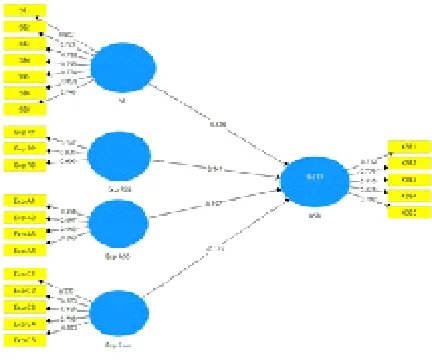
Figure 1: Structural Model
The path coefficients are the estimates of the hypothesized relationship between the endogenous latent construct (Knowledge sharing behaviour) and exogenous latent constructs (self-efficacy, and expectations) in the structural model. Path coefficients that are close to +1 are considered to represent strong positive relationships while those that tend towards -1 are considered to represent strong negative relationships [49]. The significance of the path estimates is determined through the bootstrapping procedure in the Smart PLS-SEM software using the critical t-value for significance testing at 5 percent level of significance. Table 3 shows the path coefficients (β) with their respective t-values, p-values and f2 values. As shown in the table, there was five paths show significant positive relationships while only one path shows a negative significant relationship.
TABLE3
PATH COEFFICIENT
Beta T-Sta P-Value Result R2
S-E 0.436 9.193 0.000 Supported
46.9 Exp Rew 0.141 2.919 0.004 Supported
Exp Ass 0.197 3.666 0.000 Supported
The R-square represents the amount of variance in the endogenous latent construct explained by all the exogenous latent constructs in the structural model [49]. The result shown in Table 3 indicated that the entire two exogenous constructs in the structural model effect on the endogenous latent construct (R=.469). This shows that the combined effect of the exogenous latent constructs explains about 47 percent of the variance in the endogenous latent construct. Based on the values derived from the related study, the general rule for high R2 is 0.20, however values below 0.10 are considered to have low levels of predictive accuracy [49]. The importance of Pakistani telecom industry and its unresolved issue related to knowledge sharing behaviour (KSB) which cannot provide profitability and productivity for the development of industry. The result indicates that self-efficacy possessed a significant in terms of KSB in the telecom industry, Pakistan. Based on the result, self-efficacy within the telecom industry operating in Pakistan contribute towards sharing knowledge among employees. The employees believed when they shared their knowledge in the professional work environment their confidence in themselves increased. It seems that a sense of personal competence and confidence may be a requirement for a person to engage in knowledge sharing. Based on the related findings, it can be established that there is statistically significant influence among self-efficacy on telecom industry in Pakistan regarding knowledge sharing behaviour. Furthermore, the finding confirms some previous studies as well [46], [53], [54], [55]. In current study indicate from the data analysis, expected rewards and expected association, which are the respondents’ belief in the possibility of receiving immediate tangible rewards in return for their knowledge sharing, have significant relationships towards knowledge sharing behaviour (KSB). This was in line with the finding in previous research of Kuo, [56] that this relationship is very important to share their knowledge among employees. Kankanhalli, Tan, and Wei, [57] suggested that expected reward such as monetary or non-monetary benefits, influencing on knowledge sharing behaviour contingent on particular contextual factors. This finding was also reported by Yio-Eih, Hsiang and Hsiang, [58] that expected rewards provide high level of incentive to the employees that consequences been tightly linked to actions. In the same vein, Cantoni, Bello, and Frigerio, [59] affirmed that rewards and incentives have developed a positive attitude for knowledge sharing and create an organizational culture that values knowledge sharing practices. The results about expected contribution indicates that there was negative but significant relationship with KSB which is based on the perception of the employees of telecom industry in Pakistan. This study also showed strong but negative relationship between expected contribution of telecom industry and KS among their employees. Expected contribution represents the relational perspective and the findings can be used to drive towards knowledge sharing in the same ways. The relational perspectives lead to a negative towards knowledge sharing. Therefore, mean that this is because employees are afraid and less confident about making social relationships and even less contributing their knowledge to the productivity of the industry. Furthermore, the inconsistencies in the findings might be as a result of different culture, measurement in different context and respondents/samples used. So, the fear to lose job, employees hoard to share their knowledge, idea, information and consequently contribution with other
employees enable industry to decrease their knowledge, irrelevant work processes, decrease productivity and did not help them to achieve their objectives. In this study for the first time tried to scientifically analyze the combined effect of self-efficacy and expectations with KSB. The results indicate that self-efficacy and two dimensions of the expectation such as expected reward (H2) and expected association (H3) effects on KSB, which is based on the perception of the employees of telecom industry in Pakistan. Therefore, all the employees were self-confident and this confidence indeed boosts their KSB and work culture which leads to development and productivity of the telecom industry.
5 RESEARCH
IMPLICATION
AND
CONTRIBUTION
This study contributes to explore the influence of self-efficacy and expectations role on knowledge sharing behaviour. Social Cognitive theory such as SCT contribute through relationship between self-efficacy, expectations and KSB which have been confirmed in previous studies. Accordingly, the SCT suggested that self-confidence and expectations may have effect towards KSB. However, the suggested effect was barely examined empirically in the knowledge sharing literature. In this context, the study explored SCT in terms of KSB to better understand the perception of employees who are working telecom industry in Pakistan. The finding suggested that management needs to make relationship among employees which can actively bring people together and contribute to a knowledge-based culture in industry. Management should encourage employees to put in the effort and contribute to the community with their expert opinions. The management should arrange training sessions for employees to enhance the personal learning and give confidence on what they learnt and contributed, encourage them to share their valuable knowledge with other colleagues. Future research may be extended to include different samples in different countries or industries to explore the phenomenon of KSB. This study has used cross-sectional method to collect data which may induce common method bias; for future findings longitudinal research can also be used. While in current study did not test any moderating and mediating relationships, future research can also examine the influence of both mediation and moderation.
6 CONCLUSION
2054
7
REFERENCES
[1]. Johannessen, J. A., Olaisen, J., & Olsen, B. (2001). Mismanagement of tacit knowledge: The importance of tacit knowledge, the danger of information technology, and what to do about it. International Journal of Information Management, 21(1), 3–20.
[2]. Yossif Noaman, A., & Fouad, F. (2014). Knowledge sharing in universal societies of some develop nations. International Journal of Academic Research, 6(3), 205– 212.
[3]. Conner, K. R., & Prahalad, C. K. (1996). A Resource-Based Theory of the Firm: Knowledge versus Opportunism. Organization Science, 7(5), 477–501. [4]. Lin, S. W., & Lo, L. Y. S. (2015). Mechanisms to
motivate knowledge sharing: integrating the reward systems and social network perspectives. Journal of Knowledge Management, 19(2), 212–235.
[5]. Usoro, A., Sharratt, M. W., Tsui, E., & Shekhar, S. (2007). Trust as an antecedent to knowledge sharing in virtual communities of practice. Knowledge Management Research and Practice, 5(3), 199–212. [6]. Bartol, K. M., & Srivastava, A. (2002). Encouraging
Knowledge Sharing: The Role of Organizational Reward Systems. Journal of Leadership & Organizational Studies, 9(1), 64–76.
[7]. Liou, D. K., Chih, W. H., Yuan, C. Y., & Lin, C. Y. (2016). The study of the antecedents of knowledge sharing behavior. Internet Research, 26(4), 845–868.
[8]. Javaid, M., Abdullah, N. H., Zeb, A., & Hussain, K. (2018, July). The Impact of Authentic Leadership on Knowledge Sharing Behavior with the Moderating role of Islamic Work Ethics. In Journal of Physics: Conference Series (Vol. 1049, No. 1, p. 012007). IOP Publishing.
[9]. Bibi, S., & Ali, A. (2017). Knowledge sharing behavior of academics in higher education. Journal of Applied Research in Higher Education, 9(4), 550–564.
[10]. Zubair, M., Ahmad, N., & Ahmed, R. R. (2014). Key Factors to Promote Knowledge Sharing in Karachi Pharmaceutical Industry. Information and Knowledge Management, 4(4), 125–138.
[11]. Yousaf, M. J., Ali, Q., Sohaib, M., & Ihsan, M. (2013). Empirical Investigation of Knowledge Sharing Obstacles in Education Sector of Pakistan. International Journal of Management & Organizational Studies, 2(2), 8–15. [12]. Ahmed, F., Shahzad, K., Aslam, H., Bajwa, S. U., &
Bahoo, R. (2016). The Role of Collaborative Culture in Knowledge Sharing and Creativity among Employees. Pakistan Journal of Commerce & Social Sciences, 10(2), 335–358.
[13]. Tahir, M., Khan, F., Far, S. M., Jadoon, I. A., Khan, H., & Munir, Y. (2012). Factors affecting knowledge sharing, stress and team building of industrial sector of Pakistan. Academic Journal of Management Sciences, 1(1), 57– 65.
[14]. Cheema, S., & Javed, F. (2017). The effects of corporate social responsibility toward green human resource management: The mediating role of sustainable environment. Cogent Business & Management, 4(1).
[15]. Samadi, B. (2015). Factors influencing organizational trust and knowledge sharing behaviour in MSC status
companies.
[16]. Wang, H., Sui, Y., Luthans, F., Wang, D., & Wu, Y. (2014). Impact of authentic leadership on performance: Role of followers’ positive psychological capital and relational processes. Journal of Organizational Behavior, 35(1), 5–21.
[17]. Ikujiro Nonaka. (1994). A dynamic theory of organizational knowledge creation. Organization Science 5 N-1, 5(1).
[18]. Alavi, M., & Leidner, D. E. (2014). Knowledge management and knowledge management systems: Conceptual foundations and research issues. MIS Quarterly, 25(1), 107–136.
[19]. Ipe, M. (2003). Knowledge Sharing in Organizations: A Conceptual Framework. Human Resource Development Review, 2(4), 337–359.
[20]. Kumar, N., & Che Rose, R. (2012). The impact of knowledge sharing and Islamic work ethic on innovation capability. Cross Cultural Management: An International Journal, 19(2), 142-165.
[21]. Borges, R. (2012). Tacit knowledge sharing between IT workers. Management Research Review, 36(1), 89– 108.
[22]. Bandura, A. (2001). Social Cognitive Theory: An Agentic Perspective. Annual Review of Psychology, 52(1), 1–26.
[23]. Bandura, A. (1977). Self-efficacy: Toward a Unifying Theory of Behavioral Change. Psychological Review1, 84(2), 191–215.
[24]. Tseng, F., & Kuo, F. (2010). Computers in Human Behavior The way we share and learn: An exploratory study of the self-regulatory mechanisms in the professional online learning community. Computers in Human Behavior, 26(5), 1043–1053.
[25]. Liu, N. C., & Liu, M. S. (2011). Human resource practices and individual knowledge-sharing behavior – an empirical study for Taiwanese R&D professionals. The International Journal of Human Resource Management, 22(4), 981–997.
[26]. Mckeown, T., Cochrane, R., Mckeown, T., & Cochrane, R. (2012). Professional contractor wellbeing: mutual benefits of organizational support. 33(7), 786-803.
[27]. Li, C. (2016). Self-efficacy and innovation effectiveness in the online game industry. Total Quality Management & Business Excellence.
[28]. Hsu, M., Ju, T. L., Yen, C., & Chang, C. (2007). Knowledge sharing behavior in virtual communities: The relationship between trust, self-efficacy, and outcome expectations. International Journal of Human-Computer Studies, 65(2), 153–169.
[29]. Lin, M. J. J., Hung, S. W., & Chen, C. J. (2009). Fostering the determinants of knowledge sharing in professional virtual communities. Computers in Human Behavior, 25(4), 929–939.
[30]. Taylor, P., Tsai, M., & Cheng, N. (2012). Behaviour & Information Technology Understanding knowledge sharing between IT professionals – an integration of social cognitive and social exchange theory, (June 2015), 37–41.
[32]. Lee Endres, M., Endres, S. P., Chowdhury, S. K., & Alam, I. (2007). Tacit knowledge sharing, self-efficacy theory, and application to the Open Source community. Journal of Knowledge Management, 11(3), 92–103. [33]. Bandura, A. (1986). The Explanatory and Predictive
Scope of Self-Efficacy Theory. Journal of Social and Clinical Psychology, 4(3), 359–373.
[34]. Porter, L. W., & Steers, R. M. (1973). Organizational, work, and personal factors in employee turnover and absenteeism. Psychological Bulletin, 80(2), 151–176. [35]. Kirsch, I. (1985). Response expectancy as a
determinant of experience and behavior. American Psychologist, 40(11), 1189–1202.
[36]. Price, D. D., Finniss, D. G., & Benedetti, F. (2008). A Comprehensive Review of the Placebo Effect: Recent Advances and Current Thought. Annual Review of Psychology, 59(1), 565–590.
[37]. Wilson, T. D., Lisle, D. J., Kraft, D., & Wetzel, C. G. (1989). Preferences as expectation-driven inferences: Effects of affective expectations on affective experience. Journal of Personality and Social Psychology, 56(4), 519–530.
[38]. Davenport, B. T. H., Prusak, L., & Webber, A. (2003). Working knowledge: how organizations manage what they know [Book Review]. IEEE Engineering Management Review (Vol. 31).
[39]. Bock, G. W., & Kim, Y. G. (2001). Breaking the myths of rewards: An exploratory study of attitudes about knowledge sharing. Pacific Asia Conference on Information Systems (PACIS), 2001 December.
[40]. Constant, D., Kiesler, S., & Sproull, L. (1994). What’s Mine Is Ours, or Is It? A Study of Attitudes about Information, 5(4).
[41]. Wang, Z., & Wang, N. (2012). Knowledge sharing, innovation and firm performance. Expert Systems with Applications, 39(10), 8899–8908.
[42]. Zani, N. M., Hashim, K. F., Mazida, A., & Ahmad, M. N. (2014). Examining the Determination of Flood Victim’s Knowledge Sharing Behavior: from the Perspectives of Social Cognitive Theory. Proceeding of Knowledge Management International Conference (Kmice) 2014, Vols 1 and 2, 861–866.
[43]. Hsu, C. L., & Lin, J. C. C. (2008). Acceptance of blog usage: The roles of technology acceptance, social influence and knowledge sharing motivation. Information and Management, 45(1), 65–74.
[44]. Ahmed, F., Shahzad, K., Aslam, H., Bajwa, S. U., & Bahoo, R. (2016). The role of collaborative culture in knowledge sharing and creativity among employees. Pakistan Journal of Commerce and Social Sciences (PJCSS), 10(2), 335-358.
[45]. Bock, G. W., Zmud, R. W., Kim, Y. G., & Lee, J. N. (2005). Behavioral Intention Formation in Knowledge Sharing: Examining the Roles of Extrinsic Motivators, Social-Psychological Forces, and Organizational Climate. MIS Quarterly, 29(1), 87–111.
[46]. Zhang, J. X., & Schwarzer, R. (1995). Measuring optimistic self-beliefs: A Chinese adaptation of the General Self-Efficacy Scale. International Journal of Psychology in the Orient.
[47]. Bock, G. W., & Kim, Y. G. (2002). Breaking the myths of rewards: An exploratory study of attitudes about knowledge sharing. Information Resources
Management Journal (IRMJ), 15(2), 14-21.
[48]. Weisberg, Krosnick, B. (1996). An introduction to survey research, polling, and data analysis. Sage. [49]. Hair, J. F. J., Hult, G. T. M., Ringle, C., & Sarstedt, M.
(2014). A Primer on Partial Least Squares Structural Equation Modeling (PLS-SEM). Long Range Planning (Vol. 46).
[50]. Fornell, C., & Larcker, D. F. (1981). Evaluating Structural Equation Models with Unobservable Variables and Measurement Error. Algebra and Statistics. Journal of Marketing Research, 18(3), 382–388.
[51]. Gefen, D., Straub, D., & Boudreau, M. C. (2000). Structural Equation Modeling and Regression: Guidelines for Research Practice, 4(October).
[52]. Ali, F., Gon, W., & Ryu, K. (2016). The effect of physical environment on passenger delight and satisfaction: Moderating effect of national identity. Tourism Management, 57, 213–224.
[53]. Black, J., Kim, K., Rhee, S., Wang, K., & Sakchutchawan, S. (2018). Self-efficacy and emotional intelligence. Team Performance Management: An International Journal, TPM-01-2018-0005.
[54]. Liou, D. K., Chih, W. H., Yuan, C. Y., & Lin, C. Y. (2016). The study of the antecedents of knowledge sharing behavior. Internet Research, 26(4), 845–868. [55]. Wang, J. R., & Zhang, Y. (2011). Empirical study on
influencing factors of team members’ knowledge sharing behavior in complex product development. International Conference on Management and Service Science, MASS 2011.
[56]. Kuo, T. (2012). How expected benefit and trust influence knowledge sharing. Internet ResearchVol. 22(1), 4-28.
[57]. Kankanhalli, Tan, & Wei. (2005). Contributing Knowledge to Electronic Knowledge Repositories: An Empirical Investigation. MIS Quarterly, 29(1), 113. [58]. Yio-Eih, S., Hsiang, N., & Hsiang, T. (2005). Why
Individual Share Knowledge in the Work Place? The Effects of Motivation and Context. Isu. Edu. Tw, 1–22. [59]. Cantoni, F., Bello, M., & Frigerio, C. (2001). Lowering