NON-INVASIVE CONCEALED WEAPON
DETECTION AND IDENTIFICATION USING V
BAND MILLIMETER WAVE IMAGING RADAR
SYSTEM
Ashutosh Kumar Rai
1, Sovers Singh Bisht
2Department of Computer Science Engineering, IIMT College of Engineering ,Greater Noida,(India)
ABSTRACT
This paper presents a millimeter wave imaging radar system operating at 60 GHz for non invasive and
non- destructive concealed weapon detection and identification. In order to mimic, the concealed weapon
target, an aluminum toy gun covered with cloth has been used. Different signal processing techniques
were applied in order to fully detect and identify the concealed weapon target. Techniques like; discrete
convolution, mean and standard deviation based thresholding and canny edge detection were applied
and their applicability was tested towards successful hidden target identification. The correct target
location and shape identifi- cation validates the MMW radar’s capability towards stand- off concealed
object detection and identification. Further, the proposed technique can be used with other different
kinds of weapon targets for applications requiring personal screening and security check.
Index Terms: Millimeter Wave, Imaging, Radar, Non-Invasive, Thresholding, Template
Convolution, Edge Detection.
I. INTRODUCTION
The millimeter wave (MMW) region of the electro- magnetic spectrum fills the gap between microwaves and infrared frequency. The field of MMW science and tech- nology has changed significantly within the last few years, which can be attributed to several new advances in the MMW technology such as; filters, signal sources, ampli- fiers, antennas, etc.[1]. This encourages new interest in applying this waveband for high resolution imaging[2]. There are several merits of MMW wave spectrum, like; higher transmission rate, capability of spread spectrum, less crosstalk interference due to larger bandwidth, reduced hardware size and easy penetration to dielectric materials with enough resolution[3]. This is mainly useful in security applications where MMW imaging can be used as a system of detecting concealed weapon. MMW imaging system is similar to the conventional radar system except transmitted frequency.
high-resolution but it is not good for health[5]. THz systems are sensitive to temperature. In the passive MMW imaging mode, signal is not emitted by transmitter, but the receiver receives MMW radiation from the local environment. Passive imaging works on the concept that objects above absolute zero emits some form of MMW radiation[6]. However, active MMW sys- tems provide higher-resolution and three-dimensional (3- D) imaging that provides the shape of concealed targets for better identification. Active MMW imaging can be fully coherent, which permits the system to obtain three- dimensional (3-D) imaging. These systems can also rapidly obtain the data at high signal to noise ratios. Finally, be- cause of the coherent collection of scattered data, different image enhancement techniques can be used to perform high- resolution imaging without using lenses or reflectors for focusing. All focusing is performed mathematically using computer image reconstruction techniques [7] [8].
In this paper, we have used indigenously designed 60 GHz active MMW imaging radar for concealed target detection and identification for security applications. For the con- cealed weapon, we have used aluminum toy gun placed at stand-off distance. The remaining paper is organized as follows: section II describes MMW radar setup, section III discusses different signal processing techniques used for target detection and identification. Results are discussed in section IV and section V gives the conclusion.
II. MILLIMETER WAVE RADAR SETUP DESIGN
A. Experiment Set Up
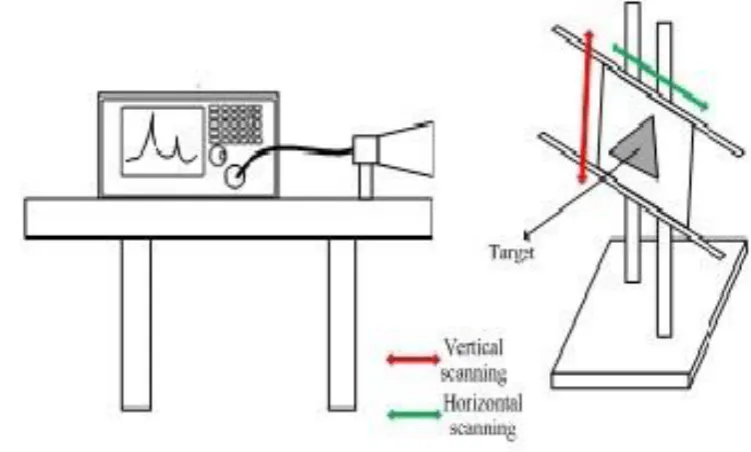
Fig.1. Experimental setup for millimetre wave active imaging radar with target mounted on a
2D scanning frame
Table I Specification f or SF C W Based Active Millimeter Wave Imaging Radar
S. No SFCW imaging radar parameter
Typical Values
1 Operating frequency 60 GHz
2 Bandwidth 2GHz
(59-61GHz) 3 No. of frequency points
(N)
201 4 Transmitted Power 10dBm
5 Range resolution 7.5cm
6 Cross range resolution 0.417,cm 7 Beamwidth ( E, H Plane) 9.1, 10.4
8 Gain 25dBi
9 Swath 56.88,cm2
B. Target arrangement for concealed weapon detection
Fig.2. Target arrangement used for millimeter wave stand-off concealed weapon detection and
identification (a) Toy gun, (b) concealed toy gun covered with cloth piece.
III. METHODOLOGY: SIGNAL PROCESSING TECHNIQUES
The reflected signal from the concealed target is col- lected as the one port complex reflection coefficient (S11) and further undergoes different signal processing steps in order to retrieve useful information for concealed target identification. The detailed steps are shown in the flowchart in fig. 2 and are described in the following subsections
A. Signal Pre-processing
The received signal is in frequency domain form, and thus, converted to time domain using inverse fast Fourier transform (IFFT). This time domain signal is further con- verted to spatial domain or range profile to extract infor- mation related to target location in down range. Received signal reflected from the target at a distance z from radar in complex scattering coefficient s(z) is defined as;
N −1
S(Z ) = X
S(fn )ej2π fn (2z/c) (1)
n=0
N −1
S(Z ) = X
S(fn )ej2π fn (2Z/c−2Zref /c) (2) n=0
Where, tref , zref represents time delay and distance due to metal sheet at antenna flare.
B. Image Enhancement techniques
The 2D C scan image of the concealed target is formed at the down range location, where, the reflection intensity is maximum. However, the extracted C scan image is of very poor resolution due to the noise added from the oblique and multipath reflections, reflection from target surroundings, etc. So, different image enhancement tech- niques were applied in order to improve the image quality.
1) Template Convolution: Target image enhancement
can be achieved using linear filtering operation through discrete (template) convolution. Discrete convolution is a neighborhood operation where a filter kernel or mask is sequentially convolved with each of the image pixel. Mask is generally odd in size so as to position it correctly and symmetrically over any pixel. However, choice of particular mask shape and size determines the quality and intelligibility of the resultant image. Here, we have used the 3x3 gaussian filter kernel because of its optimal performance as compared to other averaging filters[10].
2) Image segmentation: Once the image quality isimproved, thresholding operation is performed so as to segment the target from the background. Since, statisti- cal parameters of any image carry vital information in determining image spatial characteristics, we have used image statistics based thresholding technique. Mean and standard deviation based global thresholding technique has been used here. The value of threshold is determined as;
Threshold (T)=mean(µ )+n X standard deviation(σ ) Where, n is the scaling factor.
3) Edge detection: Next, in order to determine the actual shape of the target, its features need to be extracted. For this, the technique used is called the edge detection. Edge detection basically determines the boundary of the target depending upon the intensity contrast between the target and the background. Out of different available edge detection techniques viz., Sobel, Canny, Prewitt, Roberts, we have used canny based edge detector because of its better performance in terms of improved signal to noise ratio and adaptive local gradient measurement[11].
IV. RESULTS AND DISCUSSION
Fig.3
Fig.4
Fig.5
object from a stand-off distance. Further, this approach can be applied and tested for other different target types and materials.
VI. CONCLUSION
We have demonstrated the experimental results for target detection and identification using the V band millimeter wave imaging radar system for concealed weapon de- tection. The undercover metallic weapon (toy gun) was detected from a stand-off distance of 0.5 meter. Further, actual shape of the gun was successfully recognized us- ing different image processing techniques, viz., discrete convolution, thresholding and edge detection. As a future work, we plan to detect and identify different others types of weapon targets of different dielectric materials.
REFERENCES
1. C.-H. Tseng and T.-H. Chu, ”An effective usage of vector network analyzer for microwave imaging,” Microwave Theory and Techniques, IEEE Transactions on, vol. 53, pp. 2884-2891, 2005.
2. C. Zech, A. Hlsmann, I. Kallfass, A. Tessmann, M. Zink, M.
3. Schlechtweg, et al., ”Active millimeter-wave imaging system for material analysis and object detection,” in SPIE Security+ Defence, 2011, pp. 81880D-81880D-9.
4. H. Cetinkaya, A. Kizilhan, A. Vertii, S. Demirci, E. Yigit, and C. Ozdemir, ”The millimeter-wave imaging of concealed objects,” in Antennas and Propagation (APSURSI), 2011 IEEE International Symposium on, 2011, pp. 228-231.
5. D. M. Sheen, D. L. McMakin, and T. E. Hall, ”Active millimeter- wave and sub-millimeter-wave imaging for security applications,” in Infrared, Millimeter and Terahertz Waves (IRMMW-THz), 2011 36th International Conference on, 2011, pp. 1-3.
6. S. W. Harmer, N. Bowring, D. Andrews, N. D. Rezgui, M. South- gate, and S. Smith, ”A Review of Nonimaging Stand-Off Concealed Threat Detection with Millimeter-Wave Radar [Application Notes],” Microwave Magazine, IEEE, vol. 13, pp. 160-167, 2012.
8. D. M. Sheen, D. L. McMakin, and T. E. Hall, ”Three-dimensional millimeter-wave imaging for concealed weapon detection,” Microwave Theory and Techniques, IEEE Transactions on, vol. 49, pp. 1581-1592, 2001.
9. D. Sheen, D. McMakin, and T. Hall, Near-fieldthree-dimensional radar imaging techniques and applications,” Applied Optics, vol. 49, pp. E83-E93, 2010.
10. S. Agarwal, A. S. Bisht, D. Singh, and N. P. Pathak, ”A novel neural network based image reconstruction model with scale and rotation invariance for target identification and classification for Active mil- limetre wave imaging,” Journal of Infrared, Millimeter, and Terahertz Waves, vol. 35, pp. 1045-1067, 2014. 11. S. Schaller, J. E. Wildberger, R. Raupach, M. Niethammer, K.
12. Klingenbeck-Regn, and T. Flohr, ”Spatial domain filtering for fast modification of the tradeoff between image sharpness and pixel noise in computed tomography,” Medical Imaging, IEEE Transactions on, vol. 22, pp. 846-853, 2003.