*Corresponding author's present address: Division of Plant Physiology, IARI, New Delhi-110 012, E-mail: [email protected]
VARIABILITY IN SENESCENCE PATTERN AND MEMBRANE STABILITY IN WHEAT
GENOTYPES UNDER NORMAL AND LATE SOWN CONDITIONS
SUNIL KUMAR PANDEY* AND J.P. SRIVASTAVA
Department of Plant Physiology, Institute of Agricultural Sciences, Banaras Hindu University, Varanasi-221 005, India Received on 20 March, 2009, Revised on 30 June, 2009
SUMMARY
A field experiment was conducted during rabi season to find out the senescence pattern and membrane stability of flag leaf and their relationships with yield in three genotypes of wheat (HUW-234, HUW-468 and Chirya-3) under normal and late sown conditions. Changes in chlorophyll content of flag leaf of mother shoot were recorded at 5, 10, 15, and 20 days after anthesis. The chlorophyll content in the flag leaf of main shoot (MS) decreased rapidly after 10 days of anthesis and more so in genotype HUW-468 and Chirya-3 under late sowing and resulted in lower mean chlorophyll content. On the other hand, mean electrolyte leakage under late sowing was more in genotype HUW-234 and HUW-468. Chirya-3 exhibited lesser damage in flag leaf cell membrane under late sown conditions. The study showed that the major reduction in main shoot and yield under late sowing was due to a decrease in grain number per ear. Genotypic differences existed with respect to sustenance of grain weight per ear and cell membrane stability under terminal heat stress in wheat. An ability to sustain higher grain weight along with cell membrane stability under heat stress is therefore, desired for higher yield under late sown conditions.
Key words: Chlorophyll, membrane stability, osmotic stress, temperature stress, wheat
increase in temperature above 25ºC during grain filling period (Asana and Williams 1965). It has been reported that stability indices of cell membrane and chlorophyll are affected under heat stress (Sairam et al. 1997, Guha Sarkar et al. 2001). Physiological analysis of grain development of wheat under late sown conditions in North-East-Plain-Zone (NEPZ) are not much studied, particularly in relation to cell membrane and chlorophyll stability. The present study was therefore, undertaken to investigate the changes in membrane stability of flag leaf due to heat and osmotic stresses in relation to grain development and yield under late sown conditions in wheat genotypes differing in their sensitivity to terminal heat stress.
INTRODUCTION
MATERIALS AND METHODS
The experiment was conducted at agricultural research farm of the Institute of Agriculture Sciences, Banaras Hindu University, Varanasi. Three wheat genotypes, viz. HUW-234, HUW-468 and Chirya-3 were grown under normal (11 December) and late (15 January) sown conditions in randomized block design with three replications. Genotypes HUW-234 and HUW-468 are most popular in this region (NEPZ), while the genotype Chirya-3 has been known to have stay green trait, i.e. delayed senescence of leaves particularly during later phase of grain development. Chlorophyll content of flag leaf of mother shoot (MS) was recorded at 5, 10, 15 and 20 days after anthesis by SPAD-502, a hand held chlorophyll meter (Minolta Corporation). The electrolyte leakage due to osmotic or temperature stress was measured in flag leaf of mother shoot at an interval of five days after anthesis (5, 10 and 15 days after anthesis) by modified method of Blum (1998) and Singh et al. (1992). Leaves were washed thoroughly and discs of 0.9 mm diameter were cut. Ten such discs were placed in vials containing 10 ml of 40 per cent 6000 polyethylene glycol (PEG). Osmotic potential of this concentration of PEG was -1.40 MPa. Vials were incubated at 10 ± 1º C for 24 hours, then the conductivity (C1) of this bathing media was measured with dried reading conductivity meter (Systronics Model 304). The vials containing leaf discs and bathing media were autoclaved for 15 minutes at 15 PSI and final conductivity (C2) of bathing media was measured and the percent electrolytes leaked was calculated.
C for 24 hours in 10 ml distilled water. Yield and yield attributes were analyzed at harvest. These parameters and other physiological observations were taken on mother shoot only, as under abiotic stresses, mother shoot is the main determinant of yield.
RESULTS AND DISCUSSION
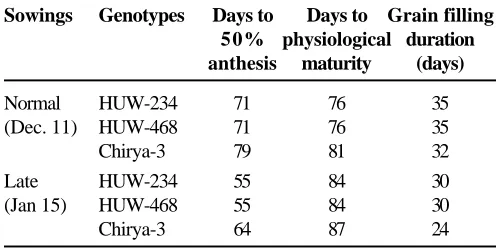
Late sowing reduced the duration between sowing to 50% anthesis and physiological maturity and the duration between anthesis to physiological maturity, i.e. grain filling duration in all the three genotypes (Table 1). The reduction in grain filling duration was maximum in genotype Chirya-3 (9 days) while in HUW-234 and HUW-468 the reduction was of same extent (5 days). The stay green character in Chirya-3 genotype was evident as in this genotype anthesis occurred on 18th
March and attained physiological maturity on 10th April
under late sown condition, while under normal sown condition all the genotypes reached physiological maturity by 7th April.
Conductivity of incubation medium before autoclaving (C1)
Conductivity of incubation medium after autoclaving (C2) Percent
electrolytes leaked
= x 100
The conductivity of electrolytes leaked due to temperature stress was measured in the same way with the only deviation that the samples were taken in 10 ml distilled water and incubated in a water bath for 60 minutes at 50 ± 1º C. After incubation samples were kept at room temperature for cooling and then washed thoroughly with distilled water and incubated at 10 ± 1º
Table 1. Days to fifty per cent anthesis, physiological maturity and grain filling duration in wheat genotypes under normal and late sown conditions
Sowings Genotypes Days to Days to Grain filling 50% physiological duration anthesis maturity (days)
Normal HUW-234 71 76 35
(Dec. 11) HUW-468 71 76 35
Chirya-3 79 81 32
Late HUW-234 55 84 30
(Jan 15) HUW-468 55 84 30
Chirya-3 64 87 24
developed fully, while under normal sown condition, competition for assimilates between grains of the same ear has been much prominent and they could not get sufficient assimilate (source limitation of grain development), and weight of single grain decreased. Such observations have been reported in other crops also (Srivastava and Bhardwaj 1987). Mean chlorophyll content in the flag leaf of main shoot was less under late sowing in HUW-468 and Chirya-3, but genotypic differences were not significant. Chlorophyll content
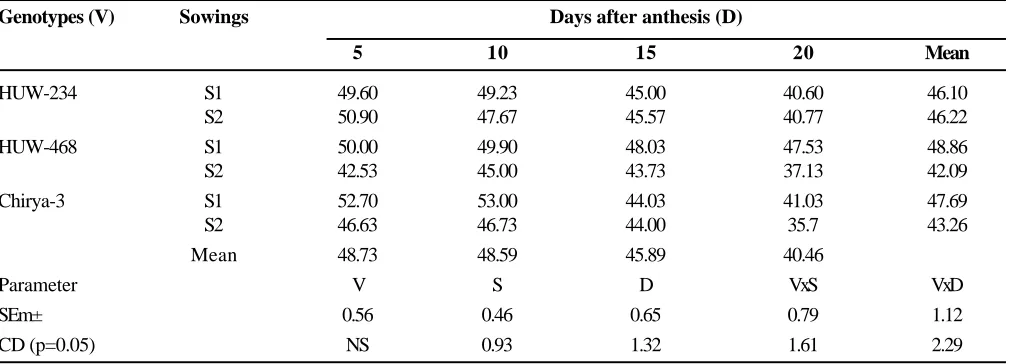
decreased rapidly after 10 days of anthesis more so in HUW-468 and Chirya-3 under late sown condition (Table 3). These genotypes also showed a greater decrease in grain weight per ear under late sowing (Table 2). It indicates that ‘stay green’ character of Chirya-3 genotype is not expressed under present experimental conditions in NEPZ region.
Effect of thermal and osmotic stresses on electrolytes leakage (directly related to cell membrane Table 2. Grains per ear, grain weight per ear (g) and single grain weight (mg) of mother shoot ear in three
genotypes of wheat under normal and late sown conditions
Genotype Grains per ear Grain weight per ear Single grain weight (mg)
S 1 S 2 S 1 S 2 S 1 S 2
HUW-234 55.33 40.00 1.79 1.78 32.35 44.50
HUW-468 62.33 44.00 1.77 1.63 28.40 37.05
Chirya-3 48.67 39.67 1.59 1.30 32.68 32.77
Mean 55.44 41.22 1.72 1.57 31.14 38.38
Parameter SEm± CD at 5% SEm± CD at 5% SEm± CD at 5%
Genotype (V) 5.99 NS 0.16 NS 1.12 3.46
Treatment (S) 4.89 10.89 0.13 0.20 2.77 8.55
V x S 8.47 18.86 0.22 NS 3.11 29.65
S1= Normal sowing, S2= Late sowing
Table 3. Chlorophyll content in flag leaf (SPAD units) of three genotypes of wheat under normal and late sown conditions
Genotypes (V) Sowings Days after anthesis (D)
5 10 15 20 Mean
HUW-234 S1 49.60 49.23 45.00 40.60 46.10
S2 50.90 47.67 45.57 40.77 46.22
HUW-468 S1 50.00 49.90 48.03 47.53 48.86
S2 42.53 45.00 43.73 37.13 42.09
Chirya-3 S1 52.70 53.00 44.03 41.03 47.69
S2 46.63 46.73 44.00 35.7 43.26
Mean 48.73 48.59 45.89 40.46
Parameter V S D VxS VxD
SEm± 0.56 0.46 0.65 0.79 1.12
CD (p=0.05) NS 0.93 1.32 1.61 2.29
Note: interaction between SxD VxSxD were non significant
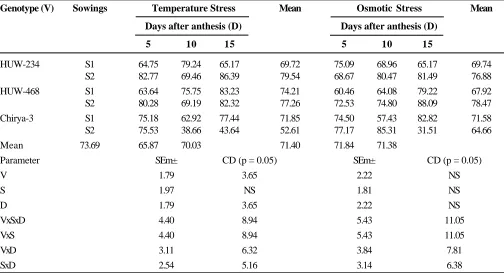
damage) from flag leaf of normal and late sown genotypes exhibited significant differences but no definite trend was recorded with respect to growth stages (Table 4). However, mean electrolytes leakage under late sown condition were more in genotypes 234 and HUW-468. It is interesting to note that, on an average, genotype Chirya-3 exhibited lesser damage of flag leaf cell membrane under late sown condition, even as compared to normal sown plants of the same genotype under hyper thermal as well as hyper osmotic stresses. It appears that stay green trait of Chirya-3 is expressed in less cell membrane damage and improved maintenance of cell membrane under heat stress.
It is concluded that major reduction in mother shoot ear yield under late sown condition occurred due to reduction in grain number per ear. Heat stress during grain filling period, on account of late sowing, enhances cell membrane damage. Genotypic differences exist with respect to sustenance of grain number per ear and cell membrane stability due to terminal heat stress in wheat.
Therefore, it is possible to combine these traits either by conventional breeding approaches or by biotechnological tools to develop genotypes able to sustain higher grain number per ear along with high cell membrane stability to heat stress for higher yield under late sown condition.
REFERENCES
Asana, R.D. and Williams, R.A. (1965). The effect of temperature stress on grain development in wheat. Australian J. Agric. Res. 16: 1-3.
Bagga, A.K. and Raswon, H.M. (1977). Contrasting responses of morphologically similar wheat cultivars to temperature appropriate to warm temperature climates with hot summer: A study in control environment. Aust. J. Plant Physiol. 4: 877-887.
Blum, A. (1998). Improving wheat grain filling under stress by stem reserve mobilization. Euphytica. 100: 77-83.
Chaudhary, R.M., Shukla, D.S. and Pandey, P.C. (1994). Biochemical basis of high temperature tolerance in
Table 4. Effect of temperature stress and osmotic stress on membrane injury (in terms of per cent electrolytes leakage) from wheat genotypes at various stages after anthesis under normal and late sown condition
Genotype (V) Sowings Temperature Stress Mean Osmotic Stress Mean
Days after anthesis (D) Days after anthesis (D)
5 10 15 5 10 15
HUW-234 S1 64.75 79.24 65.17 69.72 75.09 68.96 65.17 69.74
S2 82.77 69.46 86.39 79.54 68.67 80.47 81.49 76.88
HUW-468 S1 63.64 75.75 83.23 74.21 60.46 64.08 79.22 67.92
S2 80.28 69.19 82.32 77.26 72.53 74.80 88.09 78.47
Chirya-3 S1 75.18 62.92 77.44 71.85 74.50 57.43 82.82 71.58
S2 75.53 38.66 43.64 52.61 77.17 85.31 31.51 64.66
Mean 73.69 65.87 70.03 71.40 71.84 71.38
Parameter SEm± CD (p = 0.05) SEm± CD (p = 0.05)
V 1.79 3.65 2.22 NS
S 1.97 NS 1.81 NS
D 1.79 3.65 2.22 NS
VxSxD 4.40 8.94 5.43 11.05
VxS 4.40 8.94 5.43 11.05
VxD 3.11 6.32 3.84 7.81
SxD 2.54 5.16 3.14 6.38
developing grains of wheat (Triticum aestivum L.). Indian J. Exp. Biol. 32: 296-298.
Guha Sarkar, C.K., Srivastava, P.S.L. and Deshmukh, P.S. (2001). Grain growth rate and heat susceptibility index, traits for breeding genotype tolerant to terminal high temperature stress in bread wheat (Triticum aestivum L.), Indian J. Genetics 61: 209-212.
Kobza, J. and Edwards, G.E. (1987). Influence of leaf temperature on photosynthetic carbon metabolism in wheat. Plant Physiol. 83: 69-74.
Nicolas, M.E., Gleadow, R.M. and Dalling, M.J. (1984). Effects of drought and high temperature on grain growth in wheat. Aust. J. Plant Physiol. 11: 553-566.
Sairam, R.K., Deshmukh, P.S. and Shukla, D.S. (1997). Increased antioxidant enzyme activity in response to drought and temperature stress related with stress tolerance in wheat genotypes, Abstract: National Seminar ISPP, IARI, New Delhi.
Singh, M., Srivastava, J.P. and Kumar, A (1992). Cell membrane stability in relation in drought tolerance in wheat genotypes. J. Agron. Crop Sci. 168: 186-190.