Customer Orientation in
Highly Relational Services:
Antecedents and
Consequences.
Javier Morales Mediano June 2018
Dedication
Acknowledgments
I would like to give a very special thanks to my supervisor, Dr. José Luis Ruiz-Alba Robledo. His passion, support and service were crucial in helping me to attain my goals. My debt to him will last forever.
I would also like to thank the Graduate School of the UWL for their help, and in particular, the kind support provided from Professor Tony Olden and Maria Pennells.
My gratitude also goes to those who facilitated the generous contributions from other faculties that guided and inspired me in different parts of this research; Dr. Miguel Angel Rodríguez Molina, Dr. Mathew Todres, Dr. Lorna Wang, and Dr. Anabela Soares.
This study would not have been possible had it not been for the unselfish help offered by the following in assisting me in connecting with the interview participants: Luis Arias Hormaechea and Natalia Centenera Ulecia from the IESE Business School, Ainhoa Alonso Miranda from Santander Asset Management, Alvaro Perera Peña from Allfunds Bank, Juanen Flores Alonso from Minsait, and José Luis Terrón Guijarro from Allen & Overy. I also wish to thank the 25 professionals for their invaluable participation in my study.
I am also indebted to Gaspar Ariño Gutierrez, for his continuous hospitality (even at short notice) when needed, and María Mora Figueroa, for her nice conversations before starting to write.
I should not forget to mention my friends, Andrés, Angel, Josemaría, José Antonio and Ulpiano. One of them has already finished this adventure, and the rest are next. The leisure time we spent together was part of my inspiration for this duty.
Abstract
The aim of this study is to investigate the role and implications of the customer orientation of service employees (COSE) in highly relational services (HRS) and its front-line employees.
Customer orientation (CO) is considered a key pillar in the development of relationship marketing (RM). However, there are not COSE studies trying to fully exploit its potential by the use of highly relational settings and the introduction of new consequences from the original COSE model aligned with those of RM goals. Accordingly, the COSE model was adequately framed under the relationship marketing (RM) theory, compared with other different CO models and then assessed via a qualitative study. For this study, private banking (PB) was chosen as HRS due to its particular characteristics, namely; a dyadic relationship between customers and employees (private bankers), a high customisation of the service, a needed judgement of the employee, and a particular way of delivery.
The qualitative study was comprised of 25 semi-structured interviews to PB practitioners in order to address different research questions regarding the importance and applicability of the COSE model. Additionally, this research questioned what changes to the COSE model should be introduced for it to be adapted to HRS. Furthermore, new potential outcomes of COSE were examined together with the current situation related to the application of measurements of COSE in practice.
This analysis confirmed the validity of the construct. COSE was proved to be notably important in PB, as in any HRS. Regrettably, no PB firm has a standardised process for measuring COSE. Moreover, the four dimensions that make up COSE received different grades of importance. Social skills were agreed to be more important than technical skills. Motivation was also considered as less important than social skills. Likewise, decision-making authority generated some disagreement as it can eventually result in a worse performance of the service delivery. There is a risk of the private banker to lose his or the focus on the service delivery due to the close relationship with the customer. Therefore, the interests of the three parties (company, employee and customer) have to be calibrated and aligned. Regarding the different COSE outcomes, new consequences were elicited; trust, loyalty, word of mouth, and customer-oriented deviance, from which some of the consequences were confirmed to be outcomes of RM too.
Finally, an improved and extended COSE model has been proposed, including the potential effect of some characteristics of the firm and the employee. This is as well as a questionnaire to use in a future quantitative study that is adapted to the reality of the PB service.
Dissemination
Articles and Conferences
Morales Mediano, J. and Ruiz-Alba, J (2018) ‘The Market Orientation and Customer Orientation continuum in services’, Journal of Services Marketing. (Submitted).
Morales Mediano, J. and Ruiz-Alba, J (2018) ‘New perspective on Customer Orientation of Service
Employees: A conceptual framework’, The Service Industries Journal. (Accepted).
Morales Mediano, J. (2017) ‘Moderating variables and consequences of Customer Orientation of Service Employees in the private banking sector’, UWL Annual Doctoral Students' Conference. London, 24 May. (Awarded with the 1st prize to the best oral presentation).
Morales Mediano, J. and Ruiz-Alba, J. (2016) ‘La toma de decisiones en el servicio de banca privada y la orientación al cliente’, First on/off Conference in Marketing Decision Making – Universidad de Barcelona. Barcelona, 29-30 September.
Morales Mediano, J. (2016) ‘Customer Orientation of Service Employees in the private banking sector: A managerial perspective’, UWL Annual Doctoral Students' Conference. London, 25 May. (Awarded with the 2nd prize to the best oral presentation).
Other Research
Villanueva, J. and Morales Mediano, J. (2018) ‘Generali seguros: El lanzamiento de una marca’. IESE Publishing Case Study Collection. (In progress).
Ruiz-Alba, J., Soares, A., and Morales Mediano, J. (2016) ‘Servitization in the pharmaceutical
distribution’, 3rd International Symposium SRUK (Society of Spanish Researchers in the United
Kingdom). London, 4 July.
Ruiz-Alba, J., Soares, A., and Morales Mediano, J. (2016) ‘Servitization and co-opetition in the
pharmaceutical distribution’, The Spring Servitization Conference. Birmingham, 18-19 May.
Ruiz-Alba, J., Soares, A., and Morales Mediano, J. (2016) ‘Servitization and co-opetition in the
pharmaceutical distribution: back to Basics?’, Universia Business Review, 49 (February), pp. 96-115.
Teaching Activities
Visiting Lecturer at Universidad Pontificia Comillas (ICADE). Modules: Global Marketing and Strategic Marketing. Level 6. Academic year 2017/2018.d
Table of Contents
DEDICATION I
ACKNOWLEDGMENTS II
ABSTRACT III
DISSEMINATION IV
ARTICLES AND CONFERENCES IV
OTHER RESEARCH IV
TEACHING ACTIVITIES IV
TABLE OF CONTENTS V
LIST OF TABLES X
LIST OF FIGURES XI
LIST OF ABBREVIATIONS XII
CHAPTER 1: INTRODUCTION 1
1.1. RESEARCH BACKGROUND AND JUSTIFICATION 1
1.1.1. Relationship Marketing and Customer Orientation 1
1.1.2. The Service Sector Interest 3
1.2. RESEARCH AIM,QUESTIONS AND OBJECTIVES 3
1.3. PRIVATE BANKING AS A RESEARCH SETTING 4
1.3.1. Importance of the Research Setting 4
1.3.2. Private Banking Services 5
1.4. CONTRIBUTIONS 7
1.5. THESIS STRUCTURE 7
CHAPTER 2: LITERATURE REVIEW 10
2.1. INTRODUCTION TO THE LITERATURE REVIEW 10
2.2. MARKETING RESEARCH BACKGROUND 10
2.2.1. Relationship Marketing 10
2.2.2. Relationship Marketing Outcomes 11
2.2.2.1. Trust 12
2.2.2.2. Loyalty 13
2.2.2.3. Word of Mouth 14
2.2.2.4. Customer-Oriented Deviance 15
2.2.3. Market Orientation 16
2.2.4. Market and Customer Orientation Continuum 17
2.3. CUSTOMER ORIENTATION OF SERVICE EMPLOYEES 19
2.3.1. Customer Orientation Models 19
2.3.1.1. The SOCO Scale (Saxe and Weitz, 1982) 20
2.3.1.2. The MKTOR Model (Narver and Slater, 1990) 21
2.3.1.5. The Multi-factor, Multi-item Approach to MO (Deng and Dart, 1994) 25 2.3.1.6. The Short SOCO Scale (Thomas, Soutar and Ryan, 2001) 26
2.3.1.7. The COSW Model (Brown et al., 2002) 27
2.3.1.8. The Service Provider’s CO Model (Susskind, Kacmar and Borchgrevink, 2003) 28 2.3.1.9. The Internal Benefits Model (Donavan, Brown and Mowen, 2004) 29
2.3.1.10. The Frontline Employee Model (Ifie, 2014) 31
2.3.2. The COSE Model (Hennig-Thurau and Thurau, 2003) 31
2.3.2.1. Definition 31
2.3.2.2. Advantages of the COSE model 33
2.3.2.3. Antecedents 34
2.3.2.3.1. Technical Skills 35
2.3.2.3.2. Social Skills 35
2.3.2.3.3. Motivation 35
2.3.2.3.4. Decision-making Authority 36
2.3.2.4. Consequences 36
2.3.2.5. The First Test and Subsequent Studies 37
2.4. RESEARCH GAP 40
CHAPTER 3: METHODOLOGY 42
3.1. RESEARCH PHILOSOPHY 42
3.2. RESEARCH DESIGN 43
3.2.1. Research Approach 43
3.2.2. Research Strategy 44
3.3. RESEARCH ETHICS 45
3.4. QUALITATIVE METHOD 46
3.5. RESEARCH SETTING 48
3.5.1. Importance of the Research Setting 48
3.5.2. Private Banking 48
3.5.2.1. Definition of the Private Banking Service 49
3.5.2.2. Private Banking Models 51
3.5.2.3. Customer Segmentation 52
3.5.2.4. The Private Banker as a Service Employee 53
3.5.2.5. Financial Performance in Private Banking 55
3.6. EMPIRICAL STUDY 56
3.6.1. Interview Protocol 57
3.6.2. Sampling Strategy 58
3.6.3. Data Collection 59
3.6.4. Data Management and Analysis 60
3.6.5. Content Aggregation and Qualitative Data Analysis Software 61
3.6.5.1. Dedoose 62
3.6.5.2. MAXQDA 62
3.6.5.3. ATLAS.ti 63
3.6.5.4. NVivo 64
3.6.6. Limitations 64
3.7. ANALYSIS AND CODIFICATION OF THE INTERVIEWS 65
3.7.1. Analysis of Collected Data 66
3.7.1.1. Collected Data by Groups of Participants 67
3.7.1.1.1. Customer Segment Served Groups 67
3.7.1.1.3. Employee Seniority Groups 69
3.7.1.2. Visual Representation of Collected Data 71
3.7.2. Codification Results 72
3.7.2.1. Qualitative Assessment of COSE 75
3.7.2.2. COSE Antecedents 79
3.7.2.3. COSE Consequences 84
3.7.2.4. Codification Results by Category 87
CHAPTER 4: FINDINGS AND DISCUSSION 90
4.1. FINDINGS FROM THE INTERVIEWS 90
4.1.1. Importance of COSE 90
4.1.1.1. Service 92
4.1.1.2. Differentiation 92
4.1.1.3. Relationship and Long Term 93
4.1.1.4. Responsibility and Risk 93
4.1.2. Pervasiveness of COSE in Private Banking 94
4.1.2.1. Organisational Level 95
4.1.2.2. Resources Definition 96
4.1.2.3. COSE Span 96
4.1.2.4. Portfolio Strategy 97
4.1.2.5. Intimacy 97
4.1.3. Measurement of COSE 98
4.1.3.1. No Direct Measure 99
4.1.3.2. Unstructured Measure 100
4.1.3.3. Portfolio Performance 100
4.1.3.4. Service Performance 101
4.1.3.5. Customer Surveys 101
4.1.4. Improvement Potential of COSE 102
4.1.4.1. Organisational Motivation and Incentives 103
4.1.4.2. Number of Customers 104
4.1.4.3. Organisation and Resources 105
4.1.4.4. Social and Technical Training 106
4.1.5. Antecedents of COSE 106
4.1.5.1. Technical Skills 108
4.1.5.1.1. Experience 108
4.1.5.1.2. General and Product Knowledge 109
4.1.5.1.3. Learning Orientation 110
4.1.5.1.4. Tools 110
4.1.5.2. Social Skills 111
4.1.5.2.1. Perspective Taking 111
4.1.5.2.2. Personality 112
4.1.5.3. Motivation 113
4.1.5.3.1. Consequences Valence 114
4.1.5.3.2. Probability of Success 115
4.1.5.3.3. Reward Expectation 115
4.1.5.4. Decision-Making Authority 116
4.1.5.4.1. Organisation Structure and Culture 116
4.1.5.4.2. Self-perception 117
4.1.6. Characteristics of the Service Influencing COSE 118
4.1.6.2. Type of Firm 122
4.1.6.3. Employee Seniority 124
4.1.7. Consequences of COSE 126
4.1.7.1. Customer Satisfaction, Commitment, and Retention 126
4.1.7.2. Financial Performance 128
4.1.7.3. Trust 130
4.1.7.4. Loyalty 131
4.1.7.5. Word of Mouth 133
4.1.7.6. Customer-Oriented Deviance 133
4.2. DISCUSSION OF RESULTS AND ANSWERS TO RESEARCH QUESTIONS 134
4.2.1. Research Question 1 135
4.2.1.1. COSE Importance in HRS 135
4.2.1.2. COSE Presence in HRS 136
4.2.1.3. COSE Measurement in HRS 137
4.2.2. Research Question 2 137
4.2.2.1. Social Skills 138
4.2.2.2. Technical Skills 139
4.2.2.3. Motivation 140
4.2.2.4. Decision-Making Authority 140
4.2.3. Research Question 3 141
4.2.3.1. Customer Segment 141
4.2.3.2. Type of Firm 142
4.2.3.3. Employee Seniority 143
4.2.4. Research Question 4 143
4.2.4.1. Customer Satisfaction, Retention and Commitment 143
4.2.4.2. Financial Performance 144
4.2.4.3. Trust 144
4.2.4.4. Loyalty 145
4.2.4.5. Word of Mouth 146
4.2.4.6. Customer-Oriented Deviance 146
4.2.5. Research Question 5 147
4.3. SUMMARY OF RESULTS 148
4.4. EXTENDED COSEMODEL 153
CHAPTER 5: CONCLUSION 155
5.1. IMPLICATIONS OF THE RESEARCH 155
5.1.1. Academic Contributions 155
5.1.1.1. Methodological Innovation 155
5.1.1.2. Academic Characterisation of Private Banking 156
5.1.1.3. Identification of Research Streams Regarding MO and CO 156 5.1.1.4. Highly Relational Services and Relationship Marketing 156
5.1.1.5. Improvement of the COSE Model 157
5.1.2. Managerial Contributions 157
5.1.2.1. COSE as a Means to RM 157
5.1.2.2. COSE as an Instrument for Managing People 158
5.1.2.3. COSE as a Differentiation 158
5.2. LIMITATIONS OF THE STUDY 158
5.3. FUTURE RESEARCH 159
REFERENCES 167
APPENDICES 182
APPENDIX 1 182
APPENDIX 2 183
APPENDIX 3 184
APPENDIX 4 185
APPENDIX 5 186
APPENDIX 6 187
APPENDIX 7 188
APPENDIX 8 189
APPENDIX 9 190
APPENDIX 10 191
APPENDIX 11 192
List of Tables
Table 2.1: Summary of the three research streams regarding MO and CO 18
Table 2.2: Compilation of CO models 20
Table 2.3: Summary of CO models 34
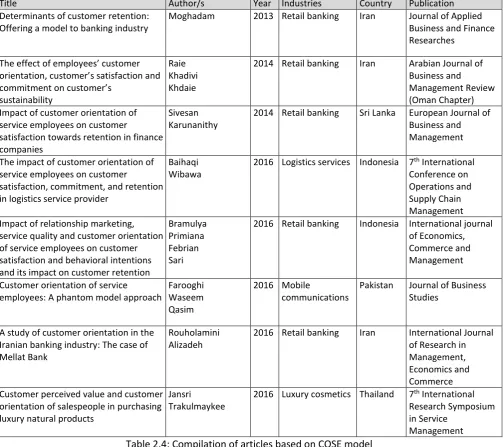
Table 2.4: Compilation of articles based on COSE model 39
Table 2.5: Compilation of COSE consequences 40
Table 3.1: Summary of the research philosophy and design 45
Table 3.2: Distribution of participants by customer segment and type of firm 59 Table 3.3: Steps and stages of the interview analysis and codification process 66 Table 3.4: Characterisation of interviews data by customer segment 68 Table 3.5: Characterisation of interviews data by type of firm 69 Table 3.6: Characterisation of interviews data by the level of seniority 70 Table 3.7: Description of codes for the qualitative assessment of COSE 78 Table 3.8: Coding main figures in the qualitative assessment of COSE 79
Table 3.9: Description of codes for the antecedents of COSE 83
Table 3.10: Coding main figures in the COSE characteristics 84
Table 3.11: Description of codes for the consequences of COSE 86
Table 3.12: Coding main figures in the COSE consequences 87
Table 4.1: Number of respondents by antecedent and corresponding ranking of importance 108 Table 4.2: Summary of the results for each research question 152
List of Figures
Figure 2.1: SOCO model 20
Figure 2.2: The MKTOR model 22
Figure 2.3: The CO among service employees model 24
Figure 2.4: The Quadrads-based Model 25
Figure 2.5: The multi-factor, multi-item model 26
Figure 2.6: The COSW model 28
Figure 2.7: The service provider's CO model 29
Figure 2.8: The internal benefits model 30
Figure 2.9: COSE model 32
Figure 2.10: Path coefficients between COSE and the consequences studied in the original test 37
Figure 3.1: Segmentation of private banking clients 53
Figure 3.2: Aggregated net interviews time in minutes by group of participants 71 Figure 3.3: Aggregated interviews word count by group of participants 71 Figure 3.4: Participant distribution and interview duration by customer segment and seniority 72 Figure 3.5: Participant distribution and word count by customer segment and seniority 72
Figure 3.6: Number of codes per group and level of codes 74
Figure 3.7: Hierarchy of codes for the qualitative assessment of COSE 76 Figure 3.8: Hierarchy of codes for the analysis of the antecedents of COSE 81 Figure 3.9: Hierarchy of codes for the analysis of the consequences of COSE 85 Figure 3.10: Number of words coded for the assessment of COSE by participant category 87 Figure 3.11: Number of words coded for the COSE antecedents by participant category 88 Figure 3.12: Number of words coded for the COSE consequences by participant category 89 Figure 4.1: Average position and deviation of each antecedent in importance for practitioners 107 Figure 4.2: Distribution of participants according to their seniority and position. 125 Figure 4.3: Proposed COSE model to be tested quantitatively 153
Figure A.1: The SOCO model scale 182
Figure A.2: List of items of the original MKTOR model scale 183
Figure A.3: The Quadrads-based model scale 184
Figure A.4: The original multi factor, multi item scale 185
Figure A.5: The original and reduced SOCO scales 186
Figure A.6: The COSW model scale 187
Figure A.7: The service provider's CO model scale 188
Figure A.8: The internal benefits CO model scale 189
Figure A.9: The frontline employees model scale 190
Figure A.10: The COSE model scale 191
Figure A.11: The consent document for the qualitative interviews 192
Figure A.12: Page 1 of 3 of the interview protocol 193
Figure A.13: Page 2 of 3 of the interview protocol 194
List of Abbreviations
CAQDAS Computer Assisted Qualitative Data Analysis
CEO Chief Executive Officer
CO Customer Orientation
COD Customer-Oriented Deviance
COSE Customer Orientation of Service Employees
COSW Customer Orientation of Service Workers
EFPA European Financial Planning Association
EU European Union
HRS Highly Relational Services
HNWI High Net Worth Individuals
IEAF Instituto Español de Analistas Financieros (Spanish Institute of Financial Analysts)
IFA Independent Financial Advisor
MO Market Orientation
MiFID Markets in Financial Markets Directive
PB Private Banking
RM Relationship Marketing
RQ Research Question
SEM Structural Equations Model
SOCO Selling Orientation – Customer Orientation
UHNWI Ultra High Net Worth Individuals
UWL University of West London
VHNWI Very High Net Worth Individuals
Chapter 1:
Introduction
1.1.
Research Background and Justification
1.1.1.
Relationship Marketing and Customer Orientation
Relationship marketing (RM) was developed for the first time by Berry (1983), and since then, numerous research about the topic has been published. RM is about “maintaining, attracting, and enhancing customer relationships” (Berry, 1983, p. 25). In the last decade of the 20th century, RM gained importance because of the maturity of the service sector, the increasing easiness for it to be implemented thanks to new technologies, and the benefits that it produces for companies and customers (Berry, 1995).
Heskett Jones, Loveman, Sasser and Schlesinger (1994) suggested that when RM goals are attained,
not only does the customers’ satisfaction increase, but so does their loyalty and their likeliness to get
involved in word-of-mouth communications with their peers. Indeed, RM highlights the need to assess customer value and to provide adequate service to make the customers loyal (Fisk, Brown and Bitner, 1993), to increase their trust (Berry, 1995), or to encourage word of mouth activities (Hennig-Thurau, Gwinner and Gremler, 2002).
Moreover, customer orientation (CO) is considered critical in the development of relationship marketing (RM) strategies in companies (Webster, 1988). CO attracts the interest of many researches in the service marketing arena, despite being an old concept in the field (Kelley, 1992). Since Saxe and Weitz (1982) designed their selling orientation - customer orientation (SOCO) scale, and empirically tested the scale amongst sales forces from different retail, industrial, and service companies, a selected group of distinguished scholars have profusely studied CO. Its importance emerges from the difficult challenge that implied its conceptualisation and the further development of a measurement instrument with the aim of assessing and evaluating the construct, and eventually, its impact on business success. Such a variety of perspectives have made it difficult to achieve a consensus about the meaning of CO, and its differentiation, with the construct of Market Orientation (MO) proposed and tested in two different approaches; one by Kohli and Jaworski (1990), and another one by Narver and Slater (1990).
In the present thesis, after a thorough revision of the eleven most accepted definitions of CO and their respective measurement scales, each one being part of one of the three research streams highlighted above, it is the latter of the three streams that has been embraced for two reasons:
− CO is considered to be a behavioural construct, in opposition to a cultural one. − It is the employee, and not the organisation, that develops and applies CO.
In particular, the adopted definition of customer orientation of service employees (COSE) is as follows: Customer orientation is the characteristic of the service employee that (1) has the capacity and skill to identify, understand and satisfy the needs of their clients, and (2) acts to that end (Hennig-Thurau and (Hennig-Thurau, 2003).
According to this model, COSE consists of four dimensions in relation to service employees: a) technical skills, b) social skills, c) motivation and d) decision-making authority. Technical and social skills are the knowledge and capacity needed by an employee to respond to the customer’s
requirements. Motivation refers to the personal incentive that the service employee has to fulfil those needs, while decision-making authority is the perceived freedom (by the employee) that he or she enjoys in order to fulfil the customer’s needs (Hennig-Thurau and Thurau, 2003). In order to assess the level of COSE, Hennig-Thurau (2004) developed a scale that was used and validated in up to 18 empirical studies in different service industries and countries. The four dimensions of COSE were found to positively impact on customer satisfaction, employee commitment and retention by Hennig-Thurau (2004) in an empirical study of media retail and travel agent companies. Although the relationship with these three consequences of the COSE construct were not of the same strength, they were still considered as crucial factors for a service companies’ success and were assumed to be an indirect measure of business performance.
In fact, the outcomes of successful RM activity are those from COSE, according to Hennig-Thurau and Thurau (2003). However, neither COSE nor the other CO models that were studied proved to be adequate to further develop the RM theory. This is so because no highly relational services (HRS) settings were chosen to conduct these studies. In other words, if COSE is a means to achieve RM goals and COSE is based on the RM theory, it is surprising that the empirical test that Hennig-Thurau conducted in 2004 (1) did not include any of the outcomes of RM that he and his co-authors studied in 2002, and (2) was set in a retail context, as did many others that followed, where almost no formal relationship exists (Lovelock, 1983). The settings that were chosen by Hennig-Thurau (2004) were travel agencies and retailers of media products. Both services can be considered as mostly transactional, discrete and without a formal relationship between the customer and the employee (Lovelock, 1983). The fact that these two settings were chosen, that could be considered as transactional rather than relational ones, is probably the reason why no explicit connection to the RM theory was made by Hennig-Thurau (2004), limiting the contribution of COSE’s empirical test towards
RM theory development. These two aspects of the original study (exclusion of RM outcomes and focus on transactional services) significantly limited the potential of the COSE model.
1.1.2.
The Service Sector Interest
Finally, the growing importance of the service sector in the modern economy over the last few decades has generally been highlighted by authors as a justification for further research in the field (Ostrom et al., 2010; Anderson et al., 2013; Gustafsson et al., 2015). The estimated weight of the
service sector in the EU’s gross domestic product (GDP) in 2016 was 74%, and in Spain, it was 75%, compared with that of the global economy which was 64% (Central Intelligence Agency, 2017).
Moreover, the role of service employees and their characteristics are a prominent part of the different research priorities due to:
− The particularities of services, and the importance of the participation of customers (Ostrom et al., 2015).
− The impact of how the service is defined in relation to customer satisfaction and company performance (Ostrom et al., 2010).
Within the different service industries, financial services receive special attention because of their role within societies and their development (Anderson et al., 2013; Ostrom et al., 2015). In fact, from the macroeconomic viewpoint, the weight of financial services in the EU’s GDP is noteworthy, close to
5% in 2015 (The Economic Intelligence Unit, 2016). Despite the maturity of the industry, another aspect that makes financial services an appealing research field for marketing academics is the opportunity that it offers to further develop theories and constructs within the service marketing field because of the situation of the sector being at the forefront in the development of RM (Berry, 1995; Dibb and Meadows, 2001)
1.2.
Research Aim, Questions and Objectives
The overarching aim of the research, corresponding to this final thesis, is to study and understand the implications of the customer orientation of service employees in a highly relational service and that of its employees. The idea behind this aim is to provide an improved model of customer orientation with full utility capabilities for highly relational services by considering their particularities.
As a consequence of the above, the following research questions (RQ) are proposed: RQ 1: What is the consideration about customer orientation in highly relational services?
RQ 2: What are the dimensions that comprises the customer orientation of service employees in highly relational services?
RQ 3: How do these dimensions change depending on the characteristic of the service, the customer and the employee?
In order to address the above research questions, there are several objectives that should be accomplished:
1. Systematically studying the theoretical evolution of the CO concept from its inception, and differentiating it from the concept of MO, in order to confirm if the COSE model is adequate for the particularities of HRS.
2. In parallel, enquiring into the PB service in order to identify the characteristics that make the service an adequate setting as HRS for the further development of COSE.
3. Investigate the understanding, importance and existence of a private bankers’ level of COSE
from a managerial perspective (through a series of qualitative interviews). This will be done in an exhaustive manner so that the different customer segments, types of entities, and level of employee seniority are considered.
4. Critically analyse the COSE construct and its constituent dimensions from a practitioner’s
perspective, and to evaluate their impact on the overall level of COSE and the COSE outcomes that have been tested in previous studies.
5. Simultaneously, drawing on the practitioners’ points of view, this study will identify and analyse other potential outcomes should be generated by a high level of COSE in HRS. 6. Together with the outcomes, the study will identify and critically analyse the different
variables that affect the importance of each COSE dimension.
7. Designing and proposing a concise and adequate model to assess the antecedents and consequences of the customer orientation of service employees in HRS, as well as the different variables that can act as moderators and mediators of the established relationships.
8. Configuring a detailed questionnaire adapted to the new model that can be used to test the identified outcomes and relationships in HRS.
9. Suggesting several recommendations to academics and practitioners.
1.3.
Private Banking as a Research Setting
1.3.1.
Importance of the Research Setting
(Lassar, Manolis, and Windsor, 2000; Halstead et al., 2008). The idea behind these studies was to try to choose the adequate context to further develop the construct of CO and therefor the field of RM.
However, one may wonder if there is still room for further development of the COSE construct. To answer this, the first question to be answered would be if there is any context out there where COSE is of such importance that it becomes intrinsic to the type of service itself and where it not only produces a series of specific outcomes, but where it also serves as a critical factor for the survival of firms. Here is where the characteristics of the private banking service (PB) service and its employees should make a difference from anything that has been said before.
1.3.2.
Private Banking Services
PB or wealth management is particularly significant for the wider banking industry in Europe, where according to an industry report published by J.P. Morgan and Oliver Wyman (2014), 82% of financial services professionals rated the wealth management industry as being attractive or very attractive. In the same report, it was stated that the PB services catered to 39% of the total assets under management (AUM) in 2014, with further growth in this proportion expected in the following years (J.P. Morgan and Wyman, 2014). Prior to this, it has been recognised that the PB service is one of the most profitable within the financial service industry (Baglole, 2004).
PB is a group of products and services specifically designed and managed to address the special financial needs of high worth customers, commonly known as High Net Worth Individuals (HNWI). These needs can be different from one customer to another, thus the customer relationship has to be personalised and made to measure, as was defined by Javier Marín, the former chief executive officer (CEO) of Santander Bank (Marín, 2005).
PB service is generally based on only one contact employee, the private banker, whose relationship with the customer is expected to last for as many years as possible. This is even through different family generations, when young individuals inherit an older current customer’s wealth. In order to do
so, there are two basic pillars; confidentiality and trust. This makes the banker-customer relationship very close and the alignment of interests between them and the banking firm a critical aspect (Molyneux and Omarini, 2005).
Based on Marín (2005) and Molyneux and Omarini (2005), the PB service is usually provided by the following three types of firms:
− PB business units of larger commercial or retail banking corporations (such as the PB services offered from HSBC and Santander).
− Specialised private banks (not related to commercial banks), such as UBS Wealth Management or Pictet & Cie.
− Independent Financial Advisors (IFA) focused on HNWI which include local and usually smaller firms that are not incorporated as banks and therefore use the financial products of third parties.
for selling and distribution activities. The direct payment approach, in contrast, occurs where the customer pays a fee calculated by a percentage of the total assets that are managed by the PB firm.
Therefore, the group of products and services that are offered to HNWI is justified by the minimum amount of investible assets that are required to have access to the PB services. This minimum varies
between different entities, being in the vast majority over €500,000 in investible assets in total (Pinto,
2015). Regarding that minimum, three sub-segments of customers are often defined as HNWI with a
total worth between €500,000 and €5 million, Very High Net Worth Individuals (VHNWI) with assets between €5 million and €30 million, and Ultra High Net Worth Individuals (UHNWI) with a wealth over €30 million. To be accurate, it is important to clarify that HNWI has two meanings; one is the subsegment of customers described before, and another meaning is the broadest term to refer to PB customers in general.
In the last two decades, PB customers have become more demanding, more active and involved in the management of their assets, and more sceptical and disloyal towards their banks and private bankers (IEAF, 2006). These transformations have come alongside a progressive modification of regulations affecting the PB business. This is a change that will culminate with the introduction of the second law of the European Union (EU) on Markets in Financial Markets Directive, also known as MiFID II, by which it is expected that transparency in the provision of financial services will increase and, consequently, private banks will be forced to charge direct fees for their services (McKinsey & Company, 2013; Accenture and Afi, 2014; European Commission, 2014).
All of these changes have made the industry focus on the role of the private banker with particular interest, as the means to enhance service, and consequently, to increase the level of customer satisfaction and loyalty. Private bankers must therefore be more proactive, open to participate in continuous learning, and able to identify, understand and adequately respond to their customers’
needs (IEAF, 2006).
Because of that, the private banker and his or her CO could be considered an ideal field of inquiry in the service marketing and RM fields. However, despite the importance of PB within the financial services industry and the attractiveness of the private bankers’ CO as role models for other service
employees, such a service has been the subject of very few academic studies (Horn and Rudolf, 2011, Burgstaller and Cocca, 2011). The majority of these studies have been based on the simple application of what has been researched in the retail banking service (Strandberg, Wahlberg and Öhman, 2012). No specific research about the level of CO of private bankers from the customer perspective, and its consequences, have been conducted. This is, to put it mildly, a gap that should not continue to exist, not only because of its potential for research about financial services, but also because PB has proven to be an exceptional investigation field for any highly relational services.
1.4.
Contributions
As will be presented in full detail in chapter 7, several contributions for both academics and professionals can be found in this research. From the academic perspective, the contributions are as follows:
− An innovative application of the qualitative methodology to a field where quantitative methodology is mostly used.
− The review about MO and CO, and the identification of three different research streams in that regard.
− The application of the service classification developed by Lovelock (1983) to PB.
− The recompilation and consolidation of several academic and professional sources about PB, so that a concise definition and characterisation of the service can be provided. − The extension of the use of CO measurement to an HRS where it has never been studied
before (Hennig-Thurau 2004).
− The adaptation and improvement of the methodology created by Hennig-Thurau (2004) tested by other authors.
− The identification and qualitative validation of the new consequences of COSE, that are of particular importance for HRS like PB.
From the practitioners’ perspective, the most important contribution is the proposition of a variable like COSE that is not extensively used in the industry but that has proven to be of enormous value in increasing the financial performance, customer satisfaction and other several variables related to the relationship marketing goals.
1.5.
Thesis Structure
The thesis is structured into five chapters that are divided into sections, subsections, and items. Each of them is numbered accordingly in order to facilitate the reading of the document.
research setting. Due to the particularities of HRS and PB, it is important that those readers less familiarised with the service are able to have an actual overview of the key features comprising PB, the type of clients that are served, and the characteristics of the private banker. Chapter 1 is closed with a brief explanation of the contributions and the thesis structure.
In the literature review, the second chapter of the thesis, a thorough look at the different concepts that relate to this study is provided. The chapter is divided into three sections:
− The first section presents a few key elements of the marketing field; the study of some relevant aspects of marketing theory and RM, its outcomes, and the differentiation between MO and CO.
− Secondly, an outline of the most important constructs regarding CO is offered together with the detailed explanation of the COSE model that have been used in the research.
− In the third section, the research gap is presented.
Chapter 3 commences with a short explanation of the research philosophy that has been assumed. The research strategy and ethical positioning of the study is then addressed, followed by a detailed explanation of the qualitative methodology. Then, the research setting is further developed. The chapter continues with the explanation of how the qualitative study conducted has been organised and put into practice.
This last section of the chapter also includes a detailed revision of the different software that is generally used in qualitative research and closes with a description of the limitations. The closing section, dedicated to the empirical component, provides the actual analysis that has been conducted and the results obtained. This part contains an explanation of the codification process that was undertaken, the description and characterisation of all of the data collected by groups of participants, and the results from the codification process. A series of charts has been provided in order to visually present the analysis of the information collected.
Chapter 4 consists of the presentation of the findings from the interviews that were conducted in order to grasp the managerial viewpoint about the topic. To do so, every interview transcription (and the corresponding codes) has been meticulously dissected and analysed to expose the different ideas and to identify any opposing viewpoints. Several literal quotes from the interviews accompany the different findings, so each finding is reinforced and/or clarified. These findings follow the structure of codes that was presented in the previous chapter.
Chapter 2:
Literature Review
2.1.
Introduction to the Literature Review
Before entering into the detail of the literature review, it is worth dedicating a few lines to clearly define what the purpose of a literature review should be. Several authors have offered a series of goals for literature reviews (Bell, 2005; Saunders, Lewis and Thornhill, 2009; Neuman, 2014) that can be summarised, namely:
1. To get familiar with the research field and to prove it to the reader. The author may gain confidence about the topic under study and, in parallel, the reader may notice it and be confident about the professionalism and research dexterity of the author.
2. To identify the potential interest of the research that is about to be conducted by finding explicit mentions to research avenues in previous studies or by spotting research gaps that have been overlooked so far.
3. To support the research design that is more adequate to the purpose of the study, according to different existing methodologies and the common use for the specific field of knowledge.
2.2.
Marketing Research Background
2.2.1.
Relationship Marketing
Berry (1983) defined Relationship Marketing (RM) as the attraction, sustainment and enhancement of the customer relationship. RM is founded on the idea that retaining customers is more profitable that acquiring new ones (Berry, 1983), and the fact that employees should take a prominent role in the relationship, as it has already been pointed out by several authors during the 1970s (Berry, 1995). especially in service companies.
Indeed, service companies have been incorporated into the marketing literature as part of the research for many years (Black, 1951; Baumol, 1957; Kotler and Levy, 1969; Lavidge, 1970). According to Grönroos (2000), in relation to service marketing it is necessary nowadays:
− To accept an extended, as opposed to a simple exchange, role of marketing, − To evaluate how the marketing process is able to fulfil customer expectations, − And to focus on the marketing process and the relationship instead of the outcome. To do so, it is required to implement RM initiatives. Berry (1983) stated that there are five elements for incorporating RM strategies within service companies:
1. Focusing on the service that is central to meet the customer needs and on which the customer relationship is built.
3. Incorporating extra benefits to the core service in order to differentiate from the competitors.
4. Adjusting pricing to the particularities of the customer in order to increase customer loyalty and consolidate the relationship.
5. Involving employees in the marketing activity so the marketing activity and the service delivery is performed adequately in front of the customer.
Definitively, since the concept of RM was coined for the first time by Berry (1983), an enormous amount of research about the approach has been published, making the field considered to be a mature one (Berry, 1995). Being a mature concept does not necessarily mean that is no longer of interest, but that it has been already integrated as a cornerstone of the marketing theory (Hennig-Thurau and Hansen, 2000). However, when facing the challenge of conducting new research in such a mature field, academics should try to find out which contexts, research settings and sources must be used in order to broaden a theory. It is the objective of the research that will ultimately determine the context and sources to be used (Saunders, Lewis and Thornhill, 2009). Indeed, “one important challenge for the future development of relationship marketing theory is therefore the integration of industry-specific knowledge into a general theory base” (Hennig-Thurau and Hansen, 2000, p. 13).
Surprisingly, despite the consideration of CO as the key in the development of RM strategies in companies (Webster, 1988), the vast majority of the studies in the field of CO do not address the theoretical framework that should support the development of new knowledge (Kelley, 1992; Susskind, Kacmar and Borchgrevink, 2003) or only vaguely refer to the marketing concept as the underlying theory (Saxe and Weitz, 1982; Brown, Mowen, Donanvan and Licata, 2002). Certainly, Ifie (2014) is an exception to the lack of theoretical haven. However, in a different context, it is purely related to motivation of employees and their fit within organisations, by the use of balance theory and fit theory, as explained in item 2.3.1.10.
In order to escape from the lack-of-theory trap, in this study, similarly to Hennig-Thurau and Thurau (2003), it has considered COSE as a model within the RM discipline that still has room for further development. This is assuming that the appropriate setting conditions are procured. It is acknowledged that just embracing one theory that gives shelter to the construct that is under study is not a justification in front of other theories, like social exchange or resource-based. However, it was considered out of the scope of this study to enter into such a theoretical debate.
2.2.2.
Relationship Marketing Outcomes
2.2.2.1. Trust
Any exchange implies certain levels of risk and uncertainty, particularly in high credence services (Zeithaml, 1981) like it is in the case of financial services (Eisingerich and Bell, 2007). In such cases, trust takes a prominent role in creating a competitive advantage for companies (Barney and Hansen, 1994), creating higher value for customers (Sirdeshmukh, Singh and Sabol, 2002), and therefore making them become more attractive for customers.
Regrettably, while it is generally accepted how important and omnipresent trust is in every relationship and commercial exchange, currently, a consensus about its exact definition and meaning is lacking, nor has there been a classification of the different types of trust (Tyler and Stanley, 2007). According to them, trust is contextual and subjective. Therefore, it is very complex to define, yet a universal phenomenon, which is why it has resulted in largely concentrated extensive research with divergent results. Morgan and Hunt (1994) have highlighted that trust between parties is fostered if each partner demonstrates reliability and integrity, and also if they have the confidence from the other in the relationship outcome.
In the case of relational services, like banking, numerous studies have explored the particularities of trust within the financial services industry (Tyler and Stanley, 2007). The existence of this kind of relational services is related to the existence of trust at personal and corporate levels (Knights, Noble, Vurdubakis and Willmott, 2001). Tyler and Stanley (2007), based on 147 interviews with bank professionals (53) and bank customers (147), concluded that trust was, effectively, a mutual way of managing risk between the parties involved (bank, banker and customer). Nevertheless, they reached the following conclusions:
− Personal and corporate trust, (i.e. trust in the financial service employee and trust in the banking firm), are not necessarily related due to the particular relevance of the banker in the provision of any financial services, as is the case for PB.
− Personal trust is provided by the reliability, efficiency, and honesty of bankers, and their personal behaviour in a certain context of service.
In fact, reliability and honesty, together with trust itself, are extensively used in the literature as items to measure the level of trustworthiness in relational service settings (Morgan and Hunt, 1994; Doney and Cannon, 1997; Chiou, Droge, and Hanvanich, 2002; Eisingerich and Bell, 2007; Chenet, Dagger and O'Sullivan, 2010; Hansen, 2012).
In addition to the definition and measurement of trust, several authors have attempted to study the consequences of trust:
− Continuity (Anderson and Weitz, 1989; Selnes, 1998)
− Loyalty (Chiou, Droge, and Hanvanich, 2002; Sirdeshmukh, Singh, and Sabol, 2002; Eisingerich and Bell, 2007)
− Customer’s future intentions (Morgan and Hunt, 1994; Doney and Cannon, 1997; Garbarino
and Johnson, 1999)
Whereas amongst the antecedents of trust; satisfaction (Selnes, 1998; Garbarino and Johnson, 1999), and service quality (Chiou, Droge, and Hanvanich, 2002; Chenet, Dagger and O'Sullivan, 2010) are the most recurrent in the literature. However, only a few have considered the characteristics of service employees that manages the relationship with the customer as determinants (Selnes, 1998; Sirdeshmukh, Singh and Sabol, 2002) and none of them under the form of a validated construct like customer orientation.
2.2.2.2. Loyalty
In a seminal article, Oliver (1999) defined the four levels at which customer loyalty is developed: − Cognitive loyalty, which refers to the information regarding a product or service that is
believed or known by the customer.
− Affective loyalty, which is the development of liking or a positive attitude towards the company.
− Conative loyalty, whose effect is the behavioural intention of the customer to repatronise the product or service.
− Action loyalty, which is the mechanism that results in the effective repetition of the purchase or use of the service.
Based on Oliver’s (1999) conceptualisation of loyalty, several authors have developed similar and
reliable scales to measure the level of loyalty in services (McMullan and Gilmore, 2003; Harris and Goode, 2004), and more specifically in relational contexts, like banking (Pedersen and Nysveen, 2001; Henrique and Matos, 2015). Oliver defended that there are other factors affecting loyalty in addition to satisfaction. However, when using RM constructs as antecedents of satisfaction, one could wonder if every dimension of COSE affects customer satisfaction equally, and therefore customer loyalty as well. In other words, the different antecedents of customer satisfaction can eventually affect customer loyalty, making the direct connection between satisfaction and loyalty more complex than it was originally considered by Oliver (1999).
According to Jones and Sasser (1995), customer loyalty makes companies more profitable, just like customer satisfaction contributes to loyalty. However, research about the connection between satisfaction and loyalty has resulted in the following assertion; only a high level of customer satisfaction translates into a higher loyalty. As soon as satisfaction is not at the highest level, the loyalty rate decreases exponentially. Developing customer loyalty is more than just continually seeking to achieve customer satisfaction, it is about enhancing the relationship with the customer.
Nevertheless, they did not study what characteristics of the employee influence customer loyalty and they also failed to differentiate between loyalty to the employee and loyalty to the firm.
Due to the nature of HRS with a high level of personalisation and a long-term relationship perspective, the loyalty attained by the customer, to both the employee and the firm, are crucial. These characteristics should be considered because loyalty to the service employee can be different to the firm, as was pointed out. Such a differentiation was already proposed by Dick and Basu (1994), who stated that customer-employee loyalty is determined by the linkage between both (affective loyalty) rather than technical and measurable considerations about the company (cognitive loyalty).
2.2.2.3. Word of Mouth
Word-of-mouth communication (WOM) is informal communication about a product or service that is held between people, independent of the company providing the service or product, and therefore it is somehow out of its control (Silverman, 1997). The influence of WOM when considering the use of a new service provider has been studied and confirmed (Herr, Kardes and Kim, 1991), and also compared to traditional marketing (Trusov, Bucklin and Pauwels, 2009). Silverman (1997) lists several aspects that make WOM one of the most powerful marketing tools:
− It is independent of the firm whose product/service is the object of the conversation. − It is honest and enjoys superior credibility compared to a firm’s other communications. − It constitutes an indirect experience for the potential consumer.
− It is customer-driven, relevant and complete as it is custom made. − It is a powerful persuader and triggers behavioural reactions. − It is self-fed, unperceived and acts silently.
These aspects are most notable in the service context due to its particular characteristics regarding the relationship marketing strategy (Murray, 1991). For instance, some studies have concluded that WOM is particularly crucial when deciding about financial service providers (File and Prince, 1992; Choudhury, 2014).
The antecedents of WOM were originally studied in a research conducted by Oliver (1980), whose analysis confirmed the fact that satisfaction does not only influence the consumer’s attitude, but also
the behavioural aspects that occur after the transaction, as is the case of WOM. However, Dick and Basu (1994) suggested that, due to the level of personal engagement that is required to participate in WOM activities, they are more influenced by the attained level of loyalty than of satisfaction. Similarly,
but in the particular context of banking, Chochol’aková et al. (2015) confirmed that WOM is affected by satisfaction, but they suggested that there may be other factors influencing WOM.
In terms of the variables that form WOM, Zeithaml, Berry and Parasuraman (1996) defined three; the positive message about a service, the recommendation to use it, and the encouragement to use it. The first two were further developed by Harrison-Walker (2001) by adding the intensity of the recommendation –by means of the frequency, the number of people to whom the service is recommended, and the details of the service that is shared–, and the praise of the message –by means of the positive nature and pride from using the service–. In both studies, as mentioned above, it was proven that there is a direct impact from service quality towards WOM (Zeithaml, Berry and Parasuraman, 1996; Harrison-Walker, 2001).
Hence, in relation to an HRS, WOM can be defined as the informal communication from one customer to another about the service employee and firm (intensity and frequency) and eventually the encouragement to contact them banker in order to explore the possibility of also becoming a customer. Whether or not WOM is ignited by customer satisfaction or loyalty, the logic dictates that the CO of the front line employee and the relationship that is established with the customer is the ultimate argument used by customers to provide recommendations to other potential customers.
Nevertheless, as it was previously demonstrated for loyalty, it has not been possible to identify any study where the influence of the front-line employee characteristics over WOM attitude and behaviour has been assessed. Not even in the case of electronic WOM, despite the increasing interest on it (Rossmann, Ranjan and Sugathan, 2016).
2.2.2.4. Customer-Oriented Deviance
As has been highlighted in the literature review so far, CO is a means of the RM strategy of service companies for developing long-lasting relationships and improving their business performance. However, long relationships could negatively influence some of the outcomes of RM (Moorman, Zaltman and Deshpandé, 1992; Grayson and Ambler, 1999). In fact, deploying a customer-oriented behaviour consumes substantial financial and personal resources (Homburg, Müller and Klarmann, 2011), particularly in the industries or companies that offer highly customised services and products to meet customer needs (Niraj, Gupta and Narasimhan, 2001).
Therefore, it is important to ensure that the level of CO that is attained in a relationship is adequate to the service that is provided and also to the specific customer. In order to operationalise the consequences of a negative excess of CO in the relational service context, Leo and Russell-Bennett (2012) developed, the construct of customer-oriented deviance (COD). Their definition was based on a qualitative analysis of 22 interviews with service employees. According to Leo and Russell-Bennett (2012), COD is the use that front-line employees make of adaptation, communication, and the utilisation of resources, to favour customers, even if it implies challenging a higher authority and the
company’s rules, and therefore, harming its interests.
In a subsequent study, Leo and Russell-Bennet (2014) developed a measurement scale to assess the level of COD, with the following dimensions considered:
− Deviant service adaptation when the service is modified and departing from the firm’s
− Deviant service communication of a company when information regarding the firm is inappropriately disclosed to the customer.
− Deviant service communication of product when the recommendation of products is unaligned with the interests of the firm.
− Deviant use of resources when extra time or costs are incurred in serving the customer. The scale was validated in a quantitative study with the participation of 616 service employees (311 from the retail industry and 305 from the hospitality industry). Yet it was not tested what characteristics of the employee are the cause for such deviation, nor the potential impact this could produce.
2.2.3.
Market Orientation
Even though the term of market orientation (MO) and how to implement it was already mentioned by the middle of the last century (Keith, 1960), it was not until the last decade of the twentieth century that relevant MO research and a theory was published. Kohli and Jaworski (1990) stated that the implementation of the marketing concept underpinned by a sufficient framework has not been adequately addressed in the literature.
They defined MO as the “implementation of the marketing concept” and therefore defined a market-oriented organisation as “one whose actions are consistent with the marketing concept” (Kohli
and Jaworski, 1990, p. 1), and identified the three elements that support MO:
− Market intelligence that includes not only the identification of present and future
customers’ needs and preferences, but also monitors how the preferences can be influenced by exogenous factors like competitors, regulation or technology.
− Intelligence dissemination by involving the entire organisation and communicating with relevant departments horizontally, and with subordinates vertically in the organisation. − Responsiveness to market intelligence through: (1) choosing adequate markets where to
operate, (2) developing and launching products and/or services to satisfy market needs, and (3) obtaining a positive response from customers by producing, distributing and promoting the products/services.
Simultaneously, Narver and Slater (1990) developed an empirical approach to MO by measuring its effect on business profitability. According to them, MO is the company culture that has three behavioural components:
− Customer orientation, which is the understanding of the present and future characteristics
of a company’s buyers.
− Competitor orientation, which consists of the perception of short- and long-term
competitors’ strengths and weaknesses as well as their capabilities and strategies.
By measuring these three components, they demonstrated that profitability is determined by the level of MO. This connection was also demonstrated by Jaworski and Kohli (1993) who concluded that the MO of a company has a significant impact on its performance, in spite of any exogenous factors like competition, market context or technological changes. Yet despite that similarity in the outcomes of the company MO, it is important to point out that the approach of Narver and Slater was different to that followed by Kohli and Jaworski (1990), with regards to one significant aspect. MO was considered to be a behaviour that emanates from organisational culture, thus, MO was not considered to be a cultural aspect itself (Slater and Narver, 2000).
Provided such difference exists between both conceptualisations of MO, it is surprising how several studies have tried to compare the performance of them (e.g. Polo Peña, Frías Jamilena and Castañeda García, 2015) instead of looking for a conciliation, not only between them but also with the concept of customer orientation (CO).
2.2.4.
Market and Customer Orientation Continuum
In the preceding subsection, it has been seen how two teams of researchers have presented different approaches to the definition and measurement of the MO construct. Despite that divergence, there is the general agreement that MO is a necessary means for the implementation of the marketing concept (Gray and Hooley, 2002; Alhakimi and Baharun, 2009).
However, even prior to the development of the generally accepted concept of MO as proposed in two different and independent studies by Kohli and Jaworski (1990) and Narver and Slater (1990), CO was already identified as a key factor in the marketing sector and was measured empirically in sales teams (Saxe and Weitz, 1982). CO was defined as the practice of the marketing concept at the employee level. Since then, the construct of CO has been studied by several authors, whose research will be presented in the following subsection.
Despite the high acceptance of both MO and CO constructs, Shapiro (1988) expressed his consternation at the vague differentiation that academic literature had made up until then between MO and CO. Unfortunately, such differentiation has not been sufficiently discussed in the literature, and there is limited consensus in terms of an interpretation of the constructs (Hennig-Thurau, 2003). For instance, Homburg, Müller and Klarmann (2011) grouped the positions into two; those that consider CO as part of MO at the company level, and those that consider CO as an independent and employee-level construct. However, that differentiation is imprecise, as there are actually three different research streams that treat the relationship between both constructs differently:
− CO and MO are analogous terms for the same construct. This conception is assumed by Shapiro (1988), Kohli and Jaworski (1990), and Deshpandé, Farley and Webster (1993).
“We see customer and market orientations as being synonymous” (Deshpandé, Farley and
− CO is a component of MO. Narver and Slater (1990), Deng and Dart (1994), Siguaw, Brown and Widing (1994), Chang and Chen (1998), and Barroso Castro, Martín Armario and Sánchez del Río (2005) support this view.
“The components indicated in the market orientation scale represent the instruments with which salespeople are equipped to use customer orientation” (Siguaw, Brown and Widing,
1994, p. 107).
Furthermore, a few authors give explicit priority, theoretically (Peters and Austin, 1985) and empirically (Siguaw and Diamantopoulus, 1995; Polo Peña, Frías Jamilena and Castañeda García, 2015) to CO –over MO– considering the former to be of vital importance in the most successful companies, particularly those operating in the service sector.
− CO is different to MO, particularly in the service sector. The differences are twofold; (1) CO is a behavioural concept, whereas MO can be cultural or behavioural, depending on the author, and (2) CO is at the individual level, while MO is at the organisational level. This position is endorsed by Kelley (1992), Hoffman and Ingram (1992), Brown et al. (2002), Hennig-Thurau and Thurau (2003), Donavan, Brown and Mowen (2004), and Yoo and Arnold (2014).
“Researchers working at the organisation level have identified several organisational
outcomes of market orientation… However, our research [about customer orientation]
addresses how the marketing concept is implemented at the level of the individual [service]
worker.” (Donavan, Brown and Mowen, 2004, p. 128). Table 2.1 shows a summary of the three research streams identified:
Research stream Main aspects Authors
MO and CO are synonyms.
− MO and CO are the same, and therefore, both terms are interchangeable.
− They do not refer to a behavioural construct of the employee but to an organisational
construct related to the culture and beliefs.
Shapiro (1988)
Kohli and Jaworski (1990)
Deshpandé, Farley and Webster (1993)
CO is part of MO. − CO is a behavioural construct but part of MO which has an organisational scope.
− MO influences the customer-oriented behaviour.
Narver and Slater (1990) Deng and Dart (1994)
Siguaw, Brown and Widing (1994) Chang and Chen (1998)
CO and MO are independent.
− CO is always a behavioural construct at the employee level.
− Therefore, it is possible that companies with low level of MO have employees with high level of CO, and the other way around.
Kelley (1992)
Hoffman and Ingram (1992) Brown et al. (2002)
Hennig-Thurau and Thurau (2003) Donavan, Brown and Mowen (2004) Table 2.1: Summary of the three research streams regarding MO and CO
This dispute between concepts is a constant in the literature and theoretical debate, and one cannot say that it has been solved. This is the reason why researchers should take a stance themselves in order to conduct their studies adequately and having the three research streams clearly differentiated could be a good starting point. In this research, in order to choose the most appropriate model for application, all of the most widely known models where the concept of CO is explicitly mentioned in one way or another have been analysed. An exhaustive review and critical evaluation of eleven associated models follows now, including the model of customer orientation of service employees (COSE).
2.3.
Customer Orientation of Service Employees
2.3.1.
Customer Orientation Models
Similar to MO, the construct of CO has received diverse interpretations and measurement models. This wide variety of models makes it necessary to review and discuss the main, and more prolific, conceptualisations that have been published by scholars so far.
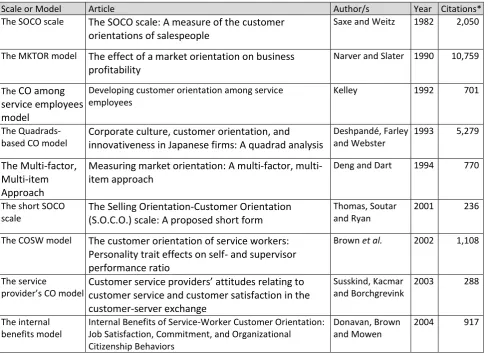
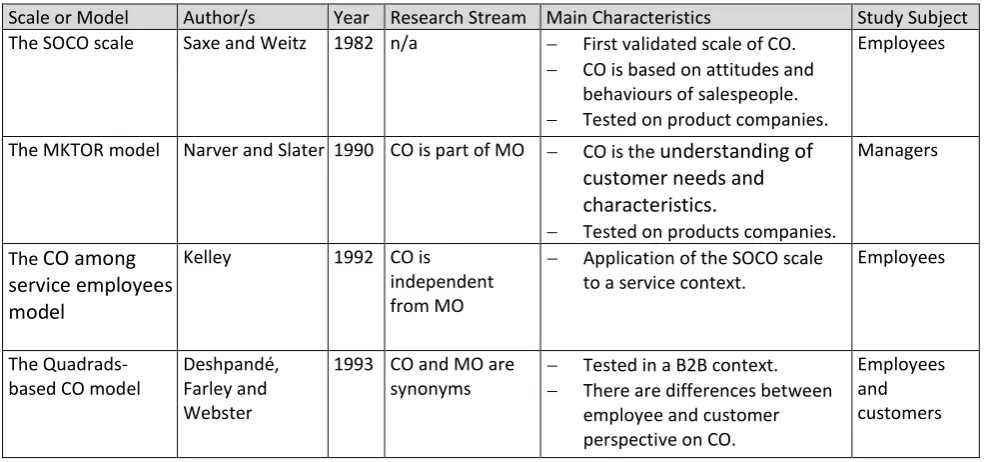
Table 2.2 shows a summary of all of the CO models that have been reviewed in detail (plus the COSE model that will be reviewed in the following subsection), including the year of publication and the number of citations according to Google Scholar (2018).
Scale or Model Article Author/s Year Citations*
The SOCO scale The SOCO scale: A measure of the customer orientations of salespeople
Saxe and Weitz 1982 2,050
The MKTOR model The effect of a market orientation on business profitability
Narver and Slater 1990 10,759
The CO among service employees model
Developing customer orientation among service employees
Kelley 1992 701
The Quadrads-based CO model
Corporate culture, customer orientation, and innovativeness in Japanese firms: A quadrad analysis
Deshpandé, Farley and Webster
1993 5,279
The Multi-factor, Multi-item Approach
Measuring market orientation: A multi-factor, multi- item approach
Deng and Dart 1994 770
The short SOCO scale
The Selling Orientation-Customer Orientation (S.O.C.O.) scale: A proposed short form
Thomas, Soutar and Ryan
2001 236
The COSW model The customer orientation of service workers: Personality trait effects on self- and supervisor performance ratio
Brown et al. 2002 1,108
The service
provider’s CO model
Customer service providers’ attitudes relating to
customer service and customer satisfaction in the customer-server exchange
Susskind, Kacmar and Borchgrevink
2003 288
The internal benefits model
Internal Benefits of Service-Worker Customer Orientation: Job Satisfaction, Commitment, and Organizational Citizenship Behaviors
Donavan, Brown and Mowen
Scale or Model Article Author/s Year Citations* The COSE model Customer orientation of service employees: Its
impact on customer satisfaction, commitment and retention
Hennig-Thurau 2004 587
CO of frontline employees model
Customer orientation of frontline employees and organizational commitment
Ifie 2014 17
(*) Number of citations provided by Google Scholar (Google, 2017)
Table 2.2: Compilation of CO models Source: Own elaboration
This list is the result of an exhaustive review of the published research regarding CO claiming to measure the construct. It is noteworthy to mention that more than 200 articles were reviewed before arriving to that short list. The majority of the found models were discarded because of the lack of originality as they were based on previous models or their limited impact on further research, and some of them because they lacked enough of an insightful approach to the conceptualisation of CO.
2.3.1.1. The SOCO Scale (Saxe and Weitz, 1982)
Saxe and Weitz are considered the first authors to define the CO construct and to develop a measurement tool termed ‘Selling Orientation – Customer Orientation’ (SOCO), which was originally related to salespeople.
According to the authors, CO is the willingness to apply the marketing concept, by which all of the activities and process of a company are leveraged to satisfy customer needs and to develop mutually beneficial long-term relationships. In particular, the CO of salesmen implied helping the customer to undertake purchasing decisions that would ultimately develop the marketing concept. Conversely, selling orientation was seeking to stimulate the demand of products, regardless of if they fully respond to customer demands.
From a more practical perspective, Saxe and Weitz emphasise that a customer-oriented approach has to be used only if the benefits (short or long-term) are greater than the associated costs. Furthermore, the authors assert that the cost effectiveness of CO would be reached when the employee has all of the req