GLOBAL JOURNAL OF ADVANCED ENGINEERING TECHNOLOGIES AND
SCIENCES
EFFECT OF FUNCTIONALIZED (COOH) MULTI-WALLED CARBON
NANO-TUBES (MWCNTS) ON ANTI-WEAR PERFORMANCE OF AN ENGINE OIL
Jaikumar Mayakrishnan*, Aswin Ganapathy
*
Automobile Engineering, Hindustan Institute of Technology & Science, Padur, India
ABSTRACT
Dissimilar materials with various nano forms were used as additives for improving properties of lubricants in the recent times. The potential of using functionalized (COOH) Multi-Walled Carbon Nano-tubes (MWCNTs) as additives in mineral oil grade SAE 20W40 was investigated in this study. High specific surface area of MWCNT might cause agglomeration and hence TRITON X-100 as surfactant was added to maintain MWCNT in the de-agglomeration state. However, the addition of Triton X-100 as surfactant in the mineral oil resulted in the variations of its tribological characteristics. The efficiency of MWCNT as anti-wear additive is also dependent on the properties of base oil. The weight percentage of MWCNT considered for preparing the nano-lubricant was taken to be 0.01%, 0.05%, 0.1%, and 0.2% of the lubricant weight. The surfactant Triton X-100 quantity using sonicator is taken to be 350 times the quantity of MWCNT by weight .The surface morphology of the samples was observed using Field Emission Scanning Electron Microscopy (FESEM). The experiments have been conducted to explore the optimum amount of MWCNT which can minimize the wear. The SAE 20 W40 lubricants containing different quantities of MWCNT were prepared with base oil using the Triton X-100 as surfactant to investigate its inference. The wear rate and frictional force was measured using pin on disk tester and anti-wear performance of the nano lubricants were studied. The results indicate that the quantity of MWCNT for base oil that was able to reduce the wear was found to be 0.05% by weight.
KEYWORDS: MWCNTs, Triton X-100, Anti-Wear, Engine Oil, FESEM, Pin on Desk Tester.
INTRODUCTION
Nano particles can be considered as modern lubricant additives. They present several major advantages over organic molecules that are presently used as lubricant additives. [1] Their nanometer size allows them to enter into the contact area like molecules. They are very quick effective even at ambient temperatures. Therefore, no induction period is necessary to obtain interesting tribological properties [2]. Lubricants mixed with nano particles are known to be the most effective method to reduce the friction and wear at contact metal parts. However, the presence of solid particles may also lead to oil starvation for lubrication regimes and these studies have been confined to those produced with millimeter or micrometer-sized particles [3]. Moreover, the lubricants with dispersed milli or micro-sized particles have not been applied to any industrial sectors [4] .Due to the problem of stability of suspensions that involve coarse-grained particles [5]. However, some of the researchers have done their investigations of nano tribology have revealed that nano particles have excellent properties for lubricant based tribological applications, such as heavy load capacity, resistance to wear and reduction in friction [6].
Recently nano materials are added in the lubricants to improve its physical and chemical properties. This will provide the new class of lubricants called as nano-lubricants [7]. Using the nano materials in the lubricant has the specific advantages such as very good thermal and chemical stability, high load carrying quality, increased heat transfer and very good anti-wear properties with reduced friction [8].
Among the various types of nano materials the MWCNT’S shows promising results such as very good anti-wear property and reduction in friction than the other nano materials, also it results in enhanced thermal properties [9]. In this study, the anti-wear performance including friction force of an engine oil using MWCNTs as a lubricant additive is investigated. In addition to this, the viscosity as one of the thermal properties of the nano lubricants is also measured.
MATERIALS AND METHODS
Table 1. Specifications of SAE 20 W 40 oil
Density at 15oC 0.91
Kinematic Viscosity at 40oC 28.40
Viscosity Index 115
Flash Point oC 232
Pour Point oC -24
The dispersion and stability are the very important factors of nano particles inside the base nano fluids. When the nano particles are not dispersed perfectly in the nano fluids, there is a possibility of occurrence of agglomeration and precipitation of nano particles which will cause the damage to the frictional surface and stop the lubricants vents. There are three suitable methods such as bath and probe ultrasonic and ball-mill to disperse the MWCNTs inside the base oil. In the present work MWCNTs are dispersed in the base oil using the bath type ultra sonicator. High specific surface area of MWCNT might cause agglomeration and hence TRITON X-100 as surfactant was added to maintain MWCNT in the de-agglomeration state.
The weight percentage of MWCNT considered for preparing the nano-lubricant was taken to be 0.01%, 0.05 %, 0.1%, and 0.2% of the lubricant weight. The surfactant Triton X-100 quantity using sonicator is taken to be 350 times the quantity of MWCNT by weight using high precision weighing machine. Then the samples are kept in the bath type sonicator, with a power and frequency of 20KHZ for sonication period of 2 hours to de-agglomerate and disperse the surfactant and MWCNTs in the base oil.
Finally, the nano lubricant samples are kept for an observation for a period of 48 hours and properties are found. The photograph of bath type ultra sonicator is shown in Figure 1.
Figure1. Bath Type Ultrasonicator
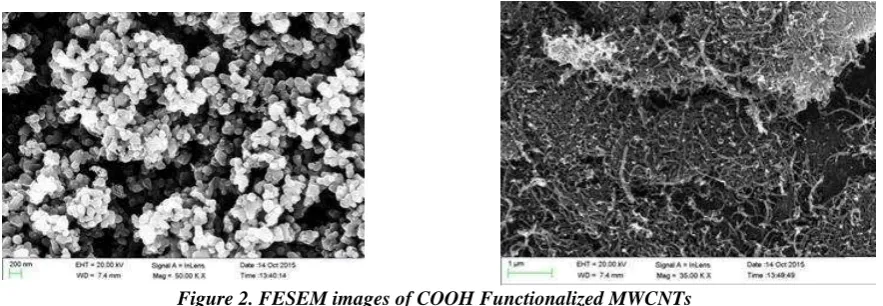
The Multi walled carbon nano tubes (COOH) functionalized are characterized using Field Emission Scanning Electron Microscope. Figure.2 shows the FESEM images of COOH Functionalized MWCNT’s.
Figure 2. FESEM images of COOH Functionalized MWCNTs
Figure 3. Photograph view of Pin-On-Disk set-up
Figure 4. Design of pin and disk
RESULTS AND DISCUSSION
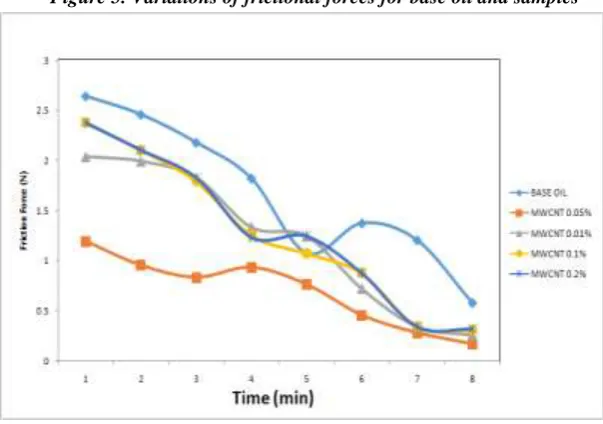
Frictional force:The friction forces are measured by using pin on disc apparatus. The friction forces are generated in between the rotating grey cast iron plate and static aluminium pin are noted in tribology data acquisition system. Figure 5 shows the variation of the frictional forces for base lubricant and various concentrations of nano fluids will be value in time. At the initial stage the friction force is very high due to the direct contact of the pin on disk. Introducing the lubricants in between the pin on disk reduce the friction generated in between them. Figure 5 shows the using of 0.05% MWCNT’S reduce the friction forces. The reduction in friction is high at 0.05% concentration so it can be used as an optimum concentration of nano material for effective friction reduction.
Figure 5. Variations of frictional forces for base oil and samples
Wear rate:
Figur 6. Wear rate for base and nano lubricants
Viscosity:
The kinematic viscosity of the base and nano fluids is measured by using the Redwood viscometer.
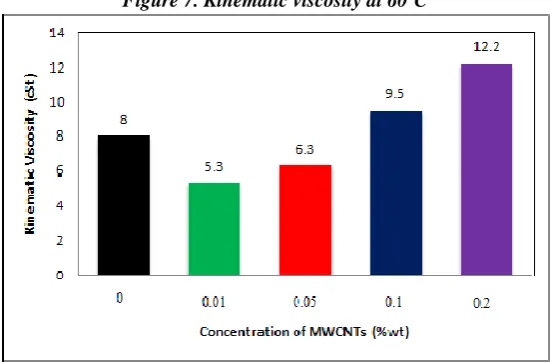
Figure 7 shows the effect of viscosity on temperature for base and various concentration of nano material. As in general, adding the nano tubes to the lubricant should increase the viscosity. Due to the effect of dispersant present in the base lubricant decreases the viscosity of the nano fluids. Though the viscosity decreases the change in viscosity with respect to the temperature change is very low. This makes the nano lubricant suitable for the high temperature application.
Figure 7. Kinematic viscosity at 60oC
CONCLUSION
Based on the experimental studies, following conclusions are made:
1. The wear of the pin descending against the disk is significantly reduced by use of MWCNT as additive in base oil.
2. The Quantity of MWCNT’S for base oil that was able to minimize the wear was found to be 0.05% by weight.
3. Adding the nano materials to the lubricant should increase the viscosity this makes the nano lubricant suitable for the high temperature application.
ACKNOWLEDGEMENTS
REFERENCES
[1] Amiruddina,b, Noreffendy Tamaldina,b, Nur Rashid Mat Nuria,b “Optimization of Tribological Performance of hBN/AL2O3 Nanoparticles as Engine Oil Additives”. The Malaysian International Tribology Conference 2013, MITC2013
[2] Binglu Ruan and Anthony M Jacob “Ultrasonication effects on thermal and rheologicalproperties of carbon nanotube suspensions.” Ruan and Jacobi Nanoscale Research Letters 2012, 7:127
[3] Kaviyarasu T, Vasanthan B “IMPROVEMENT OF TRIBOLOGICAL AND THERMAL PROPERTIES OF ENGINE LUBRICANT BY USING COPPER AND COPPER OXIDE NANO-MATERIALS” International Conference on Energy Efficient Technologies For Automobiles (EETA’ 15).
[4] S. M. Muzakkir, K. P. Lijesh and Harish Hirani “Effect of Base Oil on the Anti-Wear Performance of Multi-Walled Carbon Nano-tubes (MWCNT)” 15 March 2015, Vol.5, No.2 (April 2015), International Journal of Current Engineering and Technology E-ISSN 2277 – 4106, P-ISSN 2347 – 5161 ©2015 INPRESSCO.
[5] S.V.Prabhakar, VattikutiandChanByon“Synthesis and Characterization of Molybdenum Disulfide Nanoflowers and Nanosheets: Nano tribology”
[6] Y.-C. Liang et al., “Sensing-Throughput Trade-off for Cognitive Radio Networks,”IEEE Trans. Wireless Commun., vol. 7, pp. 1326–37 ,April 2008.
[7] Y.J. Hwang, Y.C. Ahn, H.S. Shin, C.G. Lee, G.T. Kim, H.S. Park, J.K. Lee “ “Investigation on characteristics of thermal conductivity enhancement of nanofluids.” Hindawi Publishing Corporation Journal of Nanomaterials Volume 2015, Article ID 710462, 11 pages
[8] Yan Yan Huang 1,2 and Eugene M. Terentjev 1, “Dispersion of Carbon Nanotubes: Mixing, Sonication,Stabilization, and Composite Properties”