Structural study of SrTiO
3
doped with Mn using X-ray
diffraction
Zainab Ibrahim Booq* and Sara Khalid Alghaith
Department of Physics and Astronomy, Science College of King Saud University, Turky Alaual, Riyadh, Saudi Arabia.
Accepted 24 May, 2017
ABSTRACT
Monocrystalline Mn:SrTiO3 was prepared from the compounds MnO2, TiO2, and SrCO3, which had
equivalent weights of 2.52 g. Mn was doped in this sample at 60 mol%. The sample was heated half hour, and annealed at 1223 K (950°C). The sample had an orientation of (100). The study was performed at room temperature (T = 300 K = 27°C). The structure of this crystal was investigated using X-ray diffraction and found to be cubic ( 3 ). The lattice parameter of the Mn:SrTiO3 crystal was 3.269 Å. The grain size of
this crystal was magnified 5,000 to 100,000 times using scanning electron microscopy and found to be in range of 1.33 to 91.4 nm.
Keywords: Spectrum, grain, crystal structure factor, atomic scattering factor, annealing.
*Corresponding author. [email protected].
INTRODUCTION
Strontium titanate oxide (SrTiO3 or STO) crystal is a
perovskite oxide material (ABO3, where A is the rare
earth element, B is the titanate, and O3 is the oxide) (De
Groot et al., nd). This group of materials has a wide range of applications, including uses in transistors, receivers, and non-vital memory devices (Choudhury, 2015). It is a semiconductor material (Biegalski et al., 2008), but becomes a superconductor when doped with Mn or any other transition metal ion (Fix et al., 2010; Choudhury, 2015; Gor'kov, 2016). This characteristic is responsible for the development of numerous physical properties, including good conductivity and magnetic properties (Fix et al., 2010; Gallardo et al., 2002).
It is worth mentioning that the preparation methods for most ABO3 crystals are very similar. Several preparation
techniques have been developed to produce Mn:SrTiO3
nanoparticles, including a sol–gel method, organic precursor method (Mohamed et al., 2010), powder sample method (Azzoni et al. 2000), and solution method at high temperatures (Fix et al., 2010; Azzoni et al., 2000; Choudhury et al., 2011; Choudhury et al., 2005).
In this study, a monocrystalline sample of Mn:SrTiO3
was prepared using a solution method at a high temperature, where Mn was used to dope the SrTiO3
crystal (Fix et al., 2010; Azzoni et al., 2000; Choudhury et
al., 2011; Choudhury et al., 2005). Then, X-ray diffraction (XRD) was used to investigate the structure. This was the first study to investigate the structure of this crystal using a low-resolution XRD device with a maximum current intensity was I = 1 mA and voltage V = 25 kV. The grain size was determined using scanning electron microscopy (SEM). The crystal preparation was complicated because available literature is not sufficiently clear, and there are different methods for doping the crystal and annealing at high temperatures, which requires a special furnace. In addition, special skill is required to adapt the low-resolution XRD device.
MATERIALS AND METHODS
Preparation of Mn:SrTiO3 monocrystal
The Mn:SrTiO3 monocrystal was prepared using powders
of MnO2, TiO2, and SrCO3 (Fix et al., 2010; Azzoni et al.,
2000; Choudhury et al., 2011; Choudhury et al., 2005) with purities of 70%, 99 and 98%, respectively. These compounds were added by equal weights of 2.52 g of each of the compounds were used (Choudhury et al., 2005), so that SrTiO3 was heavily doped by Mn at 60
mol%. The powders were mixed under magnetic stirring for 1 h to obtain a homogenous mixture. Then, the mixture was soaked in de-ionized (DI) water for 20 to 25 min (Choi et al., 2001; Kareev et al., 2008). A 3:1 by volume HCl:HNO3 acidic solution was added and mixed
for 12 min (Zhang et al., 2009; Kareev et al., 2008). The sample was annealed by being heated in a furnace at atmospheric pressure and temperature up to 1223 K (950°C) over a period of half hour, and then cold (Choi et al., 2001; Abadpour, 2015; Fix et al., 2010). It was then ground and pressed (Tkach et al., 2005; Dehkordi et al., 2015; Mashall and Castell, 2009) to form a pellet with a thickness of 3 mm and diameter of 12 mm. Thus, the monocrystal was formed. The surface of
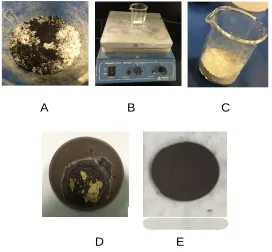
this pellet was purified using acetone (Choudhury, 2015). The steps for preparing the monocrystal are shown in Figure 1.
Study methods
XRD was used to study the structure of this monocrystal by a low-resolution device (X-ray apparatus 55481) with a molybdenum anode, maximum current intensity I = 1 mA, and voltage V = 20 kV (Gmbtt, 2001), as shown in Figure 2A. The monocrystal was polished using platinum materials, and then SEM (JSN-7610) was used to determine its grain size, as shown in Figure 2B.
Figure 1. A. Powder compound mixing. B. Magnetic stirrer. C. Homogenous sample after stirring. D. Sample after annealing. E. Mn:SrTiO3 monocrystal with thickness of 3 mm and diameter of 12
mm.
Figure 2. A. XRD (X-ray apparatus 55481) device. B. SEM (JSN-7610) device.
A B C
D E
RESULTS AND DISCUSSION
Structural study using XRD
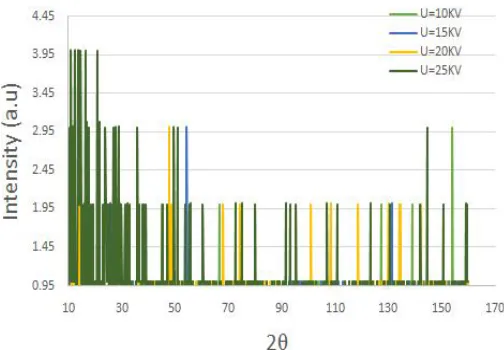
The best spectrum of this monocrystal was obtained in several steps. In the first step, the voltage was varied (V = 10, 15, 20 and 25 kV), while the current intensity was fixed at I = 1 mA, as shown in Figure 2. From this figure, it is clear that at a high voltage, the deformation in the shape of the spectral lines is duplicated in some parts of the spectra more than in the others. This indicates a large electron emission from the cathode to the anode, which made it difficult to investigate the number of reflection planes. At a low voltage, it should be noted that the spectrum has a small number of lines. In other words, the number of reflection planes in the crystal decreased because there were several electrons in the cathode that could not gain enough energy to arrive at the anode. For this reason, the X-rays coming from the source were very weak, which made it difficult to see the full crystal (Gmbtt, 2001). As seen in Figure 3, the best spectrum of this monocrystal was clearly found at a voltage V = 20 kV, and the number of reflection planes (lines) agrees with the other results [9]. The sample was grown in the direction of the [100] plane, based on a calculation for the axial axis.
The second step involved varying the current intensity (I = 0.5, 0.7, 0.75, and 1 mA), while fixing the voltage V = 20 kV, as shown in Figure 4. At a low current intensity, the number of reflection planes decreased because the number of electrons emitted from the cathode and arriving at the anode was low, which prevented all of the planes in the crystal from being seen. The best spectrum lines found in this step were at I = 1 mA, which agreed with the number of lines reported in the literature (Dehkordi et al., 2015; El-Sayed, 2002).
Finally, the best spectrum was found for Mn:SrTiO3 at a
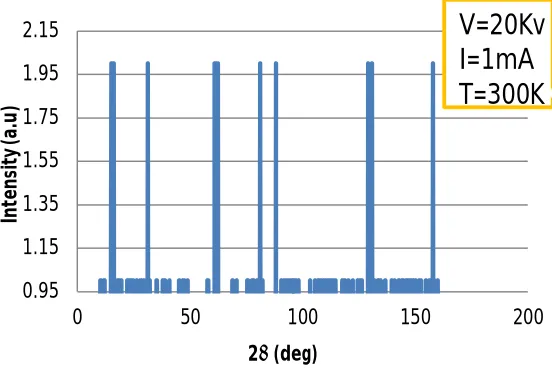
current intensity I = 1 mA, voltage V = 20 kV, and T = 300 K (27°C), as shown in Figure 5. It consisted of eleven reflection planes, which agreed with the results of other studies (Choudhury et al., 2011; El-Sayed, 2002).
The X-ray wavelength of the best spectrum was calculated using Equation 1:
= (1)
= . × (2)
= 0.62 ̇ (3)
Where is wavelength, h is plank constant, e is electron charge and V is voltage. The lattice parameter (a), which was approximately equal to the distance (d) between the planes in the crystal, was calculated from the slope in Figure 6 and Bragg's law (Equation 4), as shown in the following Equations 19:
Figure 3. Spectrum lines of Mn : SrTiO3 with variable voltage.
Figure 4. Spectrum lines of Mn:SrTiO3 with variable current
intensity.
= 2 (4)
= /2 (5)
= 3.269 ̇
(
0
.
008
%)
(6)Where n the number of reflection planes, d is the distance between the reflection planes and a is the lattice parameter. The lattice constant value obtained from the experimental data was nearly the same as that found by others (Azzoni et al., 2000; Choudhury et al., 2011). The reason for the very small differences between our lattice parameter result and that of others was the ratio of Mn doped in the STO, which was very high (heavily doped) in this study compared to others. If the doping in the crystal increased, the value of the lattice parameter decreased and vice versa (Azzoni et al., 2000).
Figure 5. Best spectrum lines of Mn:SrTiO3 crystal.
Figure 6. Relation between wavelength of reflection order (n) and diffraction angle (θ).
shown in Equation 7 and Figure 7 (Kooijman, 2005).
, , = , , (7)
In Equation 7, R is peak intensity, h, k and L are the Miller indices in the x, y and z directions, respectively. The atomic scattering factor (F) is constant in figure (6). Thus, the crystal structure factor (S) can be calculated using Equation 8 and Figure 6. The crystal structure had a value equal to zero, as shown in Equation 10 (Roessle, 2009).
=∑ ( ) (8)
=(| )|+∆ (9)
= 0 (10)
Here, n is the number of atoms in the molecule; u, v and w are the cut parts along the x, y and z axes, respectively; and e is an exponential function. The structural factor was zero. Thus, this crystal was cubic, of type ( 3 ), as shown in Figure 8 (Roessle, 2009;
0.95 1.15 1.35 1.55 1.75 1.95 2.15
0 50 100 150 200
In
te
n
si
ty
(a
.u
)
2θ(deg)
V=20Kv
I=1mA
T=300K
K
v = 20kV
I = 1mA
λ = 0.62A°
a = 3.269A°
0 1 2 3 4 5 6 7 8
0 0.2 0.4 0.6 0.8 1 1.2
n
λ
(
A
°)
Figure 7. Relation between atomic scattering factor and (sin / ).
Figure 8. Structure of Mn:SrTiO3 crystal
( 3 ) (http://photonscience.desy.de/ research highlights/archive/perv Skite like crystal in an electric field/index eng.html).
Huijben et al., 2009). This result agreed with those of others (Choudhury, 2015; Roessle, 2009; Huijben et al., 2009), where Mn2+ substituted for Sr2+ and Mn4+ substituted for Ti4+ (Silly and Castell, 2006; De Groot et al., nd; Choudhury et al., 2005; Tkach et al., 2005).
Calculating grain size using SEM technique
There are several techniques for elemental analyses at a specific location using SEM and transmission electron
microscopy (TEM). SEM is used to analyze the surface and obtain information about the particle size, and TEM is used to determine the internal structure of a solid (http://www.solids-solutions.com/rd/particle-sizing-
and-particle-size-analysis/scanning-transmission-electron-microscopy/).
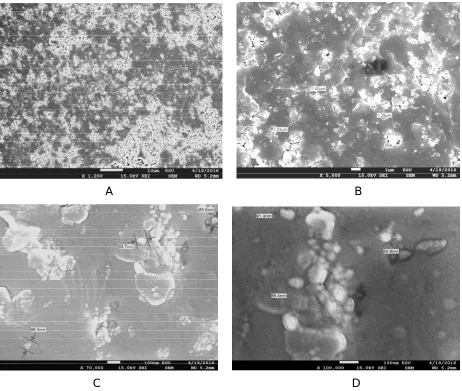
The grain size of this monocrystal was calculated using SEM, as shown in Figure 9, with a magnification of 5,000 times. The grain size of the crystal was in the range of 1.33 to 1.39 µm when magnified 5,000 times, but it was in the range of 84.9 to 91.4 nm when magnified 100,000 times. The grain size changed with the level of magnification (http://www.postnova.com/centrifugal-fff.html?gclid=CMbNkZ6Tg88CFYUy0wodgoAMEg). This result agreed with those of others (Mohamed et al., 2010). The grain size of the crystal depended on the doping ratio of the crystal. If the doping ratio of the crystal increased, the grain size decreased (Azzoni et al., 2000; Choudhury et al., 2011).
Table 1 provides a brief summary of the results.
CONCLUSION
This was the first structural study of Mn:SrTiO3 with 60
Figure 9. Mn : SrTiO3 crystal at different magnifications (1,500 to 100,000), showing differences in grain size (1.33 µm to
91.4 nm).
Table 1. Brief summary of results.
Wavelength Å Mn ratio in crystal 60% mole percent
Crystal size Thickness 3 mm diameter 12 mm Annealing temperature 1223 K = 950 °C
Crystal temperature 300 K = 27 °C Lattice parameter (a) a = 3.269 Å Crystal structure type ( 3 ) cubic Crystal grain size 1.33 µm to 91.4 nm
ACKNOWLEDGEMENTS
The authors are very grateful for the help provided by the Research Center at King Saud University in calculating the crystal grain size using SEM. We would also like to thank the physics laboratory of solar energy and some colleagues (Aml, Hana, and Hajer) in the physics and
chemistry departments, who assisted us in obtaining additional research facilities.
REFERENCES
Abadpour A. (2015). A sequential Bayesian alternative to the classical parallel fuzzy clustering model. Inform Sci, 318: 28–47.
A B
Azzoni C. B., Mozzati M. C., Galinetto P., Paleari A., Massarotti V., Bini M., Capsoni D. (2000). Magnetic investigation of Mn ions in La,Mn:SrTiO. Solid State Commun, 116: 303–308.
Azzoni C. B., Mozzati M. C., Paleari A., Massarotti V., Bini M., Capsoni D. (2000). Magnetic evidence of different environments of manganese ions in Mn-substituted strontium titanate. Solid State Commun, 114(12): 617–622.
Biegalski M. D., Fong D. D., Eastman J. A., Fuoss P. H., Streiffer S. K., Heeg T., Schubert J., Tian W., Nelson T. J., Pan X. Q., Hawley M. E., Bernhagen M., Reiche P., Uecker R., Trolier-McKinstry S., Schlom D. G. (2008). Critical thickness of high structural quality SrTi03 films
grown on orthorhombic (101) DyScO3. J App Phys, 104: 114109. Centrifugal field-flow fractionation principle, 9/9/2016,
http://www.postnova.com/centrifugal-fff.html?gclid=CMbNkZ6Tg88CFYUy0wodgoAMEg.
Choi J., Eom C. B., Mandal P., Sundaresan A., Waghmare U. V., Bhattacharjee S., Mathieu R., Lazor P., Eriksson O., Sanyal B., Nordblad P., Sharma A., Bhat S. V., Karis O., Sarma D. D., (2001). Growth mode transition from layer by layer to step flow during the growth of heteroepitaxial SrRuO3 on (001) SrTiO3. Appl Phys Lett,
79(10): 1449–1447.
Choudhury D. (2015). Site-specific doping, tunable dielectric properties, and intrinsic paramagnetism in Mn-doped SrTiO3.
Pramana J Phys, 84(6): 987–997.
Choudhury D., Goodbole R. M., Rindani S. D., Saha P. (2011). Top polarization, forward-backward asymmetry, and new physics. Phys Rev D, 84: 125–124.
Choudhury D., Mukherjee S., Mandal P., Sundaresan A., Waghmare U. V., Bhattacharjee S., Mathieu R., Lazor P., Eriksson O., Sanyal B., Nordblad P., Sharma A., Bhat S. V., Karis O., Sarma D. D. (2005). Tuning of dielectric properties and magnetism of SrTiO3 by
site-specific doping of Mn. Physical Review B, 53: 5061–5069.
De Groot F. M. F., Grioni M., et al. (nd). Chapter 2 Strontium titanate, Properties of strontium titanate, [online], Available: www.repositorio.ul.pt/bitstream/10451/1643/10/19741_ulsd_re 487_10_chapter2.pdf.
Dehkordi A. M., Bhattacharya S., Darroudi T., Alshareef H. N., Tritt T. M. (2015). New insights on the synthesis and electronic transport in bulk polycrystalline Pr-doped SrTiO3−δ. J Appl Phys, 117: 055102.
El-Sayed A. M. (2002). Influence of zinc content on some properties of Ni–Zn ferrites. Ceram Int, 28: 363–367.
Fix T., Schoofs F., MacManus-Driscoll J. L., Blamire M. G. (2010). Influence of doping at the nanoscale at LaAlO3:SrTiO3 interfaces.
Appl Phys Lett, 97(7): 072110-1072110-3.
Gallardo M. C., Becerro A. I., Romero F. J., del Cerro J., Seifert F., Redfern S. A. T. (2003). Cubic–tetragonal phase transition in Ca0.04Sr0.96TiO3: A combined specific heat and neutron diffraction
study. J Phy Condens Matt, 15(2): 91–100.
Gmbtt L. D, (2001). Instruction sheet 554 82, Germany, Hurth: Federal Republic.
Gor'kov L. P. (2016). Phonon mechanism in the most dilute superconductor: n type SrTiO3.' 21/4/2016, [online]. Available:
https://arxiv.org/ftp/arxiv/papers/1508/1508.00529.pdf.
Huijben M., Brinkman A., Koster G., Rijnders G., Hilgenkamp H., Blank D. H. A. (2009). Structure-property relation of SrTiO3–LaAlO3
interfaces. Adv Mater, 21: 1665–1677.
Kareev M., Prosandeev S., Liu J., Gan C., Kareev A., Freeland J. W., Xiao M., Chakhalian J. (2008). Atomic control and characterization of surface defect states of TiO2 terminated SrTiO3 single crystals. Appl
Phys Lett, 93: 202–228.
Kooijman H. (2005). Interpretation of crystal structure determinations. V2&3, [online], Available: http://www.cryst.chem.uu.nl/huub/notes web.pdf.
Mashall M. S. J., Castell M. R. (2009). Shape transitions of epitaxial islands during strained layer growth: Anatase TiO3(001) on
SrTiO3(001). Phy Rev Lett, 102: 146-102.
Mohamed R. M., Rashad M. M., Haraz F. A., Sigmund W. (2010). Structure and magnetic properties of nanocrystalline cobalt ferrite powders synthesized using organic acid precursor method. J Magn Magn Mat, 322: 2058–2064.
Roessle M. (2009). Basic of x-ray scattering. EMBO course 2012, [online], Available: www.ruppweb.org,camp,scatfac, 7, 2009.
Scanning & transmission electron microscopy, 9/9/2016, http://www.solids-solutions.com/rd/particle-sizing-and-particle-size-analysis/scanning-transmission-electron-microscopy/. Silly F., Castell M. R. (2006). Bimodal growth of Au on SrTiO3_001.
Phy Rev Lett, 96:1–4.
Skite like crystal in an electric field/index eng.html.
Tkach A., Vilarinho P. M., Kholkin A. L. (2005). Structure– microstructure–dielectric tunability relationship in Mn-doped strontium titanate ceramics. Acta Materialia, 53: 5061–5069.
Zhang J., Doutt D., Merz T., Chakhalian J., Kareev M., Liu J., Brillson L. J. (2009). Depth-resolved subsurface defects in chemically etched SrTiO3. Appl Phys Lett, 94: 092904–092908.
Citation: Booq Z. I., Alghaith K. A. (2017). Structural study of SrTiO3