Mohd. Ziauddin et al. J Sci Res Pharm, 2018;7(9):102-108
World Inventia Publishers
J
ournal of
S
cientific
R
esearch in
P
harmacy
http://www.jsrponline.com/
Vol. 7, Issue 9, 2018 ISSN: 2277-9469
USA CODEN: JSRPCJResearch Article
A PHARMACOLOGICAL STUDY AND EVALUATION 0F HEPATOPROTECTIVE ACTIVITY OF MERREMIA
EMARGINATA IN WISTAR RATS
Md. Farooq Ahmed 1, Syed Abdul Ruman 1, Dr. Mohammad Ziauddin 2 *, Dr. Md. Ateequr Rahman 2, Dr. Md. Majid Iqbal 2,
Dr. Anil Kumar Middha 1
1 OPJS University, INDIA; 2 Mesco College of Pharmacy, Hyderabad, INDIA.
Received on: 27-08-2018; Revised and Accepted on: 26-09-2018
ABSTRACT
M
erremia emarginata whole plant was subjected to preliminary phytochemical investigation and was found that it possess alkaloids, steroids, glycosides, flavonoids, tannins, carbohydrates and proteins. The extracts prepared by using polar solvents have demonstrated the dose dependent Hepatoprotective activity. The Methanolic extract of Merremia emarginata whole plant has shown Hepatoprotective activity in various screening models. It has demonstrated the Hepatoprotective activity which was evident by showing the variation in the liver enzymes. Our study has justified the claim of native herbal practitioners that the plant extract is useful in treating the Liver disorders.KEYWORDS: Merremia emarginata, Hepatoprotective activity, Liver disorder, Enzymes.
INTRODUCTION
A
ilments like hepatic disorder and metabolic disorders (diabetes) are appearing as a major threat in the future. These diseases are major concern in front of researcher because contributing factors are increasing in developing world.The present scenario, the lifestyle doesn’t permits us to have healthy food habits this put us in more vulnerable situation to have various Liver ailments. This leads to search of novel drug particularly of natural origin.
Gastropthy is associated to the injury caused to gastric mucosa and damaging the epithelial cells. Gastritis is inflammation of gastric mucosa. Hence author’s aim is to evaluate the hepatoprotective&anti diabetic activitiesThe liver is an important organ as it regulates many imperative metabolic functions. Hepatic damage is associated with alteration of these metabolic functions. Liver is the first organ in the body which expose to toxins absorbed from the GIT resulting in many liver diseases, this is key organ of metabolism and excretion. Thus liver diseases remain one of the serious health concerns.
A common metabolic disorder known as Diabetes mellitus with micro-and macrovascular complications those results in significant morbidity and mortality. It is considered as one of the cause among five leading causes of death in the world. Diabetes is in the top five of the most significant diseases in the developed world and is still gaining significance.
Since the existing drugs for the above said disorders encounter many side effects and need for prolonged treatment including questionable efficacy in the treatment, these reasons force the area of research to find improved treatments which will counteract the side effects and drawbacks of the existing treatment. Herbal drugs are having diversified uses are always an alternative option to the synthetic drugs
*Corresponding author:
Dr. Mohammad Ziauddin
Mesco College of Pharmacy, Hyderabad, INDIA.
* E-Mail: [email protected]
DOI:https://doi.org/10.5281/zenodo.1436375
which are well known for their side and adverse effects. Hence under these conditions exploring new cures from plants source will always be beneficial because of less side effects. On the above facts the objective of this study to evaluate Merremia emerginata as a possible cure to above said disorders.
1) Merremia emerginata:
Merremia emerginata belong to the family Convolvulaceae, is a flowering creeping perennial her grows throuout India, China and Nepal. The Merremia emerginata is found in planes and at the altitude of about 900-1000 meters. In Ayurveda, the roots & leaves of Merremia emerginata are used to treat ailments like inflmation,flatulance,diuresis,paralysis, etc, whole plant of Merremia emerginata is reported to contain alkaloids glycosides,phenolic &flavonoids along with carbohydrates and aminoacids.
Much research has been undertaken to evaluate the drug to treat various ailments and to evaluate gastroprotective.
Plan of Work:
Preparation of Methanolic extracts of Merremia emerginata by using soxhlet extraction.
Phytochemical analysis of Methanolic extracts of Merremia emerginata.
To study the acute toxicity of the Methanolic extracts of Merremia emerginata by OECD 423 guidelines.
To evaluate the hepatoprotective activity of (ME1) and (ME2) in the CCl4 induced hepatotoxicity in Wister rats.
a)Biochemical analysis of blood for marker enzymes-
SGOT
SGPT
Alkaline phosphate
Serum bilirubin and
Total bilirubin
b)To support the result of above-mentioned studies by histopathology study of liver.
MATERIALS AND METHODS
Bidar forest area. A herbarium specimen is deposited in our college museum identification and authentication was done by Dr Malikarjun Patil of pharmacognosy department of Karnataka college of pharmacy Bidar.
The powder obtained was subjected to successive soxhelt extraction with the solvents with increasing polarity i.e. petroleum ether, chloroform, methanol and water.
Preparation of methanolic extracts of M emarginata:
The authenticated whole plant of Merremia emarginata were dried in shade and powdered coarsely. Extraction was done according to standard procedure using analytical grade solvents. The coarse powder of the leaves was Soxhlet extracted with the solvents with increasing order of polarity i.e. petroleum ether (60-80oC), chloroform
(59.5-61.5oC), methanol (64.5-65.5oC) ME1, and hydroalcoholic extract
(methanol and water 50:50 ratio) ME2. After defating with petrolium ether, methanolic extract was also prepared. The extracts so obtained were concentrated under reduced pressure.
In addition the shade-dried powder was extracted directly with methanolic (hydro-alcoholic) extract which was used for pharmacological investigations after subjecting it to preliminary qualitative photochemical studies. The extracts were concentrated under reduced pressure and stored in desiccators until further use and the percentage yield of corresponding extracts were calculated.
Aims and Objectives:
Ailments like gastritis, peptic ulcer, and Liver disorders are appearing as a major threat in the future. These diseases are major concern in front of researcher because contributing factors are increasing in developing world.
The present scenario, the lifestyle doesn’t permits us to have healthy food habits this put us in more vulnerable situation to have various gastric and hepatic ailments. This leads to search of novel drug particularly of natural origin. .
Hence author’s aim is to evaluate the hepatoprotective activity. The liver is an important organ as it regulates many imperative metabolic functions. Hepatic damage is associated with alteration of these metabolic functions. Liver is the first organ in the body which expose to toxins absorbed from the GIT resulting in many liver diseases, this is key organ of metabolism and excretion. Thus liver diseases remain one of the serious health concerns.
Allopathic medicines have failed to treat hepatic diseases completely without adverse effects, chiefly the plant based preparations are in use for their treatment of liver diseases with minimum adverse effects. Unfortunately very few drugs are available for the treatment of liver diseases. Since the existing drugs for the above said disorders
encounter many side effects and need for prolonged treatment including questionable efficacy in the treatment, these reasons force the area of research to find improved treatments which will counteract the side effects and drawbacks of the existing treatment. Herbal drugs are having diversified uses are always an alternative option to the synthetic drugs which are well known for their side and adverse effects. Hence under these conditions exploring new cures from plants source will always be beneficial because of less side effects. On the above facts the objective of this study to evaluate Merremia emerginata as a possible cure to above said disorders.
1. Selection of Plant:
Appropriate selection of plants is very essential as any inappropriate selection can lead to wasting of time and resources. According to Elisabetsky and Moraes, there are three different methods of approach for the selection of medicinal plants.
a) Randomized Method: Investigation takes an arbitrary course b) Chemotaxanomical/phylogenetical: Species are selected according to given chemical category of substances in a genus or family. c) Ethnopharmacological: Selection of plants is based on their therapeutic use by an ethnic group.
There is another aspect with which everyone agrees. If the selection of plant is made on the ground of their traditional use, the chances of research success are greater. After analyzing the above two aspects, the author has considered ethnopharmacology, availability and traditional uses and the author selected the following plant.
2.Merremia emerginata:
Merremia emerginata belong to the family Convolvulaceae, is a flowering creeping perennial herb grows throuout India, China and Nepal. The Merremia emerginata is found in planes and at the altitude of about 900-1000 meters. In Ayurveda, the roots & leaves of Merremia emerginata are used to treat ailments like inflamation, flatulance, diuresis, paralysis, etc, whole plant of Merremia emerginata is reported to contain alkaloids glycosides,phenolic &flavonoids along with carbohydrates and aminoacids.
Much research has been undertaken to evaluate the drug to treat various ailments and to evaluate gastroprotective and hepatoprotective activity.
Collection of Plant Material and authentication:
The Merremia emarginata whole plant was collected from Bidar forest area. A herbarium specimen is deposited in our college museum identification and authentication was done by Dr Malikarjun Patil of pharmacognosy department of Karnataka college of pharmacy Bidar.
The powder obtained was subjected to successive soxhelt extraction with the solvents with increasing polarity i.e. petroleum ether, chloroform, methanol and water.
Preparation of methanolic extracts of Memarginata:
The authenticated whole plant of Merremia emarginata were dried in shade and powdered coarsely. Extraction was done according to standard procedure using analytical grade solvents. The coarse powder of the leaves was Soxhlet extracted with the solvents with increasing order of polarity i.e. petroleum ether (60-80oC), chloroform
(59.5-61.5oC), methanol (64.5-65.5oC) ME1, and hydroalcoholic extract
(methanol and water 50:50 ratio) ME2. After defating with petrolium ether, methanolic extract was also prepared. The extracts so obtained were concentrated under reduced pressure.
In addition the shade-dried powder was extracted directly with methanolic (hydro-alcoholic) extract which was used for pharmacological investigations after subjecting it to preliminary qualitative photochemical studies. The extracts were concentrated under reduced pressure and stored in desiccators until further use and the percentage yield of corresponding extracts were calculated.
Evaluation of Hepatoprotective activity:
The hepatoprotective activity of hydroalcoholic extract of Merremia emarginata rhizomewas evaluated by using CCl4 induced
acute hepatotoxicity model. In the hepatotoxic model, toxicant CCl4 was
administered with a dose of 0.5ml/kg i.p daily for seven days to the animals of group II, III, IV & V. The standard drug silymarin was administered with dose of 50 mg/kg p.o. Wistar rats of either sex were divided into 5 groups consisting of 6 animals in each group. Group I received 1% tween 80 for 7days & served as normal control. Group II served as negative control received 1% tween 80 p.o for seven days. Group III and Group IV received ME1 and ME2 respectively a dose of 500 mg/kg, p.o for seven days. Group V received standard drug silymarin with a dose of 100mg/kg ,p.o for seven days.
The Animals were sacrificed 24 hr after last treatment. The animals were anesthetized using ether and blood sample were collected by retro orbital plexux for biochemical estimation i.e. sALP, serum bilirubin, total bilirubin, sGOT, sGPT. After coagulation of blood at room temp serum was islolated by centrifugation at 2500 rpm for 20 minute. One liver from each group were separated. The livers after washing by normal saline were preserved in 10% formaldehyde for histopathological evaluation.
Estimation of Serum Enzymes:
a) Estmation of Glutamate Oxaloacetate Transminase (SGOT):
The Span diagnostic reagent kit is used for the determination of serum enzyme SGOT using method of Reitman S and Frankel S (1957).
Principle:
AST
L-Aspartate + 2-oxoglutarate Glutamate + oxaloacetate
gives a brown color in alkaline medium this can be measured calorimetrically at 505 nm.
The method for estimation of SGOT specified by Span Diagnostics is as follows.
Reagent preparation:
1. Reagent R1: Ready to use 2. Reagent R2: Ready to us
Stored at 2 – 80C and protected from light.
Four parts of reagent R1 is mixed with one part of reagent R2. The mixture reagents can be used within 24 hours time after the preparation.
Experimental Procedure:
500 μl of reagent had mixed with 50 μl of sample and aspirated into the reaction vessel. The reading was taken after 60 sec intervals. The value of mean absorbance change per minute (A/min) was calculated using the standard equation:
ALT (IU/L) =A/min x 1745, table 19.
b) Estmation of Glutamate Pyruvate Transaminases (SGPT):
Method of Reitman S and Frankel S (1957) and Span diagnostic reagent kit is used for the estimation of SGPT.
Principle:
Serum enzyme SGPT catalyses the following manner
ALT
L-Alanine+2-oxoglutarate Pyruvate + L-Glutamate
The private formed here is coupled with 2, 4-dinitro phenyl hydrazone (DNPH) to give the respective hydrazone which forms brown color in alkaline medium which can be calculalted calorimetrically at 505 nm.
The Span diagnostic reagent kit is used for the determination of serum enzyme SGPT the method specified by Span Diagnostics is as follows.
Reagent preparation:
1. Reagent R1: Ready to use 2. Reagent R2: Ready to use
Stored at 2 – 80C and protected from light
Four parts of reagent R1 had mixed with one part of reagent R2. This mixture reagent was used within 24 hours time after the preparation.
Experimental Procedure:
500μl of reagent had mixed with 50μl of sample and aspirated into the reaction vessel. The reading was taken after one minute’s intervals. The mean absorbance change per minute (A/min) was calculated using the fallowing equation:
ALT (IU/L) =A/min x 1745, table 1.
C) Estimation of Alkaline Phosphatase:
The method of Marsh etal.,1959 and Span diagnostic reagent kit is used for the estimation of Alkalin phosphatase.
Principle:
The enzyme reaction sequence employed in the assay of alkaline phosphatase is as follows:
ALP
P-Nitrophenyl phosphate + H2O Phosphate + P-Nitrophenol
The alkaline phosphatase hydrolyses disdisodium phenyl phosphate releasing phenol. The so released phenol react with 4-aminophenazone to form a condensation intermediate product, this intermediate product is then oxidized by potassium ferricyanide to form a colored product, which is measured calorimetrically at 624nm.
Method for the estimation of serum alkaline phosphatase is specified by Span Diagnostics is as follows:
Reagents:
1. Reagent R1: Buffer substrate –p20 x 1.2ml 2. Reagent R2: Buffer solution -25 ml
Reagent preparation: Here reconstituted one vial of the reagent with 1.2 ml of buffer solution as the working reagent.
Experimental Procedure:
500 μl of reagent had mixed with 10 μl of sample and aspirated into the reaction vessel. The reading was taken after one minute and additional three readings were taken at one minute intervals. The mean absorbance change per minute (A/min) was calculated using the fallowing equation:
ALP (IU/L) =A/min x 2757, table 1.
d) Estmation of Serum Biliruibin:
Method of Perry et al., 1983 and Span diagnostic reagent kit is used for the determination of serum bilirubin.
Principle:
The elevation of total serum bilirubin may occur due to the fallowing reason.
1.Extreme hemolysis or damage or the red blood cells .eg. Hemolysis disease of the newborn.
2.Disease Liver eg. Hepatitis and cirrhosis. 3.Obstruction in the biliary tract. eg. Gallstones.
Elevated bilirubin levels are observed in patient with liver or biliary tract diseases. Bilirubin here reacts with diazotized sulfanic acid to produced azobilirubin, which has greatest absorbance at 546 nm in the aqueous solution. Here the intensity of the colour produced in the product is directly proportional to the amount of direct or total bilirubin concentration present in the serum sample.
Method for the estimation of serum bilirubin is specified by Span Diagnostics is as follows:
Reagent preparation:
1. Total bilirubin reagent R1 : Ready to use 2. Direct bilirubin reagentR2: Ready to use 3. Bilirubin activator : Ready to use 50
Experimental Procedure:
500μl of reagent had mixed with 50μl of sample and 50μl of bilirubin activator which was incubated for ten minutes and aspirated into the reaction vessel. The absorbance was taken at 540 -560 nm against a serum blank which consist of 500μl of reagent, 50μl of sample and 50μl of water , table 19
The Bilirubin content was calculated using the following equation:
Total Bilirubin (mg/dt) =Abs of sample –Abs of sample blank x 15
Direct bilirubin (mg/dt) = Abs of sample –Abs of sample blank x 10
e) Estmation of Total Protein:
Method of Lowry et al.,1951 and Span diagnostic reagent kit was used for the estimation of total protein.
Principle:
Serum proteins are responsible for maintaining the normal distribution of the water in circulation and also in the tissue by optimizing the osmotic pressure. The deficient fractions of serum protein vary in the blood and it this depends on the type of diseases. The low protein level is primarily caused by impaired synthesis, malnutrition, low (as by hemorrhage), or excessive protein catabolism, protein level are usually high in condition like dehydration.
The enzymatic reaction series employed in the assay of total protein are as follows;
Alkaline pH
Protein +Cu++ Cu2+- protein complex (Biuret)
Reagent:
1. Total protein Reagent : Ready to use 2. Total protein Reagent : Ready to use
Total protein reagent was stored at room temperature (15-250) and the standard at 2-80c. Avoid contamination of Ready to use
reagent.
Experimental procedure:
500μl of reagent had mixed with 10μl of sample which was incubated for five mins and aspirated into the reaction vessel. The absorbance was measured at 520-560nm within one hour against a reagent blank which consist of 500μl of reagent, 10μl of the standard, table 1.
The protein content was calculated using the following equation:
Abs of sample
Total protein = ……… Xconcentration of standard protein (g/dl) Abs of standard
Results of Hepato Protective Activity: Study of serum enzymes:
Toxicant CCL4 on administration results in distinctive
elevation in serum hepatic levels, SGPT, S GOT,s ALP, Serum bilirubin &
Total bilirubin when compared with the normal controls indicating liver damage (necrosis). Pretreatment of the animals with hydroalcoholic extracts (HAE1, HAE2) earlier to CCL4 administration caused a marked
reduction in the values of SGPT, S GOT,s ALP, Serum bilirubin & Total
bilirubin (p<0.01) almost compareable to the silymarin, (table 1).
Table No. 1: Effect of the Merremia emarginata extracts on serum enzyme in ccl4 induced liver injury in rats
Groups SGPT (IU/L) SGOT (IU/L) Serum ALP (IU/L) Serum bilirubin
(mg/dl) Total bilirubin (mg/dl) Group I Normal 51.5 1.56 80.5 2.14 97 1.71 0.49 0.0071 1.49 0.0220 Group II, CCL4 treated 268.5 9.74 290.33 3.04 318.33 1.76 1.05 0.0331 4.29 0.1592
Group III, CCL4 &HAE1 treated 84.5 2.59** 118. 33 3.11** 135.67 1.61** 0.61 0.0096** 1.91 0.02801** Group IV, CCL4 & HAE2 treated 96.2 1.47** 132.16 2.32** 145.83 1.01** 0.68 0.0133** 2.71 0.1833**
Group V, CCL4 & Silymarin
treated 72.8 1.25
** 104.5 3.03** 119.33 0.99** 0.56 0.0162** 1.65 0.0183**
Data are presented as mean ± SEM, (n=6), **p<0.01, when compared with CCl4 control group. Using repeated measure ANOVA followed by Dunnets t test.
Fig. 1: Effect of the Merremia emarginata on SGPT (IU/L) in CCl4 induced liver injury in rats
Fig. 3: Effect of the Merremia emarginata on Serum ALP (IU/L) in CCl4 induced liver injury in rats
Fig. 4: Effect of the Merremia emarginata on Serum bilirubin (mg/dl) in CCl4 induced liver injury in rats
Fig. 5: Effect of the Merremia emarginata on Total bilirubin (mg/dl) in CCl4 induced liver injury in rats
Result of Histopathological Studies:
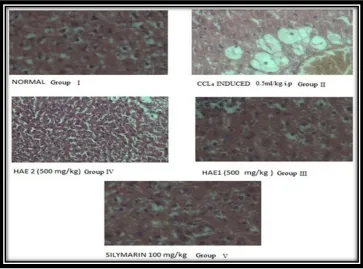
The results of histopathological studies reveal that the histological architecture of liver sections of control (group I) has normal hepatic cells with prominent nucleus, well preserved cytoplasm, nucleolus and clearly noticeable central veins. The hepatoprotective effect of methanolic extracts of Merremia emarginata was established by histopathological results of the liver tissue of control (group II) and treated (group III,IV) animals. The (group II) CCl4 treated liver section
showed severe central vein congestion, massive fatty changes,
Fig. 6: Results of histopathological studies of liver of rats of five groups
DISCUSSION
I
n gastro protective study Gastropathy is the term used when there is injury to the gastric mucosa associated with epithelial cell damage and regeneration. Peptic ulcer is the most common gastrointestinal disorder in clinical practice. A number of factors such as stress, chemical agents’ bile salts hyperosmolar Nacl, NSAIDs, may lead the gastro duodenal ulcer. Ulcers are caused due to imbalance between aggressive and defensive factors of gastric mucosa. The gastric wall mucus is thought to play an important role as defensive factor against gastrointestinal damage. Failure of the endogenous defense mechanism of the protective mucosal barrier leads to burning sensation in the abdomen. Duodenal ulcer more frequently(80% of PUDs) than gastric ulcers. The lifetime prevalence PUDs is about 10% PUDs are recurrent and most clinical studies are shown that approximately 50% of all ulcers.A recent review reported that the anti-ulcerogenic potential of many plant remedies. Worldwide have been investigated experimentally so far and diverse molecules have been determined as the active ingredients. Ulceration occurs when there is a disturbance of the normal equilibrium caused by either enhanced aggression or diminished mucosal resistance. At the same time, each of these drugs confers simpler to hematopoietic changes. Validation of the efficacy and harnessing of medicinal plants for the treatment of PUDs is a very promising approach to overcome the limitation of orthodox medicines. Already there is a blizzard of scientific evidences in support of efficacy of medicinal plants in the management of ulcers of different etiologies.
A peptic ulcer is a serious gastrointestinal disorder that requires a well-targeted therapeutic strategy. A number of drugs are available in the world for the treatment of peptic ulcer. Such as H2 antihistamines, proton pump inhibitors, anticholinergic, prostaglandins analogues, ulcer protective and ulcer healing drugs, but their clinical evaluation has shown incidence of various adverse drug reaction. This is the rationale for the development of the new anti-ulcer drug. The gastro-intestinal ailments are common worldwide due to junk food and stressful life style.
In one of our field survey a widely grown, creeping, smooth and hairy herb by name Merremia emerginata belongs to convolvulaceae family found throughout in India, in plains and hills. The phytochemical constituents of Merremia emerginata whole plant proven to show anti-ulcer property because of the presence
of,Tannins suggest its probability of being a gastroprotective herbal alternate.
The present scenario of food habits, sedentary life style demands the search for novel gastro protective/Hepatoprotective/ anti-ulcer drugs. Hence the blatant idea of selecting the plant
Merremia emerginata was conceptually adopted keeping review and hypothesis of anti-ulcer property and organ protection in view, the whole plant of Merremia emarginata is selected for assessing the Hepatoprotective ,gastro-protective, and Anti-ulcer potential.
Merremia emarginata whole plant were selected based on the basis of claims of native pratictioner and available phytochemical profile of the plant. Since leaves of the plant posses flavanoids, these are known to posses anti-oxidant property, it was thought to screen the whole plant for organprotective property by using various models of experimentally induced gastropathy and for antioxidant property. In the present study various extracts of whole plant Merremia emarginata were prepared by using successive soxhlet procedure. They are subjected to preliminary phytochemical tests. It is observed that steroids, Carbohydrates, glycosides, tannins and phenolic compounds are present in pet.ether, chloroform and methanolic extract. Flavonoids are present only in chloroform and ethanol extract.
These results are indicative of gastroprotective activity of the plant under study.
CONCLUSION
T
he Merremia emarginata whole plant contains alkaloids, steroids, glycosides, flavonoids, tannins, carbohydrates and proteins. Methanolic extract of Merremia emarginata whole plant increased the PH of Gastric juice.Methanolic extract of Merremia emarginata whole plant reduce total acidity and free acidity.
Treatment with Methanolic extract of Merremia emarginata whole plant has significantly reduced the volume of gastric juice.
Scope for Further Study:
Since, our study has indicated only the usefulness of
Meeremia emarginata whole plant in treating hepatic disorders, there is room for further study to identify, isolate, characterize and evaluate the active principle responsible for the hepatoprotective activity of the plant. In addition toxicological aspects of the plant is not studied in this project work. Hence, a study may be undertaken from the toxicological point of view. Even formulation and evaluation of this herb may also be studied.
SUMMARY
M
erremia emarginata whole plant was subjected to preliminary phytochemical investigation and was found that it possess alkaloids, steroids, glycosides, flavonoids, tannins, carbohydrates and proteins.The Methanolic extract of Merremia emarginata whole plant has shown hepatoprotective activity in various screening models . It has demonstrated the Hepatoprotective, Gastro protective /anti-ulcer activity which was evident by Serum Enzyme level.Our study has justified the claim of native herbal practitioners that the plant extract is useful in treating the hepatic disorders..
REFERENCES:
1. Mukherjee PK. Quality control of herbal drugs. An approach to evaluation of botanicals. Business horizons pharmaceuticals publishers; New Delhi 2002;13.
2. Tripathi KD. Essentials of medical pharmacology. 5th ed.
Jaypee Brothers, Medical Publishers; New Delhi 2004;3-4. 3. Gupta S.K. Drug screening methods. First ed. Jaypee
Brothers, Medical Publishers; New Delhi: 2004;463-64. 4. Agbor GA, Kuate D, Oben JE. Medicinal plant can be good
source of antioxidant: Case study in Cameroon. Pak J Biol Sci
2007;10(4):537-44.
5. Middleton E, Kandaswami C, Theoharides TC. The effects of plant flavonoids on mammalian cells: Implication for inflammation, heart disease, and cancer. Pharmacol Rev 2000; 52:673-751.
6. Niki E. Free radical pathology and antioxidants: Over view. J Nutr SciVitaminol 1992: 538-40.
7. Gerschman R, Gilbert D, Nye SW, Dwyer P, Fenn WO. Oxygenpoisoning and x-irradiation: A mechanism in common. Nutrition 1954;119:623-6.
8. McCord JM. The evolution of free radicals and oxidative stress. The AmJ Med 2000;108:652-9.
9. Halliwell B, Gutteridge JM, Cross CE. Free radicals, antioxidant and human disease: where are we now? J Lab Clin Med 1992;119:598-620.
10. Halliwell B. The chemistry of free radicals, Toxicol Ind Health 1993;9:1-21.
11. Hawkins CL, Brown BE, Davies MJ. Hypochlorite and hypobromite mediated radical formation and its role in cell lysis. Arch Biochem Biophys 2001;395(2):137-45. 12. Sala A, Recio MC, Schinella GR, Manez S, Giner RM, Nicolas MC,
et al. Assessment of the anti-inflammatory activity and free radical scavenger activity of tiliroside. Eur J Pharmacol 2003; 461:53-61.
13. Rajnarayana K, Reddy MS, Chaluvadi MR, Krishna DR. Bioflavonoids classification, pharmacological, biochemical effects and therapeutic potential. Ind J Pharmacol 2001 ;33:2-16.
14. Halliwell B. Role of free radicals in the neurodegenerative disease: therapeutic implications for antioxidant treatment. Drug aging 2001;18:685-716.
15. Mulder TP, Rietveld AG, Amelsvoort JMV. Consumption of both blacktea and green tea results in an increase in the excretion of hippuric acidinto urine. Am J Clin Nutr 2005;81:256S-60S. 16. Arts IC, Hollman PC. Polyphenols and disease risk in
epidemiological studies. Am J Clin Nutr 2005;81:317S-25S. 17. Nwanjo HU. Free radical scavenging potential of the aqueous
extracts of Viscum album (Mistletoe) leaves in diabetic Wistar rats hepatocytes. The Internet J Nutri Welln 2007;3(2):1-9. 18. Pihan G, Regillo C, Szabo S. Free radicals and lipid
peroxidation iethanol- or aspirin-induced gastric mucosal injury. Dig Dis Sci 1987;32:1395-401.
19. Umamaheswari M, Asokkumar K, Rathidevi R, Sivashanmugam AT, Subhadradevi V, Ravi TK. Antiulcer and in vitro antioxidant activities of Jasminum grandiflorum L. J Ethnopharmacol 2007;110:464-70.
20. Achliya GS, Wadodkar SG. and Dorle AK. Evaluation hepatoprotective effect of Amalkadi Ghrita against carbon tetrachloride-induced hepatic damage in rats. J Ethnopharmacol 2004;90:229-232.
How to cite this article:
Mohammad Ziauddin et al. A PHARMACOLOGICAL STUDY AND EVALUATION 0F HEPATOPROTECTIVE ACTIVITY OF MERREMIA
EMARGINATA IN WISTAR RATS. J Sci Res Pharm 2018;7(9):102-108. DOI:https://doi.org/10.5281/zenodo.1436375
Conflict of interest: The authors have declared that no conflict of interest exists.