Available online on 15.03.2019 at http://jddtonline.info
Journal of Drug Delivery and Therapeutics
Open Access to Pharmaceutical and Medical Research
© 2011-18, publisher and licensee JDDT, This is an Open Access article which permits unrestricted non-commercial use, provided the original work is properly cited
Open Access
Research Article
Formulation and development of some BCS Class II drugs
S C Marapur *1, Dr Rakesh Kumar Jat 2, Dr J S Patil 3
1 Dept. of Pharmaceutics, BLDEA’s SSM College of Pharmacy and Research centre, Vijayapur-586 103, Karnataka, India.
2 Dept. of Pharmaceutical Science, JJT University Rajasthan
3 Department of Pharmaceutics, VT’ Shivajirao S. Jondhle College of Pharmacy, Thane, Maharashtra, India
ABSTRACT
The aim of this research was to develop and evaluate liquisolid compacts of Ezetimibe a bcs class II drug. The series of formulations containing Ezetimibe drug were formulated by using aerosil a colloidal silicone dioxide and avicel PH microcrystalline cellulose in different ratios by using suitable solvent. Solubility studies were performed in propylene glycol and polyethylene glycol (PEG-200, 400, 600) for the choice of the best non volatile liquid to dissolve Ezetimibe. On the basis of the solubility data PG was chosen as a good solvent for the Ezetimibe. Ezetimibe was dissolved in solvent PG for the preparation of solution of drug. The coating and carrier materials transferred to the drug solution and added 5% of disintegrating agent (Croscarmellose) was mixed completely and the blend is compressed into compacts. Formulated compacts were evaluated for all post compression parameters and the in-vitro drug release study was carried out. All the formulations have shown a very good drug release in 15 min except compressibility problems due to higher812 loading factor of liquid vehicle for the formulations. The selected formulation F11 containing 30% of drug solution has shown good drug release of 100.01% in 15 min compared to dissolution of pure drug and marketed tablet which shown 45.5% and 81.6 % respectively.No interactions were found between drug and polymers in FITR as well as DSC. XRD of selected formulation shows that drug present in the formulation is in amorphous form.
Keywords: Ezetimibe HCl, Avicel PH, Aerosil 200, Propylene glycol, liquisolid compacts
Article Info:Received 04 Feb 2019; Review Completed 09 March 2019; Accepted 12 March 2019; Available online 15 March 2019 Cite this article as:
Marapur SC, Jat RK, Patil JS,Formulation and development of some BCS Class II drug, Journal of Drug Delivery and
Therapeutics. 2019; 9(2):321-329 http://dx.doi.org/10.22270/jddt.v9i2.2424 *Address for Correspondence:
S C Marapur, Assistant Professor, Dept. of Pharmaceutics, BLDEA’S SSM College of Pharmacy and Research Centre, Vijaypur-586101
INTRODUCTION
The oral administration is the route of choice and is the very much preferred route for administration of drug due to more patient fulfillment (or) acceptance in the drug development. Because of some associated problems caused by this route of administration, this is complicated to achieve the plasma drugs concentrations. The drug solubility is a biggest problem and it is the most important to attain the required amount of drug into the blood.1
The drugs have incomplete bioavailability which is less water soluble and having less dissolution rate. The challenge of slightly solubility of drug in water is to develop the solubilization and dissolution of drug. Various types of techniques that can be utilized to develop the solubilization of less water soluble and water insoluble active constituent, like reduction of particle size into microns, freeze drying, dispersion of drug into solubilising agent, using complex forming agents, co solvents, chemically modifications, adjusting pH, solubilization with surface active agents, Solid
of drug solubilization, its wetting property, and to boost the drug solubility and bioavailability. In order to solve all such type of problems, the “Liquisolid Technique "was developed which may called as the Technology of Powder solution Hence main objectives of this present study were to carry out the solubility enhancement technique for the BCS class II drugs by using the liquisolid compact technique.2
MATERIALS AND METHODS
Materials: Ezetimibe Hcl is received as gift sample from Glenmark pharma Mumbai, colloidal silicone dioxide (Aerosil 200), Microcrystalline cellulose (Avicel PH 101) are received from Microlabs Bangalore and solvents like Propylene Glycol, PEG solvents are used of laboratory grades purchased from SD fine chemicals Mumbai. All other solvents and reagents were used as analytical grade.
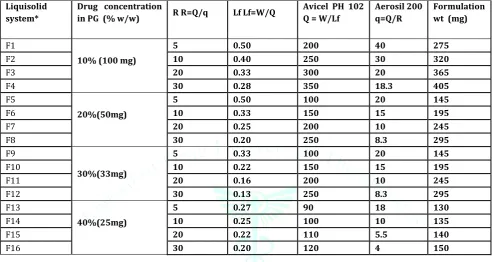
Table 1 Formulation of liquisolid compacts of Ezetimibe Liquisolid
system*
Drug concentration
in PG (% w/w) R R=Q/q Lf Lf=W/Q
Avicel PH 102 Q = W/Lf
Aerosil 200 q=Q/R
Formulation wt (mg)
F1
10% (100 mg)
5 0.50 200 40 275
F2 10 0.40 250 30 320
F3 20 0.33 300 20 365
F4 30 0.28 350 18.3 405
F5
20%(50mg)
5 0.50 100 20 145
F6 10 0.33 150 15 195
F7 20 0.25 200 10 245
F8 30 0.20 250 8.3 295
F9
30%(33mg)
5 0.33 100 20 145
F10 10 0.22 150 15 195
F11 20 0.16 200 10 245
F12 30 0.13 250 8.3 295
F13
40%(25mg)
5 0.27 90 18 130
F14 10 0.25 100 10 135
F15 20 0.22 110 5.5 140
F16 30 0.20 120 4 150
Determination of solubility of Ezetimibe drug:
Solubility studies were performed in propylene glycol and polyethylene glycol (PEG-200, 400, 600) for the choice of the best non volatile liquid to dissolve Ezetimibe. Saturated solutions have been developed by the addition of surplus medications to solvent vehicles and stirring in a shaker incubator for 48 hours at 25 º C ± 1 º C. Following this stage the filtration was done by a filter of 0.45 µm Miilpore, by diluting using distilled water and done analysis by a the help of UV visual spectral in the wavelength of 232 nm against the blank in a solvent of non volatile in nature is the most significant quality of liquisolid system. The drug solubilization helps in the molecular dispersion in non volatile solvents like that may get improvement in the rate of dilution. On the basis of the solubility data PG was chosen as a good solvent for the Ezetimibe.
Preparation of liquisolid compacts:
Ezetimibe was dissolved without changing solvent PG for the preparation of solution of drug. The combination of coating and carrier materials transferred Avicel PH102 as carrier and colloidal silicon dioxide (Aerosil 200) as the coating adjuvant which was then added to the solvent and mixed in ceramic mortar to avoid over-trituratio and reduce particle size. The blend was done in three phases; in the first phase, the drugs are slowly mixed to get even distribution of solvent medications. In the next stage, the blend was spreaded as a homogeneous coat on the surface and remained in position for few minutes of interval. In last phase addition of 5% of disintegrating agent
(Croscarmellose) was done to the granules or powder and mixed completely. The last blend is compressed into compacts by using 12 mm punches of round flat type in 16 station rotary tablet machine. 3
Evaluation of liquisolid compacts Determining the drug solubility
Solubility studies had been conducted to choose the higher solubilization of the pure drug model in solvents like nonvolatile nature, which includes drugs solubilized in various solvents of nonvolatile. The quantities of excess net drugs were added to non-volatile solvents, followed by a transfer of saturation solution to rotary transformers for 48 hours at 25oC under continuous vibration. After a period of
48 hours the saturated solution is filtered by using a filter like Millipore of 0.45 μm and analyzed.
Solubility studies were performed in the solvents propylene glycol and polyethylene glycol (PEG-200, 400, 600) to select the best non-volatile solvent to dissolve ezetimibe. Saturated solutions have been developed by the addition of excess medications to vehicles and stirring in a shaker incubator for 48 hours at 25 º C ± 1 º C. After this period the solutions were filtered through a filter of 0.45 µm Millipore, diluted with distilled water and distributed by a double radius of visible UV spectral spectrum in the wavelength of 232 nm. Determination of angle of slide
prepared with increasing amounts of liquid vehicles. To measure the angle of slide, the liquid mixtures/powder of Ezetimibe was placed on polished metal plates, and then gradually imbalanced until the liquid/powder was slided on the verge of slipping. The angle that is formed between the panel and the horizontal surface is defined as the angle of the slide.
Calculation of the loading factor:
In the liquisolid system, the microcrystalline cellulose and aerosol could only keep definite amount of solvent by the maintenance of the satisfactory flow also compressibility characteristics according to the ratio used. The ratio of powder found in was R where of powder or granules are stated like fraction of carrier adjuvant (q) and the coating adjuvant materials (q) of the system. It is possible to set up the "Ezetimibe" system, which is transferable with an acceptable flow and the possibility of compression if it does not exceed the maximum fluid limit in the carrier's material. This nature of liquid is called a liquid or solvent loading factor (LF) and may be stated as the weight fraction of solvent medicine (W) and the adjuvant carrier (q) in the method where LF = w/q. For computation of the liquid or solvenht load factor, solvents (liquid drugs without medication) with nonvolatile have been included to 10gm of carrier materials and collected for 1 minute then in this material addition of coating material done and mixed. The formulations are designed for Ezetimibe liquisolid systems according to the mathematical model described by Spireas et al. According to the theories of liquisolid tablets, the powder carrier and coating agents can only hold definite amounts of solvents and maintains an acceptable flow and compressible force. The fraction of powder in ratio R is known as
R = Q/q ——— (1)
Where R is the fraction of carrier weight (Q) and (q) of the coating material found in the formulations. The liquid load factor (LF) is defined as the weight fraction of the liquid drug (W) to the weight of the carrier (Q) in the system, which must be present in the flowing system and the compressibility.
LF = W/Q ——— (2) LF = W/Q ——— (2)
The ability to flow liquid retention (θ value) of powder absorbent material was used to calculate the required quantities of components. Therefore, the powder rates R and the liquid load factor LF of the formulations are related to the following way
Loading factor = Φ C A + Φ CO * 1 / R.
W = wt. of liquid drug, Q = wt. of carrier material Q = W/LF-(4) q = Q/R-(5)
Where, Q is carrier agent and q is the coating agent.4
Evaluation of Ezetimibe Liquisolid tablets (post compression parameter)
The compression parameters of the Ezetimibe Liquisolid tablets are as follows.
Tablets Size and shape:
The size of tablets and tablets shapes can be explained as dimensions watched and controlled. It is found by the machine throughout the process of compression.
Determination of Moisture of Granules:
The granules or powders must have enough strength to resist normal process during handle of mixture and incorporation processes without production of big amount of fine dust. In some size decreasing process throughout the process of condense in the tablets is useful to represent the areas of the fresh surfaces required for best possible link to put so the dampness content is the very vital thing for fine medicinal products.
Weight Variation Test:
As per the USP the test for tablets weight variations test of the tablets Ezetimibe Liquisolid is made by weighing 20 compacts independently by calculated common weights and compared the weight of individual tablet on mean weight. The variation in weights of tablets in test is denominated by percentage. The formula used for same weight variation test = (iw-aw)/aw X 100% where, iw = Individual or single weight of tablet. aw = average or mean weight of tablet. According to USP the tablet comply with the tests if no extra than 2 out of single weights diverge as of the mean mass by additional than the proportion divergence as shown in table.5
Drug content uniformity:
Standard preparation: About 20 mg of Ezetimibe was
weighed accurately and shift to a flask of 50 ml. and dissolve then dilute and fill up to the volume with the Phosphate solution 7.4 pH and mixed.
Preparation of sample solution: Five tablets were taken
powdered and weighed into powder. The powder equal to 20 mg is taken by weighing accurately. Drug Ezetimibe powder was transferred to a flask of 50 ml and made to dissolve in a 7.4 pH phosphate buffer. Sonication is done by keeping for 30 minutes and filtered using membrane filter 0.45. It is then dissolved and diluted to the mark. The absorption of both after the appropriate dilutions was measured in a UV-visible spectrophotometer at 232 nm of standard preparation and the preparation of the sample at 7.4 pH phosphate solutions. The repetition of method was done for 3 times.
Thickness: The tablet thickness of individual tablets was
found with a sliding caliper scale of 5 or 10 tablets, where their total thickness was measured. The thickness of the tablet must be checked within a variation of ± 5% of a standard expressed in mm.
Hardness Test:
For this test tablet hardness tester, Monsanto hardness equipment is used to evaluate the hardness of tablet was used. The equipment contains a drum and a compressor spring which is held in between two divers. The piston is located to make contact with the tablet and receives reading at zero level. The piston which is upper side is moved with force in opposition to a spring by rotating a thread lock till the tablet breaks. When the compression of spring is done, an indicator reads alongside a meter in the drum to point out strength. The force of the break is noted in a k.g. Ten Ezetimibe liquisolid compacts are compressed and measured their hardness and the permissible range in between 4-6 kg (40-60 N) if not or else noted.
Friability test: The test for Friability of tablets can find
compute the friability and the reading and is noted. This was found by using the formula:
Where, IW = initial weight of compacts FW = final weight of compacts. As per USP the compacts that loss is lesser than 0.5% to 1% (after 100 rotations) of their weights are usually considered as satisfactory.
Disintegration test:
USP devices containing 6 glass or plastic tubes which are 3 inches in length, open at the top, and covered by 10 no. net screen towards the base end of the basket stand apparatus. For checking the disintegrate time, a Ezetimibe liquisolid compact is kept on every tube and the set of basket is placed in a specific media at 37 ± 2 ° C, as the compacts leftovers 2.5 cm under the liquid surface in the movement towards ascending and descending is no nearer than 2.5 centimeters from the base of the container. A model machine device is utilized to move the basket assemble which contains the tablets top and bottom throughout the space of 5 to 6 cm. At a occurrence of 28 to 32 revolutions per minute. Plastic discs of perforated may be used in the study. The compacts are kept at the top of s and transmit a rough stroke on the tablets. Discs may be or may not be necessary or provide additional sensitivity to the study, but these are helpful for floating of compacts or tablets. Function the device for the specific time (900seconds for compacts of un coated, if not or else acceptable and permitted)
The compacts comply as per the test if the compacts are dissolved, and all drug particles pass through the mesh at the specified time. If filtrate remains, it should have a soft mass without a clearly stable nucleus. The compacts comply with the study as per the USP, if all the compacts have been fully dissolved. If the 1 or 2 compacts fail to dissolve totally, repeatation of the test should be done for 12 supplementary compacts. If the condition is not met then not lesser than 16 of the 18 compacts are to be tested.6
In vitro dissolution study of Ezetimibe Liquisolid
compacts:
Release of medications from Ezetimbe liquesolid tablets has been determined using the USP type II (paddle).
Medium Solution: 0.45% SLS to 0.05 M acetic acetate solution, PH 4.5.Size: 500 ml. Temperature maintained 37°c ± 0.5 °c . Speed of peddle 50 rpm. Solution of about 5ml has been withdrawn from the solution every time at suitable intervals of 10, 20, 30 and 45 minutes and is changed by replacing with fresh medium. After withdrawing the samples were filtered and analysis of the sample was made using a double beam of UV spectrophometer and analyzed using UV optical spectral scale in 232 nm. The drug concentration was commutated using a standard curve. 7
RESULT AND DISCUSSION
Standard calibration curves of Ezetimibe drug in 0.1 N HCl:
The calibrations curve of Ezetimibe drug was plotted by the absorbance v/s concentrations. The max of Ezetimibe drug in Acetate buffer pH 4.5 N was determined at max 232 nm.
The values of absorbance are shown in table no-20 The standard calibrations curve of Ezetimibe is in the Beer's range between 5-30 g/ml .
Determination of solubility of Ezetimibe drug: Solubility
studies were performed in propylene glycol and polyethylene glycol (PEG-200, 400, 600) for the choice of the best non volatile liquid to dissolve Ezetimibe. Saturated solutions have been developed by the addition of surplus medications to solvent vehicles and stirring in a shaker incubator for 48 hours at 25 º C ± 1 º C. Following this stage the filtration was done by a filter of 0.45 µm Miilpore, by diluting using distilled water and done analysis by a the help of UV visual spectral in the wavelength of 232 nm against the blank in a solvent of non volatile in nature is the most significant quality of liquisolid system. The drug solubilization helps in the molecular dispersion in non volatile solvents like that may get improvement in the rate of dilution. On the basis of the solubility data PG was chosen as a good solvent for the Ezetimibe.
Determination of Angle of slide:
Many standard solvent compounds or powder mixtures which contain 10 grams of carrier or coating material are prepared with increasing amounts of liquid vehicles. To determine the angle of slide, the solvent or powder prepared from Ezetimibe kept on metal plate which is polished, and then slanted steadily until the liquid or powder mixture was get slided. The angle that is formed between the panel and the surface which is horizontal is stated as the angle of slide (h).
The Angle of repose:
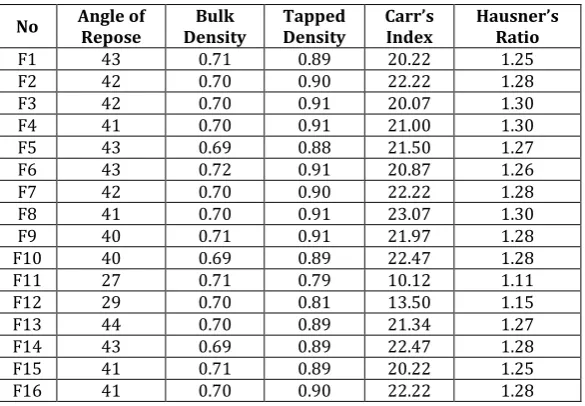
The angle of repose of these powders is formed due to the effect of the inner particles of strong friction. The most cohesive molecules in nature have a higher angle of repose. Angle of repose smaller than thirty degrees shows good flow nature from a 40 degree angle and above shows poor flow. Formulations with a angle of repose superior than 40 are not satisfactory (F1-F10 and F13-f16 formulations) combinations, F11 and F12 shown 27 degrees, and 29 degrees respectively, showed a good flow, but the F12 formula necessary in a larger quantity of carrier adjuvant that improved the size of the compact to 295 mg. So the F11 preparation was chosen for compression.
Bulk density and tapped density:
The acceptable range and values summarized in table 12 indicate the values for all combinations from F1 to F16 in Ezetimibe formulations. This outcome helps to calculate the percentage of the powder compressibility within the acceptable limit.
Carr’s Index: Based on these parameters, the F11
formulation was chosen for further evaluation. Formulation F11 showed Carr index 10.12 and Hausner’s ratio of 1.11 to the total weight of the tablet of 245 mg.
Post compression Parameters of Ezetimibe Liquisolid compacts:
Hardness: The liquisolid system must have sufficient
hardness to prevent breakage during manipulation, and also must be disintegrate. The formulation of F11 also showed a very good hardness of about 4 kg/cm 2.
Thickness: The thickness values of F1 to F16 formulas are
almost uniform in all formulas.
Friability test: The friability results of the Ezetimibe
Weight variation test: The percentage of tablets weight variations were found for the formulations F1 to F16. The values observed were within the acceptable limit.
Drug content uniformity: The liquisolid tablets were
evaluated to standardize the drug content by selecting ten compacts randomly. The compacts were powdered then weighed hundred mg of the powder then shifted in a volumetric flask of 100 ml, and the content of drug was estimated by spectrophotometrically at 232 nm (Indian Pharmacopeia) The drug content for compacts of all the formulations ranges in between 96.6-99.9%. The results indicates that the tablets active contents of all the preparations were found to be identical and contains right dose of the active ingredients.
Disintegration time: The disintegration time of tablets are
found to be 110 and 120 sec for formulation F11 and F12.For formulations F1 to F10 and formulations F13 to F16 was observed to be 345 to 380 sec.
Dissolution study:Dissolution studies of all formulations
from F1 to F16 were carried out in 0.45% SLS in 0.05 M Acetate Buffer, pH 4.5.No much difference is found in the solubility and rate of dissolution of all the formulations due to good solubility of drug in the solvent vehicle except compressibility problems due to higher loading factor of liquid vehicle for the formulations. All the formulations have shown a very good drug release in 15 min.
The selected formulation F11 containing 30% of drug solution has shown good drug release of 100.01% in 15 min compared to dissolution of pure drug and marketed tablet which shown 45.5% and 81.6 % respectively. The drug release data obtained for the formulation F11 along with pure drug and marketed tablet.8
Drug-Excipient Interactions: FT-IR spectra of Ezetimibe LSC:
FTIR spectroscopy was utilised for the analysis of the changes in structure and interaction possibilities of between the drug and Liquisolid compacts of Ezetimibe. The characteristic peaks of Ezetimibe was found to be 3200, 2400, 1200,800 cm-1. The FTIR spectrum of Liquisolid
compacts of Ezetimibe showed its characteristic IR absorption peaks at 3300, 2400, 1100, 650 cm-1. These
spectra observations revealed no any interactions among the carrier and drug used.
Differential Scanning Calorimetry (DSC) of Ezetimibe LSC:
The thermogram of DSC of pure Ezetimibe was showed a sharp peak of endotherm at 169.540C with respect to its
melting point, indicates the crystal character of the drug. DSC thermograms of liquisolid compacts indicated broad peaks at 187.560C, indicating a decreasing in the crystal nature of drug and its transform to amorphous form. A slight shift in
the drug melting peaks indicating dissolution of drug in the non volatile liquid PEG 600 before reaching its fusion temperature. It was concluded that the presence of the drug affects the lattice energy of the crystalline polymer leading to shifting of the peak. The vanishing of drug peak in formulations into a liquisolid compacts indicate the absolute inhibition of all drug thermal characters certainly indicates the formation of an solid solution of amorphous. No other interactions were observed in between the drug and excipients.
X-Ray Diffratrometry (XRD) of Ezetimibe LSC: The X-ray
diffractogram of the Ezetimibe Drug, Formulation F11 and Physical mixture. Ezetimibe shows sharp peaks at 16°, 17.5° and 19° and 19.5°. The nonexistence of distinguishing peak of Ezetimibe in liquisolid compacts shows that drug is completely transformed into amorphous or solubilized appearance. The nonexistence of crystal nature of the drug in the liquisolid compacts may be due to the effect of solubilisation in the solvent material which was absorbed in the carrier material and adsorbed on the coating materials. The liquisolid system and physical mixture preparations have the same diffracting pattern and found no other peaks. The amorphization or solubilization of Ezetimibe has increased the dissolution rate.
Stability Study: The stability study was conducted for F11
formulations stored in 40°C/75% RH for 30 days. The various parameters were studied such as hardness, friability, drug contents uniformity, in vitro dissolution. There was not much variations observed in any parameters throughout study period of time. 9, 10
CONCLUSION
Table 2: Precompression parameters of liquisolid powders
No Angle of Repose Density Bulk Tapped Density Carr’s Index Hausner’s Ratio
F1 43 0.71 0.89 20.22 1.25
F2 42 0.70 0.90 22.22 1.28
F3 42 0.70 0.91 20.07 1.30
F4 41 0.70 0.91 21.00 1.30
F5 43 0.69 0.88 21.50 1.27
F6 43 0.72 0.91 20.87 1.26
F7 42 0.70 0.90 22.22 1.28
F8 41 0.70 0.91 23.07 1.30
F9 40 0.71 0.91 21.97 1.28
F10 40 0.69 0.89 22.47 1.28
F11 27 0.71 0.79 10.12 1.11
F12 29 0.70 0.81 13.50 1.15
F13 44 0.70 0.89 21.34 1.27
F14 43 0.69 0.89 22.47 1.28
F15 41 0.71 0.89 20.22 1.25
F16 41 0.70 0.90 22.22 1.28
Table 3: Post compression parameter of liquisolid compacts Formulation
Code Hardness (kg/cm2) Weight Variation Friability % Thickness mm
F1 3.5 275±2.5 0.35 2.9
F2 3.5 320±5.25 0.28 3.5
F3 4.0 365±5.33 0.55 3.6
F4 4.5 405±4.23 0.39 3.5
F5 3.5 145±2.5 0.52 2.5
F6 4.0 195±2.2 0.88 2.4
F7 4.0 245±3.5 0.67 2.8
F8 3.5 295±3.7 0.49 2.8
F9 3.5 145±5.25 0.43 2.5
F10 3.5 195±5.21 0.31 2.6
F11 4.0 245±4.5 0.58 2.8
F12 4.5 295±2.5 0.40 2.8
F13 3.5 130±3.33 0.55 2.5
F14 4.0 135±3.5 0.50 2.4
F15 4.0 140±2.55 0.55 2.5
F16 3.5 150±2.54 0.72 2.6
Table 4: Disintegration and drug content of liquisolid compacts Formulation
Code F1 Disintegration time (sec) 360 Uniformity (%) Drug Content 96.6±0.25
F2 350 97.7±0.85
F3 345 98.4±0.66
F4 350 99.3±0.56
F5 390 98.5±0.50
F6 370 96.70±0.55
F7 375 97.0±0.45
F8 365 99.9±0.75
F9 355 98.1±0.85
F10 350 99.5±0.80
F11 280 98.0±0.90
F12 310 99.2±0.25
F13 380 97.0±0.10
F14 375 98.5±0.25
F15 370 97.3±0.50
Figure 1: In vitro Dissolution of formulation F11, marketed tablet and pure drug
500 750 1000 1250 1500 1750 2000 2500 3000 3500 4000
cm-1 40
50 60 70 80 90 100
%T
Ezetimibe1
Ezetimibe
Figure 2: FTIR of Ezetimibe Drug
500 750 1000 1250 1500 1750 2000 2500 3000 3500 4000
cm-1 20
30 40 50 60 70 80 90 100 110
%T
Ezetimibe-formulation1
Ezetimibe-formulation
Figure 3: FTIR of Ezetimibe Formulation
Figure 5: DSC of Ezetimibe drug
Figure 6: X-Ray Diffraction pattern of Ezetimibe
Figure 7: X-Ray Diffraction pattern of Ezetimibe Liquisolid compacts
Table 5: Stability study of optimized formulation F 11 at 40 0C/75% RH
F.Code After time(in days) Hardness
(kg/cm2)
DT
time (sec) Thickness Drug content Friability %
FV11
10 4.2 280 2.8±.5 98.0±0.50 0.58
20 4.10 275 2.8±.5 98.0±0.50 0.55
30 4.0 285 2.8±.5 98.0±0.00 0.55
REFERENCES
1. Gangode BD, Ahirrao S, Chavan D, Jadhav A, Kshirsagar S, Liquisolid technique: an approach for enhancement of solubility. Indian Journal of Drugs; 2016; 4(4):149-167. 2. Chella Naveen., Nalini Shastri.,Rama Rao Tadikonda., Use of the
liquisolid compact technique for improvement of the dissolution rate of valsartan. Acta Pharmaceutica Sinica B;
2012; 2(5):502–508.
3. Fahmy RH., Kassem MA., Enhancement of famotidine dissolution rate through liquisolid tablets formulation:invitro and invivoevaluation.Eur J Pharm Biopharm. 2008; 69(3):993-1003.
4. Ramesh J, Vijaya Kumar B, Narasimha Reddy U, Formulation and evaluation of olanzapine liquisolid compact tablets. IJPT; 2016; 8(2):11780-11789.
5. Arulkumaran KSG, Padmapreetha J, Enhancement of solubility of ezetimibe by liquisolid technique. International Journal of Pharmaceutical Chemistry and Analysis; 2014; 1(1):14-38.
6. Kaur M, Bala R, Arora S, KauR M. Formulation and evaluation of liquisolid compacts of amlodipine besylate. IRJP; 2013; 4(1). 7. Sandhya P., Khanam S, Bhatnagar D, Rao Patnaik KSK,
Subrahmanyam CVS, Formulation and Evaluation of Liquisolid Compacts of Carvedilol. IOSR Journal of Pharmacy and Biological Sciences; 2013; 6(5):26-36.
8. Vilas G. Jamakandi., Shashidhar S. Kerur., Umesh S. Patil. Formulation and Evaluation of Immediate Release Tablet of Carvedilol using Liquisolid Compacts Technique for Solubility Enhancement. Asian journal of pharmaceutics. 2016; 10(3). 9. Javadzadeh Y, SiahiShadbad MR, BarzegarJalali M, Nokhodchi A,
Enhancement of dissolution rate of piroxicam using liquisolid compacts.Farmaco, 2005; 60(4):361-5
10. Javadzadeh Y, Siahi MR, Asnaashari S, Nokhodchi A. Liquisolid