Original Research Article
Assessment of awareness about keys of safer food among teaching and
non-teaching staff in tertiary care center: a cross sectional study
Ashfaq Modiwala
1*, Rajshekhar R. Wavare
2, Ajit Deshpande
2, S. L. Kantharia
1INTRODUCTION
Globally, billions of people are at risk of food borne diseases (FBDs) and millions fall ill from these every year. Many die as a result of consuming unsafe food. FBDs can also affect economic development through the tourism, agricultural and food export industries. The South-East Asia Region has the second highest burden of FBDs after the African Region, with more than 150 million cases and 175 000 deaths annually.1
According to the World Health Organization (WHO), in 2005 alone, 1.8 million people died from diarrheal
disorders, and most of these cases were attributed to the ingestion of contaminated food and drinking water.2
These disorders, usually either infectious or toxic in nature are caused by agents that enter the body through ingestion of food. Unsafe food containing harmful bacteria, viruses, parasites or chemical substances, causes more than 200 diseases ranging from diarrhea to cancers. Food borne and waterborne diarrheal diseases kill an estimated 2 million people annually, including many children.3
Unsafe food poses global health threats, endangering everyone. Infants, young children, pregnant women, the
ABSTRACT
Background: Food borne diseases, usually either infectious or toxic in nature. Agents that enter the body through ingestion of food pose global health threats, endangering everyone with an underlying illness which is particularly vulnerable. The objective of the study was to assess the awareness of safe food among non-teaching and teaching staff in tertiary care center.
Methods: A cross-sectional study conducted among 457 study subjects where 268 (58.6%) were Non-teaching staff and 189 (41.35%) were teaching staffs. Study subjects were those who were presently working; interviewed by using predesigned and pre-tested modified WHO pro-forma.
Results: Mean percentage score for the good awareness was 60.32%. While comparing among study subjects it was found that overall awareness was higher among teaching staff. Awareness about death occurs due to food-borne diseases, followed by preventing cross-contamination by keeping separate raw and cooked food was found to be significant (p<0.05) among teaching staff while compared to non-teaching staff. Whereas rinse by running water is more practiced among (p<0.05) non-teaching staff compared to teaching staff in the study.
Conclusions: The lack of awareness regarding safe food was being served as potential risk in our tertiary care center. There is an urgent need of training programme for both teaching and non-teaching staff in tertiary care center.
Keywords: Safe food, Food borne diseases, Awareness, Non-teaching staff, Teaching staff
Department of Community Medicine, 1Amaltas Institute of Medical Science, Dewas, 2Sri Aurobindo Medical College and Postgraduate Institute, Indore, Madhya Pradesh, India
Received: 25 February 2018
Accepted: 22 March 2018
*Correspondence:
Dr. Ashfaq Modiwala,
E-mail: [email protected]
Copyright: © the author(s), publisher and licensee Medip Academy. This is an open-access article distributed under the terms of the Creative Commons Attribution Non-Commercial License, which permits unrestricted non-commercial use, distribution, and reproduction in any medium, provided the original work is properly cited.
elderly and those with an underlying illness are particularly vulnerable.3
According to Food Net, the United States’ food safety report card, significant progress had been made toward decreasing food borne illnesses caused by key pathogens, except Salmonella.4 This decline is good news, but this rate is still higher than healthy people 2020 goals.5
India, being a culturally and socially diverse nation in the food industry, staffs from various part of the country come to the tertiary centre leaves their homes for good work profile from bigger towns which also make differences in food safety practices. Therefore, in this background an attempt was made to study with an objective to assess the awareness about keys of safer food practices among non-teaching and teaching staff of tertiary care center.
METHODS
Research design and location
A cross-sectional Interview based study conducted in the Amaltas Institute of Medical Sciences, Dewas M.P, Central India.
The study subjects were non-teaching and teaching staffs who were currently working in the tertiary care centre on their duty hours from 9:00 am to 4:00 pm in the period of 1st week of September 2017 on a National Nutritional week.
Targeted population, setting and instruments for getting information
A total of 457 study subjects who were present on their day time duties were selected and interviewed for this study. The data collection tool used for the study was predesigned and pre-tested modified world health day pro-forma containing question related the information on socio demographic status such as (age, gender, education) and awareness of safe food was used.5 The pro-forma consists of 8 questions. All questions about awareness were in dichotomous pattern such as true response or false response.
The non-teaching staffs of department of community medicine were enrolled from the tertiary care centre that were trained and oriented regarding the study, collected the data by giving the questionnaire to each staff for self assessment, whereas staff who were illiterate and unable to read English were interviewed in convenient languages. Investigator selected and interviewed only those staff who came forward at the time of survey and kept appropriate distance between one staffs from other from other so that correct awareness can be assessed on same particular time. Investigators clearly stated to the study subjects that the information will be used only for scientific purposes and verbal consent was taken from all the study subjects.
Data analysis
A variable file was created on MS Office Excel 2010. Graph-pad software was used for analyzing the data. The descriptive statistics were performed for each question was expressed in percentage basis. The Chi-square test was applied with the p-value of less than 0.05 considered as significant.
RESULTS
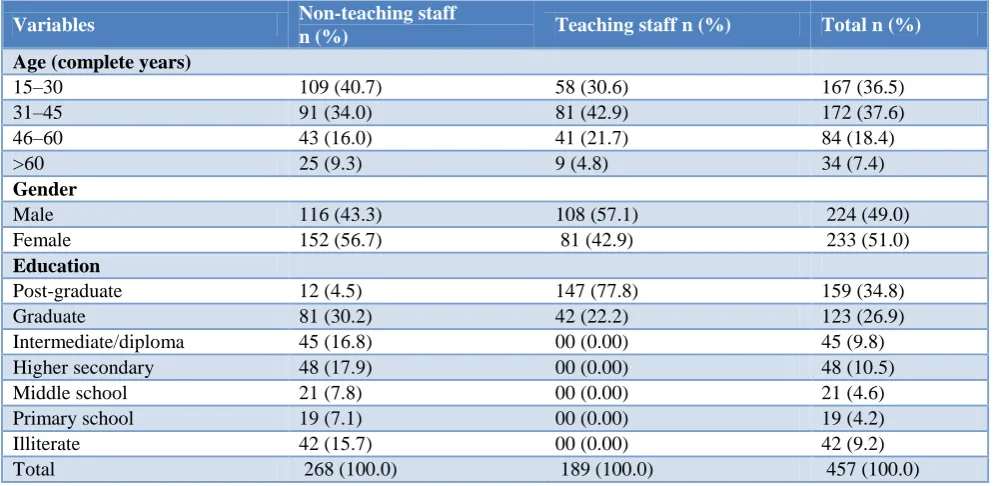
Table 1 represents socio-demographic status of 457 study subjects out of which 268 (58.6%) were non-teaching staffs and 189 (41.4%) were teaching staff who participated, at the time of survey. According to age in complete years; majority of the non-teaching staff were in age group of (15-30) years i.e. 109 (40.7%), while in teaching staff majority were in age group of (31-45) i.e. 172 (37.6%). According to gender; majority of the non-teaching staff were female 152 (56.7%) whereas in teaching staff 108 (57.1%) were males. According to the education status 81 (30.2%) of non-teaching staff were graduates followed by intermediate and diploma holders; whereas 159 (34.8%) teaching staff were post-graduates in the present study respectively.
Table 2 represents the non-teaching staff’s positive awareness about safe food; found that majority of the staff answered correctly i.e. 224 (83.6%) correctly answered that death do occur due to food borne diseases, followed by 165 (61.6%) answered that food is not always safe to eat, if it smells ok and looks good. Whereas, 215 (80.2%) correctly answered that some microorganisms were required for making food products.232 (86.6%) answered cross contamination can be avoided by separating the raw from cooked food, followed by re-heat food thoroughly is good for the health.
While, less than half of the staff i.e. 128 (47.8%) answered correctly that their home refrigerator were below 8°c, followed by 120 (44.8%) answered that they do not consumed cooked food within 6 hours, whereas; 118 (44.0%) answered that they are rinsing by tape water then wiping raw fruits and vegetable while consuming it in the study respectively.
Table 3 represents the teaching staff’s positive awareness about safe food; found that majority of the staff answered correctly i.e. 179 (94.7%) answered that death do occur due to food borne diseases, followed by 104 (55.0%) answered that food is not always safe to eat, if it smells ok and looks good. Whereas, 145 (76.7%) answered that some microorganisms were required for making food
products. While, 179 (94.7%) answered cross
contamination can be avoided by separating the raw from cooked food, followed 102 (54.0%) answered that it is not good to consume cooked food 6 hours later and 156 (82.5%) answered re-heat food thoroughly is good for the health.
Table 1: Socio-demographic status of study subjects.
Variables Non-teaching staff
n (%) Teaching staff n (%) Total n (%)
Age (complete years)
15–30 109 (40.7) 58 (30.6) 167 (36.5)
31–45 91 (34.0) 81 (42.9) 172 (37.6)
46–60 43 (16.0) 41 (21.7) 84 (18.4)
>60 25 (9.3) 9 (4.8) 34 (7.4)
Gender
Male 116 (43.3) 108 (57.1) 224 (49.0)
Female 152 (56.7) 81 (42.9) 233 (51.0)
Education
Post-graduate 12 (4.5) 147 (77.8) 159 (34.8)
Graduate 81 (30.2) 42 (22.2) 123 (26.9)
Intermediate/diploma 45 (16.8) 00 (0.00) 45 (9.8)
Higher secondary 48 (17.9) 00 (0.00) 48 (10.5)
Middle school 21 (7.8) 00 (0.00) 21 (4.6)
Primary school 19 (7.1) 00 (0.00) 19 (4.2)
Illiterate 42 (15.7) 00 (0.00) 42 (9.2)
Total 268 (100.0) 189 (100.0) 457 (100.0)
Table 2: Distribution of study subjects as non-teaching staffs for awareness about safe food.
Awareness about safe food True (%) False (%)
Is Death occur due to food borne diseases 224 (83.6) 44 (16.4)
Is food is safe to eat, if it smells ok & look good 165 (61.6) 103 (38.4)
Is some microorganism is good for making food 215 (80.2) 53 (19.8)
Is your refrigerator temperature is below 8°c 128 (47.8) 140 (52.2)
Keeping raw and cooked food separate prevent cross-contamination 232 (86.6) 36 (13.4)
Is good to consumed cooked food within 6 hours 120 (44.8) 148 (55.2)
Is re-heat food thoroughly good for health 223 (83.2) 45 (16.8)
Is wiping fruits & salads before eating is good 118 (44.0) 150 (56.0)
Table 3: Distribution of study subjects as teaching staff for awareness about safe food.
Awareness about safe food True (%) False (%)
Is death occur due to food borne diseases 179 (94.7) 10 (5.3)
Is food is safe to eat, if it smells ok & look good 104 (55.0) 85 (45.0)
Is some microorganism is good for making food 145 (76.7) 44 (23.3)
Is your refrigerator temperature is below 8°c 78 (41.3) 111 (58.7)
Keeping raw and cooked food separate prevent cross-contamination 179 (94.7) 10 (5.3)
Is good to consumed cooked food 6 hours later 102 (54.0) 87 (46.0)
Is re-heat food thoroughly good for health 156 (82.5) 33 (17.5)
Is wiping fruits & salads before eating is good 60 (31.7) 129 (68.5)
While, less than half of the staff i.e. 78 (41.3%) answered correctly that their home refrigerator were below 8°c, followed by 60 (31.7%) staff answered that they are rinsing by tape water then wiping raw fruits and vegetable while consuming it in the study respectively.
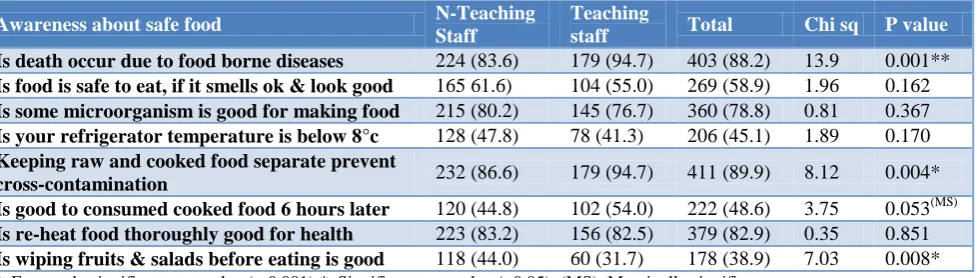
Table 4 represents the positive awareness among non-teaching and non-teaching staffs; it was found that overall awareness was higher in teaching staffs as compared to
Similarly according to positive awareness that keeping raw and cooked food separately prevents cross-contamination; 179 (94.7%) teaching staff had higher awareness compared to non-teaching staff i.e. 232 (86.6%), however after applying test of significance; it was found to be significant [chi sq- 8.12] with p=0.004.
While according to positive awareness about whether it is good to wipe fruits and salads before eating than rinse into running water; 118 (44.0%) non-teaching staff had higher awareness compared to teaching staff i.e. 60 (31.7%), however after applying test of significance; it was found to be significant [chi sq; 7.03] with p=0.008.
Table 4: Distribution of study subjects according to positive awareness about safe food among non-teaching and teaching staff.
Awareness about safe food N-Teaching
Staff
Teaching
staff Total Chi sq P value
Is death occur due to food borne diseases 224 (83.6) 179 (94.7) 403 (88.2) 13.9 0.001**
Is food is safe to eat, if it smells ok & look good 165 61.6) 104 (55.0) 269 (58.9) 1.96 0.162
Is some microorganism is good for making food 215 (80.2) 145 (76.7) 360 (78.8) 0.81 0.367
Is your refrigerator temperature is below 8°c 128 (47.8) 78 (41.3) 206 (45.1) 1.89 0.170
Keeping raw and cooked food separate prevent
cross-contamination 232 (86.6) 179 (94.7) 411 (89.9) 8.12 0.004* Is good to consumed cooked food 6 hours later 120 (44.8) 102 (54.0) 222 (48.6) 3.75 0.053(MS)
Is re-heat food thoroughly good for health 223 (83.2) 156 (82.5) 379 (82.9) 0.35 0.851
Is wiping fruits & salads before eating is good 118 (44.0) 60 (31.7) 178 (38.9) 7.03 0.008*
**: Extremely significant at p-value (< 0.001);*: Significant at p-value (<0.05); (MS): Marginally significant.
While according to positive awareness about whether it is good to consume food after 6 hours; 102 (54.0%) teaching staff had higher awareness compared to non-teaching staff i.e. 120 (44.8%), however after applying test of significance; it was found to be marginally significant [chi sq; 3.75] with p=0.053.
DISCUSSION
In general, the overall awareness was high with a mean percentage score of 60.32%. Overall Study subjects demonstrated good awareness in the categories such as 88.2% were aware that food borne diseases can cause death followed by 78.8% were aware that there are some micro-organisms which were helpful for making good food and 89.9% were aware about how they prevent cross contamination to avoiding raw and cooked food separately, whereas majority of the study subjects 82.9% were also aware about re-heat food thoroughly is good for health and more than half i.e. 58.9% were also aware about not always food is safe to eat, if it smells OK and looks good.
But, there are categories where, study subjects had less awareness such as; 45.1% subjects only knew about the refrigerator temperature and 48.6% knew that food not to consume if placed more than 6 hours. Similar study was conducted among 124 food handlers in 32 school canteens in Portugal, found that the food handlers displayed reasonable level of knowledge in personal hygiene and cross contamination, but fared worse in other areas.6
The level of awareness in our study was influenced by education of the study subjects. Similar study conducted
in tertiary care hospital of Tamil Nadu, India they found low education level influenced the knowledge of food borne diseases in their study.7 On the other hand, other studies showed that their study subjects had low level of knowledge about food hygiene issues. In a study that was performed in small and micro enterprises, to assess food handlers’ knowledge on food hygiene (n=159), in South Africa, the average percentage of correct answers was 46.0% and in another study in Ankara, Turkey, the mean food safety knowledge score of food handlers (n=764) was 43.4%±16.3%.8,9
In our study 82.9% study subjects re-heat the kept food thoroughly until food is piping out hot thoroughly; similar study from Dubai shows only 30.1 participants re-heat.10 These are crucial step to prevent cross-contamination of food.
In our study 41.1% still unaware of the fact that food which always looks good is not always safe to eaten similar study was conducted among (n=444) food handlers, employed in 104 small food businesses where 57.0% food handlers wrongly believed that they can tell by sight, smell and taste weather the food is ok or contaminated with food poisoning bacteria.11
Our study showed satisfactory knowledge 41.1% of refrigerator’s control, but there are studies with both good knowledge and lack of knowledge regarding temperature control measure to reduce the risk of food poisoning.11-13
CONCLUSION
is an urgent need of training programme for both teaching and non-teaching staff of the tertiary care centre for protecting their own self from being ill from controllable food spoiling pathogens. The results of this study may help in identifying proper and suitable methods for planning health education programs to improve their knowledge, attitudes, and practices.
ACKNOWLEDGEMENTS
This work was not been completed without a support of the non-teaching staff in the department of community medicine of the institute and all the staff currently working in the institute who gave their precious time and co-operation for Research.
Funding: No funding sources Conflict of interest: None declared
Ethical approval: The study was approved by the Institutional Ethics Committee
REFERENCES
1. World Health Organization. Food Safety. 2014. Available at: http://www.who.int/mediacentre/ factsheets/fs399/en/ Accessed on 12 February 2018. 2. World Health Organization; 2007. Food safety and
food-borne illness. Fact sheet No. 23. Available at http://wwwwho.int/mediacentre/factsheets/fs237/en/ . Accessed on 13 February 2018.
3. CDC.gov. Food Net Homepage, CDC. 2. Available
at: http://www.cdc.gov/foodnet/index.html.
Accessed on 13 February 2018.
4. Healthypeople.gov. Food Safety, Healthy People 2020. 2014. Available at: http://www.healthypeople.
gov/2020/topics-objectives/topic/food-safety/national-snapshot. Accessed on 13 February 2018.
5. World Health Day. World health day 2015 QUIZ # safe-food from farm to plate, make food safe. 2015. Available at: http://www.who.int/campaigns/ world-health-day/2015/tablemat-en.pdf. Accessed on 13 February 2018.
6. Santos MJ, Nogueira JR, Patarata L, Mayan O. Knowledge Levels of Food Handlers in Portuguese School Canteens and Their Self-Reported Behavior to-wards Food Safety. Int J Environ Health Res. 2008;18(6):387-401.
7. Anuradha M, Dandekar R. Knowledge, Attitude and Practice among food handlers on food borne diseases: A hospital based study in tertiary care hospital. Int J Biomed Adv Res. 2014;5(4):196. 8. Marais M, Conradie N, Labadarios D. Small and
Micro Enterprises—Aspects of Knowledge,
Attitudes and Practices of Managers’ Hospital, Western Cape. South African J Clin Nutr. 2007;20(2):50-61.
9. Çakiroglu FP, Uçar A. Employees’ Perception of Hygiene in the Catering Industry in Ankara (Turkey). Food Control. 2008;19(1):9-15.
10. Al Suwaidi A, Hussein H, Al Faisal W, El Sawaf E, Wasfy A. Hygienic Practices Among Food Handlers in Dubai. Int J Prevent Med Res. 2012;1(3):101-108.
11. Walker E, Pritchard C, Forsythe S. Food handler’s hygiene knowledge in small food businesses. Food Control. 2003;14(5):339-343.
12. Sharif L, Obaidat M, Al-Dalalah M. Food Hygiene Knowledge, Attitudes and Practices of the Food Han-dlers in the Military Hospitals. FNS. 2013;04(03):245-51.
13. Buccheri C, Casuccio A, Giammanco S,
Giammanco M, La Guardia M, Mammina C. Food safety in hospital: knowledge, attitudes and practices of nursing staff of two hospitals in Sicily, Italy. BMC Health Services Res. 2007;7(1):45.