Spectrum Sensing in Cognitive Radio by Statistical
Matched Wevelet Method and Matched Filter
1
Saloni,
2Pankaj Batra
1,2Dept. of Electronics and Communication, Panipat Inst. of Engg. & Tech., Panipat, Haryana, India
Abstract
Cognitive radio draw lots of research attentions in recent years for its efficient spectrum utilization. In cognitive radio networks, the first cognitive task preceding any form of dynamic spectrum management is the spectrum sensing and identification of spectrum holes in wireless environment. Spectrum Sensing is an important functionality of Cognitive Radio (CR). Accuracy and speed of estimation are the key indicators to select the appropriate spectrum sensing technique. Wideband spectrum sensing has been introduced due to the higher bandwidth demand and increasing spectrum scarcity since it provides better chance of detecting spectrum opportunity. In this project, the application of wavelet transform used for wideband spectrum opportunity detection in CRs is documented. Conventional spectrum estimation techniques which are based on Short Time Fourier Transform (STFT) suffer from familiar problems such as low frequency resolution, variance and high side lobes/leakages. In this project we used statistical method wavelet algorithm to find the spectrum holes. This is the latest technology to sense the spectrum in the cognitive radio network.. In matched filter spectrum sensing obtained by correlating a known signal with an unknown signal in order to detect the existence of the known signal or template in the unknown signal. But these spectrum sensing techniques do not give good result in case of wide bandwidth so wavelet based spectrum sensing is the only solution to sense PU in case of wide bandwidth. In this paper we introduced a new technique that is statistical matched wavelet method to sense the primary users in the wideband spectrum. And this is the latest spectrum sensing method
Keywords
Cognitive Radio, Spectrum Sensing, Wavelet Spectrum Sensing, Primary User
I. Introduction
The cognitive radio paradigm is based on the abilityof sensing the radio environment in order to make informeddecisions. This paper describes the effects of sensing on thecognitive radio channels capacity region. Sensing is modeled asa compression channel, which results in partial knowledge ofthe primary messages at the cognitive transmitter. This modelenables to impose constraints on the sensing strategy. First,the dirty paper channel capacity is derived when the channelencoder knows partially the side information. Then, the capacityarea of the Gaussian cognitive channel with partial informationis derived. Finally, numerical results illustrate the capacityreduction associated with constrained sensing, in comparison tothe capacity of the cognitive radio channel.
Nowadays users are getting engaged in the services of a number of available wireless access systems. With the development of a host of new and ever expanding wireless applications and servic-es, spectrum resources are facing huge demands. A number of new systems are capable of using the 850-5800 MHz band which is suitable for broadband wireless access systems and for cellular communications as well as the frequency bands such as the very high frequency (VHF) and ultra-high frequency (UHF) bands. It’s
very likely that in next ten years, the majority of frequency bands used for mobile communication systems will be entirely engaged and new solutions will become compulsory. So to overcome this problem use of “Cognitive Radio” technology is one possible solution which is a radio or system that uses the best wireless channels in its vicinity and is fully aware of its functioning situation and can regulate its radio operating parameters autonomously according to collaborating wireless and wired networks. Cognitive radios are also defined as “a software defined radio with a cognitive engine brain”[a]. As Most of the primary spectrum is already assigned, so it becomes very difficult to find spectrum for either new services or expanding existing services. At Presently government policies do not allow the access of licensed spectrum by unlicensed users, constraining them instead to use several heavily populated, interference-prone frequency bands. The national Institute of Information and Communications Technology (NICT), in order to realize this technology, established a project to develop enabling technologies for cognitive radio under the supervision of Ministry of Internal Affairs and Communications (MIC) in 2005. As a delegate result, software defined cognitive radio (SDCR) equipment has been developed which consists of a hardware platform (HWP) and a software platform (SWP). The HWP consists of a signal processing unit (SPU) which consists of Field-Programmable Gate Array (FPGA) and Central Processing Unit (CPU) boards, multi-band antenna support from the UHF (400 MHz) band to the 5 GHz band and a multiband RF unit (RFU) also supporting the UHF-5GHz band[1]. The SWP on the other hand, consists of numerous managers which control the spectrum sensing and reconfiguration and/or sensing for communication systems. The prototype model developed for cognitive radio is united by software and hardware platforms. It senses the signal level over the 400MHz-6GHz bands, identifies the structure of prototype by the means of software packages and also checks the connectivity.
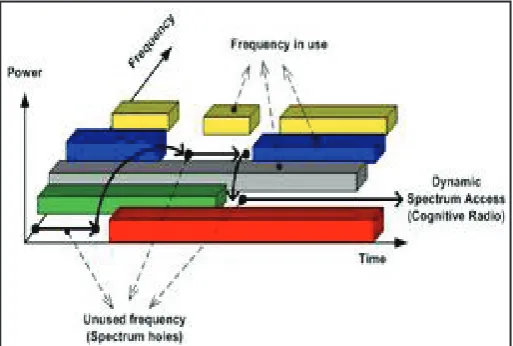
Fig. 1: Power Distribution With Respect to Frequency
quality of service which leads to the allocated spectrum being overcrowded, results in obvious degradation of user satisfaction. The licensed bands dedicated for paging, radio and televisions broadcasting, on the other hand, are wasting the allocated spectrum due to underutilization of the spectrum. Meanwhile, it results in terrific pressure on the finite radio spectrum resource. But wider band and faster rate are still pursed by communication systems and various networks for higher requirement nowadays. An interesting study conducted by FCC pointed out that more than 70% of radio spectrums are underutilized in certain times or geographic locations [1]. Nowadays users are getting engaged in the services of a number of available wireless access systems. With the development of a host of new and ever expanding wireless applications and services, spectrum resources are facing huge demands. A number of new systems are capable of using the 850-5800 MHz band which is suitable for broadband wireless access systems and for cellular communications as well as the frequency bands such as the Very High Frequency (VHF) and Ultra-High Frequency (UHF) bands. It’s very likely that in next ten years, the majority of frequency bands used for mobile communication systems will be entirely engaged and new solutions will become compulsory. To overcome the problem of this type we use “Cognitive Radio” technology that is the one possible solution which is a radio or system that uses the best wireless channels in its vicinity and is fully aware of its functioning situation and can regulate its radio operating parameters autonomously according to collaborating wired and wireless both type of system [2]. Cognitive radios are also well-defined as “a software defined radio with a cognitive engine brain”[3]. Most of the primary spectrum is previously assigned, so it becomes very difficult to find spectrum for either new services or expanding existing services. At Presently government policies do not allow the access of licensed spectrum by unlicensed users, constraining them instead to use several heavily populated, interference-prone frequency bands. The national Institute of Information and Communications Technology (NICT), in order to realize this type of technology, well-known a project to grow permitting technologies for cognitive radio under the supervision of Ministry of Internal Affairs and Communications (MIC) in 2005. As a delegate result, software defined cognitive radio (SDCR) equipment has been developed which consists of a hardware platform (HWP) and a software platform (SWP). Cognitive radio (CR), is actually dynamic spectrum utilization technology, that investigated to improve the spectrum utilization efficiency [1]. Most of spectrum sensing for the detection of spectrum holes come across low signal to noise ratio (SNR) signal detection problem. Nevertheless, non-ideal noise in which we are not able to predict the exact model of that so noise uncertainty reduces the sensing performance. So this can be overcome by use the ratio of maximum-to-mean absolute value of matched filter output[3]. When a cognitive user senses incomplete information from primary messagesthen provide the capacity area of the Gaussian cognitive channel[4]. cognitive radio, exploiting the vacant spectrum is a new way to access the spectrum. Spectrum sensing is assessing the interference temperature over the spectrum to find the unused channels. The possibility of using wavelet packet decomposition for new spectrum sensing is investigated. In which explored the spectrum sensing by using wavelets for dynamic spectrum management. Wavelet based estimation do not exceed the performance of Welch approach having good side lobe Suppression, small variance and comparable resolution with that of wavelet estimates. In the interim, the side lobe or stop band power suppressionof wavelet based estimates is analogous
with period gram. Though, wavelet estimation has lesser power variance. Still Welch approach seems stronger in this sweep source case, the number of examples needed for some be an average of might be not enoughparticularly when the duration of a snapshot is very small [5].
For fast spectrum sensing algorithm using the discrete wavelet packet transform (DWPT) and infinite impulse response (IIR) polyphase filtering schemes.That is used to overcome the problem of the conventional FFT scheme that is very slow[6]. So the spectrum sensing of spectrum holes by wavelet is very fast and simple but in previous papers wavelet was used based on discrete wavelet packet. But in this paper we uses statistical matched wavelet method to detect the spectrum holes. In statistical matched wavelet that is matched to a given signal in the statistical sense, and there are various researchers to find that the wavelets matched to a signals to give the best representation for a given signal. But this is applicable for the deterministic signal not for random signal but in statistical matched wavelet method any signal we can match with the wavelet and the signal is matched in the statistical sense. The statistically matched wavelet is designed based on the characteristics of the power quality event using the concept of fractional Brownian motion [7].
A. Spectrum Sensing
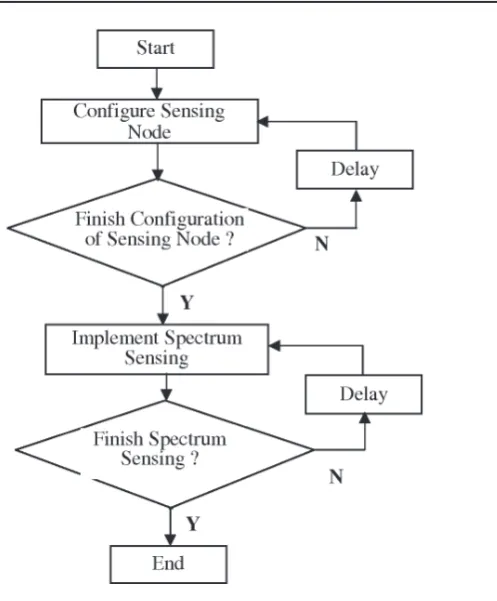
Spectrum sensing is one of the major functionalities in Cognitive Radio (CR), which allows CRs to monitor spectrum band of interest. Fast and accurate spectrum sensing technique is extensively crucial, since it provides sensing information to an intelligent spectrum management process. As a result, more efficient spectrum usage can be achieved. At the same time, existing users can maintain their communications without being interfered. Spectrum sensing should be performed first before permitting the secondary user to access the vacant licensed band as it is a key element in CR communication. Secondary users (SU) are permitted to utilize the licensed band only in the case when they do not create any type of interference for the primary users (PU). The fig. 2 [3] shows the summary of spectrum sensing concept and all the related issues (spectrum sensing techniques, types of spectrum sensing and challenges etc.
B. Multi-Dimensional Spectrum Sensing
with the help of beam forming concept.
Fig. 2: Implementation Stepes for Spectrum Sensing
In other words, another dimension can be created as an opportunity for spectral space. This angle dimension is different from the geographical space dimension; the angle dimension enables the primary and secondary user space dimension refers to the physical separation of radios in distance. It is of vital to share the same channel and to be in the same geographic area whereas the geographic important to define such an n-dimensional space for spectrum sensing. Spectrum space holes and the procedure of investigating the occupancy in all dimensions of the spectrum. The underlay spectrum sharing technique take advantage of the spread spectrum techniques which are specifically developed for cellular networks [12].
C. Detecting Spread Spectrum Primary Users
Devices which are commercially available have two types of technologies:
Fixed Frequency •
Spread Spectrum •
Spread spectrum has two further types of technologies: Frequency hopping spread spectrum (FHSS) •
Direct sequence spread spectrum (DSSS) •
An example of fixed frequency devices is IEEE 802.11a/g based WLAN and these devices function at a single frequency or channel. FHSS devices adjust their operational frequencies vigorously to multiple narrowband channels. This is called the hopping and is performed according to a sequence which is recognized by the transmitter and the receiver also. DSSS devices resemble the FHSS devices but they utilize a single band in order to spread their energy. Primary Users (PUs) which use spread spectrum signaling are hard to identify as the power of the PUs is dispersed over a broad frequency range, while the real information bandwidth is much narrower. A partial solution of this problem is that if you know the hopping pattern and method of perfect synchronization,
but it is possible but not easy to develop such an algorithm through which estimation in code dimension is possible
D. Spectrum Sensing Problem
Spectrum sensing is a key element in cognitive radio communications as it must be performed before allowing unlicensed users to access a vacant licensed band. The essence of spectrum sensing is a binary hypothesis-testing problem
H
• 0 Primary user is absent H
• 1 Primary user is present
The key metric in spectrum sensing are the probability of correct detection (Pd ) and two types of error in spectrum sensor, the first error occurs when the channel is vacant (H0) but the spectrum sensor can decide the channel is occupied, the probability of this event is the probability of false alarm (Pd), the second error when channel is occupied (H0) the spectrum sensor can decide the channel is unoccupied, the probability of this event is probability of misdetection (Pm) [3].
Pd = prob {Decision = H1 ⁄ H1} Pf = prob {Decision = H1 ⁄ H0} Pd = prob {Decision = H0 ⁄ H1}
II. Spectrum Sensing Methods and Comparison
A. Energy Detection
If the previous information of the PU signal is anonymous, then this energy detection method is optimal for detecting any zero-mean constellation signals [8]. In this energy detection approach, in order to determine whether the channel is occupied or not, the Received Signal Strength Indicator (RSSI) or Radio Frequency (RF) energy in the channel is measured. Firstly, in order to select the bandwidth of interest; the input signal is filtered by a band pass filter. After getting the square of the output signal, it is integrated over the observation interval. At the end, the output from the integrator is compared to a predetermined threshold value to conclude the presence or not of the PU signal. Specifically, the received signal Y(t) sampled in a time window are first passed through an FFT device, in order to get the power spectrum Y(f). Then the peak of this power spectrum is located and after windowing the peak of spectrum we obtain Z(f)[13].
Then the signal energy in the frequency domain is collected and the following binary decision is made. Rather than that this method can be implemented without prior knowledge of PU, it has still some drawbacks also. The first hitch is that it shows poor performance under low SNR conditions because at low
SNR noise variance is not accurately known. Another issue is about the ability to differentiate between the other secondary users which are sharing the same channel and the primary user [14]. The threshold selection is also knotty since it is highly vulnerable to the changing background noise and interference level. The binary hypotheses problem can be formulated by
Y(N) = R(N) Y(N) = S(N) + R(N)
Where N is the number of samples, N=2TW, T is duration interval, W is bandwidth, S (N) is the primary user’s signal, R(N) is the noise and Y(N) is the received signal. The noise is assumed to be additive white Gaussian noise (AWGN) with zero mean and is a random process. The signal to noise ratio is defined as the ratio of signal power to noise power.
Where Ps and N0 are the average power of signal and noise
This energy value has a central or non-central chi-square distribution. The final result is compared with threshold λ and the decision is made, the probability of detection and false alarm can be generally computed
Where Г (.,.) is the incomplete gamma function and Г (.) is the complete gamma function
Where is generalized Marcum Q-function
B. Matched Filter
A matched filter is the finest detection technique as it maximizes the signal to noise ratio (SNR) of the received signal in the existence of additive Gaussian noise [11]. It is obtained by correlating a known signal with an unknown signal in order to detect the existence of the known signal or template in the unknown signal. It is the same as convolving the unknown signal with a time-reversed version of the template. Radar transmission has common use of a matched filter but its usage in CR is limited because of little available information of Primary user signals in cognitive radio. Its usage is possible for coherent detection if partial information of PU signals is known. For example, in the case of Digital Television, to detect the presence of DTV signals, its pilot tone can be detected by passing the DTV signal through a delay- multiply circuit. Then the square of magnitude of the output signal is taken and if this square is larger than a threshold, the presence of the DTV signals can be detected.
C. Cyclostationary Detection
Man-made signals are normally not stationary but some of them are cyclostationary, showing periodicity in their statistics. This periodicity can be utilized for the detection of a random signal which has a particular modulation type in a background of noise. Such detection is cyc- called cyclostationary detection. The signal
of the PU can be detected at very low SNR values if it exhibits strong lostationary properties.
Fig. 4: Block Diagrams for Narrowband Spectrum Sensing Algorithms (a) Matched Filtering, (b) Energy Detection, (c) Cyclostationary Feature Detection.
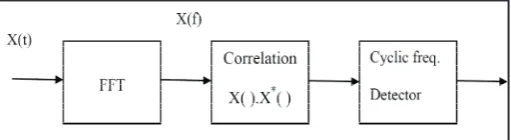
If the autocorrelation of a signal is a periodic function of time t with some period then such a signal is called cyclostationary and this cyclostationary [8].
Fig. 5: Block Diagram of Cyclostationary Method in Spectrum Sensing
D.Wavelet Based Spectrum Sensing
The wavelet approachis used for wideband spectrum sensing and it has advantages in terms of both implementation cost as well as in flexibility in adapting to the dynamic spectrum as opposed to conventional use of multiple narrowband band pass filters (BPF) [9]. Unlike the Fourier transform, using sine’s and cosines as basic functions, the wavelet transforms use irregularly shaped wavelets as basic functions and thus offer better tools to represent sharp changes and local features. In order to identify the locations of vacant frequency bands, or spectrum holes in the whole wide-band is demonstrated as a sequence of successive frequency sub bands where the power spectral characteristic is flat within each sub band but changes shortly on the border of two neighboring sub bands. By employing a wavelet transform of the power spectral density (PSD) of the observed signal x(t), the singularities of the PSD can be situated and thus the vacant frequency bands or spectrum holes can be found. But theserious challenge of implementing the wavelet approach in reality is the high sampling rates for characterizing the large bandwidth.
E. Discrete Wavelet Based Spectrum Sensing
easy and reduces the computation time and resources required. Same technique as sub-band coding was developed which was named pyramidal coding. Later these coding schemes were improvised which resulted in efficient multi-resolution analysis schemes.
1. Multi-Resolution Analysis using Filter banks
Filters are most useful signal processing functions. Realization of Wavelets is done by iteration of filters with rescaling. The determination of resolution of the signal, which is a measure of the amount of detail information in the signal, is done by the filtering operations, and the determination of scale is done by up sampling and down sampling (subsampling) operations.
The computation of DWT is done by successive lowpass and highpass filtering of the discrete time-domain signal. This is called the Mallat algorithm or Mallat-tree decomposition. Its significance is in the manner it connects the continuous-time mutiresolution to discrete-time filters. At each level, the high pass filter produces detail information, while the low pass filter associated with scaling function produces coarse approximations.
The half band filters produce signals spanning only half the frequency band at each decomposition level. As the uncertainty in frequency is reduced by half the frequency resolution is doubled. In accordance with Nyquist’s rule if the original signal has a highest frequency of ω, which requires a sampling frequency of 2ω radians, then it now has a highest frequency of ω/2 radians. It can now be sampled at a frequency of ω radians thus discarding half the samples with no loss of information. This decimation by 2 halves the time resolution as the entire signal is now represented by only half the number of samples. Thus, while the half band low pass filtering removes half of the frequencies and thus halves the resolution, the decimation by 2 doubles the scale.
In CWT, the analysis of signals are done using a set of basic functions which relate to each other by simple scaling and translation. In the case of DWT, a time-scale representation of the digital signal is obtained using digital filtering techniques. The signal to be analyzed is passed through filters with different cutoff frequencies at different scales. In discrete wavelet based spectrum sensing the whole band is divided in to sub band and it is the fast spectrum sensing algorithm for CR based that proposed two stage sensing architecture. By the use of this spectrum sensing method the problem of the conventional FFT scheme is also solved and makes spectrum sensing fast. To divide the whole spectrum band by using the IIR polyphase filtering schemes. The discrete wavelet packet transform based spectrum sensing uses only an interested frequency band that is based on the multiresolution,and the IIR polyphase filtering scheme. The main advantage of this scheme is it reduces the complexity of the discrete wavelet packet transform based spectrum sensing implementation [10].
F. Statistically Matched Wavelet
Over the last decade, a lot of work has been conceded out by various researchers to find wavelets matched to signals to provide the best representation for a given signal, but more or less, the matter of finding a matched wavelet has been gabbed for deterministic signals. And designed a wavelet matched to a signal in the time domain. The best approximation of the given signal x(t) with integer converts of a effective scaling function of some fixed support P, stretched by a given factor R, atscale Q, has been established. The approximation at resolution Q depends only on the scaling function but not depends on the corresponding wavelets. Besides this, instead of minimizing the actual distance between x(t) and
, the upper bound of error norm has been minimized. Since the minimization of norm in time domain was complex, minimization was carried out in the frequency domain by [9], assuming that the signal being analyzed is band limited. The optimality was measured with respect to minimization of frequency domain norm of the approximation error. The closed-form expression for the error norm was obtained with this constraint in the frequency domain, but it led to very complex equations that are difficult to solve.
We present a new technique for the detection of power of signal by using statistically matched wavelet. The statistically matched wavelet is designed based on the characteristics of the power quality event using the concept of fractional Brownian motion. The proposed technique is compared with Daubechies wavelet to show its superiority in the detection of power quality events [9].
1. Perfect Reconstruction Filter Banks
The input signal when decomposed into several components, where each one carries a single frequency sub band of the original signal when passed through array of band pass filters is known as filter bank. The designing of the filter bank should be such that when sub bands are recombined, it should produce the original signal. The first process is known as analysis while the latter is synthesis.The sub band coded signal with as many sub bands as the number of filters in filter bank is the output of decomposition filters.
The different frequency components in a signal are isolated by the filter bank therefore playing an important role in such applications where frequencies are more important than others. For example these important frequencies can be coded with a fine resolution. Small differences at these frequencies are significant and a coding scheme that preserves these differences must be used. On the other hand, less important frequencies do not have to be exact. A coarser coding scheme can be used, even though some of the finer details will be lost in the coding.
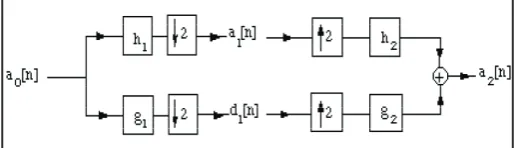
A 2-channel filter bank splits the frequency spectrum into 2 bands – one containing high frequency information and the other containing low frequency information. A 2 channel filter bank is shown in fig. 6
Fig. 6: Filter Bank
The filters h1 and g1 are the decomposition filters and the filters h2 and g2 are reconstruction filters. A two channel filter bank has the following input-output relation
In the frequency domain, this implies
2* A1(2ω)= (A0(ω)H*(ω)+A0(ω+π)H*(ω+π)) 2* D1(2ω)= A0(ω)G*(ω)+A0(ω+π)G*(ω+π)) At the reconstruction end
a2[n]= h2[m–2n]a1[m]+∑g2[m− 2n]d1[m] Which Implies
If the signal is perfectly reconstructed (a2=a1) after the decomposition and reconstruction steps, then the filter satisfies the PR property.
A2(ω)= A0(ω)
A0(ω)= 1/2 (A0(ω ) H1*(ω )+ A0(ω + π ) H1*(ω + π )) H2(ω) + 1/2 (A0 (ω)G1* (ω) + A0 (ω + π )G1* (ω + π)) G2 (ω)
Equatingcoefficients of A0(ω) and A0(ω+π) onboth sides, we get
Where Δ(ω ) = H1 (ω )G1 (ω + π ) − G1 (ω ) H1 (ω + π )
If we put the constraint that H1 =H2 =Hcf and G1 =G2 = Gcf, then the filter bank is known as a conjugate mirror filter. For a conjugate mirror filter the equations in (4) reduce to
After this we will insert the coefficient of this and we find the best representation of the signal and find the unoccupied spectrum.
Result
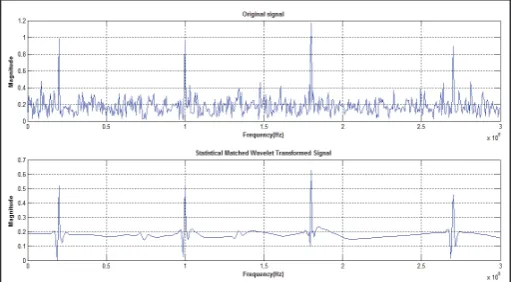
We proposed the fast spectrum sensing algorithm as a coarse sensing for CR based on the proposed two stage sensing architecture. In this project statistical matched wavelet is used to find the spectrum sensing in cognitive radio network which makes spectrum sensing fast. In cognitive radio there are secondary user can use the spectrum when primary users are not using the spectrum .These are the results given below in which the upper one is the original signal which created. And channel which have some bandwidth. Specifically, there exist 3 licensed (orprimary) users thatcan sense the interested frequency band for CR users. Weassume that each primary user’s signal is band-pass signal with some bandwidth. In addition, the channel is additivewhite Gaussian noise (AWGN) channel with zero mean and N0 / 2 variance
Case 1: Centre frequencies of 3 primary users’ signals as 0.15, 1.15 and 2.4 MHz which are shown in the figure and their magnitude are fixed as 1.1, 0.95 and 1.15 respectively that shown in the figure 7 the original signal in the channel first pass through fast fourier transform
Fig. 7: Three Primary Users and Statistical Matched Wavelet Transformed Signal
Case 2: Centre frequencies of 4 primary users’ signals as 0.2, 1.0, 1.8 and 2.7 MHz which are shown in the figure and their magnitude are fixed as 1.0, 0.95 , 1.18 and 0.9 respectively that shown in the fig. 7. The original signal in the channel first pass through fast fourier transform. Since centre frequencies that shown in the figure so the magnitude of that frequencies are greater than the others so when pass these signal to statistical matched wavelet so the result shown in the fig. 7 so by these results we can see easily which part of the spectrum in unused. The statistical matched wavelet transformed the signal in a way, that the wavelet is matched to the original signal in statistical sense
Fig. 8: Three Primary Users and Statistical Matched Wavelet Transformed Signal
Case 3: The fig. 8 given below is for the channel in which there are several primary users are using the frequency band. Centre frequencies of these primary users’ shown in the fig. 8 and their Signal to Noise Ratio (SNR) are also fixed as shown
Fig. 9: Several Primary Users and Statistical Matched Wavelet Transformed Signal
wavelet based spectrum sensing algorithm. Thesis explores various types of spectrum sensing techniques and discusses the performance of spectrum sensing techniques.
III. Conclusion
In this paper, we have proposedthe spectrum sensing in cognitive radio. And performance of statistical matched wavelet based spectrum sensing algorithm for spectrum sensing in cognitive radio. First we implemented the statistical matched wavelet transform with the help of MATLAB plate form and simultaneously we generated non periodic signal comprises of more than one frequency which is also incorporated with the additive white Gaussian noise .Each frequency describing a primary users .now with the help of statistical wavelet matched transform it is being statistically matched with the original non periodic signal comprising of noise as well. Now our aim is to reduce the noise and detect or sense the primary users and also find the unoccupied part of the channel which can be utilize by the secondary users. So that whole the channel can be efficiently utilized for communication. Hence with the help of statistical matched wavelet method the spectrum sensing in cognitive radio can be done very easily and this spectrum sensing has very good result in wideband spectrum.
References
[1] S. Haykin,"Cognitive Radio: Brain-empowered wireless communications", IEEE Journal on Selected Area in Communications 23 (5) (February 2005) pp. 201–220 [2] H. Arslan,“Cognitive Radio, Software Defined Radio, And
Adaptive Wireless Systems”, Springer, 2007.
[3] J. Mitola, G. Q. Maguire,“Cognitive radios: making software radios more personal,” IEEE Personal Commun., Vol. 6, No. 4, pp. 13-18, 1999.
[4] Chenggang Jiang, Yuanyuan Li, Wenling Bai, Yu Yang, Jinling Hu,“Statistical Matcched Filter Based Robust Spectrum Sensing in Noise Uncertainty Environment”, 2012 IEEE. [5] Lionel Gueguen, Berna Sayrac,“Sensing in Cognitive Radio
Channels: A Theoretical Perspective”, IEEE transactions on wireless communications, Vol. 8, No. 3, March 2009. [6] Sudhakar,“The Discrete Wavelet Transform” etd.lib.fsu.edu/
theses/available/etd11242003/09_ds_chapter2.pdf
[7] D.D.Ariananda, M.K.Lakshmanan, H.Nikookar,“A Study on Application of Wavelets and Filter Banks for Cognitive Radio Spectrum Estimation”, Conference on 28-29 September 2009, Rome, Italy.
[8] Sunghyun Kim, Youngwoo Yoon, Hyungsuk Jeon, Minjae Kim, Hyuckjae Lee,“Selective Discrete Wavelet Packet Trnasform-Based Energy Detector ForCognitive Radios”, 2008 IEEE.
[9] Anubha Gupta, Shiv Dutt Joshi, Surendra Prasad,“A New Approach for Estimation of Statistically Matched Wavelet”, IEEE Transactions on Signal Processing, Vol. 53, No. 5, May 2005.
[10] T. Yucek, H. Arsla,“A survey of spectrum sensing algorithms for cognitive radio applications,” IEEE Communications Surveys & Tutorials, Vol. 11, No. 1, pp. 116–130, March 2009.
[11] Sudhakar,“The Discrete Wavelet Transform” etd.lib.fsu.edu/ theses/available/etd 11242003.../09_ds_chapter 2.pdf. [12] Youngwoo Youn, Hyoungsuk Jeon, Hoiyoon Jung, Hyuckjae
Lee,“Discrete Wavelet Packet Transform based Energy Detector for Cognitive Radios”, 2007 IEEE.
[13] Anant Sahai, Shridhar Mubaraq Mishra, Rahul Tandra
“Spectrum Sensing: Fundamental Limits”, In Proc. Allerton Conf. on Communications, Control, and Computing (Monticello), Oct. 2004.
[14] Qing Zhao, Brian M. Sadler,“A Survey of Dynamic Spectrum Access”, IEEE Signal Processing Magazine May 2007. [15] ZHANG Shi-bing QIN Jin-jing,“Energy Detection Algorithm
Based on Wavelet Packet Transform under Uncertain Noise for Spectrum Sensing”, 2010 IEEE.