DIGITAL IMAGE PROCESSING
TECHNIQUES-A REVIEW
Priya K, Assistant Professor, PG Department of Computer Science, Tamil Nadu.Rasheeda Banu B, Student, PG Department of Computer Science, Tamil Nadu.
Umme Habiba T, Student, PG Department of Computer Science, Tamil Nadu.
Boosra A, Student, PG Department of Computer Science, Tamil Nadu.
ABSTRACT
In today’s scenario image processing is one of the vast growing fields. It is a method which is commonly
used to improve raw images which are received from various resources. It is a kind of signal processing. This
paper provides an overview of image processing methods. The main concern of this paper is to define various
techniques used in different phases of image processing.
Keywords: Image processing, Segmentation, Threshold, Acquisition, Enhancement.
I INTRODUCTION
Image processing is a method which is commonly used to improve raw images which are received
from various resources. It is a technique to transform an image into digital form. It is a kind of signal. It is a
dispensation where image is an input and output is also an image or features related with image. The purpose
of image processing is distributed into several groups.
Image retrieval: By image processing user can detect only that portion of the picture which is relevant to the user.
Image recognition: Image processing use mathematical procedures for processing of images.
Image sharpening and restoration: In image processing various techniques are applied on the picture to produce a better image.
II ANALOG IMAGE PROCESSING:
This processing method use electrical signals for any change required in the picture. Analog processing
includes two dimensional analog signals. In this approach images are modified by changing the electrical
III DIGITAL IMAGE PROCESSING:
In this technique processing of images are done by digital computers. Firstly via scanner-digitizer images are
converted into digital form and then further processing is done on the images. Digital image processing uses
many techniques like as correction, formatting of the data, enhance procedure to create picture with better
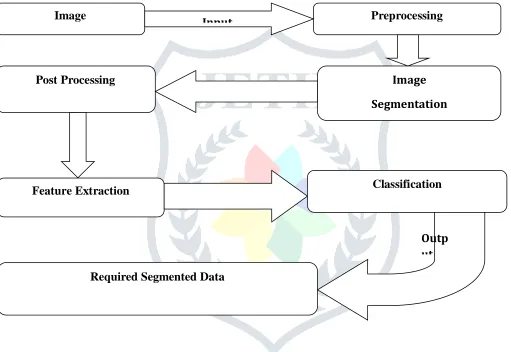
quality. Basically, there are mainly four operations used in digital image processing like as image
preprocessing, segmentation of image, feature extraction. Figure 1 shows the image processing methods to
process a required image data.
Figure 1 Image Processing Methods for Required Image Data
IV IMAGE ACQUISITION:
The first phase of every visualization scheme is the image acquisition phase. Basically, and image
acquisition is a process through which images are retrieved from various resources. The most common method
for image acquisition is real time acquisition method. This method creates a pool of files which are processed
automatically. An image acquisition method creates 3D geometric data. Image
Post Processing
Feature Extraction
Extraction
Preprocessing
Image
Segmentation
Classification
Required Segmented Data Input
V IMAGE ENHANCEMENT:
Image enhancement improves the picture displaying quality. Sometimes one picture is captured from
various resources then the quality of image is not very good due to obstacles. Image enhancement modifies
components of the pictures so that clarity of images can be increased. This technique is used for analyzing the
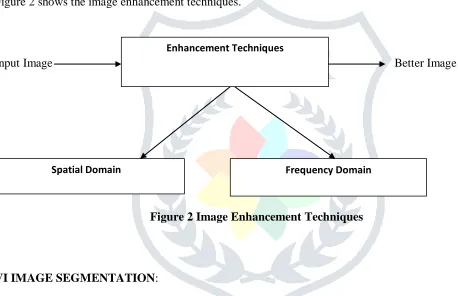
image, for feature extraction and displaying the images. There are some improvement methods namely contrast
stretching, noise filtering and histogram modification. Spatial domain techniques are work with pixels. In this
technique the values of pixels are altered in desired enhancement. It contains various techniques whose
working directly dependent on the pixels of the images. Frequency domain methods are appropriate with
images which are based on frequency mechanisms and it works on the orthogonal conversion of the image.
Figure 2 shows the image enhancement techniques.
Input Image Better Image
Figure 2 Image Enhancement Techniques
VI IMAGE SEGMENTATION:
In image segmentation, an image is divided into subparts according to the requirements of the user of
the problem. It divides the image into pixels. Image segmentation divides the image in such a way so that it
becomes very accurate. Basically this approach is used for analysis for substances, borders and additional
records processing. The outcome of image segmentation is a set of sections that together cover the total image
or group of contours removed from the image. The objective of segmentation is modifying the demonstration
of picture in such a manner that is more significant and easy to evaluate. It produces the better appearance of
image. Segmentation of images is done for compression of image, recognition of objects and for editing
purpose. For image segmentation image thresholding methods are applied. Some segmentation allocates label
to each pixel in the image, such that pixel having similar label. Enhancement Techniques
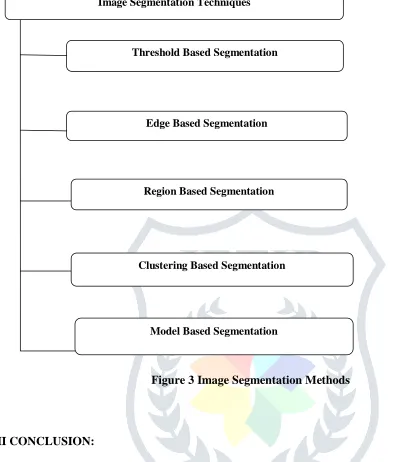
Threshold Based Segmentation:
The easiest method for segmentation is thresholding. These points are below and on upper side of the
definite threshold value. The value of the histogram is calculated by detection of edges. So threshold value is
accurate only if the detection of edges is accurate.
Edge Based Segmentation:
Another technique for segmentation is edge detection method. To recognize pixel values edges are
drawn and these edges are compared with other pixel. The edges are not closed with each other so there are
some gaps among the edges.
Region Based Segmentation:
This technique groups together certain objects used for segmentation. Region based segmentation
technique used with this method. The region must be together with each other. It is also known as similarly
based segmentation. After applying the process color and texture of the image is altered and then vector is
created from the edge flow.
Clustering Based Segmentation:
Clustering can be considered the most important unsupervised learning problem. Other kind of problem, the
clustering deals with finding a structure in a collection of unlabeled data. The clustering is a process of organizing
objects into groups whose members are similar in some way. A cluster is therefore a collection of objects which are
‘similar’ between them and are ‘dissimilar’ to the objects belonging to other clusters.
Model Based Segmentation:
Model based segmentation method is used to segment the objects from image. This method includes an initial
guess and an iterative process that modifies the initial guess. Model based segmentation framework provides the
infrastructure for fully automatic segmentation of features and their substructures in multi model images. The
Figure 3 Image Segmentation Methods
VII CONCLUSION:
Image processing is used to enhance the quality of the picture that is taken from various resources.
This paper discusses various image processing like image representation, segmentation, compression,
acquisition, image enhancement etc. These techniques are used in numerous areas. The method that we are
choosing depends upon the application area. This research can be extended to develop some more image
processing technique in future.
REFERENCE:
1. Mahmud,S.A., Mohammed, J., B., Hasan, M. S., Alzghool,M., A Survey of Digital Image Processing
Techniques in Character Recognition. IJCSNS International Journal of Computer Science and Network
Security,14(3), (2014).
2. Kaur, A. “A review paper on image segmentation and its various techniques in image processing” Image Segmentation Techniques
Threshold Based Segmentation
Edge Based Segmentation
Region Based Segmentation
Clustering Based Segmentation
3. A.A.Aly,S.b.Deris, N.Zaki, “Reserch review for digital image segmentation techniques” International
Journal of Computer Science & Information Technology 3(5), (2011).
4. Yogamangalam,R., Segmentation Techniques Comparison in Image Processing. International Journal
of Engineering and Technology (IJET), 5(1), (2013. 7. Kaganami,H.Beiji,Z. “Region based segmentation versus edge detection. Intelligent “, Information Hiding and Multimedia Signal
Processing, 1217-1221 , (2009).
5. Ma,M.T., and Manjunath,B.,S., “Edge flow: A framework of boundary detection and image
segmentation”. IEEE Trans. Image Process., .9(8), 1375–1388(2000). http://