MEDICAL EDUCATION ORIGINAL ARTICLE
30 Journal of Patan Academy of Health Sciences. 2015 July;2(1):22-24
ISSN: 2091-2749 (Print) 2091-2749 (Print) 2091-2757 (Online) 2091-2757 (Online) Correspondence
Dr. Shambhu Kumar Upadhyay Associate Professor, Department of Community Health Science Patan Academy of Health Sciences Email:
Peer Reviewed By Dr. Buddhi Poudyal
Patan Academy of Health Sciences
Peer Reviewed By Prof. Dr. Jay N Shah
Patan Academy of Health Sciences
Preparing faculty for problem-based learning
curriculum at Patan Academy of Health Sciences,
Nepal
Shambhu Kumar Upadhyay,1 Shital Bhandary,2 Satish Raj Ghimire,3 Babu Raja Maharjan,4 Ira Shrestha,5 Mili Joshi,6 Sujan Vaidya7
1
Associate Professor, 2 Assistant Professor, Department of CommunityHealth Science, 3
Assistant Professor, Department of Anatomy, 4 Assistant Professor, Department of Biochemistry, 5Assistant Professor, Department of Physiology, 6Assistant Professor, Department of Pharmacology. Patan Academy of Health Sciences. Lalutpur, Nepal 7
Associate Professor,Department of Medical Education, Kathmandu Medical College, Sinamangal, Nepal
ABSTRACT
Introduction: Patan Academy of Health Sciences (PAHS) in Nepal has adopted problem-based learning (PBL) as principal pedagogy to foster attributes predefined for its medical graduates. This study evaluates reaction of participants in PBL tutor-training program focused on PBL process and its assessment.
Methods: An orientation program was organized separately for 24 faculty members and 45 higher secondary science majoring students prior to conduction of real-time PBL tutorial sessions. Faculty’s reaction as PBL tutors was collected before and after the orientation program using a 13-item self-administered questionnaire. Internal consistency reliability of the questionnaire items and outcome of the training program were assessed using Cronbach’s alpha, coefficient of variation, Shapiro-Wilk test, paired t-test and adjusted effect size for dependent samples.
Results: The pre-test internal consistency reliability was high (0.89) whereas it was acceptable (0.69) for post-test. The average score increased from 26.50 to 34.55 and standard deviation decreased from 5.39 to 2.70 between pre- and post-test. Difference between post- and pre-tests total scores followed normal distribution and suitable parametric test (paired t-test) revealed the difference was highly significant (p< 0.0001). The adjusted effect size was high (1.65) for small dependent samples.
Conclusions: The faculty training for PBL and assessment was helpful in implementing PBL pedagogy at PAHS.
Shambhu: Preparing faculty for problem-based learning
Journal of Patan Academy of Health Sciences. 2015 July;2(1):30-34
INTRODUCTIONS
Patan Academy of Health Sciences (PAHS) has adopted innovative strategies including problem-based learning (PBL) for fostering predefined attributes1 in medical graduates. The problem based learning is principal pedagogy for six-month long introductory and two years of integrated basic sciences courses for undergraduate medical students. The PBL is helpful to instill important generic skills and behaviors: self-directed learning, good communication, team leading, critical and reflective thinking among the learners.2-5 Therefore, PAHS has incorporated the measurement of such skills and behaviors observable during PBL sessions into its summative assessment.6
Adoption and successful implementation of innovative approaches like PBL requires robust faculty development program to reduce faculty apprehension, enhance understanding and facilitation skills on PBL.7-9 The aim of this study was to evaluate the reaction of faculty on PBL tutor-training program with focus on PBL process and its assessment prior to start of the program.
METHODS
In April 2010, one day orientation program on PBL principles, process and assessment with emphasis on Tutor Assessment of Students Tool (TAS-Tool) was organized at PAHS separately for faculty as well as students prior to conducting the real-time PBL tutorial sessions. A total of 24 PAHS faculty members trained a
priori in PBL facilitation process and 45 higher
secondary science students participated in it.
A 13-item questionnaire dealing with various aspects of PBL mainly focusing on assessment was finalized by the PBL committee. It was self-administered to the participants before (pre-test) and after (post-test) the orientation program. The items were scored with 4-point forced Likert scale viz. 0 = Strongly Disagree, 1 = Disagree, 2 = Agree and 3 = Strongly Agree. The data entry and analysis was done using SPSS software version 15.0. Internal consistency reliability and outcome of the training program were assessed using Cronbach’s alpha, coefficient of variation, Shapiro-Wilk test, paired t-test and effect size.
This was followed by real-time PBL sessions: consisting of 3 tutorial sessions each of 2 hours duration, conducted in six PBL groups over a week with an alternate day between two tutorials for self-directed learning for students. Six faculty members with past PBL experience facilitated the six PBL tutorial groups
while others divided into different groups observed the PBL process silently. All 24 tutors evaluated the students attending 3 tutorial sessions in their respective groups using the TAS-Tool for its validation at PAHS PBL settings starting with the pioneer cohort of medical students.
Additional time was given to faculty for completing the PBL assessment at the end of the third tutorial session. A wrap-up session followed thereafter in an open and interactive manner amid the presence of all students, tutors, and content experts to clarify issues not resolved during group discussions.
A reflection meeting was held with faculty and students separately to share their insights and experiences. Written consent from students and verbal consent from faculty was taken.
RESULTS
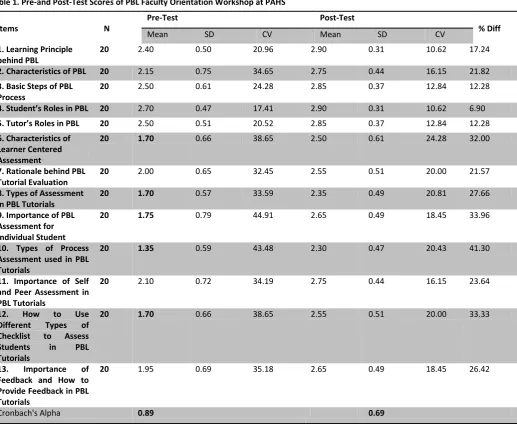
The 24 faculty members comprised of basic (9), clinical (9), community health (2) and general science (4). Twenty faculty members completed both pre- and post-test questionnaires and, thus, the analysis was based on 20 samples. Pre and post test score of PBL faculty orientation workshop is in Table 1.
Pre-test mean score was >2 for 8-items, <1.5 for “types of process assessment used in the PBL tutorials” (item 10), and 1.5-2.0 for characteristics, importance, types of assessments and checklists used in the PBL tutorial sessions (items 6, 8, 9 and 12). The coefficient of variation (CV) showing the inter-person variation of each item ranged from 44.91% for “importance of PBL assessment for individual student” (item 9) to 17.41% for role of students in PBL (item 4). The Cronbach’s alpha was 0.89. .
Post-test mean score for 12 out of 13 items were >2.5 and item 10 it was 2.0-2.5, the highest % difference in pre and post-test. The CV decrease for each item but was still high for item 6 (24.28) i.e. Characteristics of Learner Centered Assessment. The post-test internal consistency reliability or Cronbach’s alpha was 0.69. Table 2 shows summated pre- and post-test scores. The post- and pre-tests difference in total scores had normal distribution on Shapiro-Wilk test (SW = 0.985, p-value = 0.982) and paired t-test revealed highly significant difference, p<0.0001. The effect size for small dependent samples was 1.85.
Table 1 shows pre and post test score of PBL faculty orientation and table 2 shows descriptive statistics of
pre and post test score.
Shambhu: Preparing faculty for problem-based learning
Journal of Patan Academy of Health Sciences. 2015 July;2(1):30-34 Table 1. Pre-and Post-Test Scores of PBL Faculty Orientation Workshop at PAHS
DISCUSSIONS
An eight out of thirteen items had pre-test mean score >2 indicating acceptable level of prior understanding on those items among the faculties. However, most faculty were not sure about the types of process assessment used in the PBL tutorial process (with lowest pre-test mean of 1.35) despite their previous training exposure to PBL. This may be due to lack of specific focus on process assessment in past PBL trainings and workshops, thus, requiring special focus on the present PBL training program. Pre-test internal
consistency reliability was very high, Cronbach’s alpha of 0.89, which is higher than the minimum level of 0.70 suggesting positive correlations among the questionnaire items. However, CV showing inter-person variation of each item revealed highest variation for item 9 (44.91) i.e. importance of PBL assessment for individual students and lowest for item 4 (17.41) i.e. role of students in PBL suggesting the need for more focused training on certain aspects and
Items
N
Pre-Test Post-Test
% Diff
Mean SD CV Mean SD CV
1. Learning Principle behind PBL
20 2.40 0.50 20.96 2.90 0.31 10.62 17.24
2. Characteristics of PBL 20 2.15 0.75 34.65 2.75 0.44 16.15 21.82
3. Basic Steps of PBL Process
20 2.50 0.61 24.28 2.85 0.37 12.84 12.28
4. Student’s Roles in PBL 20 2.70 0.47 17.41 2.90 0.31 10.62 6.90
5. Tutor’s Roles in PBL 20 2.50 0.51 20.52 2.85 0.37 12.84 12.28
6. Characteristics of Learner Centered Assessment
20 1.70 0.66 38.65 2.50 0.61 24.28 32.00
7. Rationale behind PBL TutorialEvaluation
20 2.00 0.65 32.45 2.55 0.51 20.00 21.57
8. Types of Assessment in PBL Tutorials
20 1.70 0.57 33.59 2.35 0.49 20.81 27.66
9. Importance of PBL Assessment for Individual Student
20 1.75 0.79 44.91 2.65 0.49 18.45 33.96
10. Types of Process Assessment used in PBL Tutorials
20 1.35 0.59 43.48 2.30 0.47 20.43 41.30
11. Importance of Self and Peer Assessment in PBL Tutorials
20 2.10 0.72 34.19 2.75 0.44 16.15 23.64
12. How to Use Different Types of Checklist to Assess Students in PBL Tutorials
20 1.70 0.66 38.65 2.55 0.51 20.00 33.33
13. Importance of Feedback and How to Provide Feedback in PBL Tutorials
20 1.95 0.69 35.18 2.65 0.49 18.45 26.42
Cronbach's Alpha 0.89 0.69
Table 2. Descriptive statistics of summated pre- and post-test scores, PAHS, 2010
Mean N Standard Deviation Standard Error of Mean
P value Effect size
Score Post Test 34.55 20 2.70 0.61 < 0.0001 1.85
Pre-Test Total
26.50 20 5.39 1.20
Shambhu: Preparing faculty for problem-based learning
Journal of Patan Academy of Health Sciences. 2015 July;2(1):30-34
the training program was modified accordingly, as suggested by other researcers.10
Post-test mean scores were >2.5 for 12 out 13 items suggesting training program was effective. However, faculties were not able to understand fully about the types of process assessment used in the PBL tutorial process (item 10) as the score was still between 2.0 and 2.5. This could be because of the training program placing higher emphasis on the tutor assessment of students as compared to other types of process assessment namely self-assessment of students and peer assessment of students done by the students. Post-test internal consistency reliability decreased to 0.69 but this was in the acceptable range (~ 0.7).11 The main reason for this decrement was the homogenous scoring by the faculty in one or more items in the post-test.
Post-test results showed positive % difference from pre- and post-test scores among all the items scored by faculties. However, item 10, 9 and 12 showed the highest, second highest and third highest % difference respectively (41.30; 33.96; 33.33). This was because the inherent purpose of this training workshop was to validate the TAS-Tool6 for use at PAHS starting with the pioneer cohort of undergraduate medical students. Training faculties with hands-on PBL sessions has positive influence to assume the role of assessors.12,13 Further, knowledge on various aspects of PBL was normalized among the trainees as the coefficient of variation on each items were reduced significantly between pre- and post-tests.
The increase in pre- and post-test average score from 26.50 to 34.55 and decrease in standard deviation indicates the reduction in the variation of knowledge on PBL and PBL process assessment among the faculties. Most importantly, the highly significant result with p< 0.0001 indicates the difference between pre- and post-test scores was not by chance. Even though the sample size was small, the effect size for dependent samples was >1.3, meaning the difference was real.14 In other words, the post-test score was significantly higher than the pre-test scores indicating the success of the intervention program among 20 faculty members involved.
Studies done in other settings were suggestive of similar findings of such workshops positively influencing faculty understanding and appreciation of PBL, its philosophy and rationale, basic steps and groups dynamics, greater understanding of students’
role in PBL, inculcation of new competencies including that of facilitators and assessors required for implementing PBL-based curriculum.15,16,17,18 The results of this training program were, thus, indicative of being helpful in preparing faculties for implementing PBL at PAHS. However, it will be crucial for institution like PAHS, which is embarking on implementing an innovative curriculum, to give high emphasis on faculty development program including PBL trainings to help the staff members understand teaching-learning practices aligned with its adopted pedagogic strategies as emphasized by studies.19,20
Reflection and feedback session with faculty showed that they have gathered hands-on experiences on PBL and were more confident in facilitating and assessing PBL tutorials as shown by similar study done in Nepal.18 Likewise most students expressed that they found PBL process a participatory, interactive, and allowing their role in setting the target and achieving them together.
Small number of faculties, voluntary participation and non-implicative tutorial assessment of students were some of the limitations of this study. Hence, the impact of such training program regarding the lasting change in participation level, effective facilitation and assessment skills of faculties in actual PBL sessions with PAHS’ own medical students needs to be evaluated with larger number of faculties.
CONCLUSIONS
The faculty training for PBL and assessment adopted at PAHS was helpful to the staff members in implementing PBL pedagogy at PAHS.
REFERENCES
1. Morgan JHC. Designing an assessment tool for professional attributes of medical graduates from a new medical school in Nepal. South-East Asian Journal of Medical Education. 2009;3(1):2-7.
2. Wood DF. Problem based learning. BMJ. 2003;326(7384):328-30.
3. Schmidt HG, Vermeulen L, Van Der Molen HT. Longterm effects of problem‐based learning: a comparison of
competencies acquired by graduates of a problem‐based and a conventional medical school. Medical Education.
2006;40(6):562-7.
4. Tiwari A, Lai P, So M, Yuen K. A comparison of the effect of Problem Based Learning and lecturing on the development of students’ critical thinking. Med Education. 2006;40(6):547-54. 5. Koh GCH, Khoo HE, Wong ML, Koh D. The effects of
problem-based learning during medical school on physician competency: a systematic review. Canadian Medical Association Journal. 2008;178(1):34-41.
Shambhu: Preparing faculty for problem-based learning
Journal of Patan Academy of Health Sciences. 2015 July;2(1):30-34 6. Upadhyay SK, Bhandary S, Ghimire SR. Validating a
problem-based learning process assessment tool. Medical Education. 2011;45(11):1151-2.
7. Barrows HS, Peters MJ, editors. In: Al-Shawwa LA. Preparing
faculty members as PBL tutors in King Abdul Aziz University, Jeddha Saudi Arabia. Medical Journal Cairo University. 2011;79(1):185-19.
8. Holmes DB, Kaufman DM. Tutoring in problem‐based learning: a teacher development process. Medical Education. 1994 Jul 1;28(4):275-83
.
9. Farmer EA. Faculty development for problem-based learning. Eur J Dent Educ. 2004 May;8(2):59-66.
10. Kaufman and Holmes. In: Farmer E.A. Faculty development for problem-based learning. European Journal of Dental Education. 2004; 8:59-66
11. Downing SM. Reliability: on the reproducibility of assessment
data. Med Educ. 2004 Sep;38(9):1006-12.
12. Dalrymple KR, Wong S, Rosenblum A, Wuenschell C, Paine M, Shuler CF. PBL Core Skills Faculty Development Workshop 3: understanding PBL process assessment and feedback via scenario-based discussions, observation, and role-play. J Dent Educ. 2007 Dec;71(12):1561-73.
13. Steinert Y, Mann K, Centeno A, Dolmans D, Spencer J, Gelula M, Prideaux D. A systematic review of faculty development initiatives designed to improve teaching effectiveness in medical education: BEME Guide No. 8. Med Teacher. 2006;28(6):497-526.
14. Field A. Discovering statistics using SPSS. 3rd ed. London: Sage Publication; 2009.
15. Musal B, Abacioglu H, Dicle O, Akalin E, Sarioglu S, Esen A. Faculty development programs in Dokuz Eylül School of Medicine: In the process of curriculum change from traditional to PBL. Medical Education Online. 2002;7(2). 16. McLean M. What can we learn from facilitator and student
perceptions of facilitation skills and roles in the first year of a problem-based learning curriculum? BMC Med Educ. 2003 Oct 30;3:9.
17. Pandya H, Ghosh S. Sensitizing faculty to problem-oriented
approach as an instructional method: experience of a brief faculty development workshop. The National Medical Journal of India. 2008;21(5):243-5.
18. Baral N, Paudel BH, Das BK, Aryal M, Gautam A, Lamsal M. Preparing tutors for problem-based learning: an experience from B. P. Koirala Institute of Health Sciences, Nepal. Kathmandu Univ Med J. 2010;8(29):141-5.
19. Rubeck RF, Witzke DB. Faculty development: a field of dreams. Acad Med. 1998 Sep;73(9 Suppl):S32-7.
20. Barrows HS, Peters MJ, editors. In: Pandya H, Ghosh
Sarmishtha. Sensitizing faculty to problem-oriented approach as an instructional method: experience of a brief faculty development workshop. The National Medical Journal of India. 2008;21(5).