Author for Correspondence:
Research Article
ISSN: - 2306 – 6091
Available Online at: www.ijphr.com
An African Edge Journal
SJ Impact Factor
–
5.546
DEVELOPMENT AND VALIDATION OF UV-SPECTROSCOPIC METHOD
FOR THE ESTIMATION OF NORTRIPTYLINE HYDROCHLORIDE
IN BULK AND IN TABLET DOSAGE FORM
*K Anandakumar, S Vanitha, KM Swarna bharathi, S Sudha, VP Sangeetha,
M Jambulingam, J Ramesh
Department of Pharmaceutical Analysis, Swamy Vivekanandha College of Pharmacy
Tiruchengode- 63720, Namakkal District, Tamil Nadu, India.
Affiliated to: The Tamilnadu DR M.G.R. Medical University, Chennai, TN, India
___________________________________________________________________________
Abstract
The aim of this work was to develop and validate a simple estimation method for Nortriptyline hydrochloride in bulk and in tablet dosage form using UV Spectroscopic method. The method was developed using distilled water as a solvent and absorbance was measured at 239 nm. Beers law was obeyed the concentration range of 2 – 24 µg/ ml. Calibration curve shows a linear relationship between the absorbance and concentration. The line equation y = 0.04513x + 0.00447 with correlation coefficient (r) of 0.9996 was obtained. The method was validated as per ICH guidelines. The method was validated statistically and by recovery studies. The percentage recovery was found to be in the range between 98.00 and 102.98%. The % RSD value was found to be less than 2. A simple, accurate and cost efficient spectrophotometric method has been developed for the estimation of Nortriptyline hydrochloride in bulk and in tablet dosage form.
Keywords:
Nortriptyline hydrochloride; distilled water; UV determination; Validation._________________________________________________________________________________________
Received on- 06.02.2018; Revised and accepted on- 17.02.2018; Available online- 22.02.2018
Introduction
Nortriptyline hydrochloride is 3-(10, 11-Dihydro 5H-dibenzo [a, d] cyclohepten-5-ylidene propyl (methyl) amine hydrochloride were shown in Fig 1.
. HCl
Fig. No. 01: Chemical structure of Nortriptyline Hydrochloride
Nortriptyline hydrochloride is an anti-depressant drug. It is a white or almost white powder and is sparingly soluble in water, sparingly soluble in ethanol (90%) and in methylene chloride [1]. Nortriptyline hydrochloride was block the reuptake of both nor adrenaline and serotonin into the pre synaptic terminals by binding to the transporters, viz. serotonin transporter (SERT) and norephidrin transporter (NET). The synaptic levels of this mono amine increased and there by prolong the action on the receptor. This Nortriptyline hydrochloride potentiates amine, neurotransmitter in the CNS [2, 3]. Nortriptyline hydrochloride is the main active metabolite of Amitriptyline. It has been reported to
International Journal of
Pharmaceuticals and
Health care Research
NH
have a longer plasma half-life than Amitriptyline. Nortriptyline hydrochloride is subject to extensive first-pass metabolism in the liver to 10-hydroxy Nortriptyline, which is active.
Extensive literature survey revealed that only UV spectroscopy [4-7] and PR-HPLC [8-10] methods were reported for the estimation of Nortriptyline hydrochloride in combination with other drug but there is no method was reported for the estimation of Nortriptyline hydrochloride in bulk and in formulation by UV spectrophotometry. A few HPLC [11, 12]
and LC/MS/MS [13, 14] method were also developed for the determination of Nortriptyline hydrochloride. So, an attempt was made to develop simple, cost effective and accurate UV spectrophotometric method for the estimation of Nortriptyline hydrochloride in bulk and in tablet formulation and to validate the developed method.
Materials and methods
Nortriptyline hydrochloride standard drug substance was obtained as a gift sample from Alkem Laboratory, Mumbai.
Instrumentation
Instruments employed for the study were, SHIMADZU BL - 220 H digital balance PERKIN ELMER UV spectrophotometer
Selectionofsolvent
Different solvents such as distilled water, methanol, ethanol, toluene, acetic acid, isopropyl alcohol, N-butanol, carbon tetrachloride, benzene, hexane, ethyl alcohol, acetonitrile, chloroform, diethyl ether and acetone were tried for the estimation of Nortriptyline hydrochloride in tablet dosage form. Maximum sensitivity was found with distilled water. Hence, distilled water was selected as a solvent for the analysis of Nortriptyline hydrochloride.
Preparationofstandardstocksolution
100 mg of Nortriptyline hydrochloride raw material was accurately weighed and transferred into 100 ml volumetric flask and dissolved in minimum quantity of distilled water and made up to the volume 100 ml with distilled water. 1 ml of stock solution was transferred into 100 ml and made up to 100 ml volumetric flask dilute with distilled water. This solution was observed to contain 8 µg/ ml concentration.
Selection of wavelength for estimation and stabilitystudies
The concentration solution of 10 µg/ ml was scanned between the ranges of 200 - 400 nm using distilled water as blank. From the spectra, λmax was found to be 239 nm and was selected as analytical wavelength. The UV Spectrum of Lamivudine was shown in Fig 2.
200.0 210 220 230 240 250 260 270 280 290 300.0
0.00 0.2 0.4 0.6 0.8 1.0 1.2 1.4 1.6 1.8 2.03
nm A
Stability was performed by measuring the same solution in different time intervals. It was observed that Nortriptyline hydrochloride in distilled water was stable up to 24 hours at the selected wavelength.
Preparationofcalibrationgraph
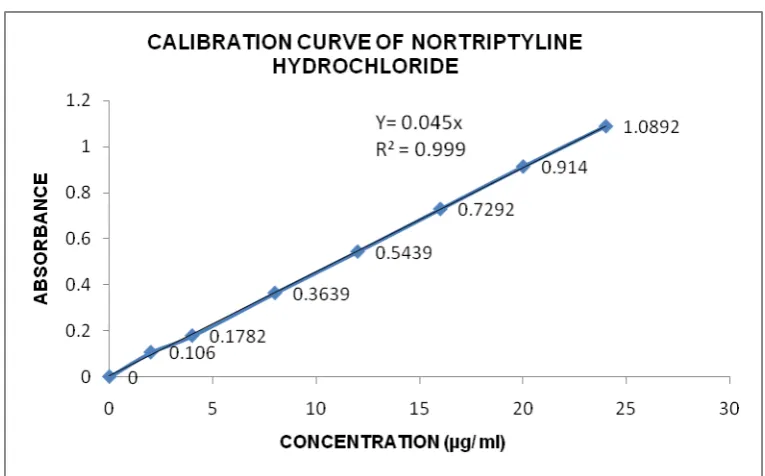
In this method, 1-6 ml of the aliquots of stock solution of Nortriptyline hydrochloride containing 400 µg/ ml were transferred into a series of eight 100 ml volumetric flasks (2-24 µg/ ml.) and made up to the volume with distilled water. The absorbance of different concentration solutions were measured at 239 nm against blank. The samples were found to be linear with the concentration range of 2 – 24 µg/ ml at 239 nm. The calibration curve was constructed by plotting concentration against absorbance. The curve obtained was linear with the concentration range of 2 – 24 µg/ ml.
Quantificationofrawmaterial
2 ml of standard solution (400 µ g/ ml) was taken into a series of six 100 ml volumetric flasks and the volume was made up to mark with distilled water. The absorbance of these solutions was measured at 239 nm. The amount of Nortriptyline hydrochloride present in the raw material was determined by using slope and intercept values from calibration graph.
Quantification offormulation
Ten tablets of formulation (NORTIMER containing 25 mg of Nortriptyline hydrochloride) was accurately weighed to find out the average weight and powdered. The tablet powder equivalent to 40mg of Nortriptyline hydrochloride was weighed and transferred into 100 ml volumetric flask. Added distilled water to dissolve the substance and the solution was solicited for 10 minutes. Then it was made up to the volume to 100 ml with distilled water and centrifuged for 15 minutes. The supernatant liquid was filtered through Whatmann filter paper No. 41. From the clear solution 2 ml was pipette out into a series of six 100 ml volumetric flasks and made up to the mark with distilled water to get the concentration of 8 µg/ ml of Nortriptyline hydrochloride, theoretically. The absorbances of six replicates were measured at 239 nm and the amount of Nortriptyline hydrochloride present in formulation
was calculated by using regression equation. This procedure was repeated for six times. The percentage label claim of Nortriptyline hydrochloride present in each tablet formulation was found to be 100.44% ± 0.1584%. The % RSD value was found to be 0.1578 indicates that the method has good precision.
Recovery studies
The recovery experiment was done by adding known concentrations of Nortriptyline hydrochloride raw material to the pre analyzed formulation. 40 mg equivalent of Nortriptyline hydrochloride formulation was taken into a series of six 100 ml standard flasks. To that 0.8 ml, 1 ml and 1.2 ml of raw material stock solution (40 µg/ ml) were added into series each six 100ml volumetric flasks. Dissolved and made up to the volume with distilled water. The solutions were sonicated for 10 minutes. After sonication, the solution was centrifuged at 100 rpm for 15 minutes. The solutions were filtered through Whatmann filter paper No. 41. From each series, 2 ml of the clear filtrate was transferred into a series of six 100 ml standard flasks and made up to volume with distilled water. The absorbances of the resulting solutions were measured at 239 nm against blank and the amount of drug recovered from the formulation was calculated by using slope and intercept values. The procedure was repeated for three times for each concentration. Validation of developed UV Spectrophotometric method
Linearityandrange
A calibration curve was plotted between concentration and absorbance. Nortriptyline hydrochloride was linear with the concentration range of 2 - 24 g / ml at 239 nm.
Precision
Accuracy (Recovery studies)
It means the concordance between it and true or most probable value. Accuracy of the method was confirmed by recovery studies. To the pre analyzed formulation, a known quantity of raw material of Nortriptyline hydrochloride was added and the procedure was followed as per the analysis of formulation. The amount of each drug recovered was calculated. This procedure was repeated for six times for each concentration.
LODandLOQ
The LOD and LOQ were estimated from the set of 6 calibration curves used to determine method linearity. LOD=3.3σ/ S and LOQ=10σ/ S Where, σ = the standard deviation of y-intercepts of regression lines
S = the slope of the calibration curve
Ruggedness
The extent to which intermediate precision should be established depends on the circumstances under which the procedure is intended to be used. The applicant should establish the effects of random events on the precision of the analytical procedure.
Typical variations to be studied include days, analysts, equipment, etc. It is not considered necessary to study these effects individually. The use of an experimental design (matrix) is encouraged.
Robustness
The robustness of an analytical procedure is a measure of its capacity to remain unaffected by small, but deliberate variation in method parameters and provides an indication of its reliability during normal usage.
Results and Discussion
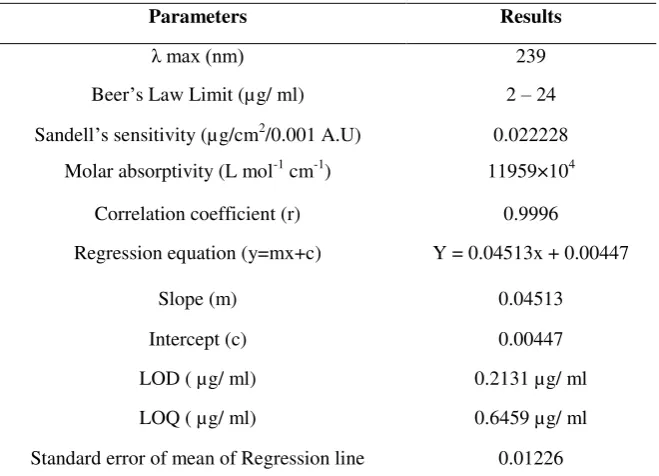
LinearityThe linearity of Nortriptyline hydrochloride was found to be in the range of 2 - 24 µg/ ml at 239 nm with correlation coefficient 0.9996. Calibration curve is shown in Fig.3. Optical characteristics were shown in Table 1. The Correlation coefficient value indicates the method was found to be linear.
Table No. 01:OpticalcharacteristicsofNortriptyline Hydrochloride
Parameters Results
λ max (nm) 239
Beer’s Law Limit (µg/ ml) 2 – 24
Sandell’s sensitivity (µg/cm2
/0.001 A.U) 0.022228
Molar absorptivity (L mol-1 cm-1) 11959×104
Correlation coefficient (r) 0.9996
Regression equation (y=mx+c) Y = 0.04513x + 0.00447
Slope (m) 0.04513
Intercept (c) 0.00447
LOD ( µg/ ml) 0.2131 µg/ ml
LOQ ( µg/ ml) 0.6459 µg/ ml
Standard error of mean of Regression line 0.01226
Precision
The percentage of Nortriptyline hydrochloride present in the raw material solution was found to be 100.76% ± 1.8740 were shown in Table 2.
Table No. 02: Quantification of raw material by UV Spectroscopic Method S.No Concentration
(µg/ ml)
Absorbance Amount found
(µg)
Percentage recovery*
Average *(%)
S.D %RSD
1 8 0.3618 7.9184 98.96
2 8 0.3741 8.1992 102.39
3 8 0.3707 8.1265 101.45 100.76 1.8740 1.8597
4 8 0.3580 7.8397 97.92
5 8 0.3740 8.1876 102.35
6 8 0.3710 8.1253 101.53
*Mean of six observations
The percentage label claim present in the tablet formulation NORTIMER was found to be 100.44% ± 0.1584 of Nortriptyline hydrochloride. The
Table No. 03: Quantification of formulation by UV Spectroscopic Method S.No Formulation Expected
amount (µg/ ml)
Amount found (µg/ ml)
Percentage obtained (%)
Average (%)
S.D %
RSD
1 8 8.0765 100.92
2 8 8.0277 100.21
3 NORTIMER 8 8.0965 100.57 100.44 0.1584 0.1578
4 8 8.0665 100.71
5 8 8.0354 99.72
6 8 8.0577 100.55
*Mean of six observations
Precision of the method was confirmed by intraday and inter day analysis. The percentage RSD value of the intraday and inter day analysis of Nortriptyline hydrochloride was found to be
1.2025 % and 1.3426 %, respectively were shown in Table 4. The low % RSD values indicated that the method was found to be precise.
Table No. 04: Intra day and Inter day analysis of formulation- UV Spectroscopic Method
S.No Concentration (µg/ ml)
Percentage obtained* S.D %RSD
INTRA DAY
INTER DAY
INTRA DAY
INTER DAY
INTRA DAY
INTER DAY
1 2 98.59 98.46
1.2022 1.3316 1.2025 1.3426
2 2 100.79 98.37
3 2 100.53 100.72
Mean 99.97 99.81 *Mean of six observations
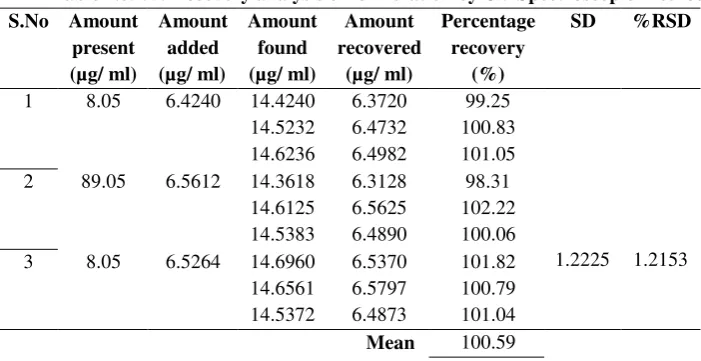
Table No. 05: Recovery analysis of formulation by UV Spectroscopic Method S.No Amount
present (µg/ ml)
Amount added (µg/ ml)
Amount found (µg/ ml)
Amount recovered
(µg/ ml)
Percentage recovery
(%)
SD %RSD
1 8.05 6.4240 14.4240 14.5232 14.6236
6.3720 6.4732 6.4982
99.25 100.83 101.05
1.2225 1.2153 2 89.05 6.5612 14.3618
14.6125 14.5383
6.3128 6.5625 6.4890
98.31 102.22 100.06 3 8.05 6.5264 14.6960
14.6561 14.5372
6.5370 6.5797 6.4873
Accuracy
Accuracy of the method was confirmed by recovery study from marketed formulation at three levels of standard addition viz., 80%, 100% and 120%. The percentage recovery for Nortriptyline hydrochloride was found to 1.2153% was shown in Table 5. This indicates that there is no interference due to the excipients used in formulation. Hence the method was found to accurate.
Limit of detection and limit of quantification LOD and LOQ were found to be 0.2131 µg/ ml and 0.6459 µg/ ml, respectively were shown in Table 1.
Ruggedness
The ruggedness of the method was confirmed by the analysis of formulation was done by using different analysts. The %RSD was found to be 0.8873, 0.7088 and 0.4060 were shown in Table 6.
Table No. 06: Ruggedness
S.No Category % Label claim SD %RSD
1 ANALYST I 99.48 0.8827 0.8873
2 ANALYST II 99.64 0.7062 0.7088
3 ANALYST III 100.03 0.4062 0.4060
*Mean of six observations
Robustness
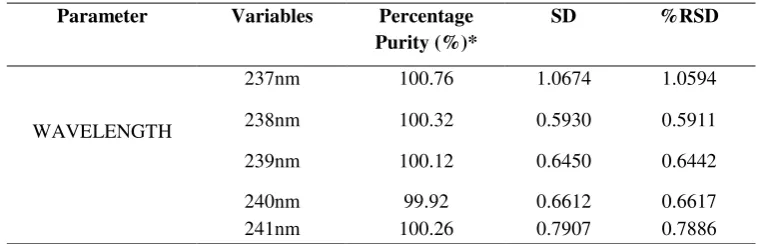
The robustness of the method was confirmed by a small deliberate change in the analytical wavelength. The wavelength change applied as ±2 nm. At the selected variable wavelength, the
amount of formulation was found. The % RSD was found to be 1.0594, 0.5911, 0.6442, 0.6617 and 0.7886 to variables of 1, 2, 3, 4 and 5, respectively were shown in Table 7.
Table No. 07: Robustness Parameter Variables Percentage
Purity (%)*
SD %RSD
WAVELENGTH
237nm 100.76 1.0674 1.0594
238nm 100.32 0.5930 0.5911
239nm 100.12 0.6450 0.6442
240nm 99.92 0.6612 0.6617
241nm 100.26 0.7907 0.7886
*Mean of six observations
Conclusion
The proposed method for the determination of Nortriptyline hydrochloride in solid dosage form was found to be precise, selective, rapid and economical. Nortriptyline hydrochloride exhibited maximum absorption at 239 nm and obeyed Beer’s law in the concentration range of 2 - 24 µg/ ml. The proposed method for the determination of Nortriptyline hydrochloride showed linear regression Y = 0.04513x + 0.00447 with correlation coefficient (R2) of 0.9996. The percentage RSD for analysis of formulation was found to be within the limit. Our studies revealed a
recovery percentage of 98.00 – 102.98%, which indicates that the developed method was found to be accurate. The proposed methods can be used for the drug analysis in routine quality control analysis of Nortriptyline hydrochloride in bulk and in tablet dosage form.
Acknowledgement
Reference
1. The Indian Pharmacopoeia Volume I and II.
The Controller of publication, New Delhi, 1996, 2014 7, A144-A145.
2. Martindale’s the Drugs reference, 444-445. 3. Merck Index. 1964, 6718.
4. Moreno Ballesteros MP, Frutos P, Lasts JL, Castro D. Comparison of UV Spectrophotometric and LC methods for the determination of Nortriptyline hydrochloride in polysorbate 80 based oil/ water microencapsulation. Indian Journal of pharmaceutical Research. 22(2), 2000, 287-294.
5. Amole A Kulkarni, Abhishek Satbhai, Snehalraut, Sarang D Kulkarni. UV Spectrophotometric estimation of Citalopram and Nortriptyline hydrochloride pharmaceutical dosage form. International Journal of Pharmacy & Pharmaceutical Research. 4(4), 2015, 104-111.
6. Safwan Ashourn, Nuha Kattaa. Simultaneous determination of Nortriptyline hydrochloride and Fluphenazine hydrochloride in microgram quantities from low dosage form by liquid chromatography-UV detection. Journal of Pharmaceutical Analysis, 2012, 438-443. 7. Yogesh Patel, Mandev B patel, Nishith K
patel. Development and Validation of Analytical UV method for simultaneous estimation of Gabapentine and Nortriptyline hydrochloride in pharmaceutical dosage form. Journal of pharmaceutical science & Bio scientific research, 2015, 432-443.
8. Naveen Kumar M Sai, Malakondaiah D, Usha Sree G, Ajitha A. Development & validation of stability indicating RP-HPLC method for simultaneous determination of Gabapentin and Nortriptyline hydrochloride in pharmaceutical dosage from. International Journal of
pharmaceutical research & analysis, 5(1), 2015, 13-17.
9. Sreenivasulu BV, Sivaramakrishna V, Ramababu C. Development of validation of new RP-HPLC method for simultaneous determination of Nortriptyline hydrochloride and Gabapentin in combined dosage form. American Journal of pharmacy, 3(4), 2015, 2321-3647
10. Srihari Konda, Shanta Kumari. Development and Validation of RP-HPLC method for simultaneous estimation of Gabapentin and Nortriptyline hydrochloride in bulk and combined dosage form. World journal of pharmaceutical research. 4(10), 2015, 1971-1981
11. Bhumi Patel. Assay of four psychotropic drug Chlorpromazine, Clomipramine, Amitriptyline and Nortriptyline hydrochloride in tablet by A single HPLC method. International Journal of pharmacy & pharmaceutical science, 8(8), 2016, 182-188.
12. Gupta M, Jain A, Verma KK. Determination of Amoxapine and Nortriptyline hydrochloride in drug plasma and serum by salt-assisted liquid-liquid micro extraction and HPLC. Journal of Separation Science. 23(29), 2010, 3774-3780. 13. Berm EJJ. A Simple blood spot method for
therapeutic drug monitoring of the Tricyclic antidepressant Amitriptyline, Nortriptyline hydrochloride, Imipramine, Clomipramine and their active metabolites using LC-MS/MS. 134, 2015, 165-172.
14. Bonke G, Jensen BP. Fast and sensitive LC-MS/MS assay for quantification of Nortriptyline hydrochloride and its active metabolites E and Z-10 hydroxy Nortriptyline hydrochloride in human plasma. Bioanalysis, 127(1-3), 2010, 266-273.