Page 170 www.ijiras.com | Email: [email protected]
Influence Of Availability Of Resources On Completion Of
Construction Projects In Public Secondary Schools In Bungoma
County, Kenya
Josephine N. Ojiambo
PhD Candidate, University of Nairobi, Kenya
Prof Charles M. Rambo University of Nairobi, Kenya
Stephen Wekesa Masinde PhD student, UNICAF, USA
I. INTRODUCTION
In a global perspective, the construction industry has not been efficient and effective in projects delivery. United Kingdom (UK) in 2010 statistics showed that 52% of projects had cost overruns in excess of 10% while 45% of projects had
time overruns of over 25% Mbathi (1986), as cited in Atkinson (1999). Mbathi (1986) further indicated that similar studies carried out in India showed that 56% of projects had cost overruns in excess of 20% while 49% had time overruns in excess of between 1 and 160 months. However, causes of delays have been identified in various parts of the world Abstract: The paper aimed to determine influence of availability of resources on completion of construction projects in public secondary schools in Bungoma County, Kenya, informed by construction management and soft value management theories. The study employed purposive sampling technique in choosing 461study respondents (Principals and Chairpersons of Parents Teachers Association) who were purposively sampled to ensure homogeneity of the selected sample in ensuring that samples are drawn from each region encompassed in the target population, then followed by simple random sampling technique from each sub county. Questionnaires and interview schedules were the main data collection instruments. Data analysis involved use of statistical package for social sciences, SPSS version 21 too where both descriptive and inferential statistics were used. Cronbach Alpha of coefficient of 0.927 was attained on all constructs of availability of resources, which was above 0.7 as recommended by Cronbach (1951) implying the research instruments were reliable. The correlation coefficient (R) or the beta value β of 0.577≠0 at p=0.00 indicated that the hypothesis was accepted. The coefficient of determination, R-square of 0.333 implied that 33.3% of the variance in completion of construction projects was explained by availability of resources. From the study findings, availability of resources namely funds for school construction, unavailability and or shortage of equipment and workers interferes with project quality and hinders project progress. The study concludes that availability of resources positively influences completion of construction projects. Availability of funds for school construction projects is necessary for their completion and delay in construction project funds interferes with project completion. Availability of materials and workers for school construction projects hastens project work. The current study was done in public secondary schools in Bungoma County. Future studies are encouraged to be done in both private and public secondary schools in the whole country and compare the results. In addition, the research concentrated on education sector. Future research is encouraged to cover other sectors and compare the findings. The findings are of importance to the Ministry of Education in Kenya and other interested parties in future. Future research have the basis of reference from this study.
Keywords: Availability of resources, Completion of construction projects, Public Secondary schools.
Page 171 www.ijiras.com | Email: [email protected] recently such as Malaysia, Saudi Arabia, Jordan, Kuwait,
Hong Kong and Thailand (Njuguna, 2008). The results reveal that there are differences and similarities as to the causes of delays.
The president of the Republic of Kenya, His Excellency Uhuru Kenyatta expressed a lot of discontent with the performance and delivery of services in government ministries. He decried poor performance and failure to deliver that continues to cause frustration among the public due to delays in completing of critical programmes and projects (GOK, 2015). Further, studies conducted across the country‟s 210 constituencies by the CDF Board (2008) and National Anti-Corruption Steering Committee NACC (2008) indicate that, since its inception in 2003, CDF has facilitated the implementation of a number of local level development projects aimed at poverty reduction and socio – economic development of people . However, many flaws have been evident in implementation of the projects. This is confirmed by a Citizen‟s Constituency Development Fund (CDF) Report Card for Kanduyi Constituency in Bungoma County for the financial year 2007/08 released in 2011(National Tax Payers Association, 2011).
The importance of resources for efficient completion of a project cannot be over emphasized; in that the availability of the resources in the right quality and quantity will determine to a reasonable extent; the availability, quality and quantity of the resultant output. Important aspects of a project includes “inputs” in the form of men, money, materials, and plans and „outputs‟ in the form of activities, products or services ( Asfandyar,2012). Amongst the basic conditions for smooth project activity operations without stoppages and unnecessary disruptions is regular and sufficient funding of the project. Regular and on schedule progress of work activities on site require sufficient cash flow in order to facilitate procurement of materials, plants and equipment on time as well as remuneration of labour force. Some of the causes of delays in construction projects and poor performance in Malaysia noted were insufficient capital delay in receiving the advance payment, financial resource management, progress payment behind time and delay in payment of completed works from the owner to the contractor. Contractors do not have strong financial background to keep the work in progress. When the contractors‟ cash flow is significantly affected this causes delay in procurement of resources. Consequently time and cost performance of projects is affected (Tawil et al; 2013; Aftab).
STATEMENT OF THE PROBLEM
The National Tax Payers Association report 2011 found that, out of a total of Kshs. 128,652,185 which had been allocated to the constituency since the onset of the CDF in the year 2003/04.Kshs. 30,588,859 had been misappropriated leading to poorly implemented projects. Subsequently, an audit report for the financial year 2009/10 released in 2012 by the National Taxpayers Association for Bungoma County Council on the performance of the Citizens‟ Local Authority Transfer Fund (LATF) found that Kshs. 11,466,000 of taxpayers‟ money had been wasted due to badly implemented projects while Kshs. 1,850,000 of taxpayers‟
money had been wasted on abandoned project. The Citizens Constituency Development Fund Report Card for Sirisia Constituency (2011) for projects funded and monitored in the financial year 2007/2008 revealed that taxpayers‟ money had been wasted due to badly implemented projects (National Tax Payers Association, 2011). Most of the studies carried out show the contractor as the sole cause of cost and time overruns in project, managerial mishaps as well as tainting the environment. This caused need for this study to establish influence of availability of resources namely funds for school construction, unavailability and or shortage of equipment and workers on completion of construction projects in secondary schools in Bungoma County, Kenya.
STUDY OBJECTIVE
To establish how availability of resources influence completion of construction projects in public secondary schools in Bungoma County, Kenya.
RESEARCH QUESTION
How does availability of resources influence completion of construction projects in public secondary schools in Bungoma County?
RESEARCH HYPOTHESIS
H1: Availability of resources significantly influence completion of construction projects in public secondary schools in Bungoma County.
II. LITERATURE REVIEW
The proponents of Soft Value Management Theory are Al Yami and Price (2006). Soft Value Management (SVM) theory is used when plans are being made on how to reduce the negative impact a project might incur in the process of implementation. When a clear roadmap is developed on the various ways a project can be managed with minimal negative effects, it becomes beneficial to the whole project. This theory applies to the proposed study in regard to the study‟s purpose to examine the influence of project critical success factors on completion of construction projects with a view of making recommendations for improving project performance within the schools, hence connects with the theory of SVM whose aim is in attempting to minimize negative impacts in a project and enhance project completion.
Page 172 www.ijiras.com | Email: [email protected] will improve the efficiency and quality of “construction
products”.
AVAILABILITY OF RESOURCES AND COMPLETION OF CONSTRUCTION PROJECT
Resources were required for any project to be successful. The resources could be in terms of human capital, the money and infrastructure. For the project to be successful, it has to be implemented with the right quality and quantity of resources. The need to have resources cannot be over emphasized as it can render a project to become a failure or it can become successful (Asfandyar, 2012). Therefore, even before the project could be rolled out, there was need to confirm if the resources had been made available or not. If the project kicks off without an assurance of the kind of resources that were deployed, delays was experienced and the project was likely to be frustrated. When the resources are not sufficient, they led to poor outcome. The financial capital needed to run the project was necessary because it had an effect on the project. On the other hand, if there was no available human capital poor outcome was evident because the people who were deployed to carry out the work were less experienced (Tawil et al; 2013; Aftab, Ismael and Kartam, 2012).
Government of Kenya invests in building facilities such as schools and Institutions, hospitals, residential developments for her workers, offices, infrastructures like roads, water, electricity and telecommunication. These facilities consume resources and time. Kagiri and Wainana (2013) looked into time and cost overruns in power projects in Kenya. The study focused a specific case study of Kenya Electricity Generating Company Limited. The study focused on the factors influencing cost and even time overruns and those that hinder successful completion of projects. Analysis is also necessary for the different variables which include; inability of the contractor, the poor preparation procedures, poor resource planning, poor timing, tedious bureaucracy, and risk allocation. Government bureaucracy was top in the list while risk allocation was the least significant. The projects had time overruns ranging from (4.6% to 53.4 %). On the other hand, the cost overruns varied between (9.4% and 29%).This is in agreement with Nyika (2012), who noted that in Kenya only 20.8 per cent of the projects were implemented on time and budget while 79.2 per cent exhibited some form of failure. Haseeb, (2011) and Abdelhak, (2012) makes similar observations of problems of delay in the field of construction.
A study carried out by Ashley, Laurie and Jaselkis, (1987) offers great revelations on the construction project effectiveness and how different sets of interviews with the project managers were conducted with an aim of ensuring that the project managers had a time to reveal what they were going through during their project implementation process. The study indicated that there was a close relationship between the resources available for the project and the kind of output given. The findings of the study were supported by Nguyen and Lan (2004), who carried out a study on the construction projects in Vietnam. Examining the determinants of timely completion of projects in Kenya: A Case of Kenya Power and Lighting Company, Thika (Kariungi, 2014). The study found that funds would have an impact on the kind of
success that would be experienced in a project. The correlation analysis indicated that there was a strong relationship between the financial constraints and procurement delays. The correlation was indicated by 0.738. Most of the projects were engulfed with financial constraints and the issue of poor time management. Timeliness was also not well observed in making the materials available for the project to kick off. Tawil et al; (2013), says insufficient funding affects projects while Aftab, Ismael and Ade, (2012) refers to delays in payments for valuations of works done negatively impacts on projects implementation. Descriptive as well as the exploratory research designs were adopted. In this case study, the target population was project engineers as well as supervisors.
Project funding levels has been identified as contributing factors to effectiveness in implementation of projects. Gaturu and Muturi (2014) assessed factors affecting the timeliness of completion of donor-funded projects in Kenya: a case of world Agro forestry centre (ICRAF). The descriptive research design was used in the study. The survey was carried out among 51 respondents. The respondents who were selected using the random selection approach comprised of project leaders, project managers, program assistants and project administrators. Primary data was collected using structured questionnaires from projects funded between 1st January 2005 and 31st December 2012.The study found that the delays in the release of funds or even delays in the process of transferring funds for specific projects would in the end have an impact on the success of the projects. This is in agreement with Kariungi (2014) who established that availability on funds on time greatly influenced project delivery success.
Lee (2004), carried out a research study on the effects of resource allocation policies on project duration. The study established that resource allocation was one of the primary lubricants of a project. This is because when the resources are allocated, it will be easier to carry on with the activities that were lined as a way of ensuring that the project was completed. The schedule of activities will be easily achieved if the kind of resources that were required will be implemented and allocated without any delay. This calls for appropriate policies to be laid down for the purposes of the different activities. However, when the right policies about allocation of resources have not been laid down, it will be hard to stick to the timelines of the project. In the process, delays will be experienced and the delay can even end up being a total stall of the project Kariungi (2014). In such a case, the project manager feels discouraged due to the lack of support in terms of the allocation of resources.
CONCEPTUAL FRAMEWORK
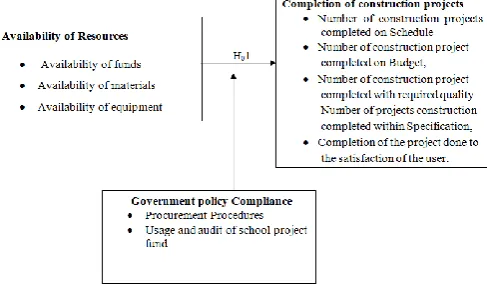
Figure 2.1 shows the interaction between availability of resources and completion of construction projects in public secondary schools in Bungoma County Kenya.
Page 173 www.ijiras.com | Email: [email protected]
Figure 2.1: Conceptual Framework
III. RESEARCH METHODOLOGY
The study adopted a descriptive survey due to its ability to consider diverse aspects of the research problem and helping the researcher to describe precisely what is being seen (Saunders et al., 2007). A descriptive research design also enables generation of factual information about the study. A descriptive research design is concerned with describing characteristics of a problem. A descriptive research design is deemed appropriate for this research paper because it helped to portray accurate profile of events and how they are. It also allowed for in-depth analysis of variables and elements of the study population as well as collection of large amounts of data in a highly efficient way. The study made use of the combination of both qualitative and quantitative data through interviews and questionnaires.
The County has 296 public secondary schools and 12 private schools. The literacy level is 60.5% with those attending school (15 yrs-18 yrs.) at 87.4% with secondary school enrolment of 130,907 students. The target population from which the study sample was drawn was 296 Principals and 296 PTA Chairpersons of public secondary schools and 9 Quality Assurance and Standards Officers giving a total of 601,as the target population.
Purposive sampling was adopted in choice of study respondents who were subjected to Stratified sampling to ensure homogeneity of the selected sample in ensuring that samples are drawn from each region encompassed in the target population, then followed by simple random sampling technique from each region. The sample size for this study was 461 drawn from a target population of 601 using Yamane (1967) theory of sampling.
Primary data was obtained from the questionnaires and interview schedules as research instruments. Questionnaires were used to capture data from the respondents. This instrument was used in the study because it is confidential, saves on time, has no bias and covers wide area (Mugenda and Mugenda, 2003). The questionnaire as an instrument used both closed ended and open ended questions in its structure.
The study used both descriptive and inferential statistics during data analysis. Numerical scores were awarded to closed ended questions. Descriptive statistics employed the use of means, frequencies and percentages and for inferential statistics. Quantitative data collected from respondents was
coded and analyzed using the Statistical Package for Social Sciences (SPSS version 20) tool. Simple regression was used to determine the influence of project characteristics on completion of construction projects. The following table shows how the hypothesis was tested and decision rule.
IV. STUDY RESULTS
A total of 452 questionnaires were issued to the respondents out of which 320 questionnaires were correctly filled and returned. This constituted 70.8% of which was considered adequate and in line with Kothari (2004) who recommended that a return rate of more than 50% was acceptable in social science research. From the results, 16 (5%) of the respondents came from Cheptais sub county, 36(11.3%) from Kimilili sub county, 28(8.8%) were from Bungoma central sub county, 58 (18.1%) from Bungoma East sub county, 48(15%) from Bungoma South sub county, 42 (13.1%) from Bumula sub county, 50 (15.6%) were from Bungoma North sub county, 32 (10%) from Bungoma West sub county while the remaining 10 (3.1%) were from Mt Elgon sub county. The results showed that 18 (5.6%) of the respondents were aged between 25-34 years, 39 (12.2%) were aged between 35- 44 years, 191 (59.7%) were aged between 45-54 years, 35 (10.9%) were aged between 55 – 64 years while the remaining 37(11.6%) were 65 years and above.
The age of the majority of respondents is important because it is an active age that is quite productive in determining the success of any given task (Sin, 2010).Out of 320 respondents who participated in the study 246 (76.9%) were male while 74 (23.1) were female. This finding goes against gender parity as articulated in Kenyan constitution. The results shows that out of 320 respondents who participated in the study 55 (17.2%) had tertiary education, while 265 (82.8%) had university education. This shows that the level of education of the people involved in the management of projects is adequate for completion of construction projects. The results indicate that out of 320 respondents who participated in the study, 248 (77.5%) had acquired training in management of projects while 72 (22.5%) had no formal training in the same.
The objective the study sought to achieve was to establish how availability of resources influence completion of the construction projects. To achieve this, their opinion showing the level of their agreement or disagreement with the statement provided in a Likert scale of 1- 5 where: Strongly agree (SA)=5, Agree(A)= 4, Neutral or not sure (N)= 3, Disagree (D)= 2 and strongly disagree (SD) = 1 were sought. The results were as shown in Table 4.1.
Statements
SA f (%)
A f (%)
NS f (%)
D F (%)
SD f (%)
Mean Std
Deviation
Availability of funds for school construction projects is necessary for
their completion.
225(70. 3)
95(29.7 )
0(0) 0(0) 0(0) 4.7031 0.45760
Delay of school construction project funds interferes with
projects
255(79. 7)
65(20.3 )
Page 174 www.ijiras.com | Email: [email protected] Availability of materials
for school construction projects hastens project
work
237(74. 1)
83(25.9 )
0(0) 0(0) 0(0) 4.7406 0.43898
Unavailability of equipment for school construction projects hinders project progress
250(78. 1)
70(21.9 )
0(0) 0(0) 0(0) 4.7813 0.41405
Shortage of equipment for school construction projects interferes with
project quality
254(79. 4)
66(20.6 )
0(0) 0(0) 0(0) 4.7938 0.40525
Availability of workers for school construction projects hastens project
work
234(73. 1)
78(24.4 )
8(2.5) 0(0) 0(0) 4.6313 0.50820
Composite mean 4.7412 0.4378
Table 4.1: Top Management Support and Completion of Construction Projects
Statement number one; availability of funds for school construction projects is necessary for their completion. Out of 320 who responded, 225(70.3%) strongly agreed, 95(29.7%) agreed while 0(0%) was not sure, disagreed and strongly disagreed respectively. The statement mean 4.7031 was below the composite mean of 4.7412 which implied availability of funds for school construction projects does not support completion of construction projects. Statement two; delay of school construction project funds interferes with projects. Out of 320 who participated in the study, 255 (79.7%) strongly agreed while the rest 65 (20.3%) agreed. None was not sure, disagreed or strongly disagreed. The statement mean 4.7969 was above the composite mean 4.7412 implying delay of school construction project funds interferes with completion of construction projects.
Statement three; availability of materials for school construction projects hastens project work. Out of 320 who participated in the study, 237 (74.1%) strongly agreed while the remaining 83 (25.9%) agreed. None of the responded was not sure, disagreed or strongly disagreed. The statement mean 4.7406 was below the composite mean 4.7412 which implies it does not support completion of construction projects. Statement four; unavailability of equipment for school construction projects hinders project progress. Out of 320 respondents who participated in the study, 250 (78.1%) strongly agreed while 70 (21.9%) agreed. None of the respondents was not sure, disagreed or strongly disagreed. The statement mean was 4.7813 which was above the composite mean 4.7412 implying unavailability of equipment for school construction projects hinders project progress and has an influence on completion of construction projects.
Statement five; shortage of equipment for school construction projects interferes with project quality. Out of 320 respondents, 254 (79.4%) strongly agreed while the remaining 66 (20.6%) agreed. None was not sure, disagreed or strongly disagreed. The statement mean 4.7938 was above the composite mean 4.7412 implying shortage of equipment for school construction projects has influence on completion of construction projects. Statement six; availability of workers for school construction projects hastens project work. Out 0f 320 respondents who participated in the study, 234 (73.1%) strongly agreed, 78 (24.4%) agreed while the remaining 8(2.5%) were not sure. None of the respondents disagreed or strongly disagreed respectively. The statement mean 4.6313
which was below the composite mean 4.7412 which implied availability of workers for school construction projects supports completion of construction projects.
HYPOTHESIS 4
H1: Availability of resources significantly influence completion of construction projects in public secondary schools in Bungoma County
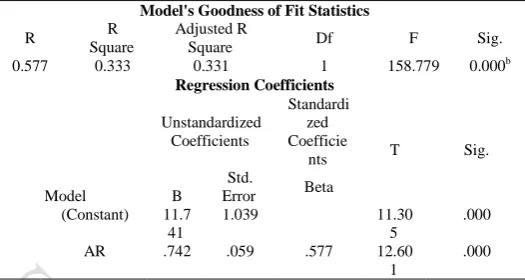
The mean of availability of resources and completion of construction project (Ycp) was regressed. This was tested using
significance of R square, regression coefficient (B) and correlation coefficient (Beta) at 95.0% confidence level. The results are presented in Table 4.2
Model's Goodness of Fit Statistics
R Square R Adjusted R Square Df F Sig.
0.577 0.333 0.331 1 158.779 0.000b
Regression Coefficients Model Unstandardized Coefficients Standardi zed Coefficie
nts T Sig.
B
Std.
Error Beta
(Constant) 11.7
41
1.039 11.30
5
.000
AR .742 .059 .577 12.60
1
.000
a. Dependent Variable: Completion of construction projects Table 4.2: Regression of Availability of Resources and
Completion of Construction Projects
The test criteria was set such that the study accepts the hypothesis is the value of beta, β3≠ O. Simple regression YCp =
α + β4AR + e was used where Ycp is completion of
construction projects, α is the y-intercept term, AR is availability of resources, β3is the beta value and e is the
standard error term. The mean of availability of resources (AR) was regressed with mean of completion of construction projects (Ycp) in public secondary schools in Bungoma
County. The results were as shown in table 4.14. This was carried out using significance of R square and Regression coefficient at 95.0% confidence level. The results reveal that the value of beta was 0.577 ≠0. The hypothesis was therefore confirmed and accepted and thus there is statistically significant relationship between availability of resources and completion of construction projects in public secondary schools in Bungoma County. Hence the equation;
Completion of construction projects = 11.741+0.577* availability of resources +3.95
From the ANOVA results the F test gave a value of F
(318,319) =158.779, p <0 .01, which was large enough to support the goodness of fit of the model in explaining the variation in the dependent variables.
Page 175 www.ijiras.com | Email: [email protected] another study, Lee (2004) found out that resource allocation
was one of the primary lubricants of a project.
V. CONCLUSION
From the study findings, availability of resources positively influences completion of construction projects. Availability of funds for school construction projects is necessary for their completion and delay in construction project funds interferes with project completion. Availability of materials for school construction projects hastens project work. Unavailability and or shortage of equipment for school construction projects interferes with project quality and hinders project progress. Availability of workers for school construction projects guarantees good flow and completion of project work.
VI. RECOMMENDATION
From the results in this study, timely availability of funds, materials and equipment is a prerequisite for completion of projects on time, in the required quality and cost and would satisfy customers.
VII. LIMITATIONS
The major limitations of this study were: the high cost implications of the study area. Bungoma County measures 2,206.9 square Km, therefore schools are many kilometers away from each other, and hence this caused challenges to the researcher who visited them. This was overcome by using motor cycles as means of transport to access schools located in the interior of the county. This helped to reduce cost. The researcher anticipated experiencing financial constraints due to wide area the County covers and the spread of schools. This was mitigated by securing funds in good time from a Sacco to avoid delaying the study due to lack of funds. The funds were used to facilitate travel, subsistence and materials required for the research. Laxity by respondents to willingly and freely share information with the researcher for not knowing what the information was to be used for was guarded by the researcher stating and introductory letters were crucial in order to assure the respondents of their safety and the confidentiality of the information. Respondents who participated in the study were given an assurance that the information sought was regarded as confidential and that the findings of the study analysis were for academic purposes only. PTA Chairpersons are not school employees and so may not be readily found in schools when required to fill questionnaires. The researcher made appointments with them through the school principals. The researcher facilitated their travel to school to be able to fill questionnaires and even carry out telephone interviews where necessary for practical reasons. Given the busy schedule of school Principals, the researcher made appointments with them to allow the use of some of their time out of their busy
schedule in filling the questionnaires. This hastened their response to filling the research questionnaire.
REFERENCES
[1] Aftab, H. M., Ismail, A. R. and Ade, A. A. A. (2012).Time and Cost Performance in Construction Projects in Southern and Central Regions of Peninsular Malaysia, International Journal of Advances in Applied Sciences, Vol. 1, (1), 45-52.
[2] Aftab, H. M., Ismail, A. R. and Ade, A. A. A. (2010).Factors affecting construction cost in Mara Large construction project in Malaysia. International journal of sustainable construction Engineering and Technology, Vol1, No. 2, December, 2010.
[3] Aje, I.O and Awodele, O.A (2006); A Study of Ethical Values of Quantity Surveyors in Nigeria; Ethical Issues and the challenges in Construction Professionals Service Delivery, Proceedings of a 2-Day National Seminar.23. [4] Al Yami, A., and A.D.F, P. (2006). A Framework for
implementing sustainable construction in Building. Boyd: D(Ed) Process 22nd annual.
[5] Asfandyar, I. (2012). Critical Success factors for different organizations in construction projects
[6] Ashley D.B, laurie C.S. and Jaselkis E.J. (1987).. Determinants ofconstruction project success. Project management Journal
[7] Atknison, R (1999). Project management cost, time, and quality, two bwst guesses and a phenomenon. Intl. J. Project Management, 17(6), 337-342.
[8] CDF Board, 2008. CDF amended Act 2007. Government of Kenya
[9] Cronbach, L. J. (1951). Coefficient alpha and the internal structure of tests. Psychometrika, 16,. 297-334 (28,307 [10] Gaturu S.N. and Muturi. W (2014). Factors affecting the
timeliness of completion of donor-funded projects in Kenya: A case of world Agro forestry center (ICRAF).European Journal of Business Management Vol. 2, Issue I
[11] Government of Kenya (2015). Press Release. Government printer.
[12] Government of Kenya 2015. Government printer.
[13] Haseeb, M., Xinhai-Lu, Bibi, A., Maloof-Ud-Dyian and Wahab, R. (2011). Problems of Projects and Effects of delays in the Construction Industry of Pakistan, Australian Journal of Business and Management Research, Vol.1 (5), 41-50.
[14] Kagiri C. and Wainana J. (2015). Time and Cost Overruns in Power Projects in Kenya: A Case Study of Kenya Electricity Generating Company Limited Time and Cost Overruns in Power Projects in KenyaVol. 3 Issue No. 2 June 2013
[15] Karungi M.S (2014). Determinants of Timely Completion of Projects in Kenya: A Case of Kenya Power and Lighting Company, Thika. ABC Journal of Advanced Research, Volume 3, No 2 (2014).
Page 176 www.ijiras.com | Email: [email protected] [17] Mbathi C.M, (1986), Building Contract Performance: A
Case Study of Government Projects in Kenya, MA Thesis, unpublished, University of Nairobi
[18] Mugenda M .O and Mugenda, G.A (2003).Research methods: Quantitative and Qualitative Approaches, Nairobi: AC TS Press.
[19] National Anticorruption Steering Committee 2008, NACC. Government of Kenya
[20] National Taxpayers Association (2011). Citizen‟s constituency Development Fund Report for Kanduyi Constituency Bungoma County.
[21] Nguyen D.L Ogunlana S and Lan D.T (2004).A study on project success factors in Vietnam. Engineering construction and Architectural Management Journal,(6), PP.404- 413.
[22] Njuguna, B (2008), The Construction Industry in Kenya and Tanzania; Understanding Mechanism that Promote Performance, ESAM DBA assignment
[23] Nyika David (2012) An Analysis of the Causes of Failures in the Implementation of Projects in Kenya.
Journal of School of the Built Environment, University of Nairobi.
[24] Radosavljevic, M. and Bennett, J.(2012) Construction Management Strategies: A theory of construction management, Oxford, Wiley-Blackwell, 2012
[25] Saunders, M., Lewis P. and Thornhill A. (2009) Research Methods for business students 4th edition Pearson education limited
[26] Tawil, N. M. , Khoiry M .A. , Arshad, I. , Hamzah, N. , Jasri, M. F. and Badaruzzaman, W. H. W. (2013). Factors Contribute To delay Project Construction in Higher Learning Education, Case Study UKM, Research Journal of Applied Sciences, Engineering and Technology, 5 (11), 3112-3116.
[27] Turner J. R. and Muller R, (2003) .On the nature of the project as a temporary organization. International Journal of Project Management, 21(1): 1.