M E T H O D O L O G Y
Open Access
epiACO - a method for identifying epistasis
based on ant Colony optimization
algorithm
Yingxia Sun
1, Junliang Shang
1,2*, Jin-Xing Liu
1*, Shengjun Li
1and Chun-Hou Zheng
1,3* Correspondence: [email protected]; [email protected]
1
School of Information Science and Engineering, Qufu Normal University, Rizhao 276826, China Full list of author information is available at the end of the article
Abstract
Background:Identifying epistasis or epistatic interactions, which refer to nonlinear interaction effects of single nucleotide polymorphisms (SNPs), is essential to understand disease susceptibility and to detect genetic architectures underlying complex diseases. Though many works have been done for identifying epistatic interactions, due to their methodological and computational challenges, the algorithmic development is still ongoing.
Results:In this study, a method epiACO is proposed to identify epistatic interactions, which based on ant colony optimization algorithm. Highlights of epiACO are the introduced fitness functionSvalue, path selection strategies, and a memory based strategy. TheSvalueleverages the advantages of both mutual information and Bayesian network to effectively and efficiently measure associations between SNP combinations and the phenotype. Two path selection strategies, i.e., probabilistic path selection strategy and stochastic path selection strategy, are provided to adaptively guide ant behaviors of exploration and exploitation. The memory based strategy is designed to retain candidate solutions found in the previous iterations, and compare them to solutions of the current iteration to generate new candidate solutions, yielding a more accurate way for identifying epistasis.
Conclusions:Experiments of epiACO and its comparison with other recent methods epiMODE, TEAM, BOOST, SNPRuler, AntEpiSeeker, AntMiner, MACOED, and IACO are performed on both simulation data sets and a real data set of age-related macular degeneration. Results show that epiACO is promising in identifying epistasis and might be an alternative to existing methods.
Keywords:Epistatic interactions, Ant colony optimization, Bayesian network, Mutual information
Background
It has been widely accepted that genome-wide association studies (GWAS) play a great role on understanding disease susceptibility and genetic architectures underlying complex diseases, and lots of single nucleotide polymorphisms (SNPs) speculated to associate with diseases have been identified. Nevertheless, most of them seem to be responsible for the causation of Mendelian diseases [1], and they have poor ability in explaining non-Mendelian diseases, i.e., complex diseases, such as cancer, heart disease, cardiopathy, Alzheimer’s disease, hypertension and many others [1, 2]. Recent advances in GWAS
confirm that nonlinear interaction effects of SNPs, namely, epistasis or epistatic interac-tions, could unveil a large portion of unexplained heritability of complex diseases [2]. Therefore, many algorithms have been proposed for identifying epistasis. However, due to their methodological and computational challenges, the algorithmic development is still ongoing [1, 3, 4].
Current epistasis detection methods can be mainly classified into three categories based on their search strategies: exhaustive search [5–7], stochastic search [8–10], and heuristic search [2, 11–15]. Exhaustive search evaluates the associations of all SNP combinations with the phenotype. Wan et al. [5] developed BOOST (BOolean Operation-based Screening and Testing) which has two stages to analyze all pairwise epistatic interactions in genome-wide case-control studies. Zhang et al. [6] proposed TEAM (Tree-based Epistasis Association Mapping) which updates contingency tables by utilizing the structure of a minimum spanning tree to search two-SNP epistatic interactions. Ritchie et al. [7] used MDR (Multifactor Dimensionality Reduction) to identify epistasis, which divides genotypes into low-risk and high-risk groups to reduce search space. As far as we know, MDR is one of the most popular methods in this field. Though these methods show great performance on identifying epistatic interactions in small scale data sets, they have poor ability on large scale data sets due to their expo-nential time complexities [1, 3]. Performance of stochastic search methods depend on their sampling numbers, and therefore they are not suitable for genome-wide scale data sets [13]. Tang et al. [8] used epiMODE (epistatic MOdule DEtection) to detect multiple-SNP epistatic interactions by introducing the concept of epistatic module and designing a Gibbs sampling strategy. Jiang et al. [9] proposed epiForest (detection of
epistatic interactions using randomForest) which uses random forest to detect epistatic interactions in case-control studies. Zhang et al. [10] developed BEAM (Bayesian Epis-tasis Association Mapping) to identify episEpis-tasis which categorizes SNPs into three non-overlapping groups based on their posterior probabilities. Heuristic search methods generally obtain solutions at substantially reduced time costs, based on their introdu-cing heuristic information and prior knowledge of biological data. For instance, Wan et al. [11] proposed SNPRuler to identify epistatic interactions using predictive rules. Though heuristic search methods sometimes miss global optimal solutions and only obtain several local optimal solutions, they are still promising methods so far.
pheromone updating strategy is not as effective as it claims to be. Our previously pro-posed method IACO [16] is an alternative to existing ACO based methods, but it is sensitive to SNPs displaying strong marginal effects.
In this paper, we develop a method epiACO to identify epistatic interactions, which based on ACO algorithm. Highlights of epiACO are the introduced fitness function
Svalue, path selection strategies, and a memory based strategy. The Svalue leverages
the advantages of both mutual information and Bayesian network to effectively and effi-ciently measure associations between SNP combinations and the phenotype. Two path selection strategies, i.e., probabilistic path selection strategy and stochastic path selec-tion strategy, are provided to adaptively guide ant behaviors of exploraselec-tion and exploit-ation. The memory based strategy is designed to retain candidate solutions found in the previous iterations, and compare them to solutions of the current iteration to gen-erate new candidate solutions, yielding a more accurate way for identifying epistasis. Experiments of epiACO and its comparison with other recent methods epiMODE, TEAM, BOOST, SNPRuler, AntEpiSeeker, AntMiner, MACOED, and IACO are performed on both simulation data sets and an age-related macular degeneration real data set. Results show that epiACO is promising in identifying epistatic interactions and might be an alternative to existing methods. The Matlab version of epiACO run-ning on Microsoft Windows is available online at: https://sourceforge.net/projects/ epiaco1/files/epiACO.rar/download.
Methods
General ant Colony optimization (ACO)
The general ACO takes inspiration from the foraging behavior of some ant species. Ants walking to and from a food source communicate with each other indirectly by se-creting pheromones on the ground, which will gradually evaporate as time passes. The subsequent ants perceive the presence of pheromones and tend to follow the paths with higher pheromone concentration [17]. Such a mechanism forms a positive feedback and eventually most of the ants, if not all, are able to transport food to their nest in the shortest path.
Mathematically, each ant choose its next position through a probability density func-tion (PDF), which is updated by pheromones and heuristic informafunc-tion. The PDF of the general ACO is defined as
Pijkð Þ ¼t τijð Þt
αη
ijβ
P
u∈Ukð Þt τiuð Þt
αη
iuβ
i∈Ukð Þt
0 otherwise
8 > > > < > > > :
ð1Þ
wherePijkð Þt is the probability of antkthat chooses the next positionjfrom the current positioniat iterationt.τij(t) is the pheromones of the path from positionito positionj
In ACO, ants find the optimal solutions through continuous updating pheromones. Pheromones of the path from position i to position j at iteration t+1 are updated according to the formula
τijðtþ1Þ ¼ð1−ρÞτijð Þ þt Δτijð Þt ð2Þ
where ρis a evaporation coefficient, andΔτij(t) is the increment of pheromones of the path from positionito positionjat iterationt, which is defined as
Δτijð Þ ¼t
Xm
k¼1
Δτk
ijð Þt ð3Þ
Δτk ijð Þ ¼t
Q Skð Þt
if ant k via the path of ij at iteration t
0 otherwise
8 <
: ð4Þ
where m is the number of ants. The increment of pheromones of the path from pos-itionito positionjfor antkat iterationtis denoted asΔτk
ijð Þt . The path length for ant
kat iterationtis denoted asSk(t).Qis a user-specified positive constant.
Fitness functionSvalue
Mutual information
In probability theory and information theory, the mutual information of two random variables is a measure of the mutual dependence between the two variables. More spe-cifically, it quantifies the amount of information obtained about one random variable, through the other random variable. The mutual information is usually used as an asso-ciation measure in feature selection problems [2, 18, 19]. In epiACO, mutual informa-tion is used to measure the associainforma-tions between SNP combinainforma-tions and the phenotype, which can be written as
MI Sð ;YÞ ¼H Sð Þ þH Yð Þ−H Sð ;YÞ ð5Þ
where H(S) is the entropy ofS,H(Y) is the entropy ofY, H(S,Y) is the joint entropy of bothSandY. Here,Srepresents a SNP combination, andYrepresents the phenotype.
The entropy and the joint entropy are defined as
H Sð Þ ¼−X j
1¼1
3
⋯X
j
K¼1
3
p sj1;⋯;sjK
⋅logp sj1;⋯;sjK
ð6Þ
H Yð Þ ¼−X j¼0 1
p yj ⋅logp yj
ð7Þ
H Sð ;YÞ ¼−X j1¼1
3
⋯X
jK¼1
3 X
j¼0 1
p sj1;⋯;sjK;yj
⋅logp sj1;⋯;sjK;yj
ð8Þ
where s is the genotype of a SNP, coded as {1, 2, 3} corresponding to homozygous common genotype, heterozygous genotype, and homozygous minor genotype; y is the label of a sample, coded as {0, 1} corresponding to control and case; and p(⋅) is the PDF.
Bayesian network
The Bayesian network is a probabilistic graphical model that represents a set of random variables and their conditional dependencies via a directed acyclic graph (DAG) [20]. In general, the Bayes theorem can be written as
P Nð jDÞ ¼P Dð jNÞP Nð Þ
P Dð Þ ð9Þ
where P(N|D) is the posterior probability of the Bayesian network model Ngiven the dataD,P(D|N) is the class-conditional density, P(D) is the probability ofD, andP(N) is the prior probability ofN.
In the DAG, the joint probability distribution of n nodes, e.g., x1,x2, ⋯ ,xn, is
defined as
p xð 1;x2;⋯;xnÞ ¼
Y
i¼1 n
p xð ijparent xð Þi Þ ð10Þ
where parent(xi) represents the parent node ofxi. In this study, SNPs and the pheno-type are denoted as nodes of DAG respectively [21–24]. The directed edges going from SNP nodes to the phenotype node implies that this SNP combination shows correlation with the phenotype [25]. According to Eq. (9), P(D|N) can be computed while all vari-ables in the DAG are discrete values,
P Dð jNÞ ¼Y i¼1
I Γ
PJ j¼1αij
Γ riþ
PJ j¼1αij
Y
j¼1 J Γ r
ijþαij
Γ αij
0 B B @
1 C C
A ð11Þ
whereIis the combinatorial number of SNP nodes with different values. Specifically, if
l-SNP nodes link to the phenotype node, the combinatorial number of SNP nodes is 3l since one SNP has three genotypes.Jis the state number of the phenotype node, which is equal to 2.riis the number of cases with SNP nodes taking theithcombination.rijis the number of cases with the phenotype node taking thejthstate and its parents taking the ith combination. αijis a parameter that refers to the prior belief about the number of cases while the nodes taking the corresponding ith combination and jth state [13]. More often, in order to take an equal likelihood for all possible distributions in each Bayesian network model, P(N), P(D) are usually set to constants and αij= 1. Then we obtain the following formula,
P Nð jDÞ∝Y i¼1
I ðJ−1Þ!
riþJ−1
ð Þ!
Y
j¼1 J
rij!
!
ð12Þ
On the basis of previous studies [22, 26, 27], K2 score is introduced and defined as
K2 score¼Y
i¼1
I ðJ−1Þ! riþJ−1
ð Þ!
Y
j¼1 J
rij!
!
ð13Þ
K2 scorelog¼
X
i¼1 I Xriþ1
b¼1
logð Þ‐b X j¼1
J Xrij
d¼1
logð Þd
!
ð14Þ
It is seen that a lower K2 score implies a greater correlation between the SNP com-bination and the phenotype.
Svalue
In epiACO, the fitness function plays an important role on deciding which SNP combina-tions are selected as the optimal solucombina-tions. Consequently, a novel fitness functionSvalue
is introduced, which combines both mutual information and Bayesian Network. The mu-tual information can effectively measure the nonlinear relationships between SNP combi-nations and the phenotype without a complex modeling [28]. The Bayesian network is widely used as a promising measure for measuring dependence of several variables [27]. In order to leverage the advantages of these two measures,Svalueis defined as
Svalue Að Þ ¼ MI
K2 scorelog ð
15Þ
It is seen that the higher the Svaluescore, the stronger the association between the SNP combination and the phenotype.
ACO based method epiACO for identifying epistasis
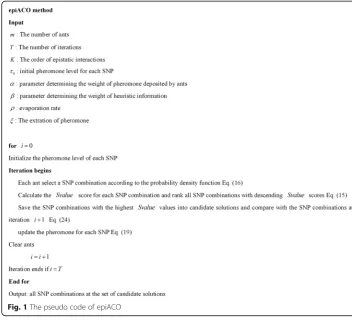
The pseudo code of epiACO is given in Fig. 1, which is mainly consist three strategies, namely, the path selection strategy, the pheromone updating strategy, and the memory based strategy.
Path selection strategy
In epiACO,mants are represented by {m1, ⋯,mk, ⋯,mm} respectively, each of which
is used to evaluate a K-SNP combination at each iteration, where Kis a user-specified order. The probability of antkselecting SNPiat iterationtis denoted asPikð Þt , which is defined as
Pikð Þ ¼t R q≤q0 S q>q0
ð16Þ
In order to control the rate of convergence, avoid falling into local optimal solution, two path selection strategies, that is, probabilistic path selection strategy and stochastic path selection strategy, are provided to adaptively guide ant behaviors of exploration and exploitation. q0is a threshold, which defined as the ratio of current iteration
num-ber to the total iteration numnum-ber. qis a number that randomly generated from the uni-form distribution of [0, 1] while Eq. (16) is employed.
The probabilistic path selection strategy is defined as
R¼ τið Þt
αη
iβ
P u∈Uk tð Þτuð Þt
αη
uβ i∈Ukð Þt
0 otherwise
8 > > < > >
: ð17Þ
The stochastic path selection strategy is defined as
S¼ 1 i ¼ rand Vð kð Þt Þ
0 otherwise
ð18Þ
where all SNPs at iterationtis sorted with the descending pheromones, and the latter half is represented asVk(t).
This strategy allows epiACO to cover a wider search space while the iteration num-ber is small and to converge on promising regions of the search space while the iteration number turns to large.
Pheromone updating strategy
In epiACO, the pheromones of all SNPs are updated according to the following formula
τiðtþ1Þ ¼ð1−ρÞτið Þ þt Δτið Þ þt Δτið Þt ð19Þ
whereΔτi(t) is the increment of pheromones of SNPiat iterationt. Besides, additional pheromone increment Δτi∗(t) is adopted to reward the SNPs that belong to the candi-date solutions.
TheΔτi(t) and theΔτi∗(t) are respectively defined as
Δτið Þ ¼t
Xm
k¼1 Δτk
ið Þt ð20Þ
Δτikð Þ ¼t
Svalue Að Þ k∈Mið Þt
0 otherwise
ð21Þ
Δτ ið Þ ¼t
Xm
k¼1 Δτk
ið Þt ð22Þ
Δτik
t
ð Þ ¼ ξSvalue Að Þ k∈Nið Þt
0 otherwise
ð23Þ
whereMi(t) is the set of ants that select SNP iat iterationt. Ais the SNP combination that has been selected.Svalue(A) is theSvalueof SNP combinationA. Ni(t) is the set of ants that select SNP iwhich belongs to candidate solutions.ξ is a specified parameter that used to control the additional increment of pheromones, and the recommended range is [0.2, 0.5].
Memory based strategy
In epiACO, SNP combinations that selected by ants at each iteration are evaluated by the fitness function Svalue. In order to retain candidate solutions with high Svalue
scores found in the previous iterations, instead of traditional ACO completely discard-ing the solutions from previous iterations due to each iteration is independent of each other, a memory based strategy is introduced. First, all SNP combinations selected at it-eration tare ranked with the descending Svaluescores. Second, an inflection point of these descendingSvaluescores is computed using the formula
f ¼arc max
g¼3 m
Svalue Ag −Svalue Ag−1
− Svalue Ag−1
−Svalue Ag−2
ð24Þ
whereAgis the SNP combination and Svalue(Ag) is theSvaluescore of the SNP combin-ationAg. Third, the SNP combinations with topf Svaluescores are viewed as the candidate solutions. Fourth, candidate solutions of previous iterations are compared to solutions of the current iteration to generate new candidate solutions, which will continue to be used in the next iteration. The merit of this strategy is that good solutions generated in any of the it-erations will not be lost, yielding a more accurate way for epistasis searching.
Results and discussion Evaluation measures
Detection power is one of the generally accepted and widely used evaluation measure in the field of identifying epistasis [2, 8, 10, 11, 29–31]. In this study, we directly use the detection power proposed by previous studies [2, 8, 10, 11, 29–31], which is defined as the proportion of data sets in which the epistasis models are perfectly identified with no false positives. That is,
Power¼ R
G ð25Þ
Computational complexity is also analyzed. We measure running time in the same computational environment to assess realistic applicability of compared methods (Intel G640 2.80GHz CPUs, 32GB RAM, Microsoft Windows, MATLAB).
Simulation and real data sets
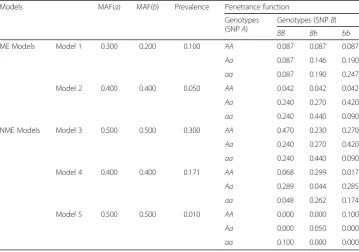
We exemplify 5 commonly used benchmark models of 2-SNP epistatic interactions for the study [8, 10, 31–34]. Details of the models are given in Table 1. Specific-ally, Model 1 is the model that displays both marginal effects and interaction effect (ME model), the penetrance of Model 1 increases only when both SNPs have at least one minor allele [8, 10]; Model 2 is also the ME model that display both marginal effects and interaction effect, the additional minor allele at each SNP of which does not further increase the penetrance [10]; Model 3 is randomly chosen from references [33, 34] that show no marginal effects but interaction effect (NME model); Model 4 is directly cited from the reference [33], which is also a NME model; Model 5 is a ZZ NME model [32].
For each model, 100 data sets are simulated by epiSIM [35], each containing 2000 cases and 2000 controls. In the first 50 data sets, 100 SNPs are genotyped, while in other 50 data sets the number of genotyped SNPs is increased to 1000. For each data set, random SNPs are set with their minor allele frequencies chosen from [0.05, 0.5] uniformly.
A real data set of age-related macular degeneration (AMD) is also used for test-ing epiACO. AMD, refers to pathological changes in the central area of the ret-ina, is the most important cause of irreversible visual loss in elderly populations,
Table 1Details of 5 commonly used benchmark models of 2-SNP epistatic interactions
Models MAF(a) MAF(b) Prevalence Penetrance function
Genotypes
(SNPA)
Genotypes (SNPB)
BB Bb bb
ME Models Model 1 0.300 0.200 0.100 AA 0.087 0.087 0.087
Aa 0.087 0.146 0.190
aa 0.087 0.190 0.247
Model 2 0.400 0.400 0.050 AA 0.042 0.042 0.042
Aa 0.240 0.270 0.420
aa 0.240 0.440 0.090
NME Models Model 3 0.500 0.500 0.300 AA 0.470 0.230 0.270
Aa 0.240 0.270 0.420
aa 0.240 0.440 0.090
Model 4 0.400 0.400 0.171 AA 0.068 0.299 0.017
Aa 0.289 0.044 0.285
aa 0.048 0.262 0.174
Model 5 0.500 0.500 0.010 AA 0.000 0.000 0.100
Aa 0.000 0.050 0.000
aa 0.100 0.000 0.000
and is considered as a complex disease having multiple epistatic interactions [8]. The AMD data set contains 103,611 SNPs genotyped by 96 cases and 50 con-trols, which has been widely used as a benchmark data set [2, 8, 9, 12, 13, 15, 16, 29, 36, 37].
Experiments on simulation data sets
In the study, performance of epiACO is analyzed by comparison with 8 typical 2-SNP epistasis detection methods, i.e., epiMODE, TEAM, BOOST, SNPRuler, AntEpiSeeker, AntMiner, MACOED, and IACO. Among them, BOOST and TEAM are exhaustive search methods, epiMODE is a stochastic search method, others are heuristic search methods. In particular, AntEpiSeeker, AntMiner, MACOED, and IACO are all ACO based methods, which will be discussed in more detail than others since they belong to the same family, as well as epiACO.
The first experiment is performed on 100-SNP data sets. The parameters of each com-pared method are generally set as default. Only a few are modified according to sugges-tions in their respective user manual to balance result accuracy and computational cost. For epiMODE, the iteration number is set to 100. For TEAM, the permutation number is set to 100. For BOOST, the iteration threshold is set to 10. For a fair comparison, param-eter settings of the ACO based methods are same. Specifically, the iteration number m
and the ant numberTare set to 25 and 200 respectively. The initial pheromoneτ0, the
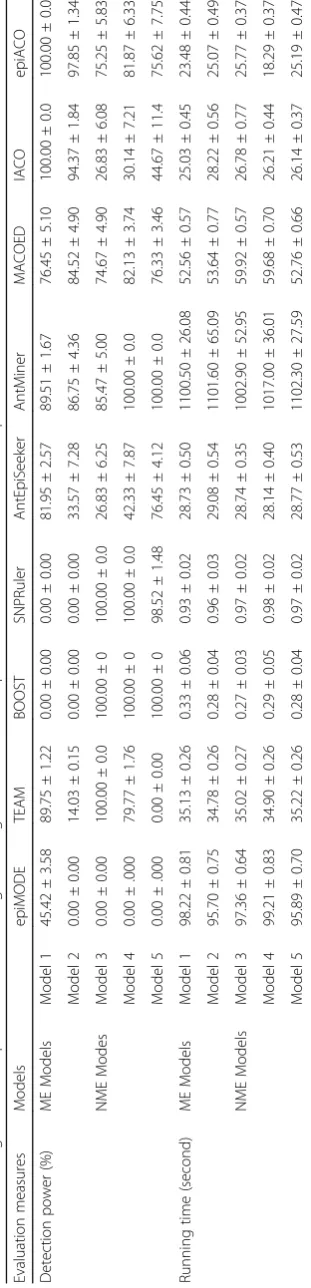
heuristic informationη, and the parametersαandβare all set to 1. The evaporation coef-ficient ρ is set to 0.2. The constant ξ is set to 0.3. For obtaining accurate results, each method runs 20 times with different random seeds on each data set of each model, which can ensure that the method has not been biased by its initial starting conditions. The aver-age detection power and the averaver-age running time with their respective standard devia-tions on 100-SNP data sets are recorded in Table 2. It is seen that epiACO is comparable and sometimes superior to compared methods, especially ACO based methods.
For ACO based compared methods, epiACO outperforms AntEpiSeeker and IACO in terms of detection power on all models while they have the similar running time. epiACO has higher detection power than those of AntMiner and MACOED on ME models, but lower detection power than those of them on NME models. Since ME models are the primary models of epistatic interactions in real genetic architectures underlying complex diseases and NME models are special cases, epiACO is more suit-able for real applications than other two methods. AntMiner has higher detection power than that of epiACO on NME models due to heuristic information of SNPs be-ing incorporated into its ant-decision rules, which on one hand improves detection power, and on the other hand significantly increases running time, hindering its widely application on large scale data sets, like those for GWAS. For MACOED, it is in fact the stochastic search method since its pheromone updating strategy is only used for more frequently detecting the epistatic interactions that have been detected in the pre-vious iterations, rather than to identify better epistatic interactions. As it is known to all, stochastic search methods are good at identifying NME models, and hence detec-tion power of MACOED on NME models are higher than that of epiACO.
power on NME models but detect nothing on ME models since they only focus on identifying NME models. TEAM performs well on some models and worse on others, implying that it is model sensitive. epiMODE detects nothing in four models and only has moderate detection power on Model 1. On the contrary, epiACO performs well on all models, either NME models or ME models, shows that epiACO is model-free and has high stability and reliability.
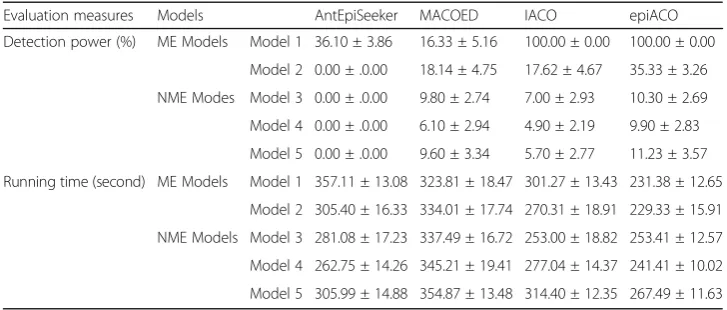
The second experiment is performed on 1000-SNP data sets. The purpose of this ex-periment is to demonstrate that epiACO has a place for larger data sets and performs better than compared methods. AntEpiSeeker, MACOED, IACO and epiACO are com-pared on these data sets with the parameters of the iteration number being 100 and the ant number being 500. Other parameters are the same as those of the first experiment. TEAM, epiMODE, AntMiner and SNPRuler are not considered here due to their unaffordable computational cost or memory on high-dimensional data sets [31]. Since BOOST is an exhaustive search method only focusing on NME models, its results on 1000-SNP data sets can be inferred that it detects nothing on ME models and has per-fect detection power on NME models. Each compared method also runs 20 times with different random seeds on each data set of each model to ensure that the method has not been biased by its initial starting conditions. The average detection power and the average running time with their respective standard deviations on 1000-SNP data sets are recorded in Table 3. It is seen that epiACO indeed performs better on larger data sets than compared methods. Specifically, it is the fastest one among the methods; though detection power does not reach a perfect level due to the small iteration num-ber and the ant numnum-ber, epiACO is still the winner.
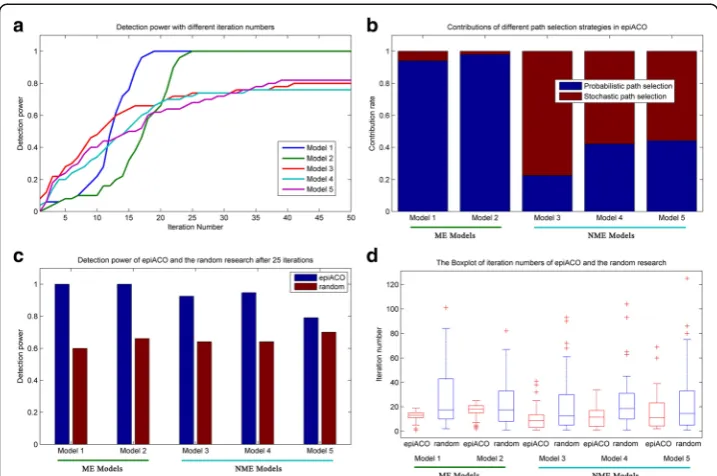
The third experiment is performed on 100-SNP data sets to test the convergence and contribution of epiACO with the parameter settings being the same as those of the first experiment, and results of which are shown in Fig. 2. From Fig. 2a, it is seen that detec-tion power of all models increase as the iteradetec-tion numbers increase, and gradually tend to be stable while the iteration numbers come to 25, which might be the evidence that epiACO has converged after 25 iterations in the first experiment. The Fig. 2b shows the contributions of different path selection strategies in epiACO. It is clear that the probabilistic path selection strategy plays a decisive role on ME models while the sto-chastic selection strategy plays a decisive role on NME models. Therefore, they
Table 3The average detection power and the average running time with their respective standard deviations of compared methods on 1000-SNP data sets
Evaluation measures Models AntEpiSeeker MACOED IACO epiACO
Detection power (%) ME Models Model 1 36.10 ± 3.86 16.33 ± 5.16 100.00 ± 0.00 100.00 ± 0.00
Model 2 0.00 ± .0.00 18.14 ± 4.75 17.62 ± 4.67 35.33 ± 3.26
NME Modes Model 3 0.00 ± .0.00 9.80 ± 2.74 7.00 ± 2.93 10.30 ± 2.69
Model 4 0.00 ± .0.00 6.10 ± 2.94 4.90 ± 2.19 9.90 ± 2.83
Model 5 0.00 ± .0.00 9.60 ± 3.34 5.70 ± 2.77 11.23 ± 3.57
Running time (second) ME Models Model 1 357.11 ± 13.08 323.81 ± 18.47 301.27 ± 13.43 231.38 ± 12.65
Model 2 305.40 ± 16.33 334.01 ± 17.74 270.31 ± 18.91 229.33 ± 15.91
NME Models Model 3 281.08 ± 17.23 337.49 ± 16.72 253.00 ± 18.82 253.41 ± 12.57
Model 4 262.75 ± 14.26 345.21 ± 19.41 277.04 ± 14.37 241.41 ± 10.02
supplement each other and both of them are indispensable for epiACO. In order to test the contribution of the ant system, both epiACO and a simple random search are run on all models with 200 ants. Fig. 2c records the detection power of them after 25 itera-tions, and Fig. 2d is a box plot of iteration numbers of them while obtaining the global optimal solutions. Results in these two subfigures show that the detection power of epiACO after 25 iterations is higher than that of the random search on all models, which implies that the introduced ACO system improves the performance of the algorithm.
Application to real data set
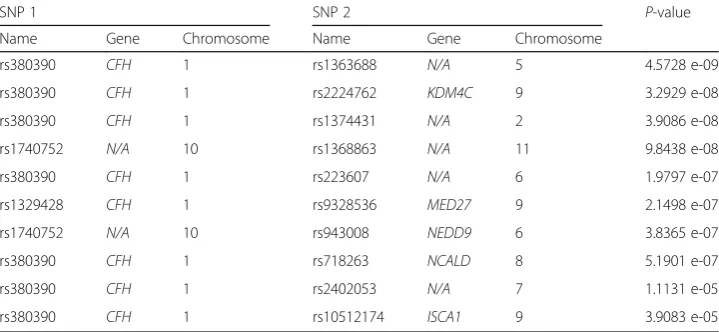
Potential of the epiACO can also be verified by analyzing a real AMD data set with dif-ferent parameter settings (m,T,ρ) being (10,000, 500, 0.2) and (20,000, 250, 0.2). The captured 2-SNP epistatic interactions that might be associated with the AMD are re-ported in Table 4 with ascending Chi-squarep-values.
It is seen that most reported epistatic interactions contain either rs380390 or rs1329428, which is due to these two SNPs having strongest main effects among all SNPs, leading to their combinations with other SNPs usually displaying strong inter-action effects, and hence being identified. SNPs rs380390 and rs1329428 reside in the
CFH gene, mutations in this gene have been associated with hemolytic-uremic syn-drome (HUS) and chronic hypocomplementemic nephropathy. These two SNPs are be-lieved to be significantly associated with AMD [8]. There are only two detected epistatic interactions in the table not containing either rs380390 or rs1329428, that is, (rs1740752, rs1368863) and (rs1740752, rs943008), which are the first time being iden-tified that might be associated with the AMD. Both SNPs of the former locate in the noncoding regions, might lead to AMD through regulating gene expression levels.
Obviously this is a bold speculation, needs further studies in depth with the use of more case-control samples, and also the biological experiments, though they are be-yond the scope of this study. SNP rs1740752 appears in these two epistatic interactions, but its main effect is moderate, implying not only that it influences the phenotype mainly through its interaction effects with other SNPs, but also that epiACO is promis-ing in identifypromis-ing epistatic interactions displaypromis-ing no marginal effect but interaction ef-fects. SNP rs2224762 resides in the intron of KDM4C gene, and chromosomal aberrations and changes in expression of this gene may be found in tumor cells. SNP rs943008 resides in the intron ofNEDD9gene, altered expression of which is strongly associated with cancer. The NEDD9 overexpression is documented to occur and in some cases linked the process of tumorigenesis of many different malignances. Besides,
NEDD9has been studies for a possible association with late onset Alzheimer’s disease,
and may be important for recovery from stroke. Therefore, mutations in NEDD9gene might involve in AMD. We hope that, from these results, some clues could be provided for the exploration of causative factors of AMD.
Conclusions
It has been widely accepted that complex diseases are mainly caused by epistatic inter-actions. In the study, a method epiACO based ACO algorithm is presented for detect-ing epistatic interactions. Highlights of epiACO are the introduced fitness function
Svalue, path selection strategies, and a memory based strategy. The Svalue leverages
the advantages of both mutual information and Bayesian network to effectively and effi-ciently measure associations between SNP combinations and the phenotype. Two path selection strategies, i.e., probabilistic path selection strategy and stochastic path selec-tion strategy, are provided to adaptively guide ant behaviors of exploraselec-tion and exploit-ation. The threshold of q0 allows epiACO to cover a wider search space while the
iteration number is small and to converge on promising regions of the search space while the iteration number turns to large, resulting in high detection power not only in ME models but also in NME models. The memory based strategy is designed to retain
Table 4Top 10 captured epistatic interactions associated with AMD.CFH: complement factor H.
N/A: no gene is available.MED27: mediator complex subunit 27.KDM4C: lysine (K)-specific demethylase 4C.NCALD:neurocalcin delta.ISCA1: iron-sulfur cluster assembly 1.NEDD9: neural precursor cell expressed developmentally down-regulated 9
SNP 1 SNP 2 P-value
Name Gene Chromosome Name Gene Chromosome
rs380390 CFH 1 rs1363688 N/A 5 4.5728 e-09
rs380390 CFH 1 rs2224762 KDM4C 9 3.2929 e-08
rs380390 CFH 1 rs1374431 N/A 2 3.9086 e-08
rs1740752 N/A 10 rs1368863 N/A 11 9.8438 e-08
rs380390 CFH 1 rs223607 N/A 6 1.9797 e-07
rs1329428 CFH 1 rs9328536 MED27 9 2.1498 e-07
rs1740752 N/A 10 rs943008 NEDD9 6 3.8365 e-07
rs380390 CFH 1 rs718263 NCALD 8 5.1901 e-07
rs380390 CFH 1 rs2402053 N/A 7 1.1131 e-05
candidate solutions found in the previous iterations, and compare them to solutions of the current iteration to generate new candidate solutions, yielding a more accurate way for identifying epistasis. Experiments of epiACO and its comparison with other recent methods epiMODE, TEAM, BOOST, SNPRuler, AntEpiSeeker, AntMiner, MACOED, and IACO are performed on both simulation data sets and a real data set of age-related macular degeneration. Results show that epiACO is promising in identifying epistasis and might be an alternative to existing methods.
The aim of this study is to develop an epistasis detection method based on ACO algorithm, which is comparable and sometimes superior to existing methods, especially ACO based methods for identifying epistasis. This does not mean that methods based on other principles are not suitable for identifying epistasis, and their performance are worse than epiACO. We believe that each method has its own merits and limitations, and the more the methods based on different principles being proposed, the faster this problem being solved. For instance, the common standard conjugate gradient algorithm [38] and the genetic algorithm [39] are important optimization algorithms, and can un-doubtedly deal with this problem.
Although the results demonstrate that epiACO performs well on both simulation data sets and a real AMD data set, several limitations remain. First, although detection power is the generally accepted and widely used evaluation measure for detecting epistatic interactions [2, 8, 10, 11, 29–31], and we directly use it in this study, other evaluation measures, for example, sensitivity, specificity, accuracy, balanced accuracy, and so on, should be used to carry out a broader performance analysis. Second, several important parameters of epiACO, including the number of ants, the number of itera-tions and the evaporation coefficient, should be discussed in detail and give their recommended settings respectively. Though how to set parameters appropriately is a great challenge for the family of swarm intelligence algorithms, like ACO algorithm. These limitations inspire us to continue working in the future.
Abbreviations
ACO:Ant colony optimization; AMD: Age-related macular degeneration; BEAM: Bayesian epistasis association mapping; BOOST: Boolean operation-based screening and testing; DAG: Directed acyclic graph; epiForest: Detection of epistatic interactions using random forest; epiMODE: Epistatic module detection; GWAS: Genome-wide association studies; MDR: Multifactor-dimensionality reduction; ME models: Models that display both marginal effects and interaction effect; NME models: Models that shows only interaction effects; PDF: Probability density function; SNP: Single-nucleotide polymorphism; TEAM: Tree-based epistasis association mapping
Acknowledgments
Not applicable.
Funding
We are grateful to the anonymous reviewers whose suggestions and comments contributed to the significant improvement of this paper. This work was in part supported by the National Natural Science Foundation of China (61502272, 61572284), the Science and Technology Planning Project of Qufu Normal University (xkj201410), the Scientific Research Foundation of Qufu Normal University (BSQD20130119).
Availability of data and materials
The data and MATLAB source codes are available online at. https://sourceforge.net/projects/epiaco1/files/epiACO.rar/download.
Authors’contributions
Ethics approval and consent to participate
Not applicable.
Consent for publication
Not applicable.
Competing interests
The authors declare that they have no competing interests.
Publisher’s Note
Springer Nature remains neutral with regard to jurisdictional claims in published maps and institutional affiliations.
Author details
1School of Information Science and Engineering, Qufu Normal University, Rizhao 276826, China.2Institute of Network
Computing, Qufu Normal University, Rizhao 276826, China.3College of Electrical Engineering and Automation, Anhui
University, Hefei 230601, China.
Received: 27 October 2016 Accepted: 29 June 2017
References
1. Moore JH, Asselbergs FW, Williams SM. Bioinformatics challenges for genome-wide association studies. Bioinformatics. 2010;26(4):445–55.
2. Shang J, Zhang J, Lei X, Zhang Y, Chen B. Incorporating heuristic information into ant colony optimization for epistasis detection. Genes Genomics. 2012;34(3):321–7.
3. Hahn LW, Ritchie MD, Moore JH. Multifactor dimensionality reduction software for detecting gene–gene and gene–environment interactions. Bioinformatics. 2003;19(3):376–82.
4. Ritchie MD, Hahn LW, Moore JH. Power of multifactor dimensionality reduction for detecting gene-gene interactions in the presence of genotyping error, missing data, phenocopy, and genetic heterogeneity. Genet Epidemiol. 2003;24(2):150–7.
5. Wan X, Yang C, Yang Q, Xue H, Fan X, Tang NLS, Yu W. BOOST: a fast approach to detecting gene-gene interactions in genome-wide case-control studies. Am J Hum Genet. 2010;87(3):325.
6. Zhang X, Huang S, Zou F, Wang W. TEAM: efficient two-locus epistasis tests in human genome-wide association study. Bioinformatics. 2010;26(12):i217–27.
7. Ritchie MD, Hahn LW, Roodi N, Bailey LR, Dupont WD, Parl FF, Moore JH. Multifactor-dimensionality reduction reveals high-order interactions among estrogen-metabolism genes in sporadic breast cancer. Am J Hum Genet. 2001;69(1):138.
8. Tang W, Wu X, Jiang R, Li Y. Epistatic module detection for case-control studies: a Bayesian model with a Gibbs sampling strategy. PLoS Genet. 2009;5(5):e1000464.
9. Jiang R, Tang W, Wu X, Fu W. A random forest approach to the detection of epistatic interactions in case-control studies. BMC bioinformatics. 2009;10(Suppl 1):S65.
10. Zhang Y, Liu JS. Bayesian inference of epistatic interactions in case-control studies. Nat Genet. 2007;39(9):1167–73. 11. Wan X, Yang C, Yang Q, Xue H, Tang NL, Yu W. Predictive rule inference for epistatic interaction detection in
genome-wide association studies. Bioinformatics. 2010;26(1):30–7.
12. Wang Y, Liu X, Robbins K, Rekaya R. AntEpiSeeker: detecting epistatic interactions for case-control studies using a two-stage ant colony optimization algorithm. BMC Research Notes. 2010;3(1):117.
13. Jing P J, Shen H B. MACOED: a multi-objective ant colony optimization algorithm for SNP epistasis detection in genome-wide association studies. Bioinformatics. 2015; 31(5):634–41.
14. Christmas J, Keedwell E, Frayling TM, Perry JR. Ant colony optimisation to identify genetic variant association with type 2 diabetes. Inf Sci. 2011;181(9):1609–22.
15. Wang Y, Liu X, Rekaya R. AntEpiSeeker2. 0: extending epistasis detection to epistasis-associated pathway inference using ant colony optimization. London: Nature Publishing Group; 2012.
16. Sun Y, Shang J, Liu J X. An improved ant colony optimization algorithm for the detection of SNP-Interactions. In: Huang DS, Han K, Hussain A, editors. Lecture Notes in Computer Science. Switzerland: Springer; 2016. p. 21-32. 17. Martens D, Baesens B, Fawcett T. Editorial survey: swarm intelligence for data mining. Mach Learn. 2011;82(1):1–42. 18. Yang J-B, Ong C-J. An effective feature selection method via mutual information estimation. IEEE Trans Syst Man
Cybern B Cybern. 2012;42(6):1550–9.
19. Peng H, Long F, Ding C. Feature selection based on mutual information criteria of dependency, max-relevance, and min-redundancy. IEEE Trans Pattern Anal Mach Intell. 2005;27(8):1226–38.
20. Gopnik A, Tenenbaum JB. Bayesian networks, Bayesian learning and cognitive development. Dev Sci. 2007;10(3): 281–7.
21. Han B, Chen XW, Talebizadeh Z, Xu H. Genetic studies of complex human diseases: characterizing SNP-disease associations using Bayesian networks. BMC Syst Biol. 2012;6(3):1–12.
22. Jiang X, Barmada MS. Identifying genetic interactions in genome-wide data using Bayesian networks. Genet Epidemiol. 2010;34(6):575–81.
23. Xia J, Neapolitan RE, Barmada MM, Visweswaran S. Learning genetic epistasis using Bayesian network scoring criteria. Bmc Bioinf. 2011;12(12):1–12.
25. Cooper GF, Herskovits E. A Bayesian method for the induction of probabilistic networks from data. Mach Learn. 1992;9(4):309–47.
26. Han B, Chen X-W, Talebizadeh Z, Xu H. Genetic studies of complex human diseases: characterizing SNP-disease associations using Bayesian networks. BMC Syst Biol. 2012;6(Suppl 3):S14.
27. Jiang X, Neapolitan RE, Barmada MM, Visweswaran S. Learning genetic epistasis using Bayesian network scoring criteria. BMC Bioinf. 2011;12(1):1.
28. Szymczak S, Igl BW, Ziegler A. Detecting SNP-expression associations: a comparison of mutual information and median test with standard statistical approaches. Stat Med. 2009;28(29):3581–96.
29. Jiang X, Neapolitan RE, Barmada MM, Visweswaran S, Cooper GF: A fast algorithm for learning epistatic genomic relationships. In: AMIA annual Symposium proceedings:2010. Am Med Inform Assoc: 341.
30. Shang J, Zhang J, Sun Y, Zhang Y. EpiMiner: a three-stage co-information based method for detecting and visualizing epistatic interactions. Digital Signal Process. 2014;24:1–13.
31. Shang J, Zhang J, Sun Y, Liu D, Ye D, Yin Y. Performance analysis of novel methods for detecting epistasis. BMC Bioinf. 2011;12(1):475.
32. Frankel WN, Schork NJ. Who's afraid of epistasis? Nat Genet. 1996;14(4):371–3.
33. Li W, Reich J. A complete enumeration and classification of two-locus disease models. Hum Hered. 2000;50(6): 334–49.
34. Greene CS, Penrod NM, Williams SM, Moore JH. Failure to replicate a genetic association may provide important clues about genetic architecture. PLoS One. 2009;4(6):e5639.
35. Shang J, Zhang J, Lei X, Zhao W, Dong Y. EpiSIM: simulation of multiple epistasis, linkage disequilibrium patterns and haplotype blocks for genome-wide interaction analysis. Genes Genomics. 2013:1–12.
36. Yu L, Maxwell S, Tao F, et al. Gene, pathway and network frameworks to identify epistatic interactions of single nucleotide polymorphisms derived from GWAS data. Bmc Syst Biol. 2012;6(Suppl 3):S15.
37. Yang C, Xiang W, Qiang Y, Hong X, Yu W. Identifying main effects and epistatic interactions from large-scale SNP data via adaptive group lasso. Bmc Bioinf. 2010;11(Suppl 1):1–11.
38. Venna J, Peltonen J, Nybo K, Aidos H, Kaski S. Information retrieval perspective to nonlinear dimensionality reduction for data visualization. J Mach Learn Res. 2010;11(1):451–90.
39. Pyka M, Heider D, Hauke S, Kircher T, Jansen A. Dynamic causal modeling with genetic algorithms. J Neurosci Methods. 2011;194(2):402–6.
• We accept pre-submission inquiries
• Our selector tool helps you to find the most relevant journal
• We provide round the clock customer support • Convenient online submission
• Thorough peer review
• Inclusion in PubMed and all major indexing services
• Maximum visibility for your research
Submit your manuscript at www.biomedcentral.com/submit