1
BIM-based deconstruction tool: Towards essential
1functionalities
2Abstract
3
This study discusses the future directions of effective Design for Deconstruction (DfD) using BIM-4
based approach to design coordination. After a review of extant literatures on existing DfD practices 5
and tools, it became evident that none of the tools is BIM compliant and that BIM implementation 6
has been ignored for end-of-life activities. To understand how BIM could be employed for DfD and 7
to identify essential functionalities for a BIM-based deconstruction tool, Focus Group Interviews 8
(FGIs) were conducted with professionals who have utilised BIM on their projects. The interview 9
transcripts of the FGIs were analysed using descriptive interpretive analysis to identify common 10
themes based on the experiences of the participants. The themes highlight functionalities of BIM in 11
driving effective DfD process, which include improved collaboration among stakeholders, 12
visualisation of deconstruction process, identification of recoverable materials, deconstruction plan 13
development, performance analysis and simulation of end-of-life alternatives, improved building 14
lifecycle management, and interoperability with existing BIM software. The results provide the 15
needed technological support for developing tools for BIM compliant DfD tools. 16
Keywords: Building deconstruction, Building Information Modelling (BIM), Functionality Framework, Focus
17
Group Interviews, Descriptive Interpretive analysis
18 19
20
21
2
1
Introduction
23
The recent wide adoption of Building Information Modelling (BIM) has revolutionised the approach 24
to timely project delivery across the world (Eastman et al., 2011). The benefits accruable from BIM 25
have stimulated several nations to set a deadline for its adoption. For example, the UK government 26
has stipulated that from April 2016, all procurement in public sector work must adopt BIM 27
approach. This deadline has forced most companies in the UK to integrate BIM into their activities 28
in order to sustain their competitive advantage. Due to the rise in BIM adoption, the implementation 29
of BIM has experienced diverse innovation especially for building design, cost estimation, 3D 30
coordination, facility maintenance, building performance analysis, etc. In addition, there is 31
progressive improvement on the capabilities of BIM and its integration with technologies such as 32
RFID, GIS, big data, Internet of Things (IoT), and others (Bilal et al., 2016a). Despite the benefits 33
accruable from the use of BIM and the steep rise in the adoption of BIM, the use of BIM for end-34
of-life scenarios is often neglected (Akinade et al., 2015). This is because most BIM 35
implementations focus on the planning to the maintenance stages of the building and only few works 36
has been done on BIM for end-of-life scenarios. 37
It is important to give additional attention to the end-of-life of building, especially in terms of waste 38
generation, because evidence shows that demolition activities accounts for over 50% of the total 39
Construction and Demolition Waste (CDW) output of the construction industry (Kibert, 2003). 40
Diverting this amount of waste could lead to a cost saving of over £1.3 billion on landfill tax and 41
haulage. Therefore, ensuring adequate management of waste at the end-of-life of building is 42
imperative since the current rate of construction suggests that building renovation and demolition 43
activities would grow substantially. The need to reduce waste at the end-of-life therefore requires 44
that demolition, as the traditional method of building disposal, be replaced with building 45
deconstruction. Deconstruction is a building end-of-life scenario that favours the recovery of 46
building components for the purpose of building relocation, component reuse, recycling or 47
remanufacture (Kibert, 2008). Design for Deconstruction (DfD) is not just concerned with the 48
recovery of building components at the end-of-life but processes that make building to be easily 49
assembled and disassembled. Despite efforts in mitigating demolition waste through deconstruction 50
(Akinade et al., 2015; Phillips et al., 2011), there has not been a progressive increase in the level of 51
DfD. Evidence shows that DfD is still far from reaching its waste minimisation potentials since less 52
3
Considering the foregoing, the use of BIM for building deconstruction management would be an 54
effort channelled in the right direction. This is because literature reveals that design decisions have 55
high impact on waste generation and end-of-life performances of buildings (Faniran and Caban, 56
1998; Osmani et al., 2008). Based on the identified gap in knowledge, this study seeks to identify 57
key BIM functionalities that could provide effective decision-making mechanisms for DfD at the 58
design stages. Therefore, the specific objectives of the study include: 59
1) To assess the effectiveness and limitations of existing DfD tools 60
2) To understand opportunities accruable from the adoption of BIM for DfD 61
3) To identify essential functionalities of a BIM-based tool for DfD 62
In order to identify inefficacies of current DfD practices and tools, this study starts with a review of 63
existing works on DfD and the discussion of the role of BIM in DfD. Afterwards, a descriptive 64
interpretive research was conducted using multiple focus group interviews. This approach allows 65
the investigator to set aside all presuppositions about the phenomenon in the search of true meanings 66
and to have in-depth understanding of the phenomenon as experienced by experts. This is important 67
to understand why the use of BIM for deconstruction is not common practice in the industry and to 68
unravel the expectations of the participants on how BIM functionalities could be leveraged for DfD. 69
2
Building deconstruction and BIM
70
Deconstruction is a building end-of-life scenario that allows efficient recovery of building 71
components (Kibert, 2008) for the purpose of reuse, recycling or remanufacturing. The recycling 72
and remanufacturing of building components is now common practice; however, a more beneficial 73
and challenging task is the ability to relocate a building or reuse its components without 74
reprocessing. This is because building relocation and components reuse requires minimal energy 75
compared to recycling and remanufacturing (Jaillon and Poon, 2014). In addition, the reuse of 76
building components guarantees a closed material loop condition where request for new resources 77
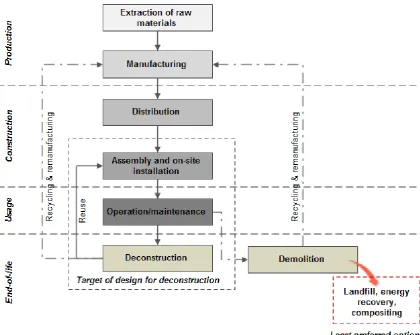
and the generation of CDW is minimised. Figure 1 shows how deconstruction enables a closed 78
material loop condition at the end-of-life of buildings. The closed material loop eliminates the linear 79
4 81
Figure 1: End-of-life scenario in a closed material loop condition
82
The aim of building deconstruction is to eliminate demolition as an end-of-life building disposal 83
option. Apart from favouring the recovery of building components and diversion of waste from 84
landfills, deconstruction is more beneficial than demolition in other ways. First, deconstruction 85
eliminates environmental pollution and CDW generation that is characteristics of demolition 86
(Akbarnezhad et al., 2014). Other benefits include reduction in harmful emission (Chini and 87
Acquaye, 2001), preservation of the embodied energy (Thormark, 2001), reduction in site 88
disturbance (Lassandro, 2003), etc. 89
Kibert (2008) suggests that effective strategy for closed-loop building material usage and material 90
recovery requires basic rules which are: (a) building must be fully deconstructible; (b) building must 91
be disassemblable; (c) construction materials must be recyclable; (d) the production and use of 92
materials must be harmless; (e) material generated as a result of the recycling process must be 93
5
reuseable/recyclable to reduce waste generation at the end of the useful life of a facility. These rule 95
upholds the reports by Egan (1998) and Latham (1994), which highlight the need to improve design 96
and construction processes in order to improve efficiency and sustainability. 97
2.1
Existing design for deconstruction tools
98
Considering the impacts of design on how buildings are constructed, it is necessary to understand 99
how design decisions affect how buildings are assembled and disassembled. Akinade et al. (2015) 100
highlighted that tackling this challenge requires the knowledge of the intertwined relationships 101
among design practice, DfD techniques and DfD tools. This therefore calls for a holistic approach 102
to how the interplay among these key areas could ensure successful building deconstruction. 103
Accordingly, the impact of computer tools for DfD and assessing the sustainability of building 104
cannot be overemphasised in this regards. In order to access the effectiveness and limitations of 105
existing DfD tools as presented in several studies, a thorough review of extant literature was carried 106
out. The review reveals that DfD tools covers life cycle assessment tools, environmental 107
sustainability tools and life cycle costing tools. The tools and how they match up with DfD related 108
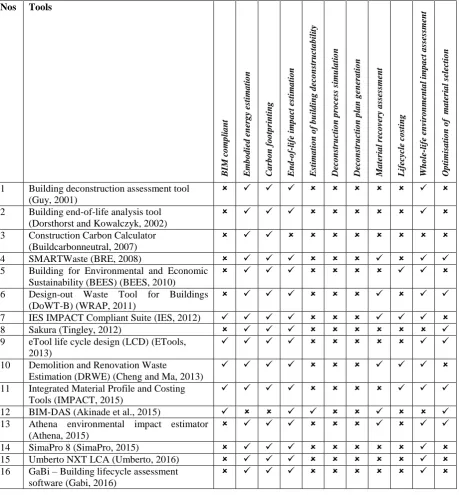
criteria are presented in Table 1. 109
110
6
Table 1: Existing DfD tools and their features
112
Nos Tools
BIM co m p li a n t Em b o d ied e n erg y estim a ti o n Ca rb o n fo o tp ri n ti n g En d -of -l ife i m p a ct e stim a ti o n Estim a ti o n o f b u il d in g d ec o n stru cta b il ity De co n structio n p ro ce ss sim u la ti o n De co n structio n p la n g en era ti o n M a ter ia l re co ve ry a ss ess m en t Li fe cy cle co stin g W h o le -li fe e n viro n m en ta l imp a ct a ss ess m en t Op ti m isa ti o n o f m a ter ia l se lec ti o n
1 Building deconstruction assessment tool
(Guy, 2001)
2 Building end-of-life analysis tool
(Dorsthorst and Kowalczyk, 2002)
3 Construction Carbon Calculator
(Buildcarbonneutral, 2007)
4 SMARTWaste (BRE, 2008)
5 Building for Environmental and Economic
Sustainability (BEES) (BEES, 2010)
6 Design-out Waste Tool for Buildings
(DoWT-B) (WRAP, 2011)
7 IES IMPACT Compliant Suite (IES, 2012)
8 Sakura (Tingley, 2012)
9 eTool life cycle design (LCD) (ETools,
2013)
10 Demolition and Renovation Waste
Estimation (DRWE) (Cheng and Ma, 2013)
11 Integrated Material Profile and Costing
Tools (IMPACT, 2015)
12 BIM-DAS (Akinade et al., 2015)
13 Athena environmental impact estimator
(Athena, 2015)
14 SimaPro 8 (SimaPro, 2015)
15 Umberto NXT LCA (Umberto, 2016)
16 GaBi – Building lifecycle assessment
software (Gabi, 2016)
113
Chief among the limitations of existing tools is that they are not BIM-compliant. Likewise, none of 114
the existing BIM software offers DfD functionalities. This evidence shows that despite the steep 115
rise in BIM implementation for several purposes, BIM implementation for end-of-life scenario of 116
buildings is not common practice. Although several studies suggest that BIM has the potentials for 117
end-of-life waste minimisation but no clear instructions has been provided on achieving this 118
7
Considering the recent trend of BIM implementation in the AEC industry, it is evident that BIM 120
will continue to change ICT usage and the industry’s cultural process (Arayici et al., 2011). This 121
game changing endeavour as well as the numerous benefits and opportunities accruable from BIM 122
adoption have prompted many countries, such as USA, UK, China, Finland, Qatar, Singapore, 123
France, etc., to invest in BIM capability development. it is therefore envisaged that BIM will 124
continue to play an important role in collaborative practices in the highly multi-disciplinary AEC 125
industry for several years. This clearly shows that a tight integration of BIM and DfD would 126
therefore be an effort in the right direction since evidence suggest that planning for effective 127
construction, operation and end-of-life management of buildings must start from the design stage 128
(Faniran and Caban, 1998; Wang et al., 2014). This brings to the fore the need for the 129
implementation of BIM-based DfD tools to ensure that participating teams can implement 130
appropriate deconstruction principles right from the design stage. These tools will be in form of 131
plugins to existing BIM software to extend their functionalities. Based on the foregoing, this paper 132
therefore seeks to unravel how BIM could complement DfD processes and to identify the essential 133
functionalities that a BIM-based tool for deconstruction must have. 134
3
Methodology
135
After identifying the limitations of existing DfD tools, a descriptive interpretive study was carried 136
out to understand how effective deconstruction process could be achieved by employing current 137
capabilities of BIM. According to Creswell (2014), descriptive interpretive methodology seeks to 138
qualitatively exhume common meaning from the experiences of several individuals. In this way, it 139
allows deep understanding of individuals’ experience about a phenomenon. This is based on the 140
belief that a poorly conceptualised phenomenon could only be addressed if the researcher is in active 141
correspondence with the participants (Holloway and Wheeler, 1996). Van Manen (1990) also 142
highlights that being interested in the story of others is the basic underlying assumption of 143
descriptive interpretive study. The investigators therefore try to set aside their experience to have a 144
fresh perspective in exploring a phenomenon. In this regard, this study seeks to explore the 145
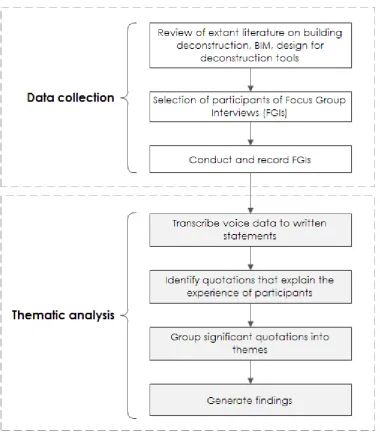
experiences of the participants in terms of the use of BIM for DfD. The methodological flowchart 146
for the study is shown in Figure 2. 147
8 149
Figure 2: Methodological flowchart for the study
150
According to Moustakas (1994), two data collection methods dominate descriptive interpretive 151
studies, which are in-depth interviews and Focus Group Interviews (FGIs). In-depth interview is 152
conducted with individuals to elicit their perspective of a phenomenon, while FGIs particularly 153
involves discussion among selected group of participants regarding a common experience (Hancock 154
et al., 1998). In this study, FGIs are employed over individual interviews because FGIs allow 155
participants to build on responses of others while discussing their personal experience. This 156
approach provides deeper insights into a wide range of perspectives within a short time and it also 157
9
Multiple FGIs were therefore conducted with participants selected from the UK construction 159
companies who have partially or fully implemented BIM on their projects. The sampling was done 160
in a way that individuals who are directly involved in building design and BIM were chosen. The 161
FGIs provide a forum for practitioners within the AEC industry to share their views and expectations 162
on BIM usage for DfD. Although the practitioners are not specialists in tool development, 163
understanding their views and expectation could help to uncover and analyse the industry 164
requirement of BIM in DfD across different disciplines. In addition, end users are key in the 165
engineering of any useful innovation development and their views and expectations need to be taken 166
into consideration (Oyedele, 2013). Accordingly, 20 professionals were selected based on 167
suggestion of Polkinghorne (1989) who recommended that FGI participants should not exceed 25. 168
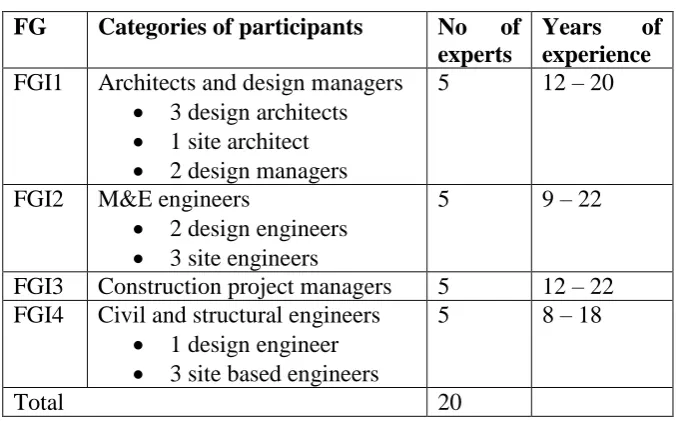
The distribution and the range of years of experience of the participants of the focus groups are 169
shown in Table 2. The distribution of year of experience of participants across all focus groups is as 170
shown in Figure 3. 171
Table 2: Overview of the focus group discussions and the participants
172
FG Categories of participants No of experts
Years of experience FGI1 Architects and design managers
3 design architects 1 site architect 2 design managers
5 12 – 20
FGI2 M&E engineers
2 design engineers 3 site engineers
5 9 – 22
FGI3 Construction project managers 5 12 – 22 FGI4 Civil and structural engineers
1 design engineer 3 site based engineers
5 8 – 18
Total 20
173
Participants of the FGIs were encouraged to discuss openly on the limitations of existing DfD 174
practices and their expectations of BIM concerning DfD. This was done with the aim of 175
understanding the possibilities of addressing limitations of DfD tools with the current capabilities 176
of BIM. Discussion and interactions among participants were recorded on a digital recorder and 177
10
study were captured. Afterward, the voice recordings were transcribed and segmented for thematic 179
analysis. These tasks were conducted to develop clusters of meanings by themes identification. 180
181
Figure 3: Distribution of year of experience of participants across all focus
182
groups
183
4
Analyses and Results
184
In a descriptive interpretive research, data analyses follow structured methods, which starts with the 185
description of researchers’ own experiences followed by the description of textual and structural 186
discussions of participants’ experiences (Creswell, 2013). This allows the researcher to move from 187
a narrow unit of analysis to broader units. According to Moustakas (1994), descriptive interpretive 188
research follows a concise analytical approach as summarised in Table 3. 189
190
191
11
Table 3: Descriptive interpretive analysis process
193
Step Analytical Method Activity
1. Describe personal experience with phenomenon.
This is important to set aside personal experiences and to focus on participants’ experiences.
2. Develop a list of significant statements from interview transcripts.
Transcribe voice data to written statements.
Identify quotations that explain participants’ experiences with phenomenon.
3. Develop coding scheme for thematic analysis
Identify units of meaning using thematic analysis
Group significant statements into themes using coding scheme
4. Describe “what” participants experience
with phenomenon
Carry out a textual description of participants’ experiences with verbatim quotations.
5. Describe “how” the experiences happened. Carry out a structural description of the setting and
context in which phenomenon was experienced. 6. Synthesise “what” the participant
experienced and “how” they experienced it
Carry out a composite description that contains the textual and structural descriptions
194
Thematic analysis was carried out using appropriate coding scheme to identify units of meaning 195
from significant statement and to classify them into recurring themes. The coding scheme employs 196
four tags, which are discipline, context, keywords, and theme category. Discipline coding 197
classification shows the job role of the participant that provided a transcript segment. Context coding 198
depicts the circumstances informing a transcript segment. The context coding classification include: 199
(i) New – marks the start of a new subject of discussion; (ii) Response – signifies a response to a 200
question; (iii) Build-up – shows when a contribution to an ongoing discussion is made; and (iv) 201
Moderator – marks a control segment provided by the moderator. Keyword coding classification 202
depicts a summary of the main issue raised within a segment. This helps to identify prevalent issues 203
and concerns across the transcript. The keywords are underlined within the quotation segments. The 204
theme category shows the principal theme under which the issue discussed in the transcript segment 205
falls. Example of quotation classification based on this coding scheme is shown in Table 4. 206
Table 4: Example of classification based on the coding scheme
207
No. Quotation Source Discipline Context Theme category
1. “…We can then use the tools to
determine the type and volume of materials that can be reused after deconstruction”
FGD 2 Design
engineer
New Quantification of
recoverable material
2. “…BIM can allow the visualisation of
building demolition and deconstruction process during the design”
FGD 1 Design
architect
Build-up Visualisation of
12
The results of the analyses suggest that it is important to adopt solutions available within tools used 208
throughout the entire lifecycle of buildings in the implementation of a robust tool for DfD. This is 209
to ensure effective management of end-of-life scenarios right from the planning stages, through 210
subsequent stages, i.e., design, construction, commissioning, usage and maintenance stages. 211
Arguably, the participants of FG1 pointed out directions for the adoption of BIM for DfD as follows: 212
A major breakthrough in the construction industry is the use of BIM packages
213
to model, visualise and simulate building forms and performances. In fact,
214
any useful innovation in the AEC industry must embrace BIM…
215
“We all understand that the usability of building components is influenced by
216
various decisions made throughout the life of the building. In order to ensure
217
that a building is fit for disassembly, it is important that tools [design for
218
deconstruction tools] are accessible within current BIM design tools used
219
throughout the lifecycle of buildings…”
220
“We know that end-of-life activities are influenced by decisions made at all
221
building stages. As such, to ensure that buildings are demountable at the
end-222
of-life, project teams must use tools that are relevant from the design stage
223
throughout the entire building cycle …”
224
These assertions imply that the future DfD tools must be BIM compliant considering the current 225
rate of BIM adoption in the industry. The participants echoed that integrating DfD with BIM would 226
offer greater flexibility to influence end-of-life performance of buildings at a stage where design 227
change is cheaper. 228
Thematic data analysis reveals seven key BIM functionalities to be leveraged for DfD. These key 229
functionalities include: (i) improved stakeholders’ collaboration, (ii) visualisation of deconstruction 230
process, (iii) identification of recoverable materials, (iv) deconstruction plan development, (v) 231
performance analysis and simulation of end-of-life alternatives, (vi) improved building whole life 232
management, (vii) interoperability with existing BIM software. Thereafter, these key functionalities 233
13
framework highlights the potentials of BIM in driving effective DfD and it provides a basis for the 235
development of BIM-based DfD tools. 236
237
Figure 4: Functionality framework for BIM-based design for deconstruction
238
tools
14
5
Functionality framework for BIM-based design for
240
deconstruction tools
241
This section discusses the functionality framework for BIM-based DfD tools. The identified 242
functionalities would exploit existing BIM key functionalities through BIM software Application 243
Programming Interface (API) (Akinade et al., 2016; Bilal et al., 2016b). The key components of 244
functionality framework are as follows: 245
5.1
Improved collaboration among stakeholders
246
The extent to which project teams collaborate and communicate is critical to the success of building 247
construction projects (Oyedele and Tham, 2007). DfD takes no exception to this because it is 248
important that continued justification should be provided for deconstruction at all life cycle stage 249
and all stakeholders must be committed to it. In this regard, BIM can play a major role in ensuring 250
that all stakeholders are actively involved in taking deconstruction related decisions right from 251
planning through the entire building life cycle. In keeping with the foregoing fact, the participants 252
of FGI3 suggest that adopting BIM on projects allows every member of the project teams to focus 253
on the success of the project. It was stressed that: 254
“Taking the right decisions for this [design for deconstruction] requires
255
using appropriate tools from the design stages. Such tools will help all teams
256
to contribute to project decisions and to the success of the project…”
257
Collaborative stakeholders’ relationship approach encourages ‘shared risk and shared reward’ 258
philosophy, which engenders process efficiency, harmony among stakeholders and reduced 259
litigation (Eadie et al., 2013a). As such, BIM provides a robust platform for communication and 260
information sharing amongst all stakeholders. BIM also engenders design coordination, task 261
harmonisation, clash detection, and CDW management process monitoring. The participants of 262
FGI3 echoed that incorporating DfD functionality into BIM would encourage effective participation 263
of all projects teams. Adopting BIM would therefore facilitate transparent access to shared 264
15
5.2
Visualisation of deconstruction process
266
A common thread runs through all BIM software and it is parametric modelling functionality that 267
enables visualisation of the aesthetics and functions of buildings (Sacks et al., 2004). According to 268
Tolman (1999). Parametric modelling employs an object-oriented approach that enables the reuse 269
of object instances in building models, while sustaining object attributes, behaviour and constraints. 270
This feature has aided the adoption of BIM across the AEC industry to improve project delivery and 271
building performance. However, parametric modelling has not been leveraged for visualising 272
building deconstruction process at the design stage and before the actual deconstruction takes place. 273
This belief was shared by the participants of FGI1 who agreed that: 274
Visualising forms and performances of buildings has reduced the need for
275
rework that serves as the major source of construction waste. Likewise, BIM
276
can allow the visualisation of building demolition and deconstruction process
277
during the design … However, no BIM tool currently offers this capability …
278
This excerpt suggests that a BIM platform that allows deconstruction process visualisation would 279
assist to optimise the DfD process in order to benchmark and minimise the impact of end-of-life 280
alternatives. In addition, enabling this feature in BIM software will help to prepare adequately for 281
the actual deconstruction at the end-of-life of buildings. This will help to develop appropriate pre-282
deconstruction audit report and to put in place strategies for site, transport, and waste management. 283
5.3
Quantification of recoverable materials
284
BIM implementation goes beyond 3D computer modelling and visualisation (Eastman et al., 2011). 285
A key feature that make BIM stands out is Intelligent modelling that provides the ability to embed 286
key asset and process information into building models right from the early planning stage and 287
throughout the life of the building (Xu-dong and Jie, 2006). The information is preserved within a 288
federated model to improve decision making during construction, maintenance of buildings and at 289
the end-of-life of buildings. Accordingly, information about building materials could be enriched to 290
support the whole life performance prediction of the materials. This will therefore empower BIM to 291
be employed in the identification of recoverable material types and quantity throughout the entire 292
16
Design for deconstruction practice will be taken seriously if it is possible to
294
predict the amount of recoverable elements at the end-of-life of buildings…
295
… This [design for deconstruction tool] will be usable if it is accessible within
296
BIM platforms. We can then use the tools to determine the type and volume
297
of materials that can be reused after deconstruction.
298
The above assertions suggest that apart from the visualisation of deconstruction process, a key 299
feature that BIM-based DfD tools must have is the ability to predict the amount of recoverable and 300
non-recoverable materials at the end-of-life of buildings. This feature will allow stakeholder to be 301
able to predict types and volume of materials that are reusable, those that could be recycled, and 302
those that must be disposed. Achieving this will enable the provision of empirical evidence in 303
support of DfD. 304
5.4
Deconstruction plan development
305
In agreement with earlier studies, the participants of the FGIs agreed that another benefit of BIM is 306
automatic capture of design parameters for report generation. It was highlighted during the FGIs 307
that employing BIM during design would eliminate human error during data entry. For example, 308
existing DfD require practitioners to manually transfer design parameters from the bill of quantity. 309
This approach therefore makes these tools susceptible to errors in waste estimation. It was 310
highlighted in FGI2 that this feature could be harness in the development of deconstruction plans 311
and other documents such as pre-demolition audit reports and pre-refurbishment audit reports: 312
“One would appreciate the use of BIM when its potential is fully utilised
313
especially when design documents are generated on the fly...”
314
“… In terms of design for deconstruction, I believe BIM could be used to
315
prepare the deconstruction plans and end-of-life audit reports at varying level
316
of details”
17
In support of the above excerpts, Davison and Tingley (2011) argue that the development of a 318
deconstruction plan is an important requirement for a successful DfD. However, no tool exists with 319
the capability of generating deconstruction plans from building models. The participants also argued 320
that BIM features that enable on-demand generation of design documents (such as plan drawings, 321
sections, schedules, etc.) from the model of the buildings could be leveraged for deconstruction plan 322
development. This therefore will improve design coordination, time management, and engineering 323
capabilities of DfD activities and documentation. 324
5.5
Performance analysis and simulation of end-of-life alternatives
325
Another functionality of BIM that aids its wide acceptability is the ability to analyse and simulate 326
buildings’ performance such as cost estimation, energy consumption, lighting analysis, etc. 327
(Manning and Messner, 2008). According to Eastman et al. (2011), building performance analyses 328
provide a platform for functional evaluation of building models before the commencement of 329
construction. This allows comparison of alternative design options in selecting the most cost-330
effective and sustainable solution. The increasing popularity of BIM in the AEC industry has 331
strengthened the development of various tools for design analyses and performance evaluation. 332
Performance evaluation capability of BIM could be employed in DfD tools to identify possible 333
design and operational errors that can hamper deconstruction. The participants of FGI1 highlighted 334
that despite the availability of BIM based tools for the analyses of various building performances 335
such as airflow, energy, seismic analyses, etc., no tool exists for DfD: 336
“A major breakthrough we have experienced in the construction industry is
337
the ability to carry out performance analysis on building models. Numerous
338
performance analyses are available to identify potential design errors and
339
operational issues at a stage where design changes are cheaper…”
340
“Despite the benefits of building performance analysis and the
341
environmental/economic impacts of construction waste, none of the existing
342
BIM software has capabilities for design for deconstruction. This gap calls
343
for a rethink of BIM functionalities towards capacity for end-of-life
344
simulation of building performance and disposal options right from early
345
design stages.”
18
To support the above excerpts, the use of BIM for the analysis and simulation of deconstruction 347
process will help to justify the environmental and economic benefits of deconstruction. This is 348
because evidence shows that building deconstruction may be the most environmentally beneficial; 349
however, it may not be the most economically viable option (Hamidi and Bulbul, 2012). As such, 350
BIM can be used to simulate the cost benefit performance of deconstruction in order to decide on 351
the appropriate design and end-of-life options. 352
5.6
Improved building lifecycle management
353
While discussing the role of BIM in whole-life performance of buildings, the participants agreed 354
that the use of BIM encompasses all project work stages from the planning stage to the end-of-life 355
of buildings. BIM allows information on building requirements, planning, design, construction, and 356
operations can be amassed and used for making management related decisions on facilities. This 357
feature allows all teams to embed relevant project information into a federated model. For instance, 358
project information such as bill of quantity, project schedule, cost, facility management information, 359
etc. is incorporated into a single building model. The information thus enables a powerful modelling, 360
visualisation and simulation viewpoint that helps to identify design, construction and operation 361
related problems before they occur. This distinguishing feature makes BIM applicable to all work 362
stages by accumulating building lifecycle information (Eadie et al., 2013b). The participants of FGI1 363
suggest that: 364
“Many practitioners in the AEC industry understand the benefits of adding
365
more information into models, which could extend parametric BIM into 4D,
366
5D, 6D, etc. Preserving information throughout the lifecycle of buildings is
367
important for effective facility management. In addition, the information
368
could be accessed to make useful end-of-life decisions for buildings.”
369
In addition, improved lifecycle management of building offered by BIM encourages data 370
transparency, concurrent viewing and editing of a single federated model, and controlled 371
coordination of information access (Grilo and Jardim-Goncalves, 2010). In this way, BIM helps to 372
address interdisciplinary inefficiency (Arayici et al., 2012) within the fragmented AEC industry. 373
This will certainly improve team effectiveness while reducing project cost and duplication of effort. 374
19
surpass the cost. The participants highlighted that since waste is generated at all project work stages, 376
adopting BIM for waste management will allow effective capturing of waste related data from 377
design to the end-of-life of buildings. 378
5.7
Interoperability with existing BIM software
379
Although one could argue that the adoption of BIM is on the rise (Arayici et al., 2011), a major 380
challenge confronted by construction companies is software interoperability (Steel et al., 2012). In 381
view of this, project teams expend much effort in carefully selecting appropriate BIM software for 382
effective collaboration and communication. This view was also shared among the participants of 383
the FGIs. The participants highlighted that the use of IFC standard has improved model exchange 384
among BIM software for design analyses. It was agreed among the participants of FGI1 that future 385
DfD tools must embrace IFC open schema for model exchange with BIM software: 386
“While BIM software have diverse schema for model representation, the IFC
387
open standard has allowed seamless exchange of models among them. One
388
can now easily share building models with other project teams with different
389
BIM software. Future DfD tools must therefore be BIM compliant and must
390
support the use of IFC …”
391
It is worth noting that IFC schema allows the extension of its tags to capture various parameters for 392
building objects. Despite this opportunity, IFC schema has not been equipped with adequate 393
mechanism to streamline construction waste analysis and deconstruction process. This gap calls for 394
a closer look into how IFC could be extended to support data exchange between DfD tools and BIM 395
software. As such, information exchange requirement of DfD processes need to be identified and 396
captured within existing BIM and IFC models. 397
6
Conclusion
398
It is evident that despite the benefits accruable from the use of BIM, its use for end-of-life scenarios 399
is often neglected. Giving more attention to the end-of-life of building is important because 400
demolition activities accounts for over 50% of the total CDW output of the construction industry. 401
20
efficient DfD. Although architects and design engineers are aware of DfD, existing DfD tools cannot 403
support them effectively. Based on the foregoing, this study therefore seeks to identify essential 404
functionalities of a BIM-based DfD tools. This is because evidence shows that design decisions 405
have high impact on the entire life cycle of buildings (Faniran and Caban, 1998; Osmani et al., 2008) 406
and that design based philosophy offers flexible and cost-effective approach to building life cycle 407
management. 408
To achieve the objectives of this study, this paper assesses limitations of existing DfD tools and 409
discusses the role of BIM in effective DfD. Thereafter, the study employs a descriptive interpretive 410
methodological framework in order to enhance an in-depth exploration of how the experience of 411
experts could help to address the phenomenon under study. After conducting a set of FGIs to discuss 412
BIM functionalities for DfD with professional from the construction industry, the qualitative data 413
analysis of the data reveals seven key functionalities of BIM-based DfD tools. The key 414
functionalities include (i) improved collaboration among stakeholders, (ii) visualisation of 415
deconstruction process, (iii) identification of recoverable materials, (iv) deconstruction plan 416
development, (v) performance analysis and simulation of end-of-life alternatives, (vi) improved 417
building lifecycle management, and (vii) interoperability with existing BIM software. The key 418
functionalities were then developed into a BIM functionality framework for integrating existing 419
DfD tools with BIM platforms. 420
The study suggests that the adoption of BIM could significantly increase the performance of DfD 421
tools. To achieve this, the BIM functionality framework for DfD tools highlights the potentials of 422
BIM in driving effective DfD and it provides a basis for the development of BIM-based DfD tools. 423
The study therefore shows that BIM is key to improve the collaborative capabilities of DfD tools. 424
This is especially required as the industry is far shifting towards a fully collaborative digital 425
workflow and the building deconstruction industry can benefit from this. In addition, this study 426
implies that visualisation capability of BIM could be employed to simulate and visualise building 427
deconstruction process during the design stage. This will enable for the detection of possible site 428
operational or management issues, such as transportation logistics, waste management, scaffolding 429
requirements, health and safety considerations, that could hinder building deconstruction. 430
Achieving this will help to identify recoverable materials during simulation of deconstruction 431
21
Furthermore, BIM will empower DfD tools for improved document management and improved 433
lifecycle management. Deconstruction plan could therefore be developed and embedded within a 434
BIM federated model to support end-of-life deconstruction of the building. In addition, BIM will 435
enable software interoperability between DfD tools and existing BIM platforms. This will enable 436
DfD tools and BIM software to exchange data seamlessly without any loss of information. The 437
study therefore reveals the need to explore how IFC could be extended to support data exchange 438
between DfD tools and BIM software. This therefore necessitates the identification of information 439
exchange requirements and format that capture DfD needs within existing BIM and IFC models. 440
In a summarised discussion, this study presents dual contributions: (i) the results of this study 441
improves the understanding of BIM functionalities and how they could be employed to improve the 442
effectiveness of existing DfD tools, and (ii) the BIM functionalities framework will support the 443
implementation of BIM-based software prototypes for DfD management. These contributions have 444
significant implications for DfD research and industrial practices. The BIM functionalities 445
framework highlights the potentials of BIM in driving effective DfD process and providing a basis 446
for the development of BIM-based DfD tools. BIM software and DfD tools developers would 447
benefit from the results of this study by providing deeper understanding of what is required to enable 448
a BIM-based DfD. The capabilities of BIM for visualisation and analysis could thus be leveraged 449
to simulate deconstruction processes from the design stage. 450
Despite the contributions of this study, there are some limitations. First, the study was carried out 451
using qualitative methods to explore depth rather than breadth obtainable with quantitative methods. 452
As such, further studies could investigate the generalisation of the findings from this study using a 453
quantitative approach such as questionnaire survey. This is necessary to understand whether the 454
findings from the small sample FGIs could be generalised to a larger sample. Second, the 455
participants of the FGIs were drawn from the UK only. The results should therefore be interpreted 456
and used within this context. Other studies can explore transferability of findings from this study to 457
other countries. In this way, the result of this study could provide a basis for comparative study with 458
22
Acknowledgement
460
The authors would like to express their sincere gratitude to Innovate UK (grant application No. 461
54832 – 413479 and File No 102473) and EPSRC (Grant Ref: EP/N509012/1) for providing the 462
financial support for this study. 463
References
464
Akbarnezhad, a., Ong, K.C.G., Chandra, L.R., 2014. Economic and environmental assessment of 465
deconstruction strategies using building information modeling. Autom. Constr. 37, 131–144. 466
doi:10.1016/j.autcon.2013.10.017 467
Akinade, O.O., Oyedele, L.O., Bilal, M., Ajayi, S.O., Owolabi, H.A., Alaka, H.A., Bello, S.A., 468
2015. Waste minimisation through deconstruction: A BIM based Deconstructability 469
Assessment Score (BIM-DAS). Resour. Conserv. Recycl. 105, 167–176. 470
doi:10.1016/j.resconrec.2015.10.018 471
Akinade, O.O., Oyedele, L.O., Munir, K., Bilal, M., Ajayi, S.O., Owolabi, H.A., Alaka, H.A., Bello, 472
S.A., 2016. Evaluation criteria for construction waste management tools: towards a holistic 473
BIM framework (in press). Int. J. Build. Technol. urban Dev. 1–19. 474
Arayici, Y., Coates, P., Koskela, L., Kagioglou, M., Usher, C., O’Reilly, K., 2011. BIM adoption 475
and implementation for architectural practices. Struct. Surv. 29, 7–25. 476
Arayici, Y., Egbu, C., Coates, P., 2012. Building information modelling (Bim) implementation and 477
remote construction projects: Issues, challenges, and critiques. Electron. J. Inf. Technol. 478
Constr. doi:ISSN 1874-4753 479
Athena, 2015. Athena Sustainable Materials Institute Homepage [WWW Document]. URL 480
http://www.athenasmi.org/ (accessed 10.28.15). 481
BEES, 2010. Building for Environmental and Economic Sustainability [WWW Document]. URL 482
http://www.nist.gov/el/economics/BEESSoftware.cfm (accessed 4.25.16). 483
Bilal, M., Oyedele, L.O., Akinade, O.O., Ajayi, S.O., Alaka, H.A., Owolabi, H.A., Qadir, J., Pasha, 484
M., Bello, S.A., 2016a. Big data architecture for construction waste analytics (CWA): A 485
conceptual framework. J. Build. Eng. doi:10.1016/j.jobe.2016.03.002 486
Bilal, M., Oyedele, L.O., Qadir, J., Munir, K., Akinade, O.O., Ajayi, S.O., Alaka, H.A., Owolabi, 487
H.A., 2016b. Analysis of critical features and evaluation of BIM software: towards a plug-in 488
for construction waste minimization using big data. Int. J. Sustain. Build. Technol. Urban Dev. 489
1–18. 490
BRE, 2008. SMARTWASTE [WWW Document]. URL http://www.smartwaste.co.uk/index.jsp 491
(accessed 4.25.16). 492
Buildcarbonneutral, 2007. Construction Carbon Calculator [WWW Document]. URL 493
http://buildcarbonneutral.org/ (accessed 4.24.16). 494
Cheng, J.C.P., Ma, L.Y.H., 2013. A BIM-based system for demolition and renovation waste 495
estimation and planning. Waste Manag. 33, 1539–51. doi:10.1016/j.wasman.2013.01.001 496
23
Proceedings of the CIB Task Group 39-Deconstruction Meeting. pp. 138–162. 498
Creswell, J.W., 2014. Research design: Qualitative, quantitative, and mixed methods approaches. 499
Sage Publications, London. 500
Creswell, J.W., 2013. Qualitative inquiry and research design: Choosing among five approaches, 501
3rd ed. Sage Publications, London. doi:10.1111/1467-9299.00177 502
Davison, B., Tingley, D.D., 2011. Design for deconstruction and material reuse. Proc. ICE - Energy 503
164, 195–204. doi:10.1680/ener.2011.164.4.195 504
Dorsthorst, B., Kowalczyk, T., 2002. Design for recycling. Design for deconstruction and materials 505
reuse, in: Proceedings of the International Council for Research and Innovation in Building 506
Construction (CIB) Task Group 39 – Deconstruction Meeting. Karlsruhe, pp. 70–80. 507
Eadie, R., Browne, M., Odeyinka, H., McKeown, C., McNiff, S., 2013a. BIM implementation 508
throughout the UK construction project lifecycle: An analysis. Autom. Constr. 36, 145–151. 509
doi:10.1016/j.autcon.2013.09.001 510
Eadie, R., Browne, M., Odeyinka, H., McKeown, C., McNiff, S., 2013b. BIM implementation 511
throughout the UK construction project lifecycle: An analysis. Autom. Constr. 36, 145–151. 512
doi:10.1016/j.autcon.2013.09.001 513
Eastman, C., Teicholz, P., Sacks, R., Liston, K., 2011. BIM handbook: A guide to building 514
information modeling for owners, managers, designers, engineers and contractors. John Wiley 515
& Sons. 516
Egan, J., 1998. Rethinking construction, Department of the Environment, Transport and the 517
Regions, London. 518
ETools, 2013. eToolLCD [WWW Document]. URL http://etoolglobal.com/about-etoollcd/ 519
(accessed 4.25.16). 520
Faniran, O., Caban, G., 1998. Minimizing waste on construction project sites. Eng. Constr. … 5, 521
182–188. 522
Gabi, 2016. GaBi - Building Life Cycle Assessment software [WWW Document]. URL 523
http://www.gabi-software.com/international/solutions/building-lca/ (accessed 4.24.16). 524
Grilo, A., Jardim-Goncalves, R., 2010. Value proposition on interoperability of BIM and 525
collaborative working environments. Autom. Constr. 19, 522–530. 526
doi:10.1016/j.autcon.2009.11.003 527
Guy, B., 2001. Building deconstruction assessment tool. Deconstruction Mater. Reuse Technol. 528
Econ. Policy 125–136. 529
Hamidi, B., Bulbul, T., 2012. A Comparative Analysis of Sustainable Approaches to Building End-530
of-Lifecycle: Underlying Deconstruction Principles in Theory and Practice, in: ICSDEC 2012. 531
American Society of Civil Engineers, pp. 155–162. doi:doi:10.1061/9780784412688.018 532
Hancock, B., Ockleford, E., Windridge, K., 1998. An introduction to qualitative research. Trent 533
focus group, Nottingham. 534
Holloway, I., Wheeler, S., 1996. Qualitative research for nurses. Blackwell Science, Oxford. 535
IES, 2012. IMPACT Compliant Suite [WWW Document]. URL
536
http://www.iesve.com/software/ve-for-engineers/module/IMPACT-Compliant-Suite/3273 537
(accessed 4.25.16). 538
24
http://www.impactwba.com/index.jsp (accessed 4.25.16). 540
Jaillon, L., Poon, C.S., 2014. Life cycle design and prefabrication in buildings: A review and case 541
studies in Hong Kong. Autom. Constr. 39, 195–202. doi:10.1016/j.autcon.2013.09.006 542
Kibert, C.J., 2008. Sustainable Construction: Green Building Design and Delivery: Green Building 543
Design and Delivery. John Wiley & Sons. 544
Kibert, C.J., 2003. Deconstruction: the start of a sustainable materials strategy for the built 545
environment. Ind. Environ. 26, 84–88. 546
Lassandro, P., 2003. Deconstruction case study in Southern Italy: economic and environmental 547
assessment, in: CIB Publication. 548
Latham, M., 1994. Constructing the team: joint review of procurement and contractual arrangements 549
in the United Kingdom construction industry: final report. Available from 550
http//www.cewales.org.uk/cew/wp-content/uploads/Constructing-the-team-The-Latham-551
Report.pdf. 552
Manning, R., Messner, J., 2008. Case studies in BIM implementation for programming of healthcare 553
facilities, in: ITcon - IT in Construction, 13 (Special Issue - Case Studies of BIM Use). ITcon. 554
Moustakas, C., 1994. Phenomenological research methods. Sage Publications. 555
Osmani, M., Glass, J., Price, A.D.F., 2008. Architects’ perspectives on construction waste reduction 556
by design. Waste Manag. 28, 1147–1158. 557
Oyedele, L.O., 2013. Analysis of architects’ demotivating factors in design firms. Int. J. Proj. 558
Manag. 31, 342–354. doi:10.1016/j.ijproman.2012.11.009 559
Oyedele, L.O., Tham, K.W., 2007. Clients’ assessment of architects’ performance in building 560
delivery process: Evidence from Nigeria. Build. Environ. 42, 2090–2099. 561
doi:10.1016/j.buildenv.2005.06.030 562
Polkinghorne, D.E., 1989. Phenomenological research methods, in: Existential-Phenomenological 563
Perspectives in Psychology. Springer, pp. 41–60. 564
Sacks, R., Eastman, C.M., Lee, G., 2004. Parametric 3D modeling in building construction with 565
examples from precast concrete. Autom. Constr. 13, 291–312. 566
SimaPro, 2015. SimaPro 8: Sustainability Life Cycle Assessment Carbon Footprinting [WWW 567
Document]. URL http://www.simapro.co.uk/index.html (accessed 4.24.16). 568
Steel, J., Drogemuller, R., Toth, B., 2012. Model interoperability in building information modelling. 569
Softw. Syst. Model. 11, 99–109. doi:10.1007/s10270-010-0178-4 570
Thormark, C., 2001. Assessing the recycling potential in buildings, in: CIB Task Group 39: 571
Deconstruction and Materials Reuse: Technology, Economic, and Policy. University of 572
Florida, pp. 78–86. 573
Tingley, D.D., 2012. Design for Deconstruction: An Appraisal. The University of Sheffield. 574
Tolman, F.P., 1999. Product modeling standards for the building and construction industry: past, 575
present and future. Autom. Constr. 8, 227–235. 576
Umberto, 2016. Umberto NXT LCA [WWW Document]. URL
577
http://www.umberto.de/en/versions/umberto-nxt-lca/ (accessed 4.25.16). 578
Van Manen, M., 1990. Researching lived experience: Human science for an action sensitive 579
pedagogy. Suny Press. 580
25
at the design stage: A Shenzhen case study, China. Resour. Conserv. Recycl. 82, 1–7. 582
doi:10.1016/j.resconrec.2013.11.003 583
WRAP, 2011. Designing-out Waste Tool for Buildings. Available from http//dowtb.wrap.org.uk/. 584
Xu-dong, Z., Jie, T., 2006. BIM based on intelligent parametric modeling technology. J. Chongqing 585
Univ.(Natural Sci. Ed. 6, 27. 586