R E S E A R C H
Open Access
Changes in traditional ecological
knowledge of forage plants in immigrant
villages of Ningxia, China
Ying Ma
1, Binsheng Luo
1, Qiang Zhu
2, Dongxing Ma
3, Qi Wen
4, Jinchao Feng
1and Dayuan Xue
1*Abstract
Background:Ecological migration serves as an important measure for poverty eradication as well as for the protection, inheritance, and utilization of traditional ecological knowledge. This study investigated and cataloged the traditional forage plant resources and recorded the associated traditional knowledge of immigrant villages in Hongsibu District of Ningxia, China. The diversity of traditional forage plant resources and the changes in associated traditional ecological knowledge were compared among ecological immigrant villages from different emigration areas, with a hope of providing a reference for forage development, the conservation of wild forage plant resources, and the development of regional animal husbandry.
Methods:From March 2018 to May 2019, a field investigation was conducted in six villages in Ningxia. Through the snowball technique, a total of 315 immigrants were interviewed using various methods, including semistructured interviews and key person interviews, which included opportunities for free listing. The changes in the utilization of traditional forage plants were compared between the ecological migrants and the original inhabitants, and the causes underlying the changes were analyzed. In addition, the major forage plant species in the research area were investigated and evaluated.
Results:(1) The six investigated villages reported 224 traditional forage plant species that belong to 42 families and 150 genera. Compared with their original living areas, the number of traditional forage plant species used in the immigrant villages decreased with the increase in the relocation distance. (2) The utilization of traditional forage plants varied among the immigrants who moved to Hongsibu District from forest areas, loess hilly areas, and semiarid desertified areas. The smaller the difference was in ecological environment between the immigration and emigration areas, the more the traditional forage plant knowledge had been retained. (3) The diversity and associated knowledge of traditional forage plants retained by ecological migrants are closely correlated to gender, age, education level, and occupation.
Conclusion:This study revealed that the diversity of traditional forage plants and associated knowledge retained after migration vary among ecological immigrants from different areas; generally, the immigrants that relocated from a closer place retained more ecological knowledge. In the immigrant villages with significantly different natural resources and a long distance from the migrants’original locations, the diversity of traditional forage plants decreased, and the traditional knowledge about forage plants showed signs of being forgotten and abandoned by the younger generation. Therefore, measures are urgently needed to document and protect the forage plant resources and preserve the traditional knowledge of ecological immigrants.
Keywords:Ecological immigrant, Forage plant, Traditional knowledge, Hongsibu District, Ningxia
© The Author(s). 2019Open AccessThis article is distributed under the terms of the Creative Commons Attribution 4.0 International License (http://creativecommons.org/licenses/by/4.0/), which permits unrestricted use, distribution, and reproduction in any medium, provided you give appropriate credit to the original author(s) and the source, provide a link to the Creative Commons license, and indicate if changes were made. The Creative Commons Public Domain Dedication waiver (http://creativecommons.org/publicdomain/zero/1.0/) applies to the data made available in this article, unless otherwise stated. * Correspondence:[email protected]
1College of Life and Environmental Sciences, Minzu University of China,
Beijing 100081, People’s Republic of China
Background
Based on the characteristics of local plant resources, local farmers and herdsmen inherit traditional know-ledge of forage plants [1] and have a deep understanding of and practical experience with local forage resources [2]. This plays an important role in maintaining the positive development of agricultural and animal hus-bandry socioecological systems [3]. Local farmers’ and herdsmen’traditional knowledge of forage plants, gained from local livelihoods and cultures that rely on natural herbage [4], plays an important role in regional biodiver-sity protection [5]. Farmers and herdsmen in areas with a long history of rearing livestock have a rich knowledge of forage plants, which has been recorded in the coun-tries such as Morocco, West Africa, Brazil, Ethiopia, Pakistan, and Austria [2, 4, 6–10] to provide techniques and strategies for utilization, classification management, and sustainable development of forage plant resources. As a contracting party of the Convention on Biological Diversity, China has made active efforts to protect and record traditional knowledge associated with biodiversity and biological resources over the past two decades [11, 12]. Traditional knowledge for sustainable use of forage plants is indispensable and invaluable. For example, under China’s policy of returning farmland to forests and grassland, farmers and herdsmen of Dulong (Drung or T’rung, an ethnic group in China) in the area of Yun-nan Province, where available grassland resources are very limited, successfully maintained a sustainable agri-cultural system for livestock, forage plants, and crops by using their knowledge of native forage plants [7]. Animal husbandry is an ecological adaptation of humans living in grasslands. The herdsmen in Inner Mongolia of China have accumulated relevant knowledge regarding palat-ability and seasonal periodicity of forage plants, as well as livestock fatness status, which provides a good refer-ence for the modernization of animal husbandry, such as intensive animal husbandry and the development of family farms [13].
Ecological migration is a phenomenon of population migration due to the interaction of ecological environ-ment and other factor s[14–16]. In China, due to the needs of ecological civilization construction [17] and the aim of eliminating poverty [18], populations formerly living in those areas for designed nature preservation, or with severely damaged ecological environments, or eco-logically fragile, or not suitable for human habitation, are requested to emigrate to other places for settlement. This is called ecological migration [14–18]. Ecological migration plays an important role in effectively alleviat-ing environmental degradation [19], improving the living standards of immigrants, and developing local economy [20]. As an important measure of protecting biodiversity and reducing poverty [21], ecological migration results
in a win-win situation to a certain extent. Ecological migration is of great value for preserving traditional cul-tures and knowledge related to biodiversity [22–25]. However, the separation of immigrants from their original natural resources and cultural atmosphere brings serious challenges regarding the preservation of traditional knowledge accumulated over generations [25], especially the inheritance of farmers and herds-men’s traditional knowledge of forage plants.
Ningxia is representative of an agro-pastoral transition zone [26] in China with massive ecological migration [27], where a thorough understanding regarding the connection and change between migrants and forage plant knowledge is particularly important. The forage plants in different ecological regions such as loess hilly regions, forest regions, and semiarid desertified regions in Ningxia have different characteristics. Therefore, trad-itional forage plant knowledge accumulated by farmers and herdsmen is regional, dependent, and adaptable. However, little attention has been paid to the impact of ecological migration on forage plant knowledge, and related research findings are scarce. Hence, further re-search on this topic is urgently needed. Through investi-gating the retention of traditional knowledge regarding forage plants and related livestock feeding experiences among ecological immigrants from different emigration areas in the Hongsibu District of Ningxia, this study aims to quantitatively analyze the changes in forage plant resources and the underlying influencing factors. Our findings may provide reference for the protection of forage plant resources and associated traditional know-ledge during the implementation of ecological migration policy.
Method
Research area
The research was conducted in six villages in the Ningxia Hui Autonomous Region: four immigration villages in Hongsibu District, one emigration village in Jingyuan County, Guyuan Prefecture, and one emigra-tion village in Haiyuan County, Zhongwei Prefecture (Fig.1, Tables1and2).
Yellow River to irrigate the barren land. Within 20 years, more than 200,000 people in central and southern Ningxia moved into Hongsibu District, an ecological migration representative area of poverty-alleviation actions. The four villages in the Hongsibu District research area were Liush-utai Village Group 2 in Xinzhuang, inhabited by people who moved from Shangwan Village in Xinmin, Jingyuan County, Guyuan, in 2006 (Village a); Yongxin Village Xinquan Group in Liuquan, inhabited by people who moved from Talachuan in Hechuan Village, Jiatang, Haiyuan County, Zhongwei, in 1999 (Village b); Xian-gyuan Village XianXian-gyuan Group in Dahe, inhabited by people who moved from Shuayishan Village in Shitangou Town, Tongxin County, Wuzhong, in 2000 (Village c); and Shuitao Village Group 1 in Liuquan, inhabited by people who moved from Shuitao Village–Wanghutai Village in Weizhou, Tongxin County, Wuzhong, in 2000 (Village d). Among them, Villages c and d are semiarid desertified areas, and their immigrants migrated from areas within 5 km.
Jingyuan County of Guyuan (106° 12′–106° 29′E, 35° 15′–35° 37′ N), located in the Liupan Mountain water conservation area in southwestern Ningxia, is the origin of the Jing River, Qingshui River, and Hulu River. It has a relatively humid climate with an annual precipitation of 300–600 mm. This area is covered with diverse types of vegetation, including temperate deciduous broad-leaved forests, coniferous and broad-broad-leaved mixed for-ests, mountain shrub steppe, and alpine and subalpine meadows. Animal and plant species in the area are
abundant, offering an important gene pool of animal and plant resources in Ningxia. In this research area was Village e: Zhangtai Village Team 3 in Xinmin, Jingyuan County, Guyuan, which is within a forest area. This village neighbors the location from where the residents of Village a emigrated. Haiyuan County of Zhongwei (105° 09′–106° 10′ E, 36° 06′–37° 04′ N) is located in the loess hilly area of Ningxia, which mainly includes loess hilly-gully and soil-rock mixed mountainous areas. It has an annual precipitation of 300–500 mm and is mainly covered by artificial deciduous broad-leaved for-ests, forest grasslands, and steppe. In this research area was Village f: Chenwan Team of Baotai Village, Jiatang of Haiyuan County, Zhongwei. It is a loess hilly area that neighbors the location from where the residents of Village b emigrated.
The dominant contributor to the livelihood of the six villages included in this study is animal husbandry, mainly cattle, and sheep farming. Other contributors include crop and forage production, forestry manage-ment, and related sectors. The ecological environment of these villages in Ningxia can be divided into three types: semiarid desertified for Villages a, b, c, and d; for-est for Village e; and loess hilly for Village f. Corres-pondingly, the types of forage plant resources vary among the three ecological environment types. Further, considering the migration status, the six villages selected are ideal for assessing changes in traditional forage plant knowledge of ecological migrants. In this study, the impact of ecological migration on the retention of
traditional forage plant knowledge was analyzed through evaluating the similarities and differences between mi-grants and residents in the unmoved village neighboring the original emigration location (Tables1and2).
Data collection
Data were collected from March 2018 to May 2019. During the initial stage from March to May 2018, a pre-liminary investigation of ecological migration projects and forage plant resources in Ningxia was conducted, from which six representative villages were selected for data collection. Subsequently, field surveys were con-ducted in the six villages from June 2018 to May 2019. With the help of general secretaries of local village com-mittees, heads of forest and grassland stations, and local livestock farming masters (“Yang ba shi”), 315 partici-pants (165 males and 150 females) were sampled through a snowballing technique and given semistruc-tured interviews. The interviewed households accounted for approximately 30% of total households in each village [7, 9, 28]. Prior to the study, informed consent was
obtained from all participants regarding the interview procedures. The demographic characteristics, including gender, age, education level, and occupation, are pre-sented in Table3[4,8].
In the field surveys, respondents were invited to freely list the forage plants they used [8,29]. The interview in-cluded the following questions: (1) Do you know which plants cattle and sheep like to eat? (2) What plants do you feed your cattle and sheep? (3) What parts of these plants do cattle and sheep eat? (4) Are these plants fed to cattle and sheep as tender grass or stored green hay? (5) What types of plants are used to feed livestock in each season? (6) Is there any difference in the plants fed to cattle and sheep before and after migration?
In the second stage of the field study, accompanied by plant experts from the local forest and grassland station and by livestock farming masters, the investigators identi-fied and collected forage plant samples and documented the detailed information of each sample. Voucher speci-mens and physical samples of forage plants were collected according to various identification documents, including Table 1Geo-relations of six villages in the research area
Ecological immigrant type Ecological immigration location Migration distance
Migration date
Neighboring village of the emigration area
Immigrants from the Liupan Mountain water conservation area
Village a, Liushutai Village Group 2 in Xinzhuang, inhabited by people who moved from Shangwan Village in Xinmin, Jingyuan County, Guyuan
Approximately 300 km
2006 Village e: Zhangtai Village Team 3 in Xinmin, Jingyuan County, Guyuan, which is an unmoved neighboring village of the original Shangwan Village in Xinmin, Jingyuan County, Guyuan
Immigrants from loess hilly areas
Village b: Yongxin Village Xinquan Group in Liuquan, inhabited by people who moved from Talachuan in Hechuan Village, Jiatang, Haiyuan County, Zhongwei
Approximately 200 km
1999 Village f: Chenwan Team of Baotai Village in Jiatang, Haiyuan County, Zhongwei, which is an unmoved neighboring village of the original Talachuan natural village of Hechuan Village in Jiatang, Haiyuan County, Zhongwei
Immigrants from key arid and sandstorm control areas under dryland–to–nearby wetland migration projects
Village c: Xiangyuan Village Xiangyuan Group in Dahe, inhabited by people who moved from Shuayishan Village in Shitangou Town, Tongxin County, Wuzhong
Approximately 20 km
2000 No residents near the emigration area
Immigrants from key arid and sandstorm control areas under dryland–to–nearby wetland migration projects
Village d: Shuitao Village Group 1 in Liuquan, inhabited by people who moved from Shuitao Village - Wanghutai Village in Weizhou, Tongxin County, Wuzhong
Approximately 2 km
2000 No residents near the emigration area
The dryland-to-nearby wetland migration projects resettle immigrants from deep mountain areas lacking water sources and transportation to nearby flat areas with water sources, with the migration distance less than 20 km
Neighboring village of the emigration area refers to the village that remains in the vicinity of the immigrants’original residence
Table 2Basic information of the six villages in the research area
The village Number of households Population Number of households interviewed Interview proportion Altitude (m) Geographic location
Village a 118 560 42 36% 1475 106° 10′E, 37° 27′N
Village b 101 370 39 39% 1300 106° 24′E, 37° 46′N
Village c 240 820 73 30% 1300 105° 99′E, 37° 37′N
Village d 180 730 68 38% 1263 106° 29′E, 37° 46′N
Village e 128 538 48 38% 1821 106° 47′E, 35° 36′N
Flora of China, Flora of Ningxia, Flora of Liupan Moun-tain,Atlas of Animals and Plants of Nanhua Mountain in Ningxia, and Vascular Plants in Luoshan Mountain of Ningxia. All voucher specimens were stored in the College of Life and Environmental Sciences, Minzu University of China. After collection and preliminary identification, the plant samples were identified and verified by plant taxo-nomic experts, including Qiang Zhu from the Ningxia Forestry Research Institute, Bo Liu from Minzu University of China, Sheng Qiang from Nanjing Agricultural Univer-sity, and Kechang Li, a former head of a forest and grass-land station in Ningxia.
Data analysis
Traditional forage plant information collected from 315 respondents was analyzed using four data analysis methods.
1. Relative frequency of citation (RFC):RFC ¼FCsN
This parameter refers to the ratio of the number of respondents who mention a particular forage plant (i.e., frequency of citation, FC) to the number of all respon-dents participating in the survey (N). The larger the RFC, the more important and valuable the forage plant is in the area. The importance of each forage plant was indicated by its FC value, which allowed all forage plants mentioned in the survey to be listed in order of import-ance [30,31].
2. JaccardJI¼AþbC−C100 index (JI):
whereArepresents the number of forage plant species used by villagers in Village a, B represents the number of forage plant species used by villagers in Village b, and Crepresents the number of forage plant species used by both Village a and Village b. The JI can be used to com-pare and evaluate the similarity in the use of forage plant species between two villages [32]. The JI value is
between 0 and 100. The greater the value is, the more similar two villages are in using forage plants; low values indicate that there is a great difference in the under-standing and utilization of plants between the two vil-lages [33,34].
3. Cluster analysis
The types of forage plants used by the villagers were recorded and counted for analysis with each village as a unit. Using the chi-square value of the number of forage plant types used in each village as a distance function, systematic cluster analysis was performed to evaluate the similarity in the use of forage plants between villages by using an intergroup classification method. The greater the similarity is, the smaller the distance function. Subsequently, a classification was conducted based on distance function. Cluster analysis was used as a supple-ment to the JI-based assesssupple-ment to verify the similarities and differences in the diversity of traditional forage plants used by villagers from different villages.
4. Multivariate analysis of variance (MANOVA)
Four factors (gender, age, education level, and iden-tity/occupation of the respondents) were used as refer-ence variables. MANOVA was performed to evaluate whether the four reference variables had a significant impact on the number of forage plants mentioned by the respondents.
Results
Diversity and distribution of traditional forage plants
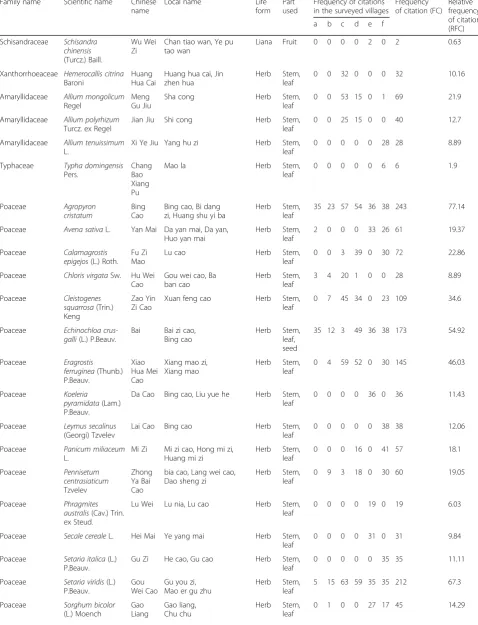
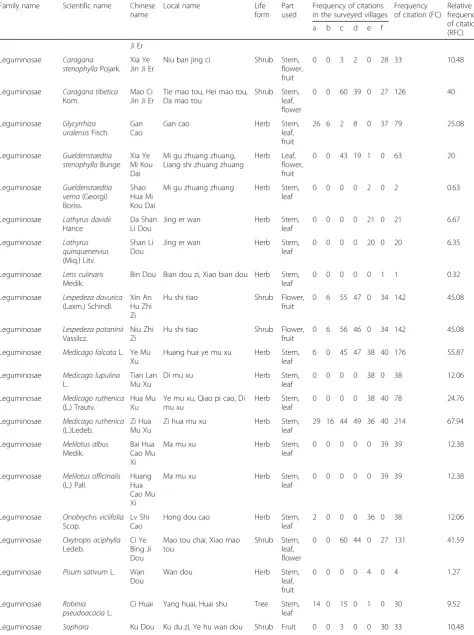
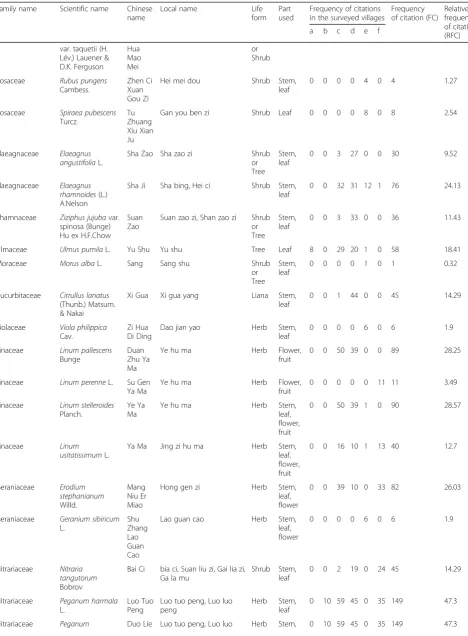
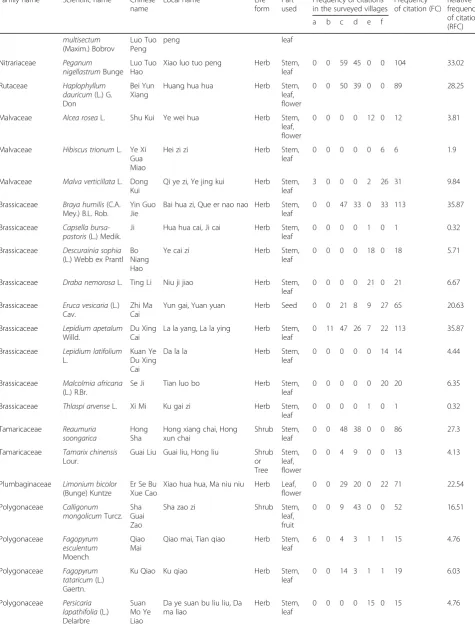
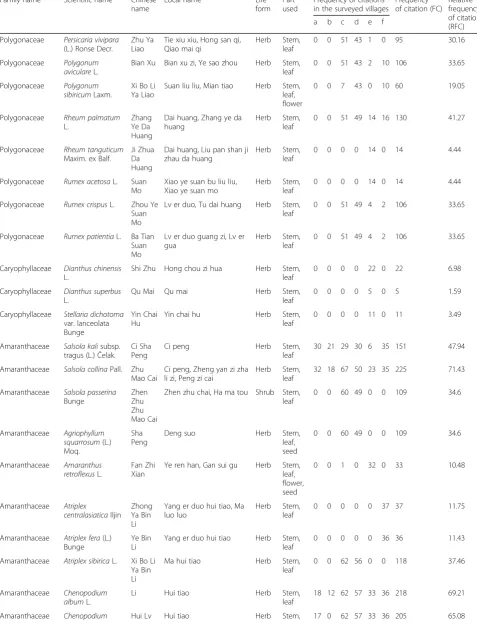
A total of 224 forage plant species belonging to 150 genera in 42 families were enumerated by respondents during the survey (Table4). The following are the plant families that included more than ten traditional forage plant species: Leguminosae (33 species, 14.10%), Compo-sitae (29 species, 12.39%), Gramineae (24 species,
Table 3Sociodemographic characteristics of participants
Category Gender Age Education Level Occupation
Male Female ≤19 20–39 40–59 ≥60 I P M H V F B W D S O
Village a 21 21 4 10 18 10 13 22 4 3 3 32 0 1 1 4 1
Village b 21 18 4 13 17 5 16 16 4 3 1 27 1 6 0 3 1
Village c 42 31 5 13 38 17 27 32 11 3 3 61 0 2 1 5 1
Village d 27 41 6 24 21 17 31 19 16 2 2 57 2 3 0 3 1
Village e 26 22 6 11 19 12 18 16 9 5 1 31 2 4 3 5 2
Village f 28 17 3 14 14 14 23 14 5 3 2 36 0 3 0 3 1
Quantity 165 150 28 85 127 75 128 119 49 19 12 244 5 19 5 23 7
Proportion 52% 48% 9% 27% 40% 24% 40% 38% 16% 6% 4% 77% 2% 6% 2% 7% 2%
10.26%), Amaranthaceae (21 species, 8.97%), Rosaceae (15 species, 6.41%), and Polygonaceae (12 species, 5.13%) (Fig. 2). Among 224 forage plant species, 181 (81%) are herbaceous and lianoid plants, and 43 (19%) are trees and shrubs, suggesting that the local farmers and herds-men mainly depend on herbaceous plants as livestock feed. For most traditional forage plants (213 species, 95%), stems and leaves are the most common parts used for livestock feed; among them, for 39 species (17.4%), flowers and fruit were also used for livestock feed. This indicates a high diversity of local forage plant resources. For 11 species (0.05%), only roots, flowers, and seeds can be used for livestock feed. Although these forage plants only account for a small proportion, each has its own unique characteristics and should not be ignored. For example, in two plant species (0.008%),Potentilla anser-inaand Daucus Carota, roots are the only part used for livestock feed, but they are highly favored by cattle and sheep due to a rich starch content and juicy taste. In three species (0.013%), Schisandra chinensis, Sophora alopecuroides, andEruca vesicaria, only the fruit is used for livestock feed. The fruit of S. chinensis, which has a sour, “numbing,” and spicy taste, can be used as medi-cine. For S. alopecuroides, only the seeds can be fed to sheep and cattle, but they are seasonally toxic, thus requiring more caution when used as feed.E. vesicariais a local oil crop, and its oil cake and oil residue are nu-tritious livestock feed. For two plant species (0.008%), Artemisia argyi and Ammopiptanthus mongolicus, only the flowers can be used for livestock feed. The former is mainly used for medicinal moxibustion in local areas, but its inflorescence is occasionally used to feed cattle and sheep. For A. mongolicus, only sheep eat some flowers.
Value and knowledge of major forage plants for feeding livestock
The RFC value calculated in this study ranged from 0.32 to 77.14. For each forage plant species, the higher the RFC value, the more frequently it is used by local vil-lagers to feed livestock, and the more important and valuable it is in the area. The top 13 plant species with an RFC value greater than 50 wereAgropyron cristatum (RFC 77.1), Artemisia scoparia (RFC 73.0), Salsola col-lina(RFC 71.4),Chenopodium album(RFC 69.2), Medi-cago ruthenica (RFC 67.9), Artemisia capillaris (RFC 67.6), Setaria viridis(RFC 67.3), Chenopodium glaucum (RFC 65.1), Zea mays (RFC 56.8), Sonchus (RFC 56.2), Sonchus oleraceus (RFC 56.2), Medicago falcata (RFC 55.9), and Echinochloa crus-galli (RFC 54.9). These plants have a good palatability and are favorite feed of cattle and sheep. Their stems and leaves are the com-mon parts used for livestock feed in the form of either
tender grass or green hay. Among them,maize(Z. mays) and alfalfa (M. ruthenica) are cultivated forage grasses with high forage value.Wheatgrass (A. cristatum),green bristlegrass(S. viridis), and paspalum(E. crus-galli) have a massive amount of leaves and soft stems favored by cattle and sheep. M. falcatais favored by domestic live-stock during the entire plant growth period and after withering; green and tender plants can increase the milk yield of dairy livestock, stems left after defoliation in winter are favorite forage of livestock, and the green hay of this species is also good winter forage. For C. glau-cum, despite its high RFC value as forage for both cattle and sheep in the forms of either green tender plants or dry hay, the villagers warned that the plants can cause itching or swelling of the whole body if livestock con-sumes too much.
S. arvensis, S. oleraceus, and L. tataricaare three im-portant local forage plants with RFC values of 56.2, 56.2, and 52.7, respectively. These three forage plant species, which were mentioned by all the respondents from Village f, share a common Chinese name, Kukucai, because of their bitter taste. They are edible and medi-cinal and can be used for livestock feed.Kukucaiis com-monly used in a homemade local cold dish. When used as an anti-inflammatory medicine, it is commonly referred to as Patrinia villosa. In addition, the juicy stems and leaves of Kukucaiare favorite forage of cattle and sheep. These applications fully reflect the important value ofKukucai.
Comparison of traditional forage plants in six villages in the study area
Table 4Traditional forage plants and their relative frequency of citation (RFC)
Family name Scientific name Chinese name
Local name Life
form Part used
Frequency of citations in the surveyed villages
Frequency of citation (FC)
Relative frequency of citation (RFC)
a b c d e f
Schisandraceae Schisandra chinensis
(Turcz.) Baill.
Wu Wei Zi
Chan tiao wan, Ye pu tao wan
Liana Fruit 0 0 0 0 2 0 2 0.63
Xanthorrhoeaceae Hemerocallis citrina
Baroni
Huang Hua Cai
Huang hua cai, Jin zhen hua
Herb Stem, leaf
0 0 32 0 0 0 32 10.16
Amaryllidaceae Allium mongolicum
Regel
Meng Gu Jiu
Sha cong Herb Stem,
leaf
0 0 53 15 0 1 69 21.9
Amaryllidaceae Allium polyrhizum
Turcz. ex Regel
Jian Jiu Shi cong Herb Stem,
leaf
0 0 25 15 0 0 40 12.7
Amaryllidaceae Allium tenuissimum
L.
Xi Ye Jiu Yang hu zi Herb Stem,
leaf
0 0 0 0 0 28 28 8.89
Typhaceae Typha domingensis
Pers.
Chang Bao Xiang Pu
Mao la Herb Stem,
leaf
0 0 0 0 0 6 6 1.9
Poaceae Agropyron
cristatum
Bing Cao
Bing cao, Bi dang zi, Huang shu yi ba
Herb Stem, leaf
35 23 57 54 36 38 243 77.14
Poaceae Avena sativaL. Yan Mai Da yan mai, Da yan, Huo yan mai
Herb Stem, leaf
2 0 0 0 33 26 61 19.37
Poaceae Calamagrostis
epigejos(L.) Roth. Fu Zi Mao
Lu cao Herb Stem,
leaf
0 0 3 39 0 30 72 22.86
Poaceae Chloris virgataSw. Hu Wei Cao
Gou wei cao, Ba ban cao
Herb Stem, leaf
3 4 20 1 0 0 28 8.89
Poaceae Cleistogenes
squarrosa(Trin.) Keng
Zao Yin Zi Cao
Xuan feng cao Herb Stem,
leaf
0 7 45 34 0 23 109 34.6
Poaceae Echinochloa
crus-galli(L.) P.Beauv.
Bai Bai zi cao, Bing cao
Herb Stem, leaf, seed
35 12 3 49 36 38 173 54.92
Poaceae Eragrostis
ferruginea(Thunb.) P.Beauv.
Xiao Hua Mei Cao
Xiang mao zi, Xiang mao
Herb Stem, leaf
0 4 59 52 0 30 145 46.03
Poaceae Koeleria
pyramidata(Lam.) P.Beauv.
Da Cao Bing cao, Liu yue he Herb Stem, leaf
0 0 0 0 36 0 36 11.43
Poaceae Leymus secalinus
(Georgi) Tzvelev
Lai Cao Bing cao Herb Stem,
leaf
0 0 0 0 0 38 38 12.06
Poaceae Panicum miliaceum
L.
Mi Zi Mi zi cao, Hong mi zi, Huang mi zi
Herb Stem, leaf
0 0 0 16 0 41 57 18.1
Poaceae Pennisetum
centrasiaticum
Tzvelev
Zhong Ya Bai Cao
bia cao, Lang wei cao, Dao sheng zi
Herb Stem, leaf
0 9 3 18 0 30 60 19.05
Poaceae Phragmites
australis(Cav.) Trin. ex Steud.
Lu Wei Lu nia, Lu cao Herb Stem,
leaf
0 0 0 0 19 0 19 6.03
Poaceae Secale cerealeL. Hei Mai Ye yang mai Herb Stem,
leaf
0 0 0 0 31 0 31 9.84
Poaceae Setaria italica(L.) P.Beauv.
Gu Zi He cao, Gu cao Herb Stem,
leaf
0 0 0 0 0 35 35 11.11
Poaceae Setaria viridis(L.) P.Beauv.
Gou Wei Cao
Gu you zi, Mao er gu zhu
Herb Stem, leaf
5 15 63 59 35 35 212 67.3
Poaceae Sorghum bicolor
(L.) Moench
Gao Liang
Gao liang, Chu chu
Herb Stem, leaf
Table 4Traditional forage plants and their relative frequency of citation (RFC)(Continued)
Family name Scientific name Chinese name
Local name Life
form Part used
Frequency of citations in the surveyed villages
Frequency of citation (FC)
Relative frequency of citation (RFC)
a b c d e f
Poaceae Stipa tianschanica
Roshev.
Ge Bi Zhen Mao
Suo cao Herb Stem,
leaf
0 0 53 58 0 36 147 46.67
Poaceae Stipa breviflora
Griseb.
Duan Hua Zhen Mao
Suo cao Herb Stem,
leaf
0 0 53 58 0 36 147 46.67
Poaceae Stipa bungeana
Trin.
Chang Mang Cao
Suo cao Herb Stem,
leaf
0 0 53 58 0 36 147 46.67
Poaceae Stipa caucasica
Schmalh.
Sha Sheng Zhen Mao
Suo cao Herb Stem,
leaf
0 0 53 58 0 36 147 46.67
Poaceae Stipa grandis
P.A.Smirn.
Da Zhen Mao
Suo cao Herb Stem,
leaf
0 0 53 58 0 36 147 46.67
Poaceae Stipa splendens
Trin.
Ji Ji Cao Ji ji, Xi ji hu zi, Suan cao Herb Stem, leaf
2 6 4 6 20 39 77 24.44
Poaceae Triticum aestivum
L.
Xiao Mai
Hong mang dong mai, Mia cao, Hong mang chun mai
Herb Stem, leaf
0 0 33 0 0 35 68 21.59
Poaceae Zea maysL. Yu Mi Yu mi Herb Stem,
leaf
12 18 47 45 48 9 179 56.83
Berberidaceae Berberis brachypoda
Maxim.
Duan Bing Xiao Bo
Suan bu liu shu Shrub Leaf 0 0 0 0 8 0 8 2.54
Ranunculaceae Actaea asiatica
H.Hara
Lei Ye Sheng Ma
Mi la de gan Herb Stem,
leaf
0 0 0 0 10 0 10 3.17
Ranunculaceae Actaea cimicifuga
L.
Sheng Ma
Sheng ma Herb Stem,
leaf
0 0 0 0 5 0 5 1.59
Ranunculaceae Thalictrum petaloideumL.
Ban Rui Tang Song Cao
Nai de cao, Yang nai cao, Yang nai de hua
Herb Leaf 0 0 0 0 22 0 22 6.98
Grossulariaceae Ribes
maximowiczianum
Komarov
Jian Ye Cha Biao Zi
Cha ye mu Shrub Leaf 0 0 0 0 3 0 3 0.95
Zygophyllaceae Tribulus terrestrisL. Ji Li Ba jue zi Herb Stem,
leaf
5 3 63 57 0 30 158 50.16
Leguminosae Ammopiptanthus mongolicus(Kom.) S.H.Cheng
Sha Dong Qing
Dong qing Shrub Flower 0 0 8 0 0 0 8 2.54
Leguminosae Astragalus efoliolatus Hand.-Mazz.
Dan Ye Huang Qi
Mao ti ti hua Herb Stem,
leaf
0 0 4 8 0 3 15 4.76
Leguminosae Astragalus scaberrimusBunge
Cao Ye Huang Qi
Mao ti ti hua Herb Stem,
leaf
0 0 0 0 0 3 3 0.95
Leguminosae Astragalus propinquus
Schischkin
Huang Qi
Huang qi Herb Stem,
leaf
0 0 0 0 3 2 5 1.59
Leguminosae Caragana
korshinskiiKom. Ning Tiao Jin
Niu ban jing cao Shrub Stem,
leaf
Table 4Traditional forage plants and their relative frequency of citation (RFC)(Continued)
Family name Scientific name Chinese name
Local name Life
form Part used
Frequency of citations in the surveyed villages
Frequency of citation (FC)
Relative frequency of citation (RFC)
a b c d e f
Ji Er
Leguminosae Caragana
stenophyllaPojark. Xia Ye Jin Ji Er
Niu ban jing ci Shrub Stem,
flower, fruit
0 0 3 2 0 28 33 10.48
Leguminosae Caragana tibetica
Kom.
Mao Ci Jin Ji Er
Tie mao tou, Hei mao tou, Da mao tou
Shrub Stem, leaf, flower
0 0 60 39 0 27 126 40
Leguminosae Glycyrrhiza uralensisFisch.
Gan Cao
Gan cao Herb Stem,
leaf, fruit
26 6 2 8 0 37 79 25.08
Leguminosae Gueldenstaedtia stenophyllaBunge
Xia Ye Mi Kou Dai
Mi gu zhuang zhuang, Liang shi zhuang zhuang
Herb Leaf, flower, fruit
0 0 43 19 1 0 63 20
Leguminosae Gueldenstaedtia verna(Georgi) Boriss.
Shao Hua Mi Kou Dai
Mi gu zhuang zhuang Herb Stem, leaf
0 0 0 0 2 0 2 0.63
Leguminosae Lathyrus davidii
Hance
Da Shan Li Dou
Jing er wan Herb Stem,
leaf
0 0 0 0 21 0 21 6.67
Leguminosae Lathyrus quinquenervius
(Miq.) Litv.
Shan Li Dou
Jing er wan Herb Stem,
leaf
0 0 0 0 20 0 20 6.35
Leguminosae Lens culinaris
Medik.
Bin Dou Bian dou zi, Xiao bian dou Herb Stem, leaf
0 0 0 0 0 1 1 0.32
Leguminosae Lespedeza davurica
(Laxm.) Schindl.
Xin An Hu Zhi Zi
Hu shi tiao Shrub Flower,
fruit
0 6 55 47 0 34 142 45.08
Leguminosae Lespedeza potaninii
Vassilcz.
Niu Zhi Zi
Hu shi tiao Shrub Flower,
fruit
0 6 56 46 0 34 142 45.08
Leguminosae Medicago falcataL. Ye Mu Xu
Huang hua ye mu xu Herb Stem,
leaf
6 0 45 47 38 40 176 55.87
Leguminosae Medicago lupulina
L.
Tian Lan Mu Xu
Di mu xu Herb Stem,
leaf
0 0 0 0 38 0 38 12.06
Leguminosae Medicago ruthenica
(L.) Trautv.
Hua Mu Xu
Ye mu xu, Qiao pi cao, Di mu xu
Herb Stem, leaf
0 0 0 0 38 40 78 24.76
Leguminosae Medicago ruthenica
(L.)Ledeb.
Zi Hua Mu Xu
Zi hua mu xu Herb Stem,
leaf
29 16 44 49 36 40 214 67.94
Leguminosae Melilotus albus
Medik.
Bai Hua Cao Mu Xi
Ma mu xu Herb Stem,
leaf
0 0 0 0 0 39 39 12.38
Leguminosae Melilotus officinalis
(L.) Pall.
Huang Hua Cao Mu Xi
Ma mu xu Herb Stem,
leaf
0 0 0 0 0 39 39 12.38
Leguminosae Onobrychis viciifolia
Scop.
Lv Shi Cao
Hong dou cao Herb Stem,
leaf
2 0 0 0 36 0 38 12.06
Leguminosae Oxytropis aciphylla
Ledeb.
Ci Ye Bing Ji Dou
Mao tou chai, Xiao mao tou
Shrub Stem, leaf, flower
0 0 60 44 0 27 131 41.59
Leguminosae Pisum sativumL. Wan Dou
Wan dou Herb Stem,
leaf, fruit
0 0 0 0 4 0 4 1.27
Leguminosae Robinia pseudoacaciaL.
Ci Huai Yang huai, Huai shu Tree Stem, leaf
14 0 15 0 1 0 30 9.52
Table 4Traditional forage plants and their relative frequency of citation (RFC)(Continued)
Family name Scientific name Chinese name
Local name Life
form Part used
Frequency of citations in the surveyed villages
Frequency of citation (FC)
Relative frequency of citation (RFC)
a b c d e f
alopecuroidesL. Zi
Leguminosae Styphnolobium japonicum(L.) Schott
Huai Huai shu Tree Stem,
leaf
0 0 15 0 1 0 16 5.08
Leguminosae Trifolium repensL. Bai Che Zhou Cao
Bai hua ye mu xu Herb Stem,
leaf
0 0 34 8 38 0 80 25.4
Leguminosae Vicia amoena
Fisch.
Shan Ye Wan Dou
Ye wan dou Herb Stem,
leaf
0 0 0 0 29 0 29 9.21
Leguminosae Vicia craccaL. Guang
Bu Ye Wan Dou
Luo dou yang, Ye wan dou
Herb Stem, leaf
0 0 3 1 29 1 34 10.79
Leguminosae Vicia fabaL. Can
Dou
Da dou Herb Stem,
leaf
8 0 3 7 13 1 32 10.16
Leguminosae Vicia sepiumL. Ye Wan Dou
Ye wan dou Herb Stem,
leaf
0 0 0 0 29 0 29 9.21
Leguminosae Vicia unijugaA.Br. Wai Tou Cai
Wai tou cai Herb Stem,
leaf
0 0 0 0 10 0 10 3.17
Rosaceae Potentilla anserina
L.
E Rong Wei Ling Cai
Jue ma Herb Root 0 0 0 0 4 0 4 1.27
Rosaceae Sibbaldianthe
bifurca(L.) Kurtto & T.Erikss.
Er Lie Wei Ling Cai
Tie pian zi, Hei gen zi yang, Ji guan cao
Herb or Shrub
Stem, leaf
0 0 53 26 5 35 119 37.78
Rosaceae Crataegus
pinnatifidaBunge Shan Zha
Shan cha shu Tree Leaf 0 0 0 0 2 0 2 0.63
Rosaceae Duchesnea indica
(Jacks.) Focke
She Mei Pie er, Mei zi Herb Stem,
leaf
0 0 0 0 2 0 2 0.63
Rosaceae Fragaria orientalis
Losinsk.
Dong Fang Cao Mei
Ye cao mei, Pie er Herb Stem,
leaf
0 0 0 0 2 0 2 0.63
Rosaceae Potentilla acaulisL. Xing Mao Wei Ling Cai
Ma shi shi Herb Leaf 0 0 0 0 0 12 12 3.81
Rosaceae Potentilla reptansL. Pu Fu Wei Ling Cai
Hong bang chui Herb Leaf 0 0 0 0 14 0 14 4.44
Rosaceae Prinsepia uniflora
Batalin
Rui He Ma ru ci, Ma ru zi Shrub Leaf 0 0 53 36 0 0 89 28.25
Rosaceae Prunus davidiana
(CarriŠre) Franch. Shan Tao
Shan mao tao, Ye tao Shrub or Tree
Stem, leaf
0 0 3 26 1 21 51 16.19
Rosaceae Prunus sibiricaL. Shan Xing
Xing zi, Heng zi Shrub
or Tree
Stem, leaf
0 0 11 26 1 23 61 19.37
Rosaceae Prunus tomentosa
Thunb.
Mao Ying Tao
Shan yin tao, Yin tao Shrub Leaf 0 0 0 0 1 0 1 0.32
Rosaceae Rubus parvifoliusL. Mao Mei
Mei dou wan Shrub Leaf 0 0 0 0 8 0 8 2.54
Table 4Traditional forage plants and their relative frequency of citation (RFC)(Continued)
Family name Scientific name Chinese name
Local name Life
form Part used
Frequency of citations in the surveyed villages
Frequency of citation (FC)
Relative frequency of citation (RFC)
a b c d e f
var. taquetii (H. Lév.) Lauener & D.K. Ferguson
Hua Mao Mei
or Shrub
Rosaceae Rubus pungens
Cambess.
Zhen Ci Xuan Gou Zi
Hei mei dou Shrub Stem,
leaf
0 0 0 0 4 0 4 1.27
Rosaceae Spiraea pubescens
Turcz.
Tu Zhuang Xiu Xian Ju
Gan you ben zi Shrub Leaf 0 0 0 0 8 0 8 2.54
Elaeagnaceae Elaeagnus angustifoliaL.
Sha Zao Sha zao zi Shrub
or Tree
Stem, leaf
0 0 3 27 0 0 30 9.52
Elaeagnaceae Elaeagnus rhamnoides(L.) A.Nelson
Sha Ji Sha bing, Hei ci Shrub Stem,
leaf
0 0 32 31 12 1 76 24.13
Rhamnaceae Ziziphus jujubavar. spinosa (Bunge) Hu ex H.F.Chow
Suan Zao
Suan zao zi, Shan zao zi Shrub or Tree
Stem, leaf
0 0 3 33 0 0 36 11.43
Ulmaceae Ulmus pumilaL. Yu Shu Yu shu Tree Leaf 8 0 29 20 1 0 58 18.41
Moraceae Morus albaL. Sang Sang shu Shrub
or Tree
Stem, leaf
0 0 0 0 1 0 1 0.32
Cucurbitaceae Citrullus lanatus
(Thunb.) Matsum. & Nakai
Xi Gua Xi gua yang Liana Stem,
leaf
0 0 1 44 0 0 45 14.29
Violaceae Viola philippica
Cav.
Zi Hua Di Ding
Dao jian yao Herb Stem,
leaf
0 0 0 0 6 0 6 1.9
Linaceae Linum pallescens
Bunge
Duan Zhu Ya Ma
Ye hu ma Herb Flower,
fruit
0 0 50 39 0 0 89 28.25
Linaceae Linum perenneL. Su Gen
Ya Ma
Ye hu ma Herb Flower,
fruit
0 0 0 0 0 11 11 3.49
Linaceae Linum stelleroides
Planch.
Ye Ya Ma
Ye hu ma Herb Stem,
leaf, flower, fruit
0 0 50 39 1 0 90 28.57
Linaceae Linum
usitatissimumL.
Ya Ma Jing zi hu ma Herb Stem,
leaf, flower, fruit
0 0 16 10 1 13 40 12.7
Geraniaceae Erodium
stephanianum
Willd.
Mang Niu Er Miao
Hong gen zi Herb Stem,
leaf, flower
0 0 39 10 0 33 82 26.03
Geraniaceae Geranium sibiricum
L.
Shu Zhang Lao Guan Cao
Lao guan cao Herb Stem,
leaf, flower
0 0 0 0 6 0 6 1.9
Nitrariaceae Nitraria tangutorum
Bobrov
Bai Ci bia ci, Suan liu zi, Gai lia zi, Ga la mu
Shrub Stem, leaf
0 0 2 19 0 24 45 14.29
Nitrariaceae Peganum harmala
L.
Luo Tuo Peng
Luo tuo peng, Luo luo peng
Herb Stem, leaf
0 10 59 45 0 35 149 47.3
Table 4Traditional forage plants and their relative frequency of citation (RFC)(Continued)
Family name Scientific name Chinese name
Local name Life
form Part used
Frequency of citations in the surveyed villages
Frequency of citation (FC)
Relative frequency of citation (RFC)
a b c d e f
multisectum
(Maxim.) Bobrov
Luo Tuo Peng
peng leaf
Nitrariaceae Peganum
nigellastrumBunge Luo Tuo Hao
Xiao luo tuo peng Herb Stem,
leaf
0 0 59 45 0 0 104 33.02
Rutaceae Haplophyllum
dauricum(L.) G. Don
Bei Yun Xiang
Huang hua hua Herb Stem,
leaf, flower
0 0 50 39 0 0 89 28.25
Malvaceae Alcea roseaL. Shu Kui Ye wei hua Herb Stem,
leaf, flower
0 0 0 0 12 0 12 3.81
Malvaceae Hibiscus trionumL. Ye Xi Gua Miao
Hei zi zi Herb Stem,
leaf
0 0 0 0 0 6 6 1.9
Malvaceae Malva verticillataL. Dong Kui
Qi ye zi, Ye jing kui Herb Stem, leaf
3 0 0 0 2 26 31 9.84
Brassicaceae Braya humilis(C.A. Mey.) B.L. Rob.
Yin Guo Jie
Bai hua zi, Que er nao nao Herb Stem, leaf
0 0 47 33 0 33 113 35.87
Brassicaceae Capsella bursa-pastoris(L.) Medik.
Ji Hua hua cai, Ji cai Herb Stem,
leaf
0 0 0 0 1 0 1 0.32
Brassicaceae Descurainia sophia
(L.) Webb ex Prantl Bo Niang Hao
Ye cai zi Herb Stem,
leaf
0 0 0 0 18 0 18 5.71
Brassicaceae Draba nemorosaL. Ting Li Niu ji jiao Herb Stem,
leaf
0 0 0 0 21 0 21 6.67
Brassicaceae Eruca vesicaria(L.) Cav.
Zhi Ma Cai
Yun gai, Yuan yuan Herb Seed 0 0 21 8 9 27 65 20.63
Brassicaceae Lepidium apetalum
Willd.
Du Xing Cai
La la yang, La la ying Herb Stem, leaf
0 11 47 26 7 22 113 35.87
Brassicaceae Lepidium latifolium
L.
Kuan Ye Du Xing Cai
Da la la Herb Stem,
leaf
0 0 0 0 0 14 14 4.44
Brassicaceae Malcolmia africana
(L.) R.Br.
Se Ji Tian luo bo Herb Stem,
leaf
0 0 0 0 0 20 20 6.35
Brassicaceae Thlaspi arvenseL. Xi Mi Ku gai zi Herb Stem,
leaf
0 0 0 0 1 0 1 0.32
Tamaricaceae Reaumuria soongarica
Hong Sha
Hong xiang chai, Hong xun chai
Shrub Stem, leaf
0 0 48 38 0 0 86 27.3
Tamaricaceae Tamarix chinensis
Lour.
Guai Liu Guai liu, Hong liu Shrub or Tree
Stem, leaf, flower
0 0 4 9 0 0 13 4.13
Plumbaginaceae Limonium bicolor
(Bunge) Kuntze
Er Se Bu Xue Cao
Xiao hua hua, Ma niu niu Herb Leaf, flower
0 0 29 20 0 22 71 22.54
Polygonaceae Calligonum mongolicumTurcz.
Sha Guai Zao
Sha zao zi Shrub Stem,
leaf, fruit
0 0 9 43 0 0 52 16.51
Polygonaceae Fagopyrum esculentum
Moench
Qiao Mai
Qiao mai, Tian qiao Herb Stem, leaf
6 0 4 3 1 1 15 4.76
Polygonaceae Fagopyrum tataricum(L.) Gaertn.
Ku Qiao Ku qiao Herb Stem,
leaf
0 0 14 3 1 1 19 6.03
Polygonaceae Persicaria lapathifolia(L.) Delarbre
Suan Mo Ye Liao
Da ye suan bu liu liu, Da ma liao
Herb Stem, leaf
Table 4Traditional forage plants and their relative frequency of citation (RFC)(Continued)
Family name Scientific name Chinese name
Local name Life
form Part used
Frequency of citations in the surveyed villages
Frequency of citation (FC)
Relative frequency of citation (RFC)
a b c d e f
Polygonaceae Persicaria vivipara
(L.) Ronse Decr.
Zhu Ya Liao
Tie xiu xiu, Hong san qi, Qiao mai qi
Herb Stem, leaf
0 0 51 43 1 0 95 30.16
Polygonaceae Polygonum aviculareL.
Bian Xu Bian xu zi, Ye sao zhou Herb Stem, leaf
0 0 51 43 2 10 106 33.65
Polygonaceae Polygonum sibiricumLaxm.
Xi Bo Li Ya Liao
Suan liu liu, Mian tiao Herb Stem, leaf, flower
0 0 7 43 0 10 60 19.05
Polygonaceae Rheum palmatum
L.
Zhang Ye Da Huang
Dai huang, Zhang ye da huang
Herb Stem, leaf
0 0 51 49 14 16 130 41.27
Polygonaceae Rheum tanguticum
Maxim. ex Balf.
Ji Zhua Da Huang
Dai huang, Liu pan shan ji zhau da huang
Herb Stem, leaf
0 0 0 0 14 0 14 4.44
Polygonaceae Rumex acetosaL. Suan Mo
Xiao ye suan bu liu liu, Xiao ye suan mo
Herb Stem, leaf
0 0 0 0 14 0 14 4.44
Polygonaceae Rumex crispusL. Zhou Ye Suan Mo
Lv er duo, Tu dai huang Herb Stem, leaf
0 0 51 49 4 2 106 33.65
Polygonaceae Rumex patientiaL. Ba Tian Suan Mo
Lv er duo guang zi, Lv er gua
Herb Stem, leaf
0 0 51 49 4 2 106 33.65
Caryophyllaceae Dianthus chinensis
L.
Shi Zhu Hong chou zi hua Herb Stem,
leaf
0 0 0 0 22 0 22 6.98
Caryophyllaceae Dianthus superbus
L.
Qu Mai Qu mai Herb Stem,
leaf
0 0 0 0 5 0 5 1.59
Caryophyllaceae Stellaria dichotoma
var. lanceolata Bunge
Yin Chai Hu
Yin chai hu Herb Stem,
leaf
0 0 0 0 11 0 11 3.49
Amaranthaceae Salsola kalisubsp. tragus (L.)Čelak.
Ci Sha Peng
Ci peng Herb Stem,
leaf
30 21 29 30 6 35 151 47.94
Amaranthaceae Salsola collinaPall. Zhu Mao Cai
Ci peng, Zheng yan zi zha li zi, Peng zi cai
Herb Stem, leaf
32 18 67 50 23 35 225 71.43
Amaranthaceae Salsola passerina
Bunge
Zhen Zhu Zhu Mao Cai
Zhen zhu chai, Ha ma tou Shrub Stem, leaf
0 0 60 49 0 0 109 34.6
Amaranthaceae Agriophyllum squarrosum(L.) Moq.
Sha Peng
Deng suo Herb Stem,
leaf, seed
0 0 60 49 0 0 109 34.6
Amaranthaceae Amaranthus retroflexusL.
Fan Zhi Xian
Ye ren han, Gan sui gu Herb Stem, leaf, flower, seed
0 0 1 0 32 0 33 10.48
Amaranthaceae Atriplex
centralasiaticaIljin Zhong Ya Bin Li
Yang er duo hui tiao, Ma luo luo
Herb Stem, leaf
0 0 0 0 0 37 37 11.75
Amaranthaceae Atriplex fera(L.) Bunge
Ye Bin Li
Yang er duo hui tiao Herb Stem, leaf
0 0 0 0 0 36 36 11.43
Amaranthaceae Atriplex sibiricaL. Xi Bo Li Ya Bin Li
Ma hui tiao Herb Stem,
leaf
0 0 62 56 0 0 118 37.46
Amaranthaceae Chenopodium albumL.
Li Hui tiao Herb Stem,
leaf
18 12 62 57 33 36 218 69.21
Table 4Traditional forage plants and their relative frequency of citation (RFC)(Continued)
Family name Scientific name Chinese name
Local name Life
form Part used
Frequency of citations in the surveyed villages
Frequency of citation (FC)
Relative frequency of citation (RFC)
a b c d e f
glaucumL. Li leaf
Amaranthaceae Chenopodium hybridumL.
Za Pei Li
Hui tiao Herb Stem,
leaf
0 0 0 0 33 0 33 10.48
Amaranthaceae Dysphania schraderiana
(Schult.) Mosyakin & Clemants
Ju Ye Xiang Li
Xiao ye hui tiao Herb Stem,
leaf
0 0 0 0 32 0 32 10.16
Amaranthaceae Halogeton arachnoideus
Bai Jing Yan Sheng Cao
Shui peng hao, Shui hao Herb Stem, leaf
0 5 4 49 34 33 125 39.68
Amaranthaceae Haloxylon ammodendron
(C.A.Mey.) Bunge ex Fenzl
Suo Suo Suo suo Shrub
or Tree
Stem, leaf
0 0 18 43 0 0 61 19.37
Amaranthaceae Kalidium cuspidatum (Ung.-Sternb.) Grubov
Jian Ye Yan Zhua Zhua
Lao shu shi dan dan, Yan hao
Shrub Stem, leaf
0 0 42 43 0 0 85 26.98
Amaranthaceae Krascheninnikovia ceratoides(L.) Gueldenst.
Tuo Rong Li
You ruo li Shrub Stem,
leaf, flower, fruit
0 0 29 43 0 0 72 22.86
Amaranthaceae Suaeda glauca
(Bunge) Bunge Jian Peng
Lv wei ba yan hao, Yan hao hao, Jian hao, Jian peng
Herb Stem, leaf
0 6 60 54 0 34 154 48.89
Amaranthaceae Sympegma regelii
Bunge
He Tou Cao
Hei chai, He chai, Hei ma tou chai, He lao gua chai
Shrub Stem, leaf
0 0 42 43 0 0 85 26.98
Amaranthaceae Bassia scoparia(L.) A.J.Scott
Di Fu Mao luo li, Li jing, Ye li jing
Herb Stem, leaf
11 0 42 35 1 11 100 31.75
Amaranthaceae Corispermum patelliforme
Die Guo Chong Shi
Mian peng Herb Stem,
leaf, seed
0 17 60 55 0 38 170 53.97
Amaranthaceae Corispermum patelliformeIljin
Sheng Chong Shi
Mian peng Herb Stem,
leaf
0 17 61 54 0 38 170 53.97
Talinaceae Pedicularis muscicolaMaxim.
Xian Sheng Ma Xian Hao
Chang chong cao Herb Stem,
leaf
0 0 0 0 1 0 1 0.32
Portulacaceae Portulaca oleracea
L.
Ma Chi Xian
Pang wa wa cai Herb Stem,
leaf
1 5 12 9 19 2 48 15.24
Rubiaceae Galium aparine L. Zhu
Yang Yang
Ran wa zi cao Herb Stem,
leaf
0 0 0 0 19 0 19 6.03
Rubiaceae Galium verumL. Peng Zi
Cai
Huang mi gan fan Herb Stem,
leaf, Flower
0 0 0 0 1 0 1 0.32
Rubiaceae Rubia cordifoliaL. Qian Cao
Qian cao zi, Ran wa zi Liana Stem, leaf
0 0 2 0 3 0 5 1.59
Apocynaceae Cynanchum
absconditumLiede Di Shao Gua
Hao gua zi Herb Leaf,
fruit
0 0 38 20 0 31 89 28.25
Apocynaceae Cynanchum
acutumL.
Yang Jiao Zi Cao
Yang nai jiao jiao, Yang jiao zi
Table 4Traditional forage plants and their relative frequency of citation (RFC)(Continued)
Family name Scientific name Chinese name
Local name Life
form Part used
Frequency of citations in the surveyed villages
Frequency of citation (FC)
Relative frequency of citation (RFC)
a b c d e f
Apocynaceae Cynanchum
chinenseR.Br.
E Rong Teng
Yang nai jiao jiao, Ma hao gua zi
Herb Leaf 0 1 55 48 0 0 104 33.02
Boraginaceae Lappula myosotis
V. Wolf
He Shi Ran ran zi, Mao ran ran Herb Stem, leaf
0 4 58 58 0 30 150 47.62
Boraginaceae Lappula squarrosa
(Retz.) Dumort.
Lan Ci He Shi
Zhan sheng cao Herb Stem,
leaf
0 0 0 0 13 0 13 4.13
Boraginaceae Lappula squarrosa
subsp. heteracantha (Ledeb.) Chater
Yi Ci He Shi
Ran ran zi, Mao ran ran Herb Stem, leaf
0 6 64 58 0 30 158 50.16
Convolvulaceae Calystegia hederaceaWall.
Da Wan Hua
Fu zi miao, Tian xuan hua, Gu zi man, Ku zi man, La ba hua, Da da wai, Bai hua gu zi man
Herb Stem, leaf, flower
3 7 1 56 30 35 132 41.9
Convolvulaceae Convolvulus arvensisL.
Tian Xuan Hua
Gu zi man, Ku zi man, Fen hua gu zi man
Herb Stem, leaf, flower
3 7 55 39 2 35 141 44.76
Convolvulaceae Convolvulus tragacanthoides
Turcz.
Ci Xuan Hua
Ying zhua ci, Tie dan dan Shrub Stem, leaf, flower
0 0 62 39 0 0 101 32.06
Convolvulaceae Cuscuta chinensis
Lam.
Tu Si Zi Huang tang, Huang chan Herb Stem, leaf
0 0 11 41 0 0 52 16.51
Convolvulaceae Ipomoea purpurea
(L.) Roth
Yuan Ye Qian Niu
Qian niu hua, La ba hua, Hei bai chou
Herb Stem, leaf, flower
4 3 21 4 3 22 57 18.1
Solanaceae Lycium barbarum
L.
Ning Xia Gou Qi
Gou ji zi, Gou qi zi Shrub Stem, leaf
0 0 15 1 0 6 22 6.98
Solanaceae Lycium chinense
Mill.
Gou Qi Gou ji zi, Gou qi zi Shrub Stem, leaf
0 0 15 1 0 6 22 6.98
Solanaceae Solanum
americanumMill. Long Kui
Ye wei hua, Ye hua hua Herb Stem, leaf
0 0 0 0 12 0 12 3.81
Solanaceae Solanum
tuberosumL.
Ma Ling Shu
Yang yu Herb Stem,
leaf
0 0 0 0 0 4 4 1.27
Plantaginaceae Plantago asiaticaL. Che Qian
Che qian cao, Niu she tou, Niu er duo
Herb Stem, leaf, flower, fruit
7 2 0 0 28 14 51 16.19
Plantaginaceae Plantago depressa
Willd.
Ping Che Qian
Che qian cao, Niu she tou, Niu er duo
Herb Stem, leaf
7 2 0 0 28 14 51 16.19
Plantaginaceae Plantago majorL. Da Che Qian
Che qian cao, Niu she tou, Niu er duo
Herb Stem, leaf, flower, fruit
7 2 0 0 28 14 51 16.19
Lamiaceae Mentha canadensis
L.
Bo He Ye bo he Herb Stem,
leaf
0 0 0 0 1 0 1 0.32
Lamiaceae Lagochilus ilicifolius
Bunge ex Benth. Dong Qing Ye Tu Chun Hua
Ji guan zi Herb Stem,
leaf
0 0 1 23 0 0 24 7.62
Lamiaceae Dracocephalum
heterophyllum
Benth.
Bai Hua Zhi Zi Hua
Mi guan guan Herb Stem,
leaf
Table 4Traditional forage plants and their relative frequency of citation (RFC)(Continued)
Family name Scientific name Chinese name
Local name Life
form Part used
Frequency of citations in the surveyed villages
Frequency of citation (FC)
Relative frequency of citation (RFC)
a b c d e f
Lamiaceae Leonurus japonicus
Houtt.
Yi Mu Cao
Jie jie hao Herb Stem,
leaf
0 0 18 10 0 0 28 8.89
Lamiaceae Stachys affinis
Bunge
Gan Lu Zi
Di liu zi Herb Stem,
leaf
0 2 6 2 1 0 11 3.49
Lamiaceae Thymus
mongolicus
(Ronniger) Ronniger
Bai Li Xiang
Di jiao Shrub Stem,
leaf
0 0 0 0 20 1 21 6.67
Campanulaceae Adenophora potaniniiKorsh.
Pao Sha Shen
Niu ling hua Herb Stem,
leaf
0 0 0 0 17 0 17 5.4
Campanulaceae Codonopsis pilosula
(Franch.) Nannf.
Dang Shen
Dang sen Herb Stem,
leaf
0 0 0 0 19 0 19 6.03
Compositae Ajania achilleoides
(Turcz.) Poljakov ex Grubov
Shi Zhuang Ya Ju
Ga ji hao, bia mi hao Shrub Leaf 0 0 29 42 0 0 71 22.54
Compositae Ajania fruticulosa
(Ledeb.) Poljakov Guan Mu Ya Ju
Ga ji hao Shrub Leaf 0 0 29 32 0 0 61 19.37
Compositae Arctium lappa L. Niu
Pang
Niu zi, Da li zi Herb Stem,
leaf
0 0 0 0 1 0 1 0.32
Compositae Artemisia annuaL. Huang Hua Hao
Chou hao, Huang hao Herb Stem, leaf
0 0 29 31 30 27 117 37.14
Compositae Artemisia argyi
H.Lév. & Vaniot
Ai Nai, Ai Herb Flower 5 5 10 2 27 29 78 24.76
Compositae Artemisia
blepharolepis
Bunge
Bai Sha Hao
bia sha hao Shrub Stem,
leaf
4 5 51 54 0 27 141 44.76
Compositae Artemisia capillaris
Thunb.
Yin Chen Hao
Bai hao tou zi, You hao Herb or Shrub
Stem, leaf
18 21 61 49 34 30 213 67.62
Compositae Artemisia
desertorumSpreng. Hei Sha Hao
Sha hao, You hao Shrub Stem,
leaf
4 16 52 55 0 27 154 48.89
Compositae Artemisia dubiaL. ex B.D.Jacks.
Wu Mao Niu Wei Hao
Yi zi hao Herb Leaf 0 0 51 0 0 0 51 16.19
Compositae Artemisia frigida
Willd.
Len Hao Chuan di hao Herb Stem,
leaf
0 0 29 31 0 0 60 19.05
Compositae Artemisia giraldii
Pamp.
Hua Bei Mi Hao
Jiao hao Herb Stem,
leaf, fruit
0 0 51 38 0 0 89 28.25
Compositae Artemisia gmelinii
Weber ex Stechm.
Bai Lian Hao
A ji hao, Dai mi hao, Ying gan gan hao, Tie gan hao
Herb Stem, leaf
0 0 29 31 18 24 102 32.38
Compositae Artemisia scoparia
Waldst. & Kitam. Zhu Mao Hao
Bai hao tou zi , You hao Herb Stem, leaf
18 21 62 59 34 36 230 73.02
Compositae Carduus crispus
Guirão ex Nyman
Si Mao Fei Lian
Ci gai Herb Leaf,
flower
0 4 0 0 0 25 29 9.21
Compositae Cirsium arvense(L.) Scop.
Ci Er Cai Ma ci ji, Ci ji gai, Xiao ji, Da ji
Herb Leaf, flower
0 4 25 18 0 25 72 22.86
Compositae Ixeris chinensis
(Thunb. ex Thunb.) Nakai
Zhong Hua Xiao Ku Mai
Yan ji ji cao, Gua la ji cao, Ma yan wo cao
Herb Stem, leaf
Table 4Traditional forage plants and their relative frequency of citation (RFC)(Continued)
Family name Scientific name Chinese name
Local name Life
form Part used
Frequency of citations in the surveyed villages
Frequency of citation (FC)
Relative frequency of citation (RFC)
a b c d e f
Compositae Helianthus annuus
L.
Xiang Ri Kui
Xiang ri kui Herb Stem,
leaf
11 5 35 36 7 30 124 39.37
Compositae Helianthus tuberosusL.
Ju Yu Yang jiang Herb Stem,
leaf, flower
0 0 52 2 0 0 54 17.14
Compositae Heteropappus altaicus(Willd.) Novopokr.
A Er Tai Gou Wa Hua
Bai hua cao Herb Stem,
leaf, flower
0 0 29 33 0 28 90 28.57
Compositae Lactuca tatarica
(L.) C.A.Mey.
Ru Ju Ma ku ku cai Herb Stem,
leaf
12 0 54 55 0 45 166 52.7
Compositae Neopallasia pectinata(Pall.) Poljakov
Zhi Ye Hao
Mi hao, Mei hao Herb Stem,
leaf
0 0 29 43 0 22 94 29.84
Compositae Rhaponticum
repens(L.) Hidalgo
Ding Yu Ju
Ku hao Herb Leaf,
flower
0 3 18 29 0 33 83 26.35
Compositae Saussurea alata
DC.
Yi Jing Feng Mao Ju
Ye da dou Herb Stem,
leaf
0 0 0 0 12 0 12 3.81
Compositae Scorzonera
divaricataTurcz.
Cha Zhi Ya Cong
Nai gua zi Herb Stem,
leaf
0 19 10 33 0 31 93 29.52
Compositae Sonchus arvensisL. Ju Mai Cai
Ku ku cai, Ku xu, Tian ku ku cai
Herb Stem, leaf
17 6 54 55 0 45 177 56.19
Compositae Sonchus oleraceus
(L.) L.
Ku Ju Cai
Ku ku cai, Tian ku cai Herb Stem, leaf
17 6 54 55 0 45 177 56.19
Compositae Taraxacum
mongolicum
Hand.-Mazz.
Pu Gong Ying
Huang huang zi, Huan huan tai
Herb Stem, leaf
18 4 54 0 0 39 115 36.51
Compositae Tussilago farfaraL. Kuan Dong
Dong hua Herb Stem,
leaf
0 0 0 0 1 0 1 0.32
Compositae Xanthium
strumariumsubsp. sibiricum (Patrin ex Widder) Greuter
Cang Er Cang er zi, Cao er Herb Stem,
leaf
0 2 13 20 0 21 56 17.78
Apiaceae Ligusticum striatum
DC.
Chuan Xiong
Chuan xiong Herb Stem,
leaf
0 0 0 0 1 0 1 0.32
Apiaceae Anthriscus sylvestris
(L.) Hoffm.
E Shen Ye hong luo bo Herb Stem,
leaf
0 0 0 0 15 0 15 4.76
Apiaceae Bupleurum
chinenseDC.
Bei Chai Hu
Da er duo chai hu Herb Stem,
leaf
0 0 0 0 18 0 18 5.71
Apiaceae Daucus carotaL. Hu Luo
Bo
Hu luo bo Herb Root 0 0 25 12 0 0 37 11.75
Apiaceae Ferula bungeana
Kitag.
Sha Hui Xiang
Mian diao diao Herb Leaf 0 0 0 0 0 4 4 1.27
Apiaceae Ligusticum sinense
Oliv.
Gao Ben Ye chuan xiong Herb Stem,
leaf
0 0 0 0 3 0 3 0.95
Apiaceae Saposhnikovia
divaricata(Turcz.) Schischk.
Fang Feng
Han sa jiao, Ma yin zi Herb Stem, leaf
0 0 0 0 6 0 6 1.9
Apiaceae Torilis japonica
(Houtt.) DC.
Xiao Qie Yi
Ye hong luo bo, Ye hui xiang
Herb Leaf 0 0 0 0 34 0 34 10.79
Ephedraceae Ephedra intermedia
Schrenk & C.A.Mey. Zhong Ma Huang
Ma huang Shrub Stem,
leaf
a great impact on the diversity of traditional knowledge regarding forage plants. Contrarily, Villages c and d, whose inhabitants migrated less than 2 km, experienced little change in the ecological environment and natural resources, and the short-distance relocation had a non-significant impact on the diversity of and knowledge re-garding forage plants, as evidenced by the relatively small change in the number of traditional forage plant species used by villagers.
In this study, the JI was used to represent the simi-larities in traditional forage plants among the six vil-lages (Fig. 3). The higher the JI is, the greater the similarity in forage plant utilization between two vil-lages. Village a has a similarity of 46.03 to Village b, higher than that to Village e nearby its emigration lo-cation, indicating that the utilization of forage plants by Village a is highly similar to the village nearby its immigration location but largely different from its emigration location. Village b shows a high similarity to Village a (46.03) and to Village f (40.50), indicating that the villagers in Villages b adapted themselves to the new environment through knowledge exchange and fusion with the residents in the immigration area while maintaining a certain homology with Village f, from where they moved. This might be attributed to the similarity in plant species between the loess hilly area from where Village b originated and its current
location in the semiarid desertified area. In addition to a similarity in the number of forage plant species, Villages c and d show a high similarity (91.73) in the types of forage plant species, indicating that the two villages are highly similar in the use of forage plants because of a close historiogeographical relationship and similar ecological environment and natural resources.
Figure4 presents a cluster tree for the similarity of forage plant species among the six villages. In the first cluster, Village b shows the closest relationship with Village a, followed by its relationship with Vil-lage f, fully proving that there are certain homologies in the utilization of forage plants between the immi-gration and emiimmi-gration areas. Village a has low simi-larity to and a large distance function with respect to Village e, near where it originated, which might be related to the large difference in natural resources be-tween the two villages. In the second cluster, Villages c and d show the closest relationship in terms of for-age plant utilization, suggesting that the two villfor-ages have high similarity in forage plant diversity and re-lated knowledge after a short-distance migration within the same ecological type. This finding is con-sistent with the results from the JI analysis between the villages. Our findings were consistent among dif-ferent analysis methods.
Fig. 2Plant families that include at least five forage plant species in the research area
Table 4Traditional forage plants and their relative frequency of citation (RFC)(Continued)
Family name Scientific name Chinese name
Local name Life
form Part used
Frequency of citations in the surveyed villages
Frequency of citation (FC)
Relative frequency of citation (RFC)
a b c d e f
Equisetaceae Equisetum arvense
L.
Wen Jing
Tuan xu, Duan xu Herb Leaf 0 0 0 0 6 0 6 1.9
Equisetaceae Equisetum ramosissimum
Desf.
Jie Jie Cao
Effects of gender, age, education level, and occupation on traditional forage plant knowledge
The distribution of traditional forage plant knowledge among local populations varies with regard to gender, age, education level, and occupation. As shown in Tables 5 and 6, knowledge level is significantly correlated with gender (P < 0.05), age (P < 0.05), education level (P < 0.05), and occupation (P < 0.05). Among 315 people interviewed in this survey, there were 165 males and 150 females, accounting for 52% and 48% of the total, respectively. Males have more knowledge of traditional forage plants than do females (P= 0.005, pairwise com-parison). The mean number of traditional forage plant species reported increased by age group: 15.196 for the
respondents under 19 years old, 42.472 for respondents 20–39 years old, 49.826 for the respondents 40–59 years old, and 51.352 for the respondents over 60 years old. The respondents over 40 years old know the most about traditional forage plant species, but there is no signifi-cant difference between 40–59 years old respondents and respondents over 60 years old regarding the mean number of plant species reported (P = 0.660, pairwise comparison). The respondents between 20 and 39 years old know less, and respondents under 19 years old know the least. From the perspective of education level, the uneducated population (illiterate) knows the most about traditional forage plant species (mean number 52.440) and have the most abundant knowledge (P value≤0.05,
pairwise comparison of this population to people with an education level of primary school, middle school, high school, technical secondary school, or above) in terms of the number of forage plant species reported. From the perspective of occupation, migrant workers (mean 37.488) have relatively less knowledge of trad-itional forage plants, while students (mean 17.417) have the least knowledge (P value < 0.001, pairwise compari-son of students to people of other occupations). In sum-mary, males over the age of 40 and with a low education level have more understanding and a rich knowledge of traditional forage plants, while students and those under 19 years old have less knowledge regarding traditional forage plants and livestock feeding.
Discussion
Several years after relocation, new natural and human environments that differ from the place of emigration can gradually change the utilization behavior and the know-ledge of ecological migrants towards plant resources [24, 35]. The diversity of traditional forage plant resources and related knowledge retained by ecological immigrants may significantly change after migration. Even though eco-logical migrants still apply traditional knowledge in their livelihood after migration, knowledge inheritance becomes a concern. The diversity of traditional forage plant resources used by immigrants refers to the types, quantity, and parts of traditional forage plants that can be used as forage [2, 9, 36], which depends, to a certain extent, on the distribution of forage plant resources around the area they live. The related knowledge includes the knowledge about forage forms of, seasonal use of, suitable livestock
for traditional forage plants, and classification of pasture habitats [1,5,8, 37–40], which is affected by certain cul-tural factors, such as livestock rearing and breeding habits, as well as traditional techniques. Previous studies have concluded that the factors affecting traditional plant resources and associated knowledge include the natural environment (ecosystem [41]), traditional culture [42], customs and habits [43], the theoretical system of trad-itional food and medicine [10, 44], traditional production and lifestyle [45, 46], and degree of modernization [47, 48]. The present study found that the diversity of trad-itional forage plants shows both differences and similar-ities between immigration and emigration locations and that the degree of preservation is closely related to the ecological environment, traditional culture, customs and habits, production and lifestyle [49–51].
Forage plant resources in Ningxia have a diverse distri-bution due to Ningxia’s complex geomorphological struc-ture: the Liupan Mountain water conservation forest in the south, Loess Plateau and Jianshan Basin in the south area, alluvial plain of the Yellow River in the mid-north, and semiarid desertified area partially covering central Ningxia. Diverse ecological environments have resulted in diverse vegetation types and plant species in Ningxia. Throughout history, Ningxia has been a mixed agricultural-pastoral area. Immigration villages a, b, c, and d in Hongsibu District of Ningxia are in a desert steppe desertification control area in central Ningxia. Therefore, the forage plants used by the villagers have psammophyte, xerophyte, and halophyte characteristics. Village f is located near the emigration area in a loess hilly region where the vegetation possesses typical xerophyte and halo-phyte characteristics. Village e is located near the
emigration area in a forest where the vegetation possesses typical damp (shady) and semidamp (semishady) moun-tain plant characteristics. In this study, the immigrants in four villages all reported more than 100 forage plant types, but the vegetation types vary among villages. The villagers in Villages c, d, and f are good at raising sheep; hence, they listed a variety of psammophytic, xerophytic, and halo-phytic plants and knew many forage plants for sheep in semiarid areas. Moreover, the plants reported by Villages c and d are highly similar but very different from those re-ported by Village f, indicating a homologous relationship between immigrants from Villages c and d. The villagers in Village e are good at raising cattle, and their“Jingyuan Yellow Cattle” is a well-known local geographical indica-tion product. The local forage plant species reported by the villagers are highly diverse, and the forage plant know-ledge of the villagers is mostly related to the plants that cattle like to eat. This can be attributed to the unique for-est landscape and plant resources in the area as well as to traditional cattle-raising experience and knowledge. In conclusion, the diversity of traditional forage plants reported is related to the regional distribution of plant resources. However, we also found a concerning problem. Villages a and b, who migrated from a forest area and loess hilly area to a semiarid desertified area, experienced
prominent changes in the natural environment and forage plant resources. The villagers in the two villages that im-migrated more than 200 km reported a significantly smaller number of forage plants. The long-distance migra-tion of immigrants results in a lack of availability of the biological resources similar to those they had access to in their home area, resulting in changes in the land and bio-logical resource types they have long relied on [52]. For immigrants in environments that lack the biological re-sources similar to those in their home area, they no longer mention and use these resources; therefore, the specific knowledge associated with these resources will gradually be forgotten [53,54].
To investigate forage knowledge, the villagers were asked to fully describe the plant parts (e.g., leaves, stems, roots, fruits, or inflorescence) that can be used for feed-ing livestock [55] and palatability (e.g., amount, juicy texture, sweet taste, bitter taste) [2]. The villagers pro-vided information regarding the different adaptive strat-egies of feeding cattle and sheep in spring, summer, autumn, and winter [4]. In addition, the details regarding how to use the plants as forage were explained. Two forms, including green tender forage and green hay, were described for further classification of forage plants [56], which is of great value to manual management of Table 5Knowledge of forage plants based on the characteristics of respondents from five villages
Characters Total number of respondents Average kinds of the forage plants mentioned pvalue
Gender 4844.385, df = 1 0.000
Male 165 45.153
Female 150 37.612
Age range 10789.559, df = 3 0.000
≤19 28 15.196
20–39 85 42.472
40–59 127 49.826
≥60 75 51.352
Education Level 1758.473, df = 3 0.002
Illiteracy 128 52.440
Primary 119 39.951
Middle 49 42.831
Higher 19 22.529
Occupation 984.535, df = 6 0.013
Village heads 12 64.750
Farmers 244 43.630
businessmen 5 52.600
Migrant workers 19 37.488
Village doctors 5 45.800
Students 23 17.417