
Journal of Algebra Combinatorics Discrete Structures and Applications
Hermitian self-dual quasi-abelian codes
Research Article
Herbert S. Palines,
Somphong Jitman
, Romar B. Dela Cruz
Abstract: Quasi-abelian codes constitute an important class of linear codes containing theoretically and prac-tically interesting codes such as quasi-cyclic codes, abelian codes, and cyclic codes. In particular, the sub-class consisting of 1-generator quasi-abelian codes contains large families of good codes. Based on the well-known decomposition of quasi-abelian codes, the characterization and enumeration of Hermitian self-dual quasi-abelian codes are given. In the case of 1-generator quasi-abelian codes, we offer necessary and sufficient conditions for such codes to be Hermitian self-dual and give a formula for the number of these codes. In the case where the underlying groups are somep-groups, the actual number of resulting Hermitian self-dual quasi-abelian codes are determined.
2010 MSC:94B15, 94B60, 16A26
Keywords: Hermitian self-dual codes, Quasi-abelian codes,1-generator,p-groups
1.
Introduction
Quasi-cyclic codes form an important class of linear codes due to their rich algebraic structures, large number of codes with good parameters, and various applications (see [9], [10], [11], [12], [14], [17], and references therein). Let Fq denote a finite field of orderq. It is known that quasi-cyclic codes of length
ml and index l over Fq can be regarded asFq[Zm]-submodules of the Fq[Zm]-module (Fq[Zm])l, where
Zm denotes the cyclic group of ordermandFq[Zm] is the group algebra ofZmoverFq (see [10]).
In a more general setting, quasi-abelian codes are defined by replacing Zm with a finite abelian
group. Particularly, ifGis a finite abelian group andH ≤G, then anH-quasi-abelian codeis defined to be an Fq[H]-submodule of theFq[H]-moduleFq[G]. This class of codes was first introduced in [18] and
further studies of their properties have been made in [4, Section 7] and [1]. More recently in [6], via the
Herbert S. Palines; Institute of Mathematical Sciences and Physics, University of the Philippines Los Baños, College, Laguna 4031, Philippines, and Institute of Mathematics, College of Science, University of the Philippines Diliman, Quezon City 1101, Philippines (email: [email protected]).
Somphong Jitman (Corresponding Author); Department of Mathematics, Faculty of Science, Silpakorn Univer-sity, Nakhon Pathom 73000, Thailand (email: [email protected]).
Discrete Fourier Transform, the structural characterization of quasi-abelian codes have been established together with the existence of asymptotically good quasi-abelian codes. Quasi-abelian codes serve as the general case for quasi-cyclic codes (if H 6=G is cyclic), abelian codes (ifH =G), and cyclic codes (if
H =Gis cyclic). Since the theory of quasi-abelian codes generalizes that of quasi-cyclic codes, a link can be established between 1-generator quasi-abelian codes and irreducible or minimal cyclic codes which plays a central role in the theory of cyclic codes [2].
Self-dual codes form another fascinating family of codes and are known to be closely related with other objects such as lattices and possess variety of practical applications (see [13]). Moreover, both Euclidean and Hermitian self-dual codes have close connection with quantum stabilizer codes [8]. In [6], the authors presented necessary and sufficient conditions for quasi-abelian codes to be Euclidean self-dual and gave enumeration of those codes based on the classification ofq-cyclotomic classes of the underlying group. Moreover, they have shown that some class of binary Euclidean self-dual strictly-quasi-abelian codes are asymptotically good.
To the best of our knowledge, no study has been done yet on Hermitian self-dual quasi-abelian codes. It is therefore of natural interest to investigate such family of codes and compare the result of this study with that of [6]. In this work, considering finite abelian groups H ≤ G, we offer sufficient and necessary conditions for an H-quasi-abelian code in Fq[G] to be Hermitian self-dual using similar
decomposition given in [6, Section 3] (see Proposition 2.3). Consequently, enumeration of Hermitian self-dual H-quasi-abelian codes is presented (see Corollary 3.1). In similar fashion, the sufficient and necessary conditions for a 1-generator quasi-abelian code to be Hermitian self-dual are obtained (see Corollary 4.3). Enumeration of Hermitian self-dual 1-generator quasi-abelian codes is also given. In the case H ∼= (Zpk)s is a p-group, pis a prime, k >0 and s > 0, we classify completely the q-cyclotomic
classes ofH (see Propositions 3.6and3.10) which lead to the actual number of the resulting Hermitian self-dual H-quasi-abelian codes. The asymptotic goodness of Hermitian self-dual strictly-quasi-abelian codes overF22sis guaranteed by [6, Section 7] since every code overF22s with generator matrix containing
only elements fromF2is Hermitian self-dual if and only if such a matrix generates a Euclidean self-dual code over F2.
The paper is organized as follows. In Section2, we recall notations and definitions which are essential to this work as well as the well-known decomposition of semi-simple group algebras. Enumeration of Hermitian self-dual quasi-abelian codes, where the underlying groups are somep-groups, is established in Section 3. Finally in Section4, we focus on the characterization and enumeration of Hermitian self-dual 1-generator quasi-abelian codes.
2.
Preliminaries
For a prime power q and positive integer n, let Fq denote a finite field of order q and let G be a
finite abelian group of order n, written additively. Denote byFq[G]thegroup algebra ofGoverFq. The
elements in Fq[G]will be written asPg∈GαgYg, whereαg∈Fq. The addition and the multiplication in
Fq[G]are given as in the usual polynomial rings overFq with the indeterminateY, where the indices are
computed additively in G. As convention,Y0 is treated as the multiplicative identity ofFq[G], where0
is the identity ofG.
LetR be a finite commutative ring with unity. A linear code of lengthnoverR is defined to be an
R-submodule ofRn. A(linear) code C in Fq[G] refers to an Fq-subspace ofFq[G]. This can be viewed
as a linear code of length noverFq by indexing then-tuples by the elements ofG. For more details, the
reader is referred to [6].
Consider a subgroup H of G, a code C in Fq[G] is called an H-quasi-abelian code(specifically, an
H-quasi-abelian code of index l, where l := [G : H]) if C is an Fq[H]-module, i.e., C is closed under
addition and multiplication by the elements in Fq[H]. IfH is a non-cyclic subgroup of G, then we say
a cyclicFq[H]-module.
Let{g1,g2, . . . ,gl}be a fixed set of representatives of the cosets ofH inG. LetR:=Fq[H]. Define
Φ :Fq[G]→ Rl by
Φ X
h∈H l
X
i=1
αh+giY
h+gi !
= (α1(Y),α2(Y), . . . ,αl(Y)),
where αi(Y) = Ph∈Hαh+giY
h ∈ R, for all i = 1,2, . . . , l. It is well known that Φ is an R-module
isomorphism interpreted as follows.
Lemma 2.1. The mapΦ induces a one-to-one correspondence betweenH-quasi-abelian codes in Fq[G]
and linear codes of length l overR.
InFnq, theEuclidean inner productof u= (u1, u2, . . . , un) andv = (v1, v2, . . . , vn)is defined to be
hu,viE:=P
n
i=1uivi. From this point, we assumeq=q02, where q0 is a prime power. Consequently, the Hermitian inner productofuandv is defined ashu,viH:=P
n
i=1uivi, where ¯ is the automorphism on
Fq defined by α7→αq0 for all α∈ Fq. For a code C of length n overFq, letC⊥E and C⊥H denote its
Euclidean dual and Hermitian dual, respectively. The codeC is said to beEuclidean(resp.,Hermitian)
self-dualifC⊥E=C (resp.,C⊥H =C).
TheHermitian inner productin Fq[G] is defined by
hu,viH:=
X
g∈G
αgβg
for allu=P
g∈GαgY
g andv=P
g∈GβgY g in
Fq[G]. TheHermitian dualof a codeC⊆Fq[G] is given
by
C⊥H :={u∈
Fq[G]| hu,viH= 0for allv∈C}.
Similarly, the codeCinFq[G]is said to beHermitian self-dualifC⊥H =C. Note that without confusion,
we use the symbol⊥Hto indicate both the Hermitian dual of a code overFq and the Hermitian dual of a
code inFq[G]. All throughout, the self-duality of quasi-abelian codes is studied with respect to the given
Hermitian inner product inFq[G].
2.1.
Decomposition and Hermitian dual codes
The main tool of this work appears in this subsection. The idea is to have a convenient decomposition of quasi-abelian codes using the well-known decomposition of semi-simple group algebras introduced in [16]. Then, combining this technique with the results of [7, Proposition 2.7] and [6, Proposition 4.1], we obtain characterization of Hermitian self-dual quasi-abelian codes (see Proposition 2.3). This will lead to enumeration of such class of codes.
For completeness, we discuss the concepts of q-cyclotomic classes and primitive idempotents as appeared in [7, Section II.C]. Given coprime positive integersiandj, themultiplicative order ofjmodulo
i, denoted byordi(j), is defined to be the smallest positive integerssuch thatidividesjs−1. For each
a∈H, denote byord(a)theadditive orderofainH.
From this point, we assume that gcd(|H|, q) = 1. A q-cyclotomic class of H containing a ∈ H, denoted by Sq(a), is defined to be the set
Sq(a) :={qi·a|i= 0,1, . . .}={qi·a|0≤i <ordord(a)(q)},
where qi·a:= q
i P
j=1
For a positive integerranda∈H, denote by−r·athe elementr·(−a)∈H. Aq-cyclotomic class
Sq(a)is said to be of typeI ifSq(a) =Sq(−q0·a) and it is of typeII if Sq(−q0·a)6=Sq(a). Clearly,
Sq(0)is a q-cyclotomic class of typeI.
Anidempotentin a ring is a non-zero elementesuch thate2=e, and it is calledprimitive idempotent if, for every other idempotentf, eitheref =eoref = 0. The primitive idempotents inR:=Fq[H] are
induced by theq-cyclotomic classes ofH (see [5, Proposition II.4]).
Assume that H containst q-cyclotomic classes. Without loss of generality, let {a1 = 0, a2, . . . , at}
be a set of representatives of the q-cyclotomic classes of H such that {ai | i = 1,2, . . . , rI} and
{arI+j, arI+rII+j = −q0·arI+j | j = 1,2, . . . , rII} are sets of representatives of q-cyclotomic classes
of typesI and II, respectively, where t=rI+ 2rII. Let {e1, e2, . . . , et}be the set of primitive
idempo-tents of Rinduced by{Sq(ai)|i= 1,2, . . . , t}, respectively. It is well known thatRei is isomorphic to
an extension field of Fq of degree|Sq(ai)|for each i= 1,2, . . . , t.
In [16], R:=Fq[H] is decomposed in terms ofei’s. Later, the components in the decomposition of
Rare rearranged in [7] and obtain the following.
R=
t
M
i=1
Rei∼= rI Y
i=1 Ei
!
×
rII Y
j=1
(Kj×K0j)
, (1)
whereEi∼=Rei,Kj ∼=RerI+j, andK
0
j∼=RerI+rII+jare finite extension fields ofFqfor alli= 1,2, . . . , rI
andj = 1,2, . . . , rII.
Remark 2.2. It is known that Ei ∼= Fqsi, Kj ∼= Fqtj and K
0
j ∼= Fqt0j, where si := |Sq(ai)|, tj :=
|Sq(arI+j)|, and t
0
j := |Sq(arI+rII+j)| for i= 1,2, . . . , rI and j = 1,2, . . . , rII. Note that |Sq(arI+j)| =
|Sq(arI+rII+j)|for each j= 1,2, . . . , rII. Thus, Kj∼=K
0
j for each j= 1,2, . . . , rII.
From (1), we have
Fq[G]∼=Rl∼= rI Y
i=1 Eli
!
×
rII Y
j=1
(Klj×K
0
j l
)
, (2)
where the isomorphisms are R-module isomorphisms. They can be viewed asFq-linear isomorphisms as
well. Consequently, every quasi-abelian code Cin Fq[G]can be viewed as
C∼=
rI Y
i=1
Ci
!
×
rII Y
j=1
Dj×D0j
, (3)
whereCi,Dj andD0j are linear codes of lengthloverEi,Kj, andK0j, respectively, for alli= 1,2, . . . , rI
andj = 1,2, . . . , rII.
Using arguments similar to the proofs of [7, Proposition 2.7] and [6, Proposition 4.1], it can be concluded that the Hermitian dual ofC is of the form
C⊥H ∼=
rI Y
i=1
C⊥H
i
!
×
rII Y
j=1
(Dj0)⊥E×D⊥E
j
. (4)
From (3) and (4), we have the following necessary and sufficient conditions for quasi-abelian codes to be Hermitian self-dual.
Proposition 2.3. An H-quasi-abelian code C in Fq[G] is Hermitian self-dual if and only if, in the
decomposition (3),
i) Ci is Hermitian self-dual for all i= 1,2, . . . , rI, and
ii) D0j=D⊥E
3.
Enumeration of Hermitian self-dual quasi-abelian codes
In this section, we enumerate Hermitian self-dual quasi-abelian codes by using the decomposition in (3), Proposition2.3and the following formulas. LetN(q, l)(resp.,NH(q, l)) denote the number of linear codes (resp., Hermitian self-dual codes) of length l overFq. It is well known (see [15] and [13]) that
N(q, l) =
l
X
i=0
i−1
Y
j=0
ql−qj
qi−qj, (5)
NH(q, l) =
l
2−1 Y
i=0
(qi+12 + 1) ifl is even,
0 otherwise,
(6)
where the empty product is set to be1.
In general, to count the number of Hermitian self-dual quasi-abelian codes inFq[G], in (3), we count
the number of Hermitian self-dual codes Ci of length l over Fqsi for all i = 1,2, . . . , rI and multiply
it with the number of all possible linear codes Dj of length l over Fqtj for all j = 1,2, . . . , rII. This
technique is clear in the following corollary. Hereafter, the numbers si,tj, andt0j will appear frequently
in the succeeding results. If needed, the reader is referred back to Remark 2.2for the definitions ofsi,
tj, andt0j.
Corollary 3.1. Let H ≤Gbe finite abelian groups such that gcd(|H|, q) = 1 andl = [G:H]. Assume that Fq[H] containsrI (resp., 2rII) primitive idempotents of typeI (resp., II). Assume further that the
primitive idempotents of typeI are induced byq-cyclotomic classes of sizesi for eachi= 1,2, . . . , rI and
the primitive idempotents of type II are induced byq-cyclotomic classes of sizes tj andt0j, pair-wise, for
each j= 1,2, . . . , rII. Then the number of Hermitian self-dual H-quasi-abelian codes in Fq[G]is
rI Y
i=1
NH(qsi, l)
rII Y
j=1
N(qtj, l). (7)
We note that Sq(0) is aq-cyclotomic class of H of type I. Then rI ≥ 1, and hence, the product
QrI
i=1NH(qsi, l) = 0for all odd positive integersl. Hence, there are no Hermitian self-dualH-quasi-abelian codes ifl= [G:H]is odd. Therefore, we have the following result derived from (6) and (7).
Lemma 3.2. There exists a Hermitian self-dual H-quasi-abelian code in Fq[G] if and only if the index
l= [G:H] is even.
Remark 3.3. From Lemma3.2, it is apparent that given a finite abelian groupGandq=q2
0, the existence of Hermitian self-dual H-quasi-abelian codes in Fq[G] depends only on the choice ofH, particularly on
index l being even.
In the theory of quasi-cyclic codes, it is practical to use a relatively small fixed value of the index l
mainly for the purpose of efficient decoding [3]. Moreover, this case contains the known case of double circulant codes (see [10, Section VI.A] and [12, Section II.A]). Since the theory of quasi-abelian codes generalizes that of quasi-cyclic codes, we can adopt those concepts. Note that a quasi-cyclic code is cyclic when l= 1. Thus l= 2is the smallest index such that a code is quasi-cyclic. Specifically forl= 2, one can talk about self-dual 1-generator quasi-abelian codes (see Section4). Consider the example below for the number of quasi-abelian codes of index 2.
Example 3.4. LetH ≤Gbe finite abelian groups such thatgcd(|H|, q) = 1andl= [G:H] = 2. Assume that Fq[H] containsrI (resp., 2rII) primitive idempotents of typeI (resp., II). Assume further that the
primitive idempotents of typeI are induced byq-cyclotomic classes of sizesi for eachi= 1,2, . . . , rI and
each j= 1,2, . . . , rII. Then the number of Hermitian self-dual H-quasi-abelian codes of index 2 in Fq[G]
is
rI Y
i=1 (qsi
0 + 1)
rII Y
j=1
(qtj+ 3).
In the next two subsections, we consider the case where the subgroupsH ofGare somep-groups. It is interesting to see that for this particular case, the cardinality and the number ofq-cyclotomic classes of
H can be explicitly determined. Hence, one can obtain the actual number of resulting Hermitian self-dual
H-quasi-abelian codes. In this regard, we offer sufficient and necessary conditions for aq-cyclotomic class ofH to be of typeI or typeII.
3.1.
H
∼
= (
Z
2k)
sThe succeeding discussion is instrumental in determining the explicit forms of rI and rII. Let
H ∼= (Zpk)s, where kandsare positive integers, andpis prime such that gcd(p, q) = 1. Define
Hpi :={h∈H|ord(h) =pi},
for each 0≤i≤k. Observe thatH1, Hp, . . . , Hpk are pair-wise disjoint andH =H1∪Hp∪ · · · ∪Hpk,
where H1 ={0}. For each1 ≤i ≤k, it is not difficult to see thatHpi = pk−iZpk
s
\ pk−(i−1) Zpk
s
. Consequently, we have|H1|= 1and, via inclusion-exclusion principle,
|Hpi|=pis−p(i−1)s,
for eachi= 1,2, . . . , k. Recall thatq=q2
0 whereq0 is a prime power. Hereafter, letνpi := ordpi(q)and
µpi:= ordpi(q0), fori= 0,1, . . . , k. Note that ifh∈Hpi, |Sq(h)|= ordord(h)(q) =νpi.
Now, consider the case whereqis odd andp= 2, i.e.,H ∼= (Z2k)s. Supposeh∈H2. Sinceord(h) = 2 for allh∈H2,q≡ ±1 (mod ord(h))andq0≡ ±1 (mod ord(h)), then we haveh=q·h=q0·h=q0·(−h) =
−q0·h. Then Sq(h) = Sq(−q0·h) is of typeI and having cardinality equal to 1. For the case where
h ∈ H2i, 2 ≤ i ≤k, we have the same result. Suppose h∈ H2i, for a given 2 ≤ i ≤ k, and assume
Sq(h)is of typeI. Then|Sq(h)| =ν2i is odd (see [7, Remark 2.6 (2)]). Moreover, the elements ofH2i
are partitioned intoq-cyclotomic classes of the same type and size (see [7, Remark 2.5 (ii)]). Thus, ν2i
divides |H2i|. In particular, ν2i divides |2k−iZ2k\2k−i+1Z2k| = 2i−2i−1 = 2i−1. Since ν2i is odd, it
must be 1.
Furthermore, it can be shown thatµ2i= 2for alli= 2,3, . . . , k. Note that2i |(q−1)sinceν2i= 1
and thus, 2i |(q2
0−1). We show that indeed,µ2i = 2. Suppose contrary, i.e., µ2i = 1 =ν2i. It implies
that q0·h=h and −h= −q0·h =q·h=h, sinceSq(h)is assumed to be of type I. It implies that
h= 0or ord(h) = 2which contradicts thath∈H2i, i= 2,3, . . . , k. We state these observations in the
following lemma.
Lemma 3.5. Leth∈H2i, for a given0≤i≤k. If Sq(h)is of typeI, thenν2i = 1. Moreover,µ2i = 2
for all i= 2,3, . . . , k.
In the next proposition, we give the necessary and sufficient conditions for a q-cyclotomic class of
H to be of type I or type II. Since all q-cyclotomic classes in H2i are of the same type and size, we
characterize the q-cyclotomic classes ofH through its subsets H2i, for0≤i≤k, keeping in mind that
Sq(h)is always of type I, for allh∈H1∪H2.
Proposition 3.6. Let h ∈ H2i, for a given 0 ≤ i ≤ k. Then Sq(h) is of type I if and only if q0 ≡
−1 (mod 2i). Equivalently, S
q(h)is of typeII if and only ifq06≡ −1 (mod 2i).
Proof. Clearly, the proposition holds for the case where h∈ H1∪H2. Now, consider h ∈ H2i, for
a given 2 ≤ i ≤ k, and assume Sq(h) is of type I. From Lemma 3.5, ν2i = 1 and µ2i = 2. Thus,
q≡1 (mod 2i)andq
On the other hand, assumeq0≡ −1 (mod 2i). Thus, for eachh∈H2i,−q0·h=h∈Sq(h). Hence,
Sq(h)is of typeI.
Remark 3.7. Using Proposition 3.6, we can completely classify the sets H2i, 0 ≤i ≤k, that contain
q-cyclotomic classes of type I or type II. Choose the largest integer 0 ≤r0 ≤k such that 2r0|(q
0+ 1). Hence, by Proposition 3.6H2i contains q-cyclotomic classes of typeI for alli= 0,1, . . . , r0 and the rest
of the sets H2j contain elements of type II, for j =r0+ 1, . . . , k. This will lead to a decomposition of
Fq[H].
Letr0 be a positive integer as described in Remark3.7. Sinceν2i = 1for all0≤i≤r0, then
rI = r0
X
i=0
|H2i|
ν2i
= 2r0s
and
rII = k
X
r=r0+1
|H2r|
2ν2r
=
k
X
r=r0+1
2rs−2(r−1)s
2ν2r
.
Thus, from (1), this will give the following decomposition,
Fq[H]∼=
2r0s
Y i=1 Fq × k Y
r=r0+1
2rs−2(r−1)s 2ν2r
Y
j0=1
(Fqν2r ×Fqν2r) .
Similar with (3), every H-quasi-abelian codeC inFq[G]can be written as
C∼=
2r0s Y i=1 Ci × k Y
r=r0+1
2rs−2(r−1)s 2ν2r
Y
j0=1
Dr,j0×Dr,j0 0
, (8)
where Ci, Dr,j0 and D0
r,j0 are linear codes of length l over Fq, Fqν2r and Fqν2r, respectively, for i =
1,2, . . . ,2r0s, r=r0+ 1, . . . , k, and j0 = 1,2, . . . ,(2rs−2(r−1)s)/2ν
2r. Given the decomposition of C in
(8), we deduce the next proposition.
Proposition 3.8. Let H ≤ G be finite abelian groups such that H ∼= (Z2k)s, gcd(|H|, q) = 1 and
l = [G : H]. Let 0 ≤ r0 ≤ k be the largest integer such that 2r0|(q0+ 1). The number of Hermitian self-dual H-quasi-abelian codes in Fq[G] is
l
2−1 Y
i=0
(qi+12 + 1)2
r0s k Y
r=r0+1
l
X
i=0
i−1
Y
j=0
(qν2r)l−(qν2r)j
(qν2r)i−(qν2r)j
2rs−2(r−1)s 2ν2r
ifl is even,
0 ifl is odd.
Proof. The result follows from (8) and Proposition2.3by counting the number of all possible Hermitian self-dual linear codesCioverFq of lengthland linear codesDr,j0overFqν2r of lengthl, fori= 1,2, . . . , r0s,
r=r0+ 1, . . . , k, andj0 = 1,2, . . . ,(2rs−2(r−1)s)/2ν
2r, then apply formulas (5) and (6).
Example 3.9. LetH ≤Gbe finite abelian groups such that H∼= (Z2)s,gcd(|H|, q) = 1 andl= [G:H].
The number of Hermitian self-dual H-quasi-abelian codes inFq[G]is
l
2−1 Y
i=0
(qi+12 + 1)2
s
ifl is even,
0 ifl is odd.
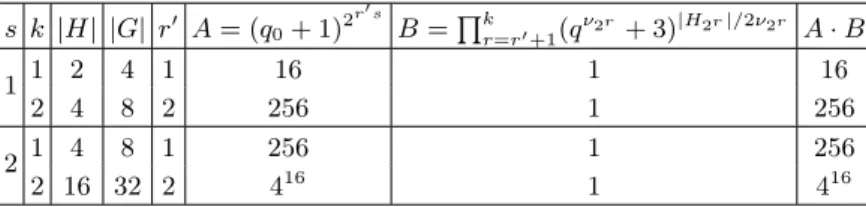
Table 3.1illustrates Proposition 3.8when q= 9, l = 2, fork= 1,2 ands= 1,2. Note that in the last column,A·B gives the number of the resulting codes. Moreover, since the value ofk≤2andq0= 3, then r0 =k, fork= 1,2. Hence, the second factor in the formula given by B is empty and set to be 1. In other words, all cyclotomic classes ofH is of type I, fork= 1,2. In this case, the numbers in the last column of the table also gives the number of Hermitian self-dual 1-generator H-quasi-abelian codes as presented in Corollary 4.5(i).
Table 1. Number of Hermitian self-dualH-quasi-abelian codes inFq[G],H= (∼ Z2k)s,l= [G:H] = 2
and q= 9.
s k |H| |G| r0 A= (q0+ 1)2
r0s
B=Qk
r=r0+1(qν2r + 3)|H2r|/2ν2r A·B
1 1 2 4 1 16 1 16
2 4 8 2 256 1 256
2 1 4 8 1 256 1 256
2 16 32 2 416 1 416
3.2.
H
∼
= (
Z
pk)
s, where
p
is an odd prime
To complete our characterization, consider H ∼= (Zpk)s, k, s > 0, where p is an odd prime and
gcd(p, q) = 1. Recall that in the case p= 2, there is a chance that the q-cyclotomic classes of H are divided exactly into classes of type I and type II. It is interesting to note that it is a totally different situation whenpis odd. Specifically, we show that all non-zero elements inH belong to just one type of
q-cyclotomic classes. Moreover, the necessary and sufficient conditions for them to be of typeI or type
II are determined. Recall thatHpi is the set containing all elements ofH of orderpi,i= 0,1, . . . , kand
H =H1∪Hp∪ · · · ∪Hpk. Note thatSq(0) ={0}=H1is of typeI. We start withHpthe characterization
ofq-cyclotomic classes ofH.
Proposition 3.10. Let h∈Hp. Then Sq(h) is of type I if and only if ordp(q) is odd andordp(q0) is
even. Equivalently, Sq(h)is of typeII if and only if ordp(q)is even or ordp(q0)is odd.
Proof. Following the notation introduced above, letνp= ordp(q). Ifh∈Hp, thenqνp·h=h.
Assume Sq(h) is of type I. Then −q0·h = qi·h = q20i·hfor some 0 ≤ i < νp. It follows that
h=−q20i−1·h=−q02i−2(q0·h) =−q20i−2(−q 2i
0 ·h) =q 2(2i−1)
0 ·h=q
(2i−1)·hwhich impliesν
p|(2i−1).
Hence,νp is odd. We note thatordp(q0)∈ {νp,2νp}. Ifordp(q0) =νp, then h=q νp
0 ·h=q 2i−1
0 ·h=−h, which implies thath= 0, a contradiction. Hence,ordp(q0) = 2νp, which is even.
Conversely, assume that ordp(q) is odd and ordp(q0) is even. It follows that ordp(q) = νp and
ordp(q0) = 2νp. Thenh=qνp·h=q
2νp
0 ·h, i.e.,(q
νp
0 −1)(q
νp
0 + 1)·h= 0. Sinceordp(q0) = 2νp, we have
p-(q0νp−1), and hence,(q
νp
0 + 1)·h= 0. It follows that q0(q
νp
0 + 1)·h= (q
νp+1
2 +q0)·h= 0. Sinceνp is odd, νp+ 1is even. Which implies that−q0·h=q
νp+1
Next, we show that all q-cyclotomic classes ofH \ {0} are of the same type. Because of this, the
q-cyclotomic classes ofH are completely characterized.
Proposition 3.11. Let a∈Hp and b∈Hpi, for any given 1≤i≤k. Then, Sq(a) is of typeI if and
only ifSq(b) is of typeI. Equivalently, Sq(a)is of typeII if and only if Sq(b)is of typeII.
Proof. Let a ∈Hp and assume that Sq(a) is of type I. Then, by Proposition 3.10, νp = ordp(q)is
odd and µp = ordp(q0) = 2νp is even. We show that pi |
qνp·pi−1−1
by induction on i. It is clear
when i = 1. Now, assume pi−1 | qνp·pi−2−1
, for 1 < i ≤ k. Then, qνp·pi−2 ≡ 1 (modpi−1) and
hence, qνp·pi−2·j ≡1 (modpi−1)for all j≥0. Thus, Pp−1
j=0q
νp·pi−2·j ≡Pp−1
j=01 (modp
i−1). This implies that p| Pp−1
j=0q
νp·pi−2·j
. Since qνp·pi−1 −1 =
qνp·pi−2−1 Pp−1
j=0q
νp·pi−2·j
, pi−1 | qνp·pi−2−1
and p|Pp−1
j=0q
νp·pi−2·j
, it follows that pi |qνp·pi−1−1
. Therefore, νpi |νp·pi−1 and means νpi is
odd. Note that µpi ∈ {νpi,2νpi}. Since µp is even, νpi is odd and µp | µpi hence,µpi = 2νpi. Hence,
pi|q2νpi
0 −1
andpi
qνpi
0 −1
. It follows thatpi |qνpi
0 + 1
. In other words,q0(qνpi
0 + 1)·b= 0or
−q0·b=q
νpi+1 0 ·b =q
ν pi+1
2 ·b∈Sq(b)for eachb∈Hpi.
Conversely, assume thatSq(b)is of typeI, for allb∈Hpi. Then,−q0·b=qj·bfor some0≤j < νpi.
It follows that −q0(pi−1·b) = qj(pi−1·b), which implies S
q(pi−1·b)is of type I. Since pi−1·b ∈Hp,
Sq(a)andSq(pi−1·b)are of the same type.
Combining Propositions 3.10and3.11, the corollary below follows immediately.
Corollary 3.12. Lethbe a non-zero element inH ∼= (Zpk)s,pis odd andgcd(p, q) = 1. Then Sq(h)is
of typeI if and only if ordp(q) is odd andordp(q0)is even. Equivalently, Sq(h)is of typeII if and only
if ordp(q) is even orordp(q0)is odd.
We are now ready to obtain a decomposition for Fq[H]. This entails computing forrI and rII. If
there exists h∈H\ {0} such thatSq(h)is of typeI, then by Corollary3.12,rII = 0and
rI = k
X
i=0
|Hpi |
νpi
=
k
X
i=0
pis−p(i−1)s
νpi
,
where νp0 = ν1 = 1 and pis−p(i−1)s is equal to 1 when i = 0. On the other hand, if there exists
h∈H\ {0}such thatSq(h)is of typeII, then Corollary3.12implies thatrI =|H1|= 1and
rII = k
X
i=1
|Hpi |
2νpi
=
k
X
i=1
pis−p(i−1)s
2νpi
.
Recall that νp:= ordp(q)andµp:= ordp(q0). From the above calculations, together with Corollary3.12 and (1), we have
Fq[H]∼=
Fq×
k Y i=1
2is−2(i−1)s
ν pi Y
j0=1
Fqνpi
ifνp is odd andµp is even,
Fq×
k Y i=1
2is−2(i−1)s 2ν
pi Y
j=1
Fqνpi ×Fqνpi
It also implies that anH-quasi-abelian codeC inFq[G]can be decomposed as
C∼=
C1×
k Y i=1
2is−2(i−1)s
ν pi Y
j0=1
Ci,j0
ifνp is odd andµp is even,
C1×
k Y i=1
2is−2(i−1)s 2ν
pi Y
j=1
Di,j×D0i,j
ifνp is even orµp is odd,
(9)
where C1 and Ci,j0 are linear codes of length l over Fq and F
qνpi, respectively, for i = 1,2, . . . , k and
j0 = 1,2, . . . ,(2is−2(i−1)s)/ν
pi. Similarly, bothDi,j andD0i,j are linear codes of lengthl overF
qνpi, for
i= 1,2, . . . , k andj= 1,2, . . . ,(2is−2(i−1)s)/2ν
pi. The above decomposition of the codeCwill lead us
to the following proposition.
Proposition 3.13. Let H ≤Gbe finite abelian groups such that H ∼= (Zpk)s,pis odd,gcd(|H|, q) = 1
andl= [G:H] is even. The number of Hermitian self-dualH-quasi-abelian codes in Fq[G] is
l
2−1 Y
i=0
(qi+12 + 1) k Y i=1 l
2−1 Y
r=0
(qνpi)r+
1 2+ 1
pis−p(i−1)s ν pi
if νp is odd and µp is even,
l
2−1 Y
i=0
(qi+12 + 1) k Y i=1 l X r=0
r−1
Y
j=0
(qνpi)l−(qνpi)j
(qνpi)r−(qνpi)j
pis−p(i−1)s
2νpi
if νp is even or µp is odd.
Proof. Apply the same arguments as in the proof of Proposition3.8to (9).
An example is given whenH ∼= (Zp)sis an elementaryp-group.
Example 3.14. Let H ≤Gbe finite abelian groups such thatH ∼= (Zp)s,pis odd,gcd(|H|, q) = 1 and
the index l= [G:H]is even. Then the number of Hermitian self-dualH-quasi-abelian codes in Fq[G] is
l
2−1 Y
i=0
(qi+12 + 1)
(qνp)i+12 + 1 psνp−1
ifνp is odd andµp is even,
l
2−1 Y
i=0
(qi+12 + 1) l X r=0
r−1
Y
j=0
(qνp)l−(qνp)j
(qνp)r−(qνp)j
ps−1
2νp
ifνp is even orµp is odd.
See Table3.2for the number of Hermitian self-dualH-quasi-abelian codes whenp= 3,q= 4,l= 2, for k= 1,2and s= 1,2. In this case,νp = 1andµp= 2. Then theq-cyclotomic classes ofH are all of
typeI, and hence, this table also illustrates the 1-generator case given in Corollary4.5(ii), typeI case.
4.
Hermitian self-dual
1
-generator quasi-abelian codes
In this section, we study1-generatorH-quasi-abelian codes inFq[G], a cyclicFq[H]-module ofFq[G],
Table 2. Number of Hermitian self-dualH-quasi-abelian codes inFq[G],H= (∼ Z3k)s,l= [G:H] = 2
and q= 4.
s k |H| |G| A= (q0+ 1) B=Qki=1(qνpi+ 1)
|Hpi|/νpi
A·B
1 1 3 6 3 9 27
2 9 18 3 729 2187
2 1 9 18 3 6561 19683
2 81 162 3 38·924 3·38·924
Proposition 2.3. We also consider the case whereH ∼= (Zpk)s, for p= 2or pis odd, and obtain explicit
enumeration.
From [6], we have the following characterization of1-generator quasi-abelian codes.
Theorem 4.1 ([6, Theorem 6.1]). Let q be a prime power and let H ≤G be finite abelian groups with
l = [G:H]and gcd(|H|, q) = 1. Let e1, e2, . . . , et be the primitive idempotents of Fq[H]. In the light of
(3), let
C∼=
t
Y
i=1
Ci
be an H-quasi-abelian code inFq[G], whereCi is a linear code of length l overLi ∼=Fq[H]ei. Then C is
1-generator if and only if theLi-dimension of Ci is at most1, for each i= 1,2, . . . , t.
Since the Fq-dimension of a 1-generator H-quasi-abelian codeC in Fq[G]cannot exceed |H|, C⊥H
could never be a 1-generator if [G : H] > 2. In the case where [G : H] = 2, we have the following characterization.
Corollary 4.2. Assume the notation in Theorem 4.1. In addition, we assume that[G:H] = 2. If C is a1-generator H-quasi-abelian code in Fq[G], then the following statements are equivalent.
i) C⊥H is a1-generator H-quasi-abelian code.
ii) Ci has Li-dimension1 for alli= 1,2, . . . , t.
iii) The Fq-dimension ofC is|H|.
Proof. The corollary follows immediately from Theorem4.1 and observations similar to those in [12, Corollary 3.2].
Combining Proposition2.3and Corollary4.2, we conclude the following characterization for Hermi-tian self-dual 1-generator quasi-abelian codes (cf. [12, Theorem 3.3]).
Corollary 4.3. A 1-generator H-quasi-abelian code C in Fq[G] is Hermitian self-dual if and only if
[G:H] = 2(i.e.,G=Z2×H) and, in (3),C is decomposed as
C∼=
rI Y
i=1
Ci
!
×
rII Y
k=1
Dj×D⊥jE
!
,
where
i) Ci is Hermitian self-dual of length 2 overEi for alli= 1,2, . . . , rI, and
The enumeration of Hermitian self-dual 1-generator quasi abelian codes immediately follows.
Corollary 4.4. Let H ≤Gbe finite abelian groups such that gcd(|H|, q) = 1, and[G:H] = 2. Assume that Fq[H] is decomposed as in (1) and containsrI (resp., 2rII) primitive idempotents of type I (resp.,
II). Assume further that the primitive idempotents of typeI are induced byq-cyclotomic classes of size
si for eachi= 1,2, . . . , rI and the primitive idempotents of typeII are induced byq-cyclotomic classes of
sizestj andt0j, pair-wise, for eachj = 1,2, . . . , rII. Then the number of Hermitian self-dual1-generator
H-quasi-abelian codes in Fq[G] is
rI Y
i=1 (qsi
0 + 1)
rII Y
j=1
(qtj + 1).
Proof. The corollary follows from Corollary4.3, (6), and the fact that the number of 1-dimensional subspaces of F2
qtj isq tj+ 1.
We end this paper by considering the case of Hermitian self-dual 1-generatorH-quasi-abelian codes where H are some p-groups.
Corollary 4.5. Let H ≤G be finite abelian groups such thatH ∼= (Zpk)s,gcd(|H|, q) = 1 andl = [G:
H] = 2(i.e., G=Z2×H). Then one of the following statements holds.
i) If p= 2, q is odd and 0 ≤r0 ≤k is the largest integer such that2r0|(q
0+ 1), then the number of Hermitian self-dual 1-generator H-quasi-abelian codes inFq[G]is
(q0+ 1)
2r0s Yk
r=r0+1
(qν2r + 1)2
rs−2(r−1)s
2ν2r !
.
ii) If p is odd and gcd(p, q) = 1, then the number of Hermitian self-dual 1-generator H-quasi-abelian codes in Fq[G] is
k
Y
i=0
qνpi
0 + 1
pis−p (i−1)s ν
pi ifν
p is odd andµp is even,
(q0+ 1)
k
Y
i=1
(qνpi+ 1)
pis−p(i−1)s
2ν pi
!
ifνp is even orµp is odd.
Proof. The first statement is derived using (8) and Corollary4.3by getting the number of Hermitian self-dual codes Ci over Fq of length l = 2, for i = 1,2, . . . ,2r
0s
, and the number of 1-dimensional linear codes Dr,j0 of length l = 2 over Fqν2r which is equal qν2r + 1, for r = r0+ 1, . . . , k and j0 =
1,2, . . . ,(2rs−2(r−1)s)/2ν
2r.
Supposepis odd, gcd(p, q) = 1, νp is odd and µp is even. This case follows directly from
Proposi-tion3.13by lettingl= 2and noting thatq=q2
0. On the other hand, supposeνpis even orµpis odd. We
apply Corollary 4.3and (9). The first factor is obtained by counting the number of Hermitian self-dual codes C1 of length 2 overFq. For the second factor, we count the number of 1-dimensional linear codes
Di,j overFqνpi, given byq
νpi
+ 1, for eachi= 1,2, . . . , k, andj= 1,2, . . . ,(pis−p(i−1)s)/2νpi.
For the case where H is an elementary p-group, we have the following example.
Example 4.6. LetH ≤Gbe abelian groups such thatH ∼= (Zp)s, an elementaryp-group,gcd(|H|, q) = 1
i) If p= 2 andq is odd, then the number of Hermitian self-dual 1-generator H-quasi-abelian codes in
Fq[G]is
(q0+ 1)2
s
.
ii) If p is odd and gcd(p, q) = 1, then the number of Hermitian self-dual 1-generator H-quasi-abelian codes in Fq[G] is
(q0+ 1)(q
νp
0 + 1)
ps−1
νp if ν
p is odd andµp is even,
(q0+ 1)(qνp+ 1)
ps−1
2νp if νp is even orµp is odd.
5.
Summary
Characterization and enumeration of Hermitian self-dual quasi-abelian codes were established based on the well-known decomposition of quasi-abelian codes. Necessary and sufficient conditions for the existence of Hermitian self-dual 1-generator quasi-abelian codes were also given. For special cases where the underlying groups are somep-groups, complete classification of cyclotomic classes has been done. As a result, the actual number of resulting Hermitian self-dual quasi-abelian codes has been determined. It is interesting to note that the results in this work is restricted to Fq[H] being a semi-simple group
algebra, i.e., the characteristic of Fq and |H|are coprime, whereH is a finite abelian group.
Acknowledgment: The authors would like to thank the anonymous referees for their helpful com-ments. H. S. Palines wishes to thank the University of the Philippines Systems for providing the Al-ternative Study “Sandwich” Grant while doing this research at the Mathematics Department, Faculty of Science, Silpakorn University, Nakhon Pathom, Thailand. Also, to the Department of Science and Technology-Science Education Institute (DOST-SEI) of the Philippines for his Ph.D. scholarship grant. S. Jitman is supported by the Thailand Research Fund under Research Grant TRG5780065.
References
[1] L. M. J. Bazzi, S. K. Mitter, Some randomized code constructions from group actions, IEEE Trans. Inform. Theory 52(7) (2006) 3210–3219.
[2] J. Conan, G. Séguin, Structural properties and enumeration of quasi–cylic codes, Appl. Algebra Engrg. Comm. Comput. 4(1) (1993) 25–39.
[3] B. K. Dey, On existence of good self–dual quasicyclic codes, IEEE Trans. Inform. Theory 50(8) (2004) 1794–1798.
[4] B. K. Dey, B. S. Rajan, Codes closed under arbitrary abelian group of permutations, SIAM J. Discrete Math. 18(1) (2004) 1–18.
[5] C. Ding, D. R. Kohel, S. Ling, Split group codes, IEEE Trans. Inform. Theory 46(2) (2000) 485–495.
[6] S. Jitman, S. Ling, Quasi–abelian codes, Des. Codes Cryptogr. 74(3) (2015) 511–531.
[7] S. Jitman, S. Ling, P. Solé, Hermitian self–dual abelian codes, IEEE Trans. Inform. Theory 60(3) (2014) 1496–1507.
[8] A. Ketkar, A. Klappenecker, S. Kumar, P. K. Sarvepalli, Nonbinary stabilizer codes over finite fields, IEEE Trans. Inform. Theory 52(11) (2006) 4892–4914.
[9] K. Lally, P. Fitzpatrick, Algebraic structure of quasicyclic codes, Discrete Appl. Math. 111(1–2) (2001) 157–175.
[11] S. Ling, P. Solé, Good self–dual quasi–cyclic codes exist, IEEE Trans. Inform. Theory 49(4) (2003) 1052–1053.
[12] S. Ling, P. Solé, On the algebraic structure of quasi–cyclic codes III: Generator theory, IEEE Trans. Inform. Theory 51(7) (2005) 2692–2700.
[13] G. Nebe, E. M. Rains, N. J. A. Sloane, Self–Dual Codes and Invariant Theory, Algorithms and Computation in Mathematics 17, Springer–Verlag, Berlin, Heidelberg, 2006.
[14] J. Pei, X. Zhang,1−generator quasi–cyclic codes, J. Syst. Sci. Complex. 20(4) (2007) 554–561.
[15] V. Pless, On the uniqueness of the Golay codes, J. Combinatorial Theory 5(3) (1968) 215–228.
[16] B. S. Rajan, M. U. Siddiqi, Transform domain characterization of abelian codes, IEEE Trans. Inform. Theory 38(6) (1992) 1817–1821.
[17] G. Séguin, A class of 1−generator quasi–cyclic codes, IEEE Trans. Inform. Theory 50(8) (2004) 1745–1753.
![Table 2. Number of Hermitian self-dual H-quasi-abelian codes in F q [G], H ∼ = (Z 3 k ) s , l = [G : H] = 2 and q = 4](https://thumb-us.123doks.com/thumbv2/123dok_us/7936108.2109780/11.892.243.647.212.316/table-number-hermitian-self-dual-quasi-abelian-codes.webp)
