Mathematical and Software Engineering, Vol. 3, No. 1 (2017), 99-107. Varεpsilon Ltd, varepsilon.com
Preliminary Context Analysis of Social Network
Web Application for Combating HIV/AIDS
Stigmatization
Eze Chinenye Mathew-Emmanuel
1, Simeon Ozuomba
2, and
Constance Kalu
31
Department of Computer Engineering, Michael Okpara University of Agriculture, Umudike, Abia State, Nigeria
2,3
Department of Electrical/Electronic and Computer Engineering, University of Uyo, AkwaIbom, Nigeria.
*Corresponding Author: [email protected]
Abstract
In this paper, context model and preliminary context analysis are presented for a niche Social Network Web Application (SNWA) for combating HIV/AIDS related stigmatization. The contexts model show the stakeholders and how online social network aptly fits into an information system tool for combating HIV/AIDS related stigmatization were presented. The preliminary context analysis was conducted to understand the situated context of use for the SNWA that will be used to address the challenges of HIV/AIDS related stigmatization. Survey research method was used in the context analysis to provide the needed answers to the important questions about the situated context of use of the niche SNWA for combating HIV/AIDS related stigmatization. Some barriers to the development and adoption of the social network were identified. The context analysis results showed that, within the study area, people who live in both urban and rural settlements are willing to adopt a web-based solution to further enhance the fight against HIV/AIDS related stigmatization.
Keywords: Context Analysis; Social Network; Web Application, HIV/AIDS; Stigmatization
1. Introduction
Importantly, nowadays, social networks are been used to organize collective actions; facilitate community development as well as to conduct advocacy and participatory facilitated volunteer information system [2]. Consequently, social network has become a very vital tool for most organizations and individuals alike in reaching out to a very wide audience [3]. Interestingly, Social Network Web Application (SNWA) is used to express community issues and lots of other things [1]. As a result, SNWA now forms a part of community networks which involves broad range of people such as community activists, government agencies, companies, corporate bodies, educational institutions and so on [2,4]. Community networks connect people who live in a given geographical location and they share both physical and virtual space, providing opportunities for both online and offline social interaction and sharing of relevant, localized everyday life information. SNS are increasingly being targeted at specific geographical communities as well as general audience [4]. Social Network strategies provide an opportunity to target entire networks rather than just individuals. [5]. SNWA provide facilitator-moderated inclusive and interactive communication tools and strategies [2]. Studies has also shown that a niche SNWA can be employed to proffer solutions to Human Immunodeficiency Virus/Human Immunodeficiency Syndrome (HIV/AIDS) related stigmatization as it provides opportunities for dialogue, communication of health messages and support all-inclusive participation diverse stakeholders on issues concerning their health [6,7]. In developing a niche software application of this kind, it requires that a preliminary context analysis should be conducted during the feasibility study phase of the software development stage [2,8]. This paper presents the context model of a Community Centered Social Network for Combating HIV/AIDS Related Stigmatization (CCSN4CHAS). The model shows how a niche information system such as SNWA can suitably be deployed to combat HIV/AIDS related stigmatization. In order to design a system of this kind, the necessary contextual factors (situated attributes of the environments where the system will be used) must be taken into consideration are presented in the context model.
The preliminary context analysis (PCA) for the proposed niche SNWA is conducted in Abia state of Nigeria using survey research method. The PCA gives an insight into the situated context of use of the proposed niche SNWA and helpful and useful information for setting a research agenda for the development and deployment of such a SNWA to tackle the scourge of HIV/AIDS related stigmatization.
Finally, a review of relevant literatures is presented in Section 2 of the paper. The context model and research methodology for the context analysis are presented in section 3 while section 4 contains the results and discussion of the context analysis results. Conclusion and recommendations for further studies are presented in Section 5.
2. Review of Relevant Works
[10]. Herek [15] defines HIV/AIDS related stigma as an lasting characteristic of an individual who is infected with HIV for which the person is negatively valued by society, hence, disadvantaged. HIV/AIDS related stigmatization is a process by which PLWHA are discredited [16]. HIV/AIDS associated stigma has silenced open discussion on the causes of the stigmatization and appropriate responses to the stigmatization [16].
Nowadays, social media has become a versatile tool for facilitating large scaled social change. Accordingly, social network is being used for addressing various challenges that relates to HIV/AIDS. Social Network is defined as an online platform that (1) provides services for a user to build a public profile and to explicitly declare the connection between his or her profile with those of other users; (2) enables a user to share information and content with the chosen users or public; (3) supports the development and usage of social applications with which the user can interact and collaborate with both friends and strangers [17,18]. In any case, social network is not only an online or web-based technology, but an age long concept that do exists and operate both in offline and online mode. Consequently, in combating HIV/AIDS, the integrated online and offline social network techniques and strategies are combined to get the best results.
3. Methodology
3.1.
The Context Model of Community Centered Social Network for
Combating HIV/AIDS Related Stigmatization (CCSN4CHAS).
The components of the Community Centered Social Network For Combating HIV/AIDS Related Stigmatization (CCSN4CHAS) as shown in Figure 1, represents the context model of the proposed system. The context model clearly portrays how online social network aptly fits into an information system tool for combating HIV/AIDS related stigmatization. The model also categorizes the CCSN4CHAS components into two information groups namely; offline community/context information and online community information. The offline community/context information lays emphasis on contextual issues and also the needs to tailor the social technologies to the situated context of use among various interest groups who would use the system [2]. The online community information largely involves a virtual platform such as social network web application (SNWA) that must support the purpose for which it is established, policies guiding its use and operations, the contents, ancillary technologies and services as well as support for the online users of the system. The implication of the context model is that the development of a SNWA needs some context information that specifies clearly the purpose and policies that will guide the establishment of the system and the interaction of all users on the SNWA.Figure 1: Context Model of Community Centered Social Network for Combating HIV/AIDS Related Stigmatization.
3.2.
Research Tool for the Preliminary Context Analysis
In order to actualize the preliminary context analysis, survey research method was adopted [19,20]. This was done through administering questionnaires to the respondents who are residents in Abia State of Nigeria. Data collection was done using a research questionnaire which consists of three sections (sections A, B and C) with the title “Strategies for Combating HIV/AIDS Related Stigmatization.”
3.3.
Data Collection
The questionnaire was administered manually between April 2014 and May 2014 using random sampling technique. Survey respondents were selected from hospitals, heart to heart centers, Universities and rural communities in Abia State of Nigeria.
4. Data Analysis and Discussion of Results
4.1.
Data Analysis and Discussion for Section A of the Questionnaire:
Survey Respondents’ Personal Data
(i) Data Analysis for Section A of the Questionnaire
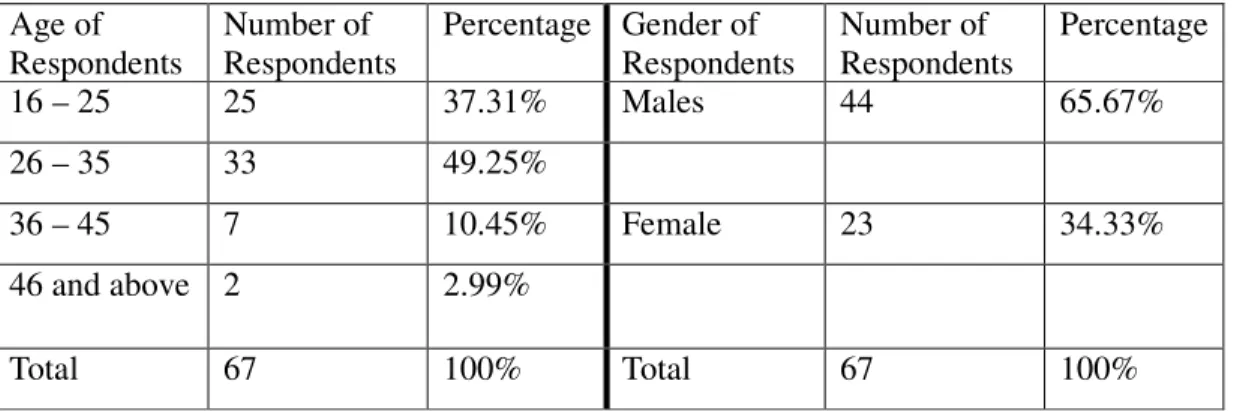
The occupation, age and gender distribution of the respondents are shown in Table 1 and 2 respectively.
ONLINE COMMUNITY FOR COMBATING HIV/AIDS RELATED STIGMATIZATION
Social Network Web Application (SNWA)
Other Social Media Technologies Purpose and Policy
Contents
HIV/AIDS RELATED
STIGMATIZATION STAKEHOLDERS
Agencies/Advocacy groups against
HIV/AIDS stigma Stigma Victims Other online community members Online Facilitator
Local Community Host/Facilitator
Local Community Members
OFFLINE SOCIAL NETWORK/COMMUNITY
Other stakeholders Offline Network
Facilitator and Link Person
Table 1: Section A: Occupation of Respondents
Occupation of Respondents Number of Respondents Percentage (%)
STUDENT 29 43.28%
CIVIL SERVANT 16 23.88%
MEDICAL/HEALTH PRACTITIONER 17 25.37%
OTHERS 5 7.46
TOTAL 67 100%
Table 2: Section A: Age and Gender distribution of Respondents
Age of Respondents
Number of Respondents
Percentage Gender of Respondents
Number of Respondents
Percentage
16 – 25 25 37.31% Males 44 65.67%
26 – 35 33 49.25%
36 – 45 7 10.45% Female 23 34.33%
46 and above 2 2.99%
Total 67 100% Total 67 100%
(ii) Discussion for the Responses to Questions in Section A
The data contained in Tables 1 and 2 show that the respondents are adults who have basic knowledge and understanding of what HIV/AIDS related stigmatization and information and communication technology means as required by the questions posed to them.
4.2.
Data Analysis for Sections B and C of the Questionnaire
(i) Data Analysis Approach for Sections B and C: 5 – Point Likert Scale Questions.
Sections B and C of the questionnaire consists of 5-Point Likert or summative scale questions with the following numeric values: Strongly agree (5); Agree (4); Neutral (3); Disagree (2); Strongly disagree (1) [2,19,20]. The data obtained from the respondents were analyzed using Relative Quality Index (RQI) denoted as Q5, Q4, Q3, Q2 and Q1 for
the five scales respectively [2]. Let nx represent the number of respondents that indicate
any of the five quality indices where x = 5, 4, 3, 2, 1. The total number of participants that actually responded to the questions being considered is represented by n. N represents the total number of respondents that turned in their questionnaire. In cases where some respondents did not indicate any response for a given question, then n < N for that question. Then [2],
= ∑ 1a
Average Relative Quality Index (ARQI) is [2];
=∑ ∑ =∑ 1b
Lastly, let Px represent the percentage of the respondents that indicated any of the five
= 100% 2a
= ∗ 100% 2b
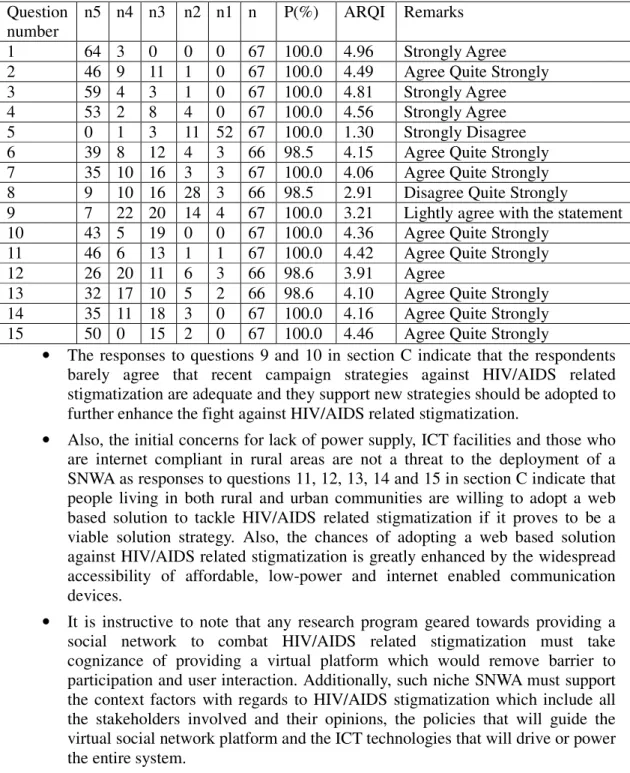
Analysis of the respondents’ responses in section B and C are presented in Table 3 and 4.
Table 3: 5-Point Likert Scale Questions of Section B and C S/N QUESTION
1 I have heard about the term Human Immunodeficiency Virus/Acquired Immunodeficiency Syndrome (HIV/AIDS) and I know what it means? 2 HIV is a deadly Virus and the resultant disease AIDS is incurable. Moreover,
HIV/AIDS is a global epidemic that has defied conclusive solution.
3 I have heard about the term HIV/AIDS related stigmatization and I know what it means.
4 HIV/AIDS stigmatization is the act of marginalizing, discriminating and labeling people who are perceived to be infected with HIV or suffering from AIDS. 5 People living with HIV/AIDS (PLWHA) should always be maltreated,
marginalized, discriminated against and need not be associated with. 6 HIV/AIDS related stigmatization has the capacity to erode an individual’s
confidence and self-worth. Therefore, it can cause some disastrous and
undesirable effects/damages on PLWHA, their family members and the society at large.
7 Stigmatization of PLWHA is a crime against humanity and should be totally condemned.
8 Persons who perpetrate stigmatization against PLWHA should be prosecuted and jailed.
9 Recent campaign efforts by Government, NGOs, local and international agencies to stop HIV/AIDS related stigmatization is adequate and they yield the desired results.
10 Apart from current campaign strategies used in combating HIV/AIDS
stigmatization such as radio/TV adverts, bill board messages, hand bills etc, some other new strategies should be adopted to combat HIV/AIDS related
stigmatization.
11 The internet has a very wide reach to people all over the world. Therefore, tools such as Social Network platforms should be adopted to further combat or rather promote the fight against HIV/AIDS related stigmatization.
12 Social Network may work very well for city and urban dwellers but not for villagers and people who live in rural communities due to poor internet literacy, lack of power supply and basic ICT infrastructure. This notwithstanding, rural dwellers can still gain access via mobile devices and the likes.
13 Internet enabled phones and like devices have made internet access easily affordable, accessible and common. Although ICT infrastructures in rural areas are relatively poor but people there can still access internet services via other computing means such as mobile devices.
14 Those who are in the rural village should be accommodated on the facilitated offline network and their activities made visible online by facilitators. This would help achieve better results against HIV/AIDS related stigmatization
4.3.
Discussion of Results for Sections B and C of the Questionnaire
• The responses for questions 1 and 2 in section B indicate that majority of the
respondents have good knowledge of HIV/AIDS and they understand what it means.
• The responses for questions 3, 4, 5, 6, 7 and 8 in section B indicate that majority
of the respondents have good knowledge of HIV/AIDS related stigmatization and they understand the harmful effects it has on its victims and the society at large.
Table 4: Analysis of the Responses to the 5 - Point Likert Scale Questions
Question number
n5 n4 n3 n2 n1 n P(%) ARQI Remarks
1 64 3 0 0 0 67 100.0 4.96 Strongly Agree
2 46 9 11 1 0 67 100.0 4.49 Agree Quite Strongly
3 59 4 3 1 0 67 100.0 4.81 Strongly Agree
4 53 2 8 4 0 67 100.0 4.56 Strongly Agree
5 0 1 3 11 52 67 100.0 1.30 Strongly Disagree 6 39 8 12 4 3 66 98.5 4.15 Agree Quite Strongly 7 35 10 16 3 3 67 100.0 4.06 Agree Quite Strongly 8 9 10 16 28 3 66 98.5 2.91 Disagree Quite Strongly
9 7 22 20 14 4 67 100.0 3.21 Lightly agree with the statement 10 43 5 19 0 0 67 100.0 4.36 Agree Quite Strongly
11 46 6 13 1 1 67 100.0 4.42 Agree Quite Strongly
12 26 20 11 6 3 66 98.6 3.91 Agree
13 32 17 10 5 2 66 98.6 4.10 Agree Quite Strongly 14 35 11 18 3 0 67 100.0 4.16 Agree Quite Strongly 15 50 0 15 2 0 67 100.0 4.46 Agree Quite Strongly
• The responses to questions 9 and 10 in section C indicate that the respondents barely agree that recent campaign strategies against HIV/AIDS related stigmatization are adequate and they support new strategies should be adopted to further enhance the fight against HIV/AIDS related stigmatization.
• Also, the initial concerns for lack of power supply, ICT facilities and those who
are internet compliant in rural areas are not a threat to the deployment of a SNWA as responses to questions 11, 12, 13, 14 and 15 in section C indicate that people living in both rural and urban communities are willing to adopt a web based solution to tackle HIV/AIDS related stigmatization if it proves to be a viable solution strategy. Also, the chances of adopting a web based solution against HIV/AIDS related stigmatization is greatly enhanced by the widespread accessibility of affordable, low-power and internet enabled communication devices.
• It is instructive to note that any research program geared towards providing a
5. Conclusion
In this paper, a context model of CCSN4CHAS was presented. The model showed the essential stakeholders that must be considered in order to develop a suitable SNWA for the purpose of combating HIV/AIDS related stigmatization.
Furthermore, a preliminary context analysis was conducted to understand the situated context of use for the SNWA that will facilitate the combat of HIV/AIDS related stigmatization. Some barriers to the development and adoption of the social network were identified. The context analysis results showed that, within the study area, people who live in both urban and rural settlements are willing to adopt a web-based solution to further enhance the fight against HIV/AIDS related stigmatization. Lastly, the study provides helpful and useful information for setting a research agenda for the development and deployment of a SNWA to tackle the scourge of HIV/AIDS stigmatization.
References
[1] Lallana, E.C. (2014). “Academy of ICT essentials for government leaders Module 11 – Social media for development.” Korea: UN – APC ICT/ESCAP, 15.
[2] Ozuomba, S. (2013) “Preliminary context analysis of community informatics social network web application.” Nigerian Journal of Technology. 32(2). 266-272.
[3] Shrivastava, K.M. (2013). Social Media in Business and Governance. New Delhi: Sterling Publishers, Pvt. Limited, 5
[4] Button, Angela and Partridge, Helen (2008). “Community networks today: Analyzing new media for local social networking and community engagement.” In Stillman, Larry; Graeme, Johnson, and French, Rebecca (2009) (Eds) Communities in Action: Papers in Community Informatics. Newcastle: Cambridge Scholars Publishing, 44-57
[5] McCree, D.H., Eke, A. and Williams, S.P. (2007). Dyadic, Small Group, and Community-Level Behavioural Intervention for STD/HIV Prevention: Behavioural Interventions for Prevention and Control of Sexually Transmitted Diseases, 2, 105-124.
[6] Aids.gov (2008). Health-Focused Social Networking Sites. Available at http://blogs.aids.gov/2008/04/health-focused-social-networking-sites.html. Accessed on the 1st day of October, 2014.
[7] Mpofu, N. and Salawu, A. (2014). Contributions of HIV/AIDS Social Networking Sites towards Awareness and Prevention of the Pandemic among Students of Rhodes University, South Africa. Mediterranean Journal of Social Sciences, 5(6), 191-202.
[8] Raftree .L. (2011) “ICT works: Best practices in incorporating ICT into proposals for
funding.” Available at
http://www.ictworks.org/2011/02/02/best-practices-incorporating-ict-proposals-funding/ Accessed on the 19th day of June, 2015.
[9] Herek, G. M. and Capitanio J.P. (1993). Public Reactions to AIDS in the United States: A Second Decade of Stigma. American Journal of Public Health, 83, 574 – 577.
[10]UNAIDS (2014) “Guidance note: Reduction of HIV-related stigma and discrimination.
Available at
http://www.unaids.org/sites/default/files/media_asset/2014unaidsguidancenote_stigma_en. pdf. Accessed on the 20th day of October, 2015.
[12]Liamputtong .P. and Kitisriworapan .S. (2012). Deviance, Difference and Stigma as Social Determinants of Health. In: P. Liamputtong; R. Fanany and Verrinder .G. (eds.) Health, Illness and Well Being: Perspectives and Social Determinants. Melbourne: Oxford University Press, 242–256.
[13]Goffman, E. (1963). Stigma: Notes on the Management of Spoiled Identity. Englewood Cliffs: Prentice Hall, 1-10.
[14]Stewart, R., Pulerwitz, J. and Esu, W. (2002). Addressing HIV/AIDS Stigma and Discrimination in a Workplace Program: Emerging Findings. Washington: Population Council.
[15]Herek, G.M. (2002). Thinking about AIDS and Stigma: A Psychologist’s Perspective. Journal of Law, Medicine and Ethics, 30: 591 – 607.
[16]UNAIDS (2005) “HIV-related stigmatization, discrimination and human rights violations. Case studies of successful programmes. Available at http://data.unaids.org/publications/irc-pub06/JC999-HumRightsViol_en.pdf Accessed on the 20th day of October, 2015, 4-8.
[17]Datta, A., Buchegger, S., Vu, L., Strufe, T. and Rzadca, K. (2010). Decentralized Online Social Networks) In: Furht, B (ed.) Handbook of Social Network Technologies and Applications. New York: Springer Science + Business Media, 349.
[18]Katie, Joseph (2013). How an SME Can Use Social Media as Part of Its Relationship Marketing Strategy: Using the Case Study of www.mysahwira.com within the Service Industry. Germany: GRIN Verlag, 1-3.
[19]Easterbrook, Steve; Singer, Janice; Storey, Margaret-Anne and Damian, Daniela (2007). “Selecting empirical methods for software engineering research.” In Shull, Forrest; Singer, Janice; and Dag S.I.K. (2007) (Eds) Guide to Advanced Empirical Software Engineering. London: Springer Science & Business Media, 11, 285-311.
[20]Shaw, Mary (2002) “What makes good research in software engineering?” International journal of software tools for technology transfer 4(1), 1-7. Available at https://www.cs.cmu.edu/~Compose/ftp/shaw-fin-etaps.pdf. Accessed on the 10th day of October, 2015.
[21]Letteney S. and LaPorte H. H. (2004). “Deconstructing Stigma: Perceptions of HIV-Seropositive Mothers and Their Disclosure to Children. Social Work in Healthcare, 38, 105-123.