Improving Generalizability of Clinical Trials by Including Underrepresented Populations
By
Julie Clarke Williams
A Master’s Paper submitted to the faculty of the University of North Carolina at Chapel Hill
in partial fulfillment of the requirements for the degree of Master of Public Health in
the Public Health Leadership Program
Chapel Hill Fall 2016
Date
1 Abstract
Results of health studies are the foundation for the practice of evidence based medicine and public health. Although randomized controlled trials remain the gold standard, the appropriate use of quasi-experimental and observational studies can provide quality results. Dissemination of clinical trial results in a systematic fashion not only facilitates the comparison of trials, but also allows for evaluation of quality. Quality clinical trials require careful attention to minimize bias and maximize internal and external validity. External validity of clinical trials is directly influenced by the generalizability of the trial results. In order for results to be generalizable, study populations must be representative of the population of interest; especially the
population segment that will benefit most from the treatment being studied. Historically, clinical trial populations are dominated by white males. Underrepresented populations often face barriers to participation. Focused efforts to minimize barriers, such as lack of access, poor cultural competence, and financial strain, will increase participation. Funding sources and regulatory bodies also influence clinical trial quality by enacting policies that promote generalizability. Guidelines presented here will facilitate the breakdown of barriers to clinical trial participation leading to diverse participation and greater generalizability so that all individuals will benefit from novel interventions.
Application of good leadership practice is needed to facilitate the breakdown of barriers and promote accrual of underrepresented populations. Ultimately, improving
2 Introduction
Clinical trials are the standard on which evidenced based medicine is centered. The gold standard is a randomized double blinded controlled clinical trial. In many cases, meeting this gold standard is not feasible, especially in a public health setting where other types of trials such as observational and quasi-experimental studies dominate. Despite inherent limitations, results from valid clinical trials provide knowledge to guide medical and public health practice. Critical evaluation of clinical trials is necessary to ensure results are translatable to clinical practice. In fact, funding agencies, including the United States federal government, are championing initiatives, such as Clinical Translational Science Associations (CTSA), to support the translation of basic science research to clinical practice. A number of tools are available to evaluate methodological quality of clinical trials. Use of these tools in combination with
standardized reporting practices will enhance the transition of results to clinical practice. Ensuring equity and sound design in a clinical trial while utilizing standardized
procedures, such as good clinical practice (GCP), provides results that are
3
Designing Clinical Trials of the Highest Possible Validity
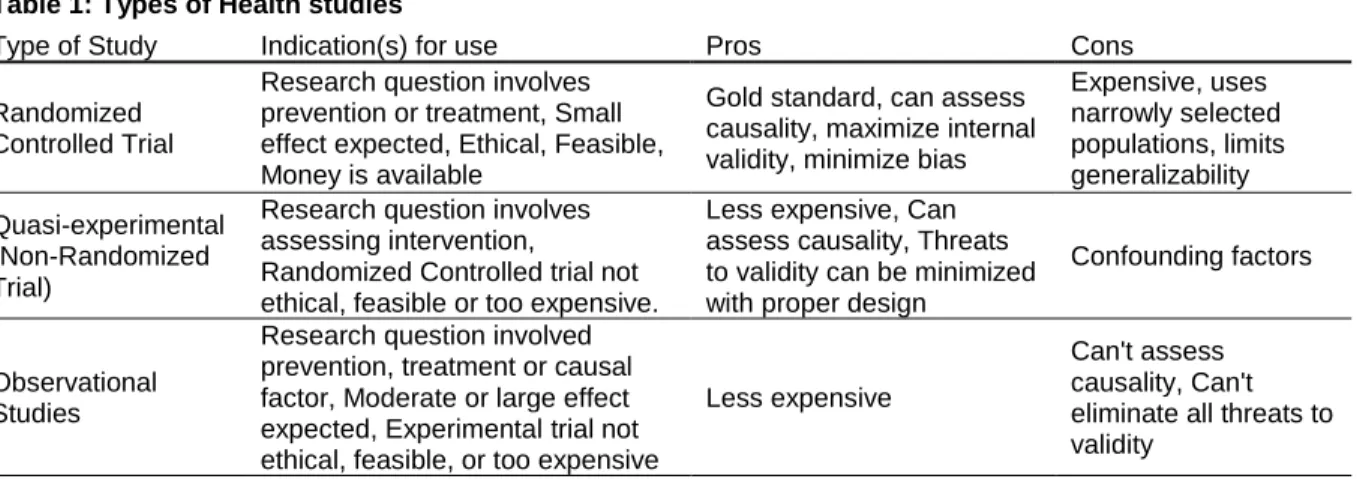
Choosing the appropriate design is a critical component of a quality clinical trial. The hypothesis is a driving factor for design, although mitigating issues such as ethical considerations must be included. For example, inclusion of a placebo control when a suitable alternative medication is available maybe unethical. While the randomized placebo controlled trial is the benchmark, other designs as shown in Table 1 and 2 are frequently utilized.
Table 1: Types of Health studies
Type of Study Indication(s) for use Pros Cons Randomized
Controlled Trial
Research question involves prevention or treatment, Small effect expected, Ethical, Feasible, Money is available
Gold standard, can assess causality, maximize internal validity, minimize bias
Expensive, uses narrowly selected populations, limits generalizability Quasi-experimental (Non-Randomized Trial)
Research question involves assessing intervention,
Randomized Controlled trial not ethical, feasible or too expensive.
Less expensive, Can assess causality, Threats to validity can be minimized with proper design
Confounding factors
Observational Studies
Research question involved prevention, treatment or causal factor, Moderate or large effect expected, Experimental trial not ethical, feasible, or too expensive
Less expensive
Can't assess causality, Can't eliminate all threats to validity
adapted from Essentials of Epidemiology in Public Health (Aschengrau & Seage, 2008) and The Use and Interpretation of Quasi-experimental Studies in Infectious Disease (Harris et al., 2004)
Table 2: Types of Observational studies
Type of Study Indication(s) for use Pros Cons
Case-Control
Little is known about the disease, evaluate multiple exposures, disease is rare or has a log induction and latent period, exposure data are costly, population is dynamic
Less expensive, Fewer subjects required
Greater chance of bias, Can't infer temporal relationship between exposure and disease
Cohort
Little is known about the exposure, Evaluate many effects of an exposure, Exposure is rare, Underlying
population is fixed
Less expensive, High quality data in prospective study, Can utilize records in retrospective study
Can't infer temporal relationship between exposure and disease Cross
Sectional
Examine associations at a single time
point Generalizability, Low cost
Can't infer temporal relationship between exposure and disease Ecologic Examine rates of disease to population
level factors
Low cost, Wide range of exposures
Ecological fallacy, Paucity of information on variables
4
Complexity must be balanced with accuracy. Industrial regulations often drive clinical trial design, leading to complex assortments of data points required for evaluation (Clinpace, 2014). These complex trials are often labor intensive on study staff, ultimately resulting in protocol deviations and ambiguity of data. To combat this issue, the Clinical Trials Transformation Initiative(CTTI), a public-private collaborative which advocates for measures to increase the quality of clinical trials, has put forth a large simple trials project (Eapen, Lauer, & Temple, 2014). This project advocates for larger trials with fewer questions which will ultimately be less expensive and more efficient.
CTTI also maintains a Quality by Design toolkit available free of charge (CTTI, 2016). This toolkit provides guidelines for conducting a quality clinical trial from
5 Assessment of Quality in Clinical Trials
Quality of clinical trials can be standardized and improved using appropriate tools. These tools are not only helpful for comparison of the quality amongst medical and public health trials, but can also serve as a guide for trial design. The Cochrane Handbook for systematic reviews of interventions suggests use of the Downs and Black instrument and the Newcastle-Ottawa scale for assessment non-randomized trials (Higgins & Green, 2011). The Downs and Black instrument provides a checklist in which a 0 or 1 is assigned to 27 parameters for a culminate score which can be utilized for both randomized and non-randomized clinical trials (Downs & Black, 1998). Within these 27 parameters are assessments of reporting quality, external validity, and internal validity. Analysis of reporting quality include:
statement of hypothesis description of outcomes
characteristics of patients including those lost to follow up interventions of interest and main findings
distribution of principle confounders estimates of random variability appropriate p-values defined apriori reporting of all adverse events.
Evaluation of external validity includes:
6
representativeness of the facilities and locations
In addition, external validity includes ensuring that the target population for the
treatment of interest is adequately represented. For example, if a treatment is likely to be primarily utilized in individuals older than 60, then the treatment should be tested in the elderly. If this treatment is instead tested in adults 18-45 then the results will not be generalizable to the population of interest, in this case individuals older than 60.
Internal validity encompasses:
preventing bias by blinding of staff and participants appropriateness of length of follow up
statistical analysis including adjustments for confounding variables losses to follow up
power calculations
compliance with study protocol
accuracy and reliability of measurements avoidance of selection bias
timing of recruitment and randomization
The Newcastle-Ottawa scale utilizes a star system to rate the quality of a trial and subdivides evaluation of non-randomized clinical trials into case-control and cohort (Wells et al., 2016). Unlike the Downs and Black instrument, the Newcastle-Ottawa scale does not evaluate reporting quality.
Criteria evaluated for case-control studies include:
7 representativeness of population
appropriate selection and definition of controls comparability of cases and controls
ascertainment of exposure, including method of ascertainment of exposure and
non-response rate
Cohort studies are evaluated based on the following criteria:
representativeness of exposed cohort ascertainment of exposure
demonstration that outcome was not present at start comparability of groups
assessment of outcome
appropriate length of follow up adequacy of follow up
Stars are awarded for positive responses to each question and tallied for comparison amongst trials.
Numerous checklists and scales are available for assessing quality of
randomized clinical trials (Moher et al., 1996). However, the Cochrane Handbook for systematic reviews of interventions suggest use of a domain based evaluation tool for assessing internal validity/bias of randomized clinical trials (Higgins & Green, 2011). This tool evaluates bias within domains of selection, performance, detection, attrition, reporting and other. Within the selection domain, the use of random sequence
8
sequence generators are tools by which patients are randomly assigned to treatment groups which are delineated in order to evaluate the treatment of interest. This random assignment is based on a randomly produced sequence, which is usually computer generated. Allocation concealment refers to the blinding of the random sequence from those assigning participants to treatment groups. Performance bias refers to the blinding of subjects and study staff, while detection bias refers to the blinding of
assessors. Attrition bias is defined by completeness of the data regarding exclusion or removal of subjects from analysis. Reporting bias refers to reporting of selected specific outcomes. The final other bias category provides the reviewer with a category for
concerns for bias not captured in the previous categories (Higgins & Green, 2011). This domain based tool focuses on internal validity but does not take into account
appropriateness of analysis, design, and reporting.
Numerous additional tools such as those presented above are available for evaluating validity of clinical trials. Each tool is useful in specific scenarios. However, no matter which tool is used, each evaluator provides a unique assessment. Assessments are typically constructed on information provided in a publication. As is detailed in the next section, standardized practices for reporting results of clinical trials are critical for comparative evaluations.
Usability/Dissemination of Results
9
that is accepted by the FDA in compliance with the FDAAA801 (NIH, 2016a).
Clinicaltrials.gov entries are completed by the responsible party, either the sponsor of the trial or the principal investigator (NIH, 2016a). Information about clinical trials assessing drugs, biologics or devices in the United States are available through clinicaltrials.gov. This website generally does not register phase I trials, feasibility studies, behavioral trials, and non-interventional studies such as registries. Information available in the clinicaltrials.gov study record includes study status (i.e.: open, recruiting, completed), sponsor, collaborators, dates of entry and changes, purpose, eligibility, contacts, and study results.
CONSORT(Consolidated Standards of Reporting Trials) is a 25-item checklist and flow diagram designed to provide a guideline for reporting results of randomized clinical trials (CONSORT, 2016). CONSORT is recognized by many of the core medical journals including The Lancet and Journal of the American Medical Association
(CONSORT, 2016). In addition, journals may require a CONSORT checklist upon submission of results of a clinical trial. The CONSORT checklist includes items typically found in a publication such as title, abstract, background, methods, results and
discussion. Within these categories are more specific details regarding trial design, participants, interventions, outcomes, sample size, randomization, blinding, statistical methods, recruitment, data, harms, limitations, generalizability, registration, funding, etc. The full checklist can be found at www.consort-statement.org.
10
target population, Efficacy or effectiveness, Adoption by target staff, settings or institutions, Implementation consistency, costs and adaptation made during delivery, and Maintenance of intervention effects in individuals and settings over time” (RE-AIM, 2016, para. 4). The RE-AIM.org website provides resources and tools for reporting and implementation of quality public health trials and interventions (RE-AIM, 2016).
Resources include checklists for planning, literature reviews, and combining CONSORT and RE-AIM ideals. An online training module is also available. Standardizing reporting techniques will facilitate study comparison and aggregation into meta-analysis as well as impact usability of results.
Good Clinical Practice: A Standard of Quality in Clinical Trials
Good clinical practice (GCP) guidelines also serve as a crucial reference for conducting quality clinical trials. GCP training is required by most if not all clinical trial funding entities. A number of GCP trainings are available including the Collaborative Institutional Training Initiative (CITI) training program and the National Institutes of Health (NIH) GCP training program among others (CITI, 2016; NIH, 2016d). GCP training ensures the integrity of a clinical trial. In the United States many of the GCP standards are based on the Belmont Report (United States, 1978), while the
international standard is the Declaration of Helsinki (World Medical Association, 2013). These documents serve as reference tools for ensuring the protection of research subjects and clinical trial integrity.
Generalizability of Clinical Trials
11
the trial. Factors that contribute to the generalizability of a study include selection of the study population and the study location. In order to ensure results of a clinical trial are generalizable to the larger population, care must be taken when defining inclusion and exclusion criteria or cases and non-cases while keeping in mind the ultimate target population. Efforts should be made to enroll subjects of varying race, ethnicity, income, socioeconomic status and when appropriate sex and age. Considerations for the hypothesis and disease under investigation are necessary. For example, a study of a novel treatment for sickle cell disease will likely enroll a majority of individuals who have been shown to have a high prevalence of the disease, such as persons of African descent. However, use of matching or balancing techniques when randomizing to treatment groups will prevent demographic factors from confounding results. For example, upon enrollment, age, sex, and ethnicity information can be incorporated into the randomization stratification so that when two white males between the ages of 50 and 60, who are matched in terms of demographics are enrolled, one of these
individuals will be randomized to treatment group A while the other is randomized to treatment group B.
Initiating a clinical trial at multiple sites improves generalizability over a trial conducted at a single center. However, diversity among the sites should also be considered. For example, expanding study locations to include community based practices improves generalizability over a multi-center trial conducted exclusively at large academic research centers. Study sites are often chosen based on the
12
clinical trials. If a physician is not initiating their own trials, they may be approached to participate for a number of reasons including their being a scientific or opinion leader in a particular field; or because they have developed an infrastructure that has resulted in a history of high enrollments; or perhaps because their patient base is of particular interest. Physicians may also seek opportunities to participate studies via cooperative groups such as those sponsored by the National Cancer institute (NCI). In most cases clinical trial participants are enrolled via a medical professional, therefore engaging physicians and public health professionals in diverse care settings will promote generalizability.
Replication of studies also impacts generalizability. For example, if a study uncovers an association in a narrow population and a second and third study find the same association in different populations, taken together these studies can provide evidence that the result is generalizable to the larger population. Ideally, all clinical trials would be conducted world-wide, but issues surrounding funding and logistics create significant limitations. In addition, in the case of devices and pharmaceuticals,
regulatory agencies in different geographical locations have differing requirements for granting approval. Replication of studies also improves internal and external validity. In fact, multiple studies are required for FDA approval of new drugs.
Barriers to Clinical Trials: Narrow Enrollment Criteria
Numerous barriers to clinical trial participation exist. Narrow enrollment criteria create a barrier for participation, however, focused enrollment criteria are often
13
in advance and eligibility should be based on this population. Often inclusion and exclusion criteria beyond the definition of the target population are related to patient safety. For example, if a drug is known to negatively impact heart function then individuals with already reduced heart function would be excluded for safety reasons. Pregnant and lactating women are often excluded from trials for similar reasons in that safety of interventions for unborn and neonatal children are unknown. Ultimately, the goals of eligibility criteria are not directed at generalizability; instead they are more often focused on improving internal validity, by limiting attrition, and improving protocol
compliance, and reliability of results. Similar considerations for populations are
necessary when defining cases in a case-control or cohort study. Cases must be well defined in order for analysis to reveal associations. If case definitions are too broad, individuals who do not truly have the disease will be captured diluting the possibility of uncovering a cause. If a case definition is too narrow, then the number of cases may be too few to identify potential causes.
Barriers to Clinical Trials: Opportunity
Another important barrier to clinical trial participation is lack of access. Access to clinical trials is influenced by a number of factors including the types of studies offered at an institution, location/proximity to a treatment center, and income/financial burden. As patients and family members become educated with respect to the illness in
question, these individuals may search for clinical trials related to their disease. If a study is not offered at the patient’s primary treating institution, they may choose to
14
institutions are more likely to be conducting clinical trials as funded research. This research is often a component of their performance evaluations, since funded trials ensure adequate finances for their salaries and also meet academic publication requirements for promotion. Community physicians are less likely to participate in research due to challenges related to time, lack of infrastructure to support trials, and in some cases financial disincentives (IOM, 2010). Physicians have noted concerns that patient relationships may be negatively influenced by the uncertainty of randomization in a clinical trial (Unger, Cook, Tai, & Bleyer, 2016). Lack of opportunity for clinical trials in the United States is also influenced by the structure of the health care system. In
countries with nationalized health care systems, clinical research takes place in a variety of sites (IOM, 2010). As mentioned previously, diversity in participating geographic locations and types of care centers promotes generalizability.
15
increases for patients with late stage disease. This study was conducted at a large public urban institution supporting pharmaceutical, cooperative group, and investigator initiated trials and thus generalizability to other institutions, particularly in rural areas, is questionable. Nonetheless, narrow inclusion and exclusion criteria and lack of available trials remain substantial limitations to participation for all populations.
Barriers to Clinical Trials: Financial Strain
Participation in clinical trials often requires additional visits to the medical facility on top of standard of care visits. If an individual lives far from the treatment center or has issues surrounding transportation, they may be unable to make additional trips required. Lack of proximity to available trials can become a financial burden for clinical trial participants. Individuals in low socioeconomic brackets are disproportionately affected by financial barriers. One way to alleviate financial barriers is to cover excess costs associated with participation (Unger, Gralow, Albain, Ramsey, & Hershman, 2016). Local institutions are recognizing financial burdens and implementing strategies to combat financial barriers (Nipp et al., 2016). One institution implemented a Cancer Care Equity Program which provided financial assistance to cancer patients as well as patient navigation and community outreach to promote awareness of options for care including clinical trials (Nipp et al., 2016). A recent study of the effects of this program on clinical trial participation documented that clinical trial participants eligible for
16
participation by approximately 19 patients per month (Nipp et al., 2016). This study highlights the financial barrier, which is influenced by proximity, associated with participation in cancer clinical trials.
Underrepresented Populations
Clinical trial populations have historically excluded important segments of the population who may benefit from the novel treatments under investigation. In fact, clinical trial participation is dominated by white males. Underrepresented populations include:
The elderly: Two thirds of cancer patients are over the age of 65 yet they
only comprise one third of the clinical trial participants (Clinpace, 2014; Lewis et al., 2003).
Adolescents and young adults: Only 10% of 15-19 year olds participate in
cancer related clinical trials, in contrast 60% of children less than 15 participate (Clinpace, 2014). Adolescents, 15-19 year olds, tend to fall into a clinical trial gap as adult trials require enrollees to be over the age of 18. Non-white racial and ethnic groups: White individuals have dominated
enrollment in NCI sponsored clinical trials, with greater than 70% in 2008 (Pinn, Roth, Bates, Wagner, & Jarema, 2009).
Women: Women are underrepresented in studies of lung and colorectal
cancer (Clinpace, 2014).
Low income: Low income patients are less likely to enroll (Unger, Gralow,
17
Rural: Although major medical centers located in urban areas provide the
greatest opportunities for clinical trial participation, suburban populations are most represented in clinical trials. Representation of rural populations is deficient (Clinpace, 2014).
Uninsured: Despite cancer clinical trials often providing free or reduced
costs for participants, uninsured individuals are less likely to participate (Colon-Otero et al., 2008).
This list is not exhaustive. Underrepresented populations are often specific to the type of study and treatment. For example, underrepresentation in trials investigating new drugs is common due to expenses required to capture a generalizable population and regulations designed to protect certain populations. Epidemiologic studies often provide broader representation with respect to underrepresented populations compared to randomized controlled trials.
Barriers for Underrepresented Populations
Even with efforts to boost enrollment (NIH, 2016e) barriers continue to exist for underrepresented populations. As mentioned previously teenagers 15-19 years of age are historically underrepresented in clinical trials. Despite statements from governments worldwide against age restrictions, age cutoffs remain in place largely due pediatric vs. adult funding sources and departmental delineations (Fern, Lewandowski, Coxon, Whelan, & National Cancer Research Institute Teenage and Young Adult Clinical Studies Group, 2014). In addition, Institutional Review Boards (IRB), restrict the
18
restrictions related to legal consent can be circumvented by inclusion of parent/guardian consent provision. A systematic review of clinical trials enrollment in Britain found no scientific basis for age related inclusion or exclusion criteria (Fern et al., 2014). More recently several countries have released initiatives aimed at increasing enrollment of teenagers in clinical trials. In the United States, this initiative, championed by the NCI and the US Children’s Oncology Group, allows for lowering of age limits for adult trials and raising of age limits for traditionally pediatric studies (Bleyer, 2007). Non-cancer related initiatives such as the adolescent trials network for HIV/AIDS interventions have also been created (ATN, 2014). Lack of inclusion of adolescents in clinical trials leaves physicians in ethical quagmires regarding safety of treatment options for this age group.
Similar to teenagers, underrepresentation of elderly individuals (>65 years of age) in clinical trials affects treatment decisions. While individuals over 65 comprise 65% of new cancer diagnosis, the elderly only make up 25% of trial participants (Denson & Mahipal, 2014). Elderly individuals are disproportionally susceptible to
exclusion criteria surrounding performance status as these individuals are more likely to experience co-morbidities affecting this parameter. Elderly patients are also more likely to experience barriers related to access such as transportation, finances, and a lack of autonomy (Denson & Mahipal, 2014). In 1974, the National Institute on Aging was created to investigate aging related health issues. Unfortunately, due to the specificity of funding allocations, this entity does little to promote age diversity in clinical trials.
19
to be the primary end user of the treatment being tested. In order to meet these guidelines, trials of drugs likely to be used by elderly populations are beginning to stratify age groups in order to obtain representative populations, including groups >75 years of age. Nonetheless, the lack of older individuals in clinical trials prevents
availability of evidence based practices for treating this population.
Despite greater burden of diseases such as diabetes and alcoholism and elevated rates of cancer deaths, indigenous people are less likely to participate in clinical trials (Sprague, Russo, LaVallie, & Buchwald, 2013). Indigenous people site barriers such as lack of access, distrust of medical professionals, lack of understanding of materials and procedures (Glover et al., 2015; Sprague et al., 2013). In the United States, additional barriers to trial participation exist due to the need for approval by appropriate tribal entities, including the Indian Health Services(IHS) IRB (IHS, 2016b). The IHS, a division within the Department of Health and Human Services, was
established to promote the health of Native Americans and Native Alaskans. The goal of the IHS is to ensure “comprehensive, culturally acceptable personal and public health services are available and accessible to American Indian and Alaska Native people” (IHS, 2016a, para. 2) As with many ethnic and racial minority groups, consideration of cultural norms can facilitate enrollment. For example, relationship building, use of culturally appropriate study design and study materials, employing indigenous study staff, and use of targeted recruitment techniques have been utilized to enhance study participation (Glover et al., 2015).
20
Americans continue to be underrepresented in clinical trials (Ford et al., 2008). Barriers to enrollment to clinical trials for African Americans are similar to other minorities and include socioeconomic barriers, lack of awareness, and lack of willingness to
participate/mistrust. The mistrust of clinical trials in this community is particularly pertinent given the infamous Tuskegee syphilis experiment. Despite the availability of treatment, the US Public Health Service studied the natural progression of syphilis in African Americans in Alabama during the 1930 to 1970s (Hughes, Sellers, Fraser, Knight, & Areghan, 2003). In fact, a qualitative focus group based study found that the Tuskegee syphilis experiment still resonated with African American cancer patients, especially those old enough to be alive when the study was conducted (Hughes, Knight, Fraser Jr., & Teague, 2005). Strategies to increase enrollment of African Americans in clinical trials include engaging African Americans using culturally sensitive materials and existing community groups (Ahaghotu et al., 2016). For example, during my MPH
practicum a member of FirstHealth of the Carolinas clinical trials team conducted a well-received informational presentation at a local meeting of the National Association for the Advancement of Colored People (NAACP). Additional approaches to increase
engagement include recruitment of African American and community based physicians to serve as investigators and increasing physician awareness of cultural sensitives (Ahaghotu et al., 2016). Finally, specific targeting of hospitals and health care systems that serve African American communities will increase access.
21
trials, perceived benefits, and incentives to participation (Arevalo et al., 2016). This study conducted focus groups in both English and Spanish, highlighting the need for clinical trial materials in Spanish as well as Spanish speaking staff. Unique to this population, fears of deportation were also expressed by participants in this study
(Arevalo et al., 2016). Similar to other underrepresented groups, strategies to overcome these barriers include, engaging local community groups and trusted physicians,
education of the purpose and expectations of a clinical trial as well as transparency regarding compensation and risk/benefits.
Similar to Hispanic Americans, representation of Asian Americans in clinical trials is disproportionately low (Ma et al., 2014). A recent qualitative study observed that unlike other minority groups, Asian Americans place less weight on cultural barriers and more emphasis the hope for a treatment/cure (Ma et al., 2014). Although similar themes of physician trust are noted, focus group participants also emphasized the importance of balancing risks and benefits. The primary care physician plays a role in Asian American enrollment in clinical trials. As such, expertise is respected and physicians should utilize open communication to explain the benefits. Physicians should also be mindful of
stigmas in the Asian community associated with the word trial, and instead use words such as research or study (Tran, 2015). Asians tend to be selfless and prefer not to disrupt their family. However, incentives and reminding potential participants that their role in the trial will benefit others are relevant motivators (Tran, 2015).
22
pregnant women, prisoners, and students, attention should be paid to balance the integrity of the trial. Trials should not discriminate against vulnerable populations but care must be taken to avoid exploitation as well. In this case the IRB serves to oversee the inclusion of these vulnerable populations. However, IRB protections of vulnerable populations may limit generalizability if they become a barrier to the conduct of a clinical trial. For example, a sponsor may choose to exclude vulnerable populations to avoid additional IRB paperwork and oversite. If vulnerable populations are excluded from trials, then evidence based practices for these individuals will continue to be lacking. Discussion
Impact of Barriers on Results
Barriers to clinical trial participation directly influence external validity and generalizability of trial results. If clinical trial enrollment is not representative of the population of interest, interpretation can be flawed and translation of results to clinical practice delayed. Safety of drugs and interventions is of particular concern. For
example, if a trial population is comprised entirely of adults, physicians may be reluctant translate these results into their practices for use by pediatric patients. Careful analysis of generalizability must be considered when extrapolating results of trials to the target population. Barriers are often impossible to avoid and different studies may face different barriers to enrollment. The use of systematic reviews to aggregate data from multiple studies may be utilized to determine generalizability and alleviate concern as well as guide evidence based practices for the wider population.
23
In 2016, the National Academy of Sciences published the proceedings of a workshop entitled “Strategies for Ensuring Diversity, Inclusion and Meaningful Participation in Clinical Trials” (National Academies of Medicine, Science and Engineering, 2016). This report put forth best practices and policies for ensuring diversity in clinical trials. Suggestions include:
Population-specific recruitment strategies and sites
Funding and institutional support for targeted infrastructure Feedback mechanisms for recruitment goals
Sensitivity to socioeconomic factors Centralized disparities committees Workforce and research team diversity
Cultural competency training for research teams Engaging with community stakeholders
Seeking community involvement
These suggestions can be amalgamated into two major categories: boosting
recruitment of diverse populations and policies/initiatives that enhance generalizability. Employing staff representative of the target population promotes relatability for
participants. Efforts to recruit representative populations to clinical trials can be
enhanced by engaging community stakeholders and organizations whose members are typically underrepresented in clinical trials. For example, outreach to faith based
24
(Hippolyte, Phillips-Caesar, Winston, Charlson, & Peterson, 2013). This group found that working directly with the leader of the faith based organization was critical. In
addition, the approach of the leader should be tailored to the size of the organization. In one instance the faith based leader participated in the trial. In this case, leading by example was particularly helpful for motivating study participants and reducing fear, stigma, and apprehension. In addition to faith based organizations, outreach to other local community centers and civic groups, including local chapters of the NAACP, senior centers, Latino, Asian, or Native American civic organizations is worthwhile. Each
community is different and, thus, the appropriate partners must be evaluated on a case by case basis. Nonetheless, building trust through community partnerships is important for diversifying clinical trial enrollment and enhancing generalizability.
Recruitment efforts can also be boosted by engaging community and minority physicians. The doctor patient relationship promotes trust. In fact, a study found that patients were more likely to participate in a clinical trial if the trial is recommended by their treating physician (Walsh & Sheridan, 2016). Therefore, recruiting physicians, who serve underrepresented populations, can increase participation by these populations and ultimately enhance generalizability. One important consideration is that the physician must be willing and able to provide the effort required to serve as an investigator. In the case of pharmaceutical trials, physicians are incentivized with monetary compensation. However, often physicians who participate in clinical trials have a history of involvement. Therefore, efforts to recruit new physician investigators are required. One possible way to engage new physicians would be to enhance
25
during training would embed trials in the physician culture, leading to graduates that are more likely to suggest a clinical trial to their patients.
Another important approach for improving diversity in clinical study participants is through incentives and initiatives put forth by the funding agencies. The majority of policies and initiatives that promote clinical trial participation in the United States are put forth through the NIH. The NIH Revitalization Act of 1993, supported by the Public Health Service Act sec. 492B, 42 U.S.C. sec. 289a-2, “ensure[s] the inclusion of women
and minority groups in clinical research…in a manner that is appropriate to the scientific
question under study” (NIH, 2016e, para. 1). This policy applies to all NIH sponsored
research. In addition to the NIH, the FDA has also put forth a policy to ensure that sex
differences are understood with regards to disease therapy (FDA, 2016). The NIH
funded office of Research on Women’s Health promotes the appropriate representation
of women in clinical trials in addition to emphasizing the importance of understanding
sex differences (NIH, 2016b). Sex differences, with respect to drug response, have
been documented. However, the extent to which these differences are consequential to
health are unknown. Therefore, the sex disparity among clinical trial participants
remains controversial (Berlin & Ellenberg, 2009).
Other NIH based initiatives aimed at diversifying clinical trial participation include
the aforementioned ATN and adolescent oncology initiative as well as, the EMPACT
consortium (Enhancing Minority Participation in Clinical Trials), and the NIH Community
Oncology Research Program (NCORP). The EMPACT consortium, formed in 2009, is
funded through the National Institute on Minority Health and Health Disparities. The goal
of the EMPACT consortium is to “increase recruitment and retention of racial/ethnic
26
health disparities” (@EMPaCTHealth, 2012, para. 1). The EMPACT consortium offers
resources and training courses specifically aimed at recruiting minorities to clinical
research. Local groups supplement national initiatives to increase minority participation
in clinical research. One example of this type of group is HealthStreet, a community
engagement program based out of the University of Florida (HealthStreet, 2016). The
mission of HealthStreet is to “to reduce disparities in healthcare and research”
(HealthStreet, 2016, para. 3). HealthStreet seeks not only to build trust in the
community and to link individuals to care but also introduce them to clinical research.
HealthStreet maintains and database of individuals who are willing to participate in
clinical trials, and researchers may utilize this database when seeking clinical trial
participants. Over 3300 people have been linked to research studies through
HealthStreet (HealthStreet, 2016).
The goal of NCORP “is to bring cancer clinical trials (cancer control, prevention,
screening, treatment, and imaging), as well as cancer care delivery research (CCDR),
to individuals in their own communities” (NIH, 2016c, para. 2). A variety of NCORPs
exist in the United States, including 34 Community Clinical Oncology programs (CCOP),
7 research bases, and 12 Minority/Underserved programs. These programs bring
access to NCI clinical trials to community oncology centers, which typically do not
support investigator initiated trials. For example, FirstHealth of the Carolinas in
Pinehurst, NC is a member of the Southeast Clinical Oncology Research (SCOR)
Consortium NCORP (See Figure 1). Based in Winston Salem, North Carolina, SCOR is
a CCOP comprised of 22 community sites across the southeast including North and
27
allow patients to remain at their primary treating institutions which overcomes the
access barrier, but also provides generalizability by promoting research at
non-traditional institutions. Both local and national initiatives are critical to promoting clinical
trial participation among historically underrepresented individuals, including vulnerable
populations. Ultimately these efforts can increase generalizability, and improve the
external validity of clinical research.
Figure 1: Map of SCOR participants in North Carolina. Blue circles are Community Clinical Oncology Programs, Green Triangles are Minority Community Sites, Blue diamonds are research bases(under red circles over Winston Salem, NC), and red circles are component/subcomponent sites of SCOR in North Carolina. Map taken from https://ncorp.cancer.gov/findasite/map.html.
Conclusions and Future Research
28
generalizability. In order for clinical trials to have maximum external validity, the patient population included in studies must be representative of the population of interest. While the randomized controlled trial is the gold standard, use of other epidemiological
methods may provide adequate information; however, both types of studies are subject to threats to external validity due to lack of diversity in study populations. A balance between complexity and validity must be achieved. Quasi-experimental and
demographically matched designs provide opportunities for high generalizability at costs lower than that of randomized controlled trials. Replication of studies also supplements original data and promotes generalizability.
This paper has discussed barriers to enrollment for underrepresented and vulnerable populations. An important consideration that affects the conduct of clinical trials in general is the important and necessary regulatory process; which sometimes also leads to barriers to participation. For example, conducting clinical trials at
specialized institutions, such as jails or schools, often requires additional IRB oversite. Sponsors may decide to avoid conducting trials at specialized institutions due to additional IRB requirements. However, increased use of approved centralized IRBs provides the opportunity to consolidate oversite while maintaining integrity of the research process.
29
Requirements for Pharmaceuticals for Human Use (ICH) has sought to address this barrier. Although ICH is comprised of representatives from the United States, Europe, Japan, Canada, and Switzerland, many other nations recognize their authority, including Mexico, Australia and Russia among others (ICH, 2016). Regional and international entities, such as the World Health Organization and the Asian-Pacific Economic cooperation, are involved in the ICH as observers or members. The ICH provides training and guidelines for the development of new drugs and devices, but most importantly the ICH provides a “one stop shop” for regulatory approval. As additional entities recognize the ICH the approval process will become less of a barrier.
As the United States becomes more culturally diverse and internationally conducted clinical trials become more feasible, the understanding of barriers to participation of all individuals is critical. Further research is required to identify
successful strategies to overcome barriers unique to specific populations. In addition, the impact of IRB protections on vulnerable populations to enrollment in clinical trials needs further study. Future investigations are required ensure the balance of protection and incorporation of these populations. Protected populations should not go without novel interventions because effects of these interventions are unknown.
Barriers to clinical trial participation influence generalizability of clinical trial results and are a direct threat to external validity. These barriers must be addressed to ensure safety and efficacy of best practices amongst all populations. Initiatives to break down barriers must be supported by funding agencies. In addition to efforts by
regulatory and funding agencies, the entire research community needs greater
30
organizations, and academic institutions, to improve the translation of research into practice for all people, including the populations who will benefit the most from new treatments.
In summary, greater leadership is required to enhance strategies that promote generalizability and external validity of clinical trials. For example, use of good
communication skills and demonstrating cultural competence will facilitate building of relationships with community groups. In addition, endorsing vision statements that incorporate removal of barriers and promote inclusion of all persons will provide a clear message to patients and providers. Developing strong and diverse teams to overcome barriers at the funding, hospital, or practice level will enhance the likelihood of success. Guidelines presented here will facilitate the breakdown of barriers to clinical trial
participation leading to diverse participation and greater generalizability so that all individuals will benefit from novel interventions.
31 References
@EMPaCTHealth. (2012, 2012-04-18T15:03:18+00:00). About EMPACT: Enhancing Minority Participation in Clinical Trials. Retrieved from
http://empactconsortium.com/about-empact/
Ahaghotu, C., Tyler, R., & Sartor, O. (2016). African American Participation in Oncology Clinical Trials--Focus on Prostate Cancer: Implications, Barriers, and Potential Solutions. Clin Genitourin Cancer, 14(2), 105-116.
doi:10.1016/j.clgc.2015.12.003
Aizer, A. A., Wilhite, T. J., Chen, M. H., Graham, P. L., Choueiri, T. K., Hoffman, K. E., Nguyen, P. L. (2014). Lack of reduction in racial disparities in cancer-specific mortality over a 20-year period. Cancer, 120(10), 1532-1539.
doi:10.1002/cncr.28617
Arevalo, M., Heredia, N. I., Krasny, S., Rangel, M. L., Gatus, L. A., McNeill, L. H., & Fernandez, M. E. (2016). Mexican-American perspectives on participation in clinical trials: A qualitative study. Contemp Clin Trials Commun, 4, 52-57. doi:10.1016/j.conctc.2016.06.009
Aschengrau, A., & Seage, G. (2008). Essentials of Epidemiology in Public Health. Sudbury, Massachusetts: Jones and Bartlett Publishers.
ATN. (2014). Adolescent Trials Network Home Page. Retrieved from https://www.atnonline.org/public/default.asp
32
Bleyer, A. (2007). Adolescent and young adult (AYA) oncology: the first A. Pediatr Hematol Oncol, 24(5), 325-336. doi:10.1080/08880010701316850
CITI. (2016). Collaborative Institutional Training Initiative. Retrieved from
https://www.citiprogram.org/index.cfm?pageID=14&languagePreferenc
e=English&region=1
Clinpace. (2014). An Overview of Oncology Clinical Trials.
Colon-Otero, G., Smallridge, R. C., Solberg, L. A., Keith, T. D., Woodward, T. A., Willis, F. B., & Dunn, A. N. (2008). Disparities in participation in cancer clinical trials in the United States : a symptom of a healthcare system in crisis. Cancer, 112(3), 447-454. doi:10.1002/cncr.23201
CONSORT. (2016). Welcome to the CONSORT Website. Retrieved from http://www.consort-statement.org/
CTTI. (2016, 2016-06-26). Clinical Trials Transformation Initiative QbD (Quality By Design) Toolkit. Retrieved from https://www.ctti-clinicaltrials.org/toolkit/qbd Denson, A. C., & Mahipal, A. (2014). Participation of the elderly population in clinical
trials: barriers and solutions. Cancer Control, 21(3), 209-214.
Downs, S. H., & Black, N. (1998). The feasibility of creating a checklist for the assessment of the methodological quality both of randomised and
non-randomised studies of health care interventions. J Epidemiol Community Health, 52(6), 377-384.
33
FDA. (1994). Guideline for Industry Studies in Support of Special Populations: Geriatrics. Retrieved from
http://www.fda.gov/downloads/drugs/guidancecomplianceregulatoryinformation/g
uidances/ucm073131.pdf.
FDA. (2016). Women's Health Research - The Inclusion of Women in Clinical Trials. Retrieved from
http://www.fda.gov/ScienceResearch/SpecialTopics/WomensHealthResearch/uc
m131731.htm
Fern, L. A., Lewandowski, J. A., Coxon, K. M., Whelan, J., & National Cancer Research Institute Teenage and Young Adult Clinical Studies Group, U. K. (2014).
Available, accessible, aware, appropriate, and acceptable: a strategy to improve participation of teenagers and young adults in cancer trials. Lancet Oncol, 15(8), e341-350. doi:10.1016/S1470-2045(14)70113-5
Ford, J. G., Howerton, M. W., Lai, G. Y., Gary, T. L., Bolen, S., Gibbons, M. C., . . . Bass, E. B. (2008). Barriers to recruiting underrepresented populations to cancer clinical trials: a systematic review. Cancer, 112(2), 228-242.
doi:10.1002/cncr.23157
Glover, M., Kira, A., Johnston, V., Walker, N., Thomas, D., Chang, A. B., . . . Brown, N. (2015). A systematic review of barriers and facilitators to participation in
randomized controlled trials by Indigenous people from New Zealand, Australia, Canada and the United States. Glob Health Promot, 22(1), 21-31.
34
Harris, A. D., Bradham, D. D., Baumgarten, M., Zuckerman, I. H., Fink, J. C., & Perencevich, E. N. (2004). The use and interpretation of quasi-experimental studies in infectious diseases. Clin Infect Dis, 38(11), 1586-1591.
doi:10.1086/420936
HealthStreet. (2016). What is HealthStreet? HealthStreet College of Public Health and Health Professions University of Florida. Retrieved from
http://healthstreet.program.ufl.edu/information-about-healthstreet/what-is-healthstreet/
Higgins, J., & Green, S. e. (2011). Cochrane Handbook for Systematic Reviews of Interventions Retrieved from www.handbook.cochrane.org
Hippolyte, J. M., Phillips-Caesar, E. G., Winston, G. J., Charlson, M. E., & Peterson, J. C. (2013). Recruitment and retention techniques for developing faith-based research partnerships, New York city, 2009-2012. Prev Chronic Dis, 10. doi:10.5888/pcd10.120142
Hughes, G. D., Knight, B., Fraser Jr., L., & Teague, R. (2005). Ethical Considerations for Conducting Cancer Medical Studies: The Tuskegee Study Aftermath. Online Journal of Health Ethics, 2(1), 5. doi:10.18785/ojhe.0201.05
Hughes, G. D., Sellers, D. B., Fraser, L. B., Knight, B., & Areghan, G. A. (2003). Barriers and strategies for sustained participation of African-American men in cohort studies. Ethn Dis, 13(4), 534-536.
ICH. (2016). International Council for Harmonisation of Technical Requirements for Pharmaceuticals for Human Use Official web site. Retrieved from
35
IHS. (2016a). About IHS | Indian Health Service (IHS). Retrieved from https://www.ihs.gov/aboutihs/
IHS. (2016b). Indian Health Services | Human Subjects Research Protections | Research. Retrieved from https://www.ihs.gov/dper/research/hsrp/
IOM. (2010). Transforming Clinical Research in the United States: Challenges and Opportunities: Workshop Summary. Washington (DC): National Academies Press.
Lewis, J. H., Kilgore, M. L., Goldman, D. P., Trimble, E. L., Kaplan, R., Montello, M. J., . . . Escarce, J. J. (2003). Participation of patients 65 years of age or older in cancer clinical trials. J Clin Oncol, 21(7), 1383-1389.
Ma, G. X., Seals, B., Tan, Y., Wang, S. Y., Lee, R., & Fang, C. Y. (2014). Increasing Asian American participation in clinical trials by addressing community concerns. Clin Trials, 11(3), 328-335. doi:10.1177/1740774514522561
Moher, D., Fortin, P., Jadad, A. R., Jüni, P., Klassen, T., Le Lorier, J., . . . Penna, A. (1996). Completeness of reporting of trials published in languages other than English: implications for conduct and reporting of systematic reviews. Lancet, 347(8998), 363-366.
NIH. (2016a). Home - ClinicalTrials.gov. Retrieved from https://clinicaltrials.gov/ct2/home
NIH. (2016b). National Institutes of Health Office of Research on Women's health. Retrieved from https://orwh.od.nih.gov/
36
NIH. (2016d). NIH Clinical Center: Clinical Research Training On-Line. Retrieved from http://www.cc.nih.gov/training/training/crt.html
NIH. (2016e). NIH Guidelines on the Inclusion of Women and Minorities as Subjects in Clinical Research - Amended, October, 2001. Retrieved from
http://grants.nih.gov/grants/funding/women_min/women_min.htm
National Academies of Medicine, Science and Engeneering. (2016). Strategies for ensuring diversity, inclusion, and meaningful participation in clinical trials: Proceedings of a workshop. Washington, DC: The National Academies Press. Nipp, R. D., Lee, H., Powell, E., Birrer, N. E., Poles, E., Finkelstein, D., . . . Moy, B.
(2016). Financial Burden of Cancer Clinical Trial Participation and the Impact of a Cancer Care Equity Program. Oncologist, 21(4), 467-474.
doi:10.1634/theoncologist.2015-0481
Pinn, V., Roth, C., Bates, A., Wagner, R., & Jarema, K. (2009). Monitoring Adherence to the NIH Policy on the Inclusion of Women and Minorities as Subjects in Clinical Research (Comprehensive Report: Fiscal Year 2007 and 2008 Tracking Data). Bethesda, MD: National Institutes of Health, Department of Health and Human Services.
RE-AIM. (2016). Reach Effectiveness Adoption Implementation Maintenance (RE-AIM) | Virginia Tech. Retrieved from http://www.re-aim.hnfe.vt.edu/index.html
37
SCOR. (2016). SCOR - Southeast Clinical Oncology Research Consortium. Retrieved from http://southeastclinicaloncology.org/
Sprague, D., Russo, J., LaVallie, D. L., & Buchwald, D. (2013). Barriers to cancer clinical trial participation among American Indian and Alaska Native tribal college students. J Rural Health, 29(1), 55-60. doi:10.1111/j.1748-0361.2012.00432.x Tran, H. L. (2015). How to Discuss Clinical Trial Participation with an Asian American
Patient.
Unger, J. M., Cook, E., Tai, E., & Bleyer, A. (2016). The Role of Clinical Trial
Participation in Cancer Research: Barriers, Evidence, and Strategies. Am Soc Clin Oncol Educ Book, 35, 185-198. doi:10.14694/EDBK_156686
Unger, J. M., Gralow, J. R., Albain, K. S., Ramsey, S. D., & Hershman, D. L. (2016). Patient Income Level and Cancer Clinical Trial Participation: A Prospective Survey Study. JAMA Oncol, 2(1), 137-139. doi:10.1001/jamaoncol.2015.3924 United States. (1978). The Belmont report: Ethical principles and guidelines for the
protection of human subjects of research. Bethesda, Md: The Commission. Walsh, E., & Sheridan, A. (2016). Factors affecting patient participation in clinical trials
in Ireland: A narrative review. Contemporary Clinical Trials Communications, 3, 23–31. doi:10.1016/j.conctc.2016.01.002
Wells, G., Shea, B., O'Connell, D., Peterson, J., Welch, V., Losos, M., & Tugwell, P. (2016). The Newcastle-Ottawa Scale (NOS) for assessing the quality of nonrandomised studies in meta-analyses. Retrieved from
38