EVALUATING
THE
INFLUENCE
OF
UNIVERSITY
ORGANIZATIONAL
CHARACTERISTICS
AND
ATTRIBUTES
ON
TECHNOLOGY
COMMERCIALIZATION
Lisa A. Goble
A dissertation submitted to the faculty of the University of North Carolina at Chapel Hill in
partial fulfillment of the requirements for the degree of Doctor of Philosophy in the
Department of Public Policy.
Chapel Hill
2013
ABSTRACT
LISA A. GOBLE: Evaluating the Influence of University Organizational Characteristics and Attributes on Technology Commercialization
(Under the direction of Maryann Feldman)
This dissertation project seeks to make a contribution to the growing body of literature on
academic technology commercialization and the entrepreneurial efforts of faculty and students at US
research universities. The academic environment across the United States has seen an increased
emphasis on moving the results of academic research into the commercial sector. In addition to their
core missions of education and basic research, universities are expected to have a larger role in
stimulating regional and national economies. This dissertation project contributes to this growing
body of literature on university technology commercialization efforts by summarizing findings on
characteristics and factors known to have an influence technology transfer outcomes, evaluating a
technology licensing consortium between three large research institutions, and empirically evaluating
specific university and technology licensing office characteristics for their influence on the
technology transfer process and its outcomes.
Three related research studies contribute to this project. The motivating framework,
background and context for the three research projects in this dissertation are presented in an
introductory chapter. The literature review in Chapter 2 summarizes findings from a selection of
studies evaluating characteristics and attributes of US universities, their technology licensing offices
(TLOs), and regions that have an influence upon a university‘s involvement in technology
commercialization efforts. Findings are summarized for how various characteristics influence the
technology transfer process, invention disclosure from faculty, and subsequent licensing and startup
licensing consortium between three North Carolina universities: Duke University, The University of
North Carolina at Chapel Hill, and North Carolina State University during 1988-1995. This
consortium facilitated a growing entrepreneurial culture, increased patenting and technology licensing
activities at each campus, and enabled the successful licensing of several academic inventions. In
Chapter 4, an empirical analysis utilizes survey data from 76 universities to review potential
correlations between university organizational and TLO characteristics and the metrics commonly
reported by US research universities engaged in technology transfer. This research fills a gap in the
literature by evaluating the potential influence TLO organizational reporting structure and
characteristics of the TLO director may have on the technology commercialization efforts and
outcomes of US research institutions. Chapter 5 integrates the general findings from the three
projects, and outlines the significance of those findings for how characteristics of the university and
TLO influence the technology transfer process and its outcomes. Implications and recommendations
for university administrators and for policy development within the US university environment and
This dissertation is dedicated to Alan and Megan Goble, without whom I would be lost. Your
ACKNOWLEDGEMENTS
I would like to acknowledge first my committee members who have supported this
project, providing helpful guidance and direction: Maryann Feldman (Chair), Dan
Gitterman, Ashu Handa, Mark Crowell, and John Hardin. Each has provided invaluable
support in helping me focus my passion towards a useful and productive outcome. Dr.
Feldman in particular is acknowledged for her creativity, leadership, support and never
ending patience in shepherding a non-traditional student through this dissertation project.
Graduate student and other colleagues in the Department of Public Policy have provided
moral support and invaluable feedback: Stephanie Schmitt, Jennifer Miller, Lauren Lanahan,
Tia Palermo, Shanyce Campbell, Alex Graddy-Reed, Lennis Carrier.
Colleagues and mentors at UNC Greensboro have been supportive in encouraging my
graduate education and this dissertation project while working with UNCG‘s Office of
Innovation Commercialization: Jerry McGuire, Kay Canady, Al Link, Stuart Allen.
Technology transfer, economic development, and other colleagues across NC and the US
have provided editing expertise and immense support along the way: Laura Collins, Howard
Carrier, Cathy Innes, Iryna Lendel, Robin Phelps, Sharlini Sankaran, Henriette Schoen, Gina
Stewart, Marti van Scott.
This work has benefited from helpful comments, questions and suggestions from a
presentation of this work at the Technology Transfer Society Conference, April 2013.
TABLE OF CONTENTS
List of Tables ... xi
List of Figures ... xiii
List of Abbreviations ... xiv
Chapter 1 Introduction ... 1
University Characteristics and Technology Transfer ... 3
Dissertation Approach ... 5
Literature Review ... 6
Case Study ... 7
Empirical Analysis ... 8
Outline of the Dissertation ... 10
Chapter 2. University, TLO, and Regional Characteristics Related to the Technology Transfer Process and its Outcomes–A Literature Review ... 11
Introduction ... 11
Benchmarking and Growth in Technology Transfer ... 14
Summary ... 19
Disclosure Submission ... 22
Summary ... 25
Summary ... 34
Startups, IPO Events & Use of Equity ... 38
Summary ... 51
Discussion ... 60
Gaps for Further Analysis ... 66
Policy Considerations... 68
Chapter 3. Collaborative Technology Transfer: A History of North Carolina‘s Triangle University Licensing Consortium ... 78
Introduction ... 78
National Policies... 80
Bayh-Dole Act, (P.L. 96-517) ... 80
Kaufman Foundation ... 81
Current Federal Initiatives ... 82
Institutional Organization, History, and Culture ... 83
History of TULCO ... 85
Early Technology Transfer Efforts ... 85
Cambridge Recommendations ... 87
TULCO Funding and Formation ... 91
Geographic Location ... 93
TULCO Operations ... 94
Methodology ... 100
Analysis of TULCO Technology Transfer Activities ... 102
Evidence from Interviews ... 110
Discussion ... 113
Recommendations ... 115
Conclusion ... 118
Chapter 4. US University Organizational Characteristics and Technology Transfer Performance ... 120
Introduction ... 120
Process of Technology Transfer ... 122
Organizational Characteristics in Technology Transfer ... 126
Organizational Structure ... 127
Educational Background ... 130
Model ... 132
Data & Method ... 133
Dependent Variables ... 134
Independent Variables ... 135
Controls ... 140
Method ... 143
Results ... 144
Discussion ... 153
Contribution of Study ... 157
University Implications ... 158
Policy Implications... 159
Chapter 5. Discussion and Policy Implications ... 161
Introduction ... 161
Literature Review ... 162
Collaborative Technology Transfer ... 165
Organizational Characteristics and Technology Transfer Performance ... 167
Conclusion ... 169
Appendix A TULCO Discussion Guide ... 172
Appendix B TULCO Figures ... 173
Appendix C Additional Tables and Figures ... 175
References ... 181
LIST OF TABLES
Table
2.1 Characteristics of Efficiency and Effectiveness in Technology Transfer ... 21
2.2 Characteristics Influencing Invention Disclosure... 26
2.3 Characteristics Influencing Licensing & Licensing Revenues ... 36
2.4 Characteristics Influencing Startup Formation, IPO Events & Equity Use... 55
2.5 Summary of Academic Technology Transfer Studies ... 71
3.1 TULCO Activities ... 103
3.2 Issued Patents, and Reported Royalties, 1988-1995... 108
3.3 Issued Patents, and Reported Royalties, 1995-2003... 109
4.1 Predicted Relationships between TLO Reporting Structure and Technology Transfer Outcomes ... 130
4.2 Predicted Relationships between TLO Director‘s Education and Technology Transfer Outcomes ... 132
4.3 Dependent and Independent Variables ... 134
4.4 Study Sample Comparisons to AUTM Population 2008-2010 ... 135
4.5 Data Statistics by TLO Organizational Structure 2008-2010 ... 137
4.6 Data Statistics by TLO Director Education 2008-2010 ... 138
4.7 Combinations of Organizational Structure and Director‘s Degree... 139
4.8 List of Controls ... 142
4.9 Descriptive Statistics ... 142
4.10 Pearson Correlations, Dependent and Independent Variables ... 143
4.11 Regression Results, Office of Research Reporting &PhD as Comparison ... 145
4.12 Organizational Structure Comparison ... 146
4.13 Educational Background Comparison ... 148
4.15 Regression Results, Economic/Business Dev. Reporting
& MBA as Comparison ... 175
4.16 Regression Results, University Leadership Reporting & BS as Comparison ... 176
4.17 Regression Results, Multiple Reporting & JD Baseline Comparisons ... 177
4.18 Average Invention Disclosures, Detailed Statistics ... 178
4.19 Average Licenses, Detailed Statistics ... 178
4.20 Average Startups, Detailed Statistics ... 178
4.21 Logged Average Invention Disclosures, Detailed Statistics ... 179
4.22 Logged Average Licenses, Detailed Statistics ... 179
4.23 Logged Average Startups, Detailed Statistics ... 179
LIST OF FIGURES
Figure
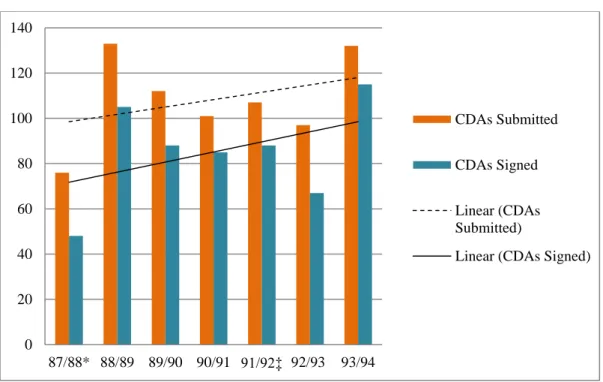
3.1 TULCO Confidentiality Agreements, Submitted and Signed ... 104
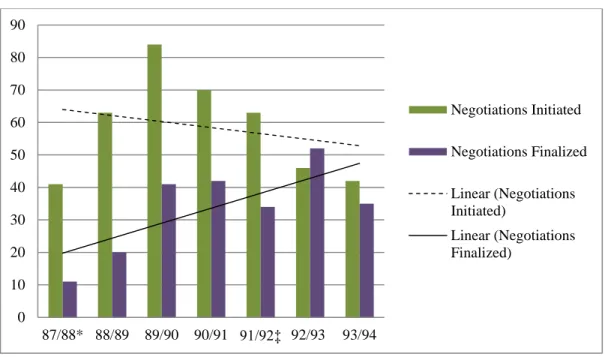
3.2 TULCO Licensing Negotiations, Initiated and Finalized ... 106
3.3 Disclosure Proportion by University 1988-1994 ... 107
3.4 University Issued Patents by Application Year, 1980-1987 ... 173
3.5 University Issued Patents by Application Year, 1988-1995 ... 173
3.6 University Issued Patents by Application Year, 1996-2003 ... 174
4.1 Internal University Technology Transfer Process ... 122
4.2 TLO Organizational Reporting Structure ... 136
4.3 TLO Director Education ... 137
4.4 Combinations of Organizational Structure & Director Education ... 139
4.5 Average Invention Disclosures ... 178
4.6 Average Licenses ... 178
4.7 Average Startups ... 178
4.8 Logged Average Invention Disclosures ... 179
4.9 Logged Average Licenses ... 179
LIST OF ABBREVIATIONS
AUTM Association of University Technology Managers
BEA Bureau of Economic Assistance
BS/BA Bachelor of Science, Bachelor of Arts
DEA Data Envelope Analysis
GDP Gross Domestic Product
GEE Generalized Estimating Equations
H.L. House Legislation
IP Intellectual Property
IPO Initial Public Offering
JD Juris Doctorate
LES Licensing Executive Society
MBA Master of Business Administration
MCNC Microelectronics Center of North Carolina
MSA Metropolitan Statistical Area
NC North Carolina
NCBC North Carolina Biotechnology Center
NCSU North Carolina State University
NIH National Institute of Health
NSF National Science Foundation
NRC National Research Council
OLS Ordinary Least Squares
P.L. Public Law
RTI Research Triangle Institute
RTP Research Triangle Park
SBIR Small Business Innovation Research
STTR Small Business Technology Transfer
SBTDC Small Business Technology Development Center
SFE Stochastic Frontier Estimation
STATT Statistics Access for Tech Transfer
TFP Total Factor Productivity
TLO Technology Licensing Office
TT Technology Transfer
TULCO Triangle University Licensing Consortium
TUCASI Triangle Universities Center for Advanced Studies, Inc.
UNC University of North Carolina at Chapel Hill
US United States
Chapter 1
Introduction
US research universities are recognized by institutional and political leaders alike for their
potential ability to enhance a region‘s long term stability and economic growth through their
technology commercialization efforts. Licensing results of academic research to industry and creating
startups to further develop and commercialize early stage inventions are acknowledged by several as
mechanisms both university leadership and regional policy developers consider to promote economic
development (Siegel & Phan, 2005; Breznitz & Feldman, 2012; Audretsch, 2013). While considering
this potential economic development impact, university administrators may be uncertain as to the
optimal alignment of organizational characteristics, practices, and policies for university technology
transfer efforts (Siegel & Phan, 2005) to meet strategic commercialization objectives.1 University
technology licensing offices (TLOs) are the primary unit at most US research universities tasked with
providing commercialization services and support to entrepreneurial faculty, translating research
results to the public, and maximizing licensing revenues for the university (Abrams, Leung &
Stevens, 2009). An increased emphasis is being placed by national legislators on academic
entrepreneurship and technology transfer efforts for economic development across the US, and many
recommendations are being proffered to stimulate the commercialization of inventions created from
publicly funded research (Wright, Clarysse, Lockett, & Knodkaert, 2007; Litan & Cook-Deegan,
2011; Merrill & Mazza, 2011). Federal initiatives are being presented to congress supporting
commercialization of federally funded academic inventions and startup formation, including The
Startup Act 3.0 (H.R.714 & S.310) 2, and the Technology and Research Accelerating National
Security and Future Economic Resiliency Act of 2013 (H.R. 2981)3. These bills propose federal
funding agencies provide funds for initiatives to identify optimal technology transfer programs for
replication across other universities to facilitate the transfer of commercially viable innovations
developed from federal funding, including the formation of university technology licensing consortia
and proof of concept centers at universities across the US. The present state of academic technology
transfer capabilities at US research universities can be linked to history, culture and experience in
transferring innovation to industry (O‘Shea, et al., 2005); as well as a key policy development (the
Bayh-Dole Act) in 1980 which allowed universities to retain title to patentable inventions sponsored
by US federal funding agencies (P.L. 96-517).4 The existing organizational cultures and
characteristics when technology licensing offices TLOs are established have an influence upon
subsequent structures, decisions, actions and processes (David, 1994), suggesting the early
organizational structure of the TLO and other university characteristics can exert influence upon the
internal technology transfer process and its outcomes.
Moving university developed innovations forward for the benefit of the public is a growing
concern for federal funding agencies and academic research institutions alike; now an implicit third
mission of US research institutions along with teaching and research activities (Etzkowitz, 2003;
Breznitz & Feldman, 2012). This effort requires balancing both traditional roles of the university and
new entrepreneurial roles (Etzkowitz et al., 2000). This expanded 3rd mission may become more
2A bill ―To jump-start economic recovery through the formation and growth of new businesses, and for other purposes,‖ introduced as H.R. 714 and S. 310, Startup Act 3.0, & presented to the 113th congress February 2013 http://www.govtrack.us/congress/bills/113/hr714, and http://www.govtrack.us/congress/bills/113/s310
3A bill requiring each federal agency ―carry out a grant program to support innovative approaches to technology transfer at institutions of higher education …, nonprofit research institutions and Federal laboratories in order to accelerate the commercialization of federally funded research...‖
http://www.govtrack.us/congress/bills/113/hr2981/text
important as academic universities evaluate potential for regional economic development impact
through technology commercialization efforts, and look for alternative sources for research funding.
In response to these initiatives and growing expectations, university leaders are evaluating existing
mechanisms and processes for technology transfer to identify sources of increased efficiency and
effectiveness. Key university technology commercialization mechanisms include direct licensing to
existing industries, the generation of university-based startups, and research partnerships with
industry and other research institutions (Phan & Siegel, 2006), all of which may result in financial
gains and other benefits for the university. TLO and university characteristics, cultures, policies and
expectations supportive of the technology transfer process may positively influence technology
commercialization efforts in the academic environment. This dissertation project, with three separate
and distinct studies, provides insight into characteristics of universities, licensing consortia, and
university TLO characteristics and attributes that can influence the technology transfer processes and
commercialization outcomes from US research universities.
University Characteristics and Technology Transfer
Heterogeneity in regional characteristics, university characteristics, and TLO characteristics
and capabilities across US research universities have been observed by practitioners and researchers
of academic technology transfer, as well as industry licensees and legislators involved in technology
transfer policy development. Siegel & Phan (2005) find the effectiveness of a university‘s technology
transfer process is influenced by competencies of university faculty inventors, licensees of university
inventions or entrepreneurs forming startups, as well as business capabilities and competencies of
licensing staff within the TLO, and university incentives to engage in entrepreneurial activities. The
institutional and environmental characteristics in which academic technology transfer activities are
carried out can influence a university‘s abilities in negotiating licensing agreements and forming
levels of industry research and development can facilitate a university‘s propensity to engage in
technology transfer activities and startup formation (Powers, 2003; Powers & McDougal, 2005a &
2005b). A clear university mission statement and leadership focused on the goals of technology
transfer contribute to a positive entrepreneurial culture and facilitate licensing activities and licensing
revenues received from technology transfer efforts (Friedman & Silberman, 2003). The propensity of
faculty to disclose inventions to the TLO is influenced by several characteristics including faculty
quality, research levels, and university incentive policies–specifically policies regarding university
royalty and equity distribution (Renault, 2006; Markman, et al, 2004). Support from university
leadership and policies in support of technology commercialization activities enable the development
of an entrepreneurial culture (O‘Shea, et al, 2005). Invention disclosures are a critical input into the
technology commercialization process; with higher disclosures leading to increased licensing and
startup activity (Siegel, Waldman & Link, 2003; Friedman & Silberman, 2003; Siegel, Veugelers, &
Wright, 2007; Feldman & Berovitz, 2010; Jensen & Jones, 2011). University inventors must also
have confidence in the commercialization skills and abilities of the TLO to successfully transfer their
innovation to the market (McGee, 2007). Organizational practices and TLO structural characteristics,
contribute to the productivity of the TLO and use of various licensing mechanisms (Feldman, Feller,
Bercovitz & Burton, 2002; Siegel, et al., 2003; Markman Gianiodis, Phan, & Balkin, 2005a;
Markman, Gianiodis, & Phan, 2009). Appropriate alignment of characteristics under control of the
university can facilitate certain technology commercialization activities in support of the university‘s
strategic technology transfer goals (Lockett & Wright, 2005).
TLOs facilitate commercialization of academic inventions through protection of intellectual
property (via patent applications, copyrights, and trademarks), marketing the inventions and
negotiating licenses with industry, and facilitating the formation of university startups (Dill, 1995;
Bozeman, 2000; Lerner, 2005). The organizational structure of the TLO within the university
transfer process (Bercovitz, et al., 2001; Markman, Gianiodis, Phan & Balkin, 2004; Markman et al.,
2005a; Markman et al., 2009). Organizational differences in these characteristics may contribute to
variances in academic entrepreneurial activity and the formation of university startups across
universities. As such, these specific characteristics can be evaluated for their relationship and
potential influence upon the outcome metrics by which TLOs are evaluated.
The work contained in this dissertation project contributes to the growing body of literature
on academic entrepreneurship and technology transfer.5 The information provided is timely as
federal discussions continue regarding efforts to stimulate the commercialization of federally funded
research; and research universities across the US continue to be scrutinized and evaluated for their
efficiency and effectiveness in moving academic innovations into the private sector (Litan &
Cook-Deegan, 2011). The studies in this project provide information for universities or other parties that
may be considering entering into partnership or consortia to facilitate technology licensing activities,
or for those evaluating internal university TLO structures and knowledge skillsets for alignment to
maximize technology transfer efforts. This research project on how specific university characteristics
may influence the academic technology transfer process and its outcomes provides information for
interested university leaders, economic development practitioners, and legislators on how university
and TLO characteristics may be aligned to facilitate academic technology transfer and support efforts
of entrepreneurial inventors.
Dissertation Approach
This dissertation project is designed to provide academic analysis through three different yet
related research projects on academic entrepreneurship and technology transfer. The first, a literature
review of specific studies on academic technology transfer, discusses the implications of findings
from these studies on drivers behind the growth in university licensing and commercialization efforts,
characteristics and attributes factoring into the technology transfer process, and influencing its
commercial outcomes. Findings from these groups of studies are summarized and synthesized for
what they tell us of how various regional, university and TLO characteristics may factor into the
academic technology transfer process, and gaps in analysis are identified for further research. The
second project is a case study of an early licensing consortium between Duke University, The
University of North Carolina at Chapel Hill (UNC) and North Carolina State University (NCSU) in
1988, and provides relevant background and perspective on early stage technology licensing consortia
between research universities. A quantitative analysis in a third project evaluates TLO reporting
structures and characteristics of TLO directors from 76 US research universities to explore possible
correlations between these characteristics and academic technology commercialization outcomes.
This analysis attempts to fill a gap in the literature by identifying organizational reporting structure
and educational degrees of TLO directors as characteristics that guide and enhance specific activities
along the technology transfer process. Each of these studies builds upon and supplements existing
research on academic entrepreneurship and technology commercialization efforts.
Literature Review
The first research project in this series of studies: University, TLO and Regional
Characteristics Related to the Technology Transfer and its Outcomes–A Literature Review, provides
an introduction to key university, TLO and other characteristics shown to have an influence upon
academic technology transfer. This literature review analyzes key research studies on organizational
resources, characteristics, attributes and licensing practices of universities and TLOs. These studies
evaluate characteristics of institutions that seem to be more effective and efficient in obtaining
invention disclosures, licensing inventions to industry and generating licensing revenues, in
characteristics are summarized and evaluated for similarities and differences, and how these
characteristics are related to the technology transfer process and its outcomes. Some differences are
noted for characteristics that seem to influence licensing activities versus startup formation. General
conclusions are discussed, implications presented for university leadership, and gaps in the literature
are identified for further analysis.
Case Study
The second research project, Collaborative Technology Transfer: A History of North
Carolina’s Triangle University Licensing Consortium, documents the history of one early stage
technology licensing consortium among the three research universities situated around the Research
Triangle Park in North Carolina (the Triangle). This consortium, the Triangle University Licensing
Consortium (TULCO) managed technology commercialization and licensing activities for the
University of North Carolina at Chapel Hill (UNC), North Carolina State University (NCSU), and
Duke University (DUKE) for eight years. Founded in 1986 and active from 1988 until 1995,
TUCLO‘s history is presented as an illustrative case study of the promise and pitfalls of a regional
licensing consortium between three large research universities.
The framework for establishing, funding, and managing of TULCO is presented, as are the
factors contributing to its dissolution. The culture around the Research Triangle Park at the time
provides background context of a growing desire to increase university-industry interactions and
transfer academic inventions to the private sector. An external consulting agency‘s 1986 report on
technology transfer capabilities in the triangle provided recommendations; upon which the initial
consortium structure was built to address this growing need. TULCO‘s impact on technology
licensing activities at each of the three universities is reviewed, with analysis of various technology
transfer activities during its operation. Funding levels, issued patents, and royalties collected by the
events leading up to the dissolution of TULCO are discussed, with recommendations presented for
those considering similar technology licensing collaborations. Post-TULCO technology transfer
activities from each of the three universities indicate increased technology licensing capacity and
activity at each institution.
This case study provides examples of success factors and potential risks for any technology
licensing collaboration. This study is timely – regional academic licensing consortia that combine
multiple institutions‘ technology licensing efforts and capabilities into a single organization to
increase effective transfer of academic innovations have been introduced into bills being reviewed by
the US Congress (S.310, H.R.714). These policy recommendations suggest regional universities
involved in licensing consortia may be more efficient at institutional technology transfer activities by
combining and leveraging resources, potentially gaining economies of scale in technology licensing
efforts. This case study provides timely perspective on such consortia and provides recommendations
that may facilitate successful technology licensing partnerships.
Empirical Analysis
The third research project; US University Organizational Characteristics and Technology
Transfer Performance, examines TLO organizational structure and educational background of the
TLO director, as factors that may influence technology transfer outcomes from US research
universities. Many previous studies examine university characteristics and relative productivity in
transferring the results of research to the commercial market.6 These studies find a number of
university characteristics support successful academic commercialization efforts including:
institutional culture, tradition and history; research funding levels and type; the presence of medical,
engineering, or law schools; university policies and orientation in support of inventors and
entrepreneurial faculty; TLO organizational structure and interaction with other academic units; as
well as characteristics of inventors and university faculty. Technology licensing office characteristics
important to the technology commercialization process include the number of disclosures received;
the age and size of the TLO; its financial structure; legal expenditures; cumulative experience; and
prior experience. Studies evaluating these characteristics suggest that heterogeneity in these
characteristics among universities can help explain why some universities seem to be more effective
than others (O‘Shea, et al., 2005; Siegel, et al., 2003; Feldman & Bercovitz, 2010; Jensen & Jones,
2011). This research project evaluates specific characteristics of the university TLO; organizational
reporting structure, and the educational background and job tenure of the TLO director to determine
their potential influence on the technology transfer process. This third research project employs an
econometric modeling approach to provide statistical inference for how these characteristics are
related to technology transfer outcomes.
There are different organizational structures of university TLOs identified from previous
work (Bercovitz, et al., 2001; Feldman & Bervocitz, 2010) that may determine how they interact with
other university functions and the availability of resources that can be leveraged for
commercialization activities. The majority of TLOs report to the research function within the
university, while some TLOs report directly to the leader of the institution, some to an economic
development or business development office, and some report to multiple university functions. These
alternate reporting structures provide an opportunity for comparison between them for their influence
on the effectiveness of university technology transfer. The educational training and background of the
TLO director bring additional skills to the technology transfer process that may facilitate certain
activities over others. The educational degree of the TLO director is tested as a proxy for skillsets of
the individual responsible for managing these activities. The findings from this empirical analysis
suggest these characteristics do have an influence upon academic technology commercialization
Outline of the Dissertation
The background and context for the three research projects is presented in this introductory
chapter. The following three chapters each comprise the entirety of each of the three research
projects. The literature review in Chapter 2 analyzes previous academic studies on university
technology transfer and entrepreneurship and the methodologies used to evaluate university and TLO
characteristics. Findings synthesized and summarized for the university characteristics and attributes
identified as important to invention disclosure receipt, licensing and revenue generation, startup
formation and use of equity. Gaps are identified and discussed for other university and TLO
characteristics unaccounted for; providing the foundation for the empirical analysis contained in
Chapter 4. Chapter 3 consists of the case-study analysis of an early licensing consortium in North
Carolina‘s Research Triangle: the Triangle University Licensing Consortium (TULCO). This case
study evaluates this licensing consortium‘s impact upon subsequent technology licensing activities at
Duke University, the University of North Carolina at Chapel Hill and North Carolina State University
after the consortium‘s demise in 1995. The empirical study comprises Chapter 4, and evaluates TLO
organizational reporting structure, educational skillsets of the TLO director, and the director‘s job
tenure for their influence on three technology licensing metrics: invention disclosures, licenses and
startups. Chapter 5 presents overall policy implications and a summary analysis of the lessons learned
from these three research projects. Policy implications are reviewed; the results of the research
projects contained herein may be of interest to university administrators and legislators regarding the
Chapter 2.
University, TLO, and Regional Characteristics Related to the
Technology Transfer Process and its Outcomes–A Literature Review
Introduction
US university technology transfer (TT) initiatives raise important policy issues as some
university administrators expect to gain substantial financial returns from technology transfer &
commercialization efforts (Friedman & Silberman, 2003); while at the same time communities and
regional legislators expect local universities to have a more direct role in stimulating economic
growth and job creation (Smilor & Mathews, 2004; Siegel & Phan, 2006). Federal legislation in
discussion by the US Committee on Science, Space and Technology proposes to award grants to
―support innovative approaches to technology transfer at research institutions,‖ for proven technology
transfer processes and efforts (H.R. 2981, 2013). The terms ‗technology transfer' (TT), and
‗technology commercialization,‘ as used in this paper refer to the process by which academic
inventions are licensed to industry or to a newly formed startup for eventual commercialization;
entrepreneurship refers to academic inventors actively engaged in the technology transfer process of
university inventions. Invention disclosures are identified by several previous studies on academic
technology transfer as a critical input into this process (Friedman & Silberman, 2003; Siegel,
Waldman & Link, 2003). Thursby and Kemp, (2002) find university effectiveness in technology
transfer can vary depending upon characteristics and capabilities of the university, research faculty,
technology licensing office (TLO) staff, and the application of available resources. Institutional
structure, organizational capabilities, and incentive policies of the university can also influence the
technology transfer process and its outcomes (Feldman, Feller, Bercovitz & Burton, 2002; Siegel,
new startup companies to commercialize university inventions (Smilor & Matthews, 2004;
Chukumba & Jensen, 2005); these two outcomes require different commercialization skills and
capabilities of the licensing staff in the TLO (Siegel, Veugelers & Wright, 2007). Universities may
wish to focus efforts on specific technology transfer outcomes, through direct licensing to industry or
forming startup companies (or both). Understanding the characteristics that influence licensing versus
startup formation will be beneficial for university administrators and policy developers working to
expand university technology commercialization efforts.
This literature review synthesizes findings from a cross section of prior studies on the
influence of various characteristics and attributes of universities, TLOs and their regions upon the
growth of technology transfer activities and outcomes among US research universities. Findings are
summarized for how university, TLO, and regional characteristics may affect the technology transfer
process. The influence of these characteristics on the invention disclosures submitted to the TLO,
licensing outcomes, and the formation of university startups is synthesized from this body of
literature. Findings suggest universities with strong capabilities in startup formation may be different
from those who have success in generating large revenues from licensing. Royalty rich TLOs who
have significant past success with licensing may be locked into direct licensing and may not have
much success with startup formation, potentially viewing that commercialization path as a last resort
(Chukumba & Jensen, 2005, p. 18). The academic technology transfer studies in this literature review
come from a variety of journals dedicated to the study of academic technology commercialization
efforts and startup formation, including several studies identified from the Journal of Technology
Transfer, a special edition from Research Policy (The Creation of Spin-off Firms at Public Research
Institutions: Managerial and Policy Implications), The Journal of Economics and Innovation of New
Technologies, and the Oxford Review of Economic Policy-Intellectual Property Edition, 2007. Other
journals include the Journal of Business Venturing, The Journal of Management Studies, and
research universities and their TLO offices, and are synthesized for their findings and how they
inform the study and practice of academic technology transfer.
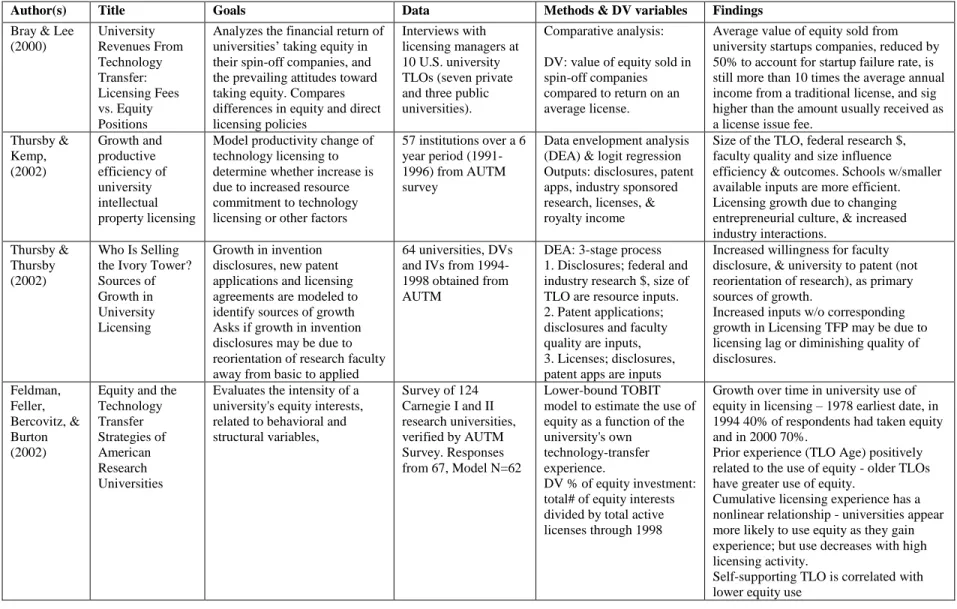
Examples of some case studies, benchmark studies, and efficiency studies that examine the
growth and relative performance of university technology transfer functions over time are evaluated
as a starting point. These studies identify characteristics of universities and TLOs that contribute to
the growth and overall effectiveness of the academic technology transfer process. The first section of
this review summarizes the general findings of these studies, including best practices and
characteristics contributing to nominal and total factor productivity growth in university technology
transfer. These studies provide background on factors driving university involvement in
commercialization of university inventions (Smilor & Matthews, 2004), and describe aspects of the
technology transfer process in US research universities.
Research identifying characteristics influencing (a) invention disclosure submission to the
TLO, (b) facilitating licensing activity and licensing revenue, and (c) startup formation and use of
equity as a licensing mechanism are each examined in subsequent sections. Invention disclosures are
identified as a critical input to the technology transfer process and the level of invention disclosures
coming into the TLO have a strong influence on both licensing and startup activity (Siegel, et al.,
2003; Jensen & Jones, 2011). We summarize findings from several studies on various characteristics
that are related to the flow of invention disclosures to the university TLO. Outcomes from university
technology transfer can fall into two general categories: licensing activities, with subsequent licensing
revenues; and startup formation with possible use of equity as a licensing mechanism for startups.
Findings are summarized on various university and TLO characteristics that have an influence upon
these outcomes. The results from these studies are compared and contrasted to evaluate the
relationships discovered between characteristics and outcomes, differences in findings are evaluated
The general managerial conclusions from this literature review and their potential policy implications
are presented in a final section.
Benchmarking and Growth in Technology Transfer
Efficiency studies, surveys, case studies and benchmark comparative studies provide
mechanisms for universities to evaluate their technology transfer activities relative to their peers, and
identify best practices in university technology commercialization efforts. Thursby and Kemp, in their
2002 study, ―Growth and Productive Efficiency of University Intellectual Property Licensing,‖
evaluate various university characteristics to identify the drivers behind the increasing levels of
technology licensing efforts at US research universities. Using data envelope analysis (DEA)
combined with quintile and logistic regression analysis, the authors examine overall productivity
changes in invention disclosure, patent applications, industry sponsored research agreements, license
agreements, and royalty payments for 57 research universities from 1991 to 1996. The DEA method
creates an efficiency frontier maximizing a ratio of multiple resource inputs to multiple outputs.
Universities are partitioned into quintiles by their input and output measures, allowing comparisons of
efficiency between universities of similar size; finding smaller schools and larger schools tend to be
more efficient on a number of dimensions than larger schools, with higher efficiency ratios for their
use of resources for TT outcomes. Logistic regression tests the influence of various characteristics for
universities defining the efficiency frontier with highest efficiency ratios. Efficiency is significantly
influenced by TLO size, federal funding, faculty size, and faculty quality. Quality of engineering
faculty members and size of bioscience faculty positively influence a universities efficiency levels.
Private universities may be up to four times more efficient than public, while the presence of a
medical school somewhat reduces efficiency scores. The study attributes an observed growth in
licensing to a changing entrepreneurial culture and increasing interactions with industry. The use of
other university characteristics that cannot be measured and may over-estimate, or under-estimate
efficiency. The dichotomous variable created for efficient universities used in the logistic regression
is evaluated in the study using the same input and output variables used in generating the frontier,
potentially introducing serial correlations and endogeneity into the analysis, introducing concerns
regarding statistical inference.
A growing receptiveness to both technology transfer and entrepreneurship is considered one
of the primary drivers for growth in academic commercialization activities. In their 2002 study, ―Who
is selling the Ivory Tower? Sources of Growth in University Licensing,‖ Thursby & Thursby (2002)
evaluate data between 1994 and 1998 from 64 universities, and a survey of 112 licensees and industry
sponsors of university IP. They evaluate growth in invention disclosure, patenting and licensing
activities at US universities, using DEA to create three ‗best practice frontiers‘ of universities with the
highest ratios of resource inputs for three outcome measures: disclosures, patents, and licenses; and
evaluate growth rates. TLO size, prior federal and industry research funding levels, and faculty size
are used as inputs for disclosures; then disclosures, TLO size, and faculty quality are used as inputs
for patents; and finally, disclosures, patents, TLO size and faculty quality are used as inputs for
licenses. This study finds universities have seen nominal growth in all activities over the 5 year
period; invention disclosures grew by 7.1%, patents by 17.1%, and licenses by 8.4%. Annual total
factor productivity (TFP) growth rates increased for disclosures (2.7%) and patent applications
(12.1%), but decreased for licensing (-1.7%); this decreased TFP may potentially be due to the time
lag between initial invention disclosure and final license (Thursby & Thursby, 2002). Logistic
regressions are also used to evaluate the relationship between the nominal growth rates and annual
total factor productivity, including TLO growth in the regression evaluating licensing activity. The
study finds higher patenting levels and increases in the size of the TLO have a negative relationship
between growth in the TLO and licensing efforts suggests there may be a steep learning curve in
developing skills required by TLO licensing professionals (Thursby & Thursby, 2002). In their
survey analysis, industry research sponsors and licensees identify low cost of university research and
growing faculty acceptance of industry supported research as important factors in the growth of
industry research contracts with universities. Overall growth in academic acceptance and university
leadership orientation toward technology transfer are identified as primary factors related to
technology licensing growth (Thursby & Thursby, 2002). Decision envelope analysis (DEA) uses
multiple inputs and outputs to create an efficiency ratio, allowing universities to benchmark
themselves against peer institutions. The deterministic nature of DEA is incapable of distinguishing
between random noise and true sources of inefficiency, so may not provide a true value.
Multicollinearity and omitted variables can be problematic in the use of DEA, so while this method
measures efficiency via an input/output ratio; it could be overlooking other characteristics that are
influencing the technology transfer process.
Organizational practices in university management and commercialization of intellectual
property can also influence the performance of university technology commercialization efforts.
Identifying and measuring those practices sheds light on their influence. A study by Siegel, Waldman
& Link (2003), ―Assessing Impact of Organizational Practices on The Relative Productivity of
University Technology Transfer Offices,‖ evaluates university productivity in technology licensing
activities from 80 universities from 1991-1996. This study uses ordinary least squares (OLS),
stochastic frontier estimation (SFE), and qualitative field research interviews. Fifty-five interviews
with university technology transfer stakeholders: business entrepreneurs, university administrators
and university scientists, identify critical environmental and organizational characteristics that may
influence licensing and licensing revenues of a university. SFE, similarly to the DEA method,
provides a measurement of the relative productivity of each university in licensing activities and
frontier and a vector of potential technical inefficiency sources simultaneously, allowing hypothesis
testing and construction of confidence intervals. The study uses several characteristics identified from
their qualitative interviews (Siegel, et al., 2003), distinguishing these characteristics from random
noise. Invention disclosures, size of the TLO, and external legal expenditures are used as inputs;
licenses and licensing revenues are outputs from this efficiency model. This study finds the size of the
TLO has a positive influence upon licensing activity, but is not significantly related to licensing
revenues. Findings indicate external legal expenditures of the TLO have a negative influence upon
license agreements, but a positive influence on revenues, suggesting legal wrangling or risk adversity
may have a negative influence on license negotiations (Siegel, et al., 2003), but may be effective in
garnering higher royalty streams. Environmental and institutional determinants of inefficiency include
indicators for public universities and the presence of a medical school, the age of the TLO, in addition
to regional characteristics such as industry R&D intensity and annual state GDP. Older TLOs are
somewhat more efficient at revenue generation, which may be indicative of the time lag between
finalizing a license and royalty income, or of cumulative effects from prior licensing efforts.
Indicators for the presence of a medical school and for public institutions are statistically
insignificant. Any precision of SFE methods is highly dependent on the number of universities in the
analysis used to project the frontier, and while production functions fit well with the data, institutional
inefficiencies in academic technology transfer activities cannot be completely explained by
environmental and institutional characteristics (Siegel, et al., 2003). The qualitative research from
interviews reveals other characteristics that might negatively influence academic technology transfer
activities: insufficient faculty rewards, a lack of resources and staffing commitment to the TLO,
cultural barriers, and administrative bureaucracy. A lack of marketing or technical skills in the TLO
and low salary compensation for TLO professionals are also suggested as potential barriers (Siegel, et
A recent study evaluates whether the 50% growth in government research funding from 1998
to 2008 corresponds to increased efficiency in academic technology transfer activities (Kim, 2013).
This study, ―The Ivory Tower Approach to Entrepreneurial Linkage: Productivity Changes in
University Technology Transfer,‖ uses the DEA method to evaluate panel data from 90 US research
universities using invention disclosures, TLO licensing staff, and research expenditures as input
factors to determine relative efficiencies between universities and overall growth in US issued
patents, licenses, and revenue. This study finds an upward trend in overall efficiency of US research
universities; with an average TFP growth of 31% over the nine years, providing some evidence that
universities have developed effective strategies to leverage resources for TT efforts. Licenses grew an
average of 4% each year and licensing income about 28%. Inputs increased over time as well:
research expenditures grew about 8.3% per year, invention disclosures grew by about 7.5% each year,
and licensing staff grew an average of 11% per year, indicating growing commitment to university
technology transfer. This study finds the presence of a medical school has little impact on higher TLO
productivity, and no significant difference in productivity between public and private institutions,
possibly due to an increased prioritization of technology transfer and commercialization across all
universities (Kim, 2013). As with other studies utilizing DEA, university annual productivity data is
quite volatile; universities have yearly fluctuation in efficiency measures, potentially due to the time
lags between disclosure of the invention and licensing. Endogeneity concerns are a problem if
productivity is measured by numerous input variables that may be highly correlated (Kim, 2013).
This production function methodology is useful however, in looking at aggregate growth or decline in
university technology transfer outputs over several years, and in benchmarking techniques for
universities who evaluate themselves relative to their peers.
Comparative analytic methods identifying best practices from five universities known to have
strong technology transfer programs and a significant influence upon regional economic development
―University Venturing: Technology Transfer and Commercialization in Higher Education,‖ compare
and contrast university policies, roles of university leadership, incentives for faculty inventors, and
use of equity in licensing from five institutions (Georgia Tech, North Carolina State, University. of
Florida, University of Texas at Austin, and Virginia Polytechnic Institute), identifying factors that
influence technology transfer and commercialization activities (Smilor & Matthews, 2004).
Interviews with university representatives and technology transfer professionals provide data on
organizational support for technology transfer and commercialization efforts, in addition to faculty
incentive structures that support entrepreneurial behavior. Institutional characteristics, royalty
distribution policies, promotion and tenure metrics, leadership support, and TLO commercialization
skillsets are evaluated to determine how these characteristics support the technology transfer process
(Smilor & Matthews, 2004). Strong support from university leadership in policy and practice,
unequivocal support for a properly resourced TLO, and incentive systems designed to support
entrepreneurial faculty are all identified as important characteristics at each of the five universities.
The dual focus of the TLO: generating startups and licensing inventions requires alignment with
appropriate skill sets (Smilor & Matthews) to fit with these differing commercial paths. The
university TLO may benefit from staff with knowledge of university research, business
commercialization skills, and links to bus development organizations to help facilitate startups and
provide resources beyond the capabilities of the TLO and the university.
Summary
Several key characteristics are identified as factors related to the technology transfer process
from these studies on university effectiveness in technology commercialization. Thursby and Kemp
(2002) note university productivity varies with capabilities of TLO staff and research faculty, as well
as the use of university resources, suggesting that the efficiency of universities in technology
research funding levels, and size of the TLO are identified as characteristics that influence technology
transfer. Each study notes the importance of an entrepreneurial culture and support from university
leadership. Invention disclosures are a critical input into the technology commercialization process,
and have a significant influence on both licensing activities and licensing revenues (Siegel, et al.,
2003). Private universities are more efficient that public universities in one 2002 study (Thursby &
Kemp, 2002), while subsequent studies show no difference between public and private institutions
(Siegel, et al, 2003, Kim, 2013). The presence of a medical school has a negative relationship with the
likelihood of a university being on the efficiency frontier in Thursby & Kemp‘s (2002) study, even
though many licenses are for biomedical inventions; authors suggest this relationship may be due to
heavy service commitment of medical schools rather than commercialization (Thursby & Kemp,
2002). Quality of the engineering faculty and size of the bioscience faculty also have a positive
influence on technology transfer efforts in Thursby & Kemp‘s (2002) study. University TLOs have
grown as there has been an increased resource commitment to technology transfer and faculty
entrepreneurs (Kim, 2013). Findings on TLO size vary: larger TLOs are more effective in revenue
generation, but less effective at licensing activities in one study (Siegel, et al, 2003). Another study
finds growth in a university TLO reduces efficiency levels for commercialization outcomes,
potentially due to steep learning curves of new licensing staff (Thursby & Thursby, 2002). Business
skills are noted as important in two of the qualitative analyses (Siegel, et al., 2003; Smilor &
Matthews, 2004), suggesting the commercialization skills of the licensing staff may be a
characteristic for further exploration. TLO age has a positive relationship with revenues, somewhat
expected due to time lags between invention disclosure, licensing, and receipt of revenues (Siegel, et
al., 2003). Regional research and development levels in Siegel, et al.‘s (2003) study have a positive
relationship with university licensing activities, suggesting universities situated in areas with higher
from this select group of studies on efficiency and best practices of US universities in technology
transfer.
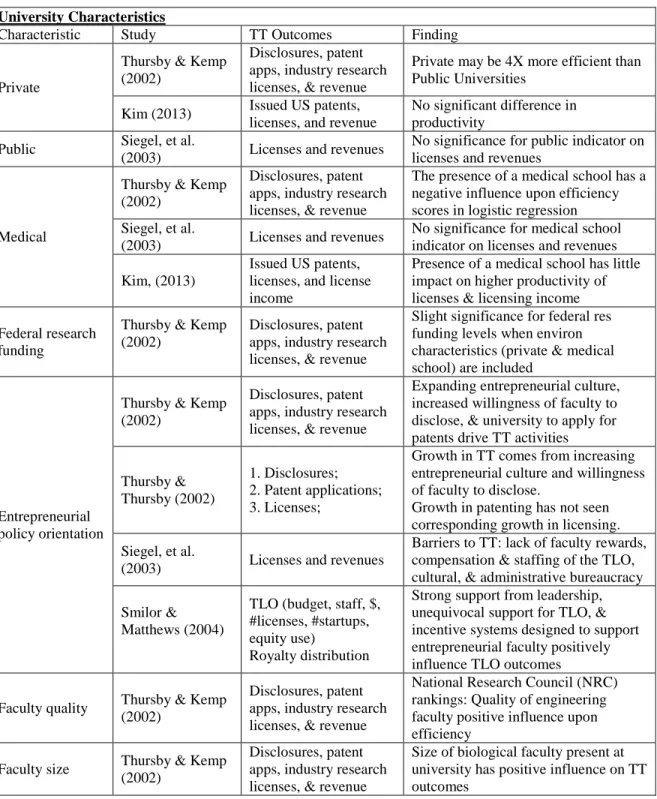
Table 2.1 Characteristics of Efficiency and Effectiveness in Technology Transfer
University Characteristics
Characteristic Study TT Outcomes Finding
Private
Thursby & Kemp (2002)
Disclosures, patent apps, industry research licenses, & revenue
Private may be 4X more efficient than Public Universities
Kim (2013) Issued US patents, licenses, and revenue
No significant difference in productivity
Public Siegel, et al.
(2003) Licenses and revenues
No significance for public indicator on licenses and revenues
Medical
Thursby & Kemp (2002)
Disclosures, patent apps, industry research licenses, & revenue
The presence of a medical school has a negative influence upon efficiency scores in logistic regression Siegel, et al.
(2003) Licenses and revenues
No significance for medical school indicator on licenses and revenues Kim, (2013)
Issued US patents, licenses, and license income
Presence of a medical school has little impact on higher productivity of licenses & licensing income Federal research
funding
Thursby & Kemp (2002)
Disclosures, patent apps, industry research licenses, & revenue
Slight significance for federal res funding levels when environ characteristics (private & medical school) are included
Entrepreneurial policy orientation
Thursby & Kemp (2002)
Disclosures, patent apps, industry research licenses, & revenue
Expanding entrepreneurial culture, increased willingness of faculty to disclose, & university to apply for patents drive TT activities
Thursby & Thursby (2002)
1. Disclosures; 2. Patent applications; 3. Licenses;
Growth in TT comes from increasing entrepreneurial culture and willingness of faculty to disclose.
Growth in patenting has not seen corresponding growth in licensing. Siegel, et al.
(2003) Licenses and revenues
Barriers to TT: lack of faculty rewards, compensation & staffing of the TLO, cultural, & administrative bureaucracy Smilor &
Matthews (2004)
TLO (budget, staff, $, #licenses, #startups, equity use) Royalty distribution
Strong support from leadership, unequivocal support for TLO, & incentive systems designed to support entrepreneurial faculty positively influence TLO outcomes
Faculty quality Thursby & Kemp (2002)
Disclosures, patent apps, industry research licenses, & revenue
National Research Council (NRC) rankings: Quality of engineering faculty positive influence upon efficiency
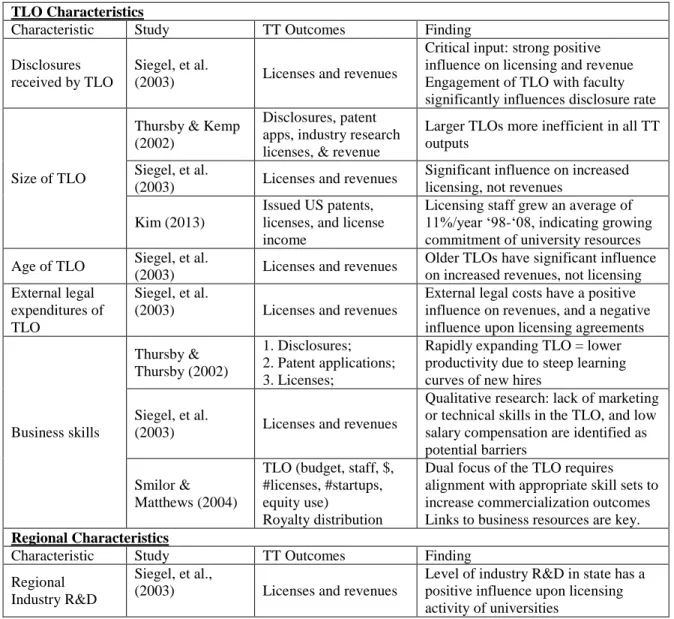
Table 2.1 (continued)
TLO Characteristics
Characteristic Study TT Outcomes Finding
Disclosures received by TLO
Siegel, et al.
(2003) Licenses and revenues
Critical input: strong positive influence on licensing and revenue Engagement of TLO with faculty significantly influences disclosure rate
Size of TLO
Thursby & Kemp (2002)
Disclosures, patent apps, industry research licenses, & revenue
Larger TLOs more inefficient in all TT outputs
Siegel, et al.
(2003) Licenses and revenues
Significant influence on increased licensing, not revenues
Kim (2013)
Issued US patents, licenses, and license income
Licensing staff grew an average of 11%/year ‗98-‗08, indicating growing commitment of university resources Age of TLO Siegel, et al.
(2003) Licenses and revenues
Older TLOs have significant influence on increased revenues, not licensing External legal
expenditures of TLO
Siegel, et al.
(2003) Licenses and revenues
External legal costs have a positive influence on revenues, and a negative influence upon licensing agreements
Business skills
Thursby & Thursby (2002)
1. Disclosures; 2. Patent applications; 3. Licenses;
Rapidly expanding TLO = lower productivity due to steep learning curves of new hires
Siegel, et al.
(2003) Licenses and revenues
Qualitative research: lack of marketing or technical skills in the TLO, and low salary compensation are identified as potential barriers
Smilor & Matthews (2004)
TLO (budget, staff, $, #licenses, #startups, equity use) Royalty distribution
Dual focus of the TLO requires alignment with appropriate skill sets to increase commercialization outcomes Links to business resources are key.
Regional Characteristics
Characteristic Study TT Outcomes Finding
Regional Industry R&D
Siegel, et al.,
(2003) Licenses and revenues
Level of industry R&D in state has a positive influence upon licensing activity of universities
Disclosure Submission
Invention disclosures from research faculty are a critical input into the technology transfer
process; previous studies find invention disclosure receipt by the university TLO influences all
subsequent technology commercialization efforts (Friedman & Silberman, 2003; Siegel, Waldman &
Link, 2003; Chukumba & Jensen, 2005; Jensen & Jones, 2011).Universities with more experienced
invention disclosures from research faculty. Siegel, Waldman & Link (2003) find invention
disclosures received by the TLO to be a critical input into the technology transfer process, and are
significantly and positively related to both licensing and licensing revenue. Higher disclosure rates
can lead to (a) more licenses, (b) execution of more licenses with equity interests (Friedman &
Silberman, 2003), (c) higher licensing revenues (Siegel, et al., 2003), and (d) the formation of more
university startups (Jensen & Jones, 2011). Determining characteristics of universities and TLOs that
have high rates of invention disclosures provide information relevant to those wishing to encourage
disclosure from research faculty. Several studies analyze the disclosure of inventions to the TLO as
part of their overall analysis of the technology transfer process, these findings help identify
characteristics of universities, university faculty, and TLOs related to high disclosure rates, which
provide increased opportunities for licensing and startup formation.
In the efficiency benchmark studies discussed above, Thursby and Thursby (2002) find
invention disclosure rates increasing by 7.1% from 1994 to 1998. This study attributes growth in the
propensity of faculty to disclose their inventions to growing cultural acceptance and previous
licensing success by the TLO. The study finds growth in invention disclosure submission is primarily
driven by an increased receptiveness of faculty to disclose results of their research rather than a
reorientation of research interests away from basic research towards applied research (Thursby &
Thursby, 2002). In interviews with key technology transfer stakeholders, including entrepreneurs,
TLO directors, and university scientists, Siegel, et al, (2003) identify relationship building as an
important element of the technology transfer process, and the TLO licensing individuals as key to
facilitating relationships between research scientists and licensees. Building relationships with
research scientists can influence their participation in the technology transfer process starting with
submission of invention disclosures; facilitating relationships between university research scientists
in the largest and smallest of the five quintiles in their comparison groups among peer universities,
suggesting the largest may have higher faculty engagement in the technology transfer process
requiring less outreach of the TLO, and smaller universities may be able to directly engage with
research faculty to build relationships, positively influencing invention disclosure rates.
Friedman & Silberman, in their 2003 study, ―University Technology Transfer: Do Incentives,
Management and Location Matter?‖ evaluate data from 93 research universities from 1997 to 1999,
and find several university and faculty characteristics influence invention disclosure submission to the
TLO. A two equation OLS regression recursive system models the technology transfer process of the
university as a sequence of events, and identifies invention disclosure from research faculty as a
critical ―raw input‖ to the technology transfer process (Friedman & Silberman, 2003, p.21). Invention
disclosures are modeled in the first regression, finding faculty quality, the number of science
departments offering a PhD degree (as determined by the National Research Council - NRC), and
levels of federal and industry sponsored research all have a positive influence on invention disclosure
submission. The estimated invention disclosures are subsequently utilized in several second stage
regressions as an independent variable to analyze characteristics influencing licensing activity,
licensing income, the number of startups, and use of equity in licensing deals. The findings for these
outcomes are further explored in the sections below. There are some limitations to this study
including a relatively high correlation among the independent variables in the equation modeling
invention disclosures; faculty quality, federal research funding, and industry research funding are all
highly correlated with each other (>0.7). The endogeneity and multicollinearity of these variables are
likely influencing each other, introducing potential bias and making causal determinations difficult
(Friedman & Silberman, 2003). An alternative measure may be the use of a ratio of industry to federal
funding to remove the correlation problem with using both funding variables.
A study by Thursby and Thursby (2007), ―University Licensing,‖ evaluates the rationale
relationship between university characteristics and licensing revenue, and the propensity of faculty to
disclose to the university TLO. This study combines OLS regression, logistic regression and
qualitative interviews to evaluate university technology commercialization, and to evaluate whether
research faculty are diverted from basic toward applied research. For invention disclosure from
faculty, the study utilizes logistic regression to evaluate the propensity of faculty disclosure to the
TLO modeled as a function of university and inventor characteristics. This study finds the scientific
background of the inventor can have an influence upon disclosure rates; inventors with an
engineering background are more likely to disclose inventions to the TLO, and bioscience faculty
least likely to disclose. Quality measures such as high publication rates and high levels of both federal
and industry research funding increase the likelihood of disclosure. Industry funding may have twice
the influence on disclosure rates compared to federal research funding, possibly due to the more
applied nature of industry funding creating outcomes with commercial value (Thursby & Thursby,
2007). The study finds little evidence that faculty are being diverted from basic research; changes in
publication rates show no substantial shift towards applied research despite the positive influence of
industry research funding on invention disclosure rates (Thursby & Thursby, 2007).
Summary
The studies summarized herein find that invention disclosure submission to the university
TLO can be influenced by different characteristics of the university, its faculty, and of the TLO itself.
University characteristics influencing disclosure rates include the university‘s culture and support for
entrepreneurial activities, which can facilitate disclosure from faculty as the critical first step in the
technology transfer process (Thursby & Thursby, 2002). The growing willingness of universities to
invest in commercialization of research-based inventions through intellectual property protection,
marketing and licensing have facilitated the development of entrepreneurial cultures at research