Molecular function and regulation of the histone methyltransferase, Ezh2
By
Susan C. Wu
A dissertation submitted to the faculty of the University of North Carolina at Chapel Hill in partial fulfillment of the requirements for the degree of Doctor of Philosophy in the
Department of Biochemistry and Biophysics
Chapel Hill 2011
Approved by:
Dr. Yi Zhang
Dr. Yue Xiong
Dr. William Marzluff
Dr. Adrienne Cox
ii ©2011 Susan C. Wu
iii ABSTRACT Susan C. Wu
Molecular function and regulation of the histone methyltransferase, Ezh2 (Under the direction of Dr. Yi Zhang)
EZH2 (Enhancer of zeste 2) is an important developmental regulator that plays an important role in numerous biological processes including multi-cellular development, stem cell biology, and cancer development. As an H3K27 histone methyltransferase, EZH2 is an epigenetic regulator that functions to repress transcription. It is often upregulated in human cancers and its oncogenic potential is thought to stem from its role in cell proliferation and repression of tumor suppressor genes. Hence, regulation of EZH2 function is important for normal cellular growth. In this dissertation, the molecular function and regulation of EZH2 are investigated. I demonstrate that genomic targets of EZH2 not only include protein-coding genes, but also encompasses lncRNAs (long non-protein-coding RNAs), a class of RNAs that account for the vast majority of the mammalian transcriptome. Using a custom-designed microarray, I show that lncRNAs exhibit cell type specific expression patterns and that their expression levels correlate with the epigenetic marks, H3K4me3 and H3K27me3. Consistent with this finding, knockdown of EZH2 results in the derepression of many lncRNAs. With regard to EZH2 regulation, I provide evidence that EZH2 contains numerous phosphorylation sites although their functions are currently unknown. Characterization of two
iv
v
To my father, Y. John Wu, who persistently instilled my interest in science at an early age.
Without his support and the countless lectures encompassing broad scientific topics, I would
vi
ACKNOWLEDGEMENTS
I must take a moment to acknowledge the extraordinary role that the following people had in
shaping this work. First and foremost, I would like to thank Dr. Yi Zhang for his guidance
during my tenure as a graduate student. I am indebted to him for his critical comments of my
work as well as the opportunities that he has provided with me, both of which have pushed
me to become a better scientist.
I would also like to acknowledge my dissertation committee members: Drs. Yue Xiong,
William Marzluff, Adrienne Cox, and Young Whang. Their continued support and scientific
guidance were undoubtedly instrumental to the completion of this work. In addition, I would
also like to thank Dr. Jean Cook who generously invested her time in providing me with the
scientific expertise that I needed.
I was also fortunate to work with an outstanding group of scientists on a day to day basis.
Thank you to past and present members of the Zhang lab who provided me with both the
encouragement and technical expertise that I needed over the years. In particular, I would
like to thank Dr. Eric Kallin who I not only had the privilege of collaborating with, but who
also contributed to my personal well-being. Drs. Nara Lee and Rob Klose were instrumental
vii
Jake Dmochowski, an outstanding undergraduate student, who not only worked with me, but
also kept me on my toes with his inquisitive questions.
In retrospect, I have learned that graduate school is not for the faint of heart and that the
challenges brought forth in front of me undoubtedly required the loving support of the
wonderful people in my life. First and foremost, I have to thank my parents, Y. John and
Grace Wu who have pushed me to realize my potential and unconditionally supported my
decision to attend graduate school. I also have to thank my brothers Jeff and Greg as well as
my sister-in-law, Helen, who have provided me with so much laughter over the years. I am
extremely grateful to be a part of such an incredible family. In addition, I want to thank all
of the friends that I have made during my time in Chapel Hill. In particular, I have to
acknowledge Elizabeth Dorn who has been a fabulous co-pilot to have in this journey.
Finally, none of this would be possible without the constant support and encouragement from
my husband, Chris Winkler. I would like to thank him for his extraordinary patience and
eternal positivity over the years. His companionship is truly special and I am sincerely
viii
TABLE OF CONTENTS
Page
LIST OF TABLES...xi
LIST OF FIGURES...xii
LIST OF ABBREVIATIONS...xiv
CHAPTER I. INTRODUCTION...1
i. Epigenetic regulation of gene expression...3
ii. Histone methylation...5
iii. Polycomb group of proteins...8
iv. Polycomb repressive complexes...10
v. Functions of H3K27 methylation...15
vi. Recruitment of PRC2 to genomic targets...18
vii. ES cell pluripotency, self-renewal, and differentiation...22
viii. EZH2 and human cancers...23
ix. Research summary...25
x. References...35
ix
i. Abstract...51
ii. Introduction...52
iii. Results...54
iv. Discussion...60
v. Experimental procedures...63
vi. References...73
II. EZH2 IS A THREONINE PHOSPHORYLATED...77
i. Abstract...78
ii. Introduction...79
iii. Results...83
iv. Discussion...89
v. Experimental procedures...92
vi. References...103
III. CDK1-MEDIATED PHOSPHORYLATION OF EZH2 LEADS TO DEGRADATION...108
i. Abstract...109
ii. Introduction...110
iii. Results...113
iv. Discussion...123
v. Experimental procedures...128
vi. References...148
IV. SUMMARY AND CONCLUDING REMARKS...152
i. Epigenetic regulation of long non-coding RNAs...153
x
iii. Investigating the functions of long non-coding RNAs...157
iv. Phosphorylation of EZH2...158
v. CDK1-mediated phosphorylation of EZH2...159
xi
LIST OF TABLES
Table
1.1 Core components of Polycomb complexes in flies and humans...34
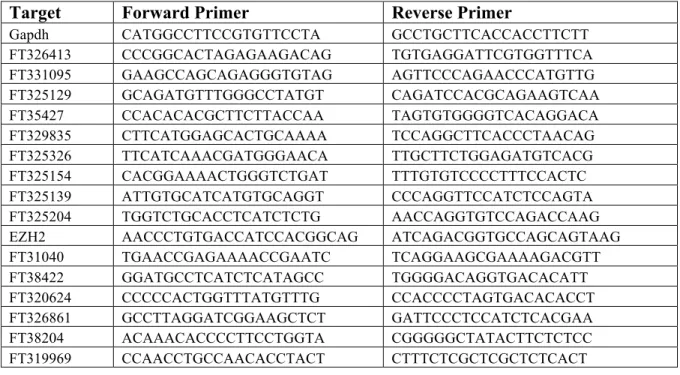
2.1 Quantitative PRC primers used in the experiments described in Chapter 2....72
3.1 Primers used for PCR-cloning of EZH2 deletion mutants...100
3.2 Mutagenesis primers used in Chapter 3...101
3.3 EZH2 sequencing primers...102
xii
LIST OF FIGURES
Figure
1.1 Mechanisms of DNA methylation and demethylation...28
1.2 Chemical structures of various methylated arginines and lysines...29
1.3 Biochemical composition of the PRC1 complex in flies and humans...30
1.4 Biochemical composition of the PRC2 complex in flies and humans...31
1.5 Resolution of bivalent genes during ES cell differentiation...32
1.6 Coordinated actions of the Polycomb repressive complexes...33
2.1 lncRNAs are differentially expressed in ES cells, NPCs, and fibroblasts...65
2.2 lncRNA promoter H3K4me3 and H3K27me3 patterns in ES cells, NPCs, and fibroblasts...67
2.3 Changes in promoter H3K4me3 and H3K27me3 levels are correlated with lncRNA expression...68
2.4 Ezh2-mediated H3K27 methylation represses lncRNA transcription in ES cells...70
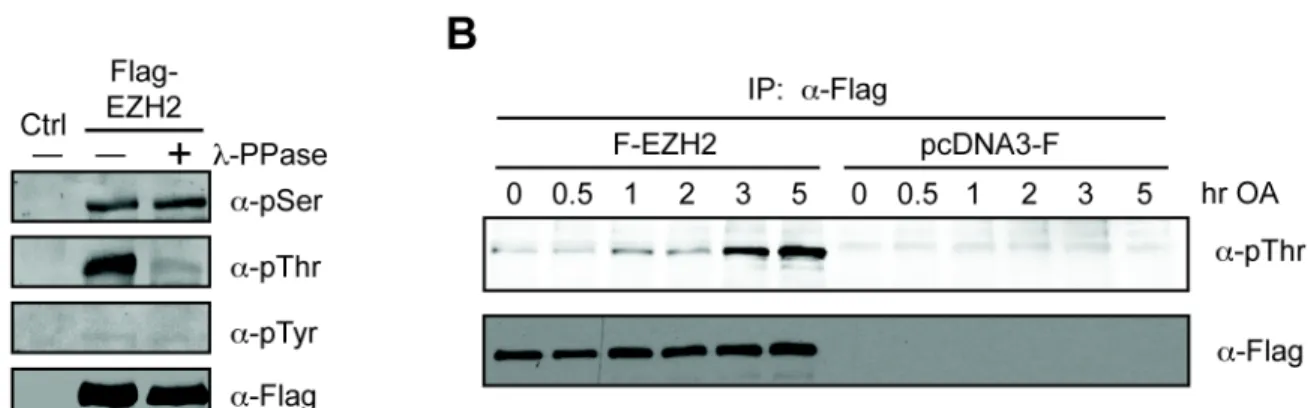
3.1 Phosphorylation of PRC2 inhibits HMT activity...95
3.2 Threonine phosphorylation of EZH2 is regulated by PP1/PP2A...97
3.3 Majority of threonine phosphorylation occurs in region aa351-593...98
4.1 EZH2 is phosphorylated at threonines 345 and 487...136
4.2 Knockdown of EZH2 results in slow growth and accumulation of cells in G2/M...138
4.3 CDK1 phosphorylates EZH2 at T345 and T487...139
xiii
4.5 Phosphorylated EZH2 is ubiquitinated and degraded via the proteosome
xiv
LIST OF ABBREVIATIONS
AEBP2 Adipocyte enhancer binding protein 2
BMI1 B lymphoma Mo-MLV insertion region 1
CDK1 Cyclin dependent kinase 1
ChIP Chromatin immunoprecipitation
ChIP-chip ChIP coupled to genomic microarrays
ChIP-seq ChIP coupled to deep sequencing
DMNT DNA methyltransferase
EED Embryonic ectoderm development
ES Embryonic stem cell
ESC Extra sex combs
EZH2 Enhancer of zeste homolog 2
E(Z) Enhancer of zeste
HDAC Histone deacetylase
HMT Histone methyltransferase
HOTAIR HOX antisense intergenic RNA
HOX Homeobox
JARID2 Jumonji/ARID domain containing protein 2
JHDM JumonjiC domain-containing histone demethylase
lncRNA long noncoding RNA
xv
PC Polycomb
PCL Polycomb-like
PSC Posterior sex combs
PH Polyhomeotic
PHO Pleiohomeotic
PHOL Pleiohomeotic-like
PP1 Protein phosphatase 1
PP2A Protein phosphatase 2A
PRC1 Polycomb repressive complex 1
PRC2 Polycomb repressive complex 2
PRE Polycomb repressive element
qPCR Quantitative polymerase chain reaction
RING1B Ring finger protein 1B
RBAP48 Retinoblastoma associated protein 48
RT Reverse transcription
SAM S-adenosyl methionine
SET Su(var)-E(z)-Trithorax
shRNA Short hairpin RNA
SUZ12 Suppressor of zeste 12
CHAPTER 1
INTRODUCTION
Minor sections have been adapted from the following sources:
Wu, S. C., and Zhang, Y. (2010). Active DNA demethylation: many roads lead to Rome. Nature Reviews Molecular Cell Biology 11, 607-620.
2
INTRODUCTION
In higher eukaryotes, every cell in a multicellular organism is ultimately derived from a single totipotent cell. During development, this totipotent cell divides and subsequent daughter cells are required to make cell fate decisions either choosing to remain totipotent or alternatively, committing to a specific cell lineage. The final result is the production of distinct cell types and tissues that make up an organism.
One of the most fascinating features of this process is the relative stability of the committed state during the development of multicellular organisms. Commitment to a specific cell lineage is established early on, long before the appearance of any specialized functions. Once committed, cells retain a developmental “memory” and rarely change their fates even after undergoing many rounds of cell division. A tremendous amount of research has attributed epigenetics to be a major player in both the cell commitment and cell memory process.
3
EPIGENETIC REGULATION OF GENE EXPRESSION
Eukaryotic chromatin contains a wealth of information required for the growth and development of a multicellular organism. This information is not only stored genetically within the DNA sequence itself but also epigenetically through molecular mechanisms that include DNA methylation, chromatin remodeling, and post-translational modifications of histone proteins (Jaenisch and Bird, 2003; Jenuwein and Allis, 2001). Although every nucleotide in the genome has the potential to be transcribed (Birney et al., 2007), the presence or absence of specific epigenetic marks influences gene expression resulting in a transcriptional program that specifies for a particular cell type. For example, in embyronic stem (ES) cells, active gene expression marks are found at genes associated with
pluripotency, while repressive marks are found at lineage-specific genes. Thus, different cell types can be defined by their epigenetic and gene expression profiles.
One well characterized epigenetic mechanism involves methylation of DNA which is associated with transcriptional silencing. In mammals, DNA methylation occurs
predominantly within the context of CpG (cytosine followed by guanine) dinucleotides, while DNA methylation in plants can occur at cytosine bases in diverse sequence contexts (Law and Jacobsen, 2010). The enzymes responsible for this modification, DNA
methyltransferases (DNMTs), are well-characterized and conserved in mammals and plants (Law and Jacobsen, 2010). DNMTs fall under two categories: de novo and maintenance (Goll and Bestor, 2005). Patterns of DNA methylation are initially established by the de novo methyltransferases, Dnmt3a and Dnmt3b, during the blastocyst stage of embryonic
4
faithfully maintained during cell divisions through the action of the maintenance
methyltransferase, Dnmt1, which has a preference for hemi-methylated DNA (Bestor et al., 1988; Bestor and Ingram, 1983; Hermann et al., 2004). Both the establishment and
maintenance of DNA methylation patterns are crucial for development as mice deficient in Dnmt3b or Dnmt1 are embryonic lethal (Li et al., 1992; Okano et al., 1999) while Dnmt3a null mice die by 4 weeks of age (Okano et al., 1999).
Although DNA methylation has been viewed as a stable epigenetic mark, studies in the past decade have revealed that this modification is not as static as once believed. Loss of DNA methylation, or DNA demethylation, has been observed in specific contexts and can occur through active or passive mechanisms (Figure 1.1). Active DNA demethylation refers to the enzymatic process that results in the removal of the methyl group from
5-methylcytosine (5meC) by breaking a carbon-carbon bond. On the other hand, passive DNA demethylation refers to the loss of the methyl group from 5meC when Dnmt1 is inhibited or absent during successive rounds of DNA replication. While passive DNA demethylation is generally understood and accepted, the subject of active DNA demethylation has been quite controversial (Ooi and Bestor, 2008; Wu and Zhang, 2010).
5
H4 (Kornberg and Lorch, 1999). Once believed to function solely as structural elements, it has become evident that histones play critical roles in regulating chromatin dynamics to modulate gene expression.
Extending from the globular domain of histone proteins are the unstructured N-terminal tails which are subject to post-translational modifications including acetylation, methylation, phosphorylation, and ubiquitination. Covalently-modified histones can alter chromatin dynamics to control the accessibility of transcription machinery or function as binding sites to recruit regulatory proteins. Because of their ability to modulate gene expression, histone modifying enzymes have a broad impact on normal cellular processes and thus their functions are generally regulated in the cell. The consequences of
misregulation are exemplified by the observation that many histone modifying enzymes are overexpressed in a broad range of human cancers (Schneider et al., 2002).
HISTONE METHYLATION
6
the exception of H3K79 which resides in the globular domain (Feng et al., 2002). Given that the scope of this work concerns lysine methylation of histone proteins, only this modification will be discussed in further detail. For more information regarding arginine methylation, the author would like to direct the reader to the following in depth reviews (Bedford, 2007; Bedford and Richard, 2005; Wysocka et al., 2006).
Depending on the residue modified, lysine methylation of histone proteins can have both positive and negative effects on transcription. Methylation of K4, K36, and K79 has been correlated with gene activation, while methylation of K9, K27, and H4K20 are
considered repressive marks. Unlike acetylation and phosphorylation, methylation does not affect the overall charge of the histone molecule and thus is not believed to regulate gene expression by disrupting histone-DNA interactions. However, in some cases, methylation can serve as a binding site for the recruitment of chromodomain-containing proteins that bind to methylated histones. For example, heterochromatin regions are enriched with
heterochromatin protein 1 (HP1) which possesses a chromodomain that specifically binds to tri- and di-methylated K9, a mark associated with repression (Bannister et al., 2001; Lachner et al., 2001). Additionally, the chromodomain of Eaf3, a member of the of histone
deacetylase complex RPD3, binds to K36 methylation (Keogh et al., 2005). Although it has become apparent that histone methylation functions more as an “information storage mark” to recruit other regulatory proteins that affect gene expression, the precise mechanisms by which histone methylation regulates transcription is poorly understood.
7
(Martin and Zhang, 2005). With the exception of Dot1/Dot1L, all lysine HMTs possess the evolutionarily conserved SET domain which was named after three Drosophila proteins discovered to contain this conserved sequence: Suppressor of variegation 3-9 (Su(var)3-9), Enhancer of zester (E(z)), and Trithorax (Trx) (Dillon et al., 2005). Although the SET domain is responsible for the enzymatic activity of lysine HMTs and is present in about 60 human proteins, only a fraction of these proteins have been shown to possess the ability to methylate histones. Furthermore, the name histone methyltransferase is a bit of a misnomer as many of these enzymes have also been shown to be target non-histone substrates as well (Huang and Berger, 2008).
Unlike histone acetylation and phosphorylation, the reversibility of histone
methylation was hotly debated for many years. In fact, it was widely believed that histone methylation was a relatively stable mark due to the strength of the carbon-nitrogen bond that would have to be broken to facilitate demethylation. Thus, it was unclear whether any enzymes possessing such high catalytic power existed. Furthermore, early biochemical studies concluded that histone methylation was quite stable in the cell due to the observation that the turnover rate of methylated histones was similar to total histones (Byvoet et al., 1972).
8
given that there are only two LSD1 homologs in mammals, a larger family of demethylases that included enzymes capable of removing the tri-methyl mark was likely to exist.
Shortly after the discovery of LSD1, the Jumonji C (JmjC) domain-containing demethylases were discovered through biochemical methods involving an assay where demethylase activity was detected by the release of radiolabeled formaldehyde (Tsukada et al., 2006). JHDM1A (Jumonji domain-containing histone demethylase 1A), the founding member of this family, catalyzes the removal of mono- and di-methyl K36, releasing
formaldehyde as a byproduct. Its activity is dependent on iron and α-ketoglutarate as well as a highly conserved histidine residue located within the JmjC domain (Tsukada et al., 2006). Subsequent phylogenetic analysis of JmjC domain-containing proteins demonstrated that this family is highly conserved in eukaryotes ranging from humans to budding yeast (Klose et al., 2006a). Since then, many mammalian JmjC domain-containing proteins have been
demonstrated to possess demethylase activity (Agger et al., 2007; Cloos et al., 2006; Klose et al., 2006b; Klose et al., 2007; Lan et al., 2007; Lee et al., 2007; Whetstine et al., 2006; Yamane et al., 2007; Yamane et al., 2006) including several that are specific for
tri-methylated lysines (Cloos et al., 2006; Klose et al., 2006b; Klose et al., 2007; Yamane et al., 2007).
POLYCOMB GROUP OF PROTEINS
9
sex-combs at each of its six legs. After a series of appropriate crosses, she attributed the phenotype to a recessive mutation that she named extra sex combs (esc) (Slifer, 1942). In 1947, a second mutation also causing the extra sex combs phenotype was discovered by Pamela Lewis and called Polycomb (Pc). The mutation produced the phenotype when heterozygous, but was lethal when homozygous.
Utilizing the power of Drosophila genetics, this seminal work paved way for the isolation of many other mutations (both dominant and recessive) that caused the extra sex combs phenotype. These genes whose mutations are responsible for this phenotype, are now collectively known as the Polycomb group and comprise of about 15 members that are highly conserved in organisms including flies, plants, and mammals. As suggested by early work in fruit flies, the Polycomb group of genes are responsible for repressing developmental control genes that establish cell fate in the developing embryo. Their importance in development is highlighted by the observation that deletion of some Polycomb genes results in early
embryonic lethality in mice (Faust et al., 1995; Niswander et al., 1988; O'Carroll et al., 2001; Pasini et al., 2004).
10
Drosophila including Ultrabithorax and Antennapedia and are collectively known as HOX genes.
HOX genes encode transcription factors that specify the anterior-posterior axis and segment identity in metazoan organisms during embryonic development. These clusters are spatially and temporally expressed through the actions of a group of activator proteins known as Trithorax proteins. Once HOX genes have done their work, they are permanently
suppressed by Polycomb proteins. This suppression prevents structures such as sex combs and wings from forming in the wrong body segments. Thus, the functional relationship between Trithorax and Polycomb proteins is antagonistic. Importantly, the suppression of these developmental regulators by Polycomb proteins is not only permanent during the lifespan of the cell, but is also heritable and passed down to all the cells’ daughters throughout the lifetime of the organism. This remarkable phenomenon has thus attracted many people to study how Polycomb proteins contribute to the “cellular memory” process.
POLYCOMB REPRESSIVE COMPLEXES
11
domain of HP1. This led to the idea that Polycomb may repress gene activity by binding to chromatin.
Subsequently, the nucleotide sequences for other Polycomb genes were determined which set the stage for extensive sequence analysis and biochemical work to understand how Polycomb proteins functioned. Early genetic studies provided the initial clue that Polycomb proteins functioned together in multi-protein complexes. Today, Polycomb-mediated gene silencing is believed to transpire primarily through the actions of two distinct complexes that regulate of chromatin structure by post-translationally modifying histone proteins.
The first complex, PRC1 (Polycomb repressive complex 1) was discovered by Robert Kingston’s group in 1999 and was biochemically purified from Drosophila embryos. Using antibodies against candidate Polycomb proteins, western blot analysis revealed that PC (Polycomb), PSC (Posterior sex combs), PH (Polyhomeotic), and SCM (Sex comb on
midleg) were present in the purified complex. Furthermore, the purified complex was able to inhibit chromatin remodeling suggesting that PRC1 functioned by binding to chromatin (Shao et al., 1999).
A few years later, mass spectrometry identified additional proteins present in the original complex, but only dRING1 (Drosophila RING protein 1) was present at a similar stoichiometric level as PC/PSC/PH, while SCM was present at sub-stoichiometric amounts (Saurin et al., 2001). With this in mind, Kingston and colleagues successfully reconstituted the core PRC1 complex containing PC, PSC, PH, and dRING1 (Figure 1.3) and found that it was functional in the inhibition of chromatin remodeling (Francis et al., 2001).
12
complex (Lavigne et al., 2004; Levine et al., 2002). RING1B is an E3-ubiquitin ligase capable of mono-ubiqutinating H2A at lysine K119, a mark associated with repression, while BMI1 can stimulate this activity (Cao et al., 2005; Kallin et al., 2009; Wang et al., 2004a). Reconstituted mammalian PRC1 complexes are functional and capable of inhibiting ATP-dependent chromatin remodeling, compacting chromatin, and repressing transcription in vitro (Francis et al., 2004; Francis et al., 2001; King et al., 2005).
Shortly after the discovery of PRC1, four groups identified a second complex of Polycomb group proteins named PRC2 in both Drosophila and mammals (Cao et al., 2002; Czermin et al., 2002; Kuzmichev et al., 2002; Muller et al., 2002). Like PRC1, PRC2 contributes to Polycomb-mediated silencing by modifying chromatin. Specifically, the key observation was that one of the PRC2 components was EZH2 (Enhancer of zeste 2) which possesses a SET domain that confers H3K27 methyltransferase activity. Subsequent work involving reconstitution of mammalian PRC2 led to the knowledge that the minimum core components for activity are EZH2, SUZ12 (suppressor of zeste 12), and EED (embryonic ectoderm development) while other components such as RBAP46/48 (RB associated protein 46/48) could stimulate its activity (Cao and Zhang, 2004) (Figure 1.4).
13
AEBP2 (adipocyte enhancer binding protein 2) was identified in one of the initial purifications of PRC2 (Cao et al., 2002). Reconstitution of PRC2 with different subunits demonstrated that AEBP2 interacts with several components of PRC2 to enhance its HMT activity (Cao and Zhang, 2004). Given that AEBP2 contains a zinc-finger, it was initially postulated that it functioned to recruit PRC2 to DNA. However, it appears to bind to DNA with low specificity (Kim et al., 2009) suggesting that other factors may play a larger role in the recruitment of PRC2 to target genes (see below). Nonetheless, AEBP2 stably participates in some PRC2 complexes as it co-localizes with PRC2 at a subset of target gene promoters (Kim et al., 2009).
In addition to AEBP2, PCL (Polycomb-like) proteins can also exist in the PRC2 complex through interactions with EZH2 and to some extent, SUZ12 and RbAp46/48 (Nekrasov et al., 2007). In Drosophila, only one PCL protein is present and is responsible for the development of normal segmentation patterns of the fly (Duncan, 1982). There are three mammalian homologues, PCL1, PCL2, and PCL3 (also known as CBX2, CBX4, and CBX6-8) which appear to be expressed in a tissue-specific manner (Walker et al., 2010). All PCL proteins share conserved protein motifs: a tudor domain and two plant homeodomain (PHD) finger proteins (Wang et al., 2004c). Consistent with the notion that some PRC2 complexes contain PCL proteins, genome-wide studies have found that PCL2 is bound at a subset of PRC2 target genes (Li et al., 2010; Walker et al., 2010). The function of PCL proteins within the PRC2 complex is presently unclear although several studies have
14
al., 2010). Discrepancies between these studies might be explained by the redundancy of mammalian PCL proteins and their cell-specific expression patterns.
JARID2 is a member of the Jumonji family of proteins which have been implicated in the demethylation of histone proteins. Unlike other members of the Jumonji family, it lacks the key residues necessary for cofactor binding and thus does not possess enzymatic activity. Interestingly, several biochemical studies have not only demonstrated a direct interaction between JARID2 and EZH2, but also that JARID2 and PRC2 share a large overlap of target genes (Landeira et al., 2010; Li et al., 2010; Pasini et al., 2010; Peng et al., 2009; Shen et al., 2009). Although JARID2 depletion results in impaired recruitment of PRC2, global levels of H3K27me3 levels were only modestly affected (Landeira et al., 2010; Shen et al., 2009). This raised questions regarding the significance of JARID2 in PRC2 recruitment.
Furthermore, if JARID2 is a major player in the recruitment of PRC2 to target genes, it is expected that JARID2 null mice would exhibit similar phenotypes compared to mice where components of the PRC2 complex are deleted. While deletion of JARID2 in mice results in embryonic lethality, these embryos develop to a much later stage than EZH2, SUZ12, or EED null embryos (Faust et al., 1995; Jung et al., 2005; Kitajima et al., 1999; Niswander et al., 1988; O'Carroll et al., 2001; Pasini et al., 2004). These inconsistencies highlight the need for further work in evaluating the contribution of JARID2 to PRC2 function.
15
complexes may vary from cell type to cell type in order to accommodate the epigenetic requirements of a particular cell.
FUNCTIONS OF H3K27 METHYLATION
As discussed above, methylation of H3K27 is mediated by the PRC2 complex through the catalytic activity of EZH2. This modification is conserved in many eukaryotes including mammals, flies, worms, and plants, but is absent in budding yeast (Cao et al., 2002). In embryonic stem (ES) cells, H3K27 methylation is quite abundant where roughly 50% of total histone H3 is di-methylated, 15% tri-methylated, and 15% mono-methylated (Peters et al., 2003). H3K27 methylation is not only stable, but also processive where tri-methylated H3K27 results from the mono-methylation of di-tri-methylated H3K27.
The advent of novel technologies including chromatin immunoprecipitation (ChIP) coupled with expression microarray analysis (ChIP-chip) or deep sequencing (ChIP-Seq) has allowed for genome-wide mapping of histone modifications, histone modifiers, and
16
The availability of genome-wide maps has also provided evidence that many genomic loci do not contain a single type of histone modification, but instead contain a combination of modifications. These combinations of histone modifications or the “histone code” (Strahl and Allis, 2000) is one possible way for the cell to meet its diverse transcriptional needs. One set of histone modifications that has attracted much attention is the bivalent domain which are regions that contain both the repressive methylated H3K27 mark and active tri-methylated H3K4 mark (Bernstein et al., 2006). Bivalent domains were originally
discovered in ES cells, but have also been observed in somatic cells albeit at lower levels (Mikkelsen et al., 2007; Mohn et al., 2008). Genes that are bivalent at their promoters are not considered to be transcriptionally active, but instead are thought to be “poised” to commit to either the active or repressed state by losing one of the two opposing marks (Figure 1.5). After losing the tri-methylated H3K4 mark, repression is then mediated by the pre-existing tri-methylated H3K27 mark. Furthermore, enforced repression may be executed by
extending the length of the tri-methylated H3K27 domain as well as by the addition of other repressive marks such as tri-methyl H3K9 (Hawkins et al., 2010) or DNA methylation (Brunner et al., 2009; Meissner et al., 2008; Mohn et al., 2008).
17
prevent acetylation of this site. Indeed, H3K27 acetylation is enriched in the absence of PRC2 and is thought to be antagonistic to Polycomb mediated silencing (Tie et al., 2009). While di- and tri-methylated H3K27 has been associated with facultative heterochromatin (heterochromatin that is regulated in a cell type specific manner), mono-methylation of H3K27 is associated with constitutive heterochromatin (gene-poor regions of the genome that are stably repressed). Oddly, while di- and tri-methylated H3K27 are found at gene promoters, enrichment of mono-methyl H3K27 has been observed within gene bodies and correlates with actively transcribed genes (Cui et al., 2009). The significance of this finding is unclear at the present.
Thus far, PRC2 contains the only known enzymatic activity capable of di- and tri-methylation of H3K27. In mammals, how mono-tri-methylation of H3K27 arises is currently unknown as this modification is still detected in cells bearing non-functional PRC2 (Pasini et al., 2007; Schoeftner et al., 2006). Although the plant enzymes, ATXR5 and ATXR6, have the capacity to lay down this modification (Jacob et al., 2009), they function independently of PRC2 and are not conserved in mammals.
18
al., 2002) allowing for the recruitment of PRC1 to ubiquitinate H2A (Figure 1.6). How stable repression is achieved by ubiquitinated H2A is unclear. In any case, it is widely accepted that PRC2 functions upstream of PRC1.
Interestingly, a substantial fraction of tri-methylated H3K27 promoters also contain RNA polymerase (Pol) II that is phosphorylated at serine 5 of its C-terminal domain (Stock et al., 2007). Low levels of transcripts have also been detected from these promoters (Zhao et al., 2007) suggesting that RNA Pol II may be paused at Polycomb target genes. This led to the hypothesis that Polycomb target genes can recruit RNA Pol II to their promoters and engage in transcriptional initiation, but prior to elongation, the polymerase encounters a block. Indeed, a recent study identified a class of short RNAs transcribed from Polycomb target genes that could recruit PRC2 to mediate repression in cis (Kanhere et al., 2010). Additional work will be required to confirm these findings and determine how PRC2 and H3K27 tri-methylation function to block the transition from transcriptional initiation to elongation.
RECRUITMENT OF PRC2 TO GENOMIC TARGETS
One persistent question in the field of Polycomb mediated gene silencing is how Polycomb complexes are recruited to chromatin. Although it is widely believed that PRC1 recruitment depends on the presence of tri-methylated H3K27 marks placed by PRC2, it is unclear how PRC2 itself is targeted to chromatin. Efforts to reveal how Polycomb
19
response elements (PREs) were identified in HOX genes based on their ability to confer Polycomb repression of reporter genes (Muller and Kassis, 2006; Ringrose and Paro, 2007).
Genetic experiments allowed for the identification of several DNA binding proteins that contribute to Polycomb repression. One key factor that binds to some PREs is the zinc finger protein, PHO (Pleiohomeotic) and the related protein, PHOL (PHO-like) which are required for PRE-mediated transgene silencing (Brown et al., 2003; Brown et al., 1998; Fritsch et al., 1999; Mihaly et al., 1998; Shimell et al., 2000). PHO functions as a stable heterodimer by interacting with the Polycomb protein, SFMBT (Scm-like with four MBT domain-containing protein 1) (Klymenko et al., 2006; Oktaba et al., 2008). Consistent with a function for PHO at endogenous targets, PHO mutants exhibit defects in HOX gene silencing (Choi et al., 2000). ChIP experiments demonstrate that disruption of PHO results in loss of PRC1 and PRC2 at HOX PREs (Wang et al., 2004b). Furthermore, mutation of PREs at PHO binding sites leads to loss of PRC1 and disrupted silencing (Klymenko et al., 2006).
Although many studies have illustrated that binding of PHO to PREs is a key event in mediating Polycomb repression, PHO alone is not sufficient to confer silencing (Brown et al., 2003; Dejardin et al., 2005; Fritsch et al., 1999; Shimell et al., 2000). Genome-wide
20
minor overlap with PRC1 and PRC2 binding sites in the genome (Oktaba et al., 2008; Schuettengruber et al., 2009).
Altogether, genome-wide studies have validated a central role for PHO whereas other DNA binding proteins appear to play a limited role. Given that any one of these factors only partially overlaps with Polycomb target genes, it is likely that the recruitment of Polycomb complexes is facilitated by a combination of DNA binding proteins. Drosophila PREs appear to be quite complex as there is no single consensus sequence that can confer PRE function. Instead, these “elements” represent a collection of transcription factor binding sites as they vary in length but are often in the range of several hundred bases. In addition to the factors listed above, the list of Polycomb complex recruiters is likely to expand. Through the use of multiple transcription factors, regulation of gene expression can occur with greater flexibility. A complete molecular description of PREs is currently lacking although it is very likely that multiple subclasses of PREs consisting of different transcription factor binding sites exist.
21
recruitment of PRC2 to target genes (Landeira et al., 2010; Li et al., 2010; Pasini et al., 2010; Peng et al., 2009) but genetic evidence as well as the observation that H3K27 tri-methylation is only modestly affected when JARID2 is depleted makes this mode of recruitment less attractive. Hence, there is little compelling evidence thus far for the participation of transcription factors in the recruitment of PRC2 in mammals. Furthermore, it is highly unlikely that only a few transcription factors are involved in the recruitment and
displacement of Polycomb complexes given the diversity of target genes in mammals that must be regulated in a cell type specific manner.
Emerging evidence suggests that long non-coding RNAs (lncRNAs) are important participants in recruiting PRC2 complexes to their target genes. Members of this class of RNAs are generally over 200 nucleotides in length and account for the vast majority of transcription that occurs in the cell (Kapranov et al., 2007). Contrary to the notion that lncRNAs represent transcriptional noise, recent studies have ascribed functional roles for lncRNAs including their involvement in the recruitment of PRC2 to target genes. LncRNAs provide an attractive mechanism for PRC2 recruitment due to their proposed abilities to bind to genomic DNA in a sequence-specific manner.
22
inactive X-chromosome, forms two stem loop structures that can bind to PRC2 in vitro (Maenner et al., 2010; Zhao et al., 2008).
Similar to XIST, the lncRNA KCNQ1OT1 (Kcnq1 overlapping transcript 1) is
transcribed from a locus encompassing ten paternally imprinted genes in a 1 megabase region (Wu and Bernstein, 2008). This lncRNA interacts with PRC2 and is required for H3K27 tri-methylation and silencing of the locus (Pandey et al., 2008; Terranova et al., 2008). In contrast to XIST and KCNQ1OT1 which function in cis, lncRNAs can also recruit PRC2 to facilitate transcriptional repression in trans. The 2.2 kilobase lncRNA, HOTAIR (HOX antisense intergenic RNA) is expressed from the HOXC locus and is essential for the repression of a 40 kilobase region of the HOXD locus (Rinn et al., 2007). A direct
interaction with PRC2 was established and HOTAIR-depleted cells exhibit a loss of H3K27 tri-methylation at the HOXD locus. It is likely that many other lncRNAs also function in trans as in situ hybridization of HOTAIR and four other lncRNAs revealed multiple speckle
patterning in the cell nucleus (Khalil et al., 2009) suggesting that these lncRNAs may recruit PRC2 to various regions of the genome. Given that one fifth of all lncRNAs identified have been reported to be associated with PRC2 (Khalil et al., 2009), it is believed the use of lncRNAs constitutes a widespread mechanism for the recruitment of PRC2.
ES CELL PLURIPOTENCY, SELF-RENEWAL, AND DIFFERENTIATION
23
by maintaining the repression of developmental regulators (Boyer et al., 2006). During differentiation, commitment to a cell lineage is executed in part by the activation of specific transcriptional programs and coincides with reduced expression of Polycomb proteins. In terminally differentiated cells, expression of Polycomb proteins is very low.
Loss of ES cell pluripotency during differentiation may be caused by (1) expression of developmental regulators that promote differentiation or (2) repression of factors required for pluripotency. In line with the first hypothesis, the fact that PRC2 stably represses
numerous developmental regulators in ES cells initially led to the suggestion that PRC2 is required for the maintenance of ES cells. However, mouse ES cells lacking components of PRC2 remain in an ES cell-like state (Chamberlain et al., 2008; Pasini et al., 2007; Shen et al., 2008). Although loss of PRC2 does not appear to affect the maintenance of ES cells, defects in differentiation are very apparent in these cells. EZH2- and EED-null ES cells exhibit a severe defect in commitment to the mesoendodermal lineage (Chamberlain et al., 2008; Shen et al., 2008) while SUZ12-deficient ES cells fail to produce a proper endodermal layer (Pasini et al., 2007). In these cells, pluripotency factors including NANOG and OCT4 are insufficiently silenced suggesting that their sustained expression overrides the aberrant expression of developmental regulators. Collectively, these observations support the second hypothesis where loss of the ES cell state requires the repression of pluripotency factors.
EZH2 AND HUMAN CANCERS
24
melanoma (Bachmann et al., 2006). Its overexpression promotes neoplastic transformation of prostate and breast epithelial cells (Karanikolas et al., 2009; Kleer et al., 2003) and the highest levels of EZH2 correlates with the worst prognosis for the patient (Varambally et al., 2002). Hence, EZH2 has been considered to be a marker for the aggressive stages of prostate and breast malignancies (Kleer et al., 2003; Varambally et al., 2002). These observations suggest an important role for EZH2 in the progression of human cancers and have been the rationale behind the development of therapeutic drugs that target EZH2 and other histone methyltransferases (Copeland et al., 2009).
Expression of EZH2 is regulated by the pRB-E2F (Bracken et al., 2003), a pathway that regulates genes whose products control cell cycle progression. Both mRNA and protein levels of EZH2 accumlate at early S phase (Bracken et al., 2003) presumably so that tri-methylated H3K27 marks are transmitted to newly synthesized chromatin (Hansen et al., 2008). EZH2 is essential for proliferation of both transformed and non-transformed cells (Bracken et al., 2003) as its depletion not only confers a proliferative disadvantage, but also leads to an accumulation of cells in the G2/M phase (Varambally et al., 2002). Conversely, primary cells ectopically expressing Ezh2 proliferate faster (Bracken et al., 2003)
characteristic of other oncogenic genes.
Proliferating cells must inhibit cellular senescence pathways in order to maintain their proliferative potential. One mechanism by which EZH2 promotes evasion of senescence is by targeting and transcriptionally silencing the CDKN2A locus (cyclin-dependent kinase
inhibitor 2A) which encodes for the tumor suppressor proteins, p16INK4A and p14ARF. A
25
Furthermore, EZH2 is downregulated in senescing populations of cells and is concomitant with decreased levels of tri-methylated H3K27 and activation of the tumor suppressor genes. Consistent with this observation, Ezh2 expression is very low in terminally differentiated somatic cells compared to ES cells (Margueron et al., 2008; Shen et al., 2008). Hence, it is believed that the oncogenic potential of EZH2 stems from its role in the repression of tumor suppressor genes.
Given that EZH2 participates in a network of pathways that are involved in cell cycle regulation, it is not surprising that overexpression of EZH2 correlates with oncogenesis. Like EZH2, many Polycomb proteins including other components of the PRC2 complex have also been implicated in cell cycle regulation and are aberrant in a variety of human cancers (Bracken and Helin, 2009). However, it remains unclear to what extent Polycomb proteins contribute to oncogenesis. Many tumors have reactivated the expression of stem cell-associated genes such as HOX genes (Shah and Sukumar, 2010) which are the best
characterized targets of Polycomb proteins, but whether this is the cause or consequence of transformation remains to be determined. Nevertheless, these observations illustrate the importance of proper regulation of EZH2 function.
RESEARCH SUMMARY
26
2008; Ravasi et al., 2006) which suggests they may actually be functional. In addition, genome wide maps of histone modifications revealed many regions containing active marks that could not be attributed to protein-coding genes (Guttman et al., 2009). These
observations suggest that like protein-coding genes, lncRNAs are epigenetically regulated. However, this hypothesis has never been directly tested and was the basis for the work performed and described in Chapter 2.
With regards to my second project, it was very apparent at the start of my graduate training that the function of EZH2 had to be properly regulated in the cell, but molecular mechanisms of EZH2 regulation were poorly understood. Therefore, I set out to investigate this question as part of my dissertation work. At that point in time, one study had just reported that EZH2 function could be inhibited via phosphorylation which was mediated by the kinase Akt (Cha et al., 2005). Given that phosphorylation is a well-studied
post-translational modification that can have a tremendous impact on protein function, I decided to identify and characterize novel EZH2 phosphorylation sites.
In the work described in Chapter 3, I demonstrate that additional EZH2
27
28
Figure 1.1 Mechanisms of DNA methylation and demethylation.
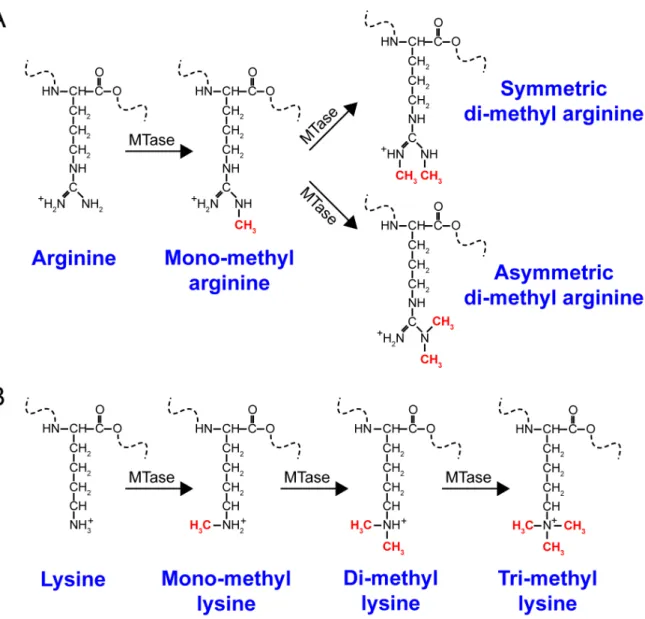
29
Figure 1.2 Chemical structures of various methylated arginines and lysines.
30
Figure 1.3 Biochemical composition of the PRC1 complex in flies and humans.
The PRC1 complex has the capacity to mono-ubiquitinate the N-terminal tail of histone H3 at K119. This complex is highly conserved in (A) flies and (B) humans and consists of
31
Figure 1.4 Biochemical composition of the PRC2 complex in flies and humans.
The PRC2 complex has the capacity to di- and tri-methylate the N-terminal tail of histone H3 at K27. This complex is highly conserved in (A) flies and (B) humans. The minimal core proteins required for histone methyltransferase activity are E(Z), ESC, and SU(Z)12 in flies and EZH2, EED, and SUZ12 in mammals where E(Z) and EZH2 contain a SET domain that confers histone methyltransferase activity. NURF55 and RBAP48 significantly stimulate the enzymatic activity of the complex. Homologues are represented by the same coloring
32
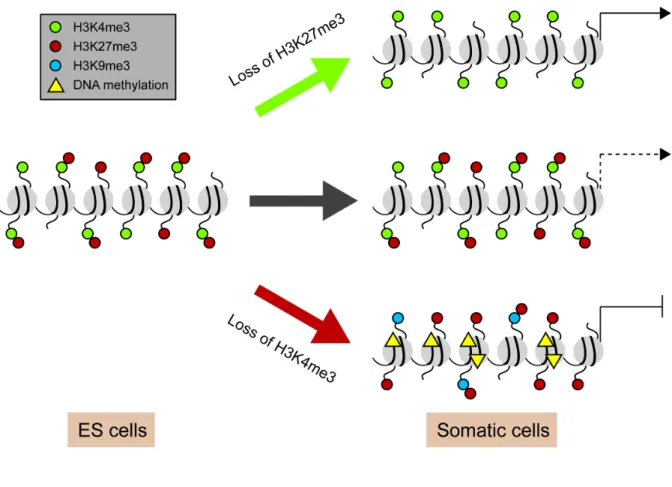
Figure 1.5 Resolution of bivalent genes during ES cell differentiation.
In embryonic stem (ES) cells, promoters of genes encoding for developmental regulators are maintained in a “poised” state through the presence of two opposing epigenetic marks, H3K4me3 and H3K27me3 also known as bivalent domains. These genes may be
sporadically transcribed, but are generally considered to be in a repressed state. Upon ES cell differentiation, most bivalent genes are resolved and this occurs through the loss of one of the two opposing marks. Activation of genes is executed by removing the repressive H3K27me3 mark while repression is mediated by loss of the active H3K4me3 mark.
33
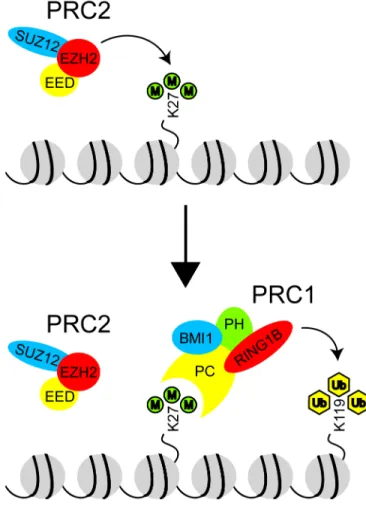
Figure 1.6 Coordinated actions of the Polycomb repressive complexes.
34
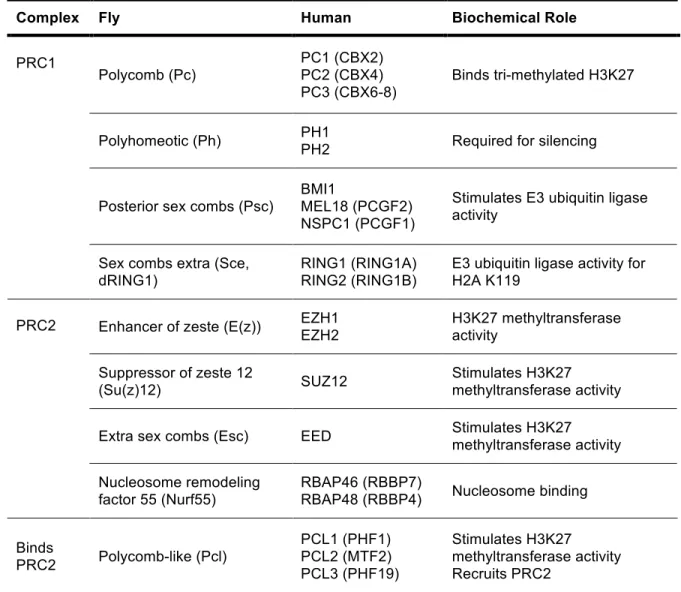
Table 1.1 Core components of Polycomb complexes in flies and humans
Complex Fly Human Biochemical Role
Polycomb (Pc)
PC1 (CBX2) PC2 (CBX4) PC3 (CBX6-8)
Binds tri-methylated H3K27
Polyhomeotic (Ph) PH1
PH2 Required for silencing
Posterior sex combs (Psc)
BMI1
MEL18 (PCGF2) NSPC1 (PCGF1)
Stimulates E3 ubiquitin ligase activity
PRC1
Sex combs extra (Sce, dRING1)
RING1 (RING1A) RING2 (RING1B)
E3 ubiquitin ligase activity for H2A K119
Enhancer of zeste (E(z)) EZH1 EZH2 H3K27 methyltransferase activity
Suppressor of zeste 12
(Su(z)12) SUZ12
Stimulates H3K27 methyltransferase activity
Extra sex combs (Esc) EED Stimulates H3K27 methyltransferase activity PRC2
Nucleosome remodeling factor 55 (Nurf55)
RBAP46 (RBBP7)
RBAP48 (RBBP4) Nucleosome binding
Binds
PRC2 Polycomb-like (Pcl)
35
REFERENCES
Agger, K., Cloos, P. A., Christensen, J., Pasini, D., Rose, S., Rappsilber, J., Issaeva, I., Canaani, E., Salcini, A. E., and Helin, K. (2007). UTX and JMJD3 are histone H3K27 demethylases involved in HOX gene regulation and development. Nature 449, 731-734.
Agherbi, H., Gaussmann-Wenger, A., Verthuy, C., Chasson, L., Serrano, M., and Djabali, M. (2009). Polycomb mediated epigenetic silencing and replication timing at the INK4a/ARF locus during senescence. PLoS One 4, e5622.
Bachmann, I. M., Halvorsen, O. J., Collett, K., Stefansson, I. M., Straume, O., Haukaas, S. A., Salvesen, H. B., Otte, A. P., and Akslen, L. A. (2006). EZH2 expression is associated with high proliferation rate and aggressive tumor subgroups in cutaneous melanoma and cancers of the endometrium, prostate, and breast. J Clin Oncol 24, 268-273.
Bannister, A. J., Zegerman, P., Partridge, J. F., Miska, E. A., Thomas, J. O., Allshire, R. C., and Kouzarides, T. (2001). Selective recognition of methylated lysine 9 on histone H3 by the HP1 chromo domain. Nature 410, 120-124.
Barski, A., Cuddapah, S., Cui, K., Roh, T. Y., Schones, D. E., Wang, Z., Wei, G., Chepelev, I., and Zhao, K. (2007). High-resolution profiling of histone methylations in the human genome. Cell 129, 823-837.
Bedford, M. T. (2007). Arginine methylation at a glance. J Cell Sci 120, 4243-4246.
Bedford, M. T., and Richard, S. (2005). Arginine methylation an emerging regulator of protein function. Mol Cell 18, 263-272.
Berger, S. L., Kouzarides, T., Shiekhattar, R., and Shilatifard, A. (2009). An operational definition of epigenetics. Genes Dev 23, 781-783.
Bernstein, B. E., Mikkelsen, T. S., Xie, X., Kamal, M., Huebert, D. J., Cuff, J., Fry, B., Meissner, A., Wernig, M., Plath, K., et al. (2006). A bivalent chromatin structure marks key developmental genes in embryonic stem cells. Cell 125, 315-326.
36
the mammalian enzymes is related to bacterial restriction methyltransferases. J Mol Biol 203, 971-983.
Bestor, T. H., and Ingram, V. M. (1983). Two DNA methyltransferases from murine
erythroleukemia cells: purification, sequence specificity, and mode of interaction with DNA. Proc Natl Acad Sci U S A 80, 5559-5563.
Birney, E., Stamatoyannopoulos, J. A., Dutta, A., Guigo, R., Gingeras, T. R., Margulies, E. H., Weng, Z., Snyder, M., Dermitzakis, E. T., Thurman, R. E., et al. (2007). Identification and analysis of functional elements in 1% of the human genome by the ENCODE pilot project. Nature 447, 799-816.
Boyer, L. A., Plath, K., Zeitlinger, J., Brambrink, T., Medeiros, L. A., Lee, T. I., Levine, S. S., Wernig, M., Tajonar, A., Ray, M. K., et al. (2006). Polycomb complexes repress
developmental regulators in murine embryonic stem cells. Nature 441, 349-353.
Bracken, A. P., and Helin, K. (2009). Polycomb group proteins: navigators of lineage pathways led astray in cancer. Nat Rev Cancer 9, 773-784.
Bracken, A. P., Kleine-Kohlbrecher, D., Dietrich, N., Pasini, D., Gargiulo, G., Beekman, C., Theilgaard-Monch, K., Minucci, S., Porse, B. T., Marine, J. C., et al. (2007). The Polycomb group proteins bind throughout the INK4A-ARF locus and are disassociated in senescent cells. Genes Dev 21, 525-530.
Bracken, A. P., Pasini, D., Capra, M., Prosperini, E., Colli, E., and Helin, K. (2003). EZH2 is downstream of the pRB-E2F pathway, essential for proliferation and amplified in cancer. Embo J 22, 5323-5335.
Brown, J. L., Fritsch, C., Mueller, J., and Kassis, J. A. (2003). The Drosophila pho-like gene encodes a YY1-related DNA binding protein that is redundant with pleiohomeotic in
homeotic gene silencing. Development 130, 285-294.
Brown, J. L., Mucci, D., Whiteley, M., Dirksen, M. L., and Kassis, J. A. (1998). The Drosophila Polycomb group gene pleiohomeotic encodes a DNA binding protein with homology to the transcription factor YY1. Mol Cell 1, 1057-1064.
37
Byvoet, P., Shepherd, G. R., Hardin, J. M., and Noland, B. J. (1972). The distribution and turnover of labeled methyl groups in histone fractions of cultured mammalian cells. Arch Biochem Biophys 148, 558-567.
Cao, R., Tsukada, Y., and Zhang, Y. (2005). Role of Bmi-1 and Ring1A in H2A ubiquitylation and Hox gene silencing. Mol Cell 20, 845-854.
Cao, R., Wang, L., Wang, H., Xia, L., Erdjument-Bromage, H., Tempst, P., Jones, R. S., and Zhang, Y. (2002). Role of histone H3 lysine 27 methylation in Polycomb-group silencing. Science 298, 1039-1043.
Cao, R., and Zhang, Y. (2004). SUZ12 is required for both the histone methyltransferase activity and the silencing function of the EED-EZH2 complex. Mol Cell 15, 57-67.
Caretti, G., Di Padova, M., Micales, B., Lyons, G. E., and Sartorelli, V. (2004). The Polycomb Ezh2 methyltransferase regulates muscle gene expression and skeletal muscle differentiation. Genes Dev 18, 2627-2638.
Cha, T. L., Zhou, B. P., Xia, W., Wu, Y., Yang, C. C., Chen, C. T., Ping, B., Otte, A. P., and Hung, M. C. (2005). Akt-mediated phosphorylation of EZH2 suppresses methylation of lysine 27 in histone H3. Science 310, 306-310.
Chamberlain, S. J., Yee, D., and Magnuson, T. (2008). Polycomb repressive complex 2 is dispensable for maintenance of embryonic stem cell pluripotency. Stem Cells 26, 1496-1505.
Choi, S. H., Oh, C. T., Kim, S. H., Kim, Y. T., and Jeon, S. H. (2000). Effects of Polycomb group mutations on the expression of Ultrabithorax in the Drosophila visceral mesoderm. Mol Cells 10, 156-161.
Cloos, P. A., Christensen, J., Agger, K., Maiolica, A., Rappsilber, J., Antal, T., Hansen, K. H., and Helin, K. (2006). The putative oncogene GASC1 demethylates tri- and dimethylated lysine 9 on histone H3. Nature 442, 307-311.
Copeland, R. A., Solomon, M. E., and Richon, V. M. (2009). Protein methyltransferases as a target class for drug discovery. Nat Rev Drug Discov 8, 724-732.
38
Czermin, B., Melfi, R., McCabe, D., Seitz, V., Imhof, A., and Pirrotta, V. (2002). Drosophila enhancer of Zeste/ESC complexes have a histone H3 methyltransferase activity that marks chromosomal Polycomb sites. Cell 111, 185-196.
Dejardin, J., Rappailles, A., Cuvier, O., Grimaud, C., Decoville, M., Locker, D., and Cavalli, G. (2005). Recruitment of Drosophila Polycomb group proteins to chromatin by DSP1. Nature 434, 533-538.
Dillon, S. C., Zhang, X., Trievel, R. C., and Cheng, X. (2005). The SET-domain protein superfamily: protein lysine methyltransferases. Genome Biol 6, 227.
Dinger, M. E., Amaral, P. P., Mercer, T. R., Pang, K. C., Bruce, S. J., Gardiner, B. B., Askarian-Amiri, M. E., Ru, K., Solda, G., Simons, C., et al. (2008). Long noncoding RNAs in mouse embryonic stem cell pluripotency and differentiation. Genome Res 18, 1433-1445.
Duncan, I. M. (1982). Polycomblike: a gene that appears to be required for the normal expression of the bithorax and antennapedia gene complexes of Drosophila melanogaster. Genetics 102, 49-70.
Faust, C., Schumacher, A., Holdener, B., and Magnuson, T. (1995). The eed mutation disrupts anterior mesoderm production in mice. Development 121, 273-285.
Feng, Q., Wang, H., Ng, H. H., Erdjument-Bromage, H., Tempst, P., Struhl, K., and Zhang, Y. (2002). Methylation of H3-lysine 79 is mediated by a new family of HMTases without a SET domain. Curr Biol 12, 1052-1058.
Francis, N. J., Kingston, R. E., and Woodcock, C. L. (2004). Chromatin compaction by a polycomb group protein complex. Science 306, 1574-1577.
Francis, N. J., Saurin, A. J., Shao, Z., and Kingston, R. E. (2001). Reconstitution of a functional core polycomb repressive complex. Mol Cell 8, 545-556.
Fritsch, C., Brown, J. L., Kassis, J. A., and Muller, J. (1999). The DNA-binding polycomb group protein pleiohomeotic mediates silencing of a Drosophila homeotic gene.
Development 126, 3905-3913.
39
Guttman, M., Amit, I., Garber, M., French, C., Lin, M. F., Feldser, D., Huarte, M., Zuk, O., Carey, B. W., Cassady, J. P., et al. (2009). Chromatin signature reveals over a thousand highly conserved large non-coding RNAs in mammals. Nature 458, 223-227.
Hansen, K. H., Bracken, A. P., Pasini, D., Dietrich, N., Gehani, S. S., Monrad, A., Rappsilber, J., Lerdrup, M., and Helin, K. (2008). A model for transmission of the H3K27me3 epigenetic mark. Nat Cell Biol 10, 1291-1300.
Hawkins, R. D., Hon, G. C., Lee, L. K., Ngo, Q., Lister, R., Pelizzola, M., Edsall, L. E., Kuan, S., Luu, Y., Klugman, S., et al. (2010). Distinct epigenomic landscapes of pluripotent and lineage-committed human cells. Cell Stem Cell 6, 479-491.
Hermann, A., Goyal, R., and Jeltsch, A. (2004). The Dnmt1
DNA-(cytosine-C5)-methyltransferase methylates DNA processively with high preference for hemimethylated target sites. J Biol Chem 279, 48350-48359.
Hoffmann, M. J., Engers, R., Florl, A. R., Otte, A. P., Muller, M., and Schulz, W. A. (2007). Expression changes in EZH2, but not in BMI-1, SIRT1, DNMT1 or DNMT3B are associated with DNA methylation changes in prostate cancer. Cancer Biol Ther 6, 1403-1412.
Huang, J., and Berger, S. L. (2008). The emerging field of dynamic lysine methylation of non-histone proteins. Curr Opin Genet Dev 18, 152-158.
Jacob, Y., Feng, S., LeBlanc, C. A., Bernatavichute, Y. V., Stroud, H., Cokus, S., Johnson, L. M., Pellegrini, M., Jacobsen, S. E., and Michaels, S. D. (2009). ATXR5 and ATXR6 are H3K27 monomethyltransferases required for chromatin structure and gene silencing. Nat Struct Mol Biol 16, 763-768.
Jaenisch, R., and Bird, A. (2003). Epigenetic regulation of gene expression: how the genome integrates intrinsic and environmental signals. Nat Genet 33 Suppl, 245-254.
Jenuwein, T., and Allis, C. D. (2001). Translating the histone code. Science 293, 1074-1080.
Jung, J., Mysliwiec, M. R., and Lee, Y. (2005). Roles of JUMONJI in mouse embryonic development. Dev Dyn 232, 21-32.
40
Kanhere, A., Viiri, K., Araujo, C. C., Rasaiyaah, J., Bouwman, R. D., Whyte, W. A., Pereira, C. F., Brookes, E., Walker, K., Bell, G. W., et al. (2010). Short RNAs are transcribed from repressed polycomb target genes and interact with polycomb repressive complex-2. Mol Cell
38, 675-688.
Kapranov, P., Cheng, J., Dike, S., Nix, D. A., Duttagupta, R., Willingham, A. T., Stadler, P. F., Hertel, J., Hackermuller, J., Hofacker, I. L., et al. (2007). RNA maps reveal new RNA classes and a possible function for pervasive transcription. Science 316, 1484-1488.
Karanikolas, B. D., Figueiredo, M. L., and Wu, L. (2009). Polycomb group protein enhancer of zeste 2 is an oncogene that promotes the neoplastic transformation of a benign prostatic epithelial cell line. Mol Cancer Res 7, 1456-1465.
Keogh, M. C., Kurdistani, S. K., Morris, S. A., Ahn, S. H., Podolny, V., Collins, S. R., Schuldiner, M., Chin, K., Punna, T., Thompson, N. J., et al. (2005). Cotranscriptional set2 methylation of histone H3 lysine 36 recruits a repressive Rpd3 complex. Cell 123, 593-605.
Khalil, A. M., Guttman, M., Huarte, M., Garber, M., Raj, A., Rivea Morales, D., Thomas, K., Presser, A., Bernstein, B. E., van Oudenaarden, A., et al. (2009). Many human large
intergenic noncoding RNAs associate with chromatin-modifying complexes and affect gene expression. Proc Natl Acad Sci U S A 106, 11667-11672.
Kim, H., Kang, K., and Kim, J. (2009). AEBP2 as a potential targeting protein for Polycomb Repression Complex PRC2. Nucleic Acids Res 37, 2940-2950.
King, I. F., Emmons, R. B., Francis, N. J., Wild, B., Muller, J., Kingston, R. E., and Wu, C. T. (2005). Analysis of a polycomb group protein defines regions that link repressive activity on nucleosomal templates to in vivo function. Mol Cell Biol 25, 6578-6591.
Kitajima, K., Kojima, M., Nakajima, K., Kondo, S., Hara, T., Miyajima, A., and Takeuchi, T. (1999). Definitive but not primitive hematopoiesis is impaired in jumonji mutant mice. Blood
93, 87-95.
Kleer, C. G., Cao, Q., Varambally, S., Shen, R., Ota, I., Tomlins, S. A., Ghosh, D., Sewalt, R. G., Otte, A. P., Hayes, D. F., et al. (2003). EZH2 is a marker of aggressive breast cancer and promotes neoplastic transformation of breast epithelial cells. Proc Natl Acad Sci U S A 100, 11606-11611.
41
Klose, R. J., Yamane, K., Bae, Y., Zhang, D., Erdjument-Bromage, H., Tempst, P., Wong, J., and Zhang, Y. (2006b). The transcriptional repressor JHDM3A demethylates trimethyl histone H3 lysine 9 and lysine 36. Nature 442, 312-316.
Klose, R. J., Yan, Q., Tothova, Z., Yamane, K., Erdjument-Bromage, H., Tempst, P., Gilliland, D. G., Zhang, Y., and Kaelin, W. G., Jr. (2007). The retinoblastoma binding protein RBP2 is an H3K4 demethylase. Cell 128, 889-900.
Klose, R. J., and Zhang, Y. (2007). Regulation of histone methylation by demethylimination and demethylation. Nat Rev Mol Cell Biol 8, 307-318.
Klymenko, T., Papp, B., Fischle, W., Kocher, T., Schelder, M., Fritsch, C., Wild, B., Wilm, M., and Muller, J. (2006). A Polycomb group protein complex with sequence-specific DNA-binding and selective methyl-lysine-DNA-binding activities. Genes Dev 20, 1110-1122.
Kornberg, R. D., and Lorch, Y. (1999). Twenty-five years of the nucleosome, fundamental particle of the eukaryote chromosome. Cell 98, 285-294.
Kotake, Y., Cao, R., Viatour, P., Sage, J., Zhang, Y., and Xiong, Y. (2007). pRB family proteins are required for H3K27 trimethylation and Polycomb repression complexes binding to and silencing p16INK4alpha tumor suppressor gene. Genes Dev 21, 49-54.
Ku, M., Koche, R. P., Rheinbay, E., Mendenhall, E. M., Endoh, M., Mikkelsen, T. S., Presser, A., Nusbaum, C., Xie, X., Chi, A. S., et al. (2008). Genomewide analysis of PRC1 and PRC2 occupancy identifies two classes of bivalent domains. PLoS Genet 4, e1000242.
Kuzmichev, A., Margueron, R., Vaquero, A., Preissner, T. S., Scher, M., Kirmizis, A., Ouyang, X., Brockdorff, N., Abate-Shen, C., Farnham, P., and Reinberg, D. (2005).
Composition and histone substrates of polycomb repressive group complexes change during cellular differentiation. Proc Natl Acad Sci U S A 102, 1859-1864.
Kuzmichev, A., Nishioka, K., Erdjument-Bromage, H., Tempst, P., and Reinberg, D. (2002). Histone methyltransferase activity associated with a human multiprotein complex containing the Enhancer of Zeste protein. Genes Dev 16, 2893-2905.
42
Lachner, M., O'Carroll, D., Rea, S., Mechtler, K., and Jenuwein, T. (2001). Methylation of histone H3 lysine 9 creates a binding site for HP1 proteins. Nature 410, 116-120.
Lan, F., Bayliss, P. E., Rinn, J. L., Whetstine, J. R., Wang, J. K., Chen, S., Iwase, S., Alpatov, R., Issaeva, I., Canaani, E., et al. (2007). A histone H3 lysine 27 demethylase regulates animal posterior development. Nature 449, 689-694.
Landeira, D., Sauer, S., Poot, R., Dvorkina, M., Mazzarella, L., Jorgensen, H. F., Pereira, C. F., Leleu, M., Piccolo, F. M., Spivakov, M., et al. (2010). Jarid2 is a PRC2 component in embryonic stem cells required for multi-lineage differentiation and recruitment of PRC1 and RNA Polymerase II to developmental regulators. Nat Cell Biol 12, 618-624.
Lavigne, M., Francis, N. J., King, I. F., and Kingston, R. E. (2004). Propagation of silencing; recruitment and repression of naive chromatin in trans by polycomb repressed chromatin. Mol Cell 13, 415-425.
Law, J. A., and Jacobsen, S. E. (2010). Establishing, maintaining and modifying DNA methylation patterns in plants and animals. Nat Rev Genet 11, 204-220.
Lee, M. G., Villa, R., Trojer, P., Norman, J., Yan, K. P., Reinberg, D., Croce, L. D., and Shiekhattar, R. (2007). Demethylation of H3K27 regulates polycomb recruitment and H2A ubiquitination. Science 318, 447-450.
Leeb, M., Pasini, D., Novatchkova, M., Jaritz, M., Helin, K., and Wutz, A. (2010). Polycomb complexes act redundantly to repress genomic repeats and genes. Genes Dev 24, 265-276.
Levine, S. S., Weiss, A., Erdjument-Bromage, H., Shao, Z., Tempst, P., and Kingston, R. E. (2002). The core of the polycomb repressive complex is compositionally and functionally conserved in flies and humans. Mol Cell Biol 22, 6070-6078.
Li, E., Bestor, T. H., and Jaenisch, R. (1992). Targeted mutation of the DNA methyltransferase gene results in embryonic lethality. Cell 69, 915-926.
Li, G., Margueron, R., Ku, M., Chambon, P., Bernstein, B. E., and Reinberg, D. (2010). Jarid2 and PRC2, partners in regulating gene expression. Genes Dev 24, 368-380.
43
Margueron, R., Li, G., Sarma, K., Blais, A., Zavadil, J., Woodcock, C. L., Dynlacht, B. D., and Reinberg, D. (2008). Ezh1 and Ezh2 maintain repressive chromatin through different mechanisms. Mol Cell 32, 503-518.
Martin, C., and Zhang, Y. (2005). The diverse functions of histone lysine methylation. Nat Rev Mol Cell Biol 6, 838-849.
Meissner, A., Mikkelsen, T. S., Gu, H., Wernig, M., Hanna, J., Sivachenko, A., Zhang, X., Bernstein, B. E., Nusbaum, C., Jaffe, D. B., et al. (2008). Genome-scale DNA methylation maps of pluripotent and differentiated cells. Nature 454, 766-770.
Mercer, T. R., Dinger, M. E., Sunkin, S. M., Mehler, M. F., and Mattick, J. S. (2008). Specific expression of long noncoding RNAs in the mouse brain. Proc Natl Acad Sci U S A
105, 716-721.
Mihaly, J., Mishra, R. K., and Karch, F. (1998). A conserved sequence motif in Polycomb-response elements. Mol Cell 1, 1065-1066.
Mikkelsen, T. S., Ku, M., Jaffe, D. B., Issac, B., Lieberman, E., Giannoukos, G., Alvarez, P., Brockman, W., Kim, T. K., Koche, R. P., et al. (2007). Genome-wide maps of chromatin state in pluripotent and lineage-committed cells. Nature 448, 553-560.
Mohn, F., Weber, M., Rebhan, M., Roloff, T. C., Richter, J., Stadler, M. B., Bibel, M., and Schubeler, D. (2008). Lineage-specific polycomb targets and de novo DNA methylation define restriction and potential of neuronal progenitors. Mol Cell 30, 755-766.
Muller, J., Hart, C. M., Francis, N. J., Vargas, M. L., Sengupta, A., Wild, B., Miller, E. L., O'Connor, M. B., Kingston, R. E., and Simon, J. A. (2002). Histone methyltransferase activity of a Drosophila Polycomb group repressor complex. Cell 111, 197-208.
Muller, J., and Kassis, J. A. (2006). Polycomb response elements and targeting of Polycomb group proteins in Drosophila. Curr Opin Genet Dev 16, 476-484.
Nekrasov, M., Klymenko, T., Fraterman, S., Papp, B., Oktaba, K., Kocher, T., Cohen, A., Stunnenberg, H. G., Wilm, M., and Muller, J. (2007). Pcl-PRC2 is needed to generate high levels of H3-K27 trimethylation at Polycomb target genes. Embo J 26, 4078-4088.
44
O'Carroll, D., Erhardt, S., Pagani, M., Barton, S. C., Surani, M. A., and Jenuwein, T. (2001). The polycomb-group gene Ezh2 is required for early mouse development. Mol Cell Biol 21, 4330-4336.
Okano, M., Bell, D. W., Haber, D. A., and Li, E. (1999). DNA methyltransferases Dnmt3a and Dnmt3b are essential for de novo methylation and mammalian development. Cell 99, 247-257.
Okano, M., Xie, S., and Li, E. (1998). Cloning and characterization of a family of novel mammalian DNA (cytosine-5) methyltransferases. Nat Genet 19, 219-220.
Oktaba, K., Gutierrez, L., Gagneur, J., Girardot, C., Sengupta, A. K., Furlong, E. E., and Muller, J. (2008). Dynamic regulation by polycomb group protein complexes controls pattern formation and the cell cycle in Drosophila. Dev Cell 15, 877-889.
Ooi, S. K., and Bestor, T. H. (2008). The colorful history of active DNA demethylation. Cell
133, 1145-1148.
Pan, G., Tian, S., Nie, J., Yang, C., Ruotti, V., Wei, H., Jonsdottir, G. A., Stewart, R., and Thomson, J. A. (2007). Whole-genome analysis of histone H3 lysine 4 and lysine 27 methylation in human embryonic stem cells. Cell Stem Cell 1, 299-312.
Pandey, R. R., Mondal, T., Mohammad, F., Enroth, S., Redrup, L., Komorowski, J., Nagano, T., Mancini-Dinardo, D., and Kanduri, C. (2008). Kcnq1ot1 antisense noncoding RNA mediates lineage-specific transcriptional silencing through chromatin-level regulation. Mol Cell 32, 232-246.
Paro, R., and Hogness, D. S. (1991). The Polycomb protein shares a homologous domain with a heterochromatin-associated protein of Drosophila. Proc Natl Acad Sci U S A 88, 263-267.
Pasini, D., Bracken, A. P., Hansen, J. B., Capillo, M., and Helin, K. (2007). The polycomb group protein Suz12 is required for embryonic stem cell differentiation. Mol Cell Biol 27, 3769-3779.
Pasini, D., Bracken, A. P., Jensen, M. R., Lazzerini Denchi, E., and Helin, K. (2004). Suz12 is essential for mouse development and for EZH2 histone methyltransferase activity. Embo J