Ralph S. Baricc,d
Department of Molecular Microbiology and Immunology, Oregon Health & Sciences University, Portland, Oregon, USAa
; Division of Infectious Diseases, Department of Medicine, Oregon Health & Sciences University, Portland, Oregon, USAb
; Department of Epidemiology, Gillings School of Global Public Health, University of North Carolina at Chapel Hill, Chapel Hill, North Carolina, USAc
; Department of Microbiology and Immunology, University of North Carolina School of Medicine, Chapel Hill, North Carolina, USAd
; Department of Medicine, Vanderbilt University, Nashville, Tennessee, USAe
; The Vanderbilt Vaccine Center, Vanderbilt University, Nashville, Tennessee, USAf
; Department of Pediatrics, Vanderbilt University, Nashville, Tennessee, USAg
; Department of Pathology, Microbiology and Immunology, Vanderbilt University, Nashville, Tennessee, USAh
; Integral Molecular, Philadelphia, Pennsylvania, USAi
; Division of Infectious Diseases and Vaccinology, School of Public Health, University of California, Berkeley, Berkeley, California, USAj
ABSTRACT
The four dengue virus (DENV) serotypes, DENV1 through 4, are endemic throughout tropical and subtropical regions of
the world. While first infection confers long-term protective immunity against viruses of the infecting serotype, a second
infection with virus of a different serotype carries a greater risk of severe dengue disease, including dengue hemorrhagic
fever and dengue shock syndrome. Recent studies demonstrate that humans exposed to DENV infections develop
neutral-izing antibodies that bind to quaternary epitopes formed by the viral envelope (E) protein dimers or higher-order
assem-blies required for the formation of the icosahedral viral envelope. Here we show that the quaternary epitope target of the
human DENV3-specific neutralizing monoclonal antibody (MAb) 5J7 can be partially transplanted into a DENV1 strain by
changing the core residues of the epitope contained within a single monomeric E molecule. MAb 5J7 neutralized the
re-combinant DENV1/3 strain in cell culture and was protective in a mouse model of infection with the DENV1/3 strain.
However, the 5J7 epitope was only partially recreated by transplantation of the core residues because MAb 5J7 bound and
neutralized wild-type (WT) DENV3 better than the DENV1/3 recombinant. Our studies demonstrate that it is possible to
transplant a large number of discontinuous residues between DENV serotypes and partially recreate a complex antibody
epitope, while retaining virus viability. Further refinement of this approach may lead to new tools for measuring
epitope-specific antibody responses and new vaccine platforms.
IMPORTANCE
Dengue virus is the most important mosquito-borne pathogen of humans worldwide, with approximately one-half the world’s
population living in regions where dengue is endemic. Dengue immunity following infection is robust and thought to be
con-ferred by antibodies raised against the infecting virus. However, the specific viral components that these antibodies recognize
and how they neutralize the virus have been incompletely described. Here we map a region on dengue virus serotype 3
recog-nized by the human neutralizing antibody 5J7 and then test the functional significance of this region by transplanting it into a
serotype 1 virus. Our studies demonstrate a region on dengue virus necessary for 5J7 binding and neutralization. Our work also
demonstrates the technical feasibility of engineering dengue viruses to display targets of protective antibodies. This technology
can be used to develop new dengue vaccines and diagnostic assays.
T
he four dengue virus serotypes (DENV1 to DENV4),
transmit-ted by
Aedes
species mosquitoes, are endemic throughout
tropical and subtropical regions of the world (
1
). Primary
infec-tion with virus of one serotype confers long-term immunity
against viruses of that serotype, but subsequent infection with
virus of a different serotype results in an increased risk of
poten-tially fatal severe dengue disease, including dengue hemorrhagic
fever and dengue shock syndrome (
2–4
). This risk has been
attrib-uted, at least in part, to the ability of some cross-reactive
antibod-ies to enhance DENV infection of Fc receptor-bearing cells (
5
,
6
).
DENV vaccines are being developed to induce neutralizing and
protective antibodies (Abs) to all four serotypes. Both the promise
and the challenge of this approach were highlighted by the most
advanced live-attenuated vaccine (LAV) candidate (
7–9
), which
has demonstrated varying efficacy across serotypes and age
groups. To further advance vaccine development, a better
under-Received25 January 2016 Accepted3 March 2016
Accepted manuscript posted online9 March 2016
CitationMesser WB, Yount BL, Royal SR, de Alwis R, Widman DG, Smith SA, Crowe JE, Jr, Pfaff JM, Kahle KM, Doranz BJ, Ibarra KD, Harris E, de Silva AM, Baric RS. 2016. Functional transplant of a dengue virus serotype 3 (DENV3)-specific human monoclonal antibody epitope into DENV1. J Virol 90:5090 –5097.
doi:10.1128/JVI.00155-16.
Editor:J. U. Jung
Address correspondence to Aravinda M. de Silva, [email protected], or Ralph S. Baric, [email protected].
Supplemental material for this article may be found athttp://dx.doi.org/10.1128 /JVI.00155-16.
standing of the properties of natural infection-induced DENV
type-specific neutralizing Abs (NAbs), which appear to be critical
for long-term protection, is needed (
10
,
11
).
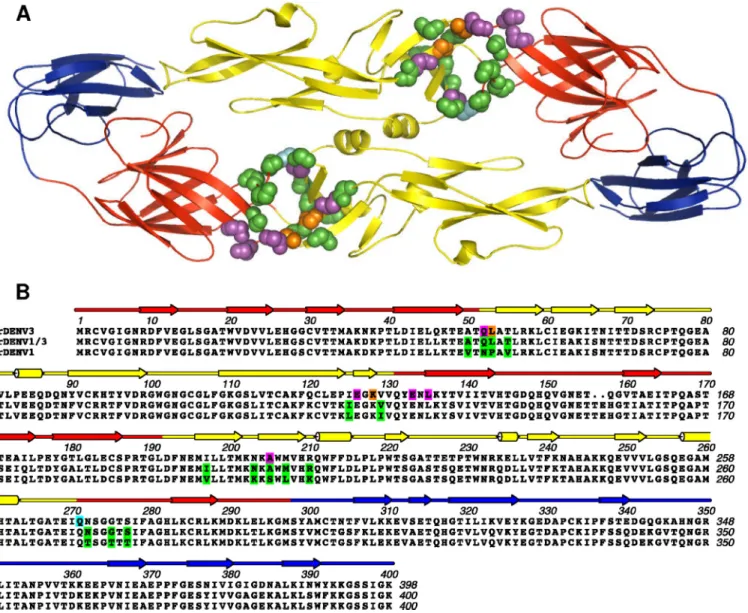
The DENV envelope glycoprotein (E) (
Fig. 1A
) is the major
surface-exposed DENV antigen and the principal target of NAbs.
The E protein structure consists of three distinct domains: I, II,
and III (EDI to EDIII) (
12
,
13
). EDIII is a continuous peptide
extending from EDI and forming an immunoglobulin-like fold,
while EDI and EDII are discontinuous and connect via four
pep-tide linkers that form the EDI/II hinge. The EDI/II hinge is
thought to play a critical role in the DENV life cycle by facilitating
E conformational changes that allow fusion between the viral and
endosomal membranes during viral entry (
14
). Several groups
dia used were supplemented with 5% fetal bovine serum (FBS), 100 U/ml penicillin, 100 mg/ml streptomycin, 0.1 mM nonessential amino acids (Gibco), and 2 mM glutamine, and all cells were incubated in the presence of 5% CO2. The 5% FBS was reduced to 2% to make infection media for
each cell line. rDENV3 is an infectious clone based on the DENV3 clinical isolate UNC3001 (22,23), and the DENV3 strain used in the mouse in-fections was the closely related DENV3 clinical isolate UNC3009 (23). Viruses used for AG129 mouse infections were propagated as previously described (24) and concentrated by centrifugation using 100,000 MWCO Amicon filters (Millipore). Titration for mouse infection was performed via plaque assay on baby hamster kidney cells (BHK21, clone 15) as pre-viously described (25).
Shotgun mutagenesis epitope mapping.A DENV3 prM/E expression construct (DENV3 strain CH53489) was subjected to high-throughput mutagenesis (“shotgun mutagenesis”) to generate a comprehensive mu-tation library (26). Point mutations were introduced into the DENV3 prM/E polyprotein by PCR using a Diversity Mutagenesis kit (Clontech Laboratories, Inc.). In total, 1,400 DENV3 mutants were generated (⬎97% coverage of the prM/E ectodomain), sequence confirmed, and arrayed into 384-well plates (one mutant per well). Each E mutant was individually transfected into HEK-293T cells and allowed to express for 22 h. Cells were fixed in 4% (vol/vol) paraformaldehyde (Electron Micros-copy Sciences) and permeabilized with 0.1% (wt/vol) saponin (Sigma-Aldrich) in phosphate-buffered saline (PBS) plus calcium and magnesium (PBS⫹⫹). Cells were stained with purified 5J7 antibody (0.2g/ml) di-luted in 10% normal goat serum (NGS) (Sigma)– 0.1% saponin, pH 9. The optimal primary antibody concentration was determined using an independent immunofluorescence titration curve against wild-type prM/E to ensure that signals were within the linear range of detection and that signal exceeded background at least 5-fold. Antibody binding was detected using 3.75g/ml Alexa Fluor 488-conjugated secondary anti-body (Jackson ImmunoResearch Laboratories) in 10% NGS– 0.1% sapo-nin. Cells were washed 3 times, and mean cellular fluorescence was deter-mined using an Intellicyt high-throughput flow cytometer (Intellicyt). Antibody reactivity against each mutant E clone was calculated relative to wild-type E protein reactivity by subtracting the signal from mock-trans-fected controls and normalizing to the signal from wild-type E-transmock-trans-fected controls. Mutations within critical clones were identified as critical to the MAb epitope if they did not support reactivity of the test MAb but did support reactivity of other antibodies. This counterscreen strategy facili-tates the exclusion of E mutants that are locally misfolded or have an expression defect (27). Critical amino acids required for antibody binding were visualized on the DENV3 E crystal structure (PDB ID1UZG) (12).
Binding ELISA. Equal virus quantities of DENV1, DENV3, and rDENV1/3 (as previously titrated by enzyme-linked immunosorbent as-say [ELISA]) were captured using a mixture of coated anti-prM and anti-E antibodies. The capture antibodies utilized were either mouse or human depending on the species of the primary antibody being tested. The pri-mary antibodies were diluted 2-fold from starting concentrations of 10 g/ml with the exception of MAb 14A4 (5g/ml). Alkaline phosphatase-conjugated secondary antibodies were utilized to detect binding of pri-mary antibodies with a P-nitrophenyl phosphate substrate and color change quantified with spectrophotometry.
DENV1 infectious clone.The recombinant DENV1 infectious clone is derived from the DENV1 reference strain West Pac ’74 (28,29) and was constructed in a manner similar to that recently described for DENV3 (22). In brief, cDNAs were transcribed from DENV1 RNA, isolated, and
ACAGCCAACCCCATAGTCAC-3=) and DENV1:4⫺(5=CATGCCTCC
AGCTATTAGTG-3=). This approximately 2.16-kb PCR product was cloned into the TOPO XL plasmid. The C fragment was amplified with
DENV1:3⫹ (5=-TCTCAAGAATGATGTGCCAC-3=) and DENV1:6⫺
(5=-CAGTCATGGCTATTTGTGTG-3=). This approximately 4.35-kb fragment was cloned into the pSMART LC (Kanr) plasmid (Lucigen). The
C fragment has an internal PflMI site (approximately position 6239), which is blocked by overlappingdcmmethylation. The D fragment was
amplified using DENV1:5⫹ (5=-CAATGGTGTGGTGAGACTGC-3=)
and 3DEN-SAP (5=-GCTCTTCNNNNAGAACCTGTTGATTCAACAG CACC-3=). This approximately 2.18-kb fragment was cloned into the TOP0 XL plasmid. A PflMI site (at approximately 10705) was removed by changing an A at position 10700 to a G using standard techniques. Plas-mids were propagated inEscherichia coli, purified, restriction enzyme di-gested, and directionally ligated with T4 DNA ligase to create a full-length cDNA of the DENV1 genome. The cDNA was transcribed with T7 poly-merase (Ambion) to produce DENV1 full-length genomic RNA. This RNA produced infectious DENV1 when electroporated into Vero E6 cells.
Construction of a recombinant DENV1 with DENV3 EDI/II hinge residues implicated in MAb 5J7 binding.The EDI/II hinge residues are encoded exclusively on the A fragment. To generate rDENV1/3, the nu-cleotides encoding the DENV1 EDI/II hinge amino acids were replaced with nucleotides encoding the DENV3 hinge and a new subclone A frag-ment containing the nucleotide substitutions was synthesized and in-serted into plasmid pUC-57 (BioBasic). Plasmid was propagated inE. coli, purified, digested, ligated, and transcribed as previously described (22). Electroporation of recombinant RNA into Vero E6 cells led to recovery of viable recombinant rDENV1/3. All infectious clones were subsequently passaged 2 times in C6/36 cells, and cell culture supernatants were clari-fied, supplemented with 20% FBS, and stored at⫺80°C. The presence of specific mutations in virus stocks was confirmed by Sanger sequencing, and the purity of virus stocks was confirmed by serotype type-specific PCR (see Fig. S1B and C in the supplemental material) and restriction enzyme fragment length polymorphism analysis using enzymes that cut parental rDENV1 but not chimeric rDENV1/3 E gene DNA amplified from RNA isolated from working virus stocks of rDENV1/3 (see Fig. S1D in the supplemental material).
l of TrueBlue HRP substrate (KPL). Foci were counted on a light box, and viral titers were calculated by standard methods.
Mouse infections.This study was carried out in strict accordance with the recommendations in theGuide for the Care and Use of Laboratory Animalsof the National Institutes of Health. All procedures were ap-proved by the UC Berkeley Animal Care and Use Committee guidelines. AG129 mice (31) were bred in the Animal Facilities at UC Berkeley. Mice 6 to 8 weeks of age were administered 50g of MAb 5J7 or an isotype control antibody (IgG1) intraperitoneally (i.p.) in a total volume of 200 l, 24 h prior to DENV inoculation. A sublethal dose (1⫻106PFU) of
rDENV1, DENV3, or rDENV1/3 was administered intravenously (i.v.) in a total volume of 100l. Three days postinoculation, mice were sacrificed. Serum was obtained from whole blood by centrifugation and stored at⫺80°C.
Software and statistics.Multiple alignments were performed using ClustalX version 1.83 (32). The structural model of the hinge epitope region was generated using a DENV1 E crystal structure predicted by SWISS-MODEL (33–36) using the rDENV1 primary amino acid se-quence threaded through the crystal structure of DENV3 E (PDB1UZG) (12). Ribbon structure figures were generated using MacPyMOL (The PyMOL Molecular Graphics System, version 1.7.4; Schrödinger, LLC.). Alignments and secondary structure figures were generated using ALINE (37). FRNT counts were entered into GraphPad Prism (version 5.00 for OSX; GraphPad Software, San Diego, CA, USA). Fifty percent FRNT (FRNT50) values were calculated by sigmoid dose-response curve fitting
with upper and lower limits of 100 and 0, respectively. All error bars show 95% confidence intervals unless otherwise specified.
RESULTS
Design and construction of a recombinant DENV1/3 strain with
the DENV3 5J7 epitope.
DENV3-specific neutralizing human
MAb 5J7 was isolated from a donor with a history of primary
DENV3 infection (
15
,
38
). We used two approaches to identify the
functionally important residues critical for MAb 5J7 binding and
neutralization of DENV3. The first approach, shotgun
mutagen-esis, used a library of DENV3 E proteins in which every residue
was separately mutated. Variant E proteins were expressed
indi-vidually, and the effect of the point mutations on 5J7 binding to E
was analyzed, identifying seven critical residues, Q52, L53, E126,
K128, E133, L135, and A203 (
Fig. 1A
and
B
), all localized to the
EDI/II hinge region. As a second approach, we passaged DENV3
in the presence of increasing concentrations MAb 5J7 to
gener-ate viral escape mutants, identifying three escape mutations,
Q269K270ins_K (
15
), L53P, and K128G (
Fig. 1A
and
B
), which
also localized to the EDI/II hinge region. Taken together, these
sites constitute amino acids required for MAb 5J7 binding and
subsequent neutralization of DENV3 in these assays.
To test if MAb 5J7 binding and neutralization could be
con-ferred to a heterotypic DENV serotype, we used the DENV3 E
structure to identify all amino acid residues within 12 Å (i.e., the
approximate size of a typical footprint of an antibody paratope) of
the most central escape mutation, K128G. Using this putative
epitope footprint, we next aligned DENV3 (donor) (
22
) and
DENV1 (recipient) E glycoprotein primary amino acid sequences
and identified the amino acids within that 12-Å footprint that
varied between donor and recipient serotypes (
Fig. 1A
and
B
).
These residues define positions to mutate in order to “transplant”
the DENV3 5J7 epitope into DENV1. Though not captured by the
12-Å footprint, we also elected to include variant residues
(posi-tions 270, 273, and 275) next to Q269, as mutation in this position
conferred neutralization escape. A total of 14 amino acids (
Fig. 1
,
green highlighted residues) in DENV1 were selected for mutating
into the corresponding DENV3 amino acids to generate the
rDENV1/3 virus displaying the 5J7 epitope.
To carry out the transplant, we first constructed a full-length
molecular clone of DENV1 strain WestPac’74. To maximize
sta-bility, the molecular clone was designed as four subclones,
main-tained on separate plasmids, with DNA carrying the DENV
ge-nome flanked by unique class II restriction endonucleases, which
allow for systematic assembly of a full-length molecular clone (see
Fig. S1A in the supplemental material) (
19
,
22
). Using this DENV1
clone as the transplant recipient, we next introduced 14 nucleotide
mutations into DNA carrying the DENV1 E gene of a DENV1
infectious clone to create the rDENV1/3 chimeric protein. The
resultant recombinant DENV1/3 virus (rDENV1/3) was sequence
verified, was shown to be free from contaminating viruses (see Fig.
S1B, C, and D in the supplemental material), and showed growth
curves and peak titers similar to those of parental rDENV1 in Vero
(mammalian) or C6/36 (insect) cells, albeit at early times the
re-combinant virus grew more slowly than the parental virus (see Fig.
S2 in the supplemental material).
The rDENV1/3 virus displays a functional 5J7 epitope.
To
determine if the 5J7 epitope was displayed and functional on the
rDENV1/3 strain, we tested the ability of MAb 5J7 to bind and
neutralize rDENV1/3. MAb 5J7 bound to rDENV1/3, confirming
the transplantation of amino acids required for antibody binding
(
Fig. 2A
). However, binding to the rDENV1/3 virus was weaker
than binding to wild-type (WT) DENV3 (
Fig. 2A
). We further
characterized the neutralization of DENV1, DENV3, and
rDENV1/3 by MAb 5J7 using a focus reduction neutralization test
(FRNT) (
Fig. 2B
). The transplanted epitope was functional, as 5J7
FIG 2Human MAb 5J7 binds and neutralizes rDENV-1/3. (A) Enzyme-linked immunosorbent assay (ELISA) binding of MAb 5J7 to rDENV-3, rDENV-1, and rDENV-1/3. Results are from 2 technical replicates. Whiskers show the standard deviation for each point estimate. (B) FRNT50curves for MAb 5J7 againstrDENV-1, rDENV-3, and rDENV-1/3. The highest MAb 5J7 Ab concentration tested was 100g/ml. Results are from 3 technical replicates. Whiskers show 95% confidence intervals for each point estimate. (C) FRNT50values for MAb 5J7 against rDENV-1, rDENV-3, and rDENV-1/3. Results are from 3 technical
neutralized the rDENV1/3. However, the WT DENV3 was
neu-tralized approximately 15-fold better than rDENV1/3 (
Fig. 2B
and
C
). These data confirmed transplantation of a significant portion
of the functional 5J7 antibody epitope into a heterotypic DENV1
background.
To assess whether 5J7 epitope transplantation into DENV1
disrupted or altered the overall structure of DENV1 E protein, we
tested the binding of a panel of previously mapped DENV-specific
MAbs (see Table S1 in the supplemental material) to rDENV1/3
(
Fig. 3A
to
F
). The DENV1 type-specific and neutralizing human
MAb 1F4 binds a quaternary epitope that is immediately adjacent
to, and potentially disrupted by, the transplanted 5J7 epitope (
16
)
(
Fig. 3G
). 5J7 epitope transplantation preserved 1F4 binding (
Fig.
3A
) to rDENV1/3, indicating that the introduction of the 5J7
epitope did not disrupt an immediately adjacent tertiary DENV1
E epitope structure. DENV1 type-specific MAb E106 (
39
) binds to
EDIII. MAb E106 bound to rDENV1/3 (
Fig. 3C
), demonstrating
proper folding of EDIII. DENV cross-reactive MAbs 1C19 and
1N5 bind to conserved residues on the BC loop and near the
fu-sion loop of EDII (
40
) (
Fig. 3G
). Both the 1C19 and 1N5 MAb
bound to rDENV1/3 (
Fig. 3B
and
D
), supporting preservation of
more distal EDII tertiary structures. Finally, as a negative control,
rDENV1/3 was probed with two DENV3-specific MAbs, 8A1 and
14A4 (
41
), that bind the DENV3 EDIII lateral ridge and A strand,
respectively (
Fig. 3G
). Neither MAb bound to rDENV1/3 (
Fig. 3E
and
F
). Taken together, these results demonstrate that the tertiary
structure and antigen terrain of the DENV1 E glycoprotein,
in-cluding the EDI/II hinge adjacent 1F4 epitope, are preserved in the
rDENV1/3 chimera with the 5J7 DENV3 epitope.
The rDENV1/3 virus is sensitive to MAb 5J7 in a mouse
model of DENV infection.
The alpha/beta and gamma interferon
receptor-deficient AG129 mouse strain is a well-established model
for DENV viremia (
42
,
43
). We used the AG129 mouse model to
test if human MAb 5J7 was protective
in vivo
against DENV3 and
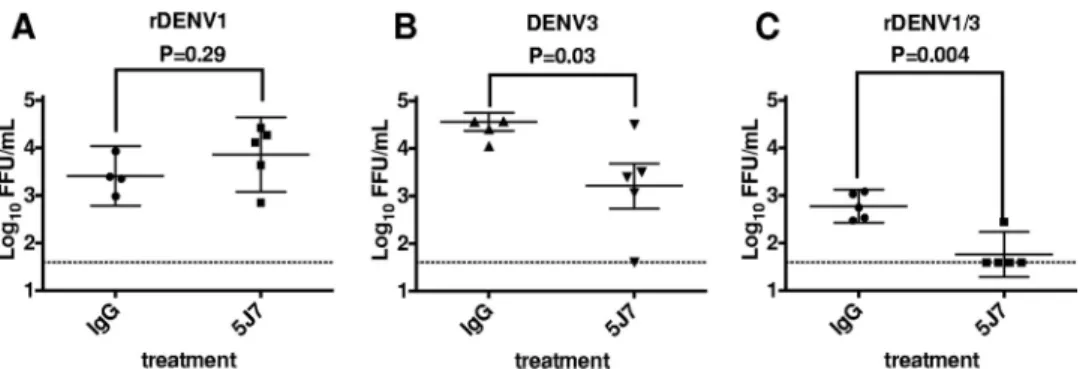
rDENV1/3 displaying the 5J7 epitope. Three groups of AG129
mice passively administered 50
g of 5J7 or an IgG1 isotype
con-trol were challenged 24 h later with 10
6PFU of DENV1, DENV3,
or rDENV1/3, and viremia was measured by infectious focus assay
3 days postchallenge. While no animals challenged with rDENV1
were protected from viremia by 5J7, when challenged with either
DENV3 or rDENV1/3 the animals treated with 5J7 displayed
sig-nificantly lower viremia than did those treated with IgG1 alone
(
Fig. 4
), demonstrating that the transplanted epitope was a target
of protective 5J7 antibodies in a mouse model of dengue infection.
DISCUSSION
resulting in increased scrutiny of this region of E protein as a target
of human neutralizing and protective antibodies. The results
pre-sented here demonstrate that the core epitope of the potently
neu-tralizing human DENV3-specific MAb 5J7, located within the
EDI/II hinge, can be both structurally and functionally
trans-planted between DENV serotypes.
The structure of MAb 5J7 bound to whole DENV3 has recently
been resolved at 9 Å by cryo-electron microscopy (cryo-EM) (
17
)
(
Fig. 5
) (
17
). The 5J7 MAb footprint, which is mainly contained
within the EDI/II hinge region of a single E protein monomer,
extends into EDIII and EDII of the adjacent E dimer (
Fig. 5
). In
other words, three E proteins are required to complete the
epitope. In the cryo-EM modeled structure of 5J7 bound to
DENV3, 24 amino acids distributed across three E protein
mole-cules come into contact with the 5J7 heavy chain. Twenty-three of
the 24 heavy-chain contact residues were present on rDENV1/3
(
Fig. 5
). The single heavy-chain contact residue that was not
matched was at position 307 on EDIII of molecule B. Of the 7
light-chain contact residues, three residues at positions 123, 223,
and 227 were not accurately matched in rDENV1/3 (
Fig. 5
).
Although our empirically defined 5J7 epitope showed good
agreement with the cryo-EM structure within the EDI/II core
FIG 4rDENV-1/3 is sensitive to MAb 5J7 in a mouse model of dengue viremia. Mice were passively transfused with 50g of MAb 5J7 or nonspecific IgG and challenged 24 h later with 106PFU rDENV-1, rDENV-3, or rDENV-1/3. Three days postinoculation, mice were terminally bled. Viremia in log10focus-forming
units (FFU) per milliliter serum as measured by direct immunofocus assay is shown on theyaxis, and challenge virus and pretreatment are indicated on thexaxis. rDENV-1/3 and DENV-3 viremia was significantly lower in animals treated with 5J7 than in animals treated with control IgG. MAb 5J7 treatment did not have an effect on rDENV-1 viremia. Whiskers show 95% confidence intervals (Mann-Whitney U test followed by Dunn’s multiple-comparisonpost hoctest,P⬍0.05).
strongly selected for under neutralizing antibody pressure. Taken
together, these two approaches demonstrate the critical role that
the EDI/II core plays in 5J7 activity, most likely due to the
preser-vation of nearly all the DENV3 residues contacted by the heavy
chain. The reduced binding and neutralization of rDENV1/3
compared to those of WT DENV3 are most likely due to the poor
display of 5J7 light-chain binding residues and, possibly, the single
heavy-chain mismatch at position 307 on molecule B (
Fig. 5
). Our
observation that transplantation of just 14 residues on the EDI/II
hinge region from DENV3 into DENV1 leads to gain of 5J7
bind-ing and neutralization indicates that the transplanted region
de-fines the core of the epitope and that the adjacent quaternary E
residues, likely, play a supportive role and contribute to overall Ab
affinity.
Our demonstration that a complex conformational antibody
epitope can be transplanted between DENV serotypes while
main-taining infectivity indicates a hitherto-underappreciated
flexibil-ity in the flavivirus E glycoprotein. Of note, the rDENV1/3 virus
has “bivalent” properties in that it displays both the
DENV1-spe-cific 1F4 and DENV3-speDENV1-spe-cific 5J7 MAb epitopes. The approach of
epitope transplantation, while maintaining virus infectivity, sets
the stage for developing new diagnostic tools to track
epitope-specific Ab responses and new recombinant flavivirus vaccines.
ACKNOWLEDGMENTS
We thank Fred Sparling, Director, Region IV Southeast Region Center of Excellence for Emerging Infections and Biodefense (SERCEB), for his long-term support and leadership, which brought these studies to frui-tion. We thank Anne Broadwater (UNC-CH), Nurgun Kose (Vanderbilt University), and Frances House (Vanderbilt University) for excellent technical support.
FUNDING INFORMATION
This work, including the efforts of Bill Messer, was funded by Sunlin and Priscilla Chou Family Foundation. This work was funded by HHS | Na-tional Institutes of Health (NIH) (R01 AI 107731, P01 AI106695-01, and HHSN272200900055C).
REFERENCES
1.Bhatt S, Gething PW, Brady OJ, Messina JP, Farlow AW, Moyes CL, Drake JM, Brownstein JS, Hoen AG, Sankoh O, Myers MF, George DB, Jaenisch T, Wint GR, Simmons CP, Scott TW, Farrar JJ, Hay SI.2013. The global distribution and burden of dengue. Nature496:504 –507.http: //dx.doi.org/10.1038/nature12060.
2.Burke DS, Nisalak A, Johnson DE, Scott RM.1988. A prospective study of dengue infections in Bangkok. Am J Trop Med Hyg38:172–180. 3.Guzman MG, Alvarez M, Halstead SB.2013. Secondary infection as a
risk factor for dengue hemorrhagic fever/dengue shock syndrome: an his-torical perspective and role of antibody-dependent enhancement of infec-tion. Arch Virol 158:1445–1459. http://dx.doi.org/10.1007/s00705-013 -1645-3.
4.Halstead SB, Nimmannitya S, Cohen SN.1970. Observations related to pathogenesis of dengue hemorrhagic fever. IV. Relation of disease severity to antibody response and virus recovered. Yale J Biol Med42:311–328. 5.Kliks SC, Nimmanitya S, Nisalak A, Burke DS. 1988. Evidence that
efficacy and safety of a novel tetravalent dengue vaccine in healthy chil-dren in Asia: a phase 3, randomised, observer-masked, placebo-controlled trial. Lancet384:1358 –1365.http://dx.doi.org/10.1016/S0140-6736(14) 61060-6.
8.Villar L, Dayan GH, Arredondo-Garcia JL, Rivera DM, Cunha R, Deseda C, Reynales H, Costa MS, Morales-Ramirez JO, Carrasquilla G, Rey LC, Dietze R, Luz K, Rivas E, Miranda Montoya MC, Cortes Supelano M, Zambrano B, Langevin E, Boaz M, Tornieporth N, Saville M, Noriega F, CYD15 Study Group. 2015. Efficacy of a tetravalent dengue vaccine in children in Latin America. N Engl J Med372:113–123. http://dx.doi.org/10.1056/NEJMoa1411037.
9.Sabchareon A, Wallace D, Sirivichayakul C, Limkittikul K, Chantha-vanich P, Suvannadabba S, Jiwariyavej V, Dulyachai W, Pengsaa K, Wartel TA, Moureau A, Saville M, Bouckenooghe A, Viviani S, Torn-ieporth NG, Lang J.2012. Protective efficacy of the recombinant, live-attenuated, CYD tetravalent dengue vaccine in Thai schoolchildren: a ran-domised, controlled phase 2b trial. Lancet380:1559 –1567.http://dx.doi .org/10.1016/S0140-6736(12)61428-7.
10. Rothman AL.2011. Immunity to dengue virus: a tale of original antigenic sin and tropical cytokine storms. Nat Rev Immunol11:532–543.http://dx .doi.org/10.1038/nri3014.
11. Dowd KA, Pierson TC.2011. Antibody-mediated neutralization of fla-viviruses: a reductionist view. Virology411:306 –315.http://dx.doi.org/10 .1016/j.virol.2010.12.020.
12. Modis Y, Ogata S, Clements D, Harrison SC.2003. A ligand-binding pocket in the dengue virus envelope glycoprotein. Proc Natl Acad Sci U S A100:
6986 – 6991.http://dx.doi.org/10.1073/pnas.0832193100.
13. Zhang Y, Zhang W, Ogata S, Clements D, Strauss JH, Baker TS, Kuhn RJ, Rossmann MG.2004. Conformational changes of the flavi-virus E glycoprotein. Structure 12:1607–1618. http://dx.doi.org/10 .1016/j.str.2004.06.019.
14. Modis Y, Ogata S, Clements D, Harrison SC.2004. Structure of the dengue virus envelope protein after membrane fusion. Nature427:313– 319.http://dx.doi.org/10.1038/nature02165.
15. de Alwis R, Smith SA, Olivarez NP, Messer WB, Huynh JP, Wahala WM, White LJ, Diamond MS, Baric RS, Crowe JE, Jr, de Silva AM.
2012. Identification of human neutralizing antibodies that bind to com-plex epitopes on dengue virions. Proc Natl Acad Sci U S A109:7439 –7444. http://dx.doi.org/10.1073/pnas.1200566109.
16. Fibriansah G, Tan JL, Smith SA, de Alwis AR, Ng TS, Kostyuchenko VA, Ibarra KD, Wang J, Harris E, de Silva A, Crowe JE, Jr, Lok SM.
2014. A potent anti-dengue human antibody preferentially recognizes the conformation of E protein monomers assembled on the virus sur-face. EMBO Mol Med 6:358 –371.http://dx.doi.org/10.1002/emmm .201303404.
17. Fibriansah G, Tan JL, Smith SA, de Alwis R, Ng TS, Kostyuchenko VA, Jadi RS, Kukkaro P, de Silva AM, Crowe JE, Lok SM.2015. A highly potent human antibody neutralizes dengue virus serotype 3 by binding across three surface proteins. Nat Commun6:6341.http://dx.doi.org/10
.1038/ncomms7341.
18. Teoh EP, Kukkaro P, Teo EW, Lim AP, Tan TT, Yip A, Schul W, Aung M, Kostyuchenko VA, Leo YS, Chan SH, Smith KG, Chan AH, Zou G, Ooi EE, Kemeny DM, Tan GK, Ng JK, Ng ML, Alonso S, Fisher D, Shi PY, Hanson BJ, Lok SM, MacAry PA.2012. The structural basis for serotype-specific neutralization of dengue virus by a human antibody. Sci Transl Med4:139ra83.http://dx.doi.org/10.1126/scitranslmed.3003888. 19. Gallichotte EN, Widman DG, Yount BL, Wahala WM, Durbin A,
Whitehead S, Sariol CA, Crowe JE, Jr, de Silva AM, Baric RS.2015. A new quaternary structure epitope on dengue virus serotype 2 is the target of durable type-specific neutralizing antibodies. mBio6(5):e01461-15. http://dx.doi.org/10.1128/mBio.01461-15.
ZH, Rey FA, Mongkolsapaya J, Screaton GR.2015. A new class of highly potent, broadly neutralizing antibodies isolated from viremic patients in-fected with dengue virus. Nat Immunol16:170 –177.http://dx.doi.org/10 .1038/ni.3058.
21. Rouvinski A, Guardado-Calvo P, Barba-Spaeth G, Duquerroy S, Vaney MC, Kikuti CM, Navarro Sanchez ME, Dejnirattisai W, Wongwiwat W, Haouz A, Girard-Blanc C, Petres S, Shepard WE, Despres P, Arenzana-Seisdedos F, Dussart P, Mongkolsapaya J, Screaton GR, Rey FA.2015. Recognition determinants of broadly neutralizing human antibodies against dengue viruses. Nature520:109 –113.http://dx.doi.org/10.1038 /nature14130.
22. Messer WB, Yount B, Hacker KE, Donaldson EF, Huynh JP, de Silva AM, Baric RS.2012. Development and characterization of a reverse ge-netic system for studying dengue virus serotype 3 strain variation and neutralization. PLoS Negl Trop Dis6:e1486.http://dx.doi.org/10.1371 /journal.pntd.0001486.
23. Messer WB, Gubler DJ, Harris E, Sivananthan K, de Silva AM.2003. Emergence and global spread of a dengue serotype 3, subtype III virus. Emerg Infect Dis9:800 – 809.http://dx.doi.org/10.3201/eid0907.030038. 24. Shresta S, Kyle JL, Snider HM, Basavapatna M, Beatty PR, Harris E.
2004. Interferon-dependent immunity is essential for resistance to pri-mary dengue virus infection in mice, whereas T- and B-cell-dependent immunity are less critical. J Virol78:2701–2710.http://dx.doi.org/10.1128 /JVI.78.6.2701-2710.2004.
25. Diamond MS, Edgil D, Roberts TG, Lu B, Harris E.2000. Infection of human cells by dengue virus is modulated by different cell types and viral strains. J Virol74:7814 –7823.http://dx.doi.org/10.1128/JVI.74.17.7814 -7823.2000.
26. Davidson E, Doranz BJ.2014. A high-throughput shotgun mutagenesis approach to mapping B-cell antibody epitopes. Immunology143:13–20. http://dx.doi.org/10.1111/imm.12323.
27. Paes C, Ingalls J, Kampani K, Sulli C, Kakkar E, Murray M, Kotelnikov V, Greene TA, Rucker JB, Doranz BJ.2009. Atomic-level mapping of antibody epitopes on a GPCR. J Am Chem Soc131:6952– 6954.http://dx .doi.org/10.1021/ja900186n.
28. Puri B, Nelson W, Porter KR, Henchal EA, Hayes CG.1998. Complete nucleotide sequence analysis of a Western Pacific dengue-1 virus strain. Virus Genes17:85– 88.http://dx.doi.org/10.1023/A:1008009202695. 29. Repik PM, Dalrymple JM, Brandt WE, McCown JM, Russell PK.1983.
RNA fingerprinting as a method for distinguishing dengue 1 virus strains. Am J Trop Med Hyg32:577–589.
30. Durbin AP, Karron RA, Sun W, Vaughn DW, Reynolds MJ, Perreault JR, Thumar B, Men R, Lai CJ, Elkins WR, Chanock RM, Murphy BR, Whitehead SS.2001. Attenuation and immunogenicity in humans of a live dengue virus type-4 vaccine candidate with a 30 nucleotide deletion in its 3=-untranslated region. Am J Trop Med Hyg65:405– 413.
31. van den Broek MF, Muller U, Huang S, Zinkernagel RM, Aguet M.
1995. Immune defence in mice lacking type I and/or type II interferon receptors. Immunol Rev 148:5–18. http://dx.doi.org/10.1111/j.1600 -065X.1995.tb00090.x.
32. Chenna R, Sugawara H, Koike T, Lopez R, Gibson TJ, Higgins DG,
Thompson JD.2003. Multiple sequence alignment with the Clustal series of programs. Nucleic Acids Res31:3497–3500.http://dx.doi.org/10.1093 /nar/gkg500.
33. Arnold K, Bordoli L, Kopp J, Schwede T.2006. The SWISS-MODEL workspace: a web-based environment for protein structure homology modelling. Bioinformatics22:195–201.http://dx.doi.org/10.1093/bioin formatics/bti770.
34. Biasini M, Bienert S, Waterhouse A, Arnold K, Studer G, Schmidt T, Kiefer F, Cassarino TG, Bertoni M, Bordoli L, Schwede T. 2014. SWISS-MODEL: modelling protein tertiary and quaternary structure us-ing evolutionary information. Nucleic Acids Res42:W252–W258.http: //dx.doi.org/10.1093/nar/gku340.
35. Guex N, Peitsch MC, Schwede T.2009. Automated comparative protein structure modeling with SWISS-MODEL and Swiss-PdbViewer: a histor-ical perspective. Electrophoresis30(Suppl 1):S162–S173.http://dx.doi.org /10.1002/elps.200900140.
36. Kiefer F, Arnold K, Kunzli M, Bordoli L, Schwede T.2009. The SWISS-MODEL Repository and associated resources. Nucleic Acids Res37:
D387–D392.http://dx.doi.org/10.1093/nar/gkn750.
37. Bond CS, Schuttelkopf AW. 2009. ALINE: a WYSIWYG protein-sequence alignment editor for publication-quality alignments. Acta Crystallogr D Biol Crystallogr65:510 –512.http://dx.doi.org/10.1107
/S0907444909007835.
38. Smith SA, Zhou Y, Olivarez NP, Broadwater AH, de Silva AM, Crowe JE, Jr.2012. Persistence of circulating memory B cell clones with potential for dengue virus disease enhancement for decades following infection. J Virol86:2665–2675.http://dx.doi.org/10.1128/JVI.06335-11.
39. Shrestha B, Brien JD, Sukupolvi-Petty S, Austin SK, Edeling MA, Kim T, O’Brien KM, Nelson CA, Johnson S, Fremont DH, Diamond MS.
2010. The development of therapeutic antibodies that neutralize homol-ogous and heterolhomol-ogous genotypes of dengue virus type 1. PLoS Pathog
6:e1000823.http://dx.doi.org/10.1371/journal.ppat.1000823.
40. Smith SA, de Alwis AR, Kose N, Harris E, Ibarra KD, Kahle KM, Pfaff JM, Xiang X, Doranz BJ, de Silva AM, Austin SK, Sukupolvi-Petty S, Diamond MS, Crowe JE, Jr.2013. The potent and broadly neutralizing human dengue virus-specific monoclonal antibody 1C19 reveals a unique cross-reactive epitope on the bc loop of domain II of the envelope protein. mBio4:e00873-13.http://dx.doi.org/10.1128/mBio.00873-13.
41. Wahala WM, Donaldson EF, de Alwis R, Accavitti-Loper MA, Baric RS, de Silva AM.2010. Natural strain variation and antibody neutralization of dengue serotype 3 viruses. PLoS Pathog6:e1000821.http://dx.doi.org/10 .1371/journal.ppat.1000821.
42. Balsitis SJ, Williams KL, Lachica R, Flores D, Kyle JL, Mehlhop E, Johnson S, Diamond MS, Beatty PR, Harris E.2010. Lethal antibody enhancement of dengue disease in mice is prevented by Fc modifica-tion. PLoS Pathog6:e1000790.http://dx.doi.org/10.1371/journal.ppat .1000790.