ISSN: 2147-611X
www.ijemst.com
Developing a Useful and Integrative
STEM Disciplinary Language
Robert M. Capraro1, Luciana R. Barroso1, Sandra Nite1, Devyn Rice1, Yvonna Lincoln1, Jamaal Young2, Jemimah Young2
1Aggie STEM and Texas A & M University 2University of North Texas
To cite this article:
Capraro, R.M., Barroso, L.R., Nite, S., Rice, D., Lincoln, Y., Young, J., & Young, J. (2018).
Developing a useful and integrative STEM disciplinary language.
International Journal of
Education
in
Mathematics,
Science
and
Technology
(IJEMST).
6
(1), 1-11.
DOI:10.18404/ijemst.357646
This article may be used for research, teaching, and private study purposes.
Any substantial or systematic reproduction, redistribution, reselling, loan, sub-licensing,
systematic supply, or distribution in any form to anyone is expressly forbidden.
Authors alone are responsible for the contents of their articles. The journal owns the
copyright of the articles.
Developing a Useful and Integrative STEM Disciplinary Language
Robert M. Capraro, Luciana R. Barroso, Sandra Nite, Devyn Rice, Yvonna Lincoln, Jamaal Young, Jemimah Young
Article Info
Abstract
Article History
Received: 06 April 2016
STEM disciplinary language is a necessary component for STEM success. It can be developed through experiences and attention to the development of STEM activities that are rich in language and can be acquired through practical experiences and systematic practice. Secondary students participated in an informal STEM summer camp where they learned to use Google Sketchup® and a 3-D printer to design their own objects. They interacted with peers and collaborated on issues as they arose, to solve problems. They took the Aural/Spatial Interactions and Invariant Components of Vocabulary for STEM instrument pre and posttest, and the results were analyzed qualitatively. Students progressed through styles of communication that were precipitated by terminological inexactitude, cognitive negotiation and then analogous/metaphoric, clarifying, and technical discourses to build mutual understanding and success.
Accepted: 08 August 2016
Keywords
Disciplinary language STEM language Discourse Informal learning STEM camp
Introduction
The idea that language only pertains to reading or native language is as outdated as the buggy whip and the icebox. As language evolves, it is influenced by popular culture and by advances in technology. However, courses in school have also had a basic and very consistent influence on language that has received attention as a form of disciplinary language (Gatenby, 1948; Noyes, 1935; Waldman, 1931), and those foundational ideas continue to evolve (Capraro, Capraro, & Rupley, 2011; Capraro, Capraro, & Rupley, 2010; Fang, 2012; Godwin, Rupley, Capraro, & Capraro, 2016; Rupley, Capraro, & Capraro, 2011; Uccelli, Galloway, Barr, Meneses, & Dobbs, 2015). The compartmentalization of disciplinary language refers to only a single discipline, but this yielded to the idea that disciplines are not solitary and do not reside in insular silos but are interdependent and can be complex, with the same words being used across content areas with very different meanings.
2007, p. 10). Thus, students who are high academic language speakers are situated to learn new concepts through listening, writing, discussing, and reading.
Methodology
Participants and Setting
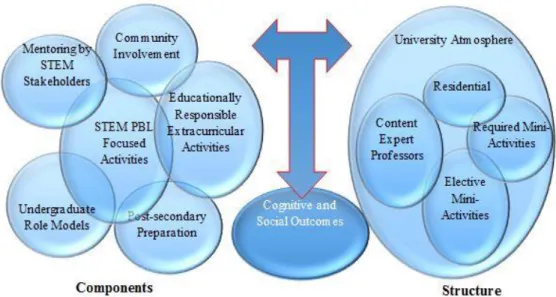
The participants were four groups (approximately 30 in each group N=120) of secondary aged students between 14 and 17 years old, inclusive. They voluntarily attended a STEM Summer Camp for two weeks. The sample was 48% female, 40% Hispanic, 21% Black, 16% Asian, and 23% White. The camp provided a diverse set of experiences. The STEM educational component of the program began each morning at 7:00 AM and culminated at 5:00 PM. The socialization component began at 5:00 PM and culminated at 9:00 PM. The camp was organized around the 7Tenets For Success(see Figure 1): 1) University atmosphere, 2) Informal STEM Project-Based Learning (PBL) activities focused on STEM fields, careers, and solving problems using Engineering Design Principles, 3) Post-secondary STEM preparation, 4) Community involvement in STEM, 5) Undergraduate STEM student role models, 6) Educationally responsible extracurricular activities, 7) Mentoring (ongoing, systematic).
The purpose of the components was to increase student affect toward and achievement in STEM disciplines by catalyzing deep and meaningful STEM based learning. These 7 Tenets for Success on which the camp was based were developed from results of a large meta-synthesis and meta-analysis study about STEM teaching, learning and experiences with running the informal summer camps over a period of 5 years. These form the basis of the theoretical framework for the camp (See Figure 1).
Tenet 1 - University Atmosphere. Post-secondary transition has been a concern in many countries, including the U.S., for some time (Elffers, 2012; Finnie, 2012). Bridge programs containing elements of college atmosphere and mentoring have been established to ease the transition for Hispanics (Keim, McDermott, & Gerard, 2010) and other American students (Lee, Almonte, & Youn, 2013).
Tenet 2 – Informal STEM PBL activities focused on STEM fields, careers, and solving problems using Engineering Design Principles. Students learn better when they are engaged in meaningful activities (Fortus, Krajcik, Dershimer, Marx, & Mamlok-Naaman, 2005) that produce authentic artifacts. Accordingly, using real-world problems within PBLs makes knowledge more relevant for students and increases the transfer of skills and information from the school setting to the real world (Satchwell & Loepp, 2002).
Tenet 3 – Post-secondary STEM Preparation. Post-secondary transition is challenging for many students, especially those underrepresented in STEM fields. Students who develop strong study habits in high school have an advantage when they enter college, particularly in college calculus (Barnett, Sonnert, & Sadler, 2014). Self-study time and completing practice exercises is positively related to course grades (Lovens, Gijbels, Coertjens, & Cote 2013), and the amount of time focused on studying has an effect on achievement.
Tenet 4 - Community Involvement in STEM. Informal STEM settings that were successful in improving STEM-related identities and increasing interest in STEM careers, especially among underrepresented groups, often used community involvement in some way. Summer camps engaged students in community projects and engaged local businesses to support camp activities (Barton & Tan, 2010).
Tenet 5 - Undergraduate STEM Student Role Models. Role model mentoring has been an effective strategy for K-12 students, college students, and professionals. Residential summer STEM camps for secondary students have successfully integrated undergraduate role models to help them understand university culture, maintain interest in STEM majors, provide insights into college culture, and guide them in hands-on learning experiences (Lin, Padmanabhan, Pieri, & Patterson, 2007).
Tenet 6 - Educationally Responsible Extracurricular Activities: learning communities, college readiness, 21st century skills. Research has shown that students who are involved in learning communities have improved
Tenet 7 - Mentoring (ongoing, systematic). Mentorship is a complex developmental relationship that is associated with positive outcomes for the mentor and trainee. Mentoring, at its most basic level, works because it provides a young person with someone who cares about him/her. A mentoring relationship based on integrity, trust, and support has been linked to greater academic success and emotional resilience (Herrera, DuBois, & Grossman, 2013).
The purpose of the components was to increase student affect toward STEM careers and achievement in STEM disciplines by catalyzing deep and meaningful STEM based learning.
Figure 1. Tenets of Success
Intervention
Students participated in courses to learn to use the 3-D printer. They participated in one activity where they learned to use Google Sketchup® and in another where they learned to use the 3-D printer and the accompanying software. The activities were two weeks in length for 1.5-hour sessions per day. Students developed both academic language, language specific to using Google Sketchup® (a computer aided design program), and language specific to using a 3-D printer. Students designed their own objects that met specific criteria: 1) they must create it in its entirety, 2) it can be abstract, 3) it must be able to be printed, and 4) it needed to serve an educational purpose. They also selected from among the following experiences for the remainder of their day: Statistics, Russian Language, Plant Biology, Cosmetic Chemistry, Solar Electricity, Computer Coding, App Design, and Robotics.
Instrument
The Aural/Spatial Interactions and Invariant Components of Vocabulary for STEM (AS-STEM) was designed
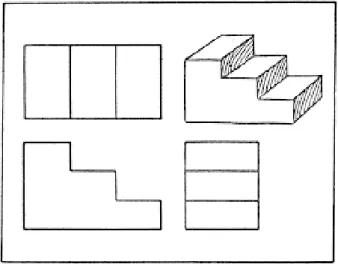
Figure 2. Four views of the 3-D object
Data Analysis
The qualitative data were collected and analyzed to determine themes (Creswell, 2007; Denzin & Lincoln, 2005). Data sources included the students’ verbal discourse, observation, and drawings. Verbal discourse was used to indicate their language use during the completion of the AS-STEM (see Appendix for the procedures). The evidence from their drawings was utilized when comparing vocabulary and observations. Descriptions written by the observer were referenced during the analysis and compared to the transcripts of their conversations. The transcribed conversations with the groups of students were analyzed in three steps (Stake, 2005). First, the recordings were transcribed and an external peer reviewed the transcriptions for accuracy. Next, the transcriptions were read several times, and the research team performed open, axial, and selective coding (Glaser & Strauss, 1967). That is, an organized and systematic process was developed for the emergent themes from the qualitative data. The initial step was open coding, that was a process of identifying essential elements, examining, comparing, conceptualizing and categorizing data. It was data reductionist in nature and an inductive process. Open coding consisted of discovery that included labeling phenomena, categorizing, and developing categories with similar properties and characteristics. Axial coding follows, and it is the assembly of the results from open coding in new ways. The purpose was to make connections between the discovered categories. With axial coding, there was a transition from inductive data analytic methods to deductive. For example, data that helped develop the categories were examined for the purpose of identifying the conditions that gave rise to it. The most common reasons for axial coding were to search for causal conditions and a contextual rationale. Causal conditions were those that reasonably precipitated the occurrence of the category. With contextual rationale, the goal was to identify the set of properties that pertain to the category. The third and final step was selective coding. With selective coding, the goal was to determine the essential, central, or core categories. The outcome of the selective coding was to validate the narrative.
Results
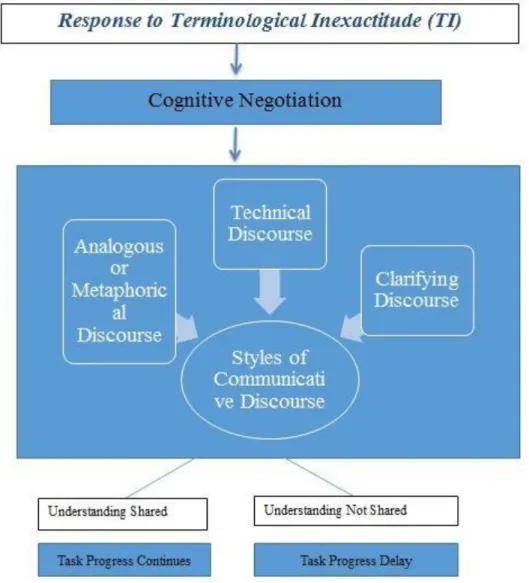
The student work generated data that, when coded, yielded two distinct theoretical structures. The first structure was peer negotiated and fitted to their particular strengths and weaknesses. The type of discourse exhibited early in the process was rather stilted, formal, and procedural. Those developed into a more technical in nature relying on underlying knowledge or prior knowledge. The next level of discourse that emerged was metaphoric language that built on common experiences and inferences about how those prior shared experiences were applicable to the task. Finally, students also used clarifying discourse focused on progress and success. The model in Figure 3 represents the development of the discourses as a result of terminological inexactitudes experienced during the activities.
above the center”. While some of the procedural steps were easily interpretable and constructible, it is easy to see from the second and third examples that most of the procedures were nearly impossible to follow. The drawers recognized that these types of procedural steps were insufficient and led to what the research team labeled Terminological Inexactitudes.
Figure 3. Language Development Model
Aside from the contemporary meaning of the phrase, in this case it is used to describe the inexact use of language that was hard to translate into a drawing that could adequately represent the shape. In example 2, one might find the idea of a rounded corner difficult to draw and the idea of regular corner also somewhat confounding. In the third example, drawing a circle at the bottom but only the bottom half could mean to draw a semi-circle to represent a hemisphere or it could have meant to only have a curve as the bottom of the figure. What led the research to the conclusions were the responses from the students who were drawing the figures. Typically, the resulting questions from the drawers were those of seeking clarity or a quest for understanding: “Do you mean the circle in in the middle of the two lines or is it closer to one edge”; “What do you mean a rounded corner? Is there a line going up and then the corner is rounded”; or “So can I draw an upside down triangle and then just make the bottom of the triangle a curve?”
looked like. Both describers and drawers used metaphors, “do you mean it looks like an upside down pyramid?”; “Draw a road that is going to come together 17 cm above the center.”, or “does it look like a bird house door?”
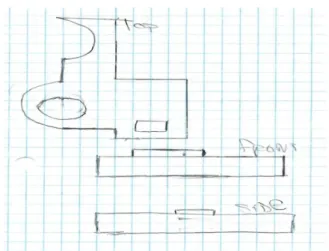
These types of discourses were predicated on a cognitive dissonance that necessitated cognitive negotiation. As students progressed in the task, both sides struggled to understand the other. The questions, comments, and directions all seemed predicated on a desire to be successful, but groups struggled to make their understanding clear to their teammates on the other side of the partition. Throughout the process, teams built a common understanding, resolved their cognitive dissonance, and completed the task or they did not build that common understanding and failed to complete the task. The post-test was used to confirm the structure of the development of the discourses identified in the pretest. However, because 3-D activities included STEM disciplinary language development to learn the 3-D design and printing, students were equipped with a new language to communicate their ideas. Students did not practice describing shapes nor were they trained to listen and draw. The activities were completely on the computer and students generally worked independently except when one student asked another for help. While technical discourse and procedures were not eradicated, the activity was permeated with a new vocabulary (See Appendix). The glossary of vocabulary terms was developed in relation to learning to use the tools in Google SketchUp®. The tools performed specific tasks and were used to complete their 3-D designs and to print an object. The tools built an understanding of how complex shapes can be drawn, and they transferred that understanding to the AS-STEM task (see Figure 4). The glossary contains the words that were used most often by students who satisfactorily completed the drawing task on the post-test (see Appendix).
The academic language students already possessed underwent a transformation. That transformation followed a seemingly predictable and traceable path. There were aspects of development transformed through a syntactic change. That change in syntax can be seen in the posttest descriptions, “Draw a semi-circle with a 4.5 cm radius. At the circumference draw one line 9 cm opposite the curve on each side. The lines should be parallel. The picture should look like a popsicle stick.”; “On the surface extrude a .5 cm rectangle 2.5 cm from the right edge.” Students had developed a sequence of ideas and organized those ideas into a meaningful and interpretable set of directions that resembled the types exhibited by the experts in the field. The syntax had changed. This change was termed syntactic reformation. As part of their STEM language development, students had reformed their syntactic structure to provide directions that could lead to the generation of an admissible drawing of a fairly complex shape. The syntax was not the only aspect of the language that had undergone change.
Figure 4. 3-D Printed Object Example & Post-test drawing
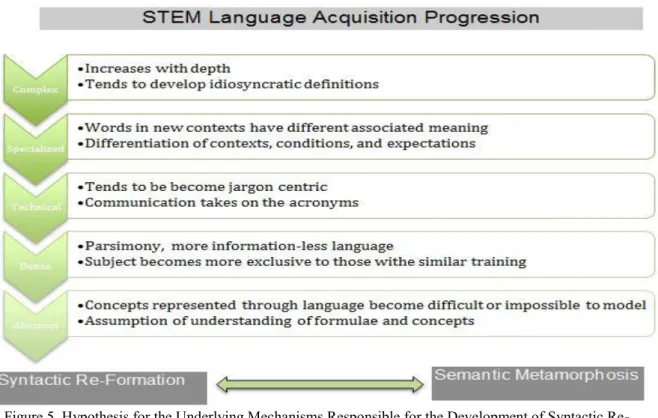
In combination, syntactic re-formation and semantic metamorphosis developed a new model through which a better understanding of how STEM language emerges can be gained. That emergence is not explained from the data, but a reasoned hypothesis can be offered. We suspect that STEM Language Acquisition Progression is related to several factors already reported in other studies. As language emerges it becomes more complex, specialized, technical, dense and abstract (de Silva Joyce & Feez, 2015; Schleppegrell & Feng, 2010) as students progress through any content. For example, as young children develop formal language they learn the alphabet and then the letter sounds, and then blends and so on until they learn about nuances of parts of speech and paragraph organization. In mathematics, students learn about counting numbers but quickly need another number system, so they only exist in the abstract. At the complexity stage, special definitions arise and contexts necessitate associated meanings. With regard to specialized language development, words within contexts have specific associated meanings and context specific conditions, and expectations for conduct within the subject arise. The technical aspects add jargon and shorthand representations, and communication can include acronyms used as words. The density becomes exclusive and elite. The communication takes on greater parsimony with more information being conveyed through less language. Finally, the abstractness makes representation less likely with greater reliance on assumptions, formulae, and concepts that in turn lay the foundations for new discovery (see Figure 5). It is the natural progression that results in the changes we observed in both the syntax and semantics of the STEM language registry.
Discussion
Figure 5. Hypothesis for the Underlying Mechanisms Responsible for the Development of Syntactic Re-Formation and Semantic Metamorphosis
The benefit of understanding the development of STEM language development lies in the interaction of terminological inexactitude model and STEM Language Acquisition Progression. Perhaps students are cognizant of the inexactness of their ability to describe a process and their struggles with enacting those descriptions. The realization of that inexactness might lead to increased effort to learn a new task that they believe could improve their performance. While they were not told that the activities would improve their abilities on the task, the obvious connections could not be masked, and students could draw reasonable parallels.
Researchers and professional development providers should consider how inquiry based activities, STEM project based learning, and other similar activities can lead to the development of integrated and meaningful STEM language. The purposeful creation of vocabulary and its explicit discussion and comparison to words and their uses across disciplines can aid in deeper and more cross-curricular academic success. Classroom teachers who wish to implement STEM teaching and learning should understand the development of STEM language as an essential component for successful learning and be attentive to the issues that can arise that might be miss-attributed to limited achievement when the reality is that the lack of language development might be the actual problem. The context, informal STEM camp, cannot be divorced from the findings. The informal setting places a certain level of independence on student learning and co-dependence while working on teams to accomplish the tasks. This unique vacillation between in- and inter- dependence may function to foster motivation to help each other. Therefore, this informal environment creates unique setting where the observed outcomes manifested over a shorter period of time than they might in a formal setting. In the formal setting long periods of independent work is expected with little inter-dependence. The lack of inter-dependence may be responsible for a lack of accountability to each other in accomplishing a task. Therefore, the potential for informal educational opportunities to greatly enhance student preparedness for formal settings is promising.
References
.Bailey, A. L. (2007). The language demands of school: Putting academic English to the test. New Haven, CT: Yale University Press.
Barnett, M. D., Sonnert, G., & Sadler, P. M. (2014) Productive and ineffective efforts: How student effort in high school mathematics relates to college calculus success. International Journal of Mathematical
Barton, A. C., & Tan, E. (2010). “It changed our lives”: Activism, science, and greening the community. Canadian Journal of Science, Mathematics and Technology Education, 10(3), 207-222. Capraro, R. M., Capraro, M. M., & Rupley, W. H. (2010). Semantics and syntax: A theoretical model for how
students may build mathematical mis-understandings. Journal of Mathematics Education, 3(2),58-66. Capraro, R. M., Capraro, M. M., & Rupley, W. H. (2011). Reading-enhanced word problem solving (REPS): A
theoretical model. European Journal of Psychology of Education, 27(1), 91-114. DOI: 10.1007/s10212-011-0068-3
Creswell, J. W. (2007). Qualitative inquiry and research design: Choosing among five approaches (2nd ed.). Thousand Oaks, CA: Sage.
Cummins, J. (1979) Cognitive/academic language proficiency, linguistic interdependence, the optimum age question and some other matters. Working Papers on Bilingualism, 19, 121-129.
de Silva Joyce, H., & Feez, S. (2015). Exploring Literacies: Theory, Research and Practice. Palgrave Macmillan.
Denzin, N. K., & Lincoln, Y. S. (2005). The Sage handbook of qualitative research (3rd ed.). Thousand Oaks, CA: Sage.
Duran, M., & Sendag, S. (2012). A preliminary investigation into critical thinking skills of urban high school students: Role of an IT/STEM program. Creative Education, 3(2), 241-250.
Elffers, L. (2012). One foot out the school door? Interpreting the risk for dropout upon the transition to post-secondary vocational education. British Journal of Sociology of Education, 33(1), 41-61.
Fang, Z. (2012). Language correlates of disciplinary literacy. Topics in Language Disorders, 32(1), 19-34. Finnie, R. (2012). Access to post-secondary education: The importance of culture. Children and Youth Services
Review, 34(6), 1161 1170. doi:10.1016/j.childyouth.2012.01.035
Fortus, D., Krajcik, J., Dershimer, R. C., Marx, R. W., & Mamlok-Naaman, R. (2005). Design- based science and real-world problem-solving. International Journal of Science Education, 27, 855-879.
Gatenby, E. V. (1948). Reasons for Failure to Learn a Foreign Language (Part I). ELT Journal, 2(4), 102-106. Glaser, B. G., & Strauss, A. L. (1967). The discovery of grounded theory: Strategies for qualitative research.
New Brunswick, N.J.: Transaction Publishers.
Godwin, A., Rupley, W., Capraro, R. M., & Capraro, M. M. (2016). Reading and mathematics bound together: Creating a home environment for preschool learning. Journal of Education and Learning, 5(1), 44-59. doi: http://dx.doi.org/10.5539/jel.v5n1p44.
Halliday, M. A. K. (2004). An introduction to functional grammar. London, UK: Arnold.
Herrera, C., DuBois, D. L., & Grossman, J. B. (2013). The role of risk: Mentoring experiences and outcomes for
youth with varying risk profiles. New York, NY: MDRC.
Hiraiwa, K., & Ishihara, S. (2012). Syntactic metamorphosis: Clefts, sluicing, and in-situ focus in Japanese.
Syntax, 15, 142–180. doi: 10.1111/j.1467-9612.2011.00164.x
Keim, J., McDermott, J. C., & Gerard, M. R. (2010). A community college bridge program: Utilizing a group program to promote transitions for Hispanic students. Community College Journal of Research and Practice, 34, 769-783.
Lesaux, N. K., Crosson, A. C., Kieffer, M. J., & Pierce, M. (2010). Uneven profiles: Language minority learners' word reading, vocabulary, and reading comprehension skills. Journal of Applied
Developmental Psychology, 31(6), 475–483.
Lee, K. A., Almonte, J. L. J., & Youn, M. J. (2013). What to do next: an exploratory study of the post-secondary decisions of American students. Higher Education, 66(1), 1-16.
Lin, W., Padmanabhan, G., Pieri, R., & Patterson, F. (2007). Experience with and lessons learned in a stem summer camp for tribal college students. Presented at the American Society for Engineering Education.
Retrieved from
://www.icee.usm.edu/ICEE/conferences/asee2007/papers/1867_EXPERIENCE_WITH_AND_LESSO NS_LEARNED_IN_A.pdf
Lovens, S. M. M., Gijbels, D., Coertjens, L., Cote, D. J. (2013) Students' approaches to learning in problem-based learning: taking into account professional behavior in the tutorial groups, self-study time, and different assessment aspects. Studies in Educational Evaluation, 39, 23-32.
Noyes, C. J. (1935). College Language and New Objectives*. The Modern Language Journal, 19(5), 325-336. Rupley, W. H., Capraro, R. M., & Capraro, M. M. (2011). Theorizing an integration of reading and
mathematics: Solving mathematical word problems in the elementary grades. Mind, Brain, and Education: Implications for Educators, 5, 227-250.
Satchwell, R. E., &. Loepp F. L (2002). Designing and implementing an integrated mathematics, science, and technology curriculum for the middle school. Journal of Industrial Teacher Education, 39, 41-66. Schleppegrell, M. J. (2004). The language of schooling: A functional linguistics. Canadian Journal of
Schleppegrell, M. J., & Fang, Z. (2010). Disciplinary literacies across content areas: Supporting secondary reading through functional language analysis. Journal of Adolescent & Adult Literacy, 53(7), 587- 597. Stake, R. E. (2005). Qualitative case studies. In N. K. Denzin & Y.S. Lincoln (Eds.), The Sage handbook of
qualitative research (3rd ed.). Thousand Oaks, CA: Sage.
Uccelli, P., Galloway, E. P., Barr, C. D., Meneses, A., & Dobbs, C. L. (2015). Beyond vocabulary: Exploring cross‐disciplinary academic‐language proficiency and its association with reading comprehension. Reading Research Quarterly, 50(3), 337-356.
Waldman, M. (1931). New Objective in Modern Language Teaching. The Modern Language Journal, 16(3), 232-244.
Author Information
Robert M. Capraro
Aggie STEM & Texas A&M University 4232 TAMU, College Station, TX 77843-4232 Contact e-mail: [email protected]
Luciana R. Barroso
Aggie STEM & Texas A&M University
Sandra Nite
Aggie STEM & Texas A&M University 4232 TAMU, College Station, TX 77843-4232
Devyn Rice
Aggie STEM & Texas A&M University 4232 TAMU, College Station, TX 77843-4232
Yvonna Lincoln
Aggie STEM & Texas A&M University 4226 TAMU, College Station, TX 77843-4226
Jamaal Young
University of North Texas
4232 TAMU, College Station, TX 77808
Jemimah Young
University of North Texas
4226 TAMU, College Station, TX 77843-4226
Appendix
Administration Procedure:
A. Team A of group 1 will be on the opposite side of visual partition from their counterpart Team A of group 2.
B. Team A of group 1 will be given a caliper and an item to describe to Team A of group 2 on the other side of the partition.
C. Team A of group 2 will then draw the front, side, and top views of the object to scale based on the directions given by Team A of group 1.
D. Team A of group 1 will not be able to see what Team A of group 2 is drawing
E. Either team may ask for clarification or specific questions about the description or progress of the drawing
F. Each period of description and drawing will last only 15 minutes
G. Once the task is complete the teams will switch roles and receive a new object.
Please contact the authors for a full list of objects.
The Glossary of Academic Vocabulary that Emerged as Part of the 3-D CAD Experience
Edge entity – Edges bound faces within geometry. The term edge and line are used interchangeably.
Entity – The smallest graphical building blocks. Entities are used to create geometry, which in turn, is used to create models.
Extrude – The action of thrusting out or growing a form.
Face entity – A planer entity bounded by 3 or more intersecting coplanar edges or lines. Geometry – The combination of 3 or more entities.
Insertion point – The point where the cursor will grab and insert the component in to a model from the Components browser
Layer – Layers are used to control the visibility of geometry within large models. A layer is an attribute with a name, such as 'Layer0,' 'Layer9,' or 'Chairs’. Elements can be assigned different layers.
Model – The object in its entirety.
Origin – The point where the drawing axes intersect or 'originate.'
Perspective – A distortion of the camera angle such that it represents the model as though you were standing at a fixed position and looking at it without moving (certain items appear closer while other items appear to be far away; entities are not to scale).
Plane – A flat or level surface. Point of view – The user's view of the model
Pulling – The process of reshaping your model by shrinking a portion of your model back toward its starting point along a single axis.
Pushing – The process of reshaping your model by expanding a portion away from its starting point and along a single axis.
Segment – A segment is a single line that, when combined, form an arc, circle, or polygon. The more segments an entity has, the smoother it appears.
Solid – Any 3D model (component or group) that has a finite closed volume. Surface – A series of joined faces.