Australian Journal of Basic and Applied Sciences
ISSN:1991-8178Journal home page: www.ajbasweb.com
Corresponding Author: Siti Zulaiha Ahmad, Faculty of Computer and Mathematical Sciences, Universiti Teknologi MARA Perlis
E-mail: [email protected]
Enhanced Interactive Mathematical Learning Courseware Using Mental Arithmetic for
Preschool Children
Siti Zulaiha Ahmad, Noor Asmaliyana Ahmad, Arifah Fasha Rosmani, Umi Hanim Mazlan, Mohammad Hafiz Ismail
Faculty of Computer and Mathematical Sciences, Universiti Teknologi MARA Perlis
A R T I C L E I N F O A B S T R A C T Article history:
Received 30 September 2014 Received in revised form 17 November 2014 Accepted 25 November 2014 Available online 6 December 2014
Key words:
Interactive Mathematical Learning Courseware 2.0 (iMLc2.0) is an enhanced version of multimedia application which aims to expose the pre-school children in mental arithmetic technique with; i) larger range of numbers, ii) implementation of standard written method and, iii) video support to visualize both techniques. The application integrates all multimedia elements and mental arithmetic techniques in interactive and supportive ways which are suitable for pre-school children. It is divided into three modules, addition, subtraction, and quizzes. The addition operation has been designed to apply the finger-brain approach which is a part of mental arithmetic technique while, mental-imagery approach is adapted for subtraction operation. Experimental test and user acceptance test have been conducted to evaluate the application. The implementation of iMLC2.0 in enriched interactive multimedia environment can be used as additional teaching and learning tool since it is supportive and attractive. In addition, it can motivate the preschooler to be prepared for future mathematical learning.
© 2014 AENSI Publisher All rights reserved. To Cite This Article: Siti Zulaiha Ahmad, Noor Asmaliyana Ahmad, Arifah Fasha Rosmani, Umi Hanim Mazlan, Mohammad Hafiz Ismail., Enhanced Interactive Mathematical Learning Courseware Using Mental Arithmetic for Preschool Children. Aust. J. Basic & Appl. Sci., 8(21): 18-24, 2014
INTRODUCTION
The process of learning mathematics, such as numbers and basic operations like addition and subtraction, takes a long time to build for new learners, especially for preschoolers. Some of them found it hard to memorize the numbers and the mathematical concepts even though they already knew and understood them. Technology and computer are main aspirations and they are now integrated in education curriculums (Ktoridou, D., et al., 2005).
With the evolution of computer technology, learning of mathematics for pre-school children can be improved. With the help of multimedia tools, their attention and interest can be developed. Furthermore, children nowadays are already exposed to computer at an early age.
Multimedia is an interactive computer-based environment with the combination of texts, voices, pictures and animations (Weiss, I., et al., 2006). Thus the teachers can teach more consistently and effectively by using it as an alternative teaching tool. This is different from the traditional method, where only the exercise book is used as their single source in learning mathematics due to lack of tools. This results a boring environment and causing children to lose their focus.
Mental Arithmetic Technique can help children to build cognitive thinking when they need to use mental representations and fingers in order to do basic operation exercises. With the support of multimedia, their imagination of the mathematical concepts can be at enhanced. This improves their performance and allows them to be more active and excited due to the utilization of multimedia combination elements during learning sessions.
Literature Review:
Mental Arithmetic Technique:
Mental arithmetic can be defined as the action of adding numbers together, multiplying them and other mathematical operations by using the brain, without the involvement of writing or the use of calculators (Longman, 2011). This technique is usually used in mathematical operations such as simple addition, subtraction, multiplication, and division.
Mental arithmetic is also one of the methods that use the movement of fingers for counting numerical values (Wu, S.S., et al., 2008; Klein, E., et la., 2011) as well as the working brain. A previous study proved that children move their real fingers to start the counting process after they build their imagination in the brain (Cheah, B.L., S.L. Ong, 2006). In addition, a study on introductory of mental arithmetic using simple application has shown a significant improvement in basic mathematic addition operation (Ahmad, S.Z., et al., 2010). Therefore in this study, we would like to apply mental arithmetic with a large range of numbers using standard written method.
Children’s Cognitive Thinking:
Every child develops their learning preference along mental process simultaneously in day-to-day activities. Cognitive or mental processes are the processes of recognizing, understanding, and learning something (Longman, 2011). The evolution of technology become as a catalyst towards development of children’s cognitive thinking and skill to enable them progresses well in learning process.
Furthermore, cognitive skills in children can be sharpened through interaction and communication with computers (Gelderblom, H., P. Kotze, 2008). Based on Piaget’s Theory, children around five to eight years old are able to obtain the skills regarding objects, events, people, and use the symbols to imagine and represent real life and some examples are the symbols of words, numbers, and images. Therefore, children can establish their cognitive thinking and build mental representations when learning sessions are supported with multimedia elements such as sound, audio, video, images, graphics, and animations.
Multimedia:
Multimedia is defined as the interactive computer-base, which is included with the texts, images, audio, video, and animations (Weiss, I., et al., 2006; Ahmad, S.Z., et al., 2010; Shujuan, Z., et al., 2010; Segers, E., et al., 2008) The use of multimedia is able to attract the children’s interest and attention towards learning mathematics.
Elements in Multimedia:
An interactive multimedia is composed of many elements that are important to deliver attractive prototype to children’s learning. Animation is primarily used to illustrate the ideas and concepts. At an early age, children usually like to learn from the moving images because of their characters, which are attractive and motivating (Betrancourt, M., A. Chassot, 2008). Animation is essential to improve understanding and brings out the interests of young learners (Betrancourt, M., A. Chassot, 2008; Fang, H., et al., 2009). Next, video is an alternative element that could provide better visualization on specific activity. In any instructional courseware we need to match learning preferences with different types of multimedia instruction in order to provide easy-manage learning environment (Zaidel, M., X. Luo, 2010).
Images or graphics are considered to be part of multimedia where creativity and imagination are needed in a learning session. Basically, the use of graphics can help to sharpen memory [11] and stimulate mental model representations (Betrancourt, M., A. Chassot, 2008; Ali, B.B., H.Z. Badioze, 2006).
The audio or sound also assists the children to give optimum attention and provides a way to learn mathematical concepts or terms from the oral speech. The implementation of sound can improve learning and pronunciation skills after listening to the spoken explanation (Ali, B.B., H.Z. Badioze, 2006). Besides that, text is one of the important element in providing interaction and information as well as an effective way to communicate (Segers, E., et al., 2008).
Methodology:
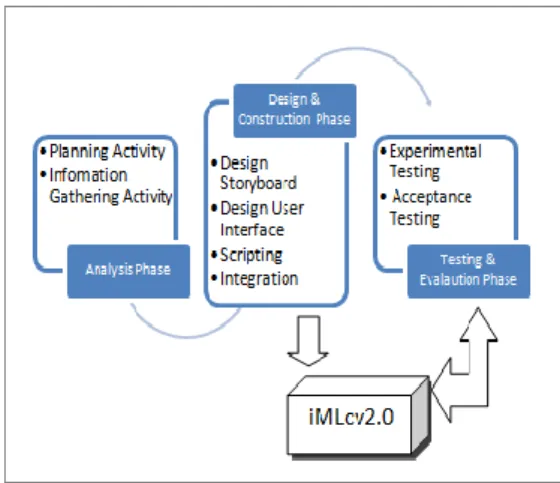
The study was conducted by applying research model as depicted in Fig. 1. The activities have been subdivided into three main phases: - Analysis, Design & Construction and Testing & Evaluation.
Analysis Phase:
observation was focused on the implementation of mathematic class, children behavior and their reaction towards learning process.
Design and Construction Phase:
The second phase consists of two main activities: design and construction. Design activity involved storyboard design process by sketching interface design concept on a paper. It is based on the information gathered from the previous stage. The following process was designing user interface that incorporated multimedia elements such as graphics, sounds, texts, animations and videos using Adobe Flash, Adobe Photoshop and Adobe Illustrator software. Those elements were specifically chosen to stimulate the children’s learning experience and to entertain them. Next, the design was translated into multimedia application in a construction activity. Scripting and integrating the designed user interface were the main tasks of construction activity using Adobe Flash, Audacity and AVS Video Editor. iMLc2.0 was delivered as a multimedia application prototype.
Testing and Evaluation Phase:
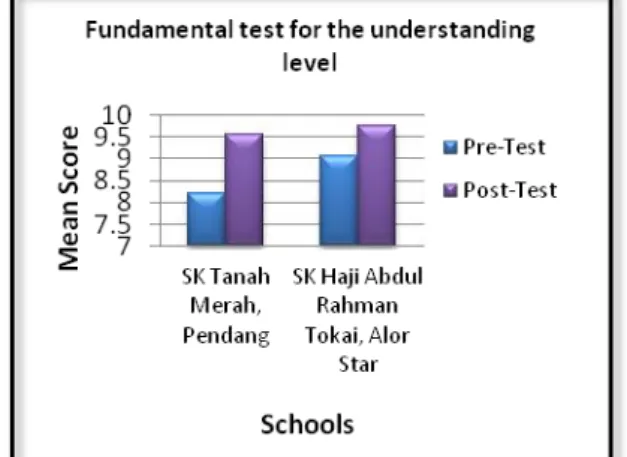
The final phase involved a series of testing and evaluation processes. The prototype was tested using usability testing and some refinements on the prototype were done based on the users’ comments. Next, experimental testing was conducted to measure the children’s performance which consist of Pre-Test and Post-Test evaluation. In Pre-Post-Test session, the children were tested with mathematic question using normal learning process while during the Post-Test session, they had to answer a different set of question by applying mental arithmetic learning process. In order to assess courseware’s acceptability among the targeted audiences, an acceptance test was conducted with kindergarten teachers. They were given a set of acceptance test questionnaires consist of 13 Likert Scale Based questions. The result was then analyzed to determine the acceptance rate of the application.
Fig. 1: Research Model
Courseware Architecture:
The courseware consists of three main menus: 1) Number, 2) Operation, and 3) Activity modules. The content has been enhanced in all aspects including the design, the interaction approach and the range of number. Fig. 2 shows the architecture of Interactive Mathematical Courseware application.
Number:
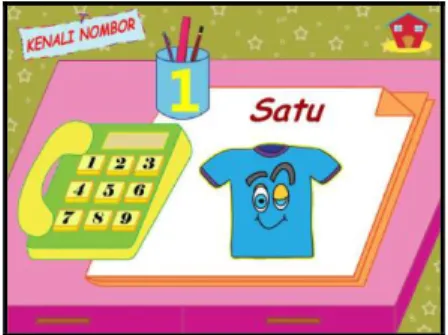
Number menu consists of Number Introduction sub menu as shown in Fig. 3. The children can learn starting from number one until number nine. It is also provided with the animation object and spelling that represents the numbers. The interface design includes graphic that familiar to children environment in order to attract their attention.
Fig. 3: Number Introduction Interface
Operation:
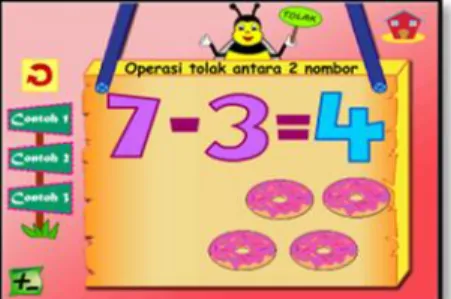
There are two sub menu involved in the operation menu of the application. They are addition and subtraction operation. Fig. 4a and Fig. 4b show the addition interface which applied mental arithmetic technique, provided with the video for addition process. In order to introduce larger range of number, we include an example as a tutorial shown in Fig. 4c which is blended with standard written method. In Fig. 5, the mental-imagery of subtraction shows the subtraction operation interface. It implemented object animation with narration to visualize the substraction process in three different range of number examples.
Fig. 4a: Addition Operation Interface with video assistance
Fig. 4b: Addition Operation Interface
Fig. 5: Subtraction Operation Interface
Activity:
There are two sub menu involved in the operation menu of the application. They are addition and subtraction operation. Fig. 4a and Fig. 4b show the addition interface which applied mental arithmetic technique, provided with the video for addition process. In order to introduce larger range of number, we include an example as a tutorial shown in Fig. 4c which is blended with standard written method. In Fig. 5, the mental-imagery of subtraction shows the subtraction operation interface. It implemented object
Activity menu consists of three different sub menus which are matching numbers, addition quizzes and subtraction quizzes. The concepts that were applied in the activity menu are drag and drop, perfect choice and writing concept. One of the activities is shown in Fig. 6, number matching activity, which uses drag and drop concept. Fig. 7 shows other activity to strengthen mental arithmetic skill in order to solve addition operation.
Fig. 6: Drag and Drop Interface: Number matching
Fig. 7: Drag and Drop Interface: Reinforcement of mental arithmetic skill
Finding and discussion:
Fig. 7: Comparison of understanding level for pre-test and post-test
Fig. 8: Comparison of time taken using two different methods
User Acceptance Test was conducted with preschool teachers in order to determine the confidence level of end users of the application and to ascertain whether it can be accepted as a teaching tool in preschool. They were given time to explore the application before answering a set of questionnaires that covers four criteria. They are Perceived Ease Use (PEU), Perceived Usefulness (PU), Attitude (ATT), and Intention to Use (BI). Mean score for all criteria were calculated and plotted into a bar chart as shown in Fig. 9 below. The highest total mean score is BI, which is 5.00 where all participants strongly agreed to adopt the application in future as a teaching aid. The total mean score for PEU is 4.63 where most of the participants agreed that the application was easy to use (user friendly) and learnable. The total mean for PU is 4.71 which reveals that the application is useful to attract children’s interest and attention. The total mean score for ATT is 4.67, which means that users are more likely to use the application because it uses multimedia elements.
Conclusion:
The main contribution in this research is more towards enhancing the interaction design and problem solving technique of the previous application (Ahmad, S.Z., et al., 2010) which are the utilization of multimedia elements (video and text animation) and content enrichment (larger range of number and standard written method). Based on this study, it can be summarized that the iMLC2.0 application was successfully accepted to be used in teaching and learning mathematics in preschool.
The inclusion of video element enable the children to increase understanding in mental arithmetic technique as they can visualize it better compared to the utilization of animations, text and sound alone. The result proved that learning mathematics through multimedia application can increase the fun and interest during the learning session. Yet, it could improve their mathematical skill in addition and subtraction operations.
The application achieves its target to be a helpful tool in improving users’ performance and sharpening their cognitive thinking. In addition, this technique could be implemented in different school levels: pre-school, primary school (lower and higher level) and secondary school. However, the approach might be different for each level.
In conclusion, this application achieves the objectives of this research, where an Interactive Mathematical Learning Courseware was designed and developed by adapting suitable multimedia elements such as text, graphics, animation, sound, and video. The implementation of mental arithmetic technique and standard written method were successfully introduced in the application. Our next research paper will be focusing specifically on instructional design diversity and its effectiveness in implementing mobile iMLc.
REFERENCES
Ahmad, S.Z., A.F. Rosmani, M.H. Ismail and M.S. Suraya, 2010. An Introductory of Mental Arithmetic Using Interactive Multimedia. Computer and Information Science, 3(4): 72-79.
Ali, B.B., H.Z. Badioze, 2006. Framework of Adaptive Multimedia Mathematics Courseware. Proceeding of the 2nd IMT-GT Regional Conference on Mathematics, Statistics and Applications.
Betrancourt, M., A. Chassot, 2008. Making Sense of Animation: How Do Children Explore Multimedia Instruction? Cognitive Processes in Children’s Multimedia Text Learning, Applied Cognitive Psychology, 22: 375-387
Cheah, B.L., S.L. Ong, 2006. Perbandingan Kebolehan Menyelesaikan Masalah Matematik Antara Murid Yang Belajar Abakus-Aritmetik Mental Dengan Murid Yang Tidak Belajar Abakus-Aritmetik Mental. Jurnal Pendidik dan Pendidikan. Universiti Sains Malaysia, 21: 85-100.
Fang, H., X. Li, H. Helge, 2009. Research on Improving Learning Interests for Elementary Students Based-on Mental Mode by Using Mathematics AnimatiBased-ons.
Gelderblom, H., P. Kotze, 2008. Designing Technology for Young Children: What we can Learn from Theories of Cognitive Development. In Proceeding of SAICSIT ’08 (South African Institute of Computer Scientists and Information Technologists). 66-75.
Klein, E., K. Moeller, K. Willmes, H. Nuerk, F. Domahs, 2011. The influence of implicit hand-based representations on mental arithmetic. Frontiers in Psychology Cognition, 2: 1-7.
Ktoridou, D., N. Etekleous, G. Gregoriou, 2005. Preschoolers Developing Mathematical Understanding through Computer-Based Activities, pp: 787-790.
Longman, 2011. Longman Dictionary of Contemporary English Online, (Pearson Education Limited). Retrieved, from http://www.ldoceonline.com/
Mayer, R.E., 2003. The Promise Of Multimedia Learning: Using The Same Instructional Design Methods Across Different Media. Learning and Instruction, 13: 125-139.
Mayer, R.E., R. Moreno, 2002. Animation as an Aid to Multimedia Learning. Educational Psychology Review, 14(1): 87-99.
Segers, E., L. Verhoeven, N.-H Hulstijn, 2008. Cognitive Processes in Children’s Multimedia Text Learning. Applied Cognitive Psychology Journal., 22: 375-387.
Shujuan, Z., S. Wei, L. Zheng, H. Qibo, 2010. The Principles of Multimedia Teaching Design Based on Cognitive Load Theory. In 2010 2nd International Conference on Education Technology and Computer (ICETC). pp: 110-112.
Weiss, I., B. Kramarski, S. Talis, 2006. Effects of Multimedia Environments on Kindergarten Children’s Mathematical Achievements and Style of Learning. Educational Media International., 43(1): 3-17.
Wu, S.S., M.L. Meyer, U. Maeda, V. Salimpoor, S. Tomiyama, D.C. Geary, 2008. Standardized Assessment of Strategy Use and Working Memory in Early Mental Arithmetic Performance. Developmental Neuropsychology, 33(3): 365-393.