S T U D Y P R O T O C O L
Open Access
Study protocol: E-freeze - freezing of
embryos in assisted conception: a
randomised controlled trial evaluating the
clinical and cost effectiveness of a policy of
freezing embryos followed by thawed
frozen embryo transfer compared with a
policy of fresh embryo transfer, in women
undergoing in vitro fertilisation
Abha Maheshwari
1*†, Siladitya Bhattacharya
2†, Ursula Bowler
3†, Daniel Brison
4†, Tim Child
3†, Christina Cole
3†,
Arri Coomarasamy
5†, Rachel Cutting
6†, Stephen Harbottle
7†, Pollyanna Hardy
8†, Edmund Juszczak
3†,
Yacoub Khalaf
9†, Jennifer J. Kurinczuk
3†, Stuart Lavery
10†, Clare Lewis-Jones
11†, Nick Macklon
12†,
Nick J. Raine-Fenning
13†, Madhurima Rajkohwa
14†, Graham Scotland
1†and Stephen Troup
15†Abstract
Background:Infertility affects one in seven couples; many of these need in vitro fertilisation (IVF). IVF involves external hormones to stimulate a woman’s ovaries to produce eggs which are harvested surgically. Embryos, created in the laboratory by mixing eggs with sperm, are grown in culture for a few days before being replaced within the uterus (fresh embryo transfer). Spare embryos are usually frozen with a view to transfer at a later point in time–especially if the initial fresh transfer does not result in a pregnancy. Despite improvements in technology, IVF success rates remain low with an overall live birth rate of 25–30% per treatment. Additionally, there are concerns about health outcomes for mothers and babies conceived through IVF, particularly after fresh embryo transfer, including maternal ovarian hyperstimulation syndrome (OHSS) and preterm delivery. It is believed that high levels of hormones during ovarian stimulation could create a relatively hostile environment for embryo implantation whilst increasing the risk of OHSS. It has been suggested that freezing all embryos with the intention of thawing and replacing them within the uterus at a later stage (thawed frozen embryo transfer) instead of fresh embryo transfer, may lead to improved pregnancy rates and fewer complications. We aim to compare the clinical and cost effectiveness of fresh and thawed frozen embryo transfer, with the primary aim of identifying any difference in the chance of having a healthy baby.
(Continued on next page)
© The Author(s). 2019Open AccessThis article is distributed under the terms of the Creative Commons Attribution 4.0 International License (http://creativecommons.org/licenses/by/4.0/), which permits unrestricted use, distribution, and reproduction in any medium, provided you give appropriate credit to the original author(s) and the source, provide a link to the Creative Commons license, and indicate if changes were made. The Creative Commons Public Domain Dedication waiver (http://creativecommons.org/publicdomain/zero/1.0/) applies to the data made available in this article, unless otherwise stated.
* Correspondence:[email protected] †All authors contributed equally to this work. 1University of Aberdeen, Aberdeen, UK
(Continued from previous page)
Methods:E-Freeze is a pragmatic, multicentre two-arm parallel group randomised controlled trial where women aged≥18 and < 42 years, with at least three good quality embryos are randomly allocated to receive either a fresh or thawed frozen embryo transfer. The primary outcome is a healthy baby, defined as a term, singleton, live birth with appropriate weight for gestation. Cost effectiveness will be calculated from a healthcare and societal perspective. Discussion:E-Freeze will determine the relative benefits of fresh and thawed frozen embryo transfer in terms of improving the chance of having a healthy baby. The results of this pragmatic study have the potential to be directly transferred to clinical practice.
Trial registration:ISRCTN registry:ISRCTN61225414. Date assigned 29/12/2015.
Keywords:IVF, Fertility, Frozen thawed embryo transfer, Fresh embryo transfer, OHSS, Elective freezing, Assisted conception, Receptivity
Plain English summary
Infertility is common, affecting one in seven couples in the UK, many of whom will ultimately need in vitro fertil-isation (IVF). IVF involves several steps; initially hormones are used to stimulate the woman’s ovaries to produce eggs, which are then removed through a surgical procedure. Next, embryos are created in the laboratory by mixing eggs with sperm. In conventional IVF, these embryos are grown for a few days before the best available embryo is placed inside the uterus in a process known as fresh em-bryo transfer. Any spare emem-bryos are then usually frozen.
Despite improvements in technology, IVF success rates remain low and there are associated risks to women and babies. It is thought that the high levels of hormones used to stimulate a woman’s ovaries to produce eggs could create a relatively hostile environment for the em-bryo within the uterus. Freezing emem-bryos and placing them in the uterus at a later stage may lead to improved pregnancy rates and fewer complications. This study aims to compare fresh and thawed frozen embryo trans-fer, with the main aim of identifying any differences in the chances of having a healthy baby as well as differ-ences in costs. The study will be available to couples at selected fertility centres across the UK.
Background
The National Institute for Health and Care Excellence (NICE) recommends IVF as the definitive treatment for prolonged unresolved infertility [1]. IVF involves several steps. Initially, hormones are used to stimulate a woman’s ovaries to produce eggs which are harvested surgically. Next, embryos are created in the laboratory by mixing eggs with sperm. In conventional IVF these are grown in culture for a few days before being replaced within the uterus by a process known as fresh embryo transfer. Spare embryos are usually frozen with a view to transfer at a later point in time–especially if the initial fresh transfer does not result in a pregnancy. Despite improvements in technology, IVF success rates remain low with an overall live birth rate of 25% per treatment. Additionally, there
are concerns about health outcomes for mothers and ba-bies conceived through IVF, particularly after fresh em-bryo transfer, including maternal ovarian hyperstimulation syndrome (OHSS) and perinatal morbidity.
A possible cause for sub-optimal live birth rates as well as adverse maternal and perinatal outcomes follow-ing IVF is the impact of exogenous hormones used for ovarian stimulation on the lining of the uterine cavity. High levels of oestrogen produced by the ovary in re-sponse to this treatment affect uterine receptivity, redu-cing the chances of successful implantation and placentation. It has been suggested that avoiding embryo transfer at a time when the uterus is less receptive could improve success rates. Such a strategy also reduces the risk of OHSS by ensuring that a pregnancy does not occur in the presence of hyperstimulated ovaries.
Preliminary data from small randomised trials from Iran [2] and the USA [3,4] suggest that a strategy of not replacing embryos when they are created but freezing them followed by thawed frozen embryo transfer into the uterus at a later date improves pregnancy rates. A meta-analysis of data from these three RCTs [5] has shown higher pregnancy rates following thawed frozen embryo transfer (odds ratio 1.32, 95% CI 1.10 to 1.59).
However, these existing trials have a number of signifi-cant limitations:
They reported implausibly high pregnancy rates (e.g. 84% per embryo transfer), which are far in excess of those reported by national and international registries.
Key outcomes including healthy baby, live birth, costs, safety and acceptability were not measured by any of the trials.
They were limited in terms of design with highly selected populations, inadequate sample sizes and per protocol analysis rather than by intention-to-treat and conduct, since all involved
One of the publications [2] has been retracted on the grounds of serious methodological flaws. Hence, the current evidence base comprising two small trials of suboptimal quality is not sufficiently robust to support a radical change in clinical practice. Additionally, their re-sults cannot be directly applied to a UK setting due to very different regulatory and funding arrangements. There is, therefore, an urgent need to perform a defini-tive randomised controlled trial in the UK evaluating elective freezing of embryos followed by subsequent thawed frozen embryo transfer in terms of clinical and cost effectiveness.
A two-arm parallel group randomised controlled trial is proposed across multiple fertility centres in the UK. Women ≥18 and < 42 years of age undergoing their first, second or third IVF/ICSI treatment, with at least 3 good quality embryos will be randomised to either fresh em-bryo transfer (standard treatment arm) or thawed frozen embryo transfer, this typically will take place after 4 to 6 weeks and always within 3 months of egg retrieval (inter-vention treatment arm).
A single episode of thawed frozen embryo transfer (after elective freezing of embryos) will be compared to a single episode of fresh embryo transfer with a healthy baby (defined as a live singleton baby born at term with an appropriate weight for gestation) – the primary outcome.
With 90% power and a two-sided 5% level of statistical significance, we will need to randomise 1086 couples (543 in each arm) to show an absolute difference in the primary outcome of at least 9% (e.g. from 25 to 34%), between fresh and thawed frozen embryo transfer respectively.
A full economic evaluation will assess the costs and consequences of the new strategy compared with standard practice. The trial data will be combined with modelling to estimate the long-term costs of health and social care using a previously developed decision analytic model.
Methods/ design
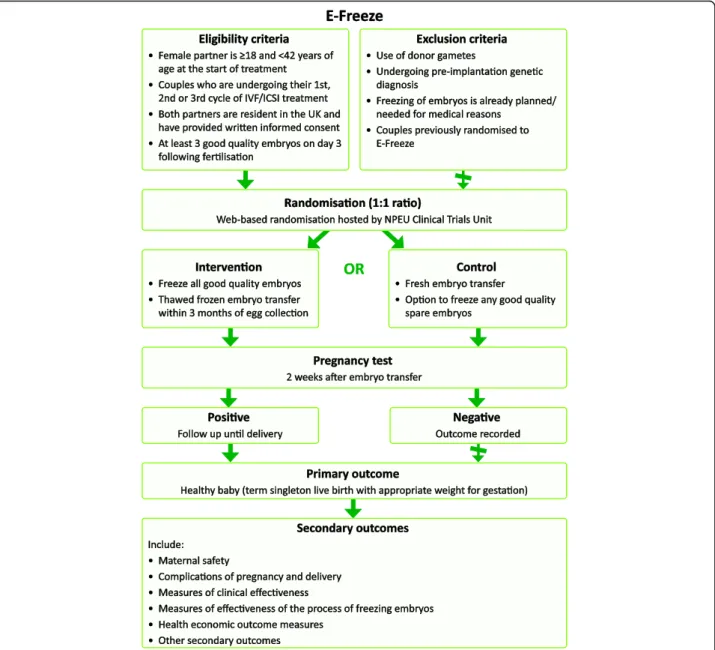
A pragmatic multi-centre two-arm parallel group rando-mised controlled trial to evaluate the effectiveness of a policy of freezing embryos followed by thawed frozen embryo transfer with a policy of fresh embryo transfer in women undergoing in vitro fertilisation will be con-ducted. All clinical elements of IVF treatment, apart from the randomised interventions, will be carried out according to local protocols. The trial design is sum-marised in Fig.1.
Number of participants
1086 couples undergoing their first, second or third cycle of IVF/ICSI treatment will be recruited from fertil-ity centres across the UK.
Inclusion criteria
The female partner is≥18 and < 42 years of age at the start of treatment (i.e. start of ovarian stimulation)
Couples who are undergoing their first, second or third cycle of IVF/ICSI treatment, where a cycle is defined as egg collection following ovarian stimulation.
Both partners are resident in the UK
Both partners are able to provide written informed consent
At least 3 good quality embryos (as defined by the Association of Clinical Embryologists, UK) on day 3 after egg collection (day of egg collection is counted as day 0). Good quality embryos on day 3 are defined as those with 6–8 cells grade 3/3 or above using the agreed national grading scheme [6].
Exclusion criteria
Couples using donor gametes
Pre-implantation genetic testing is being planned Elective freezing of all embryos is planned for
medical reasons (e.g. severe risk of OHSS) Couples previously randomised to E-Freeze
Primary outcome
The primary outcome is a healthy baby. A healthy baby is defined as a live singleton baby born at term (between 37 and 42 completed weeks of gestation) with an appropriate weight for gestation (weight between 10th and 90th centile for that gestation based on standardised charts).
Secondary outcomes
The secondary outcomes relate to maternal safety, compli-cations of pregnancy and delivery, measures of clinical ef-fectiveness, measures of effectiveness of the process of freezing embryos and health economic outcome measures.
Maternal safety outcome
Ovarian hyperstimulation syndrome (OHSS) – defined and classified as per the Royal College of Obstetricians and Gynaecologists’Green-top Guideline [7].
Complications of pregnancy and delivery outcomes
Vanishing twin or triplet (defined as either: more early fetal hearts detected than babies born, more gestational sacs than babies born or more gestational sacs than fetal hearts detected)
Miscarriage rate (defined as pregnancy loss prior to 24 weeks of gestation)
Termination
Gestational diabetes mellitus (GDM)
Multiple pregnancy (defined as more than one fetal heart or more than one gestational sac detected) Multiple births (including live and stillbirths) Hypertensive disorders of pregnancy (essential
hypertension, pregnancy induced hypertension, pre-eclampsia and pre-eclampsia)
Most severe hypertensive disorder (from least to worst: essential hypertension, pregnancy induced hypertension, pre-eclampsia and eclampsia) Antepartum haemorrhage (any bleeding per
vaginum after 28 weeks of pregnancy including placenta praevia and placental abruption)
Onset of labour (spontaneous, induced or planned caesarean section)
Mode of delivery for each baby (normal vaginal delivery, instrumental vaginal delivery or caesarean section)
Preterm delivery (defined as delivery at < 37 completed weeks)
Very preterm delivery (defined as delivery at < 32 completed weeks)
Low birth weight (defined as weight < 2500 g at birth)
Very low birth weight (defined as weight < 1500 g at birth)
Large for gestational age (defined as birth weight > 90th centile for gestational age at delivery, based on standardised charts) Small for gestational age (defined as birth
weight < 10th centile for gestational age at delivery, based on standardised charts) Congenital anomaly/birth defect (all congenital
anomalies/birth defects identified will be included) Perinatal mortality (stillbirth or late as well as early
neonatal deaths, up to 28 days after birth)
Measures of clinical effectiveness outcomes
Live birth rate (this is a live birth episode, i.e. twins will count as one)
Singleton live birth rate Singleton live birth rate at term
Singleton baby with appropriate weight for gestation Pregnancy rate (defined as positive pregnancy test at
two weeks +/−three days after embryo transfer) Clinical pregnancy rate (defined as the presence of
at least one fetal heartbeat at ultrasound between six and eight weeks of gestation; ectopic pregnancy counts as a clinical pregnancy; multiple gestational sacs count as one clinical pregnancy)
Measures of the effectiveness of the process of freezing embryos outcomes
Total number of embryos frozen, thawed and transferred for all randomised couples Proportion of thawed embryos that were then
transferred for all randomised couples Failure of all embryos to survive after thawing
leading to no embryo transfer
Health economic outcome measures
Cost to the health service of treatment, pregnancy and delivery care
Modelled long-term costs of health and social care, and broader societal costs
Other secondary outcomes
Evaluation of emotional state (for both the female and male partners) when they are advised of delay in embryo transfer in frozen arm
Study description
All couples embarking on their first, second or third cycle of IVF/ICSI or a combination of both, will receive a letter of invitation introducing the trial and a copy of the Participant Information Leaflet. This will be sent
with their clinic appointment. Participant Information Leaflets will also be distributed to couples attending an introductory patient information session, which will occur before their first clinic appointment. Eligible cou-ples will be invited by a clinician involved in their care to participate in the trial. They will have the opportunity to speak to a research nurse to ask questions.
Consent forms need to be signed by both partners sep-arately. This can be done at their clinic appointment or at a subsequent visit up until but prior to the procedure of egg collection, by an appropriately delegated member of the team. After consent, couples will each fill in a short questionnaire on how they are feeling emotionally. Each participant will seal their questionnaire in an enve-lope after completion and questionnaires will be destroyed unopened if the couple do not proceed to ran-domisation. Data needed for randomisation/minimisa-tion will be recorded by the consent and randomisarandomisation/minimisa-tion program. On the first day after egg collection the embry-ologist or research delegate will confirm consent during a routine phone call to the couple to discuss the out-come of fertilisation.
On the third day after egg collection couples with at least three good quality embryos will be randomised by the embryologist or research nurse to fresh or thawed frozen embryo transfer. Good quality embryos on day three are defined as those with 6–8 cells grade 3/3 or above using the agreed national grading scheme [6]. Couples will be informed of their randomisation alloca-tion by the embryologist or research delegate during their routine phone call on day three.
Couples who are randomised to thawed frozen embryo transfer will be contacted by the research nurse or research delegate within three working days post-randomisation to plan thawed frozen replacement treat-ment typically four to six weeks later and usually within three months of egg collection.
At embryo transfer (cleavage or blastocyst for fresh, or typically four to six weeks later for thawed frozen em-bryo transfer but usually within three months) couples will be asked to complete a short questionnaire to assess additional costs related to the treatment, and to repeat the emotions questionnaire they filled in at consent.
including stillbirth, congenital anomalies and perinatal mortality. Usually this information is provided to each IVF clinic by couples themselves. Alternatively, clinic staff con-tact couples by telephone to collect this information to re-port it back to the HFEA.
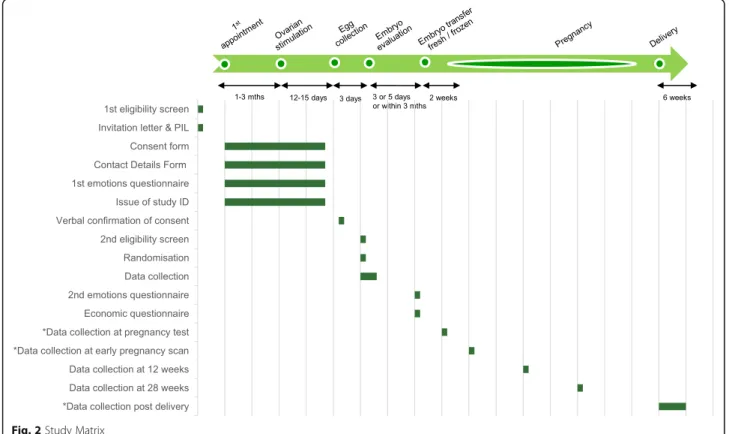
The participant pathway and data collection points are shown in the Study Matrix (Fig.2).
Ineligible and non-recruited participants
Details of all consenting couples will be entered on a dedicated secure online database. It is anticipated that a proportion of those consented may not proceed to ran-domisation; the reasons for this will be recorded (if available) including non-availability of three good quality embryos on day three. As part of routine practice, the embryologist contacts the couple by telephone to let them know how many eggs are fertilised (next day after egg collection, day one) and the quality of their embryos (on day three after egg collection). The embryologist or research delegate will confirm consent on day one and inform them whether or not they fulfilled the final inclu-sion criteria (at least three good quality embryos on day three) and which arm they have been randomised to at the time of their routine phone call on day three. The research nurse will then contact the couple if they have not fulfilled the inclusion criteria to answer any queries and offer follow-up in the clinic. Couples not proceeding to randomisation will be offered the most appropriate
standard treatment. All clinics have access to supportive counselling as a mandatory requirement of the regula-tory authority.
Randomisation
Randomisation will be performed after the creation of embryos, three days post egg collection. This will min-imise the randomisation-to-intervention time interval as embryos are either transferred at the cleavage or blasto-cyst stage. Once all eligibility criteria are established (in-cluding ensuring that three or more good quality embryos are available), women will be randomised (allo-cation ratio 1:1) to a strategy of either fresh embryo transfer or thawed frozen embryo transfer (typically four to six weeks later and usually within three months of egg collection).
Randomisation will be undertaken by the research nurse or a delegated member of the research team using a secure web-based centralised system (with 24/7 tele-phone backup 365 days/year) hosted by the National Perinatal Epidemiology Unit Clinical Trials Unit (NPEU CTU), University of Oxford. The randomisation will em-ploy a minimisation algorithm to balance across the fol-lowing factors: fertility clinic, woman’s age (at the time of start of treatment i.e. ovarian stimulation), primary/ secondary infertility, self-reported duration of infertility, method of insemination (IVF/ICSI or a combination of both) and number of previous egg collections (cycles).
Treatment allocation
Blinding of the allocated intervention is not possible in this trial because of the nature of the treatments and statutory requirements of the regulatory body–the HFEA. Discus-sion with the couple about the time and day of embryo transfer is routinely conducted over the telephone on the third day after fertilisation of eggs in the laboratory in all IVF clinics as part of routine care. A member of the IVF la-boratory (embryology) team or research delegate will in-form consented eligible couples on day three of the outcome of randomisation over the telephone.
The process will be as follows:
Standard care arm: Women will undergo fresh embryo transfer at the cleavage or blastocyst stage according to local protocols.
Intervention arm: All good quality embryos will be frozen according to local protocols. Women will be contacted by their research nurse after
randomisation and arrangements will be made for thawed frozen embryo transfer (typically this takes place within 4 to 6 weeks and usually within three months of the egg retrieval process). This will involve a few visits to hospital to prepare the endometrium.
Withdrawal procedures
Couples will be able to withdraw their consent to take part in the trial at any time without giving a reason. Withdrawal from the intervention/study will not affect their ongoing care. Non-adherence to the allocated intervention may also occur; this is defined as a differ-ence between the treatment allocation provided at ran-domisation and the allocation received by the woman at the time of embryo transfer. Non-adherence to the allo-cated intervention may occur if the clinician feels it is in the couple’s best interests, e.g. freezing all created em-bryos is necessary for medical reasons, or transferring fresh embryos for clinical reasons. In the case of a non-adherence to the allocated intervention, the couple, with their on-going consent, would continue to be part of the trial, with outcome data collected in the routine manner.
Safety reporting
Foreseeable serious adverse events (SAEs) are those events which are expected in the patient population or as a result of the routine care/treatment of a patient. Foreseeable SAEs will be collected on the electronic Case Report Form (eCRF) as part of routine data collec-tion. The following events are foreseeable in women or couples undergoing IVF treatment and as such do not require reporting as SAEs.
Foreseeable events relating to the female partner, or couple:
Ovarian hyperstimulation syndrome (OHSS) Miscarriage
Hypertensive disorders of pregnancy Antepartum haemorrhage
Gestational diabetes mellitus (GDM) Multiple pregnancy
Failure of any embryos to survive thawing
Foreseeable events relating to the baby, when born:
Low birth weight Very low birth weight Large for gestational age Preterm delivery Very preterm delivery Small for gestational age
Unforeseeable serious adverse events
An unforeseeable SAE is any event that meets the defin-ition of a SAE and is not detailed in the list above as foreseeable. The following unforeseeable SAEs must be reported:
Maternal death Stillbirth
Congenital anomaly detected antenatally or postnatally
Neonatal death
Unforeseeable SAEs will be reported up to six weeks post-delivery.
Data collection
Data for both clinical and economic outcomes will be collected using bespoke electronic case report forms (eCRFs) and entered directly into the trial’s OpenClinica electronic database by the IVF centre’s research staff. Data will be single-entered and at the point of entry the data will undergo a number of validation checks to ver-ify the validity and completeness of the data captured.
Sample size calculation
The proposed primary outcome for this trial is novel and is not currently reported by IVF clinics or national regulatory bodies. This means that a number of assump-tions have been made in order to determine the ex-pected event rate in the control arm (receiving current standard treatment), which may in turn result in a de-gree of imprecision in the estimate.
of all women undergoing one episode of IVF treatment involving a fresh embryo transfer have a live birth, and 20% have singleton live births. These figures are for women of all age groups, not necessarily for women ful-filling the inclusion criteria for this trial in terms of the number of good quality embryos in their IVF cycle. No data are available regarding the healthy baby rate (live singletons born between 37 and 42 weeks with appropri-ate weight for gestation), the primary outcome for this study. For our trial population we anticipate that the control arm event rate is likely to be less than 25%, pos-sibly as low as 17%. Although the live birth rate is ex-pected to be higher in women with at least three good quality embryos (likely to have a better prognosis), we anticipate that the healthy baby rate in our trial popula-tion will be towards the lower end of the confidence interval, around 25%, taking into account the higher risk of preterm delivery and small for gestational age babies following IVF [9].
The following assumptions have been made for the sample size calculation
We have assumed a healthy baby rate of between 17% and 25% in women eligible for the trial (age under 42 years with three good quality embryos) undergoing standard care (fresh embryo transfer). Taking into ac-count the extra time, effort and potential expense in-volved in freezing embryos and the delay in embryo transfer of up to three months, a panel of clinicians across the UK agreed that the strategy of freezing em-bryos would be considered clinically effective if the per-centage of women having a healthy baby is increased by at least 8% in absolute terms. With 90% power and using a two-sided 5% level of statistical significance, we will need to randomise a total of 1086 couples (543 in each group) in order to be able to detect an absolute differ-ence of 8% from 17% to 25% and 9% from 25% to 34% in the healthy baby rate, between fresh embryo transfer and transfer of thawed frozen embryos. The difference detectable differs slightly depending on the event rate in the standard care group, which will be reviewed period-ically by the Data Monitoring Committee (DMC).
It is a regulatory requirement for clinics in the UK to report live birth outcomes (including number, weight, gestation and gender) to the HFEA after all embryo transfers i.e. there will be no loss to follow-up. There-fore, we have not taken into account loss to follow-up for these sample size calculations. It is anticipated that a proportion of those consented may not reach random-isation (e.g. those not having three good quality day three embryos or requiring all embryos to be frozen for medical reasons); therefore a higher number will need to be consented.
Analysis
A detailed Statistical Analysis Plan (SAP) will be devel-oped and agreed by the Trial Steering Committee (TSC) before the analysis is undertaken. The analysis and pres-entation of results will follow the most up-to-date rec-ommendations of the CONSORT group. Baseline demographic factors and clinical characteristics of the woman will be summarised with counts and percentages for categorical variables, means (with standard devia-tions) for normally distributed continuous variables, or medians (with interquartile ranges) for other continuous variables.
All outcomes will be analysed in the groups to which they are assigned, regardless of deviation from the proto-col or treatment received under the intention-to-treat analysis principle. All comparative analyses will adjust for the minimisation factors wherever possible. Binary outcomes will be analysed using a log binomial regres-sion model, or using a log Poisson regresregres-sion model with a robust variance estimator if the binomial model fails to converge. Linear regression will be used for normally distributed continuous outcomes and quantile regression for skewed continuous outcomes. Comparative analyses will entail calculating the adjusted risk ratio (RR) and 95% confidence interval (CI) for the primary outcome, adjusted RRs and 99% CIs for all binary secondary out-comes, adjusted mean differences (with a 99% CI) for normally distributed continuous secondary outcomes, or median differences (99% CI) for skewed continuous sec-ondary outcome variables (unless the data can be trans-formed to normality). For neonatal secondary outcomes (e.g. low birth weight, small for gestational age, congeni-tal anomaly and perinacongeni-tal morcongeni-tality) the adjusted analysis will also account for the anticipated correlation in out-comes between multiple births.
Pre-specified subgroup analysis
The consistency of the effect of electively freezing em-bryos followed by thawed frozen embryo transfer on the primary outcome across specific subgroups will be assessed using the statistical test for interaction. Pre-specified subgroup analyses are (i) woman’s age (test for trend), (ii) fertility clinic, (iii) cleavage vs blastocyst embryo transfer, (iv) single vs multiple embryo transfer, (v) number of previous embryo transfer cycles.
Secondary analysis
Economic evaluation
A formal economic evaluation will be undertaken to assess the cost effectiveness of the alternative approaches to treat-ment used in the trial. Resource use and costs will be esti-mated primarily from a health and personal social services perspective. However, personal time and travel costs, asso-ciated with any additional treatment-related visits which are not part of standard routine practice, will also be estimated via a short questionnaire administered at the time of em-bryo transfer. This is to be completed by both partners. In addition, longer-term social costs associated with child health outcomes will be modelled based on existing litera-ture. Trial data collection instruments (eCRFs) will be used to capture participant level resource use associated with treatment, up to the trial end points of delivery or failure to become pregnant following the initial transfer. Appropriate unit costs [10,11] will be used to value resource use events recorded in the case report forms. These costs will be sum-marised by treatment allocation group (by intention-to-treat), and presented in relation to the primary and sec-ondary clinical outcomes. A cost-consequence balance sheet will be constructed to highlight the favoured strategy on cost and each clinical outcome at 12 months. The extra cost per additional healthy baby delivered (in the thawed frozen embryo transfer group versus fresh embryo transfer) will also be estimated using linear regression with adjust-ment for minimisation variables and baseline covariates as appropriate.
Many couples who fail to conceive following the initial embryo transfer will have access to subsequent frozen/ thawed transfers, although the costs and outcomes asso-ciated with these will not be captured within the trial follow-up. Additionally, some adverse birth outcomes
(e.g. preterm delivery, low birth weight) can have a far-reaching impact on costs and child health outcomes. Modelling will therefore be used to inform cost effect-iveness over an extended time horizon. In order to do this, we will adapt an existing decision model [12] to simulate the progression of couples (who do not experi-ence live birth following their initial embryo transfer) to the subsequent transfer of their remaining frozen embryos.
The model will also capture the longer-term cost and quality of life outcomes for any infants born as a result of treatment. The outputs of this modelling exercise will also be presented in the form of a cost-consequence balance sheet. Deterministic and probabilistic sensitivity analyses will be undertaken to characterise the uncertainty sur-rounding the estimated differences in costs and outcomes between approaches, and to assess the impact of changes in key model input parameters and assumptions.
Study management and oversight arrangements
Trial Steering Committee (TSC)
The role of the TSC is to provide the overall supervision of the study. The TSC should monitor the progress of the study and conduct and advise on its scientific cred-ibility. The TSC will consider and act, as appropriate, upon the recommendations of the Data Monitoring Committee (DMC) and ultimately carries the responsi-bility for deciding whether a trial needs to be stopped on grounds of safety or efficacy.
Data Monitoring Committee (DMC)
A DMC independent of the applicants and the TSC will review the progress of the trial at least annually and
Table 1Secondary analysis
Outcome Clinically relevant Denominator
Miscarriage rate per total number of women with a positive pregnancy test at two weeks +/−three days after embryo transfer
Multiple pregnancy per total number of pregnant women with an ongoing pregnancy resulting in delivery
Gestational diabetes mellitus per total number of pregnant women with an ongoing pregnancy resulting in delivery
Hypertensive disorders per total number of pregnant women with an ongoing pregnancy resulting in delivery
Antepartum haemorrhage per total number of pregnant women with an ongoing pregnancy resulting in delivery
Preterm delivery (< 37 completed weeks) per total number of pregnant women with an ongoing pregnancy resulting in delivery
Very preterm delivery (< 32 completed weeks) per total number of pregnant women with an ongoing pregnancy resulting in delivery
Low birth weight (< 2500 g at birth) per total number of babies born
Very low birth weight (< 1500 g at birth) per total number of babies born
High birth weight (> 4000 g at birth) per total number of babies born
Large for gestational age (>90th centile) per total number of babies born
Small for gestational age (<10th centile) per total number of babies born
Congenital anomaly/birth defect per total number of babies born
provide advice on the conduct of the trial to the TSC who will report to the Health Technology Assessment (HTA) programme manager. The committee will period-ically review study progress and outcomes. The DMC will consist of an independent chair and at least two other independent members, who will be experts in their field, such as an embryologist, statistician or IVF clinician.
Project Management Group (PMG)
The study will be supervised on a day-to-day basis by the Project Management Group (PMG). This group re-ports to the TSC, which has overall responsibility for the conduct of the study. The PMG will meet regularly (at least monthly).
Trial Management
The trial co-ordinating centre will be at the NPEU CTU, University of Oxford, where the Trial Manager will be based. The NPEU CTU will be responsible for trial over-sight, IT system/functions such as randomisation, clin-ical and administrative databases, all programming and statistical analyses, servicing both the DMC and TSC, and, in collaboration with the Chief Investigator and the Local Research Nurse for the general day-to-day running of the study including recruitment of sites and training of staff. A 24/7 (365 days a year) emergency helpline is available for out-of-hours queries relating to the trial. The economic analysis will be conducted at the Univer-sity of Aberdeen.
Risk Assessment and Monitoring
A study risk assessment and monitoring plan has been completed as part of the development of this study by NPEU CTU. This risk assessment and monitoring plan will be reviewed at regular intervals during the course of the study to ensure that appropriate and proportionate monitoring activity is performed.
Confidentiality, data protection and data management
Direct access to source data/documents (including hos-pital records/notes, clinical charts, laboratory reports, pharmacy records and test reports) will be granted to authorised representatives from the NPEU CTU, the Sponsor and host organisations to permit study related monitoring, audits and inspections.
Overall responsibility for ensuring that each partici-pant’s information is kept confidential will lie with the study Sponsor who has delegated this responsibility to the NPEU CTU. All paper documents will be stored se-curely and kept in strict confidence in compliance with the Data Protection Act (2018). Data entered onto the eCRFs will be automatically transferred for storage in an electronic database hosted by NPEU CTU on behalf of
the Sponsor, in which the participant will be identified only by a study specific number. The participant’s name and any other identifying details will be stored in a sep-arate database also held by NPEU CTU on behalf of the Sponsor which will be linked to the database containing study data only by the participant’s study number. After the study has been completed and the reports published, the data will be archived. Electronic and paper docu-ments will be archived by the NPEU using their secure archiving facilities, as detailed in NPEU Standard Oper-ating Procedures.
Electronic files will be stored on a file server that has restricted access. The server is in a secure location and access is restricted to a few named individuals. Access to the building in which the NPEU CTU is situated is via an electronic tag and individual rooms are kept locked when unoccupied. Authorisation to access restricted areas of the NPEU CTU network is as described in the NPEU CTU security policy. Data will be processed on a workstation by authorised staff. The computer worksta-tions access the network via a login name and password (changed regularly). No data are stored on individual workstations. Backing up is done automatically over-night to an offsite storage area. The location of the backup computer is in a separate department which has electronic tag access. Access to the room in which the backup machine is located is via a keypad system.
Practical considerations
In order to participate in the trial, couples should have at least three good quality embryos on day three after egg collection. This is to ensure that they have enough embryos to survive the freezing/thawing process. The risk of failure of an embryo to survive thawing is min-imal and the requirement to have at least three embryos should make the risk negligible. As there are no available data on the likelihood to achieve three good quality em-bryos, the impact on recruitment is unknown, however it is anticipated that at least half of those consented will not progress to take part in the trial.
There may be a long gap between consent and ran-domisation (Fig.2). An individual’s medical and personal situation can change in between; hence there will be an expected drop out between consent and randomisation. This will be in addition to those who will not have three good quality embryos.
There will be no restriction of NHS or private sites. All couples will be entitled to participate, if they fulfil the inclusion criteria and they are having treatment in a clinic that is participating in the trial. There will be no extra cost to the patients participating in the trial even if they are funding their IVF treatment themselves.
consented for follow-up. For those who consent to follow-up, we will report on cumulative live birth rate and long term outcomes of babies born (with appropri-ate approvals).
Discussion
There is widespread interest in embryo freezing and a pol-icy of freezing all embryos is increasingly being adopted globally. Although there are published trials, E-Freeze is specific to population and policies in the UK. This is a pragmatic trial; we expect that results will influence na-tional guidance for practice to a wider group rather than a restricted group. To ensure this, IVF clinics continue with their normal processes of stimulation regimens, freezing protocols and embryo transfer policies. This will encour-age more clinics to take part in the trial.
The aim of IVF is a healthy baby. This is the only trial with this outcome comparing fresh versus thawed frozen embryo transfer. The trial is also unique in exploring broader considerations, including both the emotional fac-tors associated with the wait linked to embryo freezing and the cost both in terms of freezing processes and add-itional clinic visits for the couple. This will be the first trial in the world to explore and model the long term costs as-sociated with a policy of freezing embryos and transferring later both from a healthcare and societal perspective.
Abbreviations
CI:Confidence Interval; CIG: Co-Investigator Group; DMC: Data Monitoring Committee; eCRF: Electronic Case Report Form; GCP: Good Clinical Practice; GDM: Gestational Diabetes Mellitus; HFEA: Human Fertilisation and Embryology Authority; HTA: Health Technology Assessment;
ICSI: Intracytoplasmic sperm injection; IVF: In vitro fertilisation; NICE: National Institute for Health and Care Excellence; NIHR: National Institute for Health Research; NPEU CTU: National Perinatal Epidemiology Unit Clinical Trials Unit; OHSS: Ovarian Hyperstimulation Syndrome; PMG: Project Management Group; REC: Research Ethics Committee; SAE: Serious Adverse Event; TSC: Trial Steering Committee
Acknowledgements
The E-Freeze Collaborators Group contributed to the overall design of the E-Freeze trial.
Funding
The trial is approved and funded by the National Institute of Health Research (NIHR) Health Technology Assessment (HTA) programme.
Availability of data and materials
Applications for data sharing should be made to the NPEU CTU, using
[email protected], with an accompanying protocol for the intended use of the data. This will be reviewed by the Trial Steering Committee if still operational or Data Sharing Committee/Data Controller. If approved, a Data Sharing Agreement will be compiled laying out the conditions to which the requestor must abide.
Protocol
E-Freeze Protocol, Version 2.0 (18/01/2017).
Authors’contributions
AM wrote the first draft of the protocol with scientific contributions from all co-applicants, all of whom edited and approved the final version of the manuscript. All members of the collaborators group contributed to the development of the protocol.
Ethics approval and consent to participate
The trial has approval from the North of Scotland Research Ethics
Committee, reference 15/NS/0114. The trial is sponsored by the University of Aberdeen and NHS Grampian.
Consent for publication Not applicable
Competing interests
The authors declare that they have no competing interests.
Publisher’s Note
Springer Nature remains neutral with regard to jurisdictional claims in published maps and institutional affiliations.
Author details
1University of Aberdeen, Aberdeen, UK.2University of Cardiff, Cardiff, UK. 3University of Oxford, Oxford, UK.4St. Mary’s Hospital, Manchester, UK. 5Birmingham Women’s Hospital, Birmingham, UK.6Jessop Wing Maternity Unit, Sheffield, UK.7IVF Cambridge, Cambridge, UK.8University of Birmingham, Birmingham, UK.9Guy’s and St. Thomas’Hospital, London, UK. 10IVF Hammersmith, London, UK.11Formerly Fertility Network, London, UK. 12London Women’s Clinic Group, London, UK.13University of Nottingham, Nottingham, UK.14Care Fertility, Birmingham, UK.15Reproductive Health, Manchester, UK.
Received: 26 April 2019 Accepted: 13 May 2019
References
1. NICE guidelines. Fertility: Assessment and Treatment for People with Fertility Problems [Cg156]. Accessed: [24/08/15]. Available from:https://www.nice. org.uk/guidance/cg156.
2. Aflatoonian A, Oskouian H, Ahmadi S, Oskouian L. Can fresh embryo transfers be replaced by cryopreserved-thawed embryo transfers in assisted reproductive cycles? A randomized controlled trial. J Assist Reprod Genet. 2010;27(7):357–63.
3. Shapiro BS, Daneshmand ST, Garner FC, Aguirre M, Hudson C, Thomas S. Evidence of impaired endometrial receptivity after ovarian stimulation for in vitro Fertilization: a prospective randomized trial comparing fresh and frozen-thawed embryo transfer in Normal responders. Fertil Steril. 2011;96(2):344–8. 4. Shapiro BS, Daneshmand ST, Garner FC, Aguirre M, Hudson C, Thomas S.
Evidence of impaired endometrial receptivity after ovarian stimulation for in vitro Fertilization: a prospective randomized trial comparing fresh and frozen-thawed embryo transfers in high responders. Fertil Steril. 2011;96(2):516–8.
5. Roque M, Lattes K, Serra S, Sola I, Geber S, Carreras R, et al. Fresh embryo transfer versus frozen embryo transfer in in vitro Fertilization cycles: a systematic review and meta-analysis. Fertil Steril. 2013;99(1):156–62. 6. Cutting R, Morroll D, Roberts SA, Pickering S, Rutherford A. BFS, et al. elective
single embryo transfer: guidelines for practice British fertility society and Association of Clinical Embryologists. Hum Fertil (Camb). 2008;11(3):131–46. 7. Royal College of Obstetrics and Gynaecology. Ovarian Hyperstimulation
Syndrome, Management (Green-top Guideline No. 5). Accessed: [24/08/15]. Available from:https://www.rcog.org.uk/en/guidelines-research-services/ guidelines/gtg5/.
8. Human Fertilization and Embryology Authority. Fertility treatment 2012 Trends & Figures. Accessed: [24/08/15]. Available from:https://www.hfea. gov.uk/media/2080/hfea-fertility-trends-2012.pdf.
9. Pandey S, Shetty A, Hamilton M, Bhattacharya S, Maheshwari A. Obstetric and perinatal outcomes in singleton pregnancies resulting from IVF/ICSI: a systematic review and meta-analysis. Hum Reprod Update. 2012;18(5):485–503. 10. Unit Costs of Health and Social Care. Accessed: [01/09/15]. In: Available
from; 2014.http://www.pssru.ac.uk/project-pages/unit-costs/2014/. 11. Department of Health. Reference Costs 2013–14. Accessed: [01/09/15].
Available from:https://www.gov.uk/government/uploads/system/uploads/ attachment_data/file/380322/01_Final_2013-14_Reference_Costs_ publication_v2.pdf.