ORIGINAL ARTICLE
Iran J Allergy Asthma Immunol May 2020; 19(Supple.1):83-90. Doi: 10.18502/ijaai.v19i(s1.r1).2864
Evaluation of Inflammatory State in Migraineurs:
A Case-control Study
Mansoureh Togha1, Soodeh Razeghi Jahromi2, Zeinab Ghorbani3, Amir Ghaemi4, and Pegah Rafiee2
1
Department of Headache, Iranian Center of Neurological Research, Neuroscience Institute, Tehran University of Medical Sciences, Tehran, Iran
2 Department of Clinical Nutrition and Dietetics, Faculty of Nutrition and Food Technology, National Nutrition
and Food Technology Research Institute, Shahid Beheshti University of Medical Sciences, Tehran, Iran 3
Department of Cardiology, Cardiovascular Diseases Research Center, Heshmat Hospital, School of Medicine, Guilan University of Medical Sciences, Rasht, Iran
4
Department of Virology, Pasteur Institute of Iran, Tehran, Iran
Received: 1 August 2019; Received in revised form: 30 November 2019; Accepted: 30 December 2019
ABSTRACT
Due to inconclusive findings of previous researches, we aimed to evaluate inflammatory state biomarkers in episodic and chronic migraineurs (EM and CM patients) compared to headache-free controls in the current study.
Seventy-one migraine patients and 19 age-sex-matched controls were recruited. After obtaining demographic data and recording headache characteristics, blood samples were gathered and analyzed to evaluate the serum levels of C-reactive protein(CRP), tumor necrosis factor (TNF)-α and interleukin (IL)-6.
Serum levels of IL-6, CRP and TNF-α were significantly higher among subjects with CM than the EM and controls. Further, positive correlations were noted for number of headache
days/month and serum IL-6 (r=0.53, p<0.001), CRP (r=0.62, p<0.001), and TNF-α (r=0.58,
p<0.001).
In sum, according to current findings, a pro-inflammatory state was detected among chronic and episodic migraineurs compared to healthy control, as revealed by augmented concentrations of pro-inflammatory cytokines (e.g. IL6, CRP, and TNF-α). It was also underlined that with increasing levels of inflammatory factors, headaches tended to be more chronic. However, in order to confirm the hypothesis that neuroinflammation plays a role in migraine pain genesis, long-term cohort studies and well-designed experimental and randomized controlled trials are required.
Keywords: Headache; Inflammatory cytokines; Migraine; Neuroinflammation
Corresponding Author: Mansoureh Togha, MD;
Department of Headache, Iranian Center of Neurological Research, Neuroscience Institute, Tehran University of Medical Sciences, Tehran, Iran. Tel: (+98 21) 6634 1506, Fax: (+98 21) 66348574, E-mail: [email protected]
INTRODUCTION
M. Togha, et al.
84/ Iran J Allergy Asthma Immunol, Vol. 19, No. Supple.1, May 2020
Published by Tehran University of Medical Sciences (http://ijaai.tums.ac.ir) It affects more women than men in a proportion of
2-3:1.2 Episodic migraine (EM) that is diagnosed as having migraine headaches in <15 days in a month is one of the main categories of migraine. Chronic migraine (CM) that is diagnosed as having a headache in >15 days a month of which at least 8 days have migraine characteristics or response to Triptans, for at least 3 months) is another main category of migraine.3
In spite of much new knowledge about the pathophysiology of migraine, the exact mechanisms involved in attack initiation are still to be fully elucidated. Vascular dysfunction, cortical spreading depression (CSD), activation of the trigeminovascular system, and neuro-inflammation are some of the most studied processes in migraine pathogenesis.4,5
The trigeminovascular system is believed to be involved in the sensitization of peripheral nociceptive receptors and also conducting nociceptive information from the meninges to the cortex and brain's central region.4The onset of headache attacks occurs simultaneously with the stimulation of nociceptive neurons. Vasoactive neuropeptides including calcitonin gene-related peptide (CGRP) and pituitary adenylate cyclase-activating peptide (PACAP) are secreted during this process. These factors could affect trigeminovascular activation and lead to arteries vasodilatation, plasma leakage, and mast cell degranulation.4 Moreover, inflammatory cytokines are believed to be involved in migraine pathogenesis. CSD is suggested to activate trigeminal nociceptors and initiate throbbing head pain through releasing a number of substances including tumor necrosis factor-α (TNF-α), interleukin 1-β (IL-1β), nitric oxide (NO), prostaglandins, glutamate, potassium, and hydrogen ions.4,5
Due to the fact that migraine has an augmented impact on public health and considering the relatively low treatment compliance in migraineurs (because of the reported adverse effects of current anti-migraine drugs); understanding the exact migraine pathological pathways may pave the way for advancing therapeutic approaches.6-8 Therefore, it is thought that identification of contributing factors to migraine pain genesis and applying the proper medications that are able to combat these factors could be most effective in migraine improvement and minimizing its complications.8,9
In recent decades the impact of meningeal neuro-inflammation on trigeminal nociceptor sensitization has been getting increasing interest, as one of the most
important pathways related to migraine attack initiation or progression.9 Although much effort has been made in order to determine inflammatory status in migraine patients, there is still considerable uncertainty on this area.10-17 In this regard, we previously investigated the levels of C-reactive proteins (CRP) and TNF-α in the serum of migraineurs and healthy individuals through a case-control study.13 It was observed that despite the fact that migraineurs had higher TNF-α levels, there were not any significant differences in serum CRP levels between migraine suffers compared to controls.
13
Thus, in an additional attempt to broaden current knowledge regarding inflammation status in migraineurs, we aimed at evaluating levels of inflammatory biomarkers (i.e. CRP, TNF-α, and IL-6 (an indicator for the transition from an acute inflammatory state to chronic inflammation12) in chronic and episodic migraine patients compared to healthy individuals. Further, the correlation between the number of headache days were these factors are studied in current research.
MATERIALS AND METHODS
Study Population
Seventy-one migraine patients (44 episodic and 27 chronic migraineurs) and 19 headache-free controls were enrolled in this case-control study from April to June 2018. The cases were recruited from a tertiary headache clinic at Sina University Hospital and the controls were enrolled from healthy age-sex matched non-headache volunteers in the general population by means of an advertisement asking for voluntary participants. All patients were examined by an expert headache specialist-neurologist and diagnosis of episodic or chronic migraine during at least last six months before the research was confirmed according to the International Headache Society criteria version III (ICHD-III).3 All participants aged between 18 and 45 years old, had a body mass index (BMI) between 18.5 and 35 kg/m2, and did not have medication overuse headache (MOH). Also, the subjects who did not have a medical history of other neurological conditions such as epilepsy, Parkinson's disease, multiple sclerosis, Alzheimer's disease, inflammatory, infectious, allergic or immune diseases, cardiovascular or endocrinological diseases, and liver or kidney disorders were enrolled in the current study.
all subjects at study entry. The study protocol complied with the guidelines of the 2013 version of the Helsinki Declaration. It was approved by the Iranian Center for Neurological Research institutional review board (research number=95-03-54-34008) and Ethics Committee of Tehran University of
Medical Sciences (ethical code
number=IR.TUMS.VCR.REC.1396.2270). This research was supported by a grant (research number=95-03-54-34008) from the Iranian Center of Neurological Research, Neuroscience Institute, Tehran University of Medical Sciences, Tehran, Iran.
Headache Diaries &Visual Analog Scale
At the first visit, after collecting the required information on demographic data, anthropometric characteristics, medications, and medical history of participants, blood samples were obtained from the subjects in the control group. The migraineurs were examined by headache specialist-neurologist and instructed to fill out a headache diary (designed by senior researcher Prof. M.T)18 that was given to all patients. In order to collect the information on characteristics of headache; including the number of headache days, the severity of their headaches and the number of analgesics and abortive medications taken during the month ahead. The mean severity of headaches was measured; using the visual analog scale (VAS) scoring system which rates the intensity of pain with a score ranging from 0 (almost having no pain) to 10 (the worst possible pain experienced by the subject). During this month, all patients were followed through weekly telephone calls. The blood samples were then obtained simultaneously with these diaries after 30-day at the second visit in a pain-free day in order to collect the data on inter-ictal levels of inflammatory markers.
Assessment of Serum Inflammatory Factors
Blood samples were analyzed for evaluating serum levels of Human CRP (ab99995), (from Abcam), TNF-α (88-7346-22) and Il-6 (88-7066-22) (both from eBioscience; Thermo Fisher Scientific, Inc.) applying commercial enzyme-linked immunosorbent assay (ELISA) kits based on the instruction of the manufacturer. All tests were conducted in triplicate.
Sample Size and Statistical Analysis
The present study sample size was of convenience as we did not apply a priori sample size calculation.
The normality distribution of data was first tested using the Kolmogorov–Smirnov test. Due to normal distribution, the continuous data were analyzed using the independent-sample t-test. Also, the distribution of categorical variables between groups was compared; using the Chi-square test. Analysis of variance (ANOVA) and Bonferroni posthoc t-test was performed for comparing the mean values of inflammatory factors between two groups of migraine patients and the control group. In order to examine the correlations between the number of days with headache in a month and inflammatory factors, the Pearson correlation test was applied and the correlation coefficients were noted. Analyses were performed using SPSS 21 (IBM Armonk, NW, US) and GraphPad Prism version 6 (GraphPad Software, La Jolla California USA, www.graphpad.com). The statistical significance level was considered as p<0.05 in all conducted analyses.
RESULTS
Baseline Characteristics of the Studied Population
From 19 subjects in the control group with mean±standard deviation (SD) age of 36±8 years, 79% were women. From 71 patients in the case group with a mean±SD age of 38±9 years, 86% were women. The mean BMI of the 2 studied groups was 25.31 (4.32) and 26.16 (4.35) kg/m2, respectively. No significant difference were found between the two groups in age, sex, and BMI. Of 71 migraine patients, 44 subjects had EM and 27 had CM.
Serum Levels of Inflammatory Factors in Studied Group
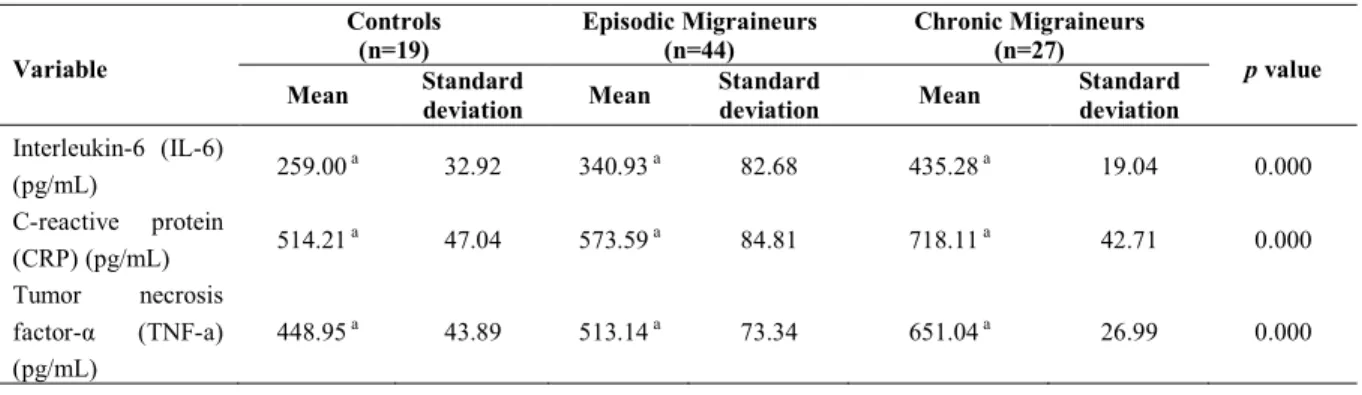
As can be seen in table 1 and figure 1, the CM patients group had significantly raised serum concentrations of IL6 (mean=435.28 pg/mL), CRP (mean=718.11 pg/mL) and TNF-α (mean=651.04 pg/mL) than the EM suffers (mean=340.93, 573.59 and 513.14 pg/mL, respectively) and controls (mean=259.00, 514.21 and 448.95 pg/mL, respectively) (p≤0.001). In addition, it was noted that the EM patients had higher serum levels of the above-mentioned inflammatory markers than controls (p≤0.001).
Headache Characteristics
M. Togha, et al.
86/ Iran J Allergy Asthma Immunol, Vol. 19, No. Supple.1, May 2020
Published by Tehran University of Medical Sciences (http://ijaai.tums.ac.ir) headache features of the EM and the CM suffers.
Although the number of days with headache was notably higher in the CM patients (mean=23.3 days/month) than the EM group (9.4 days/month), the severity of headaches did not differ between the two study arms. As it was expected, the patients with CM consumed a significantly higher number of analgesic medications per month (mean=10.36 per month) in comparison with those with EM (mean=4.15 per
month; p=0.009).
The results of the correlational analysis are set out in Figure 2 (a-c). Using Pearson correlation analysis, it was found that there was a significant strong positive correlation between the number of headache days per month and serum levels of inflammatory factors including IL-6 (r =0.53, p<0.001), CRP (r=0.62,
p<0.001) and TNF-α (r=0.58, p<0.001).
Table 1. Serum levels of inflammatory factors in episodic and chronic migraine patients compared to healthy controls
Variable
Controls (n=19)
Episodic Migraineurs (n=44)
Chronic Migraineurs (n=27)
p value Mean Standard
deviation Mean
Standard
deviation Mean
Standard deviation Interleukin-6 (IL-6)
(pg/mL) 259.00
a
32.92 340.93 a 82.68 435.28 a 19.04 0.000
C-reactive protein
(CRP) (pg/mL) 514.21
a
47.04 573.59 a 84.81 718.11 a 42.71 0.000
Tumor necrosis
factor-α (TNF-a) (pg/mL)
448.95 a 43.89 513.14 a 73.34 651.04 a 26.99 0.000
Table 2. A comparison of headache characteristics and analgesic consumption between chronic and episodic migraine patients
Variable
Episodic Migraineurs (n=44) Chronic Migraineurs (n=27)
p value Mean Standard deviation Mean Standard deviation
Number of headache days per month 9.4 6.0 23.3 6.0 0.000
Headache severity (Visual Analog Scale) 7.35 1.52 7.70 2.03 0.410
Number of analgesic medications per month 4.15 3.85 10.36 11.22 0.009
Figure 1. The mean and standard deviation of serum levels of inflammatory factors in a group of chronic and episodic migraineurs compared to healthy controls.
Figure 2. a to c. The correlation between serum levels of inflammatory factors and headache days per month in a group of chronic and episodic migraineurs.
IL-6, interleukin-6. CRP, C-reactive protein. TNF
DISCUSSION
Current findings demonstrate that chronic and episodic migraine patients seem to have concentrations of pro-inflammatory cytokines CRP and TNF-α) than healthy controls.
underlined that with increasing levels of inflammatory factors, headaches tended to be more chronic
It seems that the presence of augmented
pro-inflammatory cytokines in migraine patients which are observed in the present study further
the suggested role of neuroinflammationin migraine headache pathogenesis.9 Also, the higher concentration of inflammatory cytokines which is shown
patients compared to the EM subjects may highlight effects of the proinflammatory factors on headache progression. It should, however,
mind that due to the cross-sectional nature of the present research, these findings in migraine patients could be a consequence of the disease rather than a cause. Overall, these results on the levels of pro-inflammatory biomarkers including CRP, TNF-α, and IL migraineurs compared to controls seem to corroborate the previous evidence in this field.11-13,16,19-24
As an acute-phase agent, CRP plays a role in host immune system through activating
system, increasing the endothelial release of matrix
The correlation between serum levels of inflammatory factors and headache days per month in a group of
. TNF-α, Tumor necrosis factor-α.
that chronic and episodic migraine patients seem to have higher cytokines (e.g. IL6, than healthy controls. It was also with increasing levels of inflammatory
be more chronic.
augmented levels of in migraine patients
further confirms the suggested role of neuroinflammationin migraine Also, the higher concentration is shown in the CM EM subjects may highlight the s on migraine , however, be kept in sectional nature of the present these findings in migraine patients could be a consequence of the disease rather than a cause. Overall, inflammatory and IL-6 in seem to corroborate
24
plays a role in the complement endothelial release of matrix
metalloproteinase and production of pro
cytokines.However, prior studies aimed to assess factor in relation to migraine showed conflicting results.12-17,20,25,26 A review paper noted that there might be epidemiological evidence on
between elevated levels of CRP and
contrast to 99.3% inter-study heterogeneity of the evaluated researches.27In the most
50 migraine suffers and 40 healthy subjects, it was observed that the patients' group had higher levels of CRP.28However, our previous study f
differences in serum CRP levels of migraine cases and healthy controls.13
The role of inflammatory cytokines
and TNF-α in immune system regulation has been known.12In present research, it is demonstrated during inter-ictal periods, serum concentrations of inflammatory cytokines including IL6, CRP
α were statistically higher among the
the EM suffers and controls. The same results were noted when comparing the EM patients with healthy controls. It is noteworthy that previous reports suggested increased levels of CGRP, histamine, proteases, and pro-inflammatory factor
and IL-1β) in the cerebrospinal fluid (CSF) and plasma samples of migraineurs.9,29 Similarly,
compared the serum levels of
The correlation between serum levels of inflammatory factors and headache days per month in a group of
and production of pro-inflammatory aimed to assess this showed conflicting review paper noted that there might on the relationship between elevated levels of CRP and migraine in study heterogeneity of the In the most recent research on suffers and 40 healthy subjects, it was group had higher levels of However, our previous study failed to find differences in serum CRP levels of migraine cases and
The role of inflammatory cytokines such as IL-6 in immune system regulation has been well is demonstrated that serum concentrations of inflammatory cytokines including IL6, CRP, and
M. Togha, et al.
88/ Iran J Allergy Asthma Immunol, Vol. 19, No. Supple.1, May 2020
Published by Tehran University of Medical Sciences (http://ijaai.tums.ac.ir) cytokines in migraine patients with controls showed
their augmented levels in migraine suffers especially during ictal phases.11,13,19,22-24 For example, in an
investigation by Sarchielli et al.,19 elevated levels of TNF-α and IL-6 in internal jugular blood of migraineurs who did not have aura throughout ictal phases were detected. They concluded that these elevated levels might be caused subsequent to the production of neuropeptides in the trigeminal system.19In addition, in agreement with current observations, the results of the study conducted by Fidan and colleagues demonstrated that serum IL-6 levels of migraine patients were significantly more than the control group.22 In research by Tietjen and colleagues, it was also observed that premenopausal women with mean headache days of 12 ± 9 days per month had raised IL-6 and TNF-α levels in comparison to healthy subjects.23 Similarly, in the study by Yücelet al, the levels of IL-6 and TNF-α were higher in 31 migraineurs in their ictal phases than 24 controls.24 Also, our previous findings showing that serum TNF-α levels of migraineurs were notably raised compared to control subjects,13 are somewhat consistent with present results. Moreover, Uzar et al,.11observed that compared to controls, the levels of IL-1β and IL-6 were significantly higher in migraine suffers whereas these patients had lower IL-10 concentration; however, in contrast to current findings, TNF-αlevels of migraineurs were similar to healthy controls.11Further, Oliveira etal30reported that the EM patients had significantly higher levels of pro-inflammatory markers including TNF-α and IL-12p70 while they had lower concentrations of IL-10, IL 8, and, in contrary to our findings, lower IL-6levels.30However, a recent comparison of inter-ictal serum concentrations of cytokines in migraine suffers and controls through a sham-controlled trial that performed to investigate non-invasive vagus nerve stimulation effects, failed to show significant differences in serum TNF-α and IL-6 levels between the studied groups.31
Interestingly, based on current findings Pearson correlation analysis demonstrated significant strong positive correlations between the number of headache days per month and of IL-6, CRP, and TNF-α serum concentrations. Although the studies wherein such correlations between headache characteristics and serum inflammatory markers were assessed are limited, present results are in accordance with those obtained by Tietjen et al.23 They found a significant correlation
between the number of headache days per month and IL-6 and TNF-α.23
synthesis of prostaglandins and thus have anti-nociceptive effects, especially in inflammation-related pain.9,34 Thus, it seems that applying anti-inflammatory
agents (i.e. medications or dietary supplements) might be promising in the prevention or treatment of migraine headaches.35 Our study strengths include the following points: Examination of all patients by an expert headache specialist-neurologist, confirmation of EM or CM diagnosis based on ICHD-III criteria, following-up the cases for 1 month in order to collect headache diaries, excluding migraine patients who suffer from MOH and including age-sex matched healthy subjects as the control group. However, the case-control nature of current research makes these findings less generalizable to all migraine patients; because this study design is not able to prove a causal relationship between inflammatory state and migraine attack initiation. An additional uncontrolled issue is the presence of various confounders which may affect the inflammatory state.In addition, CSF concentrations of inflammatory cytokines were not addressed in the current study.
In sum, according to current findings, a pro-inflammatory state as revealed by augmented concentrations of pro-inflammatory cytokines (e.g. IL6, CRP, and TNF-α) was detected among chronic and episodic migraineurs compared to controls. It was also
underlined that with increasing levels of
inflammatory factors, headaches tended to be more
chronic. Thus, it seems that applying
anti-inflammatory agents (i.e. medications or dietary supplements) might be promising in the prevention or treatment of migraine headaches. However, in order to confirm the hypothesis that neuroinflammation plays a role in migraine pain genesis, long-term cohort studies and well-designed experimental and randomized controlled trials are required.
CONFLICT OF INTEREST
The authors declare no conflicts of interest.
ACKNOWLEDGEMENTS
We thank the participants of the present study. In particular, we extend our gratitude to Ms. Jabbari, the staff of Sina University Hospital and staff of the Pasteur Institute of Iran for their kind cooperation. Also, the authors would like to thank Epidemiology
and biostatistics of the Research Development Center of Sina Hospital for their technical assistance.
REFERENCES
1. Steiner TJ, Stovner LJ, Vos T, Jensen R, Katsarava Z. Migraine is first cause of disability in under 50s: will health politicians now take notice? J Headache Pain. 2018;19(1):17.
2. Vetvik KG, MacGregor EA. Sex differences in the epidemiology, clinical features, and pathophysiology of migraine. Lancet Neurol. 2017;16(1):76-87.
3. Headache Classification Committee of the International Headache Society (IHS) The International Classification of Headache Disorders, 3rd edition. Cephalalgia. 2018;38(1):1-211.
4. Dodick DW. A Phase-by-Phase Review of Migraine Pathophysiology. Headache. 2018;(58 Suppl 1):4-16. 5. Pietrobon D. Migraine: new molecular mechanisms. The
Neuroscientist. 2005;11(4):373-86.
6. Hepp Z, Bloudek LM, Varon SF. Systematic review of migraine prophylaxis adherence and persistence. J Manag Care Pharm. 2014;20(1):22-33.
7. Blumenfeld AM, Bloudek LM, Becker WJ, Buse DC, Varon SF, Maglinte GA, et al. Patterns of use and reasons for discontinuation of prophylactic medications for episodic migraine and chronic migraine: results from the second international burden of migraine study (IBMS-II). Headache. 2013;53(4):644-55.
8. Ghorbani Z, Togha M, Rafiee P, Ahmadi ZS, Rasekh Magham R, Haghighi S, et al. Vitamin D in migraine headache: a comprehensive review on literature. Neurol Sci. 2019;40(12):2459-77.
9. Ramachandran R. Neurogenic inflammation and its role in migraine. Semin Immunopathol. 2018;40(3):301-14. 10. Fidan I, Yüksel S, Ýmir T, Đrkeç C, Aksakal FN. The
importance of cytokines, chemokines and nitric oxide in pathophysiology of migraine. J Neuroimmunol. 2006;171(1):184-8.
11. Uzar E, Evliyaoglu O, Yucel Y, Ugur Cevik M, Acar A, Guzel I, et al. Serum cytokine and pro-brain natriuretic peptide (BNP) levels in patients with migraine. Eur Rev Med Pharmacol Sci. 2011;15(10):1111-6.
12. Tietjen GE, Khubchandani J. Vascular biomarkers in migraine. Cephalalgia. 2015;35(2):95-117.
M. Togha, et al.
90/ Iran J Allergy Asthma Immunol, Vol. 19, No. Supple.1, May 2020
Published by Tehran University of Medical Sciences (http://ijaai.tums.ac.ir) 14. Guldiken B, Guldiken S, Demir M, Turgut N, Kabayel L,
Ozkan H, et al. Insulin resistance and high sensitivity C-reactive protein in migraine. Can J Neurol Sci. 2008;35(4):448-51.
15. Yilmaz N, Yilmaz M, Sirin B, Yilmaztekin S, Kutlu G. The relationship between levels of plasma-soluble urokinase plasminogen activator receptor (suPAR) and presence of migraine attack and aura. J Recept Signal Transduct Res. 2017;37(5):447-52.
16. Vanmolkot F, De Hoon J. Increased C‐reactive protein in young adult patients with migraine. Cephalalgia. 2007;27(7):843-6.
17. Welch K, Brandes AW, Salerno L, Brandes JL. C‐Reactive Protein May Be Increased in Migraine Patients Who Present With Complex Clinical Features. Headache. 2006;46(2):197-9.
18. Jahromi SR, Abolhasani M, Ghorbani Z, Sadre-Jahani S, Alizadeh Z, Talebpour M, et al. Bariatric Surgery Promising in Migraine Control: a Controlled Trial on Weight Loss and Its Effect on Migraine Headache. Obes Surg. 2017;28(1):87-96.
19. Sarchielli P, Alberti A, Baldi A, Coppola F, Rossi C, Pierguidi L, et al. Proinflammatory cytokines, adhesion molecules, and lymphocyte integrin expression in the internal jugular blood of migraine patients without aura assessed ictally. Headache. 2006;46(2):200-7.
20. Güzel I, Taşdemir N, Çelik Y. Evaluation of serum transforming growth factor β1 and C-reactive protein levels in migraine patients. Neurol Neurochir Pol. 2013;47(4):357-62.
21. Perini F, D'andrea G, Galloni E, Pignatelli F, Billo G, Alba S, et al. Plasma cytokine levels in migraineurs and controls. Headache. 2005;45(7):926-31.
22. Fidan I, Yuksel S, Ymir T, Irkec C, Aksakal FN. The importance of cytokines, chemokines and nitric oxide in pathophysiology of migraine. J Neuroimmunol. 2006;171(1-2):184-8.
23. Tietjen G, Khubchandani J, Khan A, Herial N. Adiponectin and Inflammatory Cytokines in Young Women with Migraine2010.
24. Yücel M, Kotan D, Çiftçi GG, Çiftçi I, Cikriklar H. Serum levels of endocan, claudin-5 and cytokines in migraine. Eur Rev Med Pharmacol Sci. 2016;20(5):930-6. 25. Heshmat-Ghahdarijani K, Javanmard SH, Sonbolestan SA, et al. Endothelial Function in Patients with Migraine without Aura during the Interictal Period. Int J Prev Med. 2015;6:2.
26. Mustafa C, Omer Faruk B, Sinan B, Ömer A, Ahmet Y,
Dilcan K. Serum levels of pentraxin-3 and other inflammatory biomarkers in migraine: Association with migraine characteristics. Cephalalgia. 2015;36(6):518-25. 27. Lippi G, Mattiuzzi C, Cervellin G. C-reactive protein and migraine. Facts or speculations? Clin Chem Lab Med. 2014;52(9):1265-72.
28. Yildiz BT, Koca TT. Is migraine an inflammatory event? Which inflammatory markers can we use for migraine? coronary artery disease. 2019;6:9.
29. Paolo Martelletti and Rigmor Jensen e. Pathophysiology of Headaches From Molecule to Man. Paolo Martelletti RJ, editor: Springer, Cham; 2015.
30. Oliveira AB, Bachi ALL, Ribeiro RT, Mello MT, Tufik S, Peres MFP. Unbalanced plasma TNF-α and IL-12/IL-10 profile in women with migraine is associated with
psychological and physiological outcomes. J
Neuroimmunol. 2017;313:138-44.
31. Chaudhry SR, Lendvai IS, Muhammad S, Westhofen P, Kruppenbacher J, Scheef L, et al. Inter-ictal assay of peripheral circulating inflammatory mediators in migraine patients under adjunctive cervical non-invasive vagus nerve stimul. 2019;12(3):643-51.
32. Longoni M, Ferrarese C. Inflammation and
excitotoxicity: role in migraine pathogenesis. Neurol Sci. 2006;27(2):s107-s10.
33. Pardutz A, Schoenen J. NSAIDs in the Acute Treatment of Migraine: A Review of Clinical and Experimental Data. Pharmaceuticals (Basel). 2010;3(6):1966-87. 34. Ho KY, Gwee KA, Cheng YK, Yoon KH, Hee HT, Omar
AR. Nonsteroidal anti-inflammatory drugs in chronic pain: implications of new data for clinical practice. J Pain Res. 2018;11:1937-48.