A Query Language for Semantic Complex
Event Processing: Syntax, Semantics and
Implementation
Editor(s):Oscar Corcho, Universidad Politécnica de Madrid, Spain
Solicited review(s):Jean Paul Calbimonte, University of Applied Sciences and Arts Western Switzerland; one anonymous reviewer
Syed Gillani
a, Antoine Zimmermann
b, Gauthier Picard
band Frédérique Laforest
ca
Univ Lyon, INSA Lyon, France E-mail: [email protected] b
Univ Lyon, MINES Saint-Étienne, CNRS, Laboratoire Hubert Curien UMR 5516, France E-mail: [email protected], [email protected]
c
Univ Lyon, UJM Saint-Étienne, CNRS, Laboratoire Hubert Curien UMR 5516, France E-mail: [email protected]
Abstract
The field of Complex Event Processing (CEP) deals with the techniques and tools developed to efficiently process pattern-based queries over data streams. The Semantic Web, through its standards and technologies, is in constant pursuit to provide solutions for such paradigm while employing the RDF data model. The integration of Semantic Web technologies in this context can handle the heterogeneity, integration and interpretation of data streams at the semantic level. In this paper, we propose and implement a new query language, called SPAseq, that extends SPARQL with new Semantic Complex Event Processing (SCEP) operators that can be evaluated over RDF graph-based events. The novelties of SPAseq include (i) the separation of general graph pattern matching constructs and temporal operators; (ii) the support for RDF graph-based events and multiple RDF graph streams; (iii) the expressibility of temporal operators such asKleene+, conjunction, disjunction and event selection strategies; and (iv) the operators to integrate background information and streaming RDF graph streams. Hence, SPAseq enjoys good expressiveness compared with the existing solutions. Furthermore, we provide an efficient implementation of SPAseq using a non-deterministic automata (NFA) model for an efficient evaluation of the SPAseq queries. We provide the syntax and semantics of SPAseq and based on this, we show how it can be implemented in an efficient manner. Moreover, we also present an experimental evaluation of its performance, showing that it improves over state-of-the-art approaches.
Keywords: Complex Event Processing, Query Language, Semantic Web, SPARQL, RDF Streams, RDF Stream Processing, Automata Model, Query Optimisation
1. Introduction
Stream processing has become an important paradigm for processing data at high speed and large scale, where query operators such as selection, aggregation, filter-ing of data are performed in a streamfilter-ing fashion [1,2]. Complex Event Processing (CEP) systems, however, provide a different view and additional operators for
streaming applications: each data item within a data stream is considered as an event and predefined tem-poral patterns are used to generate actions to the sys-tems, people and devices. CEP systems have demon-strated utility in a variety of applications including fi-nancial trading, security monitoring, healthcare, so-cial and sensor network analysis [3,4,5]. In general, CEP denotes algorithmic methods for making sense
of events by deriving higher-level knowledge, or com-plex events from lower-level events in a timely fash-ion [3,6]. CEP applications commonly involve three requirements [3,6,7,8]:
(i) complex predicates (filtering, correlation); (ii) temporal, order and sequential patterns; and (iii) transforming event(s) into more complex
struc-tures.
The past several years have seen a large number of CEP systems and query languages being developed by both academic and industrial worlds [5,8,7,9,10,11,12,13]. Following the trend of using RDF as a unified data model for integrating diverse data sources across het-erogeneous domains, there is a great interest in us-ing RDF data model for the CEP. This results in a new field of the Semantic CEP (SCEP) [12,14]. The use of RDF as an input data model provides the fol-lowing attributes [15,16]. First, it offers a unified data model (directed labelled graphs). Second, it allows building upon countless domain knowledge formalisa-tions, in the form of vocabularies, thesauri and ontolo-gies. Third, RDF-based data integration systems ben-efit from the reasoning capabilities offered by the Se-mantic Web technologies to reason upon the context of detected events. Fourth, it makes it possible to lever-age the huge knowledge base represented by the Web of Data, thereby opening up opportunities to discover related data sets, enrich data, and create added value by mashing up all this information.
The design of an efficient SCEP system requires care-fully marrying the temporal operators with the RDF data model and the additional characteristic of event enrichment. Even though SCEP can be evolved from the common practice of stitching heterogeneous tech-niques and systems, a well organised query language is a vital part of SCEP: it not only allows users to specify known queries or patterns of events in an intuitive way, but also to showcase the expected answers of a query while hiding the implementation details.
While there does not exist a standard language for expressing continuous queries over RDF streams, a few options have been proposed. In particular, a first strand of research focuses on extending the scope of SPARQL to enable the stateless continuous evaluation of RDF triple streams called RDF Stream Processing (RSP) lan-guages. These query languages include CQELS [17], C-SPARQL [18], SPARQLStream[19]: they are used to
match query-defined graph patterns, aggregates and fil-tering operators against RDF triple streams, i.e. a
se-quence of RDF tripleshsubject,predicate,objecti, each
associated with a timestampτ. Most of these languages do not provide any explicit temporal pattern matching operator and thus cannot be classified under the SCEP languages.
The second strand of research focused on SCEP languages to extend SPARQL with stateful operators, where few options have been proposed [20,21,22]. EP-SPARQL [20] – with its expressive language and frame-work – is the primary player in this field with other works focusing on a subset of operators and function-alities. EP-SPARQL extends SPARQL with sequence constructs that allow temporal ordering over triple streams and its semantics are derived from the ETALIS language [12]. Although EP-SPARQL is a pioneering work in the field of SCEP, it suffers from drawbacks such as mixing of sequence and graph pattern matching operators, single triple stream model, lack of explicit
Kleene+, and event selection operators.
Considering these shortcomings, our contribution in this paper is twofold. First, we present a novel query language and system, called SPAseq, to enable com-plex event processing over multiple streams using the RDF graph model. Second, we present an efficient framework to process SPAseq queries. SPAseq covers the aforementioned shortcomings of existing languages and systems, and provides a unified language for SCEP over RDF graph streams, while introducing expressive explicit temporal operators. The use of explicit opera-tors lets the users specify complex queries at high level and enables the appropriate implementation details and optimisations at the domain specific level. The main features of the SPAseq query language are summarised as follows:
– One of the most important features of SPAseq is that it clearly separates the query components for describing temporal patterns over RDF graph events, from specifying the graph pattern match-ing over each RDF graph event. This results in lan-guage reusability and expressiveness. This separa-tion distinguishes SPAseq from other SCEP query languages.
– It provides an RDF graph stream model to sup-port streaming of graphs instead of triples. This al-lows to structure more complex events in a stream. Furthermore, it provides event processing over multiple RDF graph streams, while following the SPARQL specification of named datasets [23]. – It is equipped with expressive temporal
event selection strategies over events from multi-ple streams.
– It provides explicit operators to join background knowledge base and RDF graph streams.
These features stem from the general specifications described by the W3C RSP community group [24] and the use cases for the CEP [9,8,25,26,27,28].
As our second contribution, we provide an execu-tional framework for SPAseq using a non-deterministic finite automata (NFA) model calledNFAscep. Although
a large number of techniques exist to process tempo-ral operators [5,12,10], the NFA model offers higher expressiveness required for SPAseq. Hence, leverag-ing the automata-based techniques, SPAseq queries are compiled over equivalent NFAs: the compiled NFA is processed to incrementally produce the partial matches before a full match of the query is produced. More-over, we employ various optimisation techniques on top of our system. It includes indexing and partitioning of incoming streams; pushing the stateful predicates and query windows; and lazy evaluation of the disjunction and conjunction operators.
Our main contributions are summarised as follows:
– We present SPAseq, a novel SCEP language, in-cluding a full description of its syntax and seman-tics.
– We provide the detailed semantics of SPAseq and its main operators.
– We provide the NFA-based framework to effi-ciently compile and evaluate SPAseq queries. – We provide system and operator-level
optimisa-tion strategies for SPAseq queries.
– Using real-world and synthetic datasets, we demonstrate the effectiveness of our optimisation strategies and our experimental evaluations show that they outperform existing systems for the same use cases and datasets.
The rest of the paper is structured as follows. Sec-tion2presents the motivational examples to showcase the requirements for a SCEP language. Section3 re-views the related work. Section 4 presents the data model and syntax of SPAseq. Section5 presents the semantics of the SPAseq language. Section6presents the details about the compilation of SPAseq queries onto the NFAscepmodel, the evaluation of NFAscep
au-tomata and the design of the SPAseq query engine. Section7 presents the optimisations techniques used for the SPAseq query engine. Section8provides ex-perimental evaluations of the SPAseq query engine. Section9concludes the paper.
2. Motivational Examples and Requirements
In the following, we use various use cases to show the kind of expressiveness and flexibility needed for a SCEP query language. These use cases are illustra-tive to showcase how a SCEP can be applicable over provided RDF graph streams.
UC 1 (Smart Grid Monitoring)A smart grid
moni-toring application processes events from multiple dis-tributed streams with the aim to notify the users of an online service to take a decision to improve the power usage when a defined pattern is detected [29,30]. An ex-ample of it is to notify the user to switch to a renewable power source instead of fuel-based power source, if the system observes the following pattern: (A) the price of electricity generated by a fuel-based power source is greater than a certain threshold; (B) weather con-ditions are favourable for renewable energy produc-tion (one or more events); and (C) the price of storage source attached to the renewable power source is less than the fuel-based power source. Moreover, a back-ground knowledge base (KB) containing information about the homes’ addresses, owners and measurement units, etc., can be used to further enrich the matched events.
UC 2 (Trajectory Classification) Trajectory
classifi-cation uses the sequence of objects movement (trajec-tories) to determine their types [25,31]. For instance, finding the fishing boat by discovering the trajectory of a boat over some time interval. An example pattern to determine the trajectory of fishing boats represents the following pattern:A: vessel leaves the harbour,B: vessel travels by keeping steady speed and direction (one or more events),C: vessel arrives at the fishing area and stops. The information about the owner of the vessels, shipping company a vessel is operating under, address of the fishing area, etc., can be used from a background KB to enrich the matched events.
UC 3 (Fraud Management)Fraud management has
increases; (B) until it is considerably less than the ear-lier withdrawn (one or more events). Furthermore, a background KB containing the cards’ owner names, is-suing banks, etc., can further enrich the context of the matched events.
UC 4 (Stock Market Analytics) A stock market
ana-lytics platform processes financial transactions to de-tect the patterns that signify the emergence of profit opportunities [8,9,27]. Examples of such pattern are head-and-shoulders [33], V-shaped [8,34], and W-shaped [28] patterns. From the set of these patterns, the head and shoulder pattern is defined as follows:Athe left shoulder (increase in the stock price) that is formed by an uptrend;Bdetect the head being a peak higher than the left shoulder (one or more events);Cthe right shoulder that shows an increase but fails to take out the peak value of the head. Moreover, background KB con-taining the company related information, such as ad-dress, CEO, type, etc., can be joined with the matched events to extract the contextual information.
UC 5 (Traffic Management) With the growing
popu-larity of Internet of Things (IoT) technologies, more and more cities are leaning towards the initiative of smart cities to provide robust traffic management [35,36]. A key use case in this context is to be proactive against the traffic jams due to an accident or a social event. Hence taking actions to keep the traffic jams as lo-cal as possible and stop its effect propagation to the main roads of the city [36]. A query for such use case would be:AIf a road segment is congested followed byB(at least) one of its connected road segments is also congested then traffic should be directed to other directions. The information about the road segments’ congestion is gathered from a set of streams, each from a sensor located at a road segment. Further contextual information such as the exact location of the sensors, the type of the road, etc., can be extracted from an static background KB.
Using the aforementioned use cases, we identify the set of requirements for a SCEP.
2.1. RDF Graph-based Events
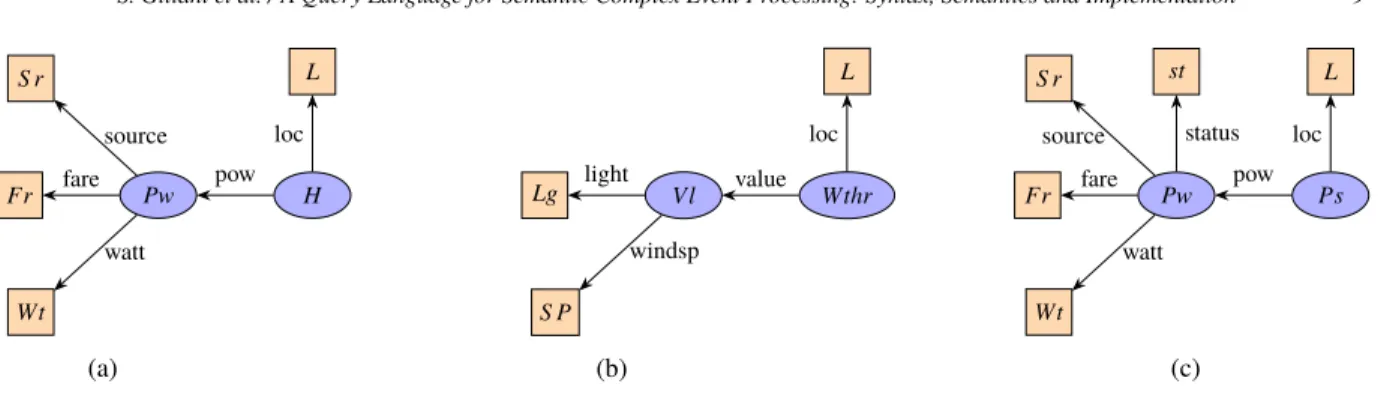
All the use cases discussed above provide events that contain multiple observations and hence require an RDF graph-based event model instead of RDF triples. This allows to structure more complex events in a stream, as opposed to plain triples. For instance, a weather event requires multiple triples to describe the
a1 b1 c1 a2 a3
1 2 3 4 5
SEQ (A, B, C)
Skip-till-Any Skip-till-Next
Strict Contiguity
M1= { a1, b1,c1 }
M2= { a2, b2,c2 }
M3= { a3, b2,c2 }
M1= { a1, b1,c1 }
M2= { a1, b2,c2 }
M3= { a2, b2,c2 }
M4= { a3, b2,c2 }
timeline
(a)
(b)
b2 c2
6 7
M1= { a1, b1,c1 }
Figure 1. (a) Pattern to be matched and the input stream, (b) the table showcase all the set of matches that can be extracted from the input stream using different event selection strategies
current weather conditions such as temperature, humid-ity, wind speed, etc. Another reason to provide RDF graph-based events is the flexibility in timestamping, i.e. using source or system timestamp. This can only be possible if timestamps can be attached to an event struc-ture. That cannot be achieved with plain triples [22,24].
2.2. Multiple Streams
2.3. Expressive Temporal Operators
The main aim of an SCEP language is to provide temporal operators on top of standard SPARQL graph pattern matching constructs. Thus, the list of temporal operators introduced for the CEP over relational mod-els [4,7,39] should be supported in a SCEP language. The two main operators, apart from the traditional se-quence operator, that are required in all the aforemen-tioned use cases areKleene+and event selection
strate-gies. They are described as follows.
Kleene+Operator. This is a widely used operator in the CEP languages [5,8,40]. It is used to extract fi-nite yet unbounded number of events with a particular property from the input streams. Most, if not all, of the aforementioned use cases cannot be expressed to its core without this operator. For example, UC1requires
Kleene+to select one or more events that represent
favourable weather conditions; UC2requiresKleene+
on activity events of the vessels; UC3requires one or more lower withdrawn amounts usingKleene+.
Event Selection Strategies.In general, thesequence
temporal patternsbetween events detect the occurrence
of an eventfollowed-byanother. However, a deeper look
reveals that it can represent various different circum-stances using different event selection strategies [4,40]. Event selection strategies determine how the selected events for a pattern follow each other, hence mix-ing the relevant and irrelevant events from the input streams [40]. The three main event selection strategies described in the CEP literature [4,8,27] arestrict con-tiguity,skip-till-nextandskip-till-any. The first
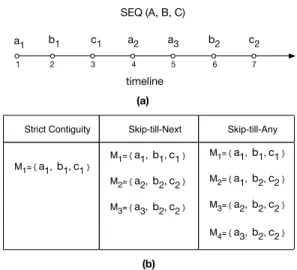
selec-tion strategy states that the events for a match should be contiguous in the input stream, the second relaxes this by skipping the irrelevant events until the next rel-evant event arrives, while the third one selects all the possible patterns by skipping both relevant and irrel-evant events. Figure1(a) shows the input stream and the pattern to be matched, while the table in Figure1 (b) shows all the matches for the pattern for each event selection strategy. Note how having the same sequence pattern but different event selection strategies results in diverse outputted matches. The importance of these operators can also be inferred from the aforementioned use cases. For instance, in UC1, weather-related events generally repeat the observed values and can be skipped to find the most relevant event to be matched; in UC4, we need to select the relevant events by ignoring local price fluctuations to preserve opportunities of detect-ing longer and thus more reliable patterns. Providdetect-ing
event selection strategies at the query level would en-able the users to determine the semantic differences between them and tailor their usage according to the targeted use cases [22]. Furthermore, these operators are also described at the query level for most of the CEP languages [8,40].
2.4. Separation of Query Constructs
A SCEP query language has to express graph pat-terns to match events’ content and temporal operators to determine the temporal relations between events. Hence, a separation of these two orthogonal constructs would enable language reusability and ease in imple-mentation. This way, constructs for graph patterns can be borrowed directly from SPARQL, and temporal op-erators from the CEP works. For example, in UC1, the price and weather conditions for events can be matched using the constructs from SPARQL 1.1, while the se-quencing andKleene+operators can be used to
deter-mine the defined sequences.
2.5. Background Knowledge Base
One of the main properties of the SCEP is to provide an extra knowledge about the situation of interest. Since the streams traditionally do not include the static infor-mation, such information can be used as a background KB. Hence a SCEP query language should provide op-erators to directly enrich events through background KB. For example, in UC1, user profiles and detailed information about the power sources; in UC 2, de-tailed information about the shipping vessels; in UC4, detailed information about the company whose stock events are in question, etc. The operators for the back-ground KB at the query-level also provide the control over which background information is required for a query, i.e. joining only the relevant information. For the same reason, existing RSP solutions [17,41] provide such operators at the query-level.
In this section, we pointed out various general re-quirements of a SCEP query language. In the next sec-tion, using them as a yardstick, we outline the limita-tions of existing languages.
3. Related Work
which include the executional semantics, data models and targeted use cases. In this section, we adopt the same classification criteria as used in [14], and divide the systems into two classes: RDF Stream Processing (RSP) systems, and Semantic Complex Event Process-ing (SCEP) systems. Their details are discussed as fol-lows.
3.1. RDF Stream Processing (RSP) Systems
The standardisation of the RSP is still an ongoing debate and the W3C RSP community group [24] is an important initiative in this context. Most of the RSP systems [17,18,19,42] inherit the processing model of Data Stream Management Systems (DSMSs), but consider a semantically annotated data model, namely RDF triple streams. Query languages for these sys-tems are inspired from CQL [43], where a contin-uous query is composed from three classes of op-erators, namely stream-to-relation (S2R), relation-to-relation (R2R), and relation-to-relation-to-stream (R2S) operators. C-SPARQL [18] and CQELS [17] are among the first contributions, and often cited as a reference in this field. They support timestamped RDF triples and queries are continuously updated with the arrival of new triples. The query languages for both systems extend SPARQL with operators such asFROM STREAMandWINDOWto
se-lect the operational streams, and the most recent triples within sliding windows. They also support the integra-tion of background KB to further enrich the incoming RDF triples. Unlike the aforementioned systems, re-cently, we proposed a system called SPECTRA [44] to process RDF graph streams. It provides various system and operator level optimisations and continuously pro-cesses the standard SPARQL queries over RDF graph streams.
All the aforementioned systems and various others [19,42] are mainly developed as real-time monitoring systems: the states of the events are not stored to im-plement temporal pattern matching among a set of events. For the same reason, their query languages do not provide any operators for temporal pattern match-ing. Although, the sequence-based query is partially supported in C-SPARQL through a timestamp function inFilter, the query construction is not intuitive and
the validity of results cannot be determined due to the missing semantics for such sequence pattern matching.
3.2. Semantic CEP Systems
Semantic CEP (SCEP) systems are inspired from the classical rule-based CEP systems, i.e. by integrating
high-level knowledge representation and background KB. To the best of our knowledge, EP-SPARQL is the only system that provides a unified language and ex-ecutional framework for processing semantically en-riched events with the temporal ordering. Hence, it is the most relevant work w.r.t ours. EP-SPARQL ex-tends SPARQL 1.0 with a set of four binary tem-poral operators: SEQ, EQUALS, OPTIONAL-SEQ, and EQUALS-OPTIONAL. Using these operators, complex
events in EP-SPARQL are defined as basic graph pat-terns. Since this technique is similar to theUNIONand OPTIONALoperators in SPARQL, events are not first
class citizens.
Although EP-SPARQL is a pioneering work in the field of SCEP, it lacks various important features. These limitations are discussed as follows:
– Triple-based Events: EP-SPARQL only supports
triples as events annotated with time-intervals. This restricts to structure more complex events as discussed before.
– Single Stream: EP-SPARQL data model is based
on a single stream model and all the triples within a defined window are merged into a default graph and then queried for matches. Hence the meta-information of triples, such as the source and oc-curring time, cannot be captured. Furthermore, it raises several questions about the treatment of blank nodes: being part of the RDF specification, blank nodes are now a core aspect of Semantic Web technology and they are featured in several W3C standards, a wide range of tools, and hun-dreds of datasets across the Web [38].
– Temporal Operators: EP-SPARQL only supports
a small subset of temporal operators. Operators such asKleene+or event selection strategies are
not supported. These operators are, however, im-portant for many use cases as discussed before. Moreover, the conjunction and disjunction oper-ators in EP-SPARQL are inspired from SPARQL (UNIONandAND). These operators do not provide
the nesting over a set of events as described for CEP systems [5,39]. This leads to a design where the semantics of temporal operators and SPARQL graph patterns are mixed, hence it can be devious to extend it and construct advanced event process-ing patterns [46].
– Enriching Events with Background Knowledge Base: The static background KB is used to
Table 1
Properties of the Existing SCEP Systems
SCEP Systems Input Model Operators Available Implementation
EP-SPARQL [20] Triple Streams Sequence, Conjunction,
Disjunction, Optional X
STARQL [21] Triple Streams Sequence 7
RSEP-QL [22] Graph Streams Sequence, Event
Selec-tion Strategies 7
CQELS-CEP [45] Graph Streams Sequence,Optional,
Negation 7
any explicit operator to join graph patterns de-fined on an external knowledge and incoming RDF events. It, however, employs Prolog rules or RDFS rules within an ETALIS engine. This results in ex-pensive reasoning process for each incoming event and the user is not able to select only the specific required information [14].
Apart from EP-SPARQL, recently, some other works also provide the intuition of SCEP. Some of these works are presented mainly for the purpose of theoretical anal-ysis instead of practical implementation, while others take an approach for transforming queries over ontolo-gies into relational ones, via ontology-based data ac-cess (OBDA) with temporal reasoning. Table1shows the properties of these systems. STARQL [47] uses the OBDA technique to determine ABox sequencing with a sorted first order logic on top of them. It provides a simple formalism/mapping to SQL for sequence op-erators and all the other opop-erators (such asKleene+,
conjunction, disjunction, event selection strategies) are not part of its framework. Furthermore, it is not a freely available system and it does not provide operators for explicitly referencing different points in time [21]. CQELS recently proposed in [45] the integration of se-quence and path negation operators inspired from EP-SPARQL. However, its sequence clause is evaluated over a single stream and its syntax and semantics does not include event selection strategies. RSEP-QL [22] is a reference model to capture the behaviour of exist-ing RSP solutions and to capture the semantics of EP-SPARQL’s sequence operator. It is based on the RDF graph model; however, its main focus is to capture the event selection strategies and other complex operators are currently not supported. It defines the semantics of the three main event selection strategies supported by the ETALIS engine. It includesrecent,chronological
andunrestricted. The recent selection strategy can be
mapped to the strict contiguity, while chronological and
unrestricted are different variations of the skip-till-next strategy. However, due to the time-interval semantics these selection strategies cannot be directly mapped to ours.
4. TheSPAseqQuery Language
Considering the shortcomings of existing languages, we propose a new language called SPAseq. The design of SPAseq is based on the following main principles: (1) support of an RDF graph stream model; (2) clear separation between the temporal and RDF graph opera-tors; (3) adequate expressive power, i.e. not only based on core SPARQL constructs but also including general purpose temporal operators (inspired from the common CEP operators); (4) genericity, i.e. independent of the underlying evaluation techniques; (5) compositionality, i.e. the output of a query can be used as an input for another one. Hence SPAseq provides all the required features as discussed in Section2.
The most important feature of SPAseq is that it clearly separates the query components for describing temporal patterns over RDF graph events, from speci-fying the graph pattern matching over each RDF graph event. This enables SPAseq to employ expressive tem-poral operators, such asKleene+, disjunction,
conjunc-tion and event selecconjunc-tion strategies over RDF graph-based events from multiple streams. In the following, we start with the data model over which SPAseq queries are processed and then provide the details regarding its syntax and semantics.
4.1. Data Model
That is, we assume three pairwise disjoint and infinite sets of IRIs (I), blank nodes (B), and literals (L). An
RDF triple is a tuplehs,p,oi ∈(I ∪B)×I ×(I ∪B∪L) and an RDF graph is a set of RDF triples. Based on this, the concepts of RDF graph event and stream are defined as follows.
Definition 1 AnRDF graph event(Ge)is a pair(τ,G)
whereGis an RDF graph, andτis an associated times-tamp that belongs to a one-dimensional, totally ordered metric space.
We do not make explicit what timestamps are be-cause one may rely on, e.g., UNIX epoch, which is a discrete representation of time, while others could use
xsd:dateTimewhich is arbitrarily precise.
In our setting,streamsare sets of RDF graph events
defined as follows:
Definition 2 AnRDF graph event streamSis a
pos-sibly infinite set of RDF graph events such that, for any given timestampsτandτ0, there is a finite amount of events occurring between them, and there is at most one single graph associated with any given timestamp.
An RDF graph event stream can be seen as a se-quence of chronologically ordered RDF graphs marked with timestamps. The constraints ensure that it is always possible to determine what unique event immediately precedes or succeeds a given timestamp. Without the first restriction, it would be possible to define a stream
{(1n,G)| n 6= 0an integer}where there is no event
immediately succeeding0. In order to handle multiple streams, we identify each using an IRI and group them in a data model we call RDFstreamset.
Definition 3 Anamed streamis a pair(u,S)where
uis an IRI, called thestream name, andSis an RDF graph event stream. AnRDF graph streamsetΣis a set of named streams such that stream names appear only once.
In the rest of the paper, we simply use the termsgraph
for RDF graph, event for RDF graph event, stream
for RDF graph stream, andstreamset for RDF graph
streamset.
Example 1 Recall UC1, here we extend it with our
data model using three named streams. The first named stream(u1,S1)provides the events about the power-related sources from a house, the second named stream
(u2,S2)provides the weather-related events for house, and the third named stream(u3,S3)provides the power
storage-related events. Figure2illustrates the general structure of the events from each source. An exemplary content of a named stream(u1,S1)is describe as fol-low:
time graph
10
:H1 :loc :L1 :H1 :pow :Pw1 :Pw1 :source ‘solar’ :Pw1 :fare 5
:Pw1 :watt 20
15
:H2 :loc :L2 :H2 :pow :Pw2 :Pw2 :source ‘wind’ :Pw2 :fare 6 :Pw2 :watt 20
. . . ...
Note that the above table describe the named stream in an informative way, in practice RDF 1.1 Trig or an Nqaud format is used to represent such streams.
4.2. Syntax of SPAseq
This section defines the abstract syntax of SPAseq, where SPAseq queries are meant to be evaluated over a streamset, and each query is built from the two main components:graph pattern matching expression
(GPM) for specifying the SPARQL graph patterns over events; and sequence expressionfor selecting the
se-quence of a set of GPM expressions. For this discus-sion, we assume that the reader is familiar with the def-inition and the algebraic formalisation of SPARQL in-troduced in [49]. In particular, we rely on the notion of SPARQL graph pattern by considering operatorsAND, OPT,UNION,FILTER, andGRAPH.
Definition 4 The syntax of a SPAseq SELECT query is
a tupleQ= (V, ω,SeqExp), whereV is a set of vari-ables,ωis a duration, andSeqExpis asequence
ex-pressiondefined according to the following grammar:
SeqExp::=Atom|SeqExp‘,’Atom|SeqExp‘;’Atom
|SeqExp‘:’Atom
Atom ::=GPM|GPM‘+’|BOp
BOp ::=GPM((‘&’|‘|’))GPM
GPM ::= (u,P)|(u,P) Graph (u,PD)
where u is an IRI, Pis a SPARQL graph pattern,
(u,P) is called agraph pattern matching expression
Pw H Fr
S r
Wt
L
fare source
watt
loc pow
(a)
Vl Wthr
Lg
S P
L
light
windsp
loc value
(b)
Pw Ps
Fr S r
Wt
L st
fare source
watt
status loc pow
(c)
Figure 2. Structure of the Events from three Named Streams, (2a)(u1,S1)Power Event, (2b)(u2,S2)Weather Event, (2c)(u3,S3)Power Storage Event
The concrete syntax of SPAseq is illustrated in Query1 which includes syntactic sugar that is close to SPARQL. It contains three GPM expressions each identified with a name (A,B, andC), which allows one
to concisely refer to GPMs and to the named streams. These names are employed by the sequence expression to apply various temporal operators. The sequence ex-pression in Query1is presented atline 9; the streams
are described at lines 3-5; the GPM expressions on
these streams start atlines 11, 19 and 27.
One of the main properties of the SPAseq language is depicted in Query1, i.e. the separation of sequence and GPM expressions. Herein, we first study how the sequence expression interacts with the graph pattern to enable temporal ordering between matched events. We start with the brief description of unary operator ({‘+’}), the event selection strategies ({‘,’,‘;’,‘:’}) and binary operators ({‘&’,‘|’}). The details of these op-erators are covered during the description of their se-mantics in Section5. Furthermore, we also present the
Graphoperator for the SPAseq query language.
4.2.1. SPAseq Unary Operators
The sequence expressionSeqExpin SPAseq is used to determine the sequence between the events matched to the graph patternP. The symbol{‘+’,}corresponds to theKleene+operator. It determines the occurrence
of one or more events of the same kind. This means a series of events can be matched using this operator.
1 SELECT ? house ? fr1 ? fr2 ? house2 ? city ? oname
2 WITHIN 30 MINUTES
3 FROM STREAM S1 < http :// smartgrid . org / mainSource >
4 FROM STREAM S2 < http :// smartgrid . org / weather >
5 FROM STREAM S3 < http :// smartgrid . org / storageSource >
6 7 WHERE {
8
9 SEQ (A; B+, C)
10
11 DEFINE GPM A ON S1 {
12 ? house : loc ?l.
13 ? house : pow : Pw .
14 : Pw : source " fuel ".
15 : Pw : fare ? fr1 .
16 FILTER(? fr1 > 20) .
17
18 GRAPH < http :// smartgrid . org /db > {
19 ? house : locatedIn ? city .
20 ? house : nearBy ? house2 .
21 ? house : ownerNAme ? oname .
22 }
23 }
24
25 DEFINE GPM B ON S2 {
26 ? wther : loc ?l.
27 ? wther : value : Vl .
28 : Vl : light ? lt .
29 : Vl : windsp ? sp .
30 FILTER (? sp > 3 && ? lt > 40) .
31 }
32
33 DEFINE GPM C ON S3 {
34 ? storage : loc ?l.
35 ? storage : pow : Pw .
36 : Pw : source " solar ".
37 : Pw : fare ? fr2 .
38 FILTER (? fr2 < ? fr1 ).
39 }
40 }
Query 1: A Sample SPAseq Query for theUC1
4.2.2. SPAseq Event Selection Strategies
The event selection strategies overload the sequence operator with the constraints to define how to select the relevant events from an input stream, while mix-ing relevant and irrelevant events (as described in Sec-tion2.3). The symbols{‘,’,‘;’,‘:’}are binary opera-tors which describe the interpretations of the sequence between events. That is, ‘,’ represents strict contiguity, ‘;’ represents skip-till-next, ‘:’ represents skip-till-any.
4.2.3. SPAseq Binary Operators
Example 2 Consider the SPAseq Query 1, which il-lustrates theUC1. The sequence expressionSEQ(A;
B+, C)illustrates that the query returns a match: if an event of typeAdefined on a streamS1matches the GPM expressionAfollowed-byone or more events (us-ing skip-till-next operator (‘;’) and (‘+’)) from stream
S2that match the GPM expressionB, and finally im-mediately followed-by(using strict contiguity operator (‘,’)) an event from stream S3that matches the GPM expression C. Notice that a GPM expression mainly utilises SPARQL graph patterns for the evaluation of each event.
4.2.4. SPAseq Graph, Window and Stream Operator
The combination of streaming information in the form of RDF graph streams and other information from the static knowledge base can lead to novel seman-tics and information rich SCEP. TheGraphoperator in
SPAseq is designed to take advantage of static infor-mation available in the form of an RDF graph. Thus, a graph patternPDdefined over the static RDF graph
GDis first evaluated and then the results are matched
with the incoming streamS. This leads to a SCEP
sys-tem, where detailed information regarding a context can be revealed with the help of already available static datasets. For instance, consider the SPAseq Query1, where we use static background KB about the house owners, their neighbours and city to have better under-standing of the matched events.
In SPAseq, the sequence expression is defined over a streamset. Thus, we use theFROM STREAMclause to
define a set of streams. For instance, in Query1we use three streams identified asS1,S2andS3(lines 3-5).
These stream names are used within the defined GPM expressions. Furthermore, since the sequence over a set of events is constrainted by the temporal window, we use theWITHINclause to define the temporal windows
(line 2in Query1). In SPAseq, windows can be defined
in seconds, minutes and hours. For instance, in Query1 we use a60 MINUTESwindow.
In this section, we presented the syntax of SPAseq query language with a query for the UC1. The queries for the remaining use cases are described in Ap-pendix A. Using the defined syntax, we present the semantics of SPAseq in the proceeding section.
5. Formal Semantics ofSPAseq
To formally define the semantics of SPAseq queries, we reuse concepts from the semantics of SPARQL as
defined in [49]. Amappingis a partial function from a
set of variables to RDF terms (B∪I ∪L). Thedomainof
a mappingµ, denoteddom(µ), is the set of variables that have an image viaµ. We say that two mappingsµand
µ0are
compatibleif they agree on all shared variables,
i.e. if µ(x) = µ0(x) for all x ∈ dom(µ)∩dom(µ0). For a graph patternP, we denote byvars(P)the set of variables appearing inPandµ(P)is the graph pattern obtained by replacing each variable v ∈ vars(P) by
µ(v)whenever defined.
We repeat the definitions of join (on), union (∪), minus (\), left outer-join ( ) and evaluation of graph
patterns as in [49].
Definition 5 LetΩ1andΩ2be sets of mappings:
Ω1onΩ2={µ1∪µ2|µ1∈Ω1, µ2∈Ω2, µ1andµ2compatible}
Ω1∪Ω2={µ|µ∈Ω1orµ∈Ω2}
Ω1\Ω2={µ1∈Ω1| for allµ2∈Ω2, µ1andµ2not compatible}
Ω1 Ω2= (Ω1onΩ2)∪(Ω1\Ω2)
Definition 6 Lettbe a triple pattern,P,P1,P2graph
patterns andGan RDF graph, then the evaluationJ·KG
is recursively defined as follows:
JtKG = {µ|dom(µ) =vars(t)andµ(t)∈G} JP1ANDP2KG =JP1KG onJP2KG JP1UNIONP2KG =JP1KG ∪JP2KG JP1OPTIONALP2KG =JP1KG JP2KG
JPFILTERRKG ={µ∈JPKG|µ(R)is true} In this section, we define the semantics of SPAseq in a bottom-up manner, where we start with the seman-tics of GPM expressions by integrating the temporal aspects of events and streams. Note that, for the sake of brevity, we show the evaluation of GPM expressions over a streamset and the aspects of evaluatingGraph
operator (over RDF dataset) within GPM expressions are discussed later. This will aid us in highlighting the decisions we took to define the semantics of SPAseq operators.
5.1. Evaluation of Graph Pattern Matching Expressions
In SPAseq, Graph Pattern Matching expressions are evaluated against a streamset over a finite time interval that “tumbles” as time passes. Consequently, we con-strain the evaluation function to a temporal boundary (i.e. a window), with a start time (τb) and an end time (τe). In addition, we use the notationΣ(u)to select a stream of nameufrom a streamset, such that
Σ(u) =
In order to define the evaluation of a GPM expres-sion, we introduce a pair(τ,JPKG)which represents a
set of mappings annotated with a timestampτof the matched event. The evaluation of a GPM expression is defined as follows.
Definition 7 The evaluation of a GPM expression
(u,P) over the streamset Σ for the time boundaries
[τb, τe] is:
J(u,P)K [τb,τe]
Σ ={(τ,JPKG)|(τ,G)∈Σ(u)∧
τb≤τ≤τe)∧JPKG6=∅}
The evaluation of the GPM expression(u,P)over an event within a streamset results in a pair(τ,JPKG)In
the absence of a match, no results are returned for the considered timestamp.
Example 3 Consider a GPM expression(u1,P1) :=
(u1,{(?h,pow,?p),(?h,loc,?l)})and a power-related named stream(u1,S1)∈Σwith events as follows:
time graph
10 :H1 :pow :Pw1
:H1 :loc :L1
15 :H2 :pow :Pw2
:H2 :loc :L2
25 :H3 :pow :Pw3
:H3 :loc :L3
. . . ...
The evaluation of(u1,P1)overΣfor the time bound-aries [5,15], i.e. J(u1,P1)K
[5,15]
Σ , is described as
fol-lows:
time ?h ?p ?l
10 :H1 :Pw1 :L1 15 :H2 :Pw2 :L2
Notice that since the end time of the window is re-stricted atτ= 15, only the events atτ= 10andτ= 15 are included in the result. The event atτ= 25is outside the window and thus is not included in the results.
In order to define the semantics of sequence expres-sions, we use the notion of BOp expressions from Def-inition4for conjunction and disjunction operators. A BOp expression does not containKleene+or event
se-lection operators.
5.2. Evaluation of Binary Operators
Herein, we define the semantics of binary operators provided for SPAseq, i.e. conjunction and disjunction of events.
Definition 8 Given two BOp expressions Ψ1,Ψ2 the
evaluation of the conjunction operator over the
streamsetΣand for the time boundaries[τb, τe]is de-fined as follows:
JΨ1&Ψ2K [τb,τe]
Σ =
(
(τ,XonY)|(τ,X)∈JΨ1K [τb,τe]
Σ ∧
(τ,Y)∈JΨ2K [τb,τe]
Σ ∧XonY 6=∅
)
The conjunction operator detects the presence of two or more events that match the defined GPM expressions and occur at the same time, i.e. containing the same timestamps.
Example 4 Consider the following, a GPM expression
(u1,P1) := (u1,{(?h,pow,?p),(?h,loc,?l)}) and a power-related named stream(u1,S1)∈Σas follows:
time graph
10 :H1 :pow :Pw1
:H1 :loc :L1
25 :H2 :pow :Pw2
:H2 :loc :L2
. . . ...
Now consider a GPM expression (u2,P2) := (u2,{(?w,value,?v),(?w,loc,?l)}) and a weather-related named stream(u2,S2)∈Σas follows:
time graph
10 :W1 :value :Vl1
:W1 :loc :L1
20 :W2 :value :Vl2
:W2 :loc :L1
. . . ...
The evaluation of the conjunction operator over the aforementioned GPM expressions and named streams (J(u1,P1) & (u2,P2)K
[10,25]
Σ ) for the time boundaries
[10,25] will result in the following sets of mappings.
time ?h ?p ?l ?w ?v
We now define the disjunction operator. It detects the occurrence of events that match to a GPM expression within the set of defined ones.
Definition 9 Given two BOp expressionsΨ1 andΨ2,
the evaluation of the disjunction operator over the streamsetΣand for the time boundaries[τb, τe]is de-fined as follows:
JΨ1|Ψ2K [τb,τe]
Σ =JΨ1K
[τb,τe]
Σ ∪JΨ2K
[τb,τe] Σ
Example 5 Consider the two GPM expressions(u1,P1)
and(u2,P2), and the two named streams(u1,S1)and
(u2,S2) ∈ Σ from Example 4. Then the evaluation of the disjunction sequence operator for the sequence expression J((u1,P1) | (u2,P2)))K
[10,25]
Σ , and for the
time boundaries [10,25] is as follows:
time ?h ?p ?l ?w ?v
10 :H1 :Pw1 :L1
10 :L1 :W1 :Vl1
15 :L1 :W1 :Vl1
20 :L1 :W2 :Vl2
25 :H2 :Pw2 :L2
Notice that the disjunction operator may generate several sets of mappings for the same timestamp, as we can see at time 10 in the example.
5.3. Evaluation of Event Selection Operators
Herein we present the semantics of the three event selection strategies namely strict contiguity, skip-till-next and skip-till-any.
Letσbe a sequence with a set of GPM expressions and binary/unary operators. The evaluation of the skip-till-any operator is defined as follows:
Definition 10 Given a sequenceσand a BOp
expres-sion Ψ, the evaluation of the skip-till-any (‘:’) se-quence operator over a streamsetΣfor the time bound-aries[τb, τe]is defined as follows:
Jσ;ΨK [τb,τe]
Σ =
(
(τ,XonY) | ∃τ0,(τ,Y)∈JΨK [τb,τe]
Σ ∧
(τ0,X)∈JσK[τb,τe]
Σ ∧τ0< τ∧XonY6=∅
)
From the above definition, the evaluation of the skip-till-any operator is simply the join between the mapping sets fromσand the GPM expression. Its evaluation is explained in the following example.
Example 6 Consider the following, a GPM expression
(u1,P1) := (u1,{(?h,pow,?p),(?h,loc,?l)}) and a power-related named stream(u1,S1)∈Σas follows:
time graph
10 :H1 :pow :Pw1
:H1 :loc :L1
15 :H2 :pow :Pw2
:H2 :loc :L1
. . . ...
A GPM expression as follows:
(u2,P2) := (u2,{(?w,value,?v),(?w,loc,?l)})
and a weather-related named stream(u2,S2)∈Σas follows:
time graph
15 :W1 :value :Vl1
:W1 :loc :L2
20 :W1 :value :Vl1
:W1 :loc :L1
25 :W2 :value :Vl2
:W2 :loc :L1
. . . ...
Then for the evaluation of the skip-till-any oper-ator on these GPM expressions for the time bound-aries [10,25], i.e. J(u1,P1);(u2,P2)K
[10,25]
Σ , we have
the mappings as given below.
time ?h ?p ?l ?w ?v
20 :H1 :Pw1 L1 :W1 :Vl1
25 :H1 :Pw1 L1 :W2 :Vl2
20 :H2 :Pw2 L1 :W1 :Vl1
25 :H2 :Pw2 L1 :W1 :Vl1
Notice that there are four matches sequences: both the first and seconds events (atτ = 10andτ = 15) from the power-related named stream matched with both events (τ = 20 and τ = 25) in the weather-related named stream. This is due to the skip-till-any operator and all the possible combinations of matches are produced.
Definition 11 Given a sequenceσand an BOp expres-sion Ψ, the evaluation of the skip-till-next (‘;’) se-quence operator over a streamsetΣfor the time bound-aries[τb, τe]is defined as follows:
Jσ;ΨK [τb,τe]
Σ =
(τ,XonY) | ∃τ0,(τ0,X)∈JσK [τb,τe]
Σ ∧τ0< τ∧ (τ,Y)∈JΨK[τb,τe]
Σ ∧XonY 6=∅
∀τ00∀Z(τ00,Z)∈ JΨK
[τb,τe]
Σ ∧(τ
0< τ00< τ)
⇒XonZ=∅
Example 7 Consider the GPM expressions (u1,P1),
(u2,P2) and the streams from Example 6. Then for the evaluation of the skip-till-next operator on these GPM expressions for the time boundaries [10,25], i.e.J(u1,P1);(u2,P2)K
[10,25]
Σ , we have the mappings as
given below.
time ?h ?p ?l ?w ?v
20 :H1 :Pw1 L1 :W1 :Vl1
20 :H2 :Pw2 :L1 :W1 :Vl1
Due to the skip-till-next operator, there are only two matches in the aforementioned example. Both events (atτ= 10andτ= 15) from the power-related stream match with just one event (atτ= 20) from the weather-related stream.
We now define the semantics of the strict contiguity operator, whereU is a set of stream names within a streamsetΣ.
Definition 12 Given a sequenceσand a BOp
expres-sionΨ, theevaluation of the strict contiguity (‘,’) se-quence operator over a streamsetΣfor the time bound-aries[τb, τe]is defined as follows:
Jσ,ΨK [τb,τe]
Σ =
(τ,XonY) | ∃τ0,(τ0,X)∈JσK [τb,τe]
Σ ∧
(τ,Y)∈JΨK [τb,τe]
Σ ∧τ0< τ ∧XonY 6=∅ ∧
∀u∀τ00∀G((τ00,G)∈Σ(u)∧τ00> τ0)⇒τ00≥τ
The semantics of the strict contiguity operator fol-lows the semantics of the skip-till-next operator, how-ever with one important difference: the contiguity be-tween the matched events. That is, an event is contigu-ous to another, only if there can be no other events between the two selected ones.
Example 8 Consider the GPM expressions and the
named streams defined in Example6. Then the eval-uation of the strict contiguity operator described as (J(u1,P1),(u2,P2)K
[10,25]
Σ ), for time boundaries
[10,25], will result in a single sequence match with the following mappings.
time ?h ?p ?l ?w ?v
20 :H2 :Pw2 :L1 :W1 :Vl1
This is due to the strict ordering of the strict con-tiguity operator. That is, for first event (atτ = 10) in power-related stream, there is no immediately followed-by event in the weather-related stream.
5.4. Evaluation of Kleene+ Operator
We now move towards the definitions of the unary operator, namelyKleene+. We first define its semantics
in a standalone manner and then recursively define it with the help of sequenceσ.
Definition 13 Theevaluation of the standalone Kleene+
operatorover the streamsetΣand for the time
bound-aries[τb, τe]is defined using auxiliary constructs·kfor integersk>0as follows:
J(u,P) 1
K [τb,τe]
Σ =J(u,P)K
[τb,τe] Σ
J(u,P)
k+1 K
[τb,τe]
Σ =J(u,P)
k;(u,P)
K [τb,τe] Σ
J(u,P)+K [τb,τe]
Σ =
[
k∈N∗ J(u,P)
k
K [τb,τe] Σ
TheKleene+operator groups all the matched events
with the defined GPM expression. Notice that the evalu-ation will not only match the longest sequence of match-ing patterns, but will also provide results for the shorter sequences (using the skip-till-next operator (‘;’). The case of theKleene+operator with sequenceσ using
additional skip-till-next and strict contiguity is defined as follows:
Definition 14 Let•denote any of ‘,’, ‘;’, or ‘:’. Given a
sequence expressionσ, theevaluation of the Kleene+
operator in a sequenceover the streamset Σand for
the time boundaries[τb, τe]are defined as follows:
Jσ•(u,P) 1
K [τb,τe]
Σ =Jσ•(u,P)K
[τb,τe] Σ
Jσ•(u,P)
k+1 K
[τb,τe]
Σ =Jσ•(u,P)
k,(u,P)
K [τb,τe] Σ
Jσ•(u,P)+K [τb,τe]
Σ =
[
k∈N∗
Jσ•(u,P)
k
Example 9 Consider the following, a GPM expression
(u1,P1) := (u1,{(?h,pow,?p),(?h,loc,?l)}) and a power-related named stream(u1,S1)∈Σas follows:
time graph
10 :H1 :pow :Pw1
:H1 :loc :L1
25 :H2 :pow :Pw2
:H2 :loc :L2
. . . ...
A GPM expression
(u2,P2) := (u2,{(?w,value,?v),(?w,loc,?l)})
and a weather-related named stream(u2,S2) ∈Σas follows:
time graph
15 :W1 :value :Vl1
:W1 :loc :L1
20 :W2 :value :Vl2
:W2 :loc :L1
. . . ...
The evaluation of the sequenceJ(u1,P1);(u2,P2)+K [10,20] Σ
with the Kleene+ and skip-till-next operators for the time boundaries [10,20] is as follows:
time ?h ?p ?l ?w ?v
15 :H1 :Pw1 :L1 :W1 :Vl1
20 :H1 :Pw1 :L1 :W2 :Vl2
Notice that the Kleene+ operator collects one or more matches for (u2,P2) from the weather-related named stream.
5.5. The Graph Operator
TheGraphoperator within GPM expressions allows
one to query both background KB and streams. In the previous sections, we omitted this construct because it needlessly makes the notations cumbersome: it would require adding an RDF dataset (in addition to a stream-set) as a parameter of the evaluation function.
However, for completeness, we present the definition of the evaluation of theGraphoperator. Now similarly
to the Definition7, we use a functionΓ(u)to select an RDF graph of nameu from an RDF datasetD, such that:
Γ(u) =
∅ if u is not a graph name inD
GD i f (u,GD)∈D
Definition 15 LetDbe an external RDF dataset and
(v,PD)be a graph pattern. Let(u,P)be the GPM ex-pression defined over the streamsetΣ, and[τb, τe]be the time boundaries. The evaluation of the GPM ex-pression and the Graph operator is defined as follows:
J(u,P)Graph(v,PD)K [τb,τe]
(Σ,D)=
(τ,JPKGonJPDKGD)| ∃τ(τ,G)∈Σ(u) ∧
∃GD∈Γ(v) ∧ τb≤τ≤τe
Example 10 Consider the same GPM expression
(u1,P1) and power-related named stream(u1,S1)∈Σ
presented in Example9. Now consider a graph pattern
(uD,PD) = (uD,{(?h,owner,?n),(?h,address,?a)}) defined over an external RDF graphDas follows:
GD
:H1 :owner :john :H1 :address :paris :H2 :owner :smith :H2 :address :lyon
The evaluation of the GPM expression and the Graph operatorJ(u1,P1)Graph(uD,PD)K
[10,20]
(Σ,D)is as follows:
time ?h ?p ?l ?n ?a
10 :H1 :Pw1 :L1 :john :paris
5.6. Evaluation of SPAseq Queries
In the previous sections, we outline the semantics of temporal operators andGraphoperator of the SPAseq
query language. Herein, to sum it up, we present the evaluation of complete SPAseqSELECTqueries.
Definition 16 LetΩbe a mapping set,πVbe the
stan-dard SPARQL projection on the set of variablesV, and ω be the duration of the window. The evaluation of SPAseq SELECTqueryQ= (V, ω,SeqExp)issued at timet, over the streamsetΣis defined as follows:
JQK
t
Σ =
[
k∈N
(τ, π
V(Ω))|
(τ,Ω)∈JSeqExpKΣ[t+k·ω,t+(k+1)·ω]
where πV(Ω) =
µ
1| ∃µ2:µ1∪µ2∈Ω∧dom(µ1)⊆ V∧
dom(µ2)∩ V =∅
The evaluation of the SPAseq queries follows a push-based semantics, i.e. results are produced as soon as the sequence expression matches to the set of events within the streamset. Thus, the resulting set of mappings takes the shape of a stream of mappings, where the order within the mappings depends on the underlying execu-tional framework. Note that the definition ofJQK
t
Σis
the intended one. It could be possible to define a con-tinuous version of the query evaluation but we want to stay agnostic to how the solutions are provided. For in-stance, the evaluation could be performed on a static file with time series, possibly including future previsions; or the solutions could be provided in bulks everyωtime units. Moreover, according to Definition16, SPAseq uses tumbling windows. This choice of windows is in-spired from the classical CEP works and it is a specific design choice of SPAseq. This enable us to focus on the other important aspects of the language and borrow existing techniques for windows. However, one could extend it for sliding windows without changing the core semantics of SPAseq.
Example 11 Recall the two GPM expressions from
Ex-ample6,(u1,P1) := (u1,{(?h,pow,?p),(?h,loc,?l)})
and (u2,P2) := (u2,{(?w,value,?v),(?w,loc,?l)}). Now consider the power-related and weather-related named streams(u1,S1),(u2,S2) ∈Σrespectively as follows:
time graph
10 :H1 :pow :Pw1
:H1 :loc :L1
25 :H2 :pow :Pw2
:H2 :loc :L2
. . . ...
time graph
15 :W1 :value :Vl1
:W1 :loc :L1
40 :W2 :value :Vl2
:W2 :loc :L2
. . . ...
Then the evaluation of a SPAseq query
Q= ({?h,?p,?v},50,((u1,P1);(u2,P2)))
with the skip-till-next operator at timeτ= 20over the streamsetΣ, i.e.JQK
20
Σ, can be described as follows:
time ?h ?p ?v
15 :H1 :Pw1 :Vl1
In this section, we presented the detailed semantics of SPAseq operators. Based on this, we also present some details how SPAseq can be extended for opera-tors such as negation and optional. Such details can be referred from AppendixB. The implementation details of SPAseq operators are provided in the proceeding section.
6. Implementing the SPAseq Query Engine
In this section, we move from the theory to the prac-tical implementation of the SPAseq query engine. We first present the NFAscepmodel that is utilised to
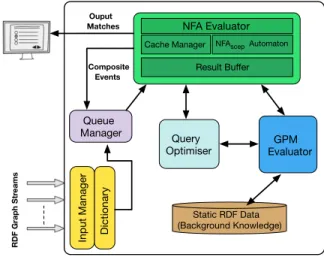
com-pile SPAseq queries, and then provide details regarding the various system’s blocks and optimisations used for the SPAseq query engine.
In general, for a CEP system, the set of defined temporal operators are evaluated in a progressive way against the incoming events. That is, before a compos-ite or complex event is detected through a full pattern match, partial matches of the query patterns emerge with time. These partial matches require to be taken into account, primarily within in-memory caches, since they express the potential for an imminent full match. There exists a wide spectrum of approaches to track the state of partial matches, and to determine the occurrence of a complex event. In summary, these approaches include rule-based techniques [12] that mostly represent a set of rules in a prolog like language, tree structures [50,5] where the pattern are parsed as join trees, graph-based representations [51,27] to merge all the rules within a single structure, and finally Finite State Machine repre-sentations, in particular Non-deterministic Finite Au-tomata (NFA) [8,52]. The choice of these representa-tions is motivated not only by their expressiveness mea-sures, but also on the performance metrics that each ap-proach tries to enhance. For instance, ETALIS [12], a rule-based engine, mostly focuses on how the complex rules are mapped and executed as Prolog objects and rules, while SASE+ [4,8], Zstream [5] and lazy evalua-tion [53] of NFAs focus on query-rewriting, predicate-related optimisations and memory management tech-niques.
leaves of the tree and the matched results are propa-gated to the root of the tree to extract a full match. However, considering the following points, we opt to use an NFA-based compilation and execution model for SPAseq queries: (i) given the semantic similarity of SPAseq’s sequence expressions to the regular ex-pressions, NFA would appear to be the natural choice; (ii) NFAs are expressive enough to capture all the com-plex patterns in SPAseq; (iii) NFAs retain many attrac-tive computational properties of Finite State Automata (FSA) on words, hence, by translating SPAseq queries into NFAs, we can exploit several existing optimisation techniques [8,52].
In addition to the NFA-based model, we use various optimisation techniques to evaluate GPM expressions proposed by our system SPECTRA [44]: since SPAseq employs an RDF graph model, it not only requires the efficient management of temporal operators, but also the efficient evaluation of graph patterns. In the follow-ing, we first describe the NFAscep model for SPAseq,
and later present how SPAseq queries are compiled and evaluated using NFAscep. The optimisation techniques
for the execution of SPAseq queries are provided in Section7.
6.1. The NFAscepModel for SPAseq
We extend the standard NFA model [40,54] in three ways. First, given that SPAseq matches events with GPM expressions, we associate each automaton edge with a predicate, and for an incoming event, this edge is traversed iff the GPM expression is satisfied by this event. Second, in order to handle statefulness between GPM expressions (shared variables), we store in each automaton instance the mappings of those events that have contributed to the state transition of this instance. Third, we map all the SPAseq operators (conjunction, disjunction, Kleene+, event selection strategies, etc.)
on the NFA model: in the existing works [8,9], the map-ping for the NFA model are only shown for a subsets of these operators and all the operators are not mapped onto a single model. We call such an automaton model as NFAscepand it is defined as follows:
Definition 17 An NFAscep automaton is a tupleA =
hX, E,Θ, ϕ, xo, xfi, where
– X: a set of states;
– E: a set of directed edges connecting states;
– Θ: is a set of state-transition predicates, where eachθ∈Θ,θ= (U,op,P)is a tuple;Uis a set of stream names,op∈ {‘&’, ‘+’, ‘|’, ‘;’} ∪ {∅}
is a temporal operator, andPis a graph pattern;
– ϕ: is a labelling functionϕ : E → Θthat maps each edge to the corresponding state-transition predicate;
– xo:xo∈Xis an initial or starting state;
– xf:xf ∈Xis a final state or acceptation state.
We define three types of states:initial(xo),ordinary
(x) andfinal(xf) states. These state types are analogous
to the ones used in the traditional NFA models to im-plement the operators such as sequence,Kleene+, etc.
Each state, except the final state, has at least one forward edge. Note that, we use a structureH= (θi,Ai,Ω)to
store the set of mappingsΩcorresponding to the state-transition predicateθiand the automaton instanceAi.
Hence, when an event makes an automaton instance traverse an edge, the mappings in that event are properly referenced.
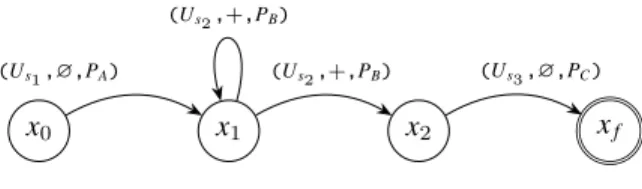
Example 12 Figure3shows the compiled NFAscepfor
the SPAseq Query 1 with the sequence expression
SEQ(A,B+,C). It contains four states, each having a set
of edges labelled with the state-transition predicates. The state-transition predicate (U, op, P) consists of three parameters: graph patternPfor the events with stream names (U);op describes the type of operator mapped to an edge, for instance edges of statex1 con-tain the Kleene+ operator. The description of mapping from the SPAseq Query1to the NFAscepin Figure3is as follows:
– The SPAseq Query1 contains the sequence ex-pressionSEQ(A,B+,C), which produces one ini-tial state, two ordinary states and a final state.
– Statex0has one edge with state-transition predi-cate ( called asGPM Ain Query1) (us1,∅,PA),
whereUs1 = {S1}and PA is the graph pattern.
Since the sequence expression in Query 1 only contains the immediately followed-by operator, the NFAscepcan simply transit to the next state on matching the state-transition predicate.
– Statex1mapsGPM Bwith Kleene+. Therefore, it has two edges each with a state-transition predi-cate (Us2,+,PB), one with the destination state x2, and other with itself as destination (x1) to consume one or more same kind of events; where
Us2={S2}andPBis the graph pattern.
– Statex2has one edge, which is used to transit to the next state if an event matches the defined state-transition predicate (Us3,∅, PC); whereUs3 =
x0 x1 x2 xf (Us1,∅,PA) (Us2,+,PB)
(Us2,+,PB)
(Us3,∅,PC)
Figure 3. Compiled NFAscepfor SPAseq Query1withSEQ(A,B+,C) expression
State-transition predicates are used to determine the action taken by a state to transit to another. For in-stance, in Figure 3 the state x0 transits to x1, if (1) the incoming event is from the defined stream name Us1, (2) the evaluation of the graph patternPAdoes not produce an empty set. Furthermore, the event selec-tion strategy also determines if there is afollowed-by
orimmediately followed-by relation between the
pro-cessed events. Note that, in the presence of theKleene+
operator, NFAscep will exhibit a non-deterministic
be-haviour, since the state-transition predicates will not be mutually exclusive.
Considering the vocabulary from existing NFA works [8,52], we say that each instance of an NFAscep
or a partial match is called arun. A run depicts the
partial matches of defined patterns, and contains the set of selected events. Each run has a currentactive state.
A run whose final state has reached is amatched run,
hence denoting that all the defined patterns are matched with the set of selected events. We call the output of the matched run as aquery match.
6.2. Compilation of SPAseq Queries
As discussed earlier, the two main components of the SPAseq language aresequenceandGPM expressions.
Due to the separation of these components, one can provide multiple different techniques to compile and process them. The compilation process of graph pat-terns using the traditional relational operators (e.g., se-lection, projection, cartesian product, join, etc.) within each GPM expression is borrowed from our earlier work [44]. Herein, we focus on the sequence expression and show how the temporal operators are mapped onto the NFAscep.
The sequence expression sorts the execution of GPM expressions according to its entries. Moreover, the tem-poral operators determine the occurrence criteria of such GPM matches and the event selection strate-gies are utilised to select the relevant events. These
constraints or properties are mapped on the NFAscep
through the compiled state-transition predicates, while the window constraints are computed during the eval-uation of each automaton run.
Let(u1,P1)and(u2,P2)be two GPM expressions, the compilation of SPAseq temporal operators onto an NFAscepautomaton is described as follows.
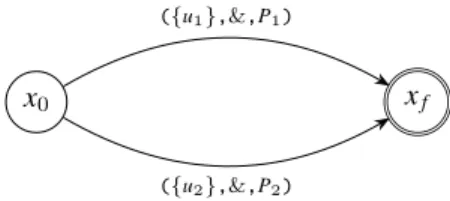
– Simple GPM expression: The NFAscepfor a
sim-ple GPM expression with a sequence expression forms a state which transits to the next one with the match of the GPM expression mapped at the state’s edge. The NFAscep automaton for a GPM
expression(u1,P1)is presented in Figure4.
x0 xf
({u1},∅,P1)
Figure 4. Example of Compilation of the GPM Expression (u1,P1)
– Kleene+: The Kleene+operator selects a set of
events if they match to the defined GPM expres-sion. Its automaton is constructed using two edges with one edge having the same source and desti-nation state. Thus, it can detect one or more con-secutive events. The corresponding NFAscep for
((u1,P1)+) is illustrated in Figure5.
x0 xf
({u1},+,P1)
({u1},+,P1)
Figure 5. Example of Compilation of the Kleene+ Operator
((u1,P1)+)
– Strict Contiguity Operator: The construction of
NFAscep for this operator is similar to the
com-pilation of a simple GPM expression, where a single edge for the corresponding state – having different source and destination states – is con-structed. The corresponding NFAscep automaton