The
OHIO
Journal of
Teacher Education
The
OHIO
Journal of
Teacher Education
Spring 2018. VOLUME 32 . NUMBER 1
PUBLISHED BY THE OHIO ASSOCIATION OF TEACHER
EDUCATORS
Message from the Editors 1
Editorial Board 3
A Call for Editorial Board Membership 4
ARTICLES
Motivation Behind Lesson Planning 5
Robin Dever, Ph.D. Kent State University -- Geauga
Pedagogy of a Fable 16
Christopher Meidl, Ph.D, Duquesne University Jordyn Hintz, BA., St. Norbert College
Coteaching partnerships during student teaching: Cooperating teachers’ professional
realizations and growth 31
Elizabeth Testa, Ph.D.,., Kent State University Lisa A. Borgerding, Ph.D., Kent State University Todd S. Hawley, Ph.D., Kent State University
Negotiating Between Efficiency and Flexibility: Learning from the Classroom Experiences
of Early-Career Elementary Teachers 49
Aaron Zimmerman Ph.D, Texas Tech University
Inquiry: How it is Presented During Professional Development
at an Informal Science Institution? 60
Gary M. Holliday, Ph.D,, The University of Akron
Engagement in Secondary Blended Classrooms
Lauren Angelone Ph.D, Xavier University 74
Alex Scrimpshire, Ph.D.,, Xavier University
Publication and Manuscript Guidelines 87
Important Dates of Note 88
A MESSAGE FROM THE EDITOR
Welcome from the The OHIO Journal of Teacher Education Editorial Team. We are honored and privileged to shepherd this journal for the educational community of Ohio
The OHIO Journal of Teacher Education (OJTE) is an online journal We invite all forms of article formats, as seen in the publication and manuscript guidelines included inside the journal. However, we do invite authors to utilize the online format. The use of links and other interactive devices will allow the online journal to be more than simply a pdf of articles that you can print at your own
workstation. In the future, the hope of the editorial team is to develop a truly functional online journal experience which can open the world of practice to our readership.
We will strive to build upon the solid foundation left by the previous editorial teams and move the OHIO Journal of Teacher Education forward as a resource for pre-service teachers, in-service teachers, and all with an interest in teacher education.
EDITORIAL BOARD
Michele Beery, Ph.D.
Wilmington College
Cynthia Bertelsen, Ph.D.
Bowling Green State University
Sue Corbin, Ph.D.
Notre Dame
College of Ohio
Joy Cowdery, Ph.D.
Muskingum University
Todd Hawley, Ph. D.
Kent State University
Stacey Pistorova, Ph.D.
Heidelberg University
Carol Ramsay, Ed. D.
Lake Erie College
Linda Ingling Rogness, Ph.D.
Muskingum University
Teresa Young, Ph.D.
Xavier University
Marlissa Stauffer, Ph.D.
Ohio Dominican University
Nicole Williams, Ph. D.
University of
A CALL FOR EDITORIAL BOARD
MEMBERSHIP
The Ohio Journal of Teacher Education (OJTE) is looking for interested individuals to join the Editorial Board of the journal. We are looking to establish a board that represents the Colleges and Universities of Ohio as well as offers a broad spectrum of
content expertise.
If interested, please submit a one page letter of intent that includes your College or University, your educational background, and your content area of interest
to the co-editors.
Dr. Mark Meyers at
TOPIC HERE
Motivation Behind Lesson Planning
Robin Dever, Ph.D...* Correspondence: Robin Dever, Ph.D. Kent State University- Geauga
14111 Claridon-Troy Road Burton, OH 44021
[email protected] Full list of author
information is available at the end of the article
Abstract:
Determining what to teach and how to teach it is an integral part of any teacher’s job. Teachers can use a variety of sources when creating their plans, including the Internet, colleagues, textbooks and curriculum materials, and prior experiences, such as their methods courses. The purpose of this study was to examine the sources first-year teachers use when creating their lesson plans and more specifically to determine whether or not ideas and materials presented in methods courses were among them. The results can help teacher educators improve the preparation teacher candidates receive in the process of lesson planning.
Introduction
First-year teachers have much to balance when setting up their classrooms, establishing routines and procedures, learning the culture of a new building, forming relationships with colleagues and administrators, and deciding what to teach each day. During their years in a teacher preparation program, teacher candidates are taught countless educational theories upon which to base their lesson plans. In addition, professors model best
practices in their respective content areas to demonstrate how to plan
Thus, two research questions motivated this study:
1. What resource (textbook, Internet, colleague, prior experience, or self-created) do first-year middle school teachers most use when creating their lesson plans? 2. Do first-year middle school teachers use the methods learned in their teacher
preparation programs when developing their lesson plans?
This study was designed to answer these questions in order to inform teacher educators about how best to prepare future teachers for the realities of lesson planning once they obtain their first teaching position.
Review of the Literature
Lesson planning is a major part of any teacher’s job. With regard to creating plans, teachers have a wide variety of resources to use as a foundation. When preparing teacher candidates to write lesson plans, teacher educators must consider the availability and use of these resources and prepare candidates to use them effectively; however, knowing the extent to which they actually do so requires research into the way in-service teachers use resources to plan lessons.
Several proposed models suggest a format for teachers to follow when creating lesson plans. The first of these is an objectives first model known as the Tyler (1950) model, widely seen as the accepted foundation of curriculum planning. Similar models followed, such as that of Hunter (1982), who recommended the following steps: establishing focus, stating objectives, modeling, and guided practice. Clark and Yinger (1980) also created a model closely resembling previous models and focusing on three steps, including using objectives and content to create an acceptable activity, followed by elaborating and implementing the activity.
Fifty-two percent of teachers in one study reported choosing activities as the center of their lesson plans in contrast to objectives or official curricula (Sullivan, Clarke, & Clarke, 2012); the choice of these activities is influenced by the physical space, use of resources, and curriculum materials (Brophy, 1982).
In addition, teachers consider their students when designing lesson plans, especially their students’ ability (Borko & Niles, 1987). Other affective considerations include their students’ moods, gender, self-concept, and work habits (Sardo Brown, 1988; Shavelson & Stern, 1981); furthermore, some novice teachers use their students’ prior knowledge and interests as a main consideration in lesson planning (Ball, Knobloch, & Hoop, 2007).
First-year, or novice, teachers face many challenges. As they navigate learning the daily operations of a classroom, they also learn to structure planning around many
contributing factors. At the beginning of their teaching experience, they tend to rely on textbooks as their primary source of lesson planning (Warren, 2000). One study showed that 85–95% of activities used in math and reading classrooms were based on a textbook
(McCutcheon, 1980). In addition, 90–95% of all classroom instruction was based on some form of published instructional material (Komoski, 1978). These statistics can be attributed to the growth of sharing websites on which teachers post lesson plans for other teachers to see or purchase. As of 2014, one site had a database of 750,000 lesson plans available for download (Hird, Larson, Okubo, & Uchino, 2014). The large number of available lesson plans may reflect quantity, not the quality of the content. Those who borrow the plans must determine their quality and whether or not they can be modified to meet the needs of their students.
Reliance on curriculum materials may wane over the course of the year as first-year teachers learn to navigate other resources (Sardo Brown, 1993). In addition, they may be influenced by memories of their own successful teachers, including instructors in their teacher preparation programs; and imagining themselves as such can drive their planning (Ball, Knobloch & Hoop, 2007; Ryan, 1986; Warren, 2000).
Teacher Education
they were taught in their teacher preparation programs (Ball et al., 2007; Clark & Yinger, 1980). In fact, participants in one study ridiculed their teacher preparation instructors for teaching them a lesson plan format that was impractical and unrealistic (Ball et al., 2007). Kagan and Tippins (1992) argued that lists of materials and objectives should not be required because they are often found in resource materials or textbooks used by teachers and are redundant when required in a lesson plan. Participants in their study also reported that including assessments in a lesson plan conveys a message that all assessments are formal and should take the form of a test or worksheet, which is often not the case.
Participants
This study involved four first-year middle school teachers, all of whom had graduated from a traditional teacher education program before obtaining their first teaching position in a school district.
Teaching in a building housing Grades 3–12, George was a seventh-grade science teacher in the rural school district where he had studied as a child. Approximately 1,000 students were enrolled in the district, and he was the only seventh-grade science teacher. Susan was a sixth-grade language arts teacher in the rural school district where her children were enrolled. After graduation from her teacher preparation program, she had worked in another district as an aide for a student in special education. Susan was the only sixth-grade language arts teacher in her district.
Julie was a sixth-grade mathematics teacher in a building housing Grades 6–8 in a rural school district with approximately 1,700 students. Her district had mandated a scripted curriculum for all math teachers and eliminated hardbound textbooks in favor of online textbooks. Students were given a code to access their textbooks online both at home and in the classroom.
Data Collection
Data gathered over a three-month period comprised lesson plans the teachers had coded to designate what resource they used to create each one. Submissions were analyzed for the codes, not content. The coding system, created by the researcher to ensure consistency among participants and to allow them to mark their plans quickly, included the following:
1. This plan was found on a website on the Internet.
2. This plan was found in a textbook or resource book I am using in my class. 3. This plan was given to me by a colleague.
4. This plan was based on a prior experience, such as something I used in my teacher preparation program or in my experience as a middle-school student.
5. This plan was self-created without consulting other sources.
Teachers were instructed that they could use multiple codes for a single lesson plan if more than one were applicable. Once they applied the numerical codes and submitted their plans, they were categorized based on the code; then a frequency table was created.
Results
A total of 298 codes were reported, derived from 178 different lesson plans. The number of lesson plans varied by participant because some taught in more than one grade level per day, resulting in more lesson plans for the same time period than others who taught a single lesson plan multiple times a day. Participant submissions were as follows: George (N=29), Susan (N=43), Tim (N=144), and Julie (N=79).
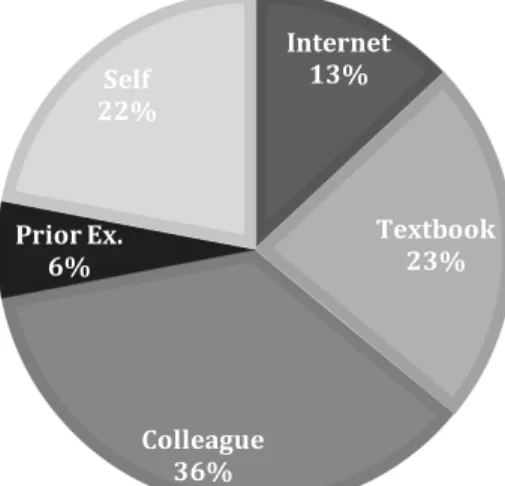
Internet 13%
Textbook 23%
Colleague 36% Prior Ex.
6% Self 22%
SOURCES
Internet Textbook Colleague Prior Ex. Self
Table 1
Participant Sources for Lesson Plans
Internet Textbook Colleague Prior Self
Experience
George 15 (52%) 2 (7%) 3 (10%) 0 (0%) 9 (31%)
(N=29)
Susan 5 (12%) 12 (28%) 9 (21%) 6 (14%) 11 (26%)
(N=43)
Julie 0 (0%) 44 (56%) 33 (42%) 0 (0%) 2 (3%)
(N=79)
Tim 19 (13%) 7 (5%) 62 (43%) 11 (8%) 45 (31%)
(N=144)
Figure 1. Total percentages of source of lesson plans.
Discussion
plans?—was determined by examining the percentage of lesson plans that teachers reported originating from various sources.
Of all lesson plans submitted, the largest percentage came from the first-year teachers’ colleagues. Because of the time constraints and stress a first-year teacher faces, this fact was unsurprising. First-year teachers can be overwhelmed, so they often turn to colleagues as a primary source for lesson planning. Because experienced teachers have already gone through the trial-and-error phase of lesson planning, they are able to pass along “tried and true” lesson plans to novice teachers (Kagan & Tippins, 1992).
In addition to depending on colleagues for lesson plans, first-year teachers rely heavily on textbooks when compared to other sources. Textbooks include many resources for
teachers to use in conjunction with the text. These resources are readily available, already correlated to the content material and standards, and require little to no preparation on the part of the teacher. As with obtaining lesson plans from colleagues, a new teacher can be tempted to rely on these resources to counterbalance the pressure of having to create new lesson plans for each day. In the case of Julie, who taught mathematics, the school district mandated that she follow a teacher-scripted textbook program, allowing for little to no deviation on the teacher’s part from the scripted material. This factor may explain why so many of Julie’s lessons were from the textbook (56%), the remaining from a colleague (42%), and none from outside sources. Her situation was in stark contrast to that of Susan, who taught language arts and used excerpts of text acquired from sources outside the traditional basal reader for her lessons. This required her to generate her own lesson plans because she did not use a traditional textbook, a fact reflected in the 26% of her lesson plans that were self-created.
The least reported source was teachers’ prior experiences, a result resembling that of Glick, Ahmed, Cave, and Chang (1992), who found that none of their participants had cited using materials or ideas from an education methods course. Experienced teachers reported that most of their lesson plans were the result of making modifications to plans after executing them; however, novice teachers do not have this type of experience to draw upon and must look to other past experiences for inspiration while creating lesson plans. These experiences tended to be either lessons they had observed during their methods courses or lessons their teachers had taught them during their own K–12 experience. Although methods courses typically focus on education theory and demonstrate best practices for individual content areas, they cannot provide the basis for all possible lesson plans; however, many methods and techniques that teachers can use as a basis for future lessons are modeled in these courses. Whether these techniques influenced the lesson plans in any way or whether the teachers had not reported them as based on prior experience—if they were not presented exactly as in methods courses—remains unclear from the data.
The data were further analyzed to answer the second research question: Do first-year middle school teachers use the methods learned in their teacher preparation programs when developing their lesson plans? The answer to this seems to be inconclusive without additional data. At first glance, the participants reported that a low number of their lesson plans (6%) were based on prior experiences. These teachers may not have applied methods and
techniques they were shown in their methods courses; however, closer examination of the data showed only two of the 17 lesson coded as based on prior experiences were marked with only this code. The remaining 15 were coded in conjunction with another source, most commonly paired with a code indicating a colleague’s influence. The two lesson plans that were solely coded as based on prior experience were lab experiences that Tim planned. This could have been a lab experiment he completed during his methods course or any other science course. The data did not specify where he had previously seen it performed.
Limitations
The researcher recognizes that this study had several limitations that affect its
generalizability. The first of these is the small sample size. Second, all participants taught in small, rural communities with small student body populations. Most of the teachers were the only content area teacher for their grade level, which may have limited the level of resources they were able to gain from colleagues teaching the same content on the same grade level. Finally, one participant was required to use a scripted curriculum and was directed not to deviate from its content, limiting her use of other sources outside of the textbook.
Future Research
Using this research as groundwork, future researchers could investigate content area as a factor in how teachers plan lessons. For example, in textbook-heavy areas, such as
mathematics, do teachers rely less on outside sources than teachers in areas such as science, where lessons tend to be less textbook centric and more hands on? In addition, the way teachers find sources for lesson planning may differ in large school buildings with multiple colleagues who teach the same content in the same grade; an examination of such a
phenomenon would be helpful. Finally, future researchers can expand on the five categories of codes used in this study to include environmental impacts, such as district mandates, schedule and organization, and student demographics to explore more in-depth influences.
Conclusion
Lesson planning has changed over time: The use of the Internet, focus on student-centered methods, and the need for differentiation have shifted the process of lesson planning from solely relying on a single source, such as textbook, to incorporating multiple sources.
First-year teachers rely less on textbooks and more on colleagues as sources of
References
Ball, A. L., Knobloch, N. A., & Hoop, S. (2007). The instructional planning experiences of beginning teachers. Journal of Agricultural Education, 48(2), 56–65.
Borko, H., & Niles, J. (1982). Factors contributing to teachers’ judgments about students and decisions about grouping students for reading instruction. Journal of Reading Behavior, 14(2), 127–140.
Brophy, J. E. (1982). How teachers influence what is taught and learned in classrooms. Elementary School Journal, 83(1), 1–13.
Clark, C. M. (1978). Teacher planning study described. Communication Quarterly, 1, 1–4. Clark, C. M., & Yinger, R. (1980). The hidden world of teaching: Implications of research
on teacher planning (Research Series 77). East Lansing, MI: Institute for Research on Teaching.
Glick, J. G., Ahmed, A. M., Cave, L. M. & Chang, H. P. (1992). Sources used by student teachers in lesson planning. Paper presented at the meeting of the National Science Teacher Association, Boston, MA.
Hird, M., Larson, R., Okubo, Y., & Uchino, K. (2014). Lesson study and lesson sharing: An appealing marriage. Creative Education, 5(10), 769–779. doi:
10.4236/ce.2014.510090
Hunter, M. (1982). Mastery teaching. El Segundo, CA: TIP Publications.
John, P. D. (2006). Lesson planning and the student teacher: Re-thinking the dominant model. Journal of Curriculum Studies, 38(4), 483–498. doi:
10.1080/00220270500363620
Kagan, D. M., & Tippins, D. J. (1992). The evolution of functional lesson plans among twelve elementary and secondary student teachers. The Elementary School Journal, 92(4), 477–489.
Komoski, P. K. (1978). The realities of choosing and using instructional materials. Educational Leadership, 36(1), 46–48.
Leinhardt, G. (1983). Routines in expert math teachers’ thoughts and actions. Paper presented at the annual meeting of the American Educational Research
Association, Montreal, Canada. Retrieved from ERIC database (ED234980) McCutcheson, G. (1980). How do elementary school teachers plan? The nature of
planning and influences on it. The Elementary School Journal, 81(1), 4–23. Ryan, K. (1986). Induction of new teachers. Bloomington, IN: Phi Delta Kappa
Educational Foundation.
Sardo Brown, D. (1988). Twelve middle-school teachers’ planning. The Elementary School Journal, 89(1), 69–87.
Shavelson, R. J., & Stern, P. (1981). Research on teachers’ pedagogical thoughts,
judgments, decisions, and behavior. Review of Educational Research, 51(4), 455– 498.
Sullivan, P., Clarke, D. J., & Clarke, D. M. (2012). Teacher decisions about planning and assessment in primary mathematics. Australian Primary Mathematics Classroom, 17(3), 20–23.
Tyler, R. (1950). Basic principles of curriculum and instruction. Chicago, IL: University of Chicago Press.
Warren, L. L. (2000). Teacher planning: A literature review. Educational Research Quarterly, 24(2), 37.
Zazkis, R., Liljedahl, P., & Sinclair, N. (2009). Lesson plays: Planning teaching versus teaching planning. For the Learning of Mathematics, 29(1), 40–47.
Author:
Robin Dever, Ph.D.
Kent State University- Geauga 14111 Claridon-Troy Road Burton, OH 44021
440-834-3720 (office)
Robin Dever is an assistant professor and program coordinator of middle childhood education at Kent State University-Geauga in Burton, OH. She also serves at the
International Baccalaureate Middle Years Programme (MYP) coordinator for KSU. Her research interests include middle childhood teacher education and professional
development. Robin is the former President of Ohio Middle Level Professors and currently serves on the Board of Directors.
TOPIC HERE
Pedagogy of a Fable
Christopher Meidl, Ph.D., and Jordyn Hintz, B.A.
* Correspondence: Christopher Meidl, Ph.D. Duquesne University
4127 Murray Avenue Pittsburgh, PA 15217
E-mail address:
Full list of author
information is available at the end of the article
Abstract:
Fables are stories intended to imbue a moral lesson. The research guiding this investigation explored how kindergarteners perceived the moral of a fable as compared to a preservice teachers intended goal. Case study framed the
methodology, with participants consisting of 20 kindergarteners. The fable The Lion and the Mouse was told orally in a whole group setting using 3 puppets. The
kindergartners completed an assessment with multiple-choice, T/F, and drew a picture. Through the drawings, students demonstrated personal connections with the story. Three themes emerged from the data: social constructs, social justice, and social competency.
Introduction
Fables are a time-honored format for story telling with the intent to develop moral and ethical thinking. Aesop wrote a collection of over 725 fables dating back to 6th century BCE. These fables served many purposes: 1) as a means for entertainment, 2) to teach moral understanding infused with reading and writing instruction, and 3) to promote self-reflection of moral situations (Horgan, 2014). A key feature of Aesop’s fables was that they often included an animal or animals that displayed human like
qualities. Traditionally, fables were passed down orally from generation to generation (Horgan, 2014).
As time passed, fables were written into traditional pieces of literature, often still delivered through oral storytelling (Dixon, 2014). With regard to their place in classroom instruction, Detlor (2001) states that fables can help build moral development, contribute to a strong classroom
. In more recent times, colorfully illustrated stories and/or multiple variations and adaptations of
traditional fables contribute to the continued utilization of moral themes from fables to teach
children. Educators are left wondering how children interpret the morals of the stories they
present children with as part of class instruction.
Building Literacy and Understanding Metaphors
In early childhood education, a common form of literacy instruction occurs through
“read-alouds.” Often, read-alouds occur daily as a means to develop alphabetic understanding,
phonemic awareness, fluency, and comprehension skills. Stories, fiction and non-fiction, help
children to understand the world around them and learn essential skills needed to read and write
(Im, Parlakian & Osborn, 2007). Fables have a particular style and rhetoric that often allow
children to connect with the story.
Fables have distinct structures and patterns that push children to think critically and
challenge them to use higher level thinking skills, lending them to be “good fits” for read-alouds
(Detlor, 2001). According to Detlor (2001) fables help children’s ability to interpret metaphors,
make inferences or judgments, and create and evaluate different solutions to a problem. Being
able to understand children’s ability to inference is important as a means to create moral
thinking.
Vosniadou & Ortony (1983) examined whether or not young children would be able to
distinguish between meaningful and non-meaningful comparisons. Children were presented with
word (A) to compare with word (B). They were instructed to either compare the two words
children could either choose, a river is like a lake (BL), a river is like a snake (BM), or a river is
like a cat (BA).
They hypothesized that younger children would choose either literal or metaphorical
comparisons over anomalous ones. Data proved their hypothesis to be true; however, four year
olds were able to distinguish between categorical and metaphorical features. This indicated that
they understand that literal and metaphorical comparisons belong to different conventional
characteristics of a word (Vosniadou & Ortony, 1983). These results indicated that because
children understand both a literal and metaphoric context the use of fables actually provided
young children the opportunity to generate meaning from these complex concepts. Fables push
students to simultaneously utilize literacy understanding and sometimes inferences, but the
question becomes whether that transfers to more ethical and moral concepts in fables.
Ethical Moral Development and Relationship to Real Life
Moral lessons meant to help us understand social, psychological, and inter-relational
concepts are the foundation of a fable. In a classic fable, the main character is faced with a moral
dilemma that they must solve. Children connect naturally to stories that are relatable to their own
lives and contexts of ethical decision-making, as well as the plots and characters in those stories.
It is important for teachers to facilitate connections between children’s prior experiences and the
dilemma presented in the fable. If there is no real life application, the child may not understand
the message and the moral lesson will be lost.
Prior knowledge and individual differences among children are said to contribute to their
overall comprehension of the theme of a moral story. Children whose schemas are not as
developed will remember less of a story than those who have more developed schemas. Narvaez,
ability to extract the theme from a moral story. They analyzed responses from 50 third graders
and 54 fifth graders. The study controlled for children’s overall literacy fluency and
comprehension so that poor moral story comprehension skills could not be attributed to their
overall literacy difficulties. Their predominant finding was that reading moral stories aloud to
children alone does not guarantee moral theme comprehension. The researchers attribute
children’s inability to grasp overarching themes to their preoccupation with small irrelevant
details.
Moral theme comprehension requires something beyond general reading comprehension.
Narvaez (2002) explains that children can often summarize a story, but not necessarily get the
“point” (p. 162). Continuing she explained, “Instead of acting as a virus and spreading easily
among those exposed, receiving moral messages turns out to be more like the game of
‘telephone,’ in which one person whispers a statement into the ear of the person in the next seat,
and the message continues to be whispered to the next person around the circle back to the point
of origin” (p. 166). Older children are able to grasp more in order to generalize moral messages
or just have difficulty remembering or applying the theme to real life situations. When reading
stories, teachers have the task of facilitating real life connections.
Reader Response Theory and Moral Stories
As mentioned previously, older children who have more life experiences will generally
be able to relate to the moral of the story better than younger children. Reader Response Theory
as described by Rosenblatt (1978) allows the reader to interpret text based the literary style and
affect, subjective experience, and psychological and social connections. Focusing on the
reactions allows researchers to examine how various readers interpret the literary work. As Iser
different readers to form their own view. Children’s unique interpretations of stories reveal
certain aspects about their developmental stage.
Iser (1978) found that children interpreted stories and drew pictures based on personal
experiences. When exposed to the same stories and given the same directions, drawings were all
uniquely different. Aligned with reader response theory, Narvaez’s (2002) work on morals in
stories has led her to the assertions that character educators must recognize: 1) “Reading is
active,” 2) “Readers ‘get’ different information from a text based on their background (e.g.,
skills, knowledge, expertise),” 3) “Readers do not necessarily ‘get’ the information or message
the author intends,” 4) “Themes can be constructed by the reader but not automatically or
easily,” and 5) “Moral messages are a special kind of theme the reader puts together that are
influenced by reading skills and moral development” (p. 169). Giese (2008) found, that educators
who bring in topics of moral and ethical tension have to account for “students' diverse capacities,
interests, and identities when they select topics, texts, and instructional strategies” (p. 203).
Moral stories often require teachers to make sense of students interpretations of stories, guiding
them through themes with aspects related to social justice and moral decision-making.
Critical literacy provides a lens for how and young children interpret text related to moral
and social justice issues. Phillips (2012) explains how storytelling workshops were “interaction
with the story occurred in small group activities where the children explored the stories through
drawing, sculpting/building, dancing and developing social actions to redress injustices” (p.
144). Included in the data collected was from children was what concerned them, what they
considered to be “just or fair,” how the characters acted (p. 145). Chafel, Amy, Hammel, and
Kathleen (2007) discuss critical literacy as providing the opportunity where teachers allow,
seriously addressing issues of social justice, equity, and diversity in developmentally appropriate
language” (p. 74). Children must be exposed to the process of developing a critical lens in order
to be invested in thinking for social justice.
A great deal of research explores preservice teachers’ intent for delivering literacy
instruction, but there are limited amounts of studies that explore young children’s understanding
of stories meant to teacher about positive character, morals, or social justice. The purpose of this
study was to understand how young children, kindergartners, interpret the moral lesson of a fable
as compared to the intended goals of a preservice teacher. The research question guiding this
study was how would children use illustrations to demonstrate their interpretation of the moral of
the story “The Lion and the Mouse?”
Methods Participants
Participants consisted of twenty kindergarten students from a public elementary school in
the Midwest. One of the children had been identified on the Autism Spectrum. The school’s
population primarily consisted of middle class, Caucasian students.
Design
This phenomenological research explored how kindergarteners perceive the moral lesson
of a fable as well as their overall comprehension of the fable. Children were read aloud the fable
“The Lion and the Mouse” and administered a short assessment to evaluate their comprehension
of the fable.
The fable that was read aloud to the kindergartners was titled “The Lion and the Mouse.”
This fable was chosen because it was short in length, yet had a powerful moral. In the fable, a
and grabs it with his large paw. The mouse is very frightened and begs the lion to let him go. The
lion asks, “Why should I let you go?” The mouse replies, “I am just a little mouse, but I can be a
good friend to you.” The lion laughs, wondering how such a little mouse could be a good friend
to him. The lion ends up letting the mouse go. A couple days pass when the mouse hears a very
loud roar. The mouse hurries along to investigate and finds the lion trapped in a big net by
hunters in the forest. Eventually, the mouse nibbles through the net and sets the lion free. The
lion allows the mouse ride on his back, and from that day on the two become the best of friends.
Procedure
After the creation of the tool for data collection, designed with developmentally
appropriate practice (Copple & Bredekamp, 2009) in mind consent and assent was gathered. One
researcher went to the classroom and told the fable to the kindergartners. To make the story more
interactive and engaging, three puppets (e.g.: a small mouse, a lion, and a lion trapped in a net)
were used when reading the story. Directly after the fable was performed, students returned to
their desks and were administered the assessment. Following the assessment, the researcher
discussed each child’s drawing with them to distinguish what they were trying to depict in the
drawing. Quotes of students explanation of their drawing were written down verbatim directly on
their picture.
Assessment as a Form of Data
The assessment protocol consisted of three different parts. The first was using
developmentally appropriate multiple-choice questions designed to measure comprehension of
the story. Responses were presented as words as well as pictures of the characters. The next
question asked the students, “Do you think people or animals that have differences can be
assessment, children were instructed to draw what they thought the most important part of the
fable was. They were not told what to draw, but were told to make their drawing as detailed as
possible. After the children finished drawing, they dictated to the researcher what was happening
in their drawings.
Data Analysis
Malchiodi (1998) explains using a phenomenological approach to understand children’s
drawings puts an, “emphasis on an openness to a variety of meanings, the context in which they
were created, and the maker’s way of viewing the world” (p. 35). Further more, “Children use art
to link their experience of the outside world with the inner-self, helping them to discover and
affirm themselves and their relationships to people, environment, and even society” (p. 37). As a
researcher using a phenomenological perspective, the drawings were interpreted for, “cognitive
abilities, emotional development, interpersonal skills, and developmental maturity” (p. 37).
Results
From the data various Analysis of the question asking students to identify the two main
characters, every student chose the correct answer, the lion and the mouse. In question two,
where students were asked, “Do you think people or animals that have differences can be
friends,” 17 out of the 19 students in the classroom chose “yes.” Although, two of the 19 had
originally circled “no” (which was the incorrect answer based on the story), they then changed
their answer to “yes.” This might have been influenced by them genuinely changing their mind
or possibly looking on in comparison with peers’ responses, which were different from their
Figure 1
Structure of the closed ended section of the
assessment tool. The intent was to gather data from the kindergarteners about comprehension using a form of elicited response.
The final portion of the assessment tool required students to illustrate what they thought
was most important from the fable. After each child had finished their illustration, a discussion
was had with each student in regards to what they drew.Using student dictation, direct quotes
from the students were recorded alongside the corresponding illustration. This was done in order
to gain additional insight before interpreting each student portrayal in their illustration regarding
The Lion and the Mouse fable. When looking at the illustrations from the kindergartners, all of
them added extra details in the surrounding environment that were not mentioned when the fable
was told. This relates to Narvaez (2002) explaining readers understand moral decision-making
and interpretations based on personal experience. Some of these extra details included, grass,
trees, the sky with sun and clouds, a cave, two waterfalls, and some students even included
animals that might be in a similar environment such as monkeys. One kindergartner described,
“The lion is caught in the net, and the mouse is coming to the rescue.” See Figure 2. When
important lesson of the fable, three themes emerged in the coding process. Themes consisted of
social justice, social constructs and context, and social competency. Social justice was infused as
five students drew the mouse helping the lion get free from the net. In these five drawings, there
were no other characters. See Figure 2.
Social constructs and contexts occurred as students labeled characters within the story.
Another group of five drew something similar, the mouse helping the lion; however, there were
also “hunters” or “bad guys” in their drawings. These students not only pointed out the injustice
of the lion in the net, but also labeled the hunters as “the bad guys.” One student explained, “The
mouse helped the lion get out of the net.” See Figure 3.
Figure 3: Several children believed the moral of the story was that you should help people because the mouse helped the lion.
Social competency was evident as students understood how the lion and the mouse became
friends. There is a general connection with themes for young children in this story and fromNarvaez
related to the intended moral of the story. That student’s depiction of the story was described as
the ending of the story “when the lion and the mouse had become friends!” See Figure 4.
.
Figure 4
This picture illustrates how friendship emerged from the multiple interactions.
Discussion
Overall, the data collected from this research depicted results showing that students’
drawings provided an informative lens to understand how students interpret a story. As Narvaez
(2002) describes, “Moral messages are a special kind of theme the reader puts together that are
influenced by reading skills and moral development” (Narvaez, 2002, p. 169). The results
children. The use of drawings compares to is supported by the work of Chafel, Amy, Hammel,
and Kathleen (2007) who discuss platforms for children to demonstrate critical literacy.
The drawings provided data for young children to express their thoughts and ideas,
especially when their vocabulary and writing skills are advanced enough to do that. Using
dictation about the drawing was also beneficial because it allows for adults to understand
symbolic meaning to get clarification on intent portrayed within a drawing. Additionally, this
mode of assessment creates an engaged and motivated learning environment. Through the
drawings, students were better able to demonstrate thoughtfulness in how they personally created
detailed context for the story The Lion and the Mouse. “Readers do not necessarily ‘get’ the
information or message the author intends” (Narvaez, 2002, p. 169).
The three themes that emerged, social constructs, social justice, and social competency,
emphasize how much the children connected sociologically with the story. While students
connected to social constructs and justice, few were able to make the larger jump of
understanding the greater moral implications from the story. These findings related to the
research of Narvaez, Gleason and Mitchell (1999) who attributed children’s inability to grasp a
moral theme. From the present data, it was apparent that for the children who drew extra details
such as hunters, trees, grass, other animals, etc. creating the aesthetic context was as important as
the interactions and moral of the story.
Implications for future research, it would be beneficial to examine whether this type of
assessment is beneficial across other grade levels. Conclusions would indicate that the use of
students’ drawings and opportunity to orally communicate their thoughts about learning is a tool
that can easily be implemented when learning about fables and other aspects of the literacy. As
social issues surrounding power and identity mixed within the story. Part of creating assessment
has led to the creation of simple tools that validate what was taught rather than demonstrate
opportunities for student expression or cognition.
Conclusion
Based on this research question, how do children understand the moral of a fable using
drawings to illustrate their interpretation, there apparently is clear indication that students
interpret the importance of a story in a variety of ways. As Vosniadou and Ortony (1983)
found, this research also supports, formal assessment of students’ understanding of the
metaphoric implications of a fable is far more complicated than comprehension expectation of
programs like Reading First. Similar to Chafel, Amy, Hammel, and Kathleen (2007), the
critical literacy skills necessary for children to interpret ethical and moral stories is complex,
however drawings and dictation allow for children to demonstrate their interpretation of the
story.
References
Beltchenko, L. (n.d). The Components of Effective Read Alouds (PowerPoint Slides).
Retrieved from http://www.d118.org/district/curriculum/initiatives/components-effective-read-alouds.pdf.
Chafel, J. A., Amy, S. F., Hammel, J., & Kathleen, H. P. (2007). Young children, social
issues, and critical literacy stories of teachers and researchers. YC Young Children, 62(1), 73-81. Retrieved from
Copple, C. & Bredekamp, S. (2009). Developmentally appropriate practice in early childhood programs, 3rd edition. Washington, D.C.: National Association for the Education of Young Children.
Detlor, T. (2001). Teaching with aesop's fables. New York, NY: Scholastic Professional Books.
Dixon, B. (2014). Fables and philosophy. Teaching Ethics. DOI: 10.5840/tej201410177
Giese, C. (2008). Powerful stories, powerful conversations: Using literature to teach for social justice (Order No. NR39989). Available from ProQuest Education Journals. (304397419). Retrieved from
http://search.proquest.com/docview/304397419?accountid=10610
Holdren, T. (2012). Using art to assess reading comprehension and critical thinking in adolescence. Journal of Adolescent & Adult Literacy, 55(8), 692-703. doi:10.1002/JAAL.00084
Horgan, J. (2014, March). Aesop's Fables. Retrieved October, 2015, from http://www.ancient.eu/article/664/.
Im, J., Parlakian, R., & Osborn, C. (2007). Stories: Their powerful role in early language and literacy. YC Young Children, 62(1), 52-53.
Iser, W. (1978). The act of reading: a theory of aesthetic response. Baltimore, MD: John Hopkins University Press.
Justice, L., Logan, J., Kaderavek, J., & Dynia, J. (2015). Print-focused read-alouds in
early childhood special education programs. Exceptional Children, 81(3): pp. 292–311.
Malchiodi, C. (1998). Understanding children’s drawings. New York, NY: The Guilford Press.
Narvaez, D. (2002). Does reading moral stories build character?. Educational Psychology Review, 14(2), 155-171.
Narvaez, D., Gleason, T., Mitchell, C., & Bentley, J. (1999). Moral theme
comprehension in children. Journal of Educational Psychology, 91(3), 477- 487.
Phillips, L. G. (2012). Retribution and rebellion: Children's meaning making of justice through storytelling. International Journal of Early Childhood, 44(2), 141-156. doi:http://dx.doi.org/10.1007/s13158-012-0053-2.
Vosniadou, S., & Ortony, A. (1983). The emergence of the literal-metaphorical- anamalous distinction in young children. Child Development, 54(1), 154-161. doi: 10.2307/1129872
Authors:
Christopher Meidl, Ph.D.
4127 Murray Avenue Pittsburgh, PA 15217
E-mail address: [email protected]
Businessphone numbers: (412)396-2620
Institutional affiliation: Duquesne University
Co-Author: Jordyn Hintz, BA Early Childhood Education, St. Norbert College, De Pere, WI.
TOPIC HERE
Coteaching partnerships during student teaching: Cooperating teachers’
professional realizations and growth
Dr. Elizabeth Testa, Dr. Lisa A. Borgerding, and Dr. Todd S. Hawley
* Correspondence: Dr. Elizabeth Testa Assistant Professor School of Teaching, Learning, and Curriculum Studies
Kent State University 401 White Hall, Kent State University
Kent, OH 44242
Full list of author
information is available at the end of the article
Abstract:
In response to the emphasis within teacher education to adopt a coteaching model of student teaching in general education courses, this study explored how coteaching relationships impacted cooperating teachers over the course of a school year. Drawing on qualitative interview and focus group data, we present findings that specifically address how the coteaching model of student teaching impacted cooperating teachers’ perceptions of their operalization of coteaching and the benefits of this model. Using a grounded theory approach to data analysis, we developed two main categories of findings: lessons learned, and professional realizations. These categories of findings suggest that the coteaching model of student teaching has the potential to overcome challenges inherent in mentoring student teachers while providing enlightening experiences and growth for experienced teaching professionals.
Introduction
Long considered the capstone experience of initial teacher
preparation, student teaching persists as the final learning context for most teacher education programs (TEPs.) However, in response to federal
initiatives from the Department of Education and national accrediting bodies (NCATE, 2010; CAEP Commission on Standards and Performance
Reporting, 2013; National Research Council, 2010), many TEPs have revamped key components of their programs, including student teaching, leading to changes that espouse coteaching models during the student teaching practicum. Accordingly, these models propose cooperating
teachers collaborate with student teachers in less hierarchical ways (Roth & Tobin, 2002) where both share in the planning, instruction, and assessment of students (Friend & Cook, 2013; Bacharach, Heck & Dahlberg, 2010a).
. At our institution, each program was given great latitude in determining how to develop the
model, or to adopt the model at all. As teacher educators and practitioner researchers, we were
interested in understanding how our programmatic emphasis on a coteaching model impacted
those participating, in particular, studying how coteaching partnerships developed, or not, over
the course of the school year and the perceptions the cooperating teachers had of the impact that
coteaching with a student teacher had upon them. To address our questions, we developed two
research questions to guide our study: 1. What are cooperating teachers’ perceptions of their
abilities to operationalize aspects of coteaching during the student teaching experience? and, 2.
What impacts did coteaching with student teachers have upon the cooperating teachers?
Theoretical Framework
Learning to teach and learning while teaching, involve interconnections among the
learner with discipline-specific content knowledge and pedagogical knowledge, the processes of
enacting this knowledge, and the various contexts surrounding teaching events (Shulman, 1986;
Feiman-Nemser, 2008). In particular, the student teaching practicum creates a complex learning
context involving a network of mediating factors affecting learners as they negotiate the setting
and make decisions about instruction. Furthermore, the cooperating teachers participating in this
study interacted with new knowledge of coteaching practices that required them to appropriate
new sets of pedagogical and conceptual tools related to coplanning, shared instruction, and
coreflection. Therefore, this research is grounded in sociocultural theories of learning. From this
stance, we believe learning to teach is a meaning-making endeavor mediated by several factors
and cooperating teacher, and each individual’s beliefs about learning to teach. Relatedly,
learning while teaching involves many of the same mediating factors.
Our work also draws upon activity theory. Activity theory assumes the primacy of action
which is carried out in specific settings comprised of social structures developed over time in
culturally grounded ways (Grossman, Smagorinsky & Valencia, 1999). The individual develops
conceptual and pedagogical tools to complete their actions within these settings. According to
Grossman et al. (1999) , “conceptual tools are principles, frameworks, and ideas about teaching
and learning… that teachers use as heuristics to guide decisions about teaching and learning” (p.
11). Commonly utilized conceptual tools include broad learning theories such as constructivism
and more specific theoretical approaches such as the writing process in language arts or
connections to nature of science in science education. Conversely, pedagogical tools refer to the
more immediate utility of classroom strategies and resources that align to conceptual frameworks
of teaching and learning (Grossman et al., 1999). For example, classroom routines such as
bellwork, exit slips, or classroom resources such as SmartBoards and textbooks are common
pedagogical tools. Another central concept, the idea of appropriation, concerns individuals
adoption of ways of knowing and acting according to their participation in socially situated
practices (Grossman et al., 1999). In this paper, we focus on the activities occurring within the
context of the relationship between the PST and the cooperating teacher and the perceptions of
how the relationship professionally impacted the cooperating teacher.
Literature Review
Previous literature has documented how cooperating teachers often feel generally
consistently lament that they were never trained for their roles with their student teacher (Clarke,
Triggs, & Nielson, 2014; Young & MacPhail, 2015). Some of this lack of preparation is related
to poor communication with the university. For example, cooperating teachers complain that
they are not clear on the university's’ expectations for cooperating teachers and do not feel
adequately supported by the university (Applegate & Lasley, 1982; Koskela & Ganser, 1995).
Cooperating teachers complain that they lack clear guidelines and consequently do not know
how to evaluate their student teachers (Koskela & Ganser, 1995; Young & MacPhail, 2015).
Cooperating teachers are sometimes challenged by various aspects of their roles as
cooperating teachers. First, cooperating teachers have a tendency to still feel very responsible
for their own students (Clarke, et al., 2014) and struggle to relinquish control of their classrooms
(Torrez & Krebs, 2012). Second, cooperating teachers struggle with providing constructive
feedback without being overly critical (Clarke, et al, 2014; Koskela & Ganser, 1995; Torrez &
Krebs, 2012; Young & MacPhail, 2015). Some of this tension arises because cooperating
teachers are challenged as they negotiate the line between being a colleague/friend and a
“critical” friend (Young & MacPhail, 2015). Finally, cooperating teachers struggle to find time
to meet and reflect with their student teachers throughout the day (Torrez & Krebs, 2012; Young
& MacPhail, 2015).
Research on the Coteaching model of student teaching
Within the field of special education, coteaching has been defined as two teaching
professionals sharing responsibility for planning, instructing, assessing, and sharing in other
professional duties (Friend & Cook, 2013). Coteaching as a model for preservice teacher
practicums has been emerging over the last decade (Bacharach, Heck & Dahlberg, 2010a;
of several preservice teachers, cooperating teachers and university faculty in secondary science
education claiming that coteaching “provides an ideal context for learning by providing a ‘zone
of proximal development’ in which the collective achieves more than the individual alone” (p.
250). Concurrently, Bacharach et al. (2010b) described the many positive impacts that
coteaching has upon all learners involved, including the P-12 students, preservice teachers, and
cooperating teachers.
In the UK, Murphy and Beggs (2010) conducted a five-year longitudinal study collecting
data on coteaching arrangements among student teachers, cooperating teachers, university
faculty and children in 120 primary science classrooms. They found highly positive impacts
upon the student teachers and cooperating teachers, in particular, an increase in the
“democratisation of teaching” because of the equalizing of relationships due to the coteaching
partnerships (Murphy & Beggs, 2010, p. 33). Murphy, Carlisle, & Beggs (2010) further asserted
that a decade of research on coteaching indicates expansive impacts on teaching and learning for
all participants. They describe the many enriched resources available through the collaboration
including those generated during coplanning, coteaching, coevaluation, shared subject or content
knowledge, shared pedagogical knowledge, division of labor, and guiding principles of
collaboration, such as, corespect, coresponsibility, and coordination.
Research Design
Context
This study was conducted using participants who have volunteered to serve as cooperating
teachers in a secondary teacher education program housed in education at a large Midwestern
teachers for licensure in 7th – 12th grades. The majors included a range of 60 to 80 semester
hours of content coursework across a broad range of subjects, 12 hours of general education
coursework (Education in a Democratic Society, Educational Psychology, Instructional
Technology, and Introduction to Exceptionalities), a three-hour adolescent literacies course, a
three-hour general secondary teaching course, six hours of content specific teaching coursework,
and a 96-hour field placement with accompanying practicum seminar coursework. This was
followed by student teaching and a content specific student-teaching seminar. Students complete
their field placement and student teaching experience at the same school and work with the same
cooperating teacher across both semesters.
Participants
This study included 13 cooperating teachers (11 female, 2 male) who agreed to
participate in this investigation of the various ways cooperating teachers, student teachers, and
university supervisors developed coteaching relationships during a yearlong internship that
culminated in 12 weeks of student teaching. In this manuscript, we draw upon data from 11
participants because each participated in two individual interviews. These 11 cooperating
teachers taught secondary science (two), math (one), and language arts (eight) across six high
schools and one middle school.
Data Collection
The sources of data for this project included two individual interviews with each
cooperating teacher and and several focus group interviews. Each cooperating teacher
participated in one of the focus group interviews. The first interview occurred in November of
the fall practicum semester, just before or after the student teachers taught a two-week unit. This
student teaching and teacher education, and the development of the student teacher-cooperating
teacher relationship and how, at that point, it was being situated within a coteaching framework.
The second interview occurred in March, during the student teaching semester. At the end of the
spring student teaching semester, the cooperating teachers were invited to participate in focus
groups and individual interviews depending on their availability.
Data Analysis
Following each individual and focus group interview, all data were fully transcribed. The
process of data analysis was guided by a grounded theory approach as described by Strauss and
Corbin (1990). First, the authors independently open-coded eight Interview 2 transcripts, and this
analysis was guided by the open question: in what ways are cooperating teachers impacted by
their participation in this student teaching experience? The authors convened and compared open
codes, developing a preliminary coding scheme that included four main impact codes:
challenges, social benefits, lessons learned, and professional realizations. An additional code
encapsulating the nature of the relationship between the cooperating teacher and student teacher
was added because of its relevancy to the nature of impacts at this time. The authors then
independently applied these preliminary codes to the eight original Interview 2 transcripts and
the eight corresponding Interview 1 transcripts. Again the authors met to discuss these
preliminary codes and develop and refine subcodes, and an additional code describing
cooperating teachers' beliefs about the process of learning to teach was added at this point. This
iterative process continued until all sets of transcripts were coded. We then met to discuss the
codes and to explore themes emerging from the data. This process led to the developing of three
major findings focusing on the lessons learned and professional realizations from the coteaching
Findings
Lessons Learned
How to Teach about Teaching. Two participants (Andie and Lexi) described lessons
they had learned about teaching about teaching. In her second interview, Lexi recounted a story
about when her student teacher did not feel comfortable sharing her concerns about entering the
teaching profession. Lexi (2) said, “it just made me aware that I need to work a little more on
my communication skills” and that previously she “didn’t’ think [she] would have to invite
someone into a conversation.” On a more positive front, Andie (2) said she had “learned a lot
about being more organized and holding someone else accountable.” Later, Andie (Focus)
explicitly reflected how she had learned to teach about teaching: “I always thought I really
understood teaching but not enough to teach it and I’m like oh, I think I can teach teaching”
(Andie, Focus).
New Lessons, Strategies, Technology. Seven participants described how they learned
about specific lessons, technology, examples, and strategies from their student teachers. Four
teachers described learning new technology from their student teachers: powerpoints (Kyle, 2),
websites (Kyle, 2), Twitter (Carin, Focus), Google Drive (Heidi, 2), blogs (Heidi, 2; Ginny 2 &
3), wikis (Ginny, 2), and various apps (Ginny, 2). Teachers described how the student teachers’
fluency with this technology has given them the experience and impetus to use technology in the
future even though, as Ginny (2) described, she “would have been leery to try [technology] on
my own.” Two participants described adopting specific activities and lessons that their student
teachers employed. Kyle (2) told his student teacher, “if you do anything on that computer, it’s
gotta be saved!” Two participants also described new methods and strategies that their student
teacher shared “creative strategies that” she had never used or had not “tried in a long time.”
Finally, Colleen. (2) benefited from her student teacher’s “real world experience” in the field of
mining.
Impact on Future Teaching. Beyond adopting specific new strategies, two cooperating
teachers described how the coteaching experience impacted their future teaching in broader
ways. First, Heidi (2) described how coteaching made her “better prepared for these kids for
next year too.” In her focus group, Heidi described how the experience will guide her future
coteaching arrangements, saying “I think I’m better geared and better equipped then to now work
with that intervention teacher here” so that they could “try to mutually plan together.” Maria (2)
felt that coteaching inspired her. She explained that, “it makes me want to be more excited about
the lessons that I’m coming up with and to think innovatively about how it is that I want to take
my students where they need to go.” She attributed this inspiration to “being around somebody
that has these newer ideas and has been trained in ways that I haven’t been” (Maria, 2).
Professional Realizations
The final set of impacts coteaching had upon cooperating teachers pertained to
professional realizations made by the participants. Several of these realizations were rooted in
coreflection and personal reflection. Cooperating teachers reflected more about their teaching,
reflected more out loud with their student teacher, and reflected more about teacher education.
Other realizations were more personal, including, cooperating teachers learning to appreciate
themselves better, feeling inspired and invigorated, and gaining a willingness to take more
Reflecting More About How I Teach. By slowing down to reflect with their student
teacher about their coteaching, five participants described how they were able to come “back to
the basics” (Carin, 2) of their teaching. For Andie (2) it meant analyzing and re-analyzing “what
we do and why.” Colleen (Focus) claims you “forget why you’re doing those things” but that the
process of explaining these choices to her student teacher helped her to examine those reasons.
She valued this process because she felt she would be more confident explaining the course to a
new hire starting the coming fall. Ginny (2) mentioned how being more reflective caused her to
revisit strategies from her past and how she relished “telling her [student teacher] wisdom from
the past.”
Five participants appreciated being able to “observe your own classroom” (Colleen,
Focus) as their student teachers taught. Kyle (2) appreciated “see[ing] what she misses, ‘cause it
gave me things to think about when I’m up there with my back turned.” Colleen (Focus) found it
enlightening to watch Shane teach and encounter classroom management problems that were
“happening because I didn’t do this or I haven’t been doing that.” Similarly, Carin (2)
deliberated her choices in responses to students during her conversations with her student
teacher. She emphasized the importance of “having someone here and thinking about how I am
interacting with these kids. Is it appropriate, is it the way we want to do it?” (Carin, 2). During
the focus group, Carin, reiterated how valuable it was to “watch Kayla in action and see where I
need to--things that I know I’ve let slip that I was seeing with her, reflected in her” (Carin,
Focus). Candace described a related awareness of these up-close interactions emphasizing that
when “somebody’s in the room watching and participating with me, I can’t be off my game”
performance, she questioned her practice asking, “how could I get everyone involved? How can I
make today different than yesterday?” (Kendra, 3).
Reflecting More About Teaching Education. Among the five teachers who expressed
an impact related to teaching education, Andie was the most ebullient. She explained how she
questioned if she “really understood teaching enough to teach it,” and after she finishing
coteaching with Shane she asserted, “I think I can teach teaching!” (3). Carin pondered the same
question as she cotaught with Kayla wondering, “Could I teach this to somebody else, what I do
on a daily basis?” (2). As a mentor teacher to new teachers in her district, Candace’s response
highlighted her belief that the district “needs to incorporate the coteaching models” into their
induction program (2). Maria shared her student teacher with Candace, who had been Maria’s
cooperating teacher a decade before. Maria felt the experience coteaching with Rebecca gave her
a unique insight by “getting to see both sides” of the teacher education partnership (1). Kendra
described a revelation about how much she “care[s] about the profession” (2).
Willing to Take Professional Risks. Five participants attributed a willingness to take
professional risks to their experience coteaching. For Carin (Focus), agreeing to be a cooperating
teacher for the first time was a “big fear” she overcame. Sharon (3) declared that, because of the
experience coteaching, she was “more open” and comfortable to share her classroom with
somebody. Colleen (Focus) felt “really comfortable” taking on greater leadership in working
with first-year teachers. Similarly, Candace (2) lobbied for “restructuring that mentoring
program” to include coteaching. Candace (Focus) also shared how she approached her building
leadership to allow her to have a duty period in which she would coteach with two 9th grade
teachers whose classes would each have 6-8 students needing literacy support. When asked if the