Vignette Element Analysis for Automated Generation of Vignettes in Pharmacy Education
By
Carolyne Ma, Robert Hubal1, Jacqui McLaughlin1,2
1Division of Practice Advancement and Clinical Education, UNC Eshelman School of Pharmacy 2Center for Innovative Pharmacy Education and Research, UNC Eshleman School of Pharmacy
Journal Format: Education in Health Professions
Honors Thesis
UNC Eshelman School of Pharmacy University of North Carolina at Chapel Hill
March 2, 2020
Approved:
Jacqui McLaughlin, PhD
Abstract
Objectives. To analyze and describe vignette elements and structure, and resulting difficulty, as a
foundation for vignette construction in medical education, and ultimately automated vignette generation.
Methods. Sixty-three vignettes representing a variety of disease states were sourced from
Objective Structured Clinical Experiences, published practice literature focused on pharmacy, and other training and assessment environments within the School. Three coders independently coded each vignette to identify underlying elements and structure. A consensus-building process was used by the coders to discuss and reconcile coding differences.
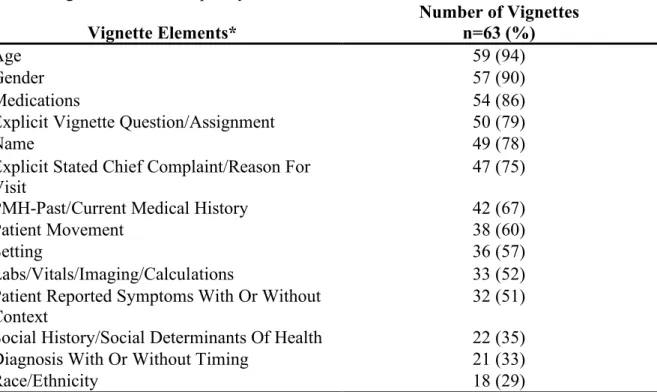
Results. The coding process resulted in 36 vignette elements. The most common elements were
age (n=59, 93.6%), gender (n=57, 90.5%), and medications (n=54, 85.7%); others included race, medications, and chief complaint. Vignette structures and wording were found to be highly variable, with elements present in different magnitudes (range 4 to 18 elements), being used with different descriptors, and given in different sequences.
Conclusion. Vignette construction could benefit from further understanding of vignette structures
and wording and their influence on level of difficulty. This undertaking will allow educators to construct better vignettes for teaching and assessment to ensure that student performance accurately represents student knowledge and skills, rather than construct irrelevant variance due to vignette-level inconsistencies in content or structure. The defined elements and structure will also enable a systematic generation of vignettes for further consistency in teaching and
Introduction
In healthcare education, vignettes are often used in teaching and learning to prepare students for clinical practice via realistic clinical situations.[1] Characteristically, vignettes are
realistic, engaging, able to stimulate integration of knowledge across disciplines, challenging, set in a context representing the students’ future careers, able to address pre-set learning objectives, logical in flow, and student-centered in design.[2] Further, with the shifting roles of healthcare
providers across a variety of settings, educator guidance on constructing clinical vignettes has become increasingly critical to students learning. This is particularly true in pharmacy, where the clinical role of the pharmacist has expanded significantly in recent years,[3] but also reflects the
increasingly interprofessional nature of healthcare.[4]
To meet such extensive requirements, preparing clinical vignettes for instruction is often labor- and time-intensive and is reliant on the purpose for which the vignette is used and the course content to which it is linked.[5] Yet, while these vignettes have become an essential
component to developing clinical reasoning and decision-making skills in the health professions curricula, and there is a need for vignette construction to follow specific guidelines,[6] educators
are not trained on how to construct them. A comprehensive literature search revealed a significant underrepresentation of research regarding the construction of clinical vignettes versus other forms of assessment, such as multiple-choice questions in pharmacy education.[7] In medical education,
the National Board of Medical Examiners (NBME) has created a handbook for constructing vignettes, Constructing Written Test Questions for the Basic and Clinical Sciences, yet such a framework does not exist in nursing or pharmacy education, and even the NBME guide
recommends but does not enforce content or structural integrity.[8] The objective of this study is
of elements and element ordering and how they may vary across subject matter, to serve as a framework for providing standardized guidance on clinical vignette infrastructure in medical education.[9][10]
Methods
Data Collection
This study consisted of a descriptive analysis examining elements as they appear in vignettes in pharmacy education and the association between elements and vignette typology. Sixty-three vignettes were sourced from Objective Structured Clinical Experiences (OSCEs), standardized patient experiences, and other training and assessment environments within the University of North Carolina (UNC) Eshelman School of Pharmacy (School) and from published pharmacy practice literature.
Qualitative Methods
Thirty-six vignettes representing a variety of disease states were selected for initial coding. Using qualitative methods, vignettes were manually coded and analyzed for common element patterns. To enhance the reliability and validity of the data, three team members
independently reviewed and coded the vignettes. Disagreement in codes were addressed through a consensus-building process wherein the three coders convened to discuss and reconcile vignette elements. The remaining twenty-seven vignettes were then coded using the framework. After all sixty-three vignettes were coded, results were again reviewed for consistency to ensure interrater reliability of 80%.
identified from NBME’s guide. Pharmacotherapy vignettes were identified as situations that assessed students’ knowledge of the use of pharmaceuticals to treat disease, whereas
Pharmacology vignettes were identified as situations that were designed to assess students’ knowledge of the drug action in the human body (i.e., absorption, distribution, metabolism, and excretion). Mechanism of Action refers to vignettes that describe biochemical interaction at a molecular level between a drug and target. Vignettes were categorized first by two individuals independently. Vignettes that did not fall into any of the three categories were excluded from further analyses.
Quantitative Methods
Further analyses were intended to determine (i) the most common elements appearing in the vignettes, (ii) the most common elements appearing in vignettes by category, (iii) differences in the proportion of elements present in each category, and (iv) the degree to which these
vignettes complied with the writing stem proposed by the NBME. For part (iv), compliance to the NBME standard was assessed by taking the sum of the absolute distance of the position of an element of a given vignette from the position of an element in a standard vignette. For example, vignette elements that follow the “standard” order—age | sex | chief complaint | past medical history | family history | physical exams | labs—were assigned positions 1 through 7. If given a vignette contained elements in a different order—for example, age | sex | chief complaint |
physical exam | past medical history | family history | labs)—then distance in this instance was
calculated as 0 + 0 + 0 + |-2| + |1| + |1| + 0.
Pharmacotherapy, Pharmacotherapy and Pharmacology, and Mechanism of Action and Pharmacology. Any results with p< 0.05 were considered statistically significant.
Results
Vignette Characteristics
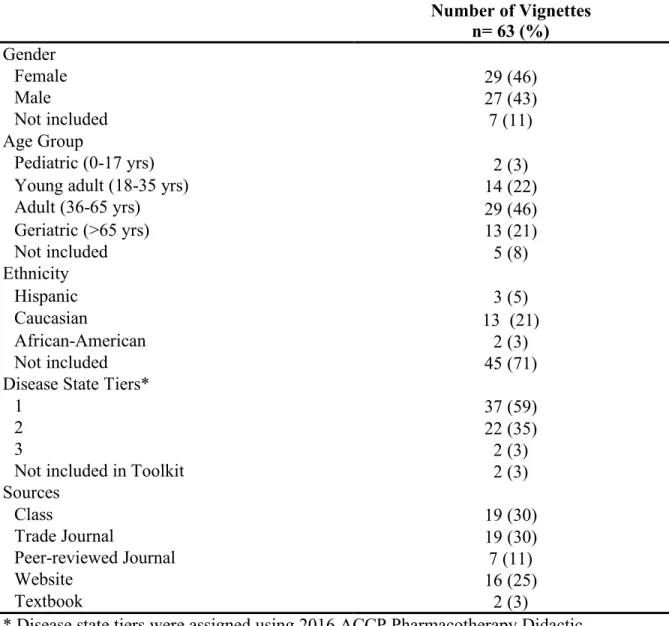
Vignettes were categorized by gender, age group, and ethnicity. Most commonly, vignettes described 36-65 years old (n=29, 46.0%) Caucasian (n=13, 26.0%) females (n=29, 46.0%) on common disease state topics that students must learn to be prepared to provide collaborative patient-centered care upon graduation and licensure. Most vignettes were sourced from courses taught within the School and from trade journals (e.g., Pharmacy Times) (Table 1).
As a proxy for difficulty, vignettes were coded into disease state tiers, values ranging from 1-3 that are assigned by the 2016 American College of Clinical Pharmacy Educational Affairs Committee that reflect levels of training pharmacy students typically receive in their didactic curriculum.[11]
Vignette Element Frequency
The coding process resulted in 36 vignette elements including race, medications, and chief complaint. The most common elements were age (n=58, 92.1%), gender (n=56, 88.9%), and patient identifiers (n=48, 76.2%) (Table 2). Vignette structures and wording were highly variable, with elements presented in different magnitudes (range 4 to 18 elements), being used with
different descriptors, and given in different sequences.
Differences were found between categories for the following vignette elements: setting, patient-reported symptoms, provider reasoning for diagnosis, labs/vitals/imaging/calculations and vignette question hint (Table 3). Between Mechanism of Action and Pharmacotherapy vignettes, patient-reported symptoms were more frequent in Pharmacotherapy than Mechanism of Action vignettes (p=.02), and vignette question hints were found to be more frequent in Mechanism of Action vignettes as opposed to Pharmacotherapy vignettes (p=.003) (Table 3). Between
Pharmacotherapy and Pharmacology vignettes, setting and patient-reported symptoms was found to be more frequent in Pharmacotherapy vignettes (psetting=.037 and psymptoms=.002), and
labs/vitals/imaging/calculations was found to be more frequent in Pharmacology vignettes (p<.001) (Table 3). Between Mechanism of Action and Pharmacology vignettes, name and labs/vitals/imaging/calculations were found to be more frequent in Pharmacology vignettes (pname=.03 and plab<.001), and vignette question hint were found to be more frequent in Mechanism of Action vignettes (p=.04) (Table 3).
Comparison of Vignette Element Ordering to NBME standard
Distance calculations ranged from 0 to 15. Most vignettes had distances ranging from 0 to 5 (n=59, 93.7%). Fewer vignettes had distances ranging from 6-10 (n=2, 3.2%) and 11-15 (n=2, 3.2%). On average, age and gender elements had the lowest order variation (average
distance=0.034 and 0.036, respectively), indicating that these elements most commonly followed the element sequencing proposed by NBME. Family history and past history, when present, were found to have the highest order variation (average distance=1 and 0.915, respectively), although in effect these are relatively short distances from the ‘standard’.
Clinical vignettes have long been utilized as a key teaching and assessment tool in medical education. However, instructors are often not provided formal guidance on how to construct these vignettes and research is notably lacking in this area compared to other
assessment methods, such as multiple choice tests. Even in other healthcare disciplines, such as medicine, guidance is available yet sparse.
The first step toward informing vignette construction in medical education was to deconstruct vignette structure and determine whether systemic patterns exist in vignettes. An exploratory analysis of vignettes using qualitative and quantitative methods resulted in a codebook of patterns and a characterization of the most frequent elements (age, gender, chief complaint, etc.) of a typical vignette used in pharmacy education assessments. The next step was to analyze the ordering of these elements against the only existing published guidance (an NBME document focused on constructing vignettes for medical examination) providing a standard template for vignettes.[8] Though NBME’s proposed template is designed for assessing medical
students, a majority of pharmacy vignettes matched closely, suggesting the applicability of a structured approach to vignette construction in pharmacy education. Yet there are notable differences. For instance, past history was a vignette element found to have one of the highest order variations. This finding may be due to the broadness of the “past history” definition for pharmacy education purposes—the interpretation used in this study included past medical history, medications, as well as history of present illness. Separating “past history” into three categories and placing them in different positions within the template might influence match outcomes.
differences with four elements among the three categories: name, race/ethnicity, patient reported symptoms, labs/vitals/imaging/calculations, and extra hint/info given in the vignette to help the student answer the vignette question. Possible factors that contribute to these differences include the stage in the pharmacy student’s career that the discipline is taught and the relevance of the vignette element to the discipline. For example, the extra hint/info was found to be significantly higher in the Mechanism of Action vignettes as compared to the Pharmacotherapy vignettes. Vignette content that involves basic sciences and molecular sciences, which cover drugs’ Mechanisms of Actions, is often taught early on in a pharmacy students’ career, and students at this level in their career may require more of such extra hints to complete the assignment
associated with the vignette. Similarly, results such as patient-reported symptoms appearing more frequently in Pharmacotherapy, relative to Mechanism of Action and Pharmacology, and
labs/imaging/calculations appearing more frequently in Pharmacology, relative to Mechanism of Action and Pharmacotherapy, may be due to the elements’ relevance to the vignette content.
Future steps that relate to vignette generation are of particular interest. A motivator for this work was to identify common and needed patterns that underlie medical educational
vignettes. Vignettes’ content and structure are important but only part of the story. For instance, there are rules for vignette generation, such as how certain procedures (e.g., lab draws) almost never occur in the community pharmacy setting, or how certain descriptors (e.g., pregnancy) cannot apply to some individuals (males, children, the elderly). One direction of follow-on work will be to apply learning techniques to a larger set of vignettes to establish further rules.
is meaningful to pharmacy but not all-encompassing of the topics that pharmacy students encounter. A third direction, then, for future work is to further investigate categories for the vignettes. Patient care, and its associated behavioral skills, is one potential expansion to the current categorization.
Limitations
This study was exploratory in nature and has some limitations. First, a relatively small subset of vignettes was analyzed. However, the formalization of processes used in the qualitative and quantitative analysis suggests findings are valid and will apply to any additional vignettes. Second, it is possible that some elements and structures were not present in the coded vignettes. To accommodate any currently unobserved elements, the framework is readily adaptable. Third, the NBME guidance for categorization and sequencing may be limited due to its specific focus on medical vignettes. The absence of a similar framework for pharmacy highlights a need for this study and may also suggests it might require modifications to the framework with new patterns found in additional pharmacy vignettes, as well as those for other domains such as nursing.
Conclusions
This study introduces mechanisms for both quantitatively and qualitatively analyzing vignettes used in medical education and utilizes these methods to deconstruct vignette structure and describe essential vignette characteristics. The use of these systematic and rigorous
References
1. McLean SF. Case-Based Learning and its Application in Medical and Health-Care Fields: A Review of Worldwide Literature. J Med Educ Curric Dev. 2016 Apr 27;3. 2. Mostert MP. Challenges of Case-Based Teaching. Behavior Analyst Today.
2007;8(4):434-442.
3. Blouin RA, Adams ML. The Role of the Pharmacist in Health Care: Expanding and Evolving. N C Med J. 2017 May-Jun;78(3):165-167.
4. Brown KPD, Salerno G, Poindexter L, Trotta K. The Evolving Role of the Pharmacist in Interprofessional Practice. N C Med J. 2019 May-Jun;80(3):178-181.
5. Eisenhardt A, Ninassi SB, Bruno S. The use of simulation and cases to teach real world decision making: Applied example for health care management graduate programs. J Learn High Educ. 2016;12(1):71-75.
6. Waxman KT. The development of evidence-based clinical simulation scenarios: Guidelines for nurse educators. Journal of Nursing Education. 2010;49(1):29-35. 7. Dell KA, Wantuch GA. How-to-guide for writing multiple choice questions for the
pharmacy instructor. Curr Pharm Teach Learn. 2017 Jan - Feb;9(1):137-144.
8. Case SM, Swanson DB. Constructing Written Test Questions For the Basic and Clinical Sciences Third Edition. 2003; National Board of Medical Examiners.
9. Ma C, Hubal R, McLaughlin J. “An Analysis of Patient Vignettes: Moving Toward Automatic Generation of Cases.” Poster presented at: 2019 American College of Clinical Pharmacy Annual Meeting; July 2019; Chicago, IL.
10.Ma C, Kabir T, Hubal R, McLaughlin J. “Case Element Analysis for Automated
11.Schwinghammer TL, Crannage AJ, Boyce EG, Bradley B, Christensen A, et al. 2016 ACCP Pharmacotherapy Didactic Curriculum Toolkit [Internet]. Lenexa, KS: American College of Clinical Pharmacy; 2016 [cited 2019 May 11]. Available from:
www.accp.com/docs/positions/misc/Toolkit_final.pdf.
Supplemental Materials:
Table 1: Vignette characteristics
Number of Vignettes n= 63 (%) Gender
Female 29 (46)
Male 27 (43)
Not included 7 (11)
Age Group
Pediatric (0-17 yrs) 2 (3)
Young adult (18-35 yrs) 14 (22)
Adult (36-65 yrs) 29 (46)
Geriatric (>65 yrs) 13 (21)
Not included 5 (8)
Ethnicity
Hispanic 3 (5)
Caucasian 13 (21)
African-American 2 (3)
Not included 45 (71)
Disease State Tiers*
1 37 (59)
2 22 (35)
3 2 (3)
Not included in Toolkit 2 (3)
Sources
Class 19 (30)
Trade Journal 19 (30)
Peer-reviewed Journal 7 (11)
Website 16 (25)
Textbook 2 (3)
* Disease state tiers were assigned using 2016 ACCP Pharmacotherapy Didactic Curriculum Toolkit.[9] Tier 1: Students receive education and training on this topic to
Tier 2: Students received education and training on this topic, but additional knowledge or skills may be required after graduation (e.g., residency training) to prepare them to provide collaborative, direct patient care. Tier 3: Students and residents may not receive education and training on this topic; rather, they will be expected to obtain the required knowledge and skills on their own to provide collaborative, direct patient care if required in their practice.
Table 2: Vignette element frequency
Vignette Elements* Number of Vignettes n=63 (%)
Age 59 (94)
Gender 57 (90)
Medications 54 (86)
Explicit Vignette Question/Assignment 50 (79)
Name 49 (78)
Explicit Stated Chief Complaint/Reason For Visit
47 (75)
PMH-Past/Current Medical History 42 (67)
Patient Movement 38 (60)
Setting 36 (57)
Labs/Vitals/Imaging/Calculations 33 (52)
Patient Reported Symptoms With Or Without Context
32 (51) Social History/Social Determinants Of Health 22 (35)
Diagnosis With Or Without Timing 21 (33)
Race/Ethnicity 18 (29)
*Elements present in less than 25% of vignettes are: Sex/Gender, Provider
Reasoning/Decision-Making, Provider Reasoning For A Diagnosis, Family
History-Medical History, Surgical History, Immunizations, Allergies, Physical Examination, Value Statement About A Lab, Patient Status Statement Of Where They Are In The Visit/Why Transition Is Happening, Family Input – Family Describing Patient, Social Conflict, Stigma, Presence Of Family Or Friends, Your Role/Title, Health Professionals You Are Directly Working With, Provider Behavior During Encounter, Compliance And
Adherence, Impact On ADL – Activities Of Daily Living, Home Monitoring (e.g.,
BP/Glucose), Preventative Health, Attempted Self-Treatment/Resolution, Patient Behavior During Encounter, Explicit Vignette Question/Assignment, Hint/Extra Info Needed To Complete Assignment
Table 3. Vignette Element Frequency, by Category MOA
n=3 (%) n=33 (%) PhTh n=17 (%) PhC p-value
1: Name 1 (25) 25 (74) 15 (88) .128
2: Age 3 (75) 31 (91) 16 (94) ns
4: Sex/Gender 2 (50) 30 (88) 16 (94) .374
5: Patient Movement 2 (25) 21 (62) 7 (41) .277
6: Setting 1 (25) 24 (71) 7 (41) .044‡
7: Explicit Stated Chief
Complaint/Reason For Visit 3 (75) 25 (74) 11 (65) .509 8: Diagnosis With Or
Without Timing 0 (0) 14 (41) 3 (18) .110
9: Patient Reported
Symptoms With Or Without
Context 0 (0) 25 (59) 5 (18) <.001* ‡
10: Provider
Reasoning/Decision-Making For Intervention 0 (0) 6 (18) 5 (29) .525 11: Provider Reasoning For
A Diagnosis 0 (0) 8 (24) 0 (0) .088
12: PMH – Past/Current
Medical History 2 (0) 19 (56) 15 (88) .082
13: Family History –
Medical History 0 (0) 6 (18) 2 (12) ns
14: Surgical History 0 (0) 2 (6) 1 (6) ns
15: Immunizations 0 (0) 2 (6) 1 (6) ns
16: Allergies 0 (0) 5 (15) 3 (18) ns
17: Medications 3 (100) 25 (53) 17 (88) .088
18: Physical Examination 0 (0) 11 (32) 2 (12) .182 19: Labs/Vitals/Imaging/
Calculation 0 (0) 15 (44) 16 (94) <.001†‡
20: Value Statement About
A Lab 0 (0) 6 (18) 8 (47) .062
21: Patient Status Statement Of Where They Are In The Visit/Why Transition Is
Happening 0 (0) 0 (0) 0 (0) ns
22: Social History/Social
Determinants Of Health 0 (0) 13 (38) 2 (12) .064 23: Family Input – Family
Describing Patient 0 (0) 0 (0) 0 (0) ns
24: Social Conflict 0 (0) 0 (0) 0 (0) ns
25: Stigma 0 (0) 1 (3) 1 (6) ns
26: Presence Of Family Or
Friends 0 (0) 0 (0) 0 (0) ns
27: Your Role/Title 0 (0) 1 (3) 2 (12) ns
28: Health Professionals You Are Directly Working
With 0 (0) 7 (21) 4 (24) ns
29: Provider Behavior
30: Compliance And
Adherence 0 (0) 6 (18) 2 (12) .818
31: Impact On ADL –
Activities Of Daily Living 0 (0) 5 (15) 1 (6) .758 32: Home Monitoring (e.g.,
BP/Glucose) 0 (0) 1 (3) 2 (12) .384
33: Preventative Health 1 (25) 2 (6) 0 (0) .121 34: Attempted
Self-Treatment/Resolution 0 (25) 3 (9) 0 (0) .617
35: Patient Behavior During
Encounter 1 (25) 6 (18) 1 (6) .253
36: Explicit Vignette
Question/Assignment 3 (100) 23 (68) 14 (82) .483 36a: Hint/Extra Info Needed
To Complete Assignment 3 (100) 3 (9) 6 (35) <.001*‡
MOA=Mechanism of Action; PhTh=Pharmacotherapy; PhC=Pharmacology
Chi-square was used to determine significance, defined as p<.05, between vignette categories ns denotes non-significance, with p>.99
* statistical difference between Mechanism of Action and Pharmacotherapy vignettes † statistical difference between Mechanism of Action and Pharmacology
‡ statistical difference between Pharmacotherapy and Pharmacology vignettes
REPORT ADDENDUM
Acknowledgments:
The authors would like to thank Tazim Kabir and Laura Bobbitt for their input in building the codebook and coding the cases.
Funding support:
Authors would like to thank the Eshelman Institute for Innovation for funding this project. Conflict of interest:
Authors of this manuscript have nothing to disclose concerning possible financial or personal relationships with commercial entities that may have a direct or indirect interest in the subject matter of this presentation.