Modeling Dark Matter and Dark Energy
Kevin J. Ludwick
A dissertation submitted to the faculty of the University of North Carolina at Chapel Hill in partial fulfillment of the requirements for the degree of Doctor of Philosophy in the Department of Physics and Astronomy.
Chapel Hill 2013
Approved by:
Y. Jack Ng
Charles R. Evans
Reyco Henning
Dmitri Khveshchenko
Abstract
KEVIN J. LUDWICK: Modeling Dark Matter and Dark Energy. (Under the direction of Paul H. Frampton.)
We study various models of dark matter and dark energy. We first examine the
implications of the assumption that black holes act as dark matter. Assuming dark
matter in galactic halos is composed solely of black holes, and using observational
constraints, we calculate the number of halo black holes and the total entropy due
to them. We then study the prospect of dark energy with a non-constant density.
We analyze several parameterizations of dark energy density from the literature
and one of our own, in particular focusing on the value of redshift at which cosmic
acceleration due to dark energy begins. In considering the properties of dark
en-ergy densities that monotonically increase over time, we present two new
catego-rizations of dark energy models that we dub ”little rip” and ”pseudo-rip” models,
and both avoid future singularities in the cosmic scale factor. The dark energy
den-sity of a little rip model continually increases for all future time, and a pseudo-rip
model’s dark energy density asymptotically approaches a maximum value. These
two types of models, big rip models, and models that have constant dark energy
densities comprise all categories of dark energy density with monotonic growth
in the future. A little rip leads to the dissociation of all bound structures in the
universe, and a pseudo-rip occurs when all bound structures at or below a
cer-tain threshold dissociate. We present explicit parameterizations of the little rip
and pseudo-rip models that fit supernova data well, and we calculate the times at
which particular bound structures rip apart. In looking at different applications of
these models, we show that coupling between dark matter and dark energy with
an equation of state for a little rip can change the usual evolution of a little rip
model into an asymptotic de Sitter expansion. We also give conditions on
mini-mally coupled phantom scalar field models and scalar-tensor models that indicate
Acknowledgments
I am grateful to my advisor, Paul Frampton, for all his dedication, guidance, and
help throughout graduate school. I am thankful for all the members of my
com-mittee and the work they have done. I am also grateful to Robert Scherrer for his
collaboration in research and all the help he has offered me. I thank Shin’ichi Nojiri
and Sergei Odintsov for their collaboration in research. I appreciate all that Jack
Ng, Chris Clemens, and the rest of the physics department have done for me.
Many thanks to Mom, Dad, Jessica, Ryan, Nathan, and the rest of my family for
all their love, support, and good advice. I appreciate the long-time friendship of
Lee, Philip, and my apartment-mate Jeremy. I would not have eaten nearly as well
as I have over the past five years had it not been for the love, friendship, and and
excellent cooking of the Seniors (my second family), Teresa, the Tarltons, and the
Cuanies. And to others I did not mention here, thank you.
Table of Contents
List of Figures . . . .viii
List of Tables . . . ix
1 Introduction . . . 1
1.1 Historical Background . . . 1
1.2 Overview of Dark Matter and Dark Energy . . . 5
1.3 Motivation and Plan of this Work . . . 12
2 Number and Entropy of Black Holes . . . 18
2.1 Introduction . . . 18
2.2 Number of Black Holes . . . 19
2.3 Entropy of Black Holes . . . 21
2.4 Reconsideration of the Entropy of the Universe . . . 23
3 Seeking Evolution of Dark Energy. . . 26
3.1 Introduction . . . 26
3.2 Evolutionary Dark Energy Models . . . 28
3.3 Analysis of the Models . . . 29
3.4 Slowly Varying Criteria . . . 34
4 The Little Rip . . . 38
4.1 Introduction . . . 38
4.2 The Conditions for a Future Singularity . . . 39
4.3 Constraining Little Rip Models . . . 45
4.4 Disintegration . . . 46
4.5 Discussion . . . 49
5 Models for Little Rip Dark Energy . . . 51
5.1 Introduction . . . 51
5.2 Inertial Force Interpretation of the Little Rip . . . 52
5.3 Coupling with Dark Matter . . . 58
5.4 Scalar Field Little Rip Cosmology . . . 62
5.4.1 Minimally Coupled Phantom Models . . . 62
5.4.2 Scalar-Tensor Models . . . 63
5.5 Including Matter . . . 67
5.6 Discussion . . . 69
6 The Pseudo-Rip . . . 71
6.1 Introduction . . . 71
6.2 Definition of Pseudo-Rip . . . 72
6.3 Model 1 . . . 75
6.4 Model 2 . . . 78
6.5 Scalar Field Realizations . . . 79
6.6 Discussion . . . 80
7 Conclusions and Future Directions . . . 83
Bibliography . . . 86
List of Figures
3.1 w(lin)0 vs. w(lin)1 . . . 30
3.2 w(CP L)0 vs.w(CP L)1 . . . 31
3.3 w(SSS)0 vs. w(SSS)1 . . . 31
3.4 w(new)0 vs. w(new)1 . . . 32
3.5 w(Z)vs.Z for all models . . . 33
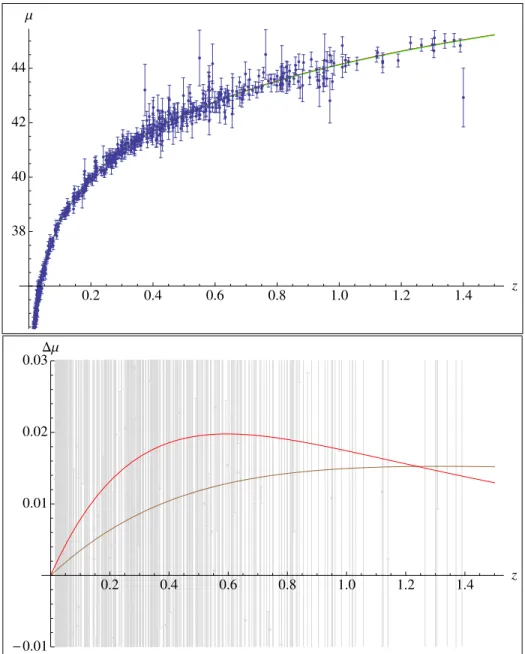
4.1 Hubble plot and Hubble residual plot . . . 47
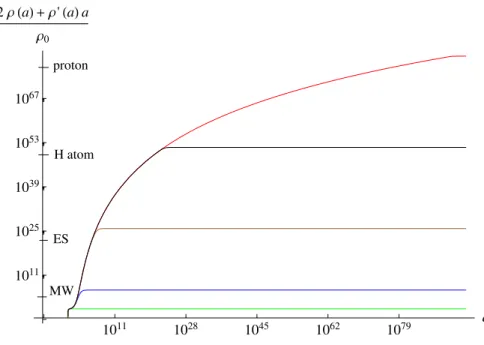
6.1 ScaledFinertfor Model 1 . . . 77
List of Tables
2.1 Number of black holes with constraints from wide binaries . . . 20
2.2 Number of black holes without constraints from wide binaries . . . . 21
2.3 Entropy of black holes with constraints from wide binaries . . . 22
2.4 Entropy of black holes without constraints from wide binaries . . . . 22
Chapter 1
Introduction
1.1
Historical Background
Our universe is mysterious and wonderful. As we plumb deeper the depths of
space with our detectors and telescopes, the more we find that we do not
under-stand. Modern cosmology, the study of our universe’s origins, structure,
dynam-ics, and ultimate fate, has dramatically evolved from what it was in the early 1900s
to what it is today.
Soon after Einstein published his tensor equation describing general relativity
in 1915, he applied his equation to the universe in 1917, giving birth to relativistic
cosmology. His equation implied that the universe was expanding, and this
de-scription did not agree with the popular conception of the universe during his day.
So he added an extra term, often called the cosmological constant term, that was
consistent with the derivation of his equation, and this extra term ensured that his
equation described the universe as static [1]. As it turns out, the addition of the
cos-mological constant term gives a quasistatic solution that is unstable under
pertur-bations. Alexander Friedmann [2] and Georges Lemaˆıtre [3] independently wrote
down the solution to Einstein’s equation for a homogeneous and isotropic
realized that the solution gave a universe that started from a singularity. His
re-alization was the origin of the big bang theory, and it was not a widely accepted
one at that time. Later, Howard Percy Robertson [4] and Arthur Geoffrey Walker
[5], working independently in the 1930s, also worked out the solution for such
a universe. Their eponymous metric, the Friedmann-Lemaˆıtre-Robertson-Walker
(FLRW) metric, is the standard metric used in modern cosmology. Lemaˆıtre [3]
in 1927 and Edwin Hubble [6] in 1929, based on data from recession velocities of
galaxies, showed that the universe was, in fact, expanding. Hubble plotted the
re-cessional velocities of a set of galaxies versus their distance away from us, and he
made a linear fit. He deduced what is known as Hubble’s Law:v =H0d, wherevis
the velocity,dis the distance, andH0is the constant slope, known as Hubble’s
con-stant. The recessional velocity of galaxies and their distances away from us are not
related by a constant in time in general, but for the set of nearby galaxies Hubble
observed, a linear relationship with a constant slope of H0 is fairly accurate. The
idea of the big bang gained more popularity because of this evidence of expansion.
Einstein later said that adding the cosmological constant term to avoid expansion
was his biggest mistake. However, it turns out that the cosmological constant is
quite useful in describing dark energy, which we will discuss soon.
In response to the discovery of universal expansion, an alternative to the big
bang theory was proposed in the 1920s by Sir James Jeans, and his theory was
called the steady-state theory. In a steady-state universe, the universe has no
be-ginning or end, and new matter is continuously generated as the universe expands.
The FLRW metric follows the cosmological principle, which says that the universe
is homogeneous and isotropic on a large scale in space, but structure changes over
time as the universe expands. The steady-state universe follows the perfect
cos-mological principle, which says that the universe is homogeneous and isotropic in
spaceandin time. So a steady-state universe does not change its appearance over time. In 1948, a revised version of the steady-state model was promulgated by
Fred Hoyle, Thomas Gold, and Herman Bondi, among others. However, evidence
against this theory cropped up in the 1960s. Quasars and radio galaxies that were
far away from our galaxy were observed, but none were seen that were close to us.
This was a violation of the perfect cosmological principle.
For most, the final blow to the steady-state theory was the discovery of the
cosmic microwave background (CMB). In 1965, Arno Penzias and Robert Wilson
published their discovery of a uniform background of microwave radiation [7].
They had built a Dicke radiometer intended for experiments for satellite
com-munication. They discovered an excess in their antenna’s temperature that was
independent of the its orientation, and it was due to the CMB. The steady-state
model predicted discrete sources of background radiation from distant stars, but
the CMB gives off an almost perfectly uniform, blackbody spectrum. However,
the big bang theory very nicely predicts the existence of a microwave background
of radiation due to the decoupling of photons from electrons and protons as the
universe cooled over time. In fact, Ralph Alpher and Robert Herman predicted
in 1948 a cosmic microwave background of5 K [8], which is close to the modern
experimental value of2.72548±0.00057 K[9]. The CMB is not perfectly uniform; however, the anisotropies, which provide valuable insight into the formation of
our early universe and its structure, are well predicted by the big bang model
when augmented by inflation and quantum fluctuations of the inflaton field.
Shortly after the expansion of the universe was confirmed, Fritz Zwicky
no-ticed a discrepancy between mass measurements of galaxies in the Coma Cluster
in 1933. There was not enough luminous matter to account for the observed
concluded that there was missing mass, ”dark matter,” that accounted for the
un-expected observations [10]. In the 1960s and 1970s, Vera Rubin and others used
a new spectrograph that measured more accurately than ever before the rotation
curves of spiral galaxies, which show how fast stars orbit around the centers of
galaxies. Like Zwicky, she found an apparent violation of the virial theorem. The
stars near the edge of the spiral galaxies she observed were moving too fast to stay
bound to their galaxies according to the galactic masses measured from the visible
matter in them. In fact, she showed that about 50% of a typical spiral galaxy’s mass
is located beyond the radius containing the luminous galactic matter. She and her
collaborators published their results in 1980 [11].
Another milestone in cosmology recently happened when the High-z
Super-nova Search Team in 1998 [12] and the SuperSuper-nova Cosmology Project in 1999 [13]
published observations of the emission spectra of Type Ia supernovae indicating
that the universe’s rate of outward expansion is increasing. These groups found
that supernovae exhibited emission spectra that were redshifted more than
ex-pected from supernovae in a decelerating or zero-acceleration universe, so they
inferred that the universe was accelerating. Galaxy surveys and the late-time
inte-grated Sachs-Wolfe effect also give evidence for the universe’s acceleration. Thus,
”dark energy” was proposed as the pervasive energy in the universe necessary
to produce the ”anti-gravitational,” outward force that causes this acceleration,
which has been observationally tested and vetted since its discovery. The 2011
Nobel Prize in Physics was awarded to Schmidt, Riess, and Perlmutter for their
pioneering work leading to the discovery of dark energy.
1.2
Overview of Dark Matter and Dark Energy
About twenty-four percent of our universe is composed of dark matter, matter
that is electromagnetically undetectable because it does not emit any observable
amount of light. However, this non-luminous matter has been detected
gravita-tionally via gravitational lensing, and anisotropies in the CMB, examination of
baryonic acoustic oscillations (BAO), and structure formation simulations provide
good support for its existence.
Because dark matter is non-luminous, it is electromagnetically neutral. It is
also safe to say that particulate dark matter is not completely made up of baryonic
particles; otherwise, the CMB and comic structure formation would be drastically
different. Observational constraints on light elements created during big bang
nu-cleosynthesis, which strongly depend of baryon abundance [14], conflict with such
a theory. (There is some room for baryonic dark matter in the form of massive
com-pact halo objects (MACHOs), which will be discussed later.) Dark matter cannot be
completely composed of ”hot” particles, meaning particles that travel at relativistic
speeds. Light particles travel at ultrarelativistic speeds in the early universe and
stream through density perturbations, dampening them. One can relate the
small-est scale at which there is clumpy dark matter to the particle’s mass. Lyman-α
constraints suggest that a dark matter particle’s mass should be≥2keV [15]. There are many posited candidates for dark matter. Probably the most popular
candidate for cold (non-relativistic) dark matter is the Weakly Interacting Massive
Particle (WIMP). Such a particle was first proposed by Steigman and Turner [16],
and it interacts and has mass that is at the weak interaction scale. If such
par-ticles are in a thermal bath in the early universe and have an annihilation cross
equation agrees with the observational value for the number density of dark
mat-ter [17]. Some examples of WIMPs are the neutralino (motivated from
supersym-metry) and the Kaluza-Klein photon (motivated from theories with extra
dimen-sions). Other dark matter candidates include axion (proposed particles that solve
the strong CP problem), supersymmetric gravitinos, and dark matter from the
hid-den sector, which is a theoretical extension to the Standard Model comprised of
fields that have very little interaction with fields in the Standard Model. Another
candidate for dark matter is the leading warm dark matter candidate, the
ster-ile neutrino. Proponents argue that this model leads to more accurate structure
formation than cold dark matter does [18, 19]. Typical examples of the
aforemen-tioned MACHOs, which were originally proposed as objects that explained the
presence of non-luminous matter in galaxy halos, include neutron stars and black
holes. Primordial black holes (PBHs) and ultra-compact minihalos (UCMHs) are
more recent dark matter candidates. They may be classified as non-baryonic
MA-CHOs, and they form via the collapse of density perturbations near the time of the
big bang [20, 21, 22].
Instead of accounting for dark matter with extra matter, we can also try
mod-ified gravity models (e.g., f(R) gravity, scalar-tensor theories, Brans-Dicke
the-ories, braneworld gravity). Another attempt of modifying gravitational laws is
called Modified Newtonian Dynamics (MOND). The challenge for such models is
to correctly describe both structure formation and galaxy rotation curves. For
ex-ample, MOND is consistent with galaxy rotation curves, but it has more trouble
with structure formation.
It is a bit surprising that the amount of baryonic matter in the universe is
dwarfed by six times as much dark matter. Perhaps even more unsettling is the
presence of dark energy in our universe, which makes up the biggest portion,
about three quarters, of our universe.
However, our physical intuition of the nature and dynamics of dark energy
is severely lacking. For a fixed amount of normal matter, as the volume
contain-ing it increases, the density of the matter for the whole volume should decrease.
However, the nature of dark energy is counterintuitive in that its density remains
constant (or even increases) over time as the universe expands.
Many explanations for cosmic acceleration have been theorized. The varied
ap-proaches include modified gravity, adding an extra component for dark energy to
the components of mass/energy in the universe, and cosmological back-reaction,
which refers to the scenario in which inhomogeneity in the universe accounts for
cosmic acceleration. The standard explanation attributes dark energy to vacuum
energy that permeates the universe and is constant over time. The model that
ac-companies this explanation is called the cosmological constant model, named after
the extra term Einstein added into his equation to give a static universe. Einstein’s
equation can be derived with an extra term that is a constant times the metric (the
speed of lightc= 1throughout):
Rµν−
1
2Rgµν + Λgµν = 8πGTµν. (1.1)
Rµν is the Ricci tensor,Ris the Ricci scalar (the contracted Ricci tensor),gµν is the
metric, andTµνis the stress-energy tensor, which contains all the information about
the mass/energy contents of spacetime. The first two terms on the lefthand side of
the equation are the usual terms from Einstein’s equation representing the
curva-ture of spacetime. The third, extra term is the contribution of vacuum dark energy,
and the constant multiplier,Λ, is called the cosmological constant. Quantum field
cosmological value by an appalling 120 orders of magnitude, the largest
discrep-ancy between theory and experiment in all of physics. Perhaps the correct theory
of quantum gravity or some other theory will explain this inconsistency, and many
explanations have been proffered, for example, based on the string landscape and
the anthropic principle. It is a mystery for now.
The FLRW metric, mentioned previously, is
ds2 =−dt2 +a(t)2
dr2
1−kr2 +r
2(dθ2+ sin2θdφ2)
, (1.2)
wherea(t)is the scale factor controlling the rate at which the universe expands/contracts,
andk determines the spatial curvature of the universe. Observations have shown
that the universe is almost completely spatially flat, i.e., k is very close to 0, so it
is usually set to0(and we usek = 0throughout this work unless otherwise
spec-ified). The spatial coordinatesr, θ, andφare comoving coordinates, meaning that
they move with the expansion/contraction of spacetime. For example, an object
that has no net force acting on it will have a constant comoving distance from the
origin,r, since it is moving only due to the expansion of the universe. The proper
distance of that object from the origin at time t isa(t)r, which changes in time in
accordance with the expansion of spacetime. By solving Einstein’s equation using
the spatially flat FLRW metric and modeling the contents of the universe as a
ho-mogeneous, perfect fluid, we can obtain the Friedmann equations (which bear the
name of the previously mentioned Alexander Friedmann):
˙
a a
2
= 8πG
3 ρ (1.3)
¨
a a =−
4πG
3 (ρ+ 3p). (1.4)
The dot overadenotes a derivative with respect to time,ρis the total density of the
mass/energy contents of the universe, andpis the fluid pressure of these. Notice
that there is no spatial dependence in these equations; this is because we
origi-nally assumed isotropy and homogeneity in our universe. These equations are
sometimes written in terms of the Hubble parameter, which is the generalization
of Hubble’s constant for any time: H ≡ a˙ a.
The cosmological constant term is usually subsumed as an extra component of
the density in the stress-energy tensor as in the following:
ρ=X
i
ρi =ρrad+ρm+ρΛ, (1.5)
where the first term is the contribution from radiation from photons and
ultrarel-ativistic neutrinos, the second term from baryonic and dark matter, and the third
term from the constant vacuum energy. Another way of expressing the
compo-nents of mass/energy is
1 =X
i
Ωi(t) = Ωrad(t) + Ωm(t) + ΩΛ(t), (1.6)
whereΩi(t)for a flat metric isρρ(t)i(t). The sum of all the fractions of the total mass/energy
in the universe at a given time adds up to1for a flat universe. (Sometimes, Ωi is
used to indicate the present-day value ofΩi(t)in the literature.) Usually, the
equa-tion of state of a perfect fluid component in the stress-energy tensor is modeled as
pi =wiρi. (1.7)
For the cosmological constant model,wΛ=−1, and the dark energy density is
con-stant only if this is the case. A universe that contains only the vacuum energy from
who found such a solution to Einstein’s equation using his cosmological constant
term [23]. We usually generalizewΛto bewDE, which is not restricted to be −1. A
troubling facet of dark energy modeled as a perfect fluid is that it necessarily
vi-olates the strong energy condition of general relativity. The energy conditions are
meant to loosely dictate what kinds of matter/energy are acceptable and physical.
For a perfect fluid, they are as follows:
weak energy condition (WEC) : ρ≥0, ρ+p≥0 (1.8)
null energy condition (NEC) : ρ+p≥0 (1.9)
strong energy condition (SEC) : ρ+p≥0, ρ+ 3p≥0 (1.10)
dominant energy condition (DEC) : ρ≥ |p|. (1.11)
The cosmological constant model violates the SEC (and not the other energy
con-ditions). We know from observations that our universe during the present epoch is
dominated by dark energy, so we can approximateρ ≈ ρDE. From equation (1.4),
we see that¨a (representing acceleration) is positive only ifρ+ 3pis negative, i.e.,
ifw ≤ −1/3. Thus, dark energy as a perfect fluid violates the SEC. (This violation can be shown without assuming ρ ≈ ρDE, but we make the assumption for the
sake of simplicity.) On the other hand, ifρ < 0and w = −1, thenp > 0, and the SEC is preserved. But then ¨a is not positive, so there is no cosmic acceleration,
and the DEC and WEC are violated. However, the most recent observational value
of wmade by the Nine-Year Wilkinson Microwave Anisotropy Probe (WMAP 9)
combining data from WMAP, the CMB, BAO, supernova measurements, andH0
measurements, is w = −1.037+0.071−0.070 at the 95% confidence level [24], assuming a perfect fluid for dark energy, a constant value of w, and a flat universe (which
is a good assumption based on observations). So the cosmological constant (CC)
model is in good agreement with observation, and it also agrees with the similar
observational value ofwwhen the universe is not assumed to be flat. In fact, the
best fit value forwis less than−1, even though all energy conditions are violated for dark energy with w < −1 according to equations (1.8) - (1.11). When com-bined with WMAP polarization and supernova data, the very latest cosmological
data, from the Planck satellite, gives w = −1.13+0.013−0.14 at the 95% confidence level [25], and the CC model is just barely preserved for this data set. Dark energy with
w < −1 is known as phantom dark energy, and its density increases over time. Therefore, observations seem to indicate that preserving the SEC and other energy
conditions may not be so important. General relativity has not been tested past the
scale of our solar system, whereas all the observations that led to this best fit value
ofwwere very far beyond that scale.
Many theoretical dark energy models have been found that are within
observa-tional constraints, and many of these models allowwDE to be a function that can
change over time. One such form of dynamical dark energy modeled with a scalar
field is called quintessence. The equation of motion for the scalar field, which
fol-lows from local conservation of mass/energy and momentum,∇µTνµ = 0 (which
follows from Einstein’s equation), is
∇µ∇µφ+
∂V
∂φ = 0, (1.12)
where V(φ)is the scalar field potential. Assuming the scalar field is spatially
ho-mogeneous (∂µφ∂µφ = ˙φ2), The fluid density and pressure of the scalar field are
ρφ=
1 2
˙
φ2+V(φ), p φ =
1 2
˙
φ2−V(φ). (1.13)
Quintessence theories with a negative, non-standard kinetic term are aptly called
k-essence theories. Because of the negative kinetic term, the field ”rolls up” the
potential. Phantom field theories are a bit troublesome since they have ”ghosts,” or
vacuum instabilities. However, these problems can be avoided if they are treated
as effective field theories that have momentum cutoffs [26, 27]. And as we have
already seen, phantom models seem to be supported by observation, so perhaps
such theories will be fleshed out better in the future as we learn more about the
nature of dark energy.
1.3
Motivation and Plan of this Work
Cosmologists have come a long way in understanding dark matter and dark
en-ergy and their observational constraints, but there are still many unanswered
ques-tions. There are still several plausible explanations of these two phenomena.
In chapter two, we explore the possibility of intermediate-mass black holes
(IMBHs) comprising all of dark matter. IMBHs typically range in mass from about
103 - 105M
. One aspect of this approach that is beneficial in the interest of
ef-ficiency and simplicity is that the introduction of new, unknown particles is not
necessary. Black holes are reasonably well understood objects that have
theoret-ical and observational grounding; for example, it is widely accepted from
obser-vations that supermassive black holes reside in the center of galaxies. Based on
constraints from microlensing and galactic disk stability, both with and without
limitations from wide binary surveys, we estimate the total number and entropy
of intermediate-mass black holes. Given that the visible universe comprises 1011
halos each of mass∼ 1012M
, typical core black holes of mean mass∼ 107M set
the dimensionless entropy (S/k) of the universe at a thousand googols (1googol
= 10100). One interesting feature of this dark matter candidate is that the entropy
contribution from these IMBHs can exceed that of supermassive black holes in
the universe, which are presently the biggest known contributor to the universe’s
entropy. Identification of all dark matter as black holes allows a dimensionless
entropy of the universe up to ten million googols, implying that dark matter can
contribute over 99% of entropy. If we hypothesize that, for some dynamical
rea-son, the entropy of the universe is maximized, this favors all dark matter as black
holes in the mass regime of∼105M
.
Chapter three concerns our investigation of dark energy models with
non-constant densities. Since such models could possibly describe dark energy, we
think it is important to study the dynamics and properties of such models. We
study how to distinguish between a cosmological constant and evolving dark
en-ergy with equation of state w(Z), where Z is the redshift. Redshift is defined as
Z = λobserved
λemitted
−1, (1.14)
whereλobserved is the observed wavelength of light from an object in question and
λemittedis the wavelength of light emitted. So we detect light that is longer in
wave-length (lower in frequency, toward the red end of the electromagnetic spectrum)
than that of the original emitted light from an object that is moving away with
the expansion of the universe. This effect is somewhat analogous to the Doppler
shift. Redshift happens due to the stretching of space, and it happens according to
the FLRW metric of spacetime. Redshift due to the expansion of the universe from
timetin the past to the present time relates to the scale factor in the following way:
Z = a(t)
a(t0)
−1. (1.15)
t0 is defined to be the present time, anda(t0), also written asa0, is usually taken to
In chapter three, we focus on the value of redshift Z∗ at which cosmic
accel-eration begins, which means that ¨a(Z∗) = 0. Four w(Z) are studied, including
the well-known CPL model and a new model that has advantages when
describ-ing the entire expansion era. If dark energy is represented by a CC model with
w = −1, Z∗ is about 0.7. We discuss the possible implications of a more accurate, model-independent measurement ofZ∗.
In 2002, Robert Caldwell [28, 29] explored dark energy models with constant
wDE < −1, phantom dark energy models. The CC model leads to a constant
cosmic acceleration, and thus dark energy provides a constant force on the
uni-verse. But for phantom models, the cosmic acceleration is increasing over time.
So if the cosmic force due to dark energy gets big enough to overcome the forces
holding together bound structures such as galaxies, solar systems, and even the
smallest atoms, these structures can be ripped apart in the future. For phantom
models, the scale factoraand ρDE approach infinity at a finite time in the future.
Caldwell called such a fate of the universe a ”big rip.” Chapter four focuses on a
particular fate of the universe we have dubbed the ”little rip.” A little rip model
features a dark energy density that increases with time (so that wDE(a) satisfies
wDE(a) < −1), butwDE approaches−1asymptotically, and there is no future
sin-gularity. We discuss conditions necessary to produce this evolution. Such
mod-els can display arbitrarily rapid expansion in the near future, leading to the
de-struction of all bound structures. We determine observational constraints on two
specific parameterizations and calculate the point at which the disintegration of
certain bound structures begins. For the same present-day value ofwDE, a big rip
with constantwDE disintegrates bound structures earlier than a little rip.
Manifestations of little rip models can be via parameterizations ofρDE, k-essence
models, scalar-tensor theories, and models in which dark energy and dark matter
are coupled. We employ all of these in chapter five.
A scalar-tensor theory is simply a theory in which gravity is described by the
action of a scalar field along with the usual tensor field of general relativity. One
such model we examine in chapter five is given by the action
S =
Z
d4x√−g
1 16πGR−
1
2ω(φ)∂µφ∂
µφ−V(φ)
, (1.16)
where g is the determinant of the metric,R is the Ricci scalar, andω(φ)and V(φ)
are functions of the field φ. V(φ) is the scalar field potential, and dark energy
is represented by φ. Without the second and third terms, minimizing the action
would result in Einstein’s equation for an empty universe, i.e., for a stress-energy
tensor Tµν = 0. We leave out terms for matter and radiation because we consider
this model only when dark energy dominates over other density components, so
these terms are negligible.
Usually, different density components are considered independent of each other,
but we consider the coupling of dark energy and dark matter, which, given our
rel-ative ignorance of the nature of these two, is plausible. Combining the two
Fried-mann equations, equations (1.3) and (1.4), we can obtain the continuity equation:
˙
ρ=−3(ρ+p)a˙
a ⇒ dρ da =−
3
a(ρ+p). (1.17)
ρand pcan be written as the sum of their components, and if each component is
independent of the others, then
X i
dρi
da =−
X i
3
a(ρi+pi) ⇒ dρi
da =−
3
for eachi. This implies
ρrad(a) =ρrad0a
−4 , ρ
m(a) =ρm0a
−3,
(1.19)
where ρi0 ≡ ρi(a0). The pressure due to a relativistic fluid isprad =
ρrad
3 , and cold
(non-relativistic) matter is without pressure. From these functional forms forρrad
and ρm, it is clear that radiation dominated the early universe (for small a). As
the universe cooled more, matter began to dominate the evolution of the universe,
thusρm(a)took over when abecame large enough. We study the implications of
the coupling between dark matter and dark energy so that the continuity equation
for these components are not separable.
Also in chapter five, we derive the conditions for the little rip in terms of the
force due to dark energy and present two representative models to illustrate the
difference between little rip models and those which are asymptotically de Sitter.
We derive conditions onwDEto distinguish between the two types of models. The
coupling between dark matter and dark energy with an equation of state that leads
to a little rip can alter the evolution, changing the little rip into an asymptotic de
Sitter expansion. We give conditions on minimally coupled phantom scalar field
models (k-essence models) and on scalar-tensor models that indicate whether or
not they correspond to a little rip expansion. We show that, counterintuitively,
despite local instability the previously discussed [26, 27], a little rip has an infinite
lifetime.
If we assume that the cosmic energy density will remain constant or strictly
increase (i.e., monotonically increase) in the future, then the possible fates for the
universe can be divided into four categories based on the time asymptotics of the
Hubble parameterH(t). Three of the categories, which we have already discussed,
are the following: the cosmological constant, for which H(t) = constant; the big
rip, for whichH(t)goes to infinity at finite time; and the little rip, for whichH(t)
goes to infinity as time goes to infinity. In chapter six, we introduce the fourth
cat-egory, which we call the ”pseudo-rip.” For a pseudo-rip, H(t) goes to a constant
as time goes to infinity, which is an intermediate case between the cosmological
constant and the little rip. Because of equation (1.3), ”H(t)” can be replaced with
”ρ” in these four conditions. In chapter six, we provide models that exemplify the
pseudo-rip and that fit observational data well. Structures with a binding force
at or below a threshold determined by the model’s parameters will dissociate. We
show that pseudo-rip models for which the density and Hubble parameter increase
monotonically can produce an inertial force which does not increase
monotoni-cally, but instead peaks at a particular future time and then decreases.
In chapter seven, we conclude and discuss future possible applications and
Chapter 2
Number and Entropy of Black Holes
1
2.1
Introduction
The identification of dark matter, for which there is compelling evidence from its
gravitational effects in galaxies and clusters thereof, is an important outstanding
question. Dark matter makes up some eighty percent of matter and a quarter of
the energy content of the universe.
Of course, it would be reassuring to identify dark matter by its production in
particle colliders and by its detection in terrestrial experiments. On the other hand,
the dark matter constituent may equally be, as assumed here, in a completely
dif-ferent and collider-inaccessible mass regime heavier than the Sun.
The observational limits on the occurrence of such multi-solar mass
astrophysi-cal objects in the halo have considerably changed recently. There remain
microlens-ing limits [31, 32] on masses below a solar mass and slightly above. There are also
respected limits from numerical study [33] of disk stability at ten million solar
masses and slightly below.
For the intermediate-mass region, a possible constraint comes from the
occur-rence of gravitationally bound binary stars at high separation approaching one
parsec. Here the situation has changed recently, and the bounds are far more
re-laxed, possibly non-existent. The first such analysis [34] allowed only some ten
percent of halo dark matter for most of the mass range. A more recent analysis [35]
permits fifty perecent and cautions that the sample of binaries may be too small to
draw any solid conclusions.
In the following, we adopt constraints from microlensing and disk stability but
keep an open mind with respect to the wide binaries. We estimate the total number
and total entropy of the black holes per halo and hence (simply multiplying by
1011) in the universe, assuming as in [36] that all dark matter can be identified as black holes.
2.2
Number of Black Holes
To estimate number and subsequently entropy of black holes we simplify by taking
as possible masses 10nM
with n integer, 1 ≤ n ≤ 7. Further, we assume the
constraints from wide binaries [35] for differentnare independent of each other.
We make our analysis first with binary constraints, denoted simply as “with”,
then with no binary constraints, denoted as “without”. Let fn be the fraction of
the halo dark matter composed of mass10nMblack holes. The total halo mass is
taken to be1012M whereupon
Σnfn = 1 (2.1)
and the numberNnis
The “with” constraints on thefnare
0 ≤ f1 ≤0.4
0 ≤ f2 ≤1.0
0 ≤ f3 ≤0.5
0 ≤ f4,5,6 ≤0.4
0 ≤ f7 ≤0.3. (2.3)
For the “without” constraints, the f1,2,7 ranges remain unchanged while the
f3,4,5,6 are free, namely
0 ≤ f1 ≤0.4
0 ≤ f2,3,4,5,6 ≤1.0
0 ≤ f7 ≤0.3. (2.4)
Allowing thefnto vary by increments∆fn = 0.1for1≤fn≤(fn)maxwe allow
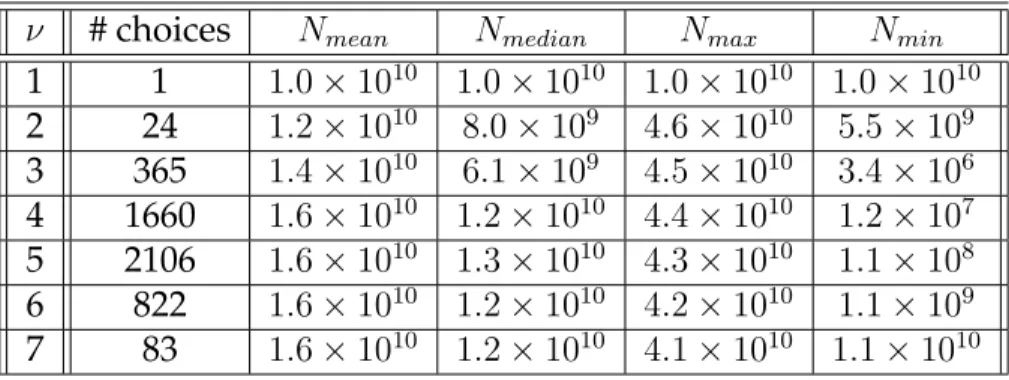
the black holes to have ν different mass (or n) values with 1 ≤ ν ≤ 7. For the “with” constraints, we then find numbers of black holes as follows:
ν # choices Nmean Nmedian Nmax Nmin
1 1 1.0×10¹⁰ 1.0×10¹⁰ 1.0×10¹⁰ 1.0×10¹⁰ 2 24 1.2×10¹⁰ 8.0×10⁹ 4.6×10¹⁰ 5.5×10⁹
3 365 1.4×10¹⁰ 6.1×10⁹ 4.5×10¹⁰ 3.4×10⁶
4 1660 1.6×10¹⁰ 1.2×10¹⁰ 4.4×10¹⁰ 1.2×10⁷
5 2106 1.6×10¹⁰ 1.3×10¹⁰ 4.3×10¹⁰ 1.1×10⁸ 6 822 1.6×10¹⁰ 1.2×10¹⁰ 4.2×10¹⁰ 1.1×10⁹
7 83 1.6×10¹⁰ 1.2×10¹⁰ 4.1×10¹⁰ 1.1×10¹⁰
Table 2.1: Number of black holes with constraints from wide binaries.
For the “without” case we find:
ν # choices Nmean Nmedian Nmax Nmin
1 5 2.2×10⁹ 1.0×10⁹ 1.0×10¹⁰ 1.0×10⁶
2 125 6.1×10⁹ 9.0×10⁸ 4.6×10¹⁰ 7.3×10⁵
3 890 1.0×10¹⁰ 4.0×10⁹ 4.5×10¹⁰ 1.6×10⁶ 4 2340 1.4×10¹⁰ 1.0×10¹⁰ 4.4×10¹⁰ 1.1×10⁷
5 2346 1.5×10¹⁰ 1.2×10¹⁰ 4.3×10¹⁰ 1.1×10⁸
6 840 1.6×10¹⁰ 1.2×10¹⁰ 4.2×10¹⁰ 1.1×10⁹ 7 83 1.6×10¹⁰ 1.2×10¹⁰ 4.1×10¹⁰ 1.1×10¹⁰
Table 2.2: Number of black holes without constraints from wide binaries.
Study of Tables 1 and 2 reveals a number of things about the putative
intermediate-mass black holes which may dominate the matter content. First, the comparison
of the tables reveals that the wide binary constraints, as they stand, do not affect
the numbers very much. Thus, unless and until a much bigger sample of wide
binaries is found (if they exist), the conclusions about numbers of black holes in a
halo is insentive to their consideration.
As expected from the defining formula, Eq. (2.2), the number of black holes
per halo can range from about a million to a few times ten billion. By sampling
distributions of the masses, not just a single mass, Tables 1 and 2 reveal that the
most likely number is at the high end, close to ten billion per halo.
Since there are generically 1011 halos, this implies a total number of about a billion trillion black holes in the universe.
2.3
Entropy of Black Holes
We can similarly estimate the total entropy of the halo black holes by exploiting
the Parker-Bekenstein-Hawking entropy formula [37, 38, 39], which says that for a
black hole with massMBH =ηM, the entropy isSBH = 1078η2.
ν # choices Smean Smedian Smax Smin
1 1 1.0×1092 1.0×1092 1.0×1092 1.0×1092
2 24 3.0×1095 7.1×1093 3.0×1096 6.4×1091
3 365 7.5×1095 2.2×1995 3.4×1096 1.5×1092 4 1660 1.1×1096 1.0×1096 3.4×1096 1.1×1093
5 2106 1.4×1096 1.2×1096 3.4×1096 1.1×1094
6 822 1.5×1096 1.2×1096 3.3×1096 1.1×1095 7 83 1.6×1096 1.2×1096 3.2×1096 1.1×1096
Table 2.3: Entropy of black holes with constraints from wide binaries.
while for the “without” case we find
ν # choices Smean Smedian Smax Smin
1 5 2.2×1095 1.0×1095 1.0×1096 1.0×1092 2 125 4.5×1095 8.0×1094 3.7×1096 6.4×1091
3 890 7.7×1095 3.0×1095 3.6×1096 1.5×1092
4 2340 1.1×1096 1.0×1096 3.5×1096 1.1×1093 5 2346 1.3×1096 1.2×1096 3.4×1096 1.1×1094
6 840 1.5×1096 1.2×1096 3.3×1096 1.1×1095
7 83 1.6×1096 1.2×1096 3.2×1096 1.1×1096
Table 2.4: Entropy of black holes without constraints from wide binaries.
Tables 3 and 4 contain much information germane to the central idea that dark
matter be identified as black holes.
The biggest known contributor of black holes in a halo is the core supermassive
black hole (SMBH). In the Milky Way it is Sag A* and for a typical galaxy a core
SMBH has mass MSM BH ∼ 107M. Its Parker-Benkenstein-Hawking entropy is
therefore about∼1092.
Multiplying by1011, the number of halos, shows that these SMBHs contribute
about 10103, or a thousand googols, to the entropy of the universe as emphasized
in [36].
The conventional wisdom is that the SMBHs are the single dominant
contribu-tor to the entropy of the universe, which is therefore about a thousand googols.
From our Tables 3 and 4 we can arrive at a very different conclusion.
2.4
Reconsideration of the Entropy of the Universe
Let us take the viewpoint that the universe, by which we mean the visible universe,
is an isolated system in the usual sense of thermodynamics and statistical
mechan-ics. In accord with the usual statistical law of thermodynamics, the entropy of the
universe will increase to its maximum attainable value.
The natural unit for the dimensionless entropy of the universeS/k= ln Ωis the
googol (10100). The supermassive black holes (SMBHs) at galactic cores contribute
about a thousand googols.
The holographic bound [40] on information or entropy contained in a
three-volume is that it be not above the surface area as measured in Planck units(10−33cm2).
If we take the visible universe to be a sphere of radius3×1010ly ∼3×1018cm, the maximum entropy is ∼ 10124 or a trillion trillion googols. This would be the en-tropy if the universe were one black hole of mass1023M
.
The numbers in Tables 3 and 4 suggest that the entropy contribution from dark
matter can exceed that of the SMBHs by orders of magnitude. Taking the view that
increasing total entropy plays a dominant role in cosmological evolution strongly
favors the formation of black holes in the105M
mass range and the view that they
constitute all dark matter.
We are more confident about the present status of dark matter than of its
de-tailed history but, of course, an interesting and legitimate question is: how did
the black holes originate? One possible formation is as remnants of Population-III
(henceforth Pop-III) stars formed at a redshiftZ ∼ 25. These Pop-III stars are nec-essary to explain the metallicity of Pop-I and Pop-II stars that formed later. Such
105M
, to live for a short time, less that a million years, then explode leaving black
holes which have a total mass that is a significant fraction of the original star’s
mass. Nevertheless, it is very unlikely [41] that a sufficient number of Pop-III stars
can form to make all dark matter. Thus, the IMBHs may have formed in the early
universe as primordial black holes.2
The first item of business is therefore to confirm that there are millions of large
black holes in our halo and in others.
The ESA Gaia project is planned to survey billions of stars in our galaxy, the
Milky Way, and should enable obtaining a large sample of gravitationally bound
wide binaries which can be analyzed for evidence of black holes perturbing them.
The goal of the SuperMACHO project is to identify the objects which produced
existing microlensing events and should allow the observation of higher longevity
microlensing signals corresponding to the mass ranges suggested for the dark
mat-ter black holes.
Finally, if we truncate ton ≤5, since Pop-III stars or IMBHs with higher masses seem unlikely [41], then the typical number of IMBHs per halo is ∼ 1010, giving about one million googols for the entropy of the universe. The majority of entropy
may be concentrated in a tiny fraction of the total number of black holes as can be
seen by studying examples, e.g.,f2 =f5 = 0.5.
The key motivation for our believing this interpretation of dark matter, as
op-posed to an interpretation involving microscopic particles, comes from
considera-tion of the entropy of the universe. The SMBHs at galactic cores contribute about
a thousand googols to the overall dimensionless entropy. As seen in the present
article, dark matter in the form of black holes can contribute as much as a million
2Note that the constraints in [21] apply at the recombination era and subsequent black hole
mergers can occur.
googols and thus make up over99%of the cosmic entropy, which is sufficient
rea-son, if we adopt that the universe is an isolated system to which the second law of
thermodynamics is applicable, for taking it seriously.
Hopefully future observations will be able to identify dark matter as black
Chapter 3
Seeking Evolution of Dark Energy
1
3.1
Introduction
The interface between astrophysics and particle physics has never been stronger
than now because our knowledge of gravity comes in large part from observational
astronomy and cosmology. At particle colliders, seeking the constituent of dark
matter is an important target of opportunity.
Dark energy is widely regarded as the most important issue in all of physics
and astronomy. Other than the cosmological constant (CC) model, and the very
interesting, if not yet fully satisfying, usage of string theory, there is no compelling
theory. So we are motivated to pursue a purely phenomenological approach to
attempt to make progress towards the understanding of dark energy.
The discovery of cosmic acceleration [13, 12] in 1998 has revolutionized
theo-retical cosmology. The simplest theotheo-retical interpretation is as a CC with constant
density and equation of state (EoS)w≡ −1. We shall refer to alternatives to the CC model, withw(Z)redshift-dependent, as evolutionary dark energy.
The equations which govern cosmic history, which assume Einstein’s
equa-tions, isotropy, homogeneity (FLRW metric [2, 3, 4, 5]), and flatness as expected
from inflation, are (withc= 1):
H(t)2 =
˙ a a 2 = 8πG 3 ρ (3.1) and ¨ a a
=−4πG
3 (ρ+ 3p), (3.2)
together with the continuity equation:
adρ
da =−3(ρ+p). (3.3)
In these equations, p is pressure and ρ is the density with components ρ =
ρΛ+ρm+ργ. Although, for small redshifts, the radiation term is by far the smallest,
we still include it.
Using Eq. (3.2), the CC model withw≡ −1, and the WMAP7 values2
ΩΛ(t0) = 0.725±0.016 and Ωm(t0) = 0.274±0.013, (3.4)
we find that [44]
Z∗ =
2ΩΛ(t0)
Ωm(t0) 13
−1 = 0.743±0.030. (3.5)
With evolution, Eq. (3.5) is modified. It is worth mentioning that Z∗ is a
constant of Nature, like Hubble’s constant, which can in principle be measured
2Note that we use the WMAP7 [43] value forΩ
m(t0), unless explicitly stated otherwise. We use
precisely, without reference to any theoretical model. We shall introduce various
evolutionary models, including the very popular CPL model [45, 46] w(CP L)(Z) and a new proposal w(new)(Z) that is more physically motivated with respect to the whole expansion history3. We present figures which make predictions forZ∗
,
and we suggest slowly varying criteria which support the use of w(new)(Z) over
w(CP L)(Z).
3.2
Evolutionary Dark Energy Models
When we consider dark energy models, we must specify an equation of statew(Z).
There is an infinite number of choices forw(Z): our objective in the present article
is to suggest a sensible choice for the functional form ofw(Z), which can be valid
for the entire extent of the present expansion era. Since there exists no compelling
evolutionary theory, we choose to consider models forw(Z)each containing two
free parameters, which we designate as w0 and w1, each ornamented by a
super-script which denotes the model. To add more parameters would be premature.
The first three are already in the literature, while the fourth is, to our knowledge,
new.
(i) Linear model (lin)
The evolutionary equation of state (EEoS) is:
w(lin)(Z) =w(lin)0 +w(lin)1 Z (3.6)
(ii) Chevallier-Polarski-Linder model [45, 46] (CPL)
3References [45, 46] do, however, specify that the CPL model is to be used only for0≤Z
.2.
The EEoS for CPL is:
w(CP L)(Z) = w0(CP L)+w(CP L)1 Z
1 +Z (3.7)
(iii) Shafieloo-Sahni-Starobinsky model [47] (SSS)
The SSS version of the EEoS is:
w(SSS)(Z) =−1 + tanh[(Z−w (SSS) 0 )w
(SSS) 1 ]
2 (3.8)
(iv) New proposal (new)
Here we consider, as a novel EEoS, a simple modification of the CPL EEoS:
w(new)(Z) =w0(new)+w1(new) Z
2 +Z (3.9)
3.3
Analysis of the Models
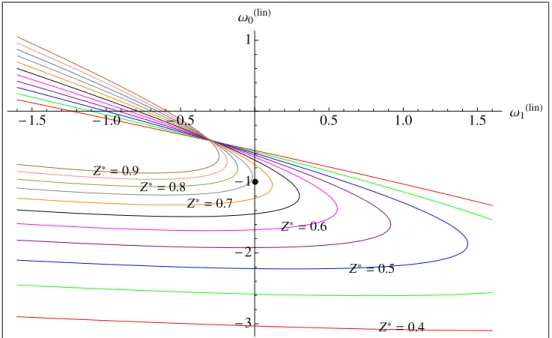
We begin with the model where the EEoS is linear in redshift, w(lin)(Z). In Fig.
3.1 are shown w0(lin) −w(lin)1 curves for Z∗ in the range 0.4 ≤ Z∗ ≤ 0.9. Several interesting features of Fig. 3.1 deserve discussion. First, the dot at (0, -1) confirms
Z∗ = 0.743 ±0.030 for the CC model. If Z∗ is measured to be Z∗ > 0.75, it is necessary thatw(lin)1 <0. IfZ∗is meaured to beZ∗ >0.831, we find thatw0(lin) >−1. AsZ∗ increases, the requisite w(lin)(Z) becomes more and more distinct from the
CC model. In Fig. 3.1, we note that for any measured value ofZ∗, there are two
possible values ofw(lin)0 for each value ofw1(lin).
Z* =0.4 Z*
=0.5 Z*
=0.6 Z*
=0.7 Z*
=0.8 Z*
=0.9
-1.5 -1.0 -0.5 0.5 1.0 1.5
Ω1H linL
-3 -2 -1 1 Ω0H
linL
Figure 3.1: w(lin)0 is plotted against w1(lin)for0.4 ≤ Z∗ ≤ 0.9 in increments of0.05. The dot at (0,-1) represents the CC model. Here we useΩm(t0) = 0.275, which is consistent with the result of
[48] for the best fit for this model.
The reader will remark the confluence of theZ∗-orbits in Fig. 3.1, which is an
artifact of the restriction to0.4≤Z∗ ≤0.9. For values ofZ∗near to but outside this range, the confluence desists. A similar phenomenon appears in later plots.
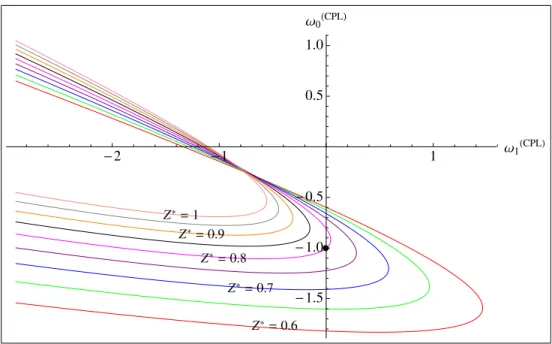
We next discuss the model w(CP L)(Z) [45, 46] in which the EEoS is linear in (1−a), whereais the scale factor. In Fig. 3.2 are shownw0(CP L)−w(CP L)1 curves for
Z∗ in the range0.6 ≤ Z∗ ≤ 1.0. There are several features of Fig. 3.2 to note. The dot at (0, -1) confirmsZ∗ = 0.8, which is the resultingZ∗value from Eq.(3.5) when
the valueΩm(t0) = 0.255is used, as determined by [47] as the best fit value for the
CPL model. If Z∗ is measured to beZ∗ > 0.810, we find thatw(CP L)1 < 0. As Z∗
increases, the necessaryw(CP L)(Z) becomes more and more distinct from the CC model. In Fig. 3.2, we see that for any measured value ofZ∗, there are two possible
values ofw(CP L)0 for each value ofw1(CP L).
Now we examine Fig. 3.3 for the SSS model. We see that for a certain range
of Z∗ > 0.8, which includes the best fit value of Z∗ which we discuss later, both
Z* =0.6 Z* =0.7 Z* =0.8 Z* =0.9 Z* =1
-2 -1 1
Ω1H CPLL -1.5 -1.0 -0.5 0.5 1.0 Ω0H
CPLL
Figure 3.2: w(CP L)0 is plotted againstw(CP L)1 for0.6 ≤Z∗ ≤ 1.0in increments of0.05. The dot at (0,-1) represents the CC model. We useΩm(t0) = 0.255, which is consistent with the analysis in
[47] for the best fit for this model.
Z* =0.8 Z* =0.6 Z* =0.7 Z* =0.9 Z* =0.85 Z* =0.6 Z*=0.7
Z* =0.8 Z*
=0.9
-5 5 Ω1
HSSSL
-1.0 -0.5 0.5 1.0 1.5 Ω0H
SSSL
Figure 3.3: w0(SSS) is plotted againstw(SSS)1 for0.6 ≤ Z∗ ≤ 0.9in increments of0.05. We use
Z* =0.6 Z*
=0.7 Z*
=0.8 Z*
=0.9
-1.5 -1.0 -0.5 0.5 1.0 1.5
Ω1H newL
-1.5 -1.0 -0.5 Ω0H
newL
Figure 3.4: w(new)0 is plotted againstw(new)1 for0.6≤Z∗ ≤0.9in increments of0.05. The dot at
(0,-1) represents the CC model. We useΩm(t0) = 0.275.
w(SSS)1 andw(SSS)0 must be greater than zero. Note also the degeneracy inw(SSS)0 for
Z∗ = 0.85,0.9.
Fig. 3.4 displays the new model. Once again we see that the CC model has
Z∗ = 0.743. ForZ∗ ≥ 0.81,w(new)0 >−1.0. We note that forZ∗ >0.75,w(new)1 must be negative.
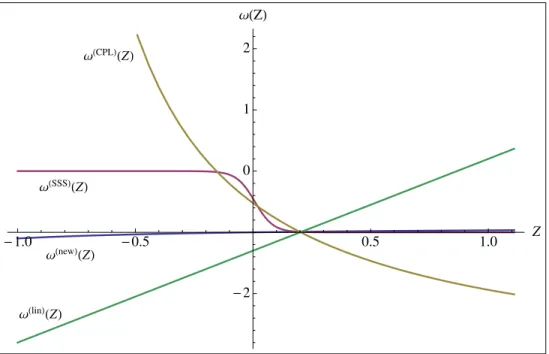
In Fig. 3.5, we show w(lin)(Z), w(CP L)(Z), and w(SSS)(Z) as a function of Z
(including the future,−1≤Z <0) using the best-fit parameters of [48] forw(lin)(Z)
and those of [47] for the other 2 models. w(new)(Z)is also plotted using the choice
ofw(new)0 =−1andw1(new)= 0.1.
Unlike the CC model, where the future of the universe is infinite exponential
expansion, the best fit for w(lin)(Z) necessarily leads to a big rip, at a finite time in the future. The EEoS for w(CP L)(Z) possesses singular behavior for Z → −1
because w(CP L)(Z) → ±∞forw(CP L)
1 being negative or positive, respectively. For
the SSS model,w(SSS)(Z)varies in the range0> w(SSS)(Z)>−1.
ΩHCPLLHZL
ΩHSSSLHZL
ΩHnewLHZL
ΩHlinLHZL
-1.0 -0.5 0.5 1.0 Z
-2
0 1 2
ΩHZL
Figure 3.5: w(Z)for all the models is plotted againstZ from the highestZ∗ value toZ = −1
(when the scale factorais infinite). The horizontal axis atw(Z) = −1is the line representing the CC model. We usew0(lin) = −1.3,w(lin)1 = 1.5, andZ∗ = 0.4067(from the best fit for this model given in [48]). We usew0(CP L)=−0.522,w1(CP L)=−2.835, andZ∗ = 1.11for the CPL model and
As for our fourth and last model w(new)(Z), from Eq.(3.9), we note that this
choice has the advantage that for allZthis EEoS lies between(w(new)0 −w1(new))and
(w0(new)+w1(new)). This is illustrated in Fig 3.5 where, for the choicesw0(new) = −1.0 andw1(new)= +0.1, the EEoS falls smoothly from−0.9at the big bang to−1.1at the big rip.
3.4
Slowly Varying Criteria
We now discuss which w(Z)for dark energy is the best for observers to employ.
Regretfully, there is no theoretical guidance about evolution. Nevertheless, we
here propose slowly varying criteria which is based purely on grounds of
aesthet-ics and, especially, conservatism. All the present data are consistent with the CC
modelw(CC) ≡ −1. We choose to remain proximate to it, as supported by [49, 50].
One consideration is that we prefer any globalw(Z)to have analytic, non-singular
behavior forZ → −1 and Z → ∞. Finally, we propose to impose the inequality representing conservatism,
|w(Z) + 1| 1 for all −1≤Z <∞. (3.10)
Next, we consider application of our slow variation criteria to the four specific
models we have discussed in tbe present article. For this task, Fig. 3.5 will be used.
To be fair to their inventors, these EEoS were intended to apply for only a limited
range of redshift.
(i) Linear model
By studying the EEoS in Eq. (3.6), we notice that forZ →+∞,w(lin)(Z)approaches
±∞ depending on the sign of w1(lin). Also, w(lin)(Z) violates the criterion of Eq.
(3.10). We conclude that this linear model is disfavored according to our slow
variation criteria.
(ii) CPL model
By examining the EEoS in Eq. (3.7), we note that asZ → −1, w(CP L)(Z)→ ∓∞for
a (±) sign forw1(CP L). Therefore, according to our criteria, this model is disfavored.
(iii) SSS model
Looking at Eq. (3.8), we see thatw(SSS)(Z)varies from0to−1for the best fit given in [47], so it is non-singular. By this token, however, it does not satisfy Eq. (3.10).
This model, then, is also disfavored by our criteria. It should be noted, though,
that [47] studied this EEoS as a toy model to illustrate the importance of an EEoS
that fits data well for small and large positiveZ.
(iv) New model
This model is non-singular for all−1≤Z <∞because [Z/(2+Z)] varies smoothly from−1to+1, as can be seen from examining Eq. (3.9). It also satisfies Eq. (3.10) if we choose appropriate values forw0(new)andw0(new).
3.5
Discussion and Conclusions
The outstanding observational question about dark energy is whether it is a CC
model with w(Z) ≡ −1 or an evolutionary model with a non-trivial EEoS. The model-independent observational measurement of Z∗ is very useful for making
this distinction.
The theoretical prediction of Z∗ is, however, dependent on the EoS that is
isZ∗ = 0.743±0.030. As the data become even more precise, the error onZ∗ will diminish, making it observationally easier to detect deviation, if any, from the CC
model.
In the four EEoS models listed earlier, the possible values of Z∗ for different
values of the parameters w0 and w1 can be read off from our plots. These plots
show that degeneracies appear. For a givenZ∗and a specific type of EEoS, there is
an allowed curve in thew1-w0plane. For all0.4≤Z∗ ≤1.0, there exist disallowed
regions in thew1-w0plane.
To go further, we have to give criteria for selecting one EEoS. The most popular
choice in the last few years has been the CPL model [45, 46] because it
approxi-mates the linear model at low redshift. Also, it has a simple interpretation in terms
of the scale factor:
w(CP L)(Z) =w(CP L)0 +w1(CP L)(1−a(Z)) (3.11)
However, as a(Z) → ∞ (Z → −1), the CPL model diverges. Of course, the authors of [45, 46] intended their model to be applicable only for a limited range
of Z. However, it seems preferable for w(Z) to cover the entire range of cosmic
history, both the past and future.
Our novel EEoS also approximates the linear model at low redshift. It has,
like the CPL model, a straightforward physical interpretation in terms of the scale
factor:
w(new)(Z) =w(new)0 +w1(new)
1−a(Z) 1 +a(Z)
(3.12)
We think one advantage of this new model over the CPL model is that it is
non-singular for−1 ≤ Z < ∞. A second advantage is that it can satisfy the slow variation criterion of Eq. (3.10).
In conclusion, the choice of an evolutionary alternative to the CC model
de-pends theoretically on constraining the EEoS, and we have proposed a new EEoS
which not only has a simple physical interpretation but also is well-behaved for
all possible redshifts. The model-independent extraction ofZ∗ from observational
data is a familiar process [51]. A more accurate model-independent estimate ofZ∗
by global fits to all relevant data is worthwhile. It is an interesting issue how the
present considerations of evolutionary dark energy are related to the possible
oc-currence of a big rip. This requires ultra-negative pressures of dark energy, so it is
interesting that situations involving phantom energy have appeared in the context
of extra spatial dimensions in string theory [52].
It has been argued [53] that dark energy effects can be detected only by
study-ing physical systems as large as galaxies. Thus, it is unlikely that any terrestrial
experiment can be sensitive to dark energy.
Understanding dark energy may, or may not (in the CC model), require a
grav-itational theory more complete than general relativity, which has been accurately
confirmed [54] only at the scale of the solar system, say∼1012meters, while dark energy operates above the galactic size, say∼ 1020meters. Thus, it is likely, even probable, that study of dark energy will inform us, in the near future, how to go
beyond Einstein, which is the most important direction both for particle physics
Chapter 4
The Little Rip
1
4.1
Introduction
Observations indicate that roughly 70% of the energy density in the universe is in
the form of an exotic, negative-pressure component, dubbed dark energy [56, 57].
(See Ref. [58] for a recent review.) If ρDE and pDE are the density and pressure,
respectively, of the dark energy, then the dark energy can be characterized by the
equation-of-state parameterwDE, defined by
wDE =pDE/ρDE. (4.1)
It was first noted by Caldwell [28] that observational data do not rule out the
possibility thatwDE <−1. Such “phantom” dark energy models have several
pe-culiar properties. The density of the dark energy increases with increasing scale factor, and both the scale factor and the phantom energy density can become
infi-nite at a fiinfi-nitet, a condition known as the “big rip” [28, 29, 59, 60]. It has even been
suggested that the finite lifetime for the universe in these models may provide an