IN NETWORK: GAMING THEORY AS A STRATEGY FOR BUILDING DIGITAL HEALTH LITERACY
Emily Dawn Bunner
A dissertation submitted to the faculty at the University of North Carolina at Chapel Hill in partial fulfillment of the requirements for the degree of Doctor of Philosophy in the
Department of English and Comparative Literature.
Chapel Hill 2015
Approved by:
Todd Taylor
Jane Danielewicz
Dan Anderson
Jordynn Jack
ii
iii
ABSTRACT
Emily Bunner: In Network: Gaming Theory as a Strategy for Building Digital Health Literacy
(Under the direction of Todd Taylor)
This dissertation examines how theories and rhetorics from game studies create deeper understanding of the literacy needs for writers in the networked, multimodal environment surrounding American health care. I combine video game and social network theories to explore how
computational algorithms and protocols interact with social networks in the communication of high-stakes knowledge. Gaming theory is a timely tool with which to address health literacy because contemporary medical communication flows through and is shaped by a technologically mediated system that can be understood as a set of rules both supporting and constraining action. My work demonstrates the importance of game studies to literacy scholarship by showing the rhetorical
iv
v
ACKNOWLEDGMENTS
I often remind my students that life doesn’t wait for college to end: things are going
to go wrong along the way. Work ahead, have a plan, and surround yourself with good
people. The complex and occasionally hilarious journey to the completion of this dissertation
was made possible by a collection of excellent companions and guides. My advisor and
mentor Todd Taylor maintained faith in me from the first day that we discussed this project.
My committee members, Jane Danielewicz, Jordynn Jack, Cynthia Haynes, and Dan
Anderson provided a wealth of resources, cross-referencing magic, and simply-worded
encouragement. My family, which certainly extends to the entire Computers and Writing
community, continually reflected back to me an image of the scholar I could become.
As always, I offer the deepest personal thanks to my partner, Kory, for finding all of
the light switches, to Jill for providing the ponies, to the crew at Linda’s for saving my seat,
to #TeamRhetoric for the writing group power sessions, and to my guild, Knowledge is
vi
TABLE OF CONTENTS
LIST OF FIGURES ... vii
INTRODUCTION ... 1
CHAPTER ONE: GAMING THEORY AND HIGH STAKES LITERACY ... 7
Gaming as System Building ... 25
Play within Systems ... 28
A Narrative Tour of a Knowledge System ... 32
CHAPTER TWO: HOW GAMING THEORY OPERATES IN MEDICAL COMMUNICATION SYSTEMS ... 38
Social networking in high stakes discourse ... 51
CHAPTER THREE: GLUTEN SENSITIVITY: RULEPLAY IN THE RHETORIC OF PERSONAL DIAGNOSIS ... 62
The science of diagnosis in the age of gadgetry ... 87
The performance of patient sociality in a gameful network: a note on ethos ... 97
CHAPTER FOUR: VACCINE RESISTANCE: NETWORKED AGENCY AGAINST “MEDICAL CERTAINTY” ... 103
The Construction of Vaccine Resistance ... 108
Creating Counter-Knowledge through Networked Community Resistance ... 115
CHAPTER FIVE: WHY NETWORKED GAMING THEORY MATTERS IN THE SCIENCE COMPOSITION CLASSROOM ... 146
vii
LIST OF FIGURES
Figure 3.1: Google Trends report on the popularity of the phrase “gluten sensitivity” in Google web searches between 2005 and 2015. ... 65
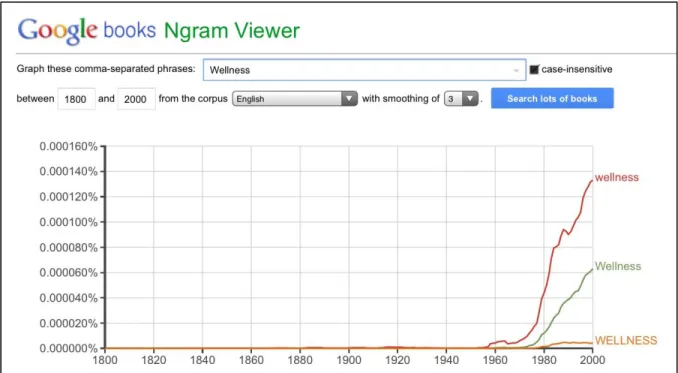
Figure 3.2: Ngram graph of the usage frequency of the word “wellness,” including variation in capitalization, in all books catalogued by Google Books with publications dates between 1800 and 2000. ... 85
Figure 4.1: Google Chart generated by Lucy Bmq to show motivations for vaccination
resistance among VRM members. ... 115
Figure 4.2: Image showing rationale for avoiding vaccination based on chemical safety concerns. ... 120
Figure 4.3: “Chemistry Cat” meme showing the amount of research supporting vaccine injury risk ... 122
Figure 4.4: Meme showing community opposition to Jenny McCarthy as a spokesperson for the anti-vaccination movement. ... 125
Figure 4.5: Meme showing that patient research goes beyond Google searches and may provide better results than mainstream medical doctors. ... 127
Figure 4.6: Meme showing intense skepticism about doctors’ knowledge of vaccine
ingredients. ... 128
Figure 4.7: Shared image showing patient questioning of side effect reporting. ... 131
Figure 4.8: Meme showing supposed contradictions of safety recommendations on the Merck website. ... 132
Figure 4.9: Shared image showing an alternate explanation of the biological link between vaccines and autism. ... 133
Figure 4.10: “Most interesting man in the world” meme showing skepticism of the political interests of the CDC. ... 135
viii
Figure 4.12: Image suggesting conspiracy on the part of those who profit from illness to prevent treatment of illnesses. ... 139
Figure 4.13: Image claiming that compulsory vaccination violates the Nuremburg code. .. 140
1
INTRODUCTION
This dissertation will examine how our rhetorical understanding of social media
systems can benefit from the application of gaming theory.1 I will analyze the construction of
medical knowledge by providers and patients to demonstrate how networked media influence
and shape communal discourse in rule-based systems. First, I will outline how gaming theory
is defined and used in the field of rhetoric. Next, I will explain current problems in
networked medical communication that gaming theory can help. Finally, I will suggest how
we can use gaming theory to prepare students to address these communication problems in
WiD and WAC composition classes. A useful connection exists between gaming studies and
health communication because contemporary medical discourse is shaped by a
technologically mediated system, and gaming theory is a highly effective tool for allowing us
to understand and intervene in diverse technologically mediated systems.
I will approach the broader problem of how gaming theory can clarify systems
operations by addressing the question: “How can a gameful understanding of contemporary
medical rhetoric improve health science discourse?” My methodology will apply gaming
theory to allow exploration of the ways in which health information is created and
transformed in connection to the larger ecosystem of social media. As medical discourse
2
comes into contact with various nodes in a broad network of research dissemination and
social media, its meaning, purpose, and reception change in rhetorically important ways.
Understanding this system is of great value to rhetoricians who study medical
communication and ethics. Rhetorical analysis will also assist in the education of medical
professionals and writing instructors who wish to engage more productively in the social
media by which much health information is disseminated. By using the example of
networked health discourse, I aim to show how gaming theory will build increased
understanding of the rhetorical implications of social media practices, many of which are
erroneously taken for granted as transparent tools for relaying data.
Rhetoric scholars commonly approach the problems of how knowledge, literacy, and
meaning are created and disseminated using a disciplinary model. Fact and evidence are
evaluated differently within various fields and disciplines; we’ve been open to this concept
since embracing the work of Foucault and Perelman in the 1960s. We can no longer study
how meaning is shaped by the practices of disciplines alone if we want to understand and
teach critical rhetorical skills in modern colleges and universities. Writing has always been
one instantiation of a larger, open system that echoes through many spheres of sociality. With
the normalization of Web 2.0 as an infrastructure for everyday sharing, creation, and literacy
development, we can more easily trace the evolution and circulation of ideas. However, we
also need to recognize that these processes have been changed by the technologies through
which they move. Current technology provides additional shaping influences and automated
inputs that did not exist prior to online interaction.
To study networked communication, we need to become comfortable with discussing
3
In his 2008 discussion of the importance of gameplay as a model of real world learning, Eric
Zimmerman claims that “systems literacy” can be considered “a paradigm for literacy in the
coming century.” Gaming, an essentially systemic activity, is an effective literacy training
tool because “there is an emerging set of skills and competencies, a set of new ideas and
practices that are going to be increasingly a part of what it means to be literate.” This claim
that games, as rule-based and systemic activity, can be used to understand larger systems of
action and communication has become a foundational concept in the small but growing field
of literacy and learning in game studies. In addition to studying the disciplines in which
literacies are formed and taught, we need tools and models to understand the larger
technological networks in which they reside.
An example of a pre-digital rhetorical framing of communication within a system can
be found in Kenneth Burke’s well-known dramatistic pentad from the Grammar of Motives
(1945). We can draw a few connections between this widely established model and gaming
theory in order to show the rhetorical foundations of current game studies practice and the
directions in which they have lead. Burke frames his approach to understanding motives and
action as a question of “What people are doing and why they are doing it.” In order to find
“some kind of answers” (italics in original) he proposes a system that breaks the question of
motives down into five elements addressing act, scene, agent, agency, and purpose. These
elements illustrate the dramatic characteristics of human relations. While this method will
not, according to Burke, provide definitive answers about human behavior, it will shed light
on the way behavior is described in language. Burke alludes to the usefulness of applying this
method to larger networks, as these “forms of thought” are “equally present in systemically
4
scientific work, in news and in bits of gossip offered at random.” In short, Burke advocates a
method of investigation that can be used to understand a variety of systems across multiple
disciplines and settings.
Burke’s interest does not extend to the actions of technology and machines beyond
how they are used as instruments that allow people to exert their own agency. Additionally,
he states from the outset that “we want to inquire into the purely internal relationships which
the five terms bear to one another…and then to see how these various resources figure in
actual statements about human motives.” Gaming theory can function as an extension of this
system of evaluation, adding such questions as: Is the agent human or nonhuman? What
interactions lead to the creation of the scene? What level of automation was involved in the
act? How do different degrees of social power influence the purpose of an action? Gaming
theory, especially when addressing issues of communication and literacy, views networked
activity as an open system that must move beyond “purely internal relationships.” Certainly,
Burke was deeply concerned with communities, social ideas, and complex relationships, but
in a pre-Internet world where locality and privacy had very different meaning, actors and
setting could be more easily separated. Burke claims that these five terms “never need to be
abandoned, since all statements that assign motives can be shown to arise out of them and to
terminate in them.” While act, scene, agent, agency, and purpose remain powerful concepts,
the definitions of each term have stretched considerably, and the relations between them
cannot be drawn in a simple pentad. Gaming theory could not unproblematically outline a
simple set of guiding questions that enclose a system, because an open system has an infinite
5
arranged in a pentad or a widely dispersed cloud, are not as important as the lines of
connection between them.
I propose that a methodology informed by gaming theory will allow us to study
complex systems of human and nonhuman actors as well as the procedures and protocols
guiding them in a useful and flexible manner that builds upon previous systems-based
rhetoric. Gaming theory addresses a variety of inputs and outputs, as well the human,
material, and digital components of a system in order to increase understanding of how
information functions in a networked world. The importance of learning how networks
operate has lead gaming theorists to embrace the concept of “procedural literacy,” the ability
to construct and analyze operations in accordance with predetermined rules or logics of a
system. In 2007, Ian Bogost popularized a methodology for “procedural rhetoric” as a subset
of this literacy that seeks to understand how and why these structural logics and rules work.
His guiding questions include “What are the rules of the system? What is the significance of
these rules (over other rules)? What claims about the world do these rules make? How do I
respond to those claims?” In Bogost’s theory, a game can serve as a model of a given system
while allowing exploration of its rules and relations through serious play. I am interested in
the affordances of gaming structure, language, and collaborative activity to demonstrate
strategies and constraints for procedural interaction within networks comprising a large
number of points or nodes.
A rhetorical investigation of how games work can be productively applied to a
number of gamelike or gameful technologies that mediate our lives, including this
dissertation’s guiding case study: health care. Providers, patients, communication tools, legal
6
in a gameful system constrained by formalized but often poorly understood procedures and
rules. After constructing and clarifying the operations of gaming theory, I will explore
communication networks of knowledge creation and negotiation within a digitally mediated
medical infrastructure and the gamefulness of literacy education in health and medicine WiD
7
CHAPTER ONE: GAMING THEORY AND HIGH STAKES LITERACY
What is gaming theory, and what does it have to do with the nuanced communication
skills required for medical study and practice? Gaming theory is a diverse and quickly
evolving field that offers many potentially productive hybridizations and border crossings
with medical rhetorics. The emergent status of this new and deeply interdisciplinary field
allows it to behave as what Eric Zimmerman calls a “cluster of practices” revolving around
the joined concepts of systems, play, and design (2008). Game practices build theoretical
frameworks by allowing us to understand networked action within a system, driven by both
players and machines. Gaming theory is then an interdisciplinary constellation of techniques
allowing playful interpretation and manipulation of relations, engagement, and design in the
structuring and support of meaning within systems. This native attention to relationships and
meaningful design ensures that gameful action will always benefit from sustained, careful
attention to power structures and identity studies as with those addressed by contemporary
feminisms and movements for social justice. Individual game titles can be powerful vehicles
for creating, reshaping, and distributing knowledge, but gaming theory also stresses concepts
such as situated learning and distributed knowledge that pervade the field of gaming on a
much broader scale than any individual game. Games and their ongoing redefinition by
changing groups of players and researchers function as theory building machines that allow
us to understand many forms of activity and participation and to increase the efficacy of
8
There are many possible points of entry into gaming theory, from a variety of
disciplines. The larger field embraces the concepts of visual design, narrative analysis,
critical race theory in character representation, code construction, audience response
research, and a variety of other subdomains within economics, computer science, art,
sociology, and other fields. My discussion will focus on the branch of game studies that
closely interacts with literacy scholarship and pedagogy. It is here that we most directly see
the value of gaming theory to educational practice, and by gradual extension, to the medical
writing classroom.
We develop new methods and theories in response to problems and crises, and there
is no shortage of proposed crises in American literacy education. Sources as diverse as the
Common Core Standards Initiative and the best-seller The Shallows, which was assigned as
required summer reading for my first year students at The University of North Carolina at
Chapel Hill in 2011, stress the need to return to foundational skills in reading and writing.
Nicholas Carr warns in nearly apocalyptic tones of the destruction of students’ ability to
focus in an age of distraction caused by digital communication, and I would claim, by digital
literacy itself (2011). In The Shallows, Carr comments on his own growing inattention,
brought on by email, social networking, and smart phones. Our students’ ability to read
deeply, he claims, is at severe risk. A similar, though more empirically researched view is
emphasized by cognitive scientist Maryanne Wolf, in her 2007 text Proust and the Squid:
“we must exert our greatest effort to ensure that immersion in digital resources does not stunt
our children’s capacity to evaluate, analyze, prioritize, and probe what lies beneath any form
of information.” Is it exactly at this point of concern that we can deploy gaming theory and
9
literate brain never mentions gaming, and she, like Carr, expresses intense fear that the
digital revolution will result in the loss of neural development and arrangements millennia in
the making. In the process, she also presents the strongest case I have ever encountered for
the importance, even necessity, of incorporating gaming into literacy education.
If a brain is shaped by our literate experiences such that cognitive processes hard-wire
in accordance with our most practiced approach to the word, then new generations may not
engage in reading in the same way that their parents did. The restructuring of how the brain
learns is a familiar topic in cognitive science and addresses how neural networks grow and
strengthen based on actively practiced relations and frequently stimulated relationships, often
affected by emotions (Smilkstein, 2011). Is this destruction or adaptation? And how do we
adapt in response? Wolf cautions us, “The question that emerges, therefore, is this: what
would be lost to us if we replaced the skills honed by the reading brain with those now being
formed in our new generations of ‘digital natives,’ who sit and read transfixed before a
screen?” This is the same question that worries Carr, but I think it is far more useful to ask
what skills might be gained, augmented, or created by the changes that Wolf carefully
illustrates based on neurological studies. The question that seems most pressingly suggested
by her work is, “How can we address the literacy needs of the digital native?” Wolf
compares the vocabularies of children who were read to often with those of children in
“linguistically impoverished” environments. The trouble here is the focus upon the printed
text and her stress on the necessity of “the language of books.” American children do not
learn to read only from books; increasingly, they learn words in the context of video games
(Hawisher and Selfe, 2007). If reading wires a brain to fire in corresponding pathways, how
10
learning processes of our students? Is it possible that there is such a thing as a “gaming
brain?” Whether or not game-based reasoning can be wired into cognitive formation, it is
part of our cultural learning landscape of networked communication. According to game
theorist and designer Jane McGonigal, by age 21, Americans have on average spent over
10,000 hours playing video games, thereby crossing the “expert” threshold (2011). We have
a great deal of experience learning by playing with systems.
No learning approach will answer the needs of every student, but gaming theory
offers a strategy that can reach many students that traditional literacy training has failed and
that college classrooms have left behind. It is important to note that the application of gaming
theory and research to education does not imply an endorsement of “edutainment” or
gamification: I am not advocating for educators to “make learning fun” by superimposing the
appearance of games onto a standard curriculum. The use of games in the classroom must
always be critically investigated in terms of what a given game actually teaches through its
gameplay. (For example, my second grade teacher used a program called “Math Orchard” to
teach us multiple digit subtraction. The game may have increased speed of recall for
frequently repeated problems, but what it really taught us was how to guess effectively at the
code words used to unlock the next level. We were learning a widely applicable and potential
valuable program-hacking skill, but certainly not the one Ms. Murphy intended to teach us
that day.) Gaming does not automatically make learning fun, nor does it ensure increased
attention or engagement when it is not incorporated into a curriculum that recognizes the
evidence-based expectations for and limits of game-based instruction. To use gaming
11
The most basic connection of games to learning is the axiom that every game must
teach its player how to play. Games are always training tools for their own rules. Anything a
game teaches necessarily has a context, and each rule represents a set of relations that exist in
a specific situation (also called a game state). Students who stand to gain the largest benefit
from gaming theory-based learning are those who learn by association and who struggle to
memorize facts in a vacuum. James Paul Gee, one of the best known scholars of gaming and
literacy, gives the example of science students being able to recite formulae but not having
the opportunity or necessary training to apply these operations to a real situation, or in some
cases, even to recognize their use outside of the classroom (2007). From this point, he builds
an argument that has become one of the foundations of game-based education: “Human
learning is not just a matter of what goes on inside people’s heads but is fully embedded in
(situated within) a material, social, and cultural world” (2007, parentheses in original). Gee
calls this concept “situated cognition,” and presents a theory of gaming as a productive
literacy encounter based upon the value of embodied, situated experience. He is first and
foremost a scholar of literacy and seeks to validate gaming insofar as it contributes to this
field: “When people learn to play videogames, they are learning a new literacy”(italics in
original). This is the core of his argument, presented in straightforward language, with no
qualifications or hesitation. Gaming literacy exists. Further, he claims that the existence of
gaming literacy presents a powerful case for considering the concept of literacy more
broadly.
“Literacy” is a master term that, as of 2014, can be stretched and reshaped to include
a broad range of definitions. I enter my discussion of gaming literacy and the usefulness of
12
overuse of the term “literacy.” I admire Gee’s bold definition, and at the same time I want to
take care not to evacuate a term of meaning by loading so many ideas into it that it begins to
rupture at the edges. In their 1999 article “Blinded by the Letter: Why are we using Literacy
as a Metaphor for Everything Else,” Johnson-Eilola and Wysocki critique this troublesome
overdetermination and potential overuse. After exploring a dense web of relations in literacy
contexts and actors, they suggest that “we could describe literacy not as a monolithic term
but as a cloud of sometimes contradictory nexus points among different positions. Literacy
can be seen not as a skill but a process of situating and resituating representations in social
spaces” (1999). Gaming has always existed as part of a distributed technological cloud and is
certainly an aid to situating and resituating; more importantly, gaming is a process, in
process, built upon a web of processes. I tread carefully around the master term, but I would
not hesitate to claim that gaming theory enables a learning situation that is sensitive to the
mutual redefining of symbols and society. Simply, gaming trains us to use (and to create,
receive, and interact with) language in socially situated ways that encourage meaningful
learning.
The role of gaming in the formation of American literacy was brought to widespread
scholarly attention by Selfe and Hawisher’s ongoing Literacy Narrative project. After
publishing Literate Lives in the Information Age (2004), which includes a collection of
narratives about literacy formation, Selfe and Hawisher remarked on the frequency with
which stories of gaming appeared in the literacy narratives of younger adults. In 2007, they
published Gaming Lives in the Twenty-First Century to reflect this growing trend. Selfe and
Hawisher support Gee’s argument that gaming can teach literacy and create productive
13
collection Rhetoric/Composition/Play, Selfe and Hawisher appeal to composition theorists:
“If we lose sight of how students are composing meaning in electronic gaming environments
and networked systems . . . we run the risk of ignoring a whole arena of serious language use
and play.” Gaming, according to Selfe and Hawisher, has a profound influence on the
development of learners as literate individuals.
Before I return to the discussion of gaming as literacy, I would like to review briefly
the concept behind much theoretical work that focuses on the procedural structures of games:
gaming as action. This theory is perhaps best developed by Alexander Galloway (2006), who
builds on Manovich’s (2001) claim that in order to play, a player must execute an algorithm.
Galloway separates gameplay from purely literate activity by stressing actions that are not
tied to visual stimuli and by proposing “grammars of action” and physical vocabularies that
the idea of literacy may be unable to encapsulate effectively. I present this action-based
approach so that it can stand as an alternate possibility as we consider gaming literacy. It
should be clear to us that gaming can play many roles and take on many forms in learning
processes, in and outside of the college classroom.
We do not need to choose between Gee’s very direct, italicized claim that “gaming is
literacy” and Galloway’s very direct, also italicized claim that “video games are actions.”
Both can be simultaneously, alternately, supplementarily, or conditionally true in relation to
the shifting situation of our gameplay. Instead, I would like to ask, “How might it be useful
to consider gaming as literacy?” I will return later to address how this question applies to
gaming as action. Gee’s conception of literacy is not an inactive one; he sees literate
behaviors as constitutive of identity, which is in turn an aid to learning. Gee is, by
14
of reinscription. He maps what he has previously argued about literacy onto what he later
discovered about gaming. In line with this approach, he structures his book on games and
literacy as a guided catalogue of thirty-six ways that games positively encourage or influence
learning, and particularly literacy education.
Gee’s study relies upon the idea of a “good video game” that has built good learning
principles into its design, which according to Gee, is something all good games do. It may be
more accurate to describe these games as functional or complete games, rather than “good”
games -- Gee leaves this definition somewhat open. A highly valuable piece of Gee’s
argument is his willingness to apply some of these claims not only to games themselves, but
also to “gamelike technologies.” This category will be vital to my own argument and will be
discussed later in this chapter as I review the conversation surrounding what qualifies as a
game and how far this label can be applied before it loses the effectiveness of its specificity.
Gee argues that both good games and gamelike technologies encourage young people to
learn in “deep ways.” His sense of learning depth implies that students who learn through
gaming are more likely to understand concepts in specific contexts and to remember them for
a significant amount of time. It would be far beyond my scope to look at all thirty-six of
Gee’s recommendations and assertions; however, I would like to investigate a few of the
claims that will most closely relate to how gaming can improve medical writing.
First, Gee explains that gaming can make student-players into partners rather than
passive listeners in the classroom. This approach seems to answer the Freirian anxiety about
situating students as receptacles for knowledge bestowed by an all-knowing and
incontestable instructor.2 Contestation, and testing more generally, is a central performance
15
in the process of play. Learning through repetition is, according to Gee, also transformed by
play insofar as repeated attempts and practice are more natural to play than to study. By
presenting a challenging obstacle, games encourage experimental trials. They do not require
repetitive study for the sake of memorization alone, but for immediate application. This trial
and error procedure closely echoes the scientific method that shapes medical theory,
classroom activity, and the writing that represents medical study or actions. It is easier to ask
students to assume the identity of a scientist as they enact the ethos of a scientist by
performing this methodology. Gee contends that one of the strengths of game-based learning
is the opportunities it presents for identity play and trial. The extent to which a game, even a
highly realistic and immersive video game, simulates authentic identity formation is a highly
contested concept. Sherry Turkle (1995) is one of the most iconic supporters of the
productive possibilities for identity play, and Lisa Nakamura (2002) is one of its most deft
and nuanced critics. Gee does not make concrete claims about how closely simulated
experience corresponds to the experience of an actor in the assumed role, but he hopes that
identity play will add meaning to the genres, audiences, and contexts addressed by a
composition or assignment.
The communal nature of knowledge acquisition and production is incorporated into
much of Gee’s argument for the value of gaming as a learning tool. One of his best known
ideas is that of the “affinity group,” suggested in place of the more popular “discourse
community” model used in many composition pedagogies.3 Affinity groups are communities
that organize themselves around shared interests and concerns rather than features of identity,
3 Discourse communities have been studied as sites of language formation since the term was coined by Martin
16
profession, or discursive constraints. I am hesitant to sweep aside the organizing power of
identity in group formation, but I believe that the affinity group is a useful concept for
understanding how communities form in digital environments. In the affinity group,
knowledge is both shared and distributed: All members share some core knowledge(s) that
define their ability to participate and interact, but other types or areas of knowledge are
distributed throughout the group, residing only in certain members. Even if a member is not
knowledgeable in a given area, they still have access to that information as a result of
distributed cognition within the group. I see this structure reflected in such situations as the
communal composition of a Wikipedia article written by experts in various subtopics, in the
structure of a fantasy role playing game where some members know how to heal and some
how to fight with swords, and in any medical lab team where some members are
knowledgeable about pharmacology, some about anatomy, and some about how to
communicate the two to an outside audience. Learning is best done in affinity groups that
resemble how people work together in “real” and digital worlds. Much traditional schooling,
as can be demonstrated by such documents as the Common Core Standards, stresses
individual mastery and performance. Students need to become adept at communal
performance that incorporates different depths of knowledge among members bound by a
shared interest.
Practice working in affinity groups is supported by game-based learning in Gee’s
study because games allow players to experiment under conditions of low-risk participation,
distributed problem-solving, social interactivity, embodied experience, and contextual
applications. Gee believes that knowledge acquired in this way will be highly transferrable
17
keep students working at the edge of their skill level. Of course, the potential of these
methods will always rely heavily on the skill and experience of the instructor, even if they
remain in the position of a de-centered learning guide. Calls to use gaming as a literacy tool
have been taken up by several scholars following Gee, notably including Alberti’s 2008
support of dialogic, interactive, and process-based problem solving, and Colby and Colby’s
(2008) focus on emergent composition. In each case, we assume that certain features are
inherent in digital games and will offer given opportunities and encourage certain behaviors
among players. These claims stumble somewhat on the gray area of what is a “good game,” a
definition that will often be left up to the instructor rather than being as certain as we might
like to envision. Are all games really interactive? How dialogic is the gaming process? If
composition responds to an emergent exigency, will the resulting rhetorical situation be more
authentic or compelling to the student writers? Each of these concerns is addressed in
ongoing debates within gaming and education studies.
I would like to expand the concept of gaming beyond literacy, without necessarily
disincluding it. Consider Johnson-Eilola and Wysocki’s claim (discussed above) that literacy
comes with a “bundle of stories” closely associated with linear-alphabetic experience that we
may or may not want to take with us and attach to the meanings of new technologies (1999).
Is literacy still a useful concept? In rhetorical communication, I find usefulness to be a more
important determinant of value than truth or definitional correlation. Insofar as gaming
teaches players to navigate certain usages of language and to produce compositions that
effectively address emergent audiences, the metaphor of literacy has many relevant
applications. When we apply gaming theory to medical communication, we will see that
18
for audience outreach. The ways in which gaming theory might encourage improved
distribution of medical information will be a central concern in later chapters. I would also
like to improve our understanding of gaming as a learning experience or tool by looking at
gameplay as action, a theory that often includes literacy as a subtype of activity.
Gaming is more than a performance of digital literacy. Games are not texts, and
certainly not only texts. They are written in computing code, which is never designed to sit
still or to be reserved for human contemplation. Code is an active language; each character,
line, or segment corresponds to an operation to be executed by a machine. When we play a
game, we rarely read the code itself (with the notable exception of game-modification
composition). In their study on game cycles, Arsenault and Perron (2007) contest
Manovich’s often-cited portrayal of gaming as interaction with programmed algorithms
(2001). It is the machine, not the player, who reads and performs these functions. We do not
interact directly with the text; gaming is a very specific type of action that cannot be reduced
to a pre-existing literacy. The actions of the gamer may themselves construct an algorithm as
a result of their interaction with the computational outputs of the code, but “the [player’s]
mental model will never represent gameplay as a computer set of instructions or calculated
formulae.” Arsenault and Perron’s claim draws on the related argument posed by prominent
game designer and theorist Jesper Juul, that “gameplay is not the rules themselves . . . but the
way the game is actually played” (2005). In Juul’s description, gameplay is a combined
consequence of programmed algorithm and player response. I describe this dynamic in order
to emphasize the specificity of the action of gameplay as distinct from an act of reading.
Seeing gaming as action opens up more possibilities for its application to education and
19
What type of action is involved in gameplay? One of the most publicized early
debates in game studies was the proposed divide between how games convey meaning or tell
stories and how games perform or enable play. This dichotomy is often framed as an
opposition between narratology and ludology, which is the study of play as a unique
procedural experience. It is important to note that this divide was popularized in 1999 by
Jesper Juul who later retracted the theory as overly simplistic. Narrative and play are both
actions performed or made possible by video games. Storytelling is an activity that is most
familiar in gaming studies from Janet Murray’s book Hamlet on the Holodeck (1997), which
explores how computers reshape narrative through interaction and digital landscapes. The
non-narrative actions of gameplay take many forms, which may or may not be related to the
story created by a given game’s corresponding fictional world. Galloway’s claim that
videogames are actions, referenced above, is predicated on the idea of a larger algorithmic
culture in which games exist. He asserts that “in video games the action of the machine is just
as important as the action of the operator” because neither would exist or persist without the
other (2006). The pervasiveness of algorithmic culture makes this claim all the more relevant
because it can be applied to a number of systems with which we routinely interact. Before we
consider the behavior of gamelike systems, we should consider the ways that games can
guide and provoke actions.
Another frequently commented upon tension in gaming studies is the extent to which
a game can be considered interactive. Many game scholars who began their careers in other
fields and transferred their expertise to gaming have explored and praised the ways that a
game promotes learning through interaction between games and players (Murray, 1997; Gee,
20
we have long passed over this crisis point and its significance to the field and a much larger
body of writers who continue to address the importance of interactivity. An effective
clarification of why this concept is inadequate or over simplified appears in Arsenault and
Perron’s investigation of gaming cycles and their relationship to computing algorithms
(2008). While the player does not read the code itself or execute its demands, she does
respond to the functions it produces. However, the computer’s response is a pre-programmed
routine that does not directly interact with any given player. The game cannot depart from the
possibilities originally written into its files. Therefore, Arsenault and Perron suggest an
alternate model of “inter(re)activity” wherein the player reacts to the preprogrammed code,
the game selects the appropriate response from its executable files in response, to which the
player reacts once again, leading to another algorithmically determined response, and so
forth. This schema is tempered somewhat by games that allow players to shape responses to
one another based upon a set of rules upheld by the computer, but Arsenault and Perron make
a strong argument for taking caution before making an assumption based on the possibility of
true interactivity with a machine.
Any discussion of interactivity or “inter(re)activity” during gameplay rests upon an
understanding of what Galloway calls “gamic action” (2006). According to this theory,
games exist when enacted, but can be enacted in at least four distinct ways, although
Galloway does acknowledge several points of overlap and generalization that could allow
later expansion.4 Galloway places gamic action along the axes of operator based or machinic, and diegetic or nondiegetic (part of the game’s fictional world, or clearly outside of the
4
21
story). These boundaries can help us see the ways that player and computer may interact or
inter(re)act with the total system of a gameplay without moving any part of the experience
outside the game itself. Games tell stories, players respond to stories, games perform
machinic functions, and players respond to the interface representation of the computing
core. Action along these axes may be relevant to a number of gamic or gamelike systems. For
example, a social media program such as Facebook constructs itself as a networking tool, I
respond to the narrated purpose of the technology by using it to connect with others, the
program executes commands enabling my input to be interpreted, and I continue to create
input influenced by the interface offered to me. How far I can take this comparison depends
on how restrictively I define the concept of “game,” and its usefulness hinges upon how I
understand the role of the interface through which I respond to the game.
Game studies, including design, theory, narratology and procedurality, is highly
conscious of its newness as a discipline. Most works in gaming studies are prefaced by an
attempt to define what the author means by “game.” This is not a token move: The
significance of each study depends heavily upon which constellation of gamic features it
targets. The earliest definition of gaming that has become part of the emergent game studies
canon is Huizinga’s 1938 formulation of play. This complex explanation may appear overly
restrictive in today’s context; Huizinga specifies that play must occur entirely outside
ordinarily life, existing within its own “magic circle” of discrete reality, it must not be
serious, it cannot be connected with material gain or profit, it must absorb the attention of the
player, promote the formation of social groups, and rely upon fixed and binding rules. We are
now more likely to include activities of profit and material interest in our definition of games,
22
understand the importance of the roles of cheating, hacking, and modification of rules as
gaming practices. As Mia Consalvo explains, “the magic circle has long been breached”
(2009). But we can’t open the floodgates and allow anything and everything to be a game
without losing the specificity of our field of study. Even if we look at a traditionally
non-game phenomenon “as a non-game,” we are comparing or mapping its features onto some shared
notion of game. At this moment in game studies, how much of our definition is shared and
understood?
An honest, though rather unsatisfying, answer is, “it’s evolving.” By and large,
gaming models gradually become less restrictive in terms of content and location, and more
finely tuned in terms of structure and execution. In 2005, Juul made a heroic effort to
compile some of the most widely recognized definitions of games into a simple table. His
work demonstrates the dramatic changes the process of definition has undergone between
Huizinga’s 1938 “magic circle” that exists outside of real world concerns, to Salen and
Zimmerman’s popular 2003 definition that “a game is a system in which players engage in an
artificial conflict, defined by rules, that results in a quantifiable outcome.” With each
definition presented, Juul shows the tension between the desire to define games more exactly
and narrowly and the desire to focus on the systems undergirding the gamic activity. I believe
that Salen and Zimmerman’s opening words, “a game is a system,” pinpoint exactly where
the greatest usefulness of gaming theory lies. We live in a world of systems, whether we’re
navigating the economy, pre-med coursework, social media, or instructions at the DMV. The
scale of quantifiability represents a key development in the networked infrastructure of
digital life. Salen and Zimmerman’s extraordinarily thorough textbook, Rules of Play (2003),
23
violence or competition, though it may apply to either. As a result, I argue that not everything
can be looked at as a game, but many systems may be explored gamefully.
Consider the popular social networking site Twitter. Twitter is a complex system
driven by commercial interests and sponsors, an extensive terms-of-service agreement, data
mining programs, and proprietary sorting algorithms. The level of human interaction layered
over this technological and procedural infrastructure introduces the element of conflict: Who
can be the most popular? Or in a less visible but more technologically powerful contest, who
can be algorithmically ranked as the “most influential” such that the site gives more screen
time to their words? The outcome is unquestionably quantifiable. The greatest uncertainty we
encounter if we try to look at Twitter gamefully is whether or not the conflict is artificial.
While some aspects of the popularity contests ubiquitous to the ecosystem of social networks
may arise from “natural” competition, the terms of this conflict, “who can get the most
followers,” are certainly constructed and gain meaning within a contingent set of social and
technological circumstances. I would argue that, like most social media platforms, Twitter is
a game. It is more important, however, to recognize that gaming theory can be usefully
applied to Twitter as a gameful system.
Applying gaming theory and terminology to other gameful systems is a growing area
of interest within game studies. Many scholars, including Hunter (2011), McGonigal (2011),
Alberti (2013), and Colby, Colby and Johnson (2013) indicate fruitful possibilities for
expanding our notion of what games are and how gameful relations work. However, tension
remains within the field regarding how games and gaming are defined and applied. Alberti
(2013), basing his approach on Alice Robison’s 2008 definition of a game as designed,
24
“the question of whether Facebook is a game or not seems more a matter of interpretive
ingenuity than scientific certainty.” Perron and Wolf suggest in their 2008 Video Game
Theory Reader 2 that “The definition of [game studies’] object and the vindication of its
examination are certainly representative of the first phase in defining the new field of
research.” They explain that we have now entered a second phase in game studies wherein
the foundations of the field and its value have been laid and the new task before us is to
“attempt to articulate its exact nature and scope, codify its tools and terminology, and
organize its findings into a coherent discipline.” As of early 2015, I believe it is clear that the
nature and scope of game studies is not being pinned down more narrowly, but opened to
broader application across more diverse fields and settings. The “codification of
terminology” may in fact become the creation of a more flexible vocabulary that shows the
relation of gamefulness to technological systems and social networks. The complexity of
creating any one stable vocabulary is so widely discussed that in 2013, Zach Waggoner
produced an edited collection called Terms of Play: Essays on Words that Matter in
Videogame Theory devoted to exploring the diversity of terms and expressions used in the
field. Some essays attempt to solidify concepts (what is ergodic?) and others throw concepts
further open (such as Holmes’ discussion of “allegorithms”). While Perron and Wolf call for
“consistency and accuracy” in order to increase trust and coherence, this does not imply
locking down the edges of the field or narrowing our research to pre-designated corridors of
investigation. Like gamers, researchers in game studies push boundaries, test limits, and
25 Gaming as System Building
The trajectory of game studies toward more diversified applications in multiple
contexts is not a new development. Game studies has a long theoretical history and is closely
related to the evolution of other network theories.
Gaming theory in its current set of instantiations and in its relation to mathematical
game theory has close ties to the larger field of systems theory. The emergence of systems
theory was one of the foundations of interdisciplinarity as a rising concern and goal in
American universities. The formal investigation of “general systems theory” emerged in the
work of Ludvig von Bertalanffy in 1969 and gained popularity alongside Foucault (1969),
Burke (1969), and Perelman’s (1969) rhetorically important works on disciplinary
knowledge. Bertalanffy frequently emphasizes that the multiple points of emergence for
similar theories from different disciplines within the same time frame demonstrates a massive
cross-disciplinary paradigm shift in thought (1969). He pinpoints this shift as the conflict
between an “analytic, mechanistic, one-way causal paradigm of classical science” and a new
worldview that considers all fields as members of open systems. Within a closed system, the
elements under investigation are isolated from their environment, such that they can only
influence and be influenced by other elements within the system. In contrast, elements in an
open system exchange matter with their environment such that various effects under
investigation may be caused by outside and seemingly unrelated elements. Bertalanffy
explains that systems are “conceptual constructs” and are governed by a set of rules that can
be studied in terms of systems themselves, rather than as elements of those systems. If we
can study the behavior of a system as a system, Bertalanffy concludes, the time has come to
26
offspring of specific and concrete problems in technology, but models, conceptualization and
principles. . . by far transcend specialist boundaries, are of an interdisciplinary nature, and
were found to be independent of their special realizations.” We can derive from this work the
existence of a systems-based literacy that is reflected in successful gameplay, even if the
game itself is also situated in a more specific context. The idea of events occurring in an open
system as the results of multiple and complex outside influences is so normalized in
contemporary culture that it is often uncritically taken for granted. Digital systems involve a
multitude of actors and influences that require careful attention in terms of how they operate
as a system, or as a game. Gaming theory is a flexible and accessible way to approach this
complex network that reaches into so many areas of daily life.
As discussed above, much work in game studies focuses on the growing need to
approach new media from systems-based perspectives. Zimmerman stresses the importance
of systems literacy as a necessity for effective communication (2008), Gee points out the
importance of relying on distributed knowledge in learning systems (2007), and McGonigal
argues for the recognition of how gameful systems have empowered the population to
accomplish both technological and social achievements (2011). We are natively networked in
daily life without conscious effort. Gaming provides an ideal model for understanding how
systems are integrated into one another such that they overlap, interact, inter(re)act, and
produce new wholes without losing their specificity. Systems embed into one another. Salen
and Zimmerman (2003) affirm that in addition to being systems themselves, a game is also “a
system of interaction between the players and the game,” as well as being a system of
27
approach this embedding hierarchically, or assign equal value to each set of relations,
depending on our motives.
Digital systems and practices of gaming that are increasingly focused on online play
are often examined in terms of connections or connectedness. Connections between public
and private information, places of play and work, and beliefs based in science and religion
are important relationships that receive frequent study. Connections between system nodes,
practices, and people are as significant to gaming theory as are the nodes themselves. In
2013, Jose van Dijck synthesized a number of approaches to actor network theory and
political economics in order to examine a value she calls connectivity. Connectivity is the
commodifiable counterpart to human connectedness that can be quantified, processed, and
acted on by protocols and algorithms in social media. Her analysis examines social media
microsystems in terms of their users, content, governance, ownership, and business models to
show the ways in which networked and commodified society has become normalized in
digital culture. She does not condemn or valorize this process, but makes a brilliant argument
for the importance of studying and recognizing what I would call the players in a gameful
system of social networking. The struggle for increased connectivity, whether by individuals
seeking to become more socially influential, or by corporations seeking to control greater
shares of user traffic overlays exceptionally well onto Salen and Zimmerman’s definition of a
game as a system including an artificial conflict with a quantifiable outcome (2003).
Van Dijck’s attention to the process of normalization takes us back to our discussion
of how neurological development adjusts to different environments of learning (Wolf, 2008).
Just as the wiring of a brain that learned language through interactive gaming varies from one
28
of networked learning environments (Carr, 2011). Our daily experiences are saturated in the
norms and values of connectivity, and the people with whom we interact -- students, patients,
colleagues -- respond within a system conditioned by connectivity. Connectivity, as it is
propagated and disseminated digitally, is driven by non-human actors in the form of
protocols and algorithms that guide human behavior after being set in motion. These
equations do not typically appear in the visible interface through which we participate in the
network, and so are frequently overlooked or remain entirely outside of general public
awareness. Gaming theory can help us investigate how these actors design and project
different environments just as the graphics of a game appear as an immersive world,
scaffolded upon numerical strings in a database. Gaming theory natively foregrounds the
persuasive acts of mechanical computation and how it creates or limits possibilities for
human communication.
Play within Systems
If games and gaming theory were limited to addressing mechanical persuasion and
the outputs of non-human actors, their usefulness in learning practice would be severely
limited. However, games, like the network protocols of social media, provide a structure
within which communication and relation can arise. Zimmerman (2013) contends that “play”
is what occurs within and because of designed rules. This guideline for game design
highlights the relation between technological structures and human activity, bearing in mind
that all structures and rules have authors with their own motives and interests. Some of the
most persuasive artifacts of code were fashioned by human work and set in motion like the
29
cache. Some constructs undergo frequent and responsive revision: Google’s proprietary
search algorithms, Apple’s autocorrect engine, the ranking of your interests on Facebook.
Some rules stand like concrete walls that shape the hallways we cross between classes. I
can’t decide that I will get to the computer lab more quickly if I walk straight through the
classrooms between my office and my destination, because I can’t pass through cinder
blocks. However, this doesn’t mean that I can’t decide whether or not I’m going to walk to
the lab at all, if I’m going to stop to talk to colleagues on the way, whether or not I refill my
coffee cup enroute, or if I skip and sing as I round the corner. The structure of the system that
is the brick and mortar of the English department building shapes but doesn’t define my
participation in the space it creates. Without the structure, there would be no office, no
hallway, and no lab. My right-angle turn would be unnecessary, and the lab computers would
get quite damp out on the lawn. The structure allows activity to exist and enables it to take on
meaning. Without a corner to round, my right angle turn might represent a very different
state of mind or intention. I can play with the system or my experience of it because rules
exist.
In the case of an online network mediated by algorithms, protocols, and interface
modules, the structure enables and shapes communication rather than footsteps. Before
providing an empty text box in which users could describe their status, Facebook used to
preformat status entries to begin “Emi is. . . which influenced what I could and could not say.
I needed to describe some action or state of being, e.g., “Emi is writing.” I could still share
something unrelated to my activity, but the format would be awkward: “Emi is why is there a
turtle on my desk?” The interface changed when enough people broke the syntax, but this
30
cause and effect. Mapped to the structure of a classic rhetorical triangle, the situation appears
less complex than it is: I speak to my Facebook contact list about a turtle. However, if you
run a Google Image Search for “rhetorical triangle,” you will see that there is immense
variation concerning which points of the triangle earn which names, what words are
overwritten across which peaks, and which lines are given arrows and new designations.
Bitzer’s “Rhetorical Situation” has been similarly dissected and reassembled over the past 40
years as “audience, constraints, and exigence” fail to meet the needs of different audiences
and scholars including Vatz, Edbauer, Garret and Xiao, Consigny, Brinton, Biesecker,
Jamieson, Hunsaker and Smith, etc., have added ecologies, cultural traditions, rhetoric itself,
fact, topics, relationships, identity, etc. We can’t simply draw a triangle, and we can’t limit
all the terms of a situation. Since systemic literacy is interdisciplinary, we can illustrate the
problem using the scientific method: It is impossible to prove a statement unless we have
eliminated all other possible answers. To say that any object is X, and definitely only X, we
have to rule out everything else it might have been. We are faced with the conjunction of
rigorous methods and unanswerable questions.
We’re left with a giant cloud of ideas and things, inputs, actions, and turtles that we
need a means of navigating. Like the scientific method, gaming theory is able to be at once
rigorous and open, defining and problem solving without providing absolute limits. Bogost
asserts, “Because games are systems, they offer a fundamentally different way of
characterizing ideas. They can inspire a different kind of deliberation than we find in other
forms of media, one that considers the uncertainty of complex systems instead of embracing
simple answers” (cited in Selfe and Hawisher, 2013). We must recognize structures and
31
and focus on how activity occurs within these rules and systems. For McGonigal (2011 these
gameful structures “create ways for us to work together at extreme scales to solve real-world
problems,” thereby optimizing human experience and creating meaningful engagement. The
structure is what fosters a positive productive force. Structures that allow media systems to
produce new affordances for “large scale collaborations” distributed across a network are
also emphasized by Rik Hunter (2011). Hunter shows that social media systems (wikis in his
example) lead to a new transition in literacy wherein the role of the reader-writer relationship
collapses under new rules for participation. Not only are we participating in different ways,
but different actors are participating as the result of changing systemic literate activity.
Annette Vee (2014) reminds us that “computational procedures are persuasive and
expressive” and possess rhetorical dimensions that require new tools to study. Vee, in her
collaboration with Jim Brown (2014) suggests that we need to consider the “algorithmic
possibilities of language production and persuasion.” Whether within a system specifically
designated as a game, or a within a structured communication network that creates space for
play within its rules, we encounter the persuasive power of computation. Bogost’s influential
work on procedural rhetoric asks us to focus on how games make arguments by representing
“how real and imagined system work” and inviting interaction (2007). Games and other
computational media persuade by “running processes and executing rule-based symbolic
manipulation” which renders those activities inherently rhetorical. The player or user does
not only respond to the appearance or sensation of a digital construct, but is influenced and
lead through different experiences based upon their interaction with what Bogost calls the
mechanics of the computation. Meaning is likewise created through computational modeling,
32 A Narrative Tour of a Knowledge System
Before introducing the complex configurations of medical rhetorics, I’d like to clarify
this link between systems-based thinking and computational persuasion with a simple
narrative example of situated action.
Imagine that I want to plant a garden. I live in Chapel Hill, North Carolina, which
according to the National Gardening Association, is located in growing zone 7b. I found this
out by Googling it. I have a few books on gardening, but I’m in the office and they’re at
home, and I, conditioned by a culture based on immediate delivery, want faster results than
jogging home to get a book could provide. The answers are right here under my fingertips,
courtesy of my overheating laptop and a Google search parsed and displayed through
Google’s Chrome browser. Another Google Search informs me that there is a very wide
variety of garden plants popular in my area, that Southern States Garden Center down the
street has many for sale, that the North Carolina Botanical Garden across the highway gives
seminars on gardening, and that I might want to buy some lovely handcrafted garden decor
from Etsy.com. I have encountered the effects of a search algorithm (Van Djick, 2013). The
recommendations for Southern States and the Botanical Gardens are based primarily on my
physical location, and would not appear if I were entering the same search terms in Forth
Worth, TX, which is also in Hardiness Zone 7b. The Etsy result for daisy print stepping
stones is based on my personal search history. Google’s algorithm takes into account the fact
that I have made a number of purchases on Etsy in the past and knows that I am likely to do
so in the future. Both of these sorting parameters increase the relevance ranking of their
results (John Jones, 2011; Google Press Center, 2012). Near the top of the page are links to
33
These are non-personalized search results that are presented based upon their
population-wide relevance rankings. Internet users from many areas and demographics searching for
similar terms have frequently clicked these links in the past. This much I can be fairly
confident of in my analysis, but because Google’s search algorithms are proprietary and kept
secret (Dalby, 2009; Google Press Center, 2012), I can’t discover all the details of why this
set of information is presented to me when I ask about “gardening in zone 7b.”
“Google it” is a common imperative in daily life, and we don’t stop to question the
interestedness or transparency of the procedure nearly often enough. I am not receiving a
neutrally sorted set of information when I enter a query. I’m not turning to a static page in a
dictionary. The knowledge that I create, act on, and potentially pass on to others is shaped by
automated procedures that persuade me to action based on the results that the code
determines are most relevant. The knowledge set with which I’m provided represents an
assortment of commercial interests, relevance rankings, geographical tagging data, and stored
preferences from prior activity (Van Dijck, 2012). My previous choices, as stored in my
browser profile, are computed into the equation that will shape my future choices. The
algorithm itself participates in my synthesis of communication into action by the weights it
gives to various data and the pathways and results it constructs (Bogost, 2007).
Viewers literate in the principles of video game design will be highly familiar with
this concept. Action in a game is not only about what you want to do, but how you can make
the system give you the best possible outcome (Juul, 2005). In an adventure game, I might
crouch before jumping only because I know that the game algorithm will determine a farther
travel distance if I do so. In a strategy game, I might build more brick factories simply
34
other resources as well. I take for granted that there is a manipulable and programmable
system that processes my actions, sometimes in unexpectedly arbitrary ways, and assigns
weights and consequences that will influence future actions: how far I can jump, how many
bricks I produce, what information I will receive about gardening in zone 7b. I can pick and
choose among the information and results I receive and play with my choices, but the
rule-based computations have provided the structure within which I make these choices
(Zimmerman, 2013).
My choices about garden plants are not determined only by the information
algorithmically provided to me by my search. First, I brought a lot of prior knowledge to this
situation because my mother was an avid gardener and I grew up learning about garden
plants. Second, not all of the plants listed in my search will be available locally or at
reasonable expense, so I can’t act on all of my results. If I do plant my garden, I will discover
that certain plants fall over and die for no apparent reason, and I will have to take further
action to create better knowledge about how to prevent this in future attempts (similar to
Gee's 2007 discussion of the game skill “iterative experiential learning”). Online sources for
help on why gardens fail will inform me of the importance of calculating shade, soil type,
and moisture levels. In this case, my yard is composed of thick red clay, so I have a valuable
hint regarding what might be wrong. When I start adding “clay soil” to my Google search for
zone 7 plants, I start getting a great deal of contradictory and confusing information, so in
this situation, I’m going to try to ask actual gardeners for advice via social media.
What does participation in social media do to the process of knowledge creation? I
am now encountering not only automated computations and procedures, but also