New Frameworks for Structured Policy Learning
Thesis by
Hoang Minh Le
In Partial Fulfillment of the Requirements for the Degree of
Doctor of Philosophy
CALIFORNIA INSTITUTE OF TECHNOLOGY Pasadena, California
2020
©2020 Hoang Minh Le
ORCID: 0000-0002-5521-5856
ACKNOWLEDGEMENTS
First and foremost, I am deeply grateful for having the guidance of my Ph.D. advisor, Yisong Yue. This dissertation would not have been possible without his support and invaluable insights. I have learned a great deal from Yisong over the past 5 years. I have many fond memories of my first conference talk, my first paper submission, my first research proposal all with Yisong generously spending late night hours to help me take the first steps towards being a machine learning researcher. Outside of technical matters, Yisong’s kindness, patience, and encouragement have been an inspiration. Yisong, it has been an honor and privilege to be your Ph.D. student. I would like to thank my Ph.D. committee members, Adam Wierman, Yisong Yue, Anima Anandkumar, and Hal Daumé, for taking the time out of their packed schedules to provide valuable comments and suggestions.
I managed to get “research getaways” at Microsoft Research NYC and Disney Research during my Ph.D. years as summer research interns. I would like to thank my collaborators and mentors, Peter Carr, Alekh Agarwal, Nan Jiang, Miro Dudík, Hal Daumé and Rob Schapire for teaching me new research perspectives. I had a fantastic exposure to the diverse research environment at Disney Research lab in Pittsburgh. I was continuously star-struck around the floor of MSR office in NYC, talking to researchers whose work I greatly admired. Both internships were highly rewarding and eye-opening experiences.
I also want to thank other collaborators (in no particular order): Cameron Voloshin, Abhinav Verma, Swarat Chaudhuri, Luciana Cendon, Victor Dorobantu, Andrew Taylor, Aaron Ames, Andrew Kang, Jianhui Chen and Patrick Lucey. I have learned tremendously thanks to having such amazing people work with. It has also been fun discussing many ideas and problems with my lab members, Stephan Zheng, Jialin Song, Eric Zhan, Yuxin Chen, Yanan Sui, Joe Marino, Guanya Shi, Angie Liu, Rose Yu, Jeremy Bernstein, Ellen Feldman, and Taehwan Kim.
The Department of Computing and Mathematical Sciences at Caltech has given me amazing research environment and access to inspiring faculty members. Coming from previous non-academic work experience, it was invaluable to take the courses from Joel Tropp, Venkat Chandrasekaran, Adam Wierman, Yisong Yue, Houman Owhadi, Thomas Vidick as a first year graduate student.
and memorable. Thanks Utkan, Corina, Dimitar, Nina, Benson, Sahin, Oguzhan, Halime, Alvita, Dawna, Kyu, Jing, Andrea, and Jenish for many fun nights and laughters. I want to give a shout-out to my Vietnamese soccer team and support group at Caltech, Kien & Phuong, Lam & Uyen, Tri & Tran, Phong & Duong, anh Thang & chi Nhan. I am very grateful to have all of you guys as part of my Caltech family.
And to my Caltech home, I am extremely lucky to have my partner Zeynep and my puppy Tobias with me through the Ph.D. journey. You guys have kept me sane, healthy, well-fed, entertained and motivated along the way. None of this would have been possible without you. Thank you for being my home!
Finally and most lovingly, I thank my immediate family for their endless love and sacrifice. I am greatly indebted to my loving parents, who did everything to give me amazing opportunities, despite how little they had. It is through their constant support and understanding that I have had such a rich life experience. I thank my sister and my little niece Trang for always being there.
ABSTRACT
Sequential decision making applications are playing an increasingly important role in everyday life. Research interest in machine learning approaches to sequential decision making has surged thanks to recent empirical successes of reinforcement learning and imitation learning techniques, partly fueled by recent advances in deep learning-based function approximation. However in many real-world sequential decision making applications, relying purely on black box policy learning is often insufficient, due to practical requirements of data efficiency, interpretability, safety guarantees, etc. These challenges collectively make it difficult for many existing policy learning methods to find success in realistic applications.
In this dissertation, we present recent advances instructured policy learning, which are new machine learning frameworks that integrate policy learning with principled notions of domain knowledge, which spans value-based, policy-based, and model-based structures. Our framework takes flexible reduction-style approaches that can integrate structure with reinforcement learning, imitation learning and robust control techniques. In addition to methodological advances, we demonstrate several successful applications of the new policy learning frameworks.
PUBLISHED CONTENT AND CONTRIBUTIONS
Jianhui Chen, Hoang M Le, Peter Carr, Yisong Yue, and James J Lit-tle. Learning online smooth predictors for realtime camera planning us-ing recurrent decision trees. In Proceedings of the IEEE Conference on Computer Vision and Pattern Recognition, pages 4688–4696, 2016. URLhttp://openaccess.thecvf.com/content_cvpr_2016/html/Chen_ Learning_Online_Smooth_CVPR_2016_paper.html.
H.M.L participated in developing the algorithm, implemented and analyzed the method, conducted the experiments, and participated in the writing of the manuscript.
Hoang Le, Andrew Kang, Yisong Yue, and Peter Carr. Smooth imitation learning for online sequence prediction. In International Conference on Machine Learning, pages 680–688, 2016. URL http://proceedings.mlr.press/v48/le16. html.
H.M.L participated in the formulation of the project, performed theoretical anal-ysis, implemented and analyzed the method, conducted the experiments, and participated in the writing of the manuscript.
Hoang Le, Nan Jiang, Alekh Agarwal, Miroslav Dudik, Yisong Yue, and Hal Daumé. Hierarchical imitation and reinforcement learning. InInternational Conference on Machine Learning, pages 2923–2932, 2018. URLhttp://proceedings. mlr.press/v80/le18a.html.
H.M.L participated in the conception of the project, formulated, implemented and analyzed the method, prepared the data, conducted the experiments, and participated in the writing of the manuscript.
Hoang Le, Cameron Voloshin, and Yisong Yue. Batch policy learning under con-straints. In International Conference on Machine Learning, pages 3703–3712, 2019. URLhttp://proceedings.mlr.press/v97/le19a.html.
H.M.L participated in the conception of the project, formulated, implemented and analyzed the method, prepared the data, conducted the experiments (with the help from Voloshin), and participated in the writing of the manuscript.
Hoang M Le, Peter Carr, Yisong Yue, and Patrick Lucey. Data-driven ghosting using deep imitation learning. URLhttp://www.sloansportsconference. com/wp-content/uploads/2017/02/1671-2.pdf.
H.M.L participated in the conception of the project, formulated, implemented and analyzed the method, prepared the data, conducted the experiments, and participated in the writing of the manuscript.
Hoang M Le, Yisong Yue, Peter Carr, and Patrick Lucey. Coordinated multi-agent imitation learning. In International Conference on Machine Learn-ing, pages 1995–2003, 2017. URL http://proceedings.mlr.press/v70/
le17a.html.
H.M.L participated in the conception of the project, formulated, implemented and analyzed the method, prepared the data, conducted the experiments, and participated in the writing of the manuscript.
A. J. Taylor, V. D. Dorobantu, H. M. Le, Y. Yue, and A. D. Ames. Episodic learning with control lyapunov functions for uncertain robotic systems*. In2019 IEEE/RSJ International Conference on Intelligent Robots and Systems (IROS), pages 6878– 6884, 2019. URLhttps://doi.org/10.1109/IROS40897.2019.8967820. H.M.L participated in analyzing the method and writing of the manuscript. Abhinav Verma, Hoang Le, Yisong Yue, and Swarat Chaudhuri.
Imitation-projected programmatic reinforcement learning. In Advances in Neu-ral Information Processing Systems, pages 15726–15737, 2019. URL
https://papers.nips.cc/paper/9705-imitation-projected-programmatic-reinforcement-learning.pdf.
H.M.L participated in the conception of the project, developed the algorithm, performed theoretical analysis, and participated in the writing of the manuscript. Cameron Voloshin, Hoang M Le, Nan Jiang, and Yisong Yue. Empirical study of off-policy policy evaluation for reinforcement learning. arXiv preprint arXiv:1911.06854, 2019. URLhttps://arxiv.org/abs/1911.06854. H.M.L participated in the conception of the project, analyzed the data, and par-ticipated in the writing of the manuscript.
TABLE OF CONTENTS
Acknowledgements . . . iii
Abstract . . . v
Published Content and Contributions . . . vi
Bibliography . . . vi
Table of Contents . . . vii
List of Illustrations . . . xi
List of Tables . . . xiv
Chapter I: Introduction . . . 1
1.1 Structured Policy Learning - Definition and Classification . . . 1
1.2 Learning with Value-Based Structure . . . 5
1.3 Learning with Policy-Based Structure . . . 6
1.4 Learning with Model-Based Structure . . . 7
1.5 Overview Discussion on Existing Approaches to Policy Learning . . 8
Chapter II: Policy Learning under Value-Based Constraints . . . 13
2.1 Policy Learning under Value-Based Constraints . . . 13
2.2 Problem Formulation in the Batch Setting . . . 15
2.3 Algorithms for Batch Policy Learning under Value-Based Constraints 18 2.4 Theoretical Analysis of Proposed Algorithms . . . 22
2.5 Empirical Study . . . 26
2.6 Other Related Work . . . 29
2.7 Discussion . . . 30
Chapter III: Off-Policy Value Estimation for Reinforcement Learning . . . 31
3.1 Introduction to Off-Policy Value Estimation . . . 31
3.2 Overview of Off-Policy Value Estimators . . . 33
3.3 Experiments . . . 37
3.4 Results . . . 38
3.5 Discussion and Future Directions . . . 46
Chapter IV: Regularized Learning with Policy-Based Structure (Smooth Im-itation Learning) . . . 49
4.1 Introduction . . . 49
4.2 Formulating the Problem as Functional Regularization . . . 51
4.3 Related Work in Imitation Learning . . . 54
4.4 Algorithm for Smooth Imitation Learning Setting . . . 56
4.5 Theoretical Analysis of Reduction-Based Algorithm . . . 58
4.6 Experiments . . . 64
4.7 Discussion . . . 68
Chapter V: Reduction to Online Learning with Policy-Based Structure (Pro-grammatic Reinforcement Learning) . . . 69
5.2 Policy Learning Problem within the Structured Policy Class . . . 71
5.3 Learning Algorithm via Reduction to Online Learning . . . 73
5.4 Theoretical Analysis . . . 75
5.5 Experiments . . . 80
5.6 Related Work . . . 83
5.7 Conclusion and Future Work . . . 85
Chapter VI: Hierarchical Imitation and Reinforcement Learning . . . 86
6.1 Introduction . . . 86
6.2 Related Work in Imitation and Reinforcement Learning . . . 87
6.3 Hierarchical Formalism . . . 88
6.4 Hierarchically Guided Imitation Learning . . . 91
6.5 Hierarchically Guided IL / RL . . . 95
6.6 Experiments . . . 97
6.7 Discussion . . . 102
Chapter VII: Policy Learning with Latent Model . . . 103
7.1 Motivating Applications for Latent Structure . . . 103
7.2 Policy Learning Problem Formulation . . . 105
7.3 Policy Learning Algorithm with Structure Learning and Inference . . 107
7.4 Experiments . . . 114
7.5 Related Work in Multi-Agent Learning Context . . . 119
7.6 Limitations and Discussions . . . 120
Chapter VIII: Concluding Remarks . . . 121
Bibliography . . . 123
Appendix A: Appendix to Chapter 2 . . . 144
A.1 Equivalence between Regularization and Constraint Satisfaction . . . 144
A.2 Convergence Proofs . . . 147
A.3 End-to-end Generalization Analysis of Main Algorithm . . . 149
A.4 Preliminaries to Analysis of Fitted Q Algorithms . . . 153
A.5 Analysis of Fitted Q Evaluation . . . 157
A.6 Analysis of Fitted Q Iteration . . . 168
A.7 Additional Instantiation of Meta-Algorithm . . . 175
A.8 Additional Experimental Details . . . 177
Appendix B: Appendix to Chapter 3 . . . 181
B.1 Notations . . . 182
B.2 Ranking of Methods . . . 183
B.3 Challenging Common Wisdom - Supporting Data . . . 188
B.4 Methods . . . 190
B.5 Environments . . . 193
B.6 Experimental Setup . . . 196
B.7 Additional Supporting Figures for Chapter 3 . . . 203
B.8 Additional Supporting Tables to Chapter 3 . . . 213
Appendix C: Appendix to Chapter 4 . . . 216
C.1 Detailed Theoretical Analysis and Proofs . . . 216
C.2 Imitation Learning With Smooth Regression Forests . . . 225
D.1 Theoretical Analysis . . . 231
D.2 Additional Experimental Results and Details . . . 245
Appendix E: Appendix to Chapter 6 . . . 249
E.1 Proofs for Chapter 6 . . . 249
E.2 Additional Experimental Details . . . 249
E.3 Additional Related Work . . . 256
Appendix F: Appendix to Chapter 7 . . . 258
F.1 Variational Inference Derivation for Hidden Markov Models . . . 258
LIST OF ILLUSTRATIONS
Number Page
1.1 Agent-Environment Interaction Abstraction . . . 8
2.1 Empirical Results of Batch Policy Learning under Value-Based Con-straints - FrozenLake . . . 27
2.2 Empirical Results of Batch Policy Learning under Value-Based Con-straints - CarRacing . . . 28
3.1 Categorization of Off-Policy Value Estimation Methods . . . 33
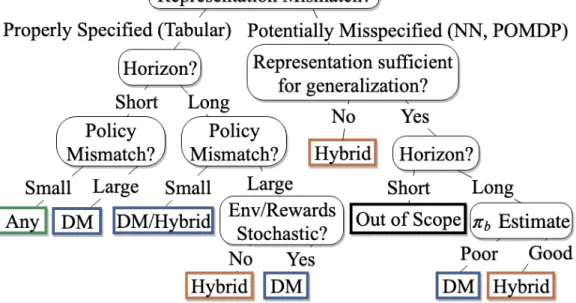
3.2 OPE Method Selection Decision Tree . . . 41
3.3 OPE - Compare IPS vs DM vs HM . . . 42
3.4 OPE Various Method Comparison . . . 44
3.5 OPE Policy Mismatch Comparison . . . 45
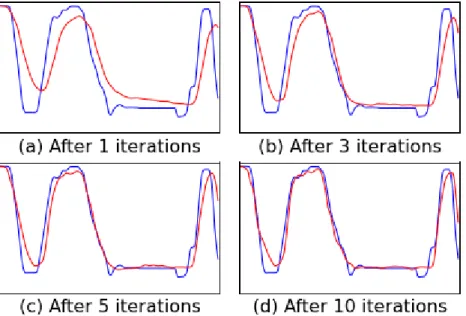
4.1 Smooth Policy Learning Illustration . . . 58
4.2 Learning with Smooth Structure vs. Standard Imitation Learning . . 65
4.3 Adaptive vs Fixed Learning Rate - SIMILE . . . 65
4.4 Varying Expert Feedback Quality . . . 66
4.5 Smoothness Structure vs Accuracy Trade-off . . . 66
4.6 Policy Learning Performance Progression . . . 67
4.7 Deterministic vs. Stochastic Policy Comparison . . . 67
5.1 A High-level Syntax for Programmatic Policies . . . 72
5.2 A Programmatic Policy in TORCS . . . 72
5.3 Lift-and-Project Policy Learning Diagram . . . 74
5.4 TORCS Experiment - Policy Improvement . . . 81
5.5 TORCS Experiment - Number of Crashes . . . 81
6.1 Hierarchical IL RL on Maze Navigation . . . 97
6.2 Hierarchical IL vs Flat IL on Maze Navigation . . . 97
6.3 Hierarchical IL RL on Montezuma’s Revenge . . . 100
7.1 Policy Learning with Latent Model - Example . . . 104
7.2 Policy Learning with Latent Model - Algorithm Schematic . . . 107
7.3 Predator-Prey Example . . . 115
7.4 Policy with and without Structure Comparison . . . 116
7.5 Policy with and without Structure Comparison - Soccer . . . 117
7.7 Latent Role Visualization . . . 119
A.1 FrozenLake and CarRacing Environment . . . 177
A.2 Regularized Policy Learning Baselines . . . 178
B.1 Graph Environment . . . 194
B.2 Graph-MC Environment . . . 194
B.3 Mountain Car Environment . . . 194
B.4 Enduro Environment . . . 194
B.5 Discrete POMDP Environment . . . 194
B.6 Gridworld Environment . . . 194
B.7 Enduro DM vs IPS . . . 203
B.8 MountainCar Comparison - Function Approx . . . 203
B.9 Enduro DM vs HM . . . 204
B.10 Direct Method Comparison - Small Policy Mismatch, Deterministic Env . . . 204
B.11 Graph MDP Comparison - Large Policy Mismatch, Stochastic Env . . 204
B.12 Compare DM vs DR - Stochastic Env, Large Policy Mismatch . . . . 205
B.13 Compare FQE, IH and WIS in Limited Data Regime in Gridworld . . 205
B.14 IPS Comparison with IH - Dense and Sparse Rewards . . . 205
B.15 Exact vs Estimated Behavior Policy Comparison - Pixel Gridworld . 206 B.16 Exact vs Estimated Behavior Policy Comparison - Pixel Gridworld . 206 B.17 Hybrid Method Comparison . . . 206
B.18 Hybrid Method Comparison . . . 207
B.19 Hybrid Method Comparison . . . 207
B.20 Hybrid Method Comparison . . . 207
B.21 Hybrid Method Comparison . . . 208
B.22 Class Comparison with Unknown Behavior Policy . . . 208
B.23 Class Comparison with Unknown Behavior Policy . . . 208
B.24 Class Comparison with Unknown Behavior Policy . . . 209
B.25 Model-based vs Hybrid Method Comparison . . . 209
B.26 FQE vs Hybrid Method Comparison . . . 209
B.27 MRDR vs Hybrid Method Comparison . . . 209
B.28 Q-Regression vs Hybrid Method Comparison . . . 210
B.29 𝑄𝜋p𝜆qvs Hybrid Method Comparison . . . 210
B.30 Retracep𝜆qvs Hybrid Method Comparison . . . 210
B.31 Tree-Backup vs Hybrid Method Comparison . . . 210
B.33 Weighted Doubly Robust Comparison - Pixel Gridworld . . . 211
B.34 MAGIC Comparison - Pixel Gridworld . . . 211
B.35 Doubly Robust Comparison - Pixel Gridworld . . . 212
B.36 WDR Comparison - Pixel Gridworld . . . 212
B.37 MAGIC Comparison - Pixel Gridworld . . . 212
D.1 Policy Improvement in MountainCar . . . 248
D.2 Policy Improvement in Pendulum . . . 248
E.1 Hierarchical IL RL vs Hierarchical RL - Maze Navigation . . . 250
E.2 Maze Domain Examples . . . 251
E.3 Montezuma’s Revenge Hierarchical Decomposition . . . 252
E.4 Hierarchical IL RL vs Hierarchical RL - Montezuma’s Revenge . . . 253
E.5 Learning Progression for Montezuma’s Revenge . . . 253
E.6 Number of High Level Expert Labels . . . 254
LIST OF TABLES
Number Page
3.1 Empirical Environments for OPE . . . 35
3.2 Empirical Environments for OPE . . . 35
3.3 OPE Method Selection Guideline - Part 1 . . . 39
3.4 OPE Method Selection Guideline - Part 2 . . . 39
5.1 TORCS Performance Results . . . 82
5.2 Policy Generalization Results in TORCS . . . 83
B.1 Glossary of terms for Chapter 3 . . . 182
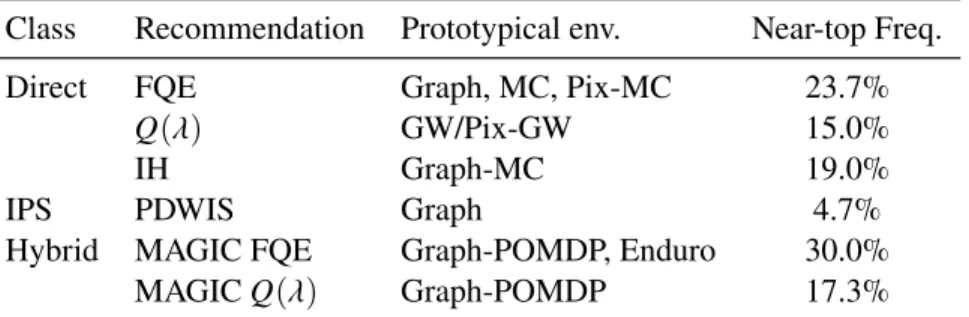
B.2 Fraction of time among the top estimators across all experiments . . . 183
B.3 OPE - Short Horizon, Small Policy Mismatch . . . 184
B.4 OPE - Short Horizon, Large Policy Mismatch . . . 184
B.5 OPE - Long Horizon, Small Policy Mismatch . . . 185
B.6 OPE - Long Horizon, Large Policy Mismatch, Deterministic Env . . 185
B.7 OPE - Long Horizon, Large Policy Mismatch, Stochastic Env . . . . 186
B.8 OPE - Insufficient Representation . . . 186
B.9 OPE - Sufficient Representation, Poor Behavior Policy Estimate . . . 187
B.10 OPE - Sufficient Representation, Good Behavior Policy Estimate . . . 187
B.11 Graph MDP, T=10, N=50 . . . 188
B.12 Graph MDP, T=100, N=50 . . . 188
B.13 Graph MDP, T=10, N=50, Larger Policy Mismatch . . . 189
B.14 IPS Methods . . . 190
B.15 Graph MDP Env Parameters . . . 197
B.16 Graph POMDP Env Parameters . . . 197
B.17 Gridworld Env Parameters . . . 198
B.18 Pixel Gridworld Env Parameters . . . 198
B.19 Discrete MountainCar Env Parameters . . . 199
B.20 MountainCar Env Parameters . . . 199
B.21 Pixel MountainCar Env Parameters . . . 200
B.22 Enduro Env Parameters . . . 200
B.23 Hyperparameters Choice by Env . . . 202
B.24 Graph MDP, 256 trajectories . . . 213
B.25 Graph MDP, 512 trajectories . . . 213
B.26 Graph MDP, 1024 trajectories . . . 214
B.28 Graph MDP, 512 trajectories, Dense Rewards . . . 215
B.29 Graph MDP, 1024 trajectories, Dense Rewards . . . 215
D.1 Performance Results in TORCS . . . 246
D.2 Generalization Results in TORCS . . . 247
D.3 Performance Results in Classic Control . . . 247
E.1 Network Architecture—Maze Domain . . . 252
C h a p t e r 1
INTRODUCTION
1.1 Structured Policy Learning - Definition and Classification
A Real-World Decision Making Motivation. The goal of this thesis is to make some contributions towards improving learning-based sequential decision making systems that are broadly beneficial for real-world applications. For the purpose of this thesis, we will consider sequential decision making to be the task of making a series of decision in a dynamic environment overtime, to achieve certain specified outcome. While the specific objective of decision making may vary depending on application domain, it is not difficult to appreciate the scope of dynamic deci-sion making systems. Traffic routing, energy and power systems, industrial robots, warehouse logistics, are among long-standing examples of sequential decision mak-ing systems that have had large impact on daily lives. Clearly, not all previous examples of decision making systems are what we would currently consider fully algorithmic, or learning-based systems. However, from conversational agents to online recommendation to search and advertising, we are clearly already interact-ing with increasinteract-ingly sophisticated learninteract-ing-based systems on a daily basis. The trends toward more data-driven and algorthmic-driven systems are rooted in exciting developments in machine learning, aided by improving computational power and increasing availability of data. Supervised machine learning has made significant advances in the past decade, with highly visible successes in the areas of computer vision (Krizhevsky et al., 2012; Deng et al., 2009) and natural language process-ing (Devlin et al., 2019). Powerful deep learnprocess-ing advances have also contributed to recent advances in sequential decision making domains, perhaps most notably computer games (Mnih et al., 2015), and board games (Silver et al., 2017), and robotic manipulations (Andrychowicz et al., 2020). Looking ahead into the near fu-ture, researchers and practitioners are exploring potential applications in other areas such as healthcare, remote work and education, autonomous vehicles, automated customer and decision support, etc. Two central questions for these aspirational applications natually arise: (i) how do we approach these diverse problem areas from a machine learning perspective? and (ii) how do we use learning to build real-world systems in a way that is computationally efficient, safe, and grounded in real-world constraints?
Policy Learning in Dynamic Environment. This dissertation focuses on the prob-lem of policy learning for sequential decision making tasks. A policy encapsulates the decision making mechanism of an agent interacting with its environment over time. At a high-level, this interaction can be viewed via an abstraction similar to the standard reinforcement learning framework (Sutton and Barto, 2018b; Bertsekas et al., 2005). The protocol is such that at each time step, the environment reveals a context, the agent takes an action given the context, and the action influences the context that the agent observes in the following time step, and so forth. Notice that in general, this abstraction can be more general than a Markov Decision Pro-cess (Puterman, 2014). Nevertheless, a policy is simply a mapping from context to (a probability distribution over) actions. Often, the policy learning goal is to derive an optimal policy, where optimality criterion depends on the exact problem formulation.
We will give a more in-depth account of contemporary approaches to policy learn-ing in the next chapter. As a rough summary, many recent work in policy learnlearn-ing focus on balancing the exploration-exploitation trade-off, or casting the interaction paradigm under reinforcement / imitation learning dichotomy. When the dynamics are unknown, reinforcement learning (RL) is a general class of samples-based techniques to learn policies, where samples often come from exploring the envi-ronment Sutton and Barto (2018b). Efficient exploration is a major challenge of reinforcement learning, and is the subject of very active research (Jiang et al., 2017). Even for multi-arm bandit problem (RL with horizon 1), learning an𝜖-optimal
pol-icy may require𝑂p1
𝜖2qsamples in the worst case (Krishnamurthy et al., 2016). One
alternative class of techniques that short-circuit the exploration issue is imitation learning(IL). Imitation learning is a direct way to learn policy by from expert or-acle, which can be computational oror-acle, or human expert. Thus imitation learning can be viewed as generalization of supervised learning to the sequential decision domains.
Some Challenges with Contemporary Approaches. Both reinforcement and imitation learning are general purpose classes of methods. However, the success stories of both groups of techniques, while impressive (Cheng et al., 2019c; Pan et al., 2018; Finn et al., 2016; Mnih et al., 2016; Silver et al., 2017), are still constrained to somewhat limited domains, where we either have abundant access to simulated data, or strong assumptions on the oracles.
RL, much recent research effort has been dedicated towards improving sample efficiency of exploration (Kakade et al., 2003; Agarwal et al., 2014; Jiang et al., 2017). Imitation learning generally has been shown to be more sample-efficient than pure exploration-based RL (Sun et al., 2017; Ross and Bagnell, 2014). However, the sample cost to the expert oracle can potentially much more expensive than the sample cost for exploration in scenarios where simulation-to-real transfer is feasible (Peng et al., 2018), or in video games domains where simulation matches reality. The learning agent has to handleimperfect cost and observation. Engineering the right cost (reward) function is difficult for many realistic scenarios. In addition, the most common modeling paradigm in RL is via Markov Decision Processess, which assume full observation (context) of the learning agent. In practice, partial observability is a prevalent setting and policy learning has to account for imperfect information.
Finally, we would like to emphasize additionalreal-world constraintsintroduced by various domains that are not adequately addressed by classical learning techniques. For policy learning methods to be trusted with realistic applications, they need to meet certain domain-specific desiderata:
• One sensible requirement is safety, concerning much of the applications re-lated to human-computer interaction, such as autonomous driving, healthcare, education, etc. (Garcıa and Fernández, 2015) At the most basic level, random exploration is orthogonal to safe learning, thus posing challenges to purely exploration-based RL
• Other reasonable constraints may include: stability, which is among the most important concerns for roboticists and control engineers (Berkenkamp et al., 2017); verifiability (or provably correctness in the formal methods sense); smoothnessrequirement for many human-facing decision making tasks, such as driving; (Bojarski et al., 2016); fairnessof policy learning in the context of socio-technical systems (Liu et al., 2018a).
Im summary, despite exciting developments, there remains a sizable gap between what current learning-based methods could achieve and broadly useful, real-world applications of policy learning across different domains.
Structured Policy Learning. This dissertation describes recent advances that attempt to narrow the gap between contemporary policy learning methods and
realistic sequential decision making domains. The proposed methods center around the theme ofstructured policy learning, which we define as the class of techniques that integratesprincipled use of domain knowledgeinto the policy learning process, in order to satisfy real-world desiderata as described above. A natural question given this definition is how should we further clarify the source of domain knowledge? While it is tempting to cast a stereotypical RL technique as assuming “no structure”, and a stereotypical IL technique as assuming a strong form of structure, we argue that in the context of realistic constraints, this distinction is not always the most helpful. Consider two examples:
• Consider a hypothetical RL scenario with idealized cost function, where single-stage cost (reward) matches exactly to the consecutive difference (dif-ferential) of the optimal reward function. In this setting, optimal cost (reward) design plays the role of the expert Ross and Bagnell (2014) and alleviates the difficulty that is associated with a long horizon problem with sparse cost (reward) signals. While this is an idealized scenario, we can view leveraging off-line (sub-optimal) data, or value specification associated with realistic re-quirements such as safety, are among possible venues to encode structure into the learning problem.
• Consider a hypothetical IL scenario where a computational expert is easy to derive via prior models (e.g., physics-based optimal controller for robotics, or rule-based experts from existing systems). In this setting, perhaps standard imitation learning techniques could succeed in learning the expert’s policy. However, in case of an imperfect model, the cost (reward) corresponding to the expert could be suboptimal in reality. The question facing the learning agent is then how to reconcile and possibly leverage the information coming from the expert in order to move towards another optimality criterion?
In examining these two examples above, we can see that integrating the right amount of domain knowledge is not necessarily about forcing a trade-off between RL and IL. In fact, as we will show in this dissertation, in many cases leveraging structure can be a complementary abstraction to improve the learning performance while treating the underlying policy learning sub-routine as a flexible reduction.
In this thesis, we will discuss three different ways to integrate structure into policy learning:
1. Value-based structure: the desired objective can be expressed via some constraints on the value function of a policy, where the value comes from prior knowledge (e.g., safety), or historical data (e.g., policy improvement). 2. Policy-based structure: the cost (reward) might be difficult to specify, and
it can be easier to build the structure more directly into the policy class (e.g., policy is locally stable)
3. Model-based structure: An (approximate) knowledge about the environment or the task is attainable (e.g., known hierarchical structure, or approximate physics-based dynamics model)
We aim to incorporate these structures into the design of learning algorithms and show how they can help improve both data efficiency and constraint satisfactions. We will discuss methodological advances as well as empirical validations. For the remainder of this chapter, we briefly introduce several concrete research directions and the corresponding contributions of this dissertation.
1.2 Learning with Value-Based Structure
This is a setting where the domain expert can naturally specify constraints on value function, or cost function objectives. In chapter 2, we consider a reinforcement learning scenario where different value-based constraints can be imposed on a pol-icy learning problem in a counterfactual manner, i.e., batch setting. The off-line, off-policy learning approach is promising for realistic applications where existing data is available, but the standard cost objective is not sufficient for learning a reliable decision making agent. We propose a meta learning algorithm, and in-stantiate with specific subroutines that offer end-to-end finite-sample performance guarantees. The finite-sample results link the number of off-policy samples with how well the algorithm can return an optimal policy subject to satisfying the value-based constraints. To certify constraint satisfaction, we propose a new off-policy policy evaluation (OPE) algorithm that is applicable in other reinforcement learning settings.
Reasoning about value-based structure in a data-efficienct way requires off-policy evaluation of policy performance as a natural component. Off-policy reasoning is highly relevant for any safe and efficient deployment of policy learning to realistic domains. In Chapter 3, we take a detailed look into the empirical performance of different off-policy estimators. We design experimental conditions that highlight
different factors that are often neglected in previous work on OPE. Through our analysis, we contribute a summary guideline for method selection. To the best of our knowledge, Chapter 3 is the first comprehensive study of contemporary OPE methods.
1.3 Learning with Policy-Based Structure
When the value-based evaluation of the constraints are hard to determined, it can be more natural to build the constraints directly into the policy class. The learning policy can then inherit the structure of the policy class, i.e., the desired structure can be (approximately) “correct-by-construction”, which is an appealing property. For policy-based structure, the challenge lies in designing algorithms that permit reasoning about other optimality criteria of learning.
Similar to how regularization encodes prior knowledge in supervised learning con-text, we take a policy class regularization perspective to policy learning in the sequential setting. In this case, regularizing with respect to a policy class allows mediating between an expressive policy class, such as deep neural networks, and less expressive policy class, but with certifiable properties.
In Chapter 4, we regularize to a smooth policy class (under precise notion of smoothness) and designed a learning algorithm that takes a reduction approach to imitation learning. We prove that exploiting this policy structure improve data efficiency of learning. The learning algorithm also outputs learned policy that has better smoothness property than using conventional imitation learning alone. We demonstrate the empirical performance of the algorithm in an realistic applications that require learning smooth decision making policies.
In Chapter 5, we generalize this approach to the RL setting where we leverage re-duction to online learning, in particular mirror descent, in the policy space. Similar to Chapter 4, regularization to a policy class is enforced via projecting onto a con-strained policy space. The projection of the online learning reduction is equivalent to an IL subroutine, where the learning policy learns from the best “expert” from the prescribed policy structure. The update step of online learning can assume the form of standard RL update. In addition to the convergence analysis, in this chapter we demonstrate a potential application in learning “programmatic” policies using RL, where the programs are representable using structured programming language. The algorithm aims to output a near optimal programmatic policy using this lift-and-project approach. We show in a driving simulation that the learned policy can
generalize better to unseen environment compared to policies learned purely from RL procedures. In addition, programmatic policies are also amenable to formal verification, whereas deep neural networks remain difficult to verify using current techniques.
1.4 Learning with Model-Based Structure
Distinct from model-based RL, the model-based structure refers to partial knowledge of the environment or the task, which the learning agent can exploit to help speed up learning process. Below are some examples of model-based structure.
Hierarchical structureis well studied in machine learning. In fact, recent success of computer vision can be attributed to good hierarchical feature learning LeCun et al. (1995); Qi et al. (2017). In reinforcement learning context, a common strategy to improve sample efficiency in RL over long time horizons is to exploit hierarchi-cal structure of the problem. In Chapter 6, we propose methods to improve the sample-efficiency of both imitation learning and reinforcement learning, taking into account the hierarchy decomposition. Our key design principle is an algorithmic framework calledhierarchical guidance, in which feedback (labels) from the high-level expert is used to focus (guide) the low-high-level learner. The high-high-level expert ensures that low-level learning only occurs when necessary (when subtasks have not been mastered) and only over relevant parts of the state space. This differs from a naïve hierarchical approach which merely gives a subtask decomposition. Focusing on relevant parts of the state space speeds up learning (improves sample efficiency), while omitting feedback on the already mastered subtasks reduces ex-pert effort (improves label efficiency). We validate the approach in long horizon domains, including the challenging Atari game Montezuma Revenge. Our exper-iments show that incorporating a modest amount of expert feedback can lead to dramatic improvements in performance compared to pure hierarchical RL.
Latent structureReinforcement learning under partial observability is intractable in general POMDP (Papadimitriou and Tsitsiklis, 1987). Recent progress has been made towards policy learning in contextual decision processes under low rank structural assumptions (Jiang et al., 2017). The difficulty of policy learning is compounded for multi-agent settings, where information regarding the intention of other agents in the environment is missing. In Chapter 7, we study the problem of policy learning for multiple coordinating agents from demonstrations. Many realistic multi-agent settings require coordination among collaborative agents to
achieve some common goal: modeling team sports, learning policies for game AI, controlling teams of multiple robots, or modeling collective animal behavior. Typically, the agents have access to the outcome of actions from other agents, but the coordination mechanism is neither clearly defined nor observed, which makes the full state only partially observable.
We propose a semi-supervised learning framework that integrates and builds upon conventional imitation learning and unsupervised structure learning. The latent structure is represented by a graphical model, which encodes a coordination mech-anism of interacting agents. In order to make learning tractable, we develop an alternating optimization method that enables integrated and efficient training of both individual policies and the latent structure model. For learning individual policies, we extend reduction-based single-agent imitation learning approaches into multi-agent domain, utilizing powerful black-box supervised techniques such as deep learning as base routines. For latent structure learning, we develop a stochas-tic variational inference approach. We show that learning a good latent structure to encode implicit coordination yields significantly superior imitation performance compared to conventional baselines.
1.5 Overview Discussion on Existing Approaches to Policy Learning
A sequential decision making agent is characterized by its interaction with the environment (Sutton and Barto, 2018b; Bertsekas et al., 2005). For each time 𝑡,
the environment reveals context𝑥𝑡 in the context space 𝑋, the agent takes an action
𝑎𝑡 P A, and the action influences the context 𝑥𝑡`
1 that the agent observes in the following time step, and so forth. This interaction paradigm is general, in the sense
Figure 1.1: Policy maps context to actions
that the context can capture partial observation of the true state, and the agent-environment interaction can also stand for an interaction between an agent and the expert oracle. As such, this abstraction can convey both the reinforcement learning
and imitation learning paradigms. A policy 𝜋 is simply a mapping from context 𝑥 PXto (a probability distribution over) actions in𝐴. As mentioned in the previous
chapter, the optimization objective of policy learning depends on the problem setup. In learning-based approaches, the dynamical system characterizing the agent - en-vironment interaction is typically viewed as unknown or uncertain. If the dynamics are known, one can leverage well-established techniques in dynamic programming and optimal control to solve for optimal policies (Bertsekas et al., 2005). When the dynamics are unknown, reinforcement learning is a general class of sample-based methods to solve optimal control problems (Sutton and Barto, 2018b). Consider a simple and stereotypical example of sequential decision making: a navigation task over a grid where an agent has to make a series of steps towards the goal while avoiding obstacles along the way. Ideally we would want such a learning agent to be able to generalize, i.e., the configuration of the environment and goal locations might change from episode to episode. Without prior knowledge of environmental dynamics, a reinforcement learning agent needs to explore the environment to search for an optimal policy. The objective in RL is usually to minimize long-term cost (or equivalently, maximizing rewards): 𝐶p𝜋q “ E“ř8
𝑡“0𝛾 𝑡
𝑐p𝑥𝑡, 𝑎𝑡q‰, where𝐶p𝜋qis
called the value function of policy𝜋, and𝑐p𝑥𝑡, 𝑎𝑡qdenotes single-stage cost (reward)
associated with observation𝑥𝑡 and action𝑎𝑡. In the last few years, the combination
of deep learning and classical RL techniques have produced very impressive em-pirical successes mentioned above: from playing Atari games (Mnih et al., 2015), to playing board games (Silver et al., 2017), to certain robotic manipulation tasks (Andrychowicz et al., 2020). Without knowing the dynamics, a learning agent needs to interact with the environment for exploration, before a good policy can be learned via optimization (exploitation). Consequently, success in reinforcement learning is still dependent on having access to environments where simulation data is cheap, as the number of interaction with the environment is significant. Bringing reinforcement learning techniques to real-world applications may introduce several challenges:
1. Well-defined cost objective: The underlying assumption in RL framework is that what the agent optimizes for can be summarized in a well-defined, scalar cost function. Even if such hypothesis is valid, one can imagine designing a good cost function is difficult in many scenarios (e.g., self-driving vehicles). The difficulty of designing cost (reward) function motivates many recent effort to investigate this inverse problem Hadfield-Menell et al. (2017); Finn et al.
(2016); Ziebart et al. (2008); Sorg et al. (2010). Designing an optimal cost function can be as hard as solving the forward problem in the worst case Ng et al. (1999).
2. Exploration: Even when we can obtain a reasonable cost function and observe full state, the learning agent may come up against the third issue, which is how to explore the environment efficiently. Efficient exploration is the holy-grail of reinforcement learning, and is the subject of very active research (Jiang et al., 2017). Even for multi-arm bandit problem (RL with horizon 1), learning an𝜖-optimal policy may require𝑂p1
𝜖2qsamples in the worst case
(Krishnamurthy et al., 2016). One side effect of random exploration is that the policy may exhibit undesirable properties during training. Given the difficulty of exploration in general, some recent work have developed more efficient exploration algorithms under structural assumptions. (Du et al., 2019) proved an efficient algorithm is possible assuming latent block structure of underlying contextual space. (Misra et al., 2019) built on similar theme and showed that exploiting state abstraction can make hard exploration problems tractable.
One alternative class of techniques that short-circuit the exploration issue is imitation learning (IL). Imitation learning is a direct way to learn policy by leveraging domain knowledge. Often the domain knowledge comes from optimal oracle, which can be computational oracle, or human expert. The goal in imitation learning is usually minimize the imitation loss with respect to the expert policy, in that sense the cost function is easy to define: 𝐶p𝜋q “ E𝑑𝜋rℓp𝜋p𝑥𝑡q, 𝜋
˚p𝑥
𝑡qqs, where 𝜋˚ is the expert
policy, and the expectation is taken over state distribution𝑑𝜋induced by the learning
policy𝜋.
Many imitation learning techniques involve reductions to supervised learning. Go-ing back to the navigation example, we can obtain a data set from queryGo-ing oracle policy𝜋˚, which is either a search or optimization oracle, or human expert to get the
shortest path. We can simply reduce the sequential decision problem to supervised learning, e.g., fitting a neural network to directly find the mapping from 𝑋 to 𝐴in
this data set. This simple strategy is also known as behavioral cloning, which was used for one of the first autonomous driving system, ALVINN (Pomerleau, 1989). Behavioral cloning is simple and straightforward to implement, and may in fact work well when data coverage is sufficient. However in many cases, especially under partial observability, a behaviorally cloned policy may fail to generalize to
unseen instances of the environment. Interactive imitation learning is an alterna-tive strategy to improve upon this weakness. Specifically, learning proceeds over multiple episodes, similar to many episodic reinforcement learning techniques. At each round of learning, the current policy, which might be performing poorly, can query online expert to yield the correct action labels corresponding to the executed trajectory. With each episode, querying the interactive oracle yields a new data set, which can again be used in some update supervised learning procedure. As such, we reduce the sequential decision problem to multiple supervised learning problems. To update the learning policy, we can use either policy aggregation (Daumé III et al., 2009), or data aggregation, in the style known as DAgger (Ross et al., 2011b). These are among the most common imitation learning techniques that have found widespread successes.
Overall, imitation learning can be significantly more sample efficient than pure exploration-based RL Sun et al. (2017). Notice that the two classes of techniques can be complementary: several recent RL success stories rely on bootstrapping the learning agent with a large repository of expert trajectories to increase data and computational efficiency (Silver et al., 2016; Vinyals et al., 2019). Many recent successes from imitation learning are likely unattainable from conventional RL techniques: autonomous driving of a real race car (Pan et al., 2018), visual speech animation (Taylor et al., 2017), or more data-efficient robotic manipulation (Duan et al., 2017). These are examples of tasks that are very difficult to do with deep RL techniques alone, either due to a lack of natural simulation environment, or unacceptable sample efficiency, or both. Still, there are two main drawbacks of imitation learning strategy:
1. Hard to obtain expert labels: Imitation learning can be viewed as general-ization of supervised learning to the sequential decision domains. Similar to supervised learning, high-quality labels are required for good learning per-formance. In many applications, it can be expensive to obtain expert oracle’s labels, especially when interactive expert is part of the learning loop. For computational expert, computational time can be an acceptable trade-off for data acquisition. However, this issue is notable when the agent is learning with human expert in the loop. Imitation learning techniques generally should address the problem of data efficiency for the expert.
2. Non-optimal expert: Second, expert oracle itself may not be optimal, or fully consistent from one expert to another. If the expert policy is not optimal, then
the cost objective to learn the policy is also faulty. Here the question of cost function design is similar to the challenge we face in reinforcement learning case.
In this section, we give a background overview for conventional approaches to policy learning. In the next chapters, as we develop our approaches tostructured policy learning, we will further provide details from relevant recent work that combines policy learning with different forms of structural considerations.
C h a p t e r 2
POLICY LEARNING UNDER VALUE-BASED CONSTRAINTS
Summary. When learning policies for real-world domains, two important questions arise: (i) how to efficiently use pre-collected off-policy, non-optimal behavior data; and (ii) how to mediate among different competing objectives and constraints. We thus study the problem of batch policy learning under multiple constraints, and offer a systematic solution. We first propose a flexible meta-algorithm that admits any batch reinforcement learning and online learning procedure as subroutines. We then present a specific algorithmic instantiation and provide performance guarantees for the main objective and all constraints. As part of off-policy learning, we propose a simple method for off-policy policy evaluation (OPE) and derive PAC-style bounds. Our algorithm achieves strong empirical results in different domains, including in a challenging problem of simulated car driving subject to multiple constraints such as lane keeping and smooth driving. We also show experimentally that our OPE method outperforms other popular OPE techniques on a standalone basis, especially in a high-dimensional setting.
2.1 Policy Learning under Value-Based Constraints
We study the problem of policy learning under multiple constraints. Contemporary approaches to learning sequential decision making policies have largely focused on optimizing some cost objective that is easily reducible to a scalar value function. However, in many real-world domains, choosing the right cost function to optimize is often not a straightforward task. Frequently, the agent designer faces multiple competing objectives. For instance, consider the aspirational task of designing au-tonomous vehicle controllers: one may care about minimizing the travel time while making sure the driving behavior is safe, consistent, or fuel efficient. Indeed, many such real-world applications require the primary objective function be augmented with an appropriate set of constraints (Altman, 1999).
Contemporary policy learning research has largely focused on either online rein-forcement learning (RL) with a focus on exploration, or imitation learning (IL) with a focus on learning from expert demonstrations. However, many real-world settings already contain large amounts of pre-collected data generated by existing policies (e.g., existing driving behavior, power grid control policies, etc.). We thus study the
complementary question: can we leverage this abundant source of (non-optimal) behavior data in order to learn sequential decision making policies with provable guarantees on both primary objective and constraint satisfaction?
We thus propose and study the problem of batch policy learning under multiple constraints. Historically, batch RL is regarded as a subfield of approximate dynamic programming (ADP) (Lange et al., 2012), where a set of transitions sampled from the existing system is given and fixed. From an interaction perspective, one can view many online RL methods (e.g., DDPG (Lillicrap et al., 2016)) as running a growing batch RL subroutine per round of online RL. In that sense,batch policy learning is complementary to any exploration scheme. To the best of our knowledge, the study of constrained policy learning in the batch setting is novel.
We present an algorithmic framework for learning sequential decision making poli-cies from off-policy data. We employ multiple learning reductions to online and supervised learning, and present an analysis that relates performance in the reduced procedures to the overall performance with respect to both the primary objective and constraint satisfaction.
Constrained optimization is a well studied problem in supervised machine learning and optimization. In fact, our approach is inspired by the work of (Agarwal et al., 2018) in the context of fair classification. In contrast to supervised learning for clas-sification, batch policy learning for sequential decision making introduces multiple additional challenges. First, setting aside the constraints, batch policy learning itself presents a layer of difficulty, and the analysis is significantly more complicated. Sec-ond, verifying whether the constraints are satisfied is no longer as straightforward as passing the training data through the learned classifier. In sequential decision making, certifying constraint satisfaction amounts to an off-policy policy evaluation problem, which is a challenging problem and the subject of active research. In this chapter, we develop a systematic approach to address these challenges, provide a careful error analysis, and experimentally validate our proposed algorithms. In summary, our contributions in this chapter are:
• We formulate the problem of batch policy learning under multiple constraints, and present the first approach of its kind to solve this problem. The definition of constraints is general and can subsume many objectives. Our approach utilizes multi-level learning reductions, and we show how to instantiate it using various batch RL and online learning subroutines. We show that guarantees from the subroutines provably lift to provide end-to-end guarantees on the
original constrained batch policy learning problem.
• While leveraging techniques from batch RL as a subroutine, we provide a refined theoretical analysis for general non-linear function approximation that improves upon the previously known sample complexity result (Munos and Szepesvári, 2008).
• To evaluate off-policy learning performance and constraint satisfaction, we propose a simple new technique for off-policy policy evaluation (OPE), which is used as a subroutine in our main algorithm. We show that it is competitive to other OPE methods.
• We validate our algorithm and analysis with two experimental settings. First, a simple navigation domain where we consider safety constraint. Second, we consider a high-dimensional racing car domain with smooth driving and lane centering constraints.
2.2 Problem Formulation in the Batch Setting
We first introduce notation. LetX Ă R𝑑 be a bounded and closed𝑑-dimensional
state space. Let A be a finite action space. Let 𝑐 : Xˆ A ÞÑ r0,𝐶ss be the primary objective cost function that is bounded by𝐶s. Let there be𝑚constraint cost
functions, 𝑔𝑖 : XˆA ÞÑ r0,𝐺ss, each bounded by𝐺s. To simplify the notation, we view the set of constraints as a vector function𝑔 :XˆAÞÑ r0,𝐺ss𝑚 where𝑔p𝑥 , 𝑎q
is the column vector of individual 𝑔𝑖p𝑥 , 𝑎q. Let 𝑝p¨|𝑥 , 𝑎q denote the (unknown)
transition/dynamics model that maps state/action pairs to a distribution over the next state. Let 𝛾 P p0,1q denote the discount factor. Let 𝜒 be the initial states
distribution.
We consider the discounted infinite horizon setting. An MDP is defined using the tuplepX,A, 𝑐, 𝑔, 𝑝, 𝛾 , 𝜒q. A policy𝜋 PΠmaps states to actions, i.e.,𝜋p𝑥q PA. The
value function𝐶𝜋 :XÞÑRcorresponding to the primary cost function𝑐is defined in
the usual way: 𝐶𝜋p𝑥q “E“ř8
𝑡“0𝛾 𝑡
𝑐p𝑥𝑡, 𝑎𝑡q | 𝑥
0“𝑥 ‰
, over the randomness of the policy𝜋 and transition dynamics 𝑝. We similarly define the vector-value function
for the constraint costs 𝐺𝜋 : X ÞÑ R𝑚 as 𝐺𝜋p𝑥q “ E“ř8
𝑡“0𝛾 𝑡
𝑔p𝑥𝑡, 𝑎𝑡q|𝑥0 “𝑥
‰ . Define𝐶p𝜋qand𝐺p𝜋qas the expectation of𝐶𝜋p𝑥qand𝐺𝜋p𝑥q, respectively, over the
Batch Policy Learning under Constraints
In batch policy learning, we have a pre-collected dataset: D “ tp𝑥𝑖, 𝑎𝑖, 𝑥1
𝑖, 𝑐p𝑥𝑖, 𝑎𝑖q, 𝑔1:𝑚p𝑥𝑖, 𝑎𝑖qu 𝑛
𝑖“1, generated from (a set of) historical
be-havioral policies denoted jointly by 𝜋
D. The goal of batch policy learning under constraints is to learn a policy𝜋 P Πfrom D that minimizes the primary objective
cost while satisfying𝑚different constraints:
min 𝜋PΠ 𝐶p𝜋q s.t. 𝐺p𝜋q ď 𝜏 (OPT) where𝐺p¨q “ r𝑔 1p¨q, . . . , 𝑔𝑚p¨qs J
and 𝜏 P R𝑚 is a vector of known constants. We
assume that (OPT) is feasible. However, the dataset D might be generated from multiple policies that violate the constraints.
Examples of Policy Learning with Constraints
Counterfactual & Safe Policy Learning. In conventional online RL, the agent needs to “re-learn” from scratch when the cost function is modified. Our framework enables counterfactual policy learning assuming the ability to compute the new cost objective from the same historical data. A simple example is safe policy learning (Garcıa and Fernández, 2015). Define safety cost 𝑔p𝑥 , 𝑎q “ 𝜙p𝑥 , 𝑎, 𝑐q as a new
function of existing cost 𝑐 and features associated with current state-action pair.
The goal here is to counterfactually avoid undesirable behaviors observed from historical data. We experimentally study this safety problem in Section 2.5.
Other examples from the literature that belong to this safety perspective include planning under chance constraints (Ono et al., 2015; Blackmore et al., 2011). The constraint here is𝐺p𝜋q “ ErIp𝑥 PX𝑒𝑟 𝑟 𝑜𝑟qs “Pp𝑥 PX𝑒𝑟 𝑟 𝑜𝑟q ď𝜏.
Multi-objective Batch Learning. Traditional policy learning (RL or IL) presup-poses that the agent optimizes a single cost function. In reality, we may want to satisfy multiple objectives that are not easily reducible to a scalar objective function. One example is learning fast driving policies under multiple behavioral constraints such as smooth driving and lane keeping consistency (see Section 2.5).
Equivalence between Constraint Satisfaction and Regularization
Our constrained policy learning framework accommodates several existing regu-larized policy learning settings. Regularization typically encodes prior knowledge, and has been used extensively in the RL and IL literature to improve learning
per-formance. Many instances of regularized policy learning can be naturally cast into (OPT):
• Entropy regularized RL(Haarnoja et al., 2017; Ziebart, 2010) maps to policy-dependent constraint cost 𝑔p𝑥q “ Hp𝜋p¨|𝑥qq, where H measures conditional
entropy.1
• Conservative policy improvement(Levine and Abbeel, 2014; Schulman et al., 2015; Achiam et al., 2017) is equivalent to𝐺p𝜋q “ 𝐷𝐾 𝐿p𝜋, 𝜋𝑘q, where𝜋𝑘 is
some “well-behaving” policy.
• Smooth imitation learning(Le et al., 2016a) is equivalent to𝐺p𝜋q “
minℎPHΔpℎ, 𝜋q, where 𝐻 is a class of provably smooth policies andΔ is a
divergence metric.
• Regularizing RL with expert demonstration(Hester et al., 2018) is equivalent to𝐺p𝜋q “Erℓp𝜋p𝑥q, 𝜋˚p𝑥qqs, where𝜋˚ is the expert policy.
We provide further equivalence derivation of the above examples in Appendix A.1. Of course, some problems are more naturally described using the regularization perspective, while others using constraint satisfaction.
More generally, one can establish the equivalence between regularized and con-strained policy learning via a simple appeal to Lagrangian duality as shown in Proposition 2.2.1 below. This Lagrangian duality also has a game-theoretic in-terpretation (Section 5.4 of (Boyd and Vandenberghe, 2004)), which serves as an inspiration for developing our approach.
Proposition 2.2.1. LetΠbe a convex set of policies. Let𝐶 :ΠÞÑR, 𝐶 :ΠÞÑR𝐾
be value functions. Consider the two policy optimization tasks:
Regularization: min 𝜋PΠ 𝐶p𝜋q `𝜆J𝐺p𝜋q Constraint: min 𝜋PΠ 𝐶p𝜋q s.t. 𝐺p𝜋q ď 𝜏
Assume that the Slater’s condition is satisfied in theConstraintproblem (i.e.,D𝜋
s.t. 𝐺p𝜋q ă 𝜏). Assume also that the constraint cannot be removed without changing
the optimal solution, i.e.,inf𝜋PΠ𝐶p𝜋q ăinf𝜋PΠ:𝐺p𝜋qď𝜏𝐶p𝜋q. Then@𝜆ą0,D𝜏, and
vice versa, such that Regularizationand Constraintshare the same optimal solutions. (Proof in Appendix A.1.)
1
Constraint value function𝐺p𝜋qcan be viewed as the expectation over discounted state visitation
2.3 Algorithms for Batch Policy Learning under Value-Based Constraints To make use of strong duality, we first convexify the policy class Π by allowing stochastic combinations of policies, which effectively expands Π into its convex hullConvpΠq. Formally, ConvpΠqcontainsrandomized policies, which we denote
𝜋 “ ř𝑇
𝑡“1𝛼𝑡𝜋𝑡 for𝜋𝑡 P Πand
ř𝑇
𝑡“1𝛼𝑡 “1. Executing a mixed𝜋 consists of first
samplingonepolicy𝜋𝑡 from𝜋
1:𝑇 according to distribution𝛼1:𝑇, and then executing
𝜋𝑡. Note that we still have Er𝜋s “ ř𝑇
𝑡“1𝛼𝑡Er𝜋𝑡s for any first-moment statistic of
interest (e.g., state distribution, expected cost). It is easy to see that the augmented version of (OPT) overConvpΠqhas a solution at least as good as the original (OPT). As such, to lighten the notation, we will equateΠwith its convex hull for the rest of the chapter.
Meta-Algorithm
The Lagrangian of (OPT) is 𝐿p𝜋, 𝜆q “𝐶p𝜋q `𝜆Jp𝐺p𝜋q ´𝜏qfor𝜆P R𝑚
`. Clearly
(OPT) is equivalent to the min-max problem: min
𝜋PΠ𝜆maxP
R`𝑘
𝐿p𝜋, 𝜆q. We assume (OPT)
is feasible and that Slater’s condition holds (otherwise, we can simply increase the constraint 𝜏by a tiny amount). Slater’s condition and policy class convexification
ensure that strong duality holds (Boyd and Vandenberghe, 2004), and (OPT) is also equivalent to the max-min problem:max
𝜆PR𝑘
` min
𝜋PΠ
𝐿p𝜋, 𝜆q.
Since 𝐿p𝜋, 𝜆qis linear in both𝜆 and 𝜋 (due to stochastic mixture2) , strong
dual-ity is also a consequence of von Neumann’s celebrated convex-concave minimax theorem for zero-sum games (Von Neumann and Morgenstern, 2007). From a game-thoeretic perspective, the problem becomes finding the equilibrium of a two-player game between the 𝜋´player and the 𝜆´player (Freund and Schapire, 1999). In
this repeated game, the 𝜋´player minimizes 𝐿p𝜋, 𝜆qgiven the current 𝜆, and the 𝜆´player maximizes it given the current (mixture over) 𝜋.
We first present a meta-algorithm (Algorithm 1) that uses any no-regret online learning algorithm (for𝜆) and batch policy optimization (for𝜋). At each iteration,
given𝜆𝑡, the𝜋-player runsBest-responseto get the best response:
Best-responsep𝜆𝑡q “ arg min
𝜋PΠ 𝐿p𝜋, 𝜆𝑡q “arg min 𝜋PΠ 𝐶p𝜋q `𝜆J 𝑡 p𝐺p𝜋q ´𝜏q. 2
This places no restrictions on the individual policies. Individual policy can be non-linear and cost function can be non-convex.
Algorithm 1Meta-algo for Batch Constrained Learning 1: foreach round𝑡do
2: 𝜋𝑡 ÐBest-responsep𝜆𝑡q 3: 𝜋p𝑡 Ð 1𝑡 ř𝑡 𝑡1“1𝜋𝑡1,𝜆p𝑡 Ð 1𝑡 ř𝑡 𝑡1“1𝜆𝑡1 4: Lmax “max𝜆𝐿p𝜋p𝑡, 𝜆q 5: Lmin “𝐿pBest-responsep𝜆p𝑡q,𝜆p𝑡q 6: if Lmax´Lmin ď𝜔then
7: Return𝜋p𝑡
8: end if 9: 𝜆𝑡`
1 ÐOnline-algorithmp𝜋1, . . . , 𝜋𝑡´1, 𝜋𝑡q
10: end for
This is equivalent to a standard batch reinforcement learning problem where we learn a policy that is optimal with respect to 𝑐`𝜆J
𝑡 𝑔. The corresponding mixed
strategy is the uniform distribution over all previous𝜋𝑡. In response to the𝜋´player,
the𝜆´player employsOnline-algorithm, which can be anyno-regret algorithm
that satisfies: ÿ 𝑡 𝐿p𝜋𝑡, 𝜆𝑡q ěmax 𝜆 ÿ 𝑡 𝐿p𝜋𝑡, 𝜆q ´𝑜p𝑇q
Finally, the algorithm terminates when the estimated primal-dual gap is below a threshold𝜔(Lines 7-8).
Leaving aside (for the moment) issues of generalization, Algorithm 1 is guaranteed to converge assuming: (i)Best-responsegives the best single policy in the class, and (ii) Lmaxand Lmin can be evaluated exactly.
Proposition 2.3.1. Assuming (i) and (ii) above, Algorithm 1 is guaranteed to stop and the convergence depends on the regret of Online-algorithm. (Proof in Appendix A.2.)
Specific Instantiation of Meta-Algorithm
We now focus on a specific instantiation of Algorithm 1. Algorithm 2 is our main algorithm in this chapter.
Policy Learning. We instantiate Best-response with Fitted Q Iteration (FQI), a model-free off-policy learning approach (Ernst et al., 2005). FQI relies on a series of reductions to supervised learning. The key idea is to approximate the true action-value function𝑄˚by a sequencet𝑄𝑘 PFu𝐾
𝑘“0, whereF is a chosen function
Algorithm 2Constrained Batch Policy Learning Input: Dataset D “ t𝑥𝑖, 𝑎𝑖, 𝑥1 𝑖, 𝑐𝑖, 𝑔𝑖u 𝑛 𝑖“1 „ 𝜋
D. Online algorithm parameters: ℓ1 norm bound𝐵, learning rate𝜂
1: Initialize𝜆 1“ p 𝐵 𝑚`1 , . . . , 𝐵 𝑚`1q PR 𝑚`1
2: foreach round𝑡do
3: Learn𝜋𝑡 ÐFQIp𝑐`𝜆J
𝑡 𝑔q //FQI with cost𝑐`𝜆
J
𝑡 𝑔
4: Evaluate𝐶pp𝜋𝑡q ÐFQEp𝜋𝑡, 𝑐q //Algo 3 with𝜋𝑡, cost𝑐
5: Evaluate𝐺pp𝜋𝑡q ÐFQEp𝜋𝑡, 𝑔q //Algo 3 with𝜋𝑡, cost𝑔
6: 𝜋p𝑡 Ð 1𝑡 ř𝑡 𝑡1“1𝜋𝑡1 7: 𝐶pp p 𝜋𝑡q Ð 1 𝑡 ř𝑡 𝑡1“1𝐶pp𝜋𝑡1q,𝐺pp𝜋p𝑡q Ð 1 𝑡 ř𝑡 𝑡1“1𝐺pp𝜋𝑡1q 8: 𝜆p𝑡 Ð 1𝑡 ř𝑡 𝑡1“1𝜆𝑡1 9: Learn𝜋rÐFQIp𝑐`𝜆p J
𝑡 𝑔q //FQI with cost𝑐`𝜆p
J 𝑡 𝑔 10: Evaluate𝐶pp r 𝜋q ÐFQEp r 𝜋, 𝑐q,𝐺pp r 𝜋q ÐFQEp r 𝜋, 𝑔q 11: Lpmax“ max 𝜆,}𝜆} 1“𝐵 ˆ p 𝐶p p 𝜋𝑡q `𝜆J ” p𝐺pp p 𝜋𝑡q ´𝜏qJ,0 ıJ˙ 12: Lpmin“𝐶pp r 𝜋q `𝜆pJ 𝑡 ” p𝐺pp r 𝜋q ´𝜏qJ,0 ıJ
13: ifLpmax´pLminď𝜔then
14: Return𝜋p𝑡 15: end if 16: Set𝑧𝑡 “ ” p𝐺pp𝜋𝑡q ´𝜏qJ,0 ıJ PR𝑚`1 17: 𝜆𝑡`1r𝑖s “𝐵 𝜆𝑡r𝑖s𝑒´𝜂 𝑧𝑡r 𝑖s ř 𝑗𝜆𝑡r𝑗s𝑒´𝜂 𝑧𝑡r 𝑗s@𝑖 //𝜆r𝑖sthe𝑖 𝑡 ℎ coordinate 18: end for
In Lines 3 & 9,FQIp𝑐`𝜆J𝑔qis defined as follows. With𝑄
0randomly initialized, for each𝑘 “1, . . . , 𝐾, we form a new training datasetDr𝑘 “ tp𝑥𝑖, 𝑎𝑖q, 𝑦𝑖u
𝑛 𝑖“1where: @𝑖 : 𝑦𝑖 “ p𝑐𝑖`𝜆J𝑔𝑖q `𝛾min 𝑎 𝑄𝑘´ 1p𝑥𝑖1, 𝑎q, andp𝑥𝑖, 𝑎𝑖, 𝑥1
𝑖, 𝑐𝑖, 𝑔𝑖q „ D (original dataset). A supervised regression procedure is
called to solve for:
𝑄𝑘 “arg min 𝑓PF 1 𝑛 𝑛 ÿ 𝑖“1 p𝑓p𝑥𝑖, 𝑎𝑖q ´𝑦𝑖q2.
FQI returns the policy: 𝜋𝐾 “ arg min
𝑎𝑄𝐾p¨, 𝑎q. FQI has been shown to work
well with several empirical domains: spoken dialogue systems (Pietquin et al., 2011), physical robotic soccer (Riedmiller et al., 2009), and cart-pole swing-up (Riedmiller, 2005), and clinical treatment (Prasad et al., 2017). Another possible model-free subroutine is Least-Squares Policy Iteration (LSPI) (Lagoudakis and Parr, 2003b). One can also consider model-based alternatives (Ormoneit and Sen, 2002).