Bayesian Survival Analysis Using Gene Expression
A THESIS SUBMITTED TO
THE SCHOOL OF MATHEMATICAL SCIENCES SCIENCE AND ENGINEERING FACULTY OF QUEENSLAND UNIVERSITY OFTECHNOLOGY
BRISBANE, QUEENSLAND, AUSTRALIA
IN FULFILMENT OF THE REQUIREMENTS FOR THE DEGREE OF DOCTOR OF PHILOSOPHY
Sri Astuti Thamrin
School of Mathematical SciencesScience and Engineering Faculty Queensland University of Technology
Brisbane, Queensland, Australia
Bayesian Survival Analysis Using Gene Expression
A THESIS SUBMITTED TO
THE SCHOOL OF MATHEMATICAL SCIENCES SCIENCE AND ENGINEERING FACULTY OF QUEENSLAND UNIVERSITY OFTECHNOLOGY
BRISBANE, QUEENSLAND, AUSTRALIA
IN FULFILMENT OF THE REQUIREMENTS FOR THE DEGREE OF DOCTOR OF PHILOSOPHY
Sri Astuti Thamrin
Supervisor: Professor Kerrie L. Mengersen Associate Supervisor: Dr James M. McGree
Statistical Science
School of Mathematical Sciences
Science and Engineering Faculty Queensland University of Technology
Brisbane, Queensland, Australia
Copyright in Relation to This Thesis c
Copyright 2013 by Sri Astuti Thamrin. All rights reserved.
The work contained in this thesis has not been previously submitted to meet require-ments for an award at this or any other higher education institution. To the best of
my knowledge and belief, the thesis contains no material previously published or written by another person except where due reference is made.
Signature:
Sri Astuti Thamrin
oS /
o5
/*otz
1VDedicated to Mama, Ayah
Setiawan, Nafis and Tsaniya.
Abstract
This research aims to compare and apply Bayesian models for patient survival using gene expression as explanatory variables. Three models were examined; the
Weibull model, the Weibull mixture model and the Weibull cure model. Bayesian model averaging (BMA) was developed to produce better descriptions of genetic
contributors to survival and of subgroups of patients with different survival charac-teristics. This can in turn provide insight into improved treatment regimes for these
patients.
In the development of the methodology, some important issues such as the effect of censored data were addressed. This research indicates that censoring has an
effect on the performance of the Weibull mixture models in that as the proportion of censoring increases, poorer parameter estimates were obtained in terms of both bias
and precision. Censoring also had a different effect on estimating the parameters of the mixture model, depending on the “closeness” of the components.
The application of BMA to combine the three competing models produced more
robust predictions of survival time. BMA also allowed the identification and analy-sis of more detailed relationships between gene expression in given phenotypes and
the survival times of the patients.
Keywords
Bayesian, Gene expression, Diffuse large B-cell lymphoma, Survival analysis, Model comparison, Variable selection, Sensitivity analysis, Bayesian modelling, Right
censored data, Mixture model, Weibull distribution, Markov Chain Monte Carlo, Bayesian model averaging, Cure model.
Acknowledgments
First and foremost, I offer my humble thank to Allah SWT for giving me the opportunity, strength and guidance to undertake my PhD.
This work would not have been possible without the support and help of many
people. I would like to convey my gratitude to my supervisors Prof. Kerrie Mengersen and Dr. James McGree for their supervision, unflinching encouragement, advice,
and guidance to perform this research. Without their help, I would not have been able to finish my study. Words is not enough to express how grateful I am. Kerrie,
I really appreciate the effort you put in helping and guiding me throughout my study, although sometimes I need time to catch your ideas. Thank you James, for
your assistance, discussion, mentoring, and patience with my questions. Again, my sincere thank you for both of you.
I would like to acknowledge the Minister of Education and Cultural of
Indone-sia, Directorate of General of Higher Education (DGHE)/DIKTI and Hasanuddin University for their financial support which made this research possible.
I would like to thank to my colleagues at QUT and Bayesian Research and
Application Group (BRAG), specially Dr. Nicole White, Su Yun Kang, James McKeon, Dr. Xiaodong, Darssan and Ben for their help, support and beautiful
friendship.
Next, I have to praise the patience and perseverance of my adored husband, Setiawan Aswad who has accompanied me and taken care of our beloved son and
I would not be a very different person today, and it would have been certainly much harder to finish my PhD.
I also would like to thank to my friends from Indonesia in Brisbane, especially
Sapri Pamulu family, Raja Juli Antoni family, Isnani Dzuhrina, Anak Agung Diah Parami Dewi and Gusti Dharmayanti and other members of Indonesian
Communi-ties in Brisbane. They certainly have genuinely helped and supported me and my family in many ways, helping to make my study and our lives easier.
Last in this list but first in my heart, I would like to thank to my family members
in Indonesia in particular my mother and father, my grandmother, my brothers, my mother and father in law for their constant emotional support and encouragement.
This PhD is an answer of my father’s challenge to study higher than him.
“Whoever struggles will achieve the goal, whoever follow patience will be suc-cessful”.
Table of Contents
Abstract vii
Keywords ix
Acknowledgments xi
List of Figures xviii
List of Tables xx
1 Introduction 1
1.1 Background . . . 1
1.2 Research Aims and Objectives . . . 4
1.3 Structure of The Thesis . . . 5
1.4 Thesis Outline . . . 5
2 Review of the role of Gene Expression in Predicting Patient Survival 7 2.1 Gene Expression . . . 7
2.2 Measuring gene expression: Microarray analysis . . . 9
3 Review of Statistical Methods for predicting patient survival 17
3.1 Survival Analysis . . . 17
3.1.1 Introduction to Survival Analysis . . . 17
3.1.2 Censored Data . . . 17
3.1.3 Characteristics of Survival Time Data . . . 19
3.1.4 Kaplan-Meier . . . 19
3.1.5 Cox Proportional Hazard . . . 20
3.1.6 Frailty Model . . . 21
3.1.7 Parametric Survival Model . . . 22
3.2 Bayesian Modelling . . . 23
3.2.1 Overview of Bayesian Approach . . . 23
3.3 Prior Distribution . . . 24
3.4 Bayesian Computation . . . 25
3.4.1 Weibull and Mixture Survival Models . . . 27
3.4.2 Mixture Weibull Models . . . 33
3.4.3 Cure Models . . . 37
3.5 Bayesian Variable Selection . . . 42
3.6 Sensitivity Analysis . . . 44
3.7 Goodness of fit . . . 46
3.8 Bayesian Model Averaging . . . 48
4 Bayesian Weibull Survival Model For Gene Expression Data 53
4.1 Abstract . . . 55
4.2 Introduction . . . 55
4.3 Survival Analysis . . . 58
4.4 Bayesian Inference for The Weibull Survival Model . . . 61
4.4.1 Weibull Model without Covariates . . . 61
4.4.2 Weibull Model with Covariates . . . 62
4.4.3 Model Evaluation and Comparison . . . 63
4.5 Case Study . . . 65
4.5.1 Weibull Model without Covariates . . . 65
4.5.2 Weibull Survival Model with Covariates . . . 68
4.5.3 Model Evaluation and Comparison . . . 71
4.6 Discussion . . . 72
5 The Impact of Censored Survival Data on Bayesian Analysis when Fit-ting A Mixture of Weibull Models 77 5.1 Abstract . . . 79 5.2 Introduction . . . 79 5.3 Methods . . . 81 5.3.1 Model formulation . . . 81 5.3.2 Computational Method . . . 84 5.3.3 Model Evaluation . . . 85 5.3.4 Simulation study . . . 86 5.4 Results . . . 87 xv
5.4.2 Application Using Real Data . . . 97
5.5 Discussion . . . 102
6 Modelling Survival Data to Account for Model Uncertainty: A Single Model or Model Averaging? 105 6.1 Abstract . . . 107
6.2 Introduction . . . 107
6.3 Methods . . . 109
6.4 Models . . . 112
6.4.1 Weibull Model . . . 112
6.4.2 Weibull Mixture Model . . . 115
6.4.3 Cure Model . . . 117
6.5 Application Using Real Data . . . 120
6.5.1 DLBCL Dataset . . . 120
6.5.2 Results . . . 121
6.6 Discussion . . . 130
7 Conclusions and Future Work 133 7.1 General discussion . . . 133
7.2 Future work . . . 138
References 162
List of Figures
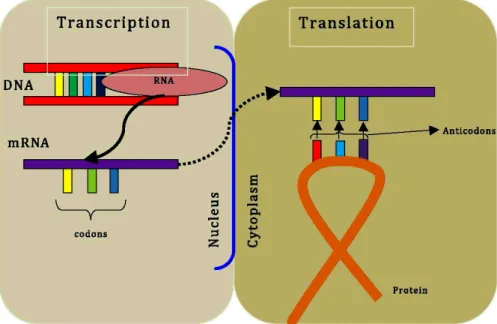
2.1 Gene structure and protein synthesis . . . 9
3.1 Weibull failure distribution with differing parameter values. . . 28
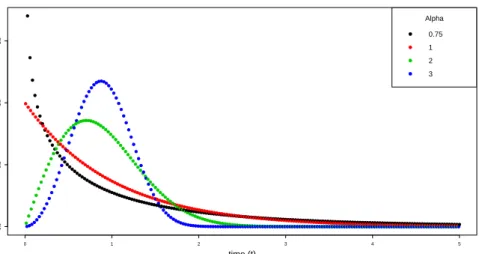
3.2 Weibull densities with different values of the shape parameter. . . . 28
4.1 Posterior densities ofαandλusing Weibull survival model without
covariates for DLBCL data. . . 66
4.2 Posterior estimated survivor function S(t) with 95% credible
in-terval for DLBCL data. Graph a) without covariates and b) with covariates (GC-B signature 2.24, lymph node signature 0.43, BMP6
signature -0.22 and MHC class II signature 1.35) . . . 67
4.3 The graph for observed survival time versus the expected survival time for training dataset (a) and validation dataset (b). . . 69
4.4 Posterior predicted survival functionS(t)of four different patients
for DLBCL data with covariates after chemotherapy. . . 71
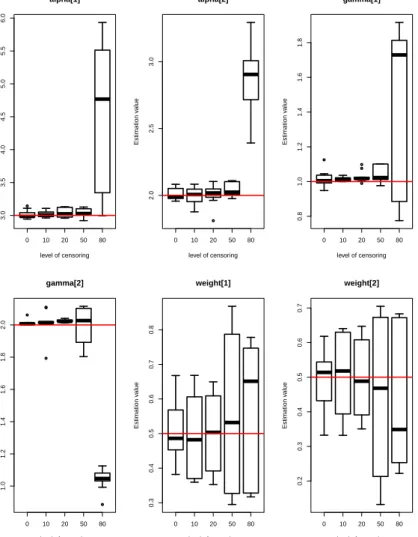
5.1 Box-plots of posterior estimates of parameters (α,γ,π) for model
M1 with five different levels of censoring. . . 88
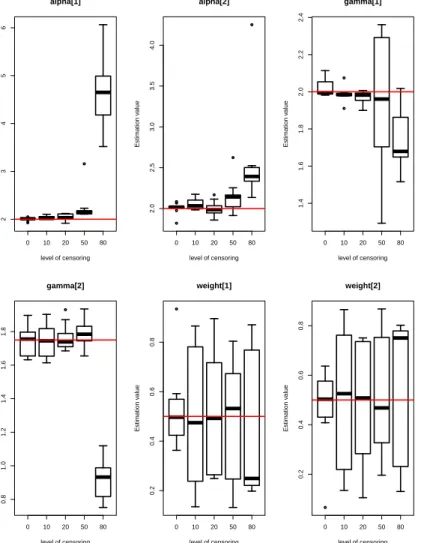
5.2 Box-plots of posterior estimates of parameters (α,γ,π) for model M2 with five different levels of censoring. . . 89
5.4 Comparison of true and estimated densities for model M1
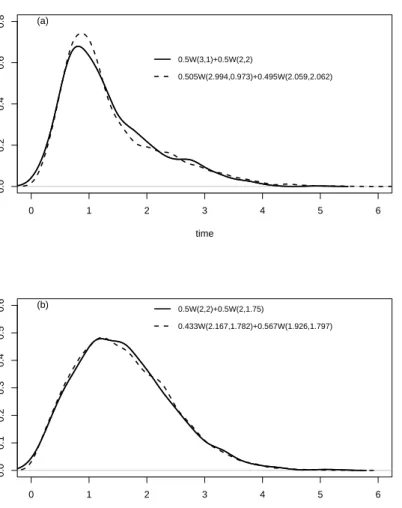
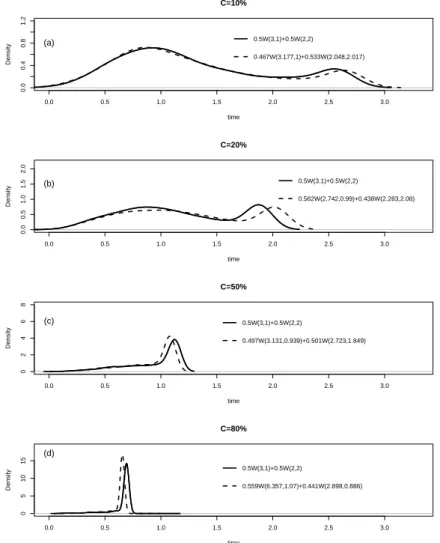
(well-separated components) with (a) 10%, (b) 20%, (c) 50%, and (d) 80%censoring. . . 92
5.5 Comparison of true and estimated densities for model M2 (two
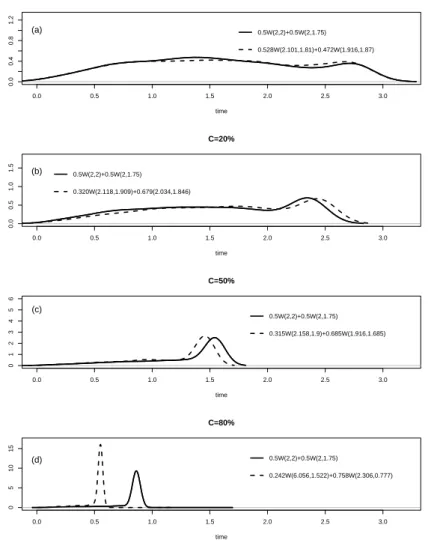
overlapping components) with (a) 10%, (b) 20%, (c) 50%, and (d) 80%censoring. . . 93
5.6 Box-plots of posterior estimates of parameters (α,βm,π) for model
M1 with five different levels of censoring. . . 94
5.7 Box-plots of posterior estimates of parameters (α,βm,π) for model M2 with five different levels of censoring. . . 95
6.1 Kaplan-Meier estimates of overall survival according to the
gene-expression subgroups. . . 123
6.2 Box-plots of the cure rates (posterior distribution ofπ) for the full DLBCL dataset, and to each of the three phenotypes (ABC, GCB
and Type III). . . 125
6.3 The posterior densities of the three models and the model averaged density for the full DLBCL dataset and each of the three
pheno-types. For comparison, the observed data is also represented as a histogram. . . 130
List of Tables
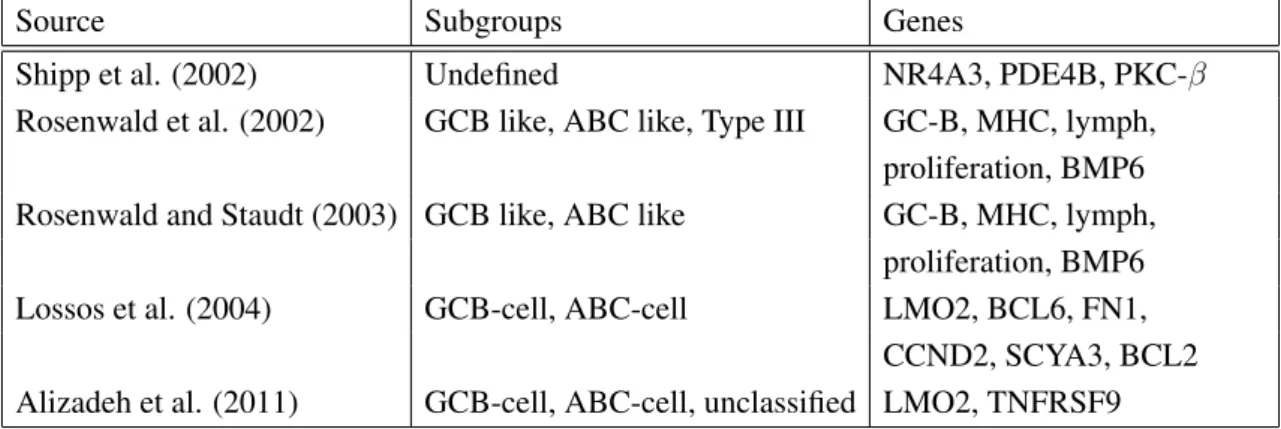
2.1 Summary of result of genes whose expression predicts survival in DLBCL. . . 14
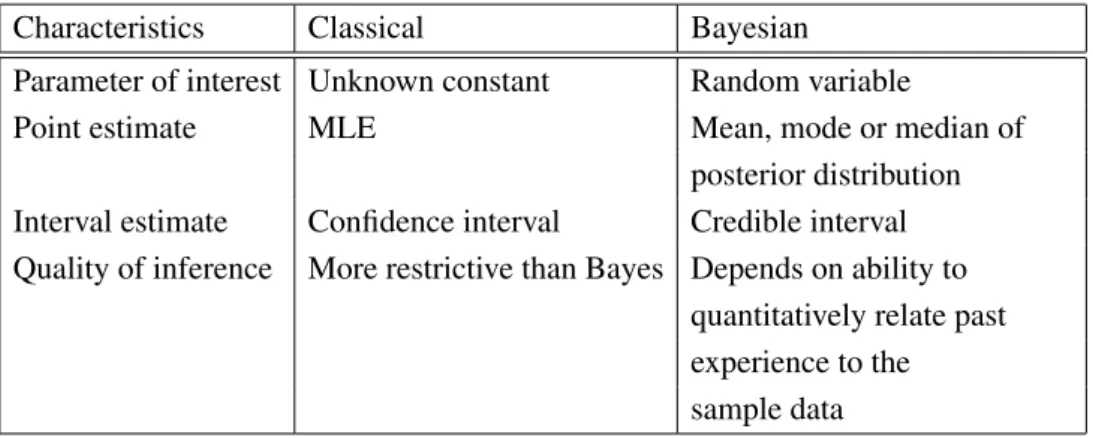
3.1 The difference between classical and Bayesian statistical inference. . 24
4.1 Posterior summary statistics for DLBCL data . . . 68
4.2 The top five of subsets model selection for Weibull survival model . 72
4.3 Sensitivity analysis for Weibull survival model without covariates . 73
4.4 Sensitivity analysis for Weibull survival model with covariates . . . 74
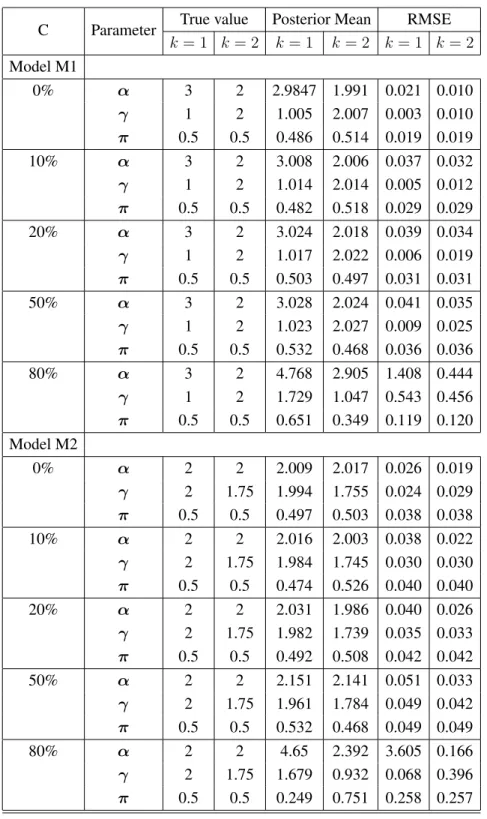
5.1 Posterior estimates of parameters (α,γ,π) and RMSE for model M1 and M2 with five different levels of censoring. . . 91
5.2 Posterior estimates of parameters (α,π,βm) and RMSE for model M1 with five different levels of censoring. . . 96
5.3 Posterior estimates of parameters (α,π,βm) and RMSE for model
M2 with five different levels of censoring. . . 99
5.4 Posterior summary statistics for DLBCL data. . . 100
5.5 Summary of posterior predictive checks for predicted survival times with five different levels of censoring. . . 101
6.1 The estimated posterior mean of the parameters, the 95%credible
intervals (CI), the BIC values and the BMA weights for each of the fitted models for the full DLBCL dataset. . . 124
6.2 The estimated posterior means of parameters, the 95% CI, BIC
values and the BMA weights for each of the models based on phe-notype for the DLBCL dataset. . . 126
6.3 The percentage of observed values that lay in the corresponding
95% credible interval for the individual models and BMA model based on the full DLBCL dataset and each of the three phenotypes. . 129
Chapter 1
Introduction
1.1
Background
In analysing the factors influencing the survival of patients with a given disease, var-ious issues can be taken into consideration as explanatory variables. Amongst these
is the biological system, in particular the gene expression of the patients. In relation to this, this research used gene expression data to aid in modelling the variability
in the patients’ survival times. These data typically come from microarrays. The significance of microarrays in genomic studies has been widely acknowledged. This
is due to the fact that microarrays can provide information about a large number of genes that may be potentially important for biological functions (Newton and
Kendziorski, 2003, Segal, 2006). This information in turn allows the examination of the variation, roles and interactions of the genes in relation to the survival time
of patients.
In this thesis, we focus on Bayesian statistical approaches to modelling survival. Although there is a large literature on Bayesian modelling and analysis, the
litera-ture on Bayesian survival is still growing and there is only limited literalitera-ture to date on Bayesian survival modelling using gene expression data and that consider model
choice issues and sensitivity analysis to censored data. For example, Kaderali et al. (2006) proposed a Bayesian Cox proportional hazards model for this purpose. In
contrast, Lee and Mallick (2004) adopted a Bayesian Weibull model, following the notion that the Weibull distribution is a popular parametric distribution for
describing survival times (Dodson, 1994).
Given the nature of microarray data to describe biological systems and outcomes of patients, and hence the potential of these covariates to produce more precise
inferences about survival, the use of a single parametric distribution to describe survival time may not be adequate. Microarray data may enable the description
of several homogeneous subgroups of patients with respect to survival time. This research therefore used Bayesian Weibull mixture models for better estimation and
prediction of this outcome. Mixture models are commonly used in describing data consisting of several groups, where each group has different properties and features
of the one family but use the same distribution. These models provide a convenient and flexible mechanism to identify and estimate distributions, which are not well
modelled by any standard parametric approaches (Stephens, 1997).
In relation to survival analysis, one fundamental issue in the use of Weibull mixture models is the effect of censored data. Censoring is an innate feature of
sur-vival and reliability data, and occurs when part of the lifetime distribution, usually at the end of the study, is unobserved. This may be due to a variety of reasons;
for example, some patients may still be alive at the end of the study period so the event of interest, namely death, has not happened. There is developing literature
on the application of Weibull mixture models in the field of survival and reliability analysis. Examples of these are Ibrahim et al. (2001b), Farcomeni and Nardi (2010),
Qian (1994) and Tsionas (2002). However, only limited attention has been paid to the effect of censoring on the mixture.
1.1. BACKGROUND 3
Models for survival analysis typically assume that everybody in the study pop-ulation is susceptible to the event of interest and will eventually experience this
event if the follow-up is sufficiently long. In recent years, there has been increasing interest in modelling survivor data with long term survivors. Most approaches to the
analysis of time to event data implicitly assume all individuals will experience the event of interest. However, there are situations when a proportion of individuals are
not expected to experience the event of interest; that is, those individuals are often referred to as immune, cured or nonsusceptible (Ibrahim et al., 2001b). To address
this issue, cure rate models are considered, which are survival models incorporating a cure fraction. These models extend the understanding of time to event data by
allowing the formulation of more accurate and informative conclusions.
The problem of model selection is abundant throughout the literature. This in-cludes both covariate selection and choice of the model itself. Some of the methods
are based on a series of significance tests (Mosler and Haferkamp, 2013) while others fit more comprehensive models; some include prior information; some use
analytic or approximate methods of estimation while others use Markov Chain Monte Carlo (MCMC) methods; different approaches use different optimisation
or model comparison criteria such us the Bayes factor (Raftery, 1996). Regardless of the method, the most common approach is to choose a single model based on
the adapted optimisation or model choice criterion. However, if a single model is selected then inferences are conditionally based on the selected model, which
often leads to excessively narrow or misleading inferences (Hjort and Claeskens, 2003, Raftery et al., 1997). This difficulty can be overcome by combining the
information provided by all suitable models into the analysis. The most common way of achieving this is to use a form of model averaging. From a Bayesian point
of view, this averaging is applied such that posterior distribution of the quantity of interest is obtained over the set of suitable models, then weighted by the respective
compare several competing models for a given dataset and to select the one “best” fits the data. Bayesian model averaging (BMA) is one way of combining models in
order to account for the uncertainty. By averaging over many different competing models, BMA incorporates model uncertainty in inference and prediction. Hence,
in this thesis, we also consider the problem of predicting survival, based on three alternatives models; a single Weibull, a mixture of Weibulls and a cure model.
In-stead of choosing a “best” model, we adopt a model averaging approach to account for model uncertainty in the prediction of survival.
1.2
Research Aims and Objectives
The primary aim of this research is to develop and apply a Bayesian modelling
approaches for prediction of patient survival using gene expression data. This research aimed to develop a new methodology that allows a better description of
genetic contributors to survival and of subgroups of patients with different survival characteristics. This can in turn provide insight into improved treatment regimes for
these patients.
Specifically, this thesis focuses on two distinct areas, covering both statistical methodology for Bayesian survival models and the application to gene expression
data. The research has the following objectives:
1. To describe and implement a Bayesian Weibull model to predict patient
sur-vival;
2. To investigate the impact of censoring on fitting a finite mixture of Weibull
distributions either with or without covariates;
3. To describe and evaluate a model averaging approach to account for model uncertainty.
1.3. STRUCTURE OF THE THESIS 5
1.3
Structure of The Thesis
This thesis is written in fulfillment of the requirement for thesis by publication. Chapters are presented here in the form which they were submitted, or accepted.
These articles are presented in Chapters 4 to 6. Each chapter has thus its own relevant literature review and there is necessarily some overlap and repetition across
chapters, and with the content of the comprehensive literature review presented in Chapters 2 and 3. Moreover, the same microarray data has been used throughout
Chapters 4 to 6 of this thesis which is repeatedly described in these chapters for the purpose of publication. Because we referred to the same papers in several chapters,
the bibliography for all chapters appears in a comprehensive bibliography at the end of the thesis.
1.4
Thesis Outline
Overall, this thesis consists of seven chapters and is outlined as follows:
Chapter 1 describes the background of the research topic and points out the research aims and objectives, and the structure of the thesis.
Chapter 2 is a literature review that related to the applied focus of this thesis,
that is, the use of gene expression in survival analysis. It covers a discussion on the basic concepts of gene expression, microarray analysis and lymphoma disease.
Chapter 3 is a literature review that provides an overview of the body of
knowl-edge associated with the research objectives and goals. The review includes a dis-cussion on survival analysis, Bayesian modelling and computation, Bayesian
vari-able selection, sensitivity analysis, goodness of fit measures and Bayesian model averaging.
Chapter 4 addresses the first issue of this study, namely describing and im-plementing Bayesian methodology to fit a Weibull distribution to predict patient
survival.
Chapter 5 addresses the second objective of this study, namely the impact of censored data on Bayesian analysis when fitting a mixture of Weibull models.
Chapter 6 is intended to meet the third objective of this research, which is to
develop a model averaging approach to incorporate the model uncertainty when predicting survival.
Chapter 7 presents the overall discussion of the research and describes how the
objectives of the thesis have been met. It highlights a summary of major findings and main contributions of this study. It also presents the implications of these
Chapter 2
Review of the role of Gene Expression in
Predicting Patient Survival
This chapter reviews literature related to the applied focus of this thesis, that is,
the use of gene expression in survival analysis. It covers a discussion on the basic concepts of gene expression, microarray analysis and lymphoma disease.
2.1
Gene Expression
The survival time of a patient suffering from a particular disease can be influenced
by various factors. One such factor is the microbiological system, specifically the gene expression of the patient.
According to the United States National Institute of Health, gene expression is
“the process by which a gene’s coded information is translated into the structures present and operating in the cell (either proteins or RNAs)” (Institute, 2013).
Sim-iliarly, Krane and Raymer (2003) define gene expression as “the process of using information that is stored in DNA to make an RNA molecule and a corresponding
protein”. Thus proteins are the main elements of cells and the production of such proteins is determined by genes, which are coded in deoxyribonucleic acid (DNA)
(Parmigiani et al., 2003).
Gene expression can therefore determine the key functions of a biological sys-tem. This is due to the fact that in genetics, gene expression constitutes the most
fundamental level at which the physical or biological features, as phenotypes, can be traced. The genetic and phenotype traits can also be influenced by environmental
factors, giving rise to gene by environment interactions. Apart from environmental aspects, the organism’s phenotype is highly associated with its related genotype.
There are two main stages of protein production from genes; transcription and
translation (see Figure 2.1). Transcription involves the production of the RNA copy of a gene. One strand of DNA double helix becomes a template for RNA
polymerase to make a messenger RNA (mRNA). After maturation, this mRNA is transported to the cytoplasm from the nucleus. In translation, the protein is
produced from the mRNA template via the assembly a chain of amino acids. In this process, the ribosome binds to the mRNA at the start codon. The ribosome
continues to the elongation phase of protein synthesis. During this stage, complexes, composed of an amino acid linked to tRNA, sequentially bind to the appropriate
codon in mRNA by forming complementary base pairs with the tRNA anticodon. The ribosome moves from codon to codon along the mRNA. Amino acids are added
one by one, translated into polypeptidic sequences dictated by DNA and represented by mRNA. Finally, a release factor binds to the stop codon, terminating translation
2.2. MEASURING GENE EXPRESSION: MICROARRAY ANALYSIS 9
Figure 2.1: Gene structure and protein synthesis. Modified fromhttp://www. accessexcellence.org
2.2
Measuring gene expression: Microarray analysis
In bioinformatics, measuring gene expression plays a very central role. This
activ-ity reflects the effort to quantify the level at which a particular gene is expressed within a cell, tissue or organism. One of the common methods of measuring gene
expression, is through microarray analysis. Microarrays have been used in a range of applications such as the discovery of disease subtypes, the development of new
diagnostic tools and the identification of underlying mechanisms of disease and medicine response (Slonim and Yanai, 2009).
In order to quantify gene expression, microarray analysis typically uses a
hy-bridisation approach. The basic idea of this approach is that a glass slide or mem-brane is spotted or “arrayed” with DNA fragments or oligonucleotides that represent
specific gene coding regions. Purified RNA is then fluorescently or radioactively labeled and hybridised to the slide/membrane. In several cases, hybridisation is
carried simultaneously with reference RNA to compare data across multiple exper-iments. After thorough washing, the raw data are obtained by laser scanning or
autoradiographic imaging (World, 2013).
In the microarray analysis, there are various issues that arise. According to Slonim and Yanai (2009), these issues can be categorised into three aspects. The
first one comes from the experimental design. In this aspect, the main common issues include the selection of an appropriate array technology and the measurement
of the expression levels from each sample on a different microarray or the compar-ison of relative expression levels between a pair of samples on each microarray.
The second aspect is the preparation of microarray data for analysis, which arise issues such as the assessment of the quality of the data, is the assurance that all
samples are comparable for further analysis and the normalisation of the raw data i.e. removing the technical variation as much as possible while leaving the
biologi-cal variation untouched. The last issues of microarray analysis are from the domain of data analysis, including the use of statistical analysis software packages and the
approaches taken to analyse the microarray data in relation to the desired goal of the study. Given these issues, this research is mainly associated with the last issue as
this research utilised the microarray data that was used by Rosenwald et al. (2002) and can be downloaded athttp://llmpp.nih.gov/DLBCL/. These data, a
part from its convenient accessibility, are considered to be in accordance with the Minimum Information About a Microarray Experiment (MIAME) standard for the
2.3. THE USE OF MICROARRAYS AND GENE EXPRESSION IN THE
ANALYSIS OF LYMPHOMA 11
2.3
The use of microarrays and gene expression in the analysis
of Lymphoma
Lymphoma is a type of blood cancer that happens when the white blood cells, called lymphocytes indicate abnormal development (Pace et al., 2007, Today, 2013). This
abnormality can be shown from their uncontrollable growth or multiplication faster than normal cell or longevity longer than they should be. Lymphoma can exist
in many parts of the body and develop a dangerous mass of cell called a tumour (Hatton, 2008, Today, 2013). In Australia, lymphomas are the sixth most common
form of cancer (Australia, 2013a). Clearly, a greater understanding of lymphomas has potential to save many lives.
There are two type of the white blood cells associated with Lymphoma disease,
including the B cell and T cell lymphocytes (Australia, 2013a, Pace et al., 2007, Today, 2013). The presence of these types of cells determine the classification
of lymphoma, that is, whether it is a Hodgkin lymphoma (HL) or non-Hodgkin’s lymphoma (NHL), named after Thomas Hodgkin, who first discovered the
abnor-malities in the lymph system in 1832 (Australia, 2013a, Pace et al., 2007, Today, 2013). The HL type is related to the abnormality of the B cells, while the NHL one
is due to either the abnormal B or T cells. DBCL which is the medical context of this research is classified under the NHL (Australia, 2013a,b, Drouet, 2007, Hatton,
2008).
Diffuse large B-cell lymphoma (DLBCL) is a sub-type of NHL and the most common lymphoma worldwide (Lenza et al., 2008). DLBCL is clinically
heteroge-nous in that 35−40% of patients respond well to current therapy, the main form of which is chemotherapy, and have prolonged survival, whereas the remainder
succumb to the disease (Alizadeh et al., 2000, Lenza et al., 2008, Rosenwald et al., 2002). In general, types of this disease are very diverse both morphologically and
prognostically, and their biological properties are largely unknown, meaning that this is a relatively difficult cancer to cure and prevent (Rosenwald et al., 2002).
Traditional morphologic subclassification often results in poor reproducibility and has not been particularly helpful in predicting outcome (Hunt and Reichard, 2008).
There is some literature on relating DLBCL genotypes to phenotypes and to
survival. Alizadeh et al. (2000) identified two molecularly distinct forms of DL-BCL which had gene expression patterns indicative of different stages of B-cell
differentiation, namely genes characteristic of germinal centre B-cells (“germinal centre B-like DLBCL”) and genes normally induced during in vitro activation of
peripheral blood B cells (“activated B-like DLBCL”). They found that patients with germinal centre B-like DLBCL had significantly (p < 0.01) better overall
survival than those with activated B-like DLBCL. The molecular classification of tumours on the basis of gene expression can thus identify previously undetected and
clinically relevant subtypes of cancer (Alizadeh et al., 2000). Hunt and Reichard (2008) also reviewed gene expression profiling studies and have classified DLBCL
into two main subtypes, germinal center B-cell (GCB) and activated B-cell (ABC), with the germinal center type showing an overall better survival. They suggested
that validation of these subtypes has become possible for the practising pathologist with the use of surrogate immunohistochemical markers (Hunt and Reichard, 2008).
However, Rosenwald et al. (2002) and Rosenwald and Staudt (2003) used hierarchi-cal clustering to define subgroups of DLBCL and found that there were three
phe-notypes subgroups of patients of DLBCL; activated B-like DLBCL, germinal centre (GC)-B like and type III DLBCL. These findings support the view that the various
subgroups represent different diseases that arise as a result of distinct mechanisms of malignant transformation (Alizadeh et al., 2000, Huang et al., 2002). Based on the
hierarchical clustering, the GC B-like DLBCL had a significantly greater likelihood of survival after chemotherapy than did the activated B-like DLBCL and Type III
2.3. THE USE OF MICROARRAYS AND GENE EXPRESSION IN THE
ANALYSIS OF LYMPHOMA 13
were differentiated from each other by distinct gene expressions of hundreds of different genes and had different survival time patterns. Similarly, Bea et al. (2005)
also identified 3 major subgroups of DLBCL: GCB, ABC, and primary mediastinal DLBCL (PMBCL).
Currently, prognostic models based on pretreatment characteristics, such as the
International Prognostic Index (IPI), are used to predict the outcome in DLBCL. IPI is the outcome predictor in DLBCL based on five clinical characteristics (age,
tumour, stage, serum lactate dehydrogenase concentration, performance status, and number of extranodal disease sites (Hatton, 2008). However, although the index is
of some value, it has not been used successfully to stratify patients for therapeutic targets (Shipp et al., 1999) (Shipp et al., 2002).
In relation to prediction of survival, Rosenwald et al. (2002) reported a
correla-tion between outcome (overall survival after chemotherapy) and gene expression data from individual microarray features, based on a Cox proportional hazards
analysis. Five genes were reportedly significant to overall survival; germinal-center B-cell (GC-B) signature, lymph-node signature, proliferation signature, BMP6 and
MHC. They concluded that DNA microarray data can be used to formulate a molec-ular predictor of survival after chemotherapy for DLBCL.
Shipp et al. (2002) reported three genes (NR4A3, PDE4B, PKC-β) that are
as-sociated with clinical outcome in the DLBCL patients by using supervised learning methods.
Lossos et al. (2004) built a predictive model for overall survival of DBLCL
patients based on six genes; LMO2, BCL6, FN1, CCND2, SCYA3 and BCL2. They used a univariate analysis to rank genes on the basis of their ability to predict
survival, then developed a multivariate model based on the expression of these six genes. Specifically, Lossos et al. (2001) showed that BCL6 has strongest prognostic
Rosenwald and Staudt (2003) used five different genes; GC-B cell signature, MHC class II, lymph node signature, proliferation signature and BMP6 to predict
DLBCL survival. They showed that gene expression is an effective tool for assess-ing the prognosis of these patients.
Lexin. (2006) proposed an integrated modelling approach, which combines
ge-nomic information, in terms of gene expression profiles, and the clinically based IPI, to predict the survival of patients with DLBCL after chemotherapy treatment.
Lexin. (2006) demonstrated that the proposed integrative modeling improved the prediction accuracy over those methods using either clinical or genomic factors
alone.
Finally, Alizadeh et al. (2011) predicted survival in DLBCL based on the ex-pression of 2 genes (LMO2, TNFRSF9) reflecting tumor and microenvironment.
They also used a multivariate Cox regression to test combinations of genes for their ability to predict survival. They concluded that the measurement of a single gene
expressed by tumor cells and a single gene expressed by the immune microenviron-ment powerfully predicts overall survival in patients with DLBCL.
The summary of result of genes whose expression predicts survival in DLBCL
from several sources are presented in Table 2.1.
Table 2.1: Summary of result of genes whose expression predicts survival in DLBCL.
Source Subgroups Genes
Shipp et al. (2002) Undefined NR4A3, PDE4B, PKC-β
Rosenwald et al. (2002) GCB like, ABC like, Type III GC-B, MHC, lymph,
proliferation, BMP6
Rosenwald and Staudt (2003) GCB like, ABC like GC-B, MHC, lymph,
proliferation, BMP6
Lossos et al. (2004) GCB-cell, ABC-cell LMO2, BCL6, FN1,
CCND2, SCYA3, BCL2
2.3. THE USE OF MICROARRAYS AND GENE EXPRESSION IN THE
ANALYSIS OF LYMPHOMA 15
Following the preliminary studies of gene expression in lymphoid malignancies, and particularly, DLBCL, an international consortium was established to use gene
expression profiling to provide a molecular diagnosis for all lymphoid malignancies. This consortium is known as the lymphoma/ Leukemia Molecular Profiling Project
(LLMPP). It is also hoped that it will be possible to define the molecular correlates of clinical parameters that can be used as indicators of prognosis and thus to improve
Chapter 3
Review of Statistical Methods for predicting
patient survival
This chapter provides an overview on literature related to research objectives and
goals which are reviewed within the chapters of this thesis.
3.1
Survival Analysis
3.1.1 Introduction to Survival Analysis
Survival analysis aims to estimate the three survival (survivorship, density, and
haz-ard) functions, denoted byS(t), f(t)and h(t), respectively (Collet, 1994). There exist parametric as well as non-parametric methods for this purpose (Kleinbaum and
Klein, 2005). The survival functionS(t)gives the probability of surviving beyond time t, and is the complement of the cumulative distribution function, F(t). The
hazard functionh(t)gives the instantaneous potential per unit time for the event to occur, given that the individual has survived up to time t (Kleinbaum and Klein,
2005).
3.1.2 Censored Data
In survival analysis, one must consider censored data. This is a key issue for the analysis of survival data and one of the reasons why survival analysis is a
special topic within statistics. The difference between survival analyses with other statistical analysis is the presence of censored data. In essence, censoring occurs
when there are some information about individual survival time, but the survival time is unknown exactly.
According to Miller (1998) and Hougaard (2000) data are said to be censored if
the observation time censored survival is only partial, not until the failure event. One major reason for this is that the person studied is alive when the data are evaluated,
and thus the complete lifetime is not known at that time.
There are many other reasons for censoring. For examples, the patients can be lost to follow-up, patients still alive at the end of the study or patients drop out
of the study. There are also several types of censoring, including right censoring, left censoring, interval censoring, random censoring, Type I censoring and Type II
censoring (Collet, 1994, Hosmer and Lemeshow, 1999, Kalbfleisch and Prentice, 2002, Kleinbaum and Klein, 2005). Right censoring occurs when a subject leaves
the study before an event occurs, or the study ends before the event has occurs (Kleinbaum and Klein, 2005). Left censoring occurs when the event of interest
has already occurred before enrollment (Collet, 1994). Interval censoring occurs when the survival time of each subject is only known to be within an interval (Sinha
et al., 1999). Random censoring occurs when each subject has a censoring time that is statistically independent of their failure time (Kalbfleisch and Prentice, 2002).
Type I censoring occurs when an experiment has a set number of subjects and stops at a predetermined time, at which point any subjects remaining are right censored
(Kalbfleisch and Prentice, 2002). Meanwhile, Type II censoring occurs when an experiment has a set number of subjects and stops when a predetermined number are
observed to have failed; the remaining subjects are then right censored (Kalbfleisch and Prentice, 2002).
3.1. SURVIVAL ANALYSIS 19
3.1.3 Characteristics of Survival Time Data
Survival time data have two important special characteristics (Kleinbaum and Klein, 2005) as follows:
• Survival times are non-negative, and consequently are usually positively skewed. However, we can adopt a more satisfactory approach as an alternative
distri-butional model for the original data.
• Typically, some subjects (as mentioned above) have censored survival times.
There are nonparametric and parametric approaches to modelling survival data. Some of these approaches are outlined now.
3.1.4 Kaplan-Meier
Kaplan-Meier procedure is an important and widely used tool in survival analysis
in dealing with censored data. It is a method for time to event data at each time point when a particular event takes place. The Kaplan-Meier curves have become
the standard method of displaying time to event data (Royston et al., 2008). The Kaplan-Meier method (Kaplan and Meier, 1958), also known as the product limit
estimator, which can be used to estimate the survival function from life time data. By using this method, we can make comparisons of the survival (or failure) rates
between two or more groups in order to see either the effect of particular treatments on the survival time of the patients (Royston et al., 2008) or to show the survivor
function risk groups (Kaderali et al., 2006, Rosenwald et al., 2002).
To estimate the survivor function without covariates, we can use the Kaplan-Meier estimator. This method does not rely on distributional assumptions
(dis-tribution free method). Therefore, the Kaplan-Meier estimator is categorized as a nonparametric technique (Collet, 1994, Kaplan and Meier, 1958). Given this
property, we can use the Kaplan-Meier estimator to describe many forms of the survivor function,S(t).
Let there benindividuals with observed survival timest1, . . . , tnandrbe death
times amongst the individuals, wherer ≤ n, j = 1,2, . . . , r. Ther ordered death times aret(1) < t(2) < . . . < t(r). Letnj denotes the number of individual who are
alive just before timet(j), including those who are about to die at this time, and let dj denotes the number who die at this time.
We suppose now to make the assumption that the death of the individuals in the
sample occur independently of one another. Then, the estimated survival function at any time in thekth constructed time interval fromt
(k)to t(k+1),k = 1,2, . . . , r, wheret(r+1)is defined to be∞and it estimates probability of surviving beyondt(k). The Kaplan-Meier estimator of the survivor function (Collet, 1994) is given by
ˆ S(t) = k Y j=1 nj −dj nj .
The Kaplan-Meier estimator plot of the survivor function is like a step-function. The estimated survival probabilities are constant between adjacent death times and
decrease at each death time (Collet, 1994).
3.1.5 Cox Proportional Hazard
A Cox proportional hazards (PH) model is a popular mathematical model used for
modelling survival. This model was proposed by Cox and Oakes (1972) and has also come to be known as the Cox regression model. The reason why the Cox PH
model is so popular, is that because it is a semiparametric and a “robust” model. The results from using this model will closely approximate the results of the correct
parametric model (Kleinbaum and Klein, 2005).
A survival analysis typically examines the relationship of the survival distri-bution to covariates. If the risk of failure at a given time depends on the value
3.1. SURVIVAL ANALYSIS 21
of x1, x2, . . . , xp of p predictor variables X1, X2, . . . , Xp, then the value of these
variables are assumed to have the time origin. If h0(t) is the hazard function for each object with the value of all predictor variableX is zero, then the function of h0(t)are the baseline hazard function (Collet, 1994). The Cox PH model is usually written in terms of the hazard model as follows
h(t) =h0(t) exp(β1X1 +β2X2+. . .+βpXp). (3.1)
There are two basic assumptions of this model; the effect of X is linear andβ
is constant over time. The latter being the assumption of a proportional hazards. It is also assumed that individuals are independent and homogeneous given their
covariates (Andersen, 1991).
An important feature of equation 3.1, which concerns the PH assumption, is that the baseline hazard is a function oft, but does not involve theX’s (Kleinbaum and
Klein, 2005). In contrast, the exponential expression shown here, involves theX’s, but does not involve t. Then, X’s here are called time independent X’s. Another
important property of the Cox model is that the baseline hazard, h0(t), can be an unspecified function. This property that makes the Cox PH model a semiparametric
model (Hosmer and Lemeshow, 1999, Kleinbaum and Klein, 2005). In contrast, a parametric model is one whose functional form is completely specified, except for
the values of the unknown parameters. For example, the Weibull PH model.
3.1.6 Frailty Model
The Cox proportional hazards (PH) model can be extended to allow time dependent variables as predictors (Kleinbaum and Klein, 2005). Frailty models are extensions
of the PH model which is an known as the Cox model (Cox and Oakes, 1972). The aim of this model is to account for unobserved heterogeneity that is caused by
unmeasured covariates (Hougaard, 1995). In statistical terms, a frailty model is a random effect model for time to event data, where the random effect (the frailty)
has a multiplicative effect on the baseline hazard function (Duchateau and Janssen, 2008). Conditional on the frailty, the survival times are assumed to be independent
with PH structure. The modeling process is then completed by assuming multilevel frailty effects (Kima and Dey, 2008).
3.1.7 Parametric Survival Model
A parametric survival model is one in which survival time (the outcome) is as-sumed to follow a known distribution (Hosmer and Lemeshow, 1999, Kleinbaum
and Klein, 2005). The distributions that are commonly used for survival time are; the Weibull (Collet, 1994, Ibrahim et al., 2001b), the exponential (a special case
of the Weibull) (Collet, 1994, Ibrahim et al., 2001b, Sparling et al., 2006), the log-logistic, the log-normal, and the generalized gamma (Ibrahim et al., 2001b).
Survival estimates were obtained from parametric survival models typically
yield plots more consistent with a theoretical survival curve. If the investigator is comfortable with the underlying distributional assumption, then the parameters
can be estimated and the survival and hazard functions can be specified as well (Kleinbaum and Klein, 2005). This simplicity and completeness of a parametric
approach makes statistical tests more powerful.
For parametric survival models, time to event is assumed to follow certain dis-tribution whose probability density function (pdf)f(t)can be expressed in terms of
unknown parameters (Collet, 1994). Once a probability density function is specified for survival time, the corresponding survival and hazard functions can be
deter-mined.
Survival methods using the Bayesian statistical framework have been collated more recently in the well regarded texts of Gelman et al. (2004), Ibrahim et al.
3.2. BAYESIAN MODELLING 23
(2001b) and Congdon (2006), with expanded applications in Congdon (2003).
3.2
Bayesian Modelling
3.2.1 Overview of Bayesian Approach
Modern Bayesian analysis began with a posthumous publication in 1763 by
Rev-erend Thomas Bayes that set the theoretical framework and after a status of around 200 years, publications by Geman and Geman (1984) and Bernando and Smith
(1994), among others, exploited computer technology and computational algorithms, and extended the modelling framework.
The idea of Bayesian statistics within the context of life data analysis is to
integrate prior knowledge, along with a given set of current observations, in order to make statistical inferences. The prior information could come from operational
or observational data, from previous comparable experiments or from engineering knowledge (Gelman et al., 2004). This type of analysis can be mainly useful when
there is limited test data for a given design. By integrating prior information about the parameters, a posterior distribution for the parameters can be obtained and
inferences on the model parameters and their functions can be made.
Supposeθis some quantity that is unknown and letp(θ)denote the prior distri-bution ofθ. Next, letybe some observed data, whose probability of occurrence is
assumed to depend onθ. This dependence is formalized byp(y |θ), the conditional probability ofyfor each possible value ofθ, and when considered as a function ofθ
is known as the likelihood (Spiegelhalter et al., 2004). The probability for different values ofθ, taking account ofyis denoted byp(θ |y).
Bayes’ theorem applied to a general quantity says that:
p(θ |y) = p(y|θ)p(θ)
p(y) .
R
p(θ |y)dθ = 1, so that
p(θ|y)∝p(y|θ)p(θ),
which says that the posterior distribution is proportional to the product of the likeli-hood and the prior (Gelman et al., 2004, p.7-9).
The main differences between classical statistical inference and Bayesian
statis-tical inference is shown in Table 3.1 (Gelman, 2008).
Table 3.1: The difference between classical and Bayesian statistical inference.
Characteristics Classical Bayesian
Parameter of interest Unknown constant Random variable
Point estimate MLE Mean, mode or median of
posterior distribution
Interval estimate Confidence interval Credible interval
Quality of inference More restrictive than Bayes Depends on ability to
quantitatively relate past experience to the sample data
3.3
Prior Distribution
Prior distributions play a very important role in Bayesian statistics. There are
two different types of prior distributions; informative and non-informative (Gelman et al., 2004, Marin and Robert, 2007, Spiegelhalter et al., 2004). Non-informative
prior distributions (vague, flat, and diffuse) play a minimal role in posterior in-ference, and posterior can be sensitive to prior (Gelman et al., 2004). The
non-informative prior distributions can be used to make inferences that are not greatly affected by external information or when external information is not available
(Gel-man et al., 2004, Marin and Robert, 2007, Spiegelhalter et al., 2004).
Informative priors have a stronger influence on the posterior distribution. The influence of the prior distribution on the posterior is related to the relative variance
3.4. BAYESIAN COMPUTATION 25
of the data and the prior. We can obtained informative priors from past data or expert information (Gelman et al., 2004, Marin and Robert, 2007, Spiegelhalter
et al., 2004).
Other categorisations of prior include conjugate prior, proper prior and improper prior (Jeffreys prior) (Gelman et al., 2004, Marin and Robert, 2007, Spiegelhalter
et al., 2004). Several papers have been published on Bayesian survival analysis that consider some very general constructions and applications of reference priors, other
than the normal prior. Among these are critical issues in Ibrahim and Laud (1991), who examine Jeffreys’s prior for class of generalized linear models and Kim and
Ibrahim (2000) who discusses non-informative priors for linear combinations of the means under the normal population. Other scholars, Berger and Bernardo (1989),
have examined reference priors for estimating a product of means. Bernardo (1997), specifically, examines the existence of non-informative priors.
Bayesian methods provide a practical and effective tool for microarray analysis
(Baldi and Long, 2001, Gottardo, 2003, Ibrahim et al., 2002, Lewin et al., 2005). The DNA microarray technology has important applications in gene expression data
analysis. However, the potential sources of random and systematic measurement er-rors are a critical issue in statistical analysis. It is impossible to propose a statistical
model that reflects all sources of errors. Therefore, a good model should capture the most essential features of the data.
3.4
Bayesian Computation
Bayesian computation generally exploits modern computer power to carry out
simu-lations (Spiegelhalter et al., 2004) based on Markov chains and is known as Markov chain Monte Carlo (MCMC). Monte Carlo methods are techniques that have the aim
of evaluating integrals rather than exact or approximate algebraic analysis (Spiegel-halter et al., 2004). Several MCMC algorithms that are commonly used are Gibbs
sampling, Metropolis-Hastings, reversible jump, slice sampling, particle filters, per-fect sampling and adaptive rejection sampling (Marin and Robert, 2007,
Spiegelhal-ter et al., 2004).
Three MCMC algorithms will be used in this research, namely Gibbs sampling, Metropolis-Hastings and slice sampling. Gibbs sampling is an algorithm to generate
a sequence of samples from the joint probability distribution of two or more random variables, with the purpose of approximating the joint distribution. Gibbs sampling
is applicable when the joint distribution is not known explicitly, but the conditional distribution of each variable is known (Gelman et al., 2004). Moreover, the Gibbs
sampling algorithm is a method to generate an instance from the distribution of each variable in turn, conditional on the current values of the other variables (Gelman
et al., 2004). Meanwhile, the Metropolis-Hastings algorithm is a rejection sampling algorithm used to generate a sequence of samples from a probability distribution
that is difficult to sample from directly. This sequence can be used in MCMC simulation to approximate the distribution, or to compute an integral (such as an
expected value) (Hastings, 1970). The Gibbs sampling algorithm is a special case of the Metropolis-Hastings algorithm which is usually faster and easier to use but is
less generally applicable (Chib and Greenberg, 1995).
Furthermore, Neal (2003) described a class of “slice sampling” methods that can be applied to sample from a wide variety of distributions. “slice sampling” is a type
of MCMC algorithm for drawing random samples from a statistical distribution. The method is based on the observation that to sample a random variable one can
sample uniformly from the region under the graph of its density function (Damien et al., 1999, Mira and Tierney, 2002, Neal, 2003, Tibbits et al., 2011). Simple forms
of univariate slice sampling are an alternative to Gibbs sampling that avoids the need to sample from nonstandard distributions (Neal, 2003).
3.4. BAYESIAN COMPUTATION 27
hand-tailored sampling programs. However, the WinBUGS software is widely used in a variety of applications (Marin and Robert, 2007).
3.4.1 Weibull and Mixture Survival Models Weibull Model
The Weibull model is perhaps the most widely used parametric survival model in reliability (Kim and Ibrahim, 2000, Murthy et al., 2004) to characterize the
probabilistic behaviour of a large number of real world phenomena (Kaminskiy and Krivtsov, 2005). A detailed review of the Weibull model can be found in Murthy
et al. (2004). Because of its various shapes of the probability density function (pdf) and its convenient representation of the distribution/ survival function, the Weibull
distribution has been used very effectively for analyzing lifetime data, particularly when the data are censored, which is very common in most life testing experiments
(Collet, 1994, Kundu, 2008).
Suppose we have independent identically distributed (i.i.d) survival times t = (t1, t2, . . . , tn)0, which follow a Weibull distribution, denoted by W(α, γ) with a
shape parameterαand a scale parameterγ. The parameterαrepresents the failure rate behavior. Ifα < 1, the failure rate decreases with time; if α > 1, the failure
rate increases with time; whenα = 1, the failure rate is constant over time, which indicates an exponential distribution. The parameterγ has the same units ast, such
as years, hours, etc. A change inγhas the same effect on the distribution as a change of the abscissa scale. Increasing the value ofγ while holding α = 1constant has
the effect of stretching out the pdf. Ifγ is increased, the distribution is stretched to the right and its height decreases, while maintaining its shape. Ifγis decreased, the
distribution is pushed in towards the left and its height increases (Figures 3.1 and 3.2) (Rinne, 2008, p.27-43).
0 1 2 3 4 5 1 2 3 4 5 time(t) failure time (h(t)) alpha=1.5, gamma=1 alpha=1, gamma=1 alpha=0.5, gamma=1
Figure 3.1: Weibull failure distribution with differing parameter values.
● ● ● ● ● ● ● ● ● ● ● ● ● ● ● ● ● ● ● ● ● ● ● ● ● ● ● ●● ● ● ●● ● ● ● ● ● ● ● ● ● ● ● ● ● ● ● ● ● ● ● ● ● ● ● ●● ● ● ● ● ● ● ● ● ● ● ● ● ● ● ● ● ● ● ● ● ● ● ● ● ● ● ● ● ● ● ● ● ● ● ● ● ● ● ● ● ● ● ● ● ● ● ● ● ● ● ● ● ● ● ● ● ● ● ● ● ● ● ● ● ● ● ● ● ● ● ● ● ● ● ● ● ● ● ● ● ● ● ● ● ● ● ● ● ● ● ● ● ● ● ● ● ● ● ● ● ● ● ● ● ● ● ● ● ● ● ● ● ● ● ● ● ● ● ● ● ● ● ● ● ● ● ● ● ● ● ● ● ● ● ● ●● ● ● ● ● ● ● ● ● ● ● ● ● ● ● ● ● ● ● ● ● ● ● ● ● ● ● ● ●● ● ● ● ● ●● ● ● ●● ● ●● ● ● ● ●● ● ●●● ● ● ●● ● ●●● ● ● ● ● ● ●● ● ● ● ● ● ● ●● ● ● ● ● ● ● ●● ● ● ● ● ● ● ●● ● ● ● ● ● ● ●● ● ● ● ● ● ● ●● ● ● ● ● ● ● ●● ● ● ● ● ● ● ●● ● ● ● ● ● ● ●● ● ● ● ● ● ● ●● ●● ● ● ● ● ●● ●● ● ● ● ● ●● ●● ●● ● ● ●● ●● ●● ● ● ●● ●● ●● ● ● ●● ●● ●● ● ● ●● ●● ●● ● ● ●● ●● ●● ● ● ● ● ●● ●● ● ● ● ● ●● ●● ● ● ● ● ●● ●● ● ● ● ● ●● ●● ● ● ● ● ●● ●● ●● ● ● ●● ●● ●● ● ● ●● ●● ●● ● ● ●● ●● ●● ● ● ●● ●● ●● ● ● ● ● ●● ●● ● ● ● ● ●● ●● ● ● ● ● ●● ●● ● ● ● ● ●● ●● ● ● ● ● ●● ●● ● ● ● ● ●● ●● ●● ● ● ●● ●● ●● ● ● ●● ●● ●● ● ● ●● ●● ●● ● ● ●● ●●●●●●●●●●●●●●●●●●●●●●●●●●●●●●●●●●●●●●●●●●●●●●●●●●●●●●●●●●●●●●●●●●●●●●●●●●●●●●●●●●●●●●●●●●●●●●●●●●●●●●●●●●●●●●●●●●●●●●●●●●●●●●●●●●●●●●●●●●●●●●●●●●●●●●●●●●● 0 1 2 3 4 5 0.0 0.5 1.0 1.5 time (t) f(t) ● ● ● ● Alpha 0.75 1 2 3
Figure 3.2: Weibull densities with different values of the shape parameter.
The density function for Weibull distributed survival times is as follows:
f(ti |α, γ) = αγtαi−1exp(−γtα i), ti >0, α >0, γ >0 0, otherwise.
3.4. BAYESIAN COMPUTATION 29
Since the logarithm of the Weibull hazard is a linear function of the logarithm of time, it is more convenient to write the model in terms of the parameterization
λ= log(γ)(Ibrahim et al., 2001b), so that:
f(ti |α, λ) =αtiα−1exp(λ−exp(λ)t α
i)
The corresponding survival function and the hazard function, using the λ pa-rameterization, are as follows:
S(ti |α, λ) = exp(−exp(λ)tαi),
h(ti |α, λ) = f(ti |α, λ)/S(ti |α, λ) =αexp(λ)tαi−1.
The likelihood function of(α, λ)is as follows:
L(α, λ|D) = n Y i=1 f(ti |α, λ)δiS(ti |α, λ)(1−δi) = αdexp{dλ+ n X i=1 (δi(α−1) log(ti)−exp(λ)tαi)}, whereD= (t, δ),d=Pn i δiandδi as follows δi =
1, if the lifetime is uncensored, i.e.,Ti =ti.
0, if the lifetime is censored, i.e.,Ti > ti.
Let xij be the jth covariate associated with ti for j = 1,2, . . . , p + 1. The
covariate data can be included into the model through λ. Given that λ must be positive, one option is to include the covariates as follows:
γi = exp(x0iβ),so that
whereβ= (β1, β2, . . . , βp)is the vector of regression parameter.
Thus, the log-likelihood function becomes:
logL(α,β|D) = n X i=1 δi log(α) + (α−1) log(ti) +x0iβ −exp(x0iβ)tαi.
We can also extend equation (3.2) to include additional variation, i, perhaps
due to explanatory variables that are not included in the model. In this case, we
obtain:
λi =x0iβ+i, (3.3)
wherei ∼N(0, σ2).
Bayesian Weibull Model
Prior information might include one or more of the model parameters. The
integra-tion of such prior informaintegra-tion into model (3.1) could be expressed in the form of a probability density,p(θ, β|H), whereH represents the background information. This prior density is then combined with the observed data, in the form of the like-lihood, using Bayes’ Theorem. Thus, the posterior joint density,p(θ, β|H, data), is proportional to the product of the likelihood and the prior density,p(θ, β|H).
In a microarray setting, one of the regression parameters may represent a gene expression, about which there will be prior information available (Kaderali et al.,
2006, Tachmazidou et al., 2008). This may take either the expert belief or the results from the analysis of similar studies.
In a complex model, the posterior densities can often be too difficult to work
with directly (Bolstad, 2010, Ibrahim et al., 2001b, Omurlu et al., 2009). To update knowledge about the parameters requires that one can sample from the posterior
3.4. BAYESIAN COMPUTATION 31
density. With MCMC methods, it is possible to generate samples from a posterior density and to use these samples to approximate expectations of quantities of
in-terest. MCMC method samples successively from a target distribution, with each sample drawn depending on the previous one (see Section 3.4).
Some papers have appeared on the Bayesian approach to Weibull survival
mod-elling. Among these are Abrams et al. (1996) who analyzed parametric propor-tional hazards models in clinical data. Kostoulas et al. (2010) examined a Bayesian
Weibull survival model for time to infection data measured with delay, and Kundu (2008) also analysed the Bayesian inference of unknown parameters of the
progres-sively censored Weibull distribution. Other scholars, Ahmed et al. (2010) analysed the comparison of the Bayesian and maximum likelihood estimation for Weibull
distribution and Kaminskiy and Krivtsov (2005) proposed a simple procedure for Bayesian estimation of the Weibull distribution. However, the literature on Bayesian
survival is still growing and there is limited literature to date on Bayesian survival modelling using gene expression and consider model choice issues and sensitivity
analysis, e.g. Weibull model.
Under the assumptions stated in Section 3.4.1, a Bayesian formulation of the Weibull model takes the form
ti ∼W(ti |α, λ), i= 1,2, ..., n.
α∼p(α|θα).
λ∼p(λ|θλ),
where θα andθλ are the hyperparameters of the prior distribution of α and λ,
re-spectively. In this model, inference may initially focus on the posterior distribution of the shape parametersαand the scale parameterλ.
posterior distribution of(α, λ)is given by
p(α, λ|D)∝L(α, λ|D)p(α)p(λ).
Since the joint posterior distribution of(α, λ |D)does not have a closed form, we use MCMC methods for computation (Gilks et al., 1996). Given the conditional distributions defined in Algorithm 1, the conditional distribution ofλdoes not have
an explicit form.
Algorithm 1Weibull survival model without covariates 1: k = 0, Set initial values[α0, λ0]
Fork = 1 :K, whereKis large,
2: Sampleα(t+0) ∼α|λ(t), D, fori= 1,2, ..., n 3: Sampleλ(t+0) ∼λ|α(t), D, fori= 1,2, ..., n 4: Setk =k+ 1and go to step 1
5: Continue required number of iterations 6: Stop
In order to build a Weibull model with covariates, we develop a hierarchical model, introducing the covariatesxi throughλusing the equation (3.3).
The joint posterior distribution of(α,β)is given by
p(β, α |D)∝L(α,β |D)p(α)p(β)
MCMC analysis is done using the conditional distributions of the parameters, as described in Algorithm 2. As discussed earlier, the conditional distribution of αdoes not have an explicit form and as such can be sampled from approximately
3.4. BAYESIAN COMPUTATION 33
Algorithm 2Weibull survival model with covariates 1: k= 0, Set initial values[α0, β0]
Fork= 1 : K, whereK is large,
2: Sampleα(t+0) ∼α |β(t), D, fori= 1,2, ..., n 3: Sampleβ(t+0) ∼λ|α(t), D, fori= 1,2, ..., n 4: Setk =k+ 1and go to step 1
5: Continue required number of iterations 6: Stop
3.4.2 Mixture Weibull Models
In many cases, the application of a single parametric distribution is not sufficient to
describe the complexity of the data being observed. For instance, the data may have been generated from several (possibly uncensored) homogenous subgroups. To
produce an appropriate inference, these groups should be taken into consideration.
Mixture models are usually used in modelling data consisting of several groups, where each group has different properties and characteristics of the one family but
use the same distribution. This model provides a convenient and flexible mechanism for identification and estimation of distributions which are not well modelled by
any standard parametric family (Stephens, 1997). This is achieved by assuming that the observed data can be represented by a weighted sum of distributions, with
each distribution defined by a unique parameter set representing a subspace of the population.
Weibull mixture models have received increasing attention in recent statistical
research with applications in the field of survival and reliability analysis. The advances in EM algorithm (Dempster et al., 1977), the Bayesian paradigm (Berger,
1985), (Besag et al., 1995), and MCMC computational methods (Diebolt and Robert, 1994) have substantially expanded the methodology and application of Weibull
mix-ture models. For example, in the Bayesian context, Marin et al. (2005a) described methods to fit a Weibull mixture model with an unknown number of components.
Chen et al. (1985) used a two component mixture model for the analysis of cancer survival data, generalizing an earlier idea by Berkson and Gage (1952). Similarly,
Farcomeni and Nardi (2010) proposed a two component mixture to describe survival times after an invasive treatment. Qian (1994) also used a mixture of a Weibull
component and a surviving fraction in the context of a lung cancer clinical trial. Tsionas (2002) considered a finite mixture of Weibull distributions with a larger
number of components for capturing the form of a particular survival function.
There is developing literature for fitting mixture models to censored data. For example, Miyata (2011) used the maximum likelihood estimator for fitting a
mix-ture of exponential distributions and a mixmix-ture of normal distributions with censored data, and Hanson (2006) modelled censored lifetime data using a mixture of
gam-mas. An overview can be found in Ibrahim et al. (2001b). However, there is limited attention to Bayesian mixture models in the field of survival analysis, e.g. Weibull
mixture and limited attention to the effect of censoring on the mixture.
Initially, we assume that we observe survival timeton patients possibly from a heterogeneous population. As in Section 3.4.1, the two parameter Weibull density
function for survival time is given by
W(t |α, γ) =αγtα−1exp (−γtα),
for α > 0 and γ > 0, where α is a shape parameter and γ is a scale parameter
(Ibrahim et al., 2001b). A mixture of K Weibull densities is defined by (Marin et al., 2005a) f(t|K,π,α,γ) = K X m=1 πmW(t|αm, γm), (3.4)
whereα = (α1, . . . , αK), γ = (γ1, . . . , γK), are the parameters of each Weibull
distribution andπ = (π1, . . . , πK) is a vector of nonnegative weights that sum to
3.4. BAYESIAN COMPUTATION 35
The corresponding survival functionS(t|K,π,α,γ)and hazard functionh(t| K,π,α,γ)are as follows S(t|K,π,α,γ) = K X m=1 πmexp (−γmtαm), h(t|K,π,α,γ) = f(t|K,π,α,γ)/S(t|K,π,α,γ).
Let xij be the jth covariate associated with patient i, for j = 1,2, . . . , p. The
covariates can be included in the model as follows (Farcomeni and Nardi, 2010)
log(γm) =x0iβm =λm, (3.5)
where xi = (xi1, . . . , xip), γm = (γ1m, . . . , γpm) and βm = (β1m, . . . , βpm), for
i= 1,2, . . . , nandm= 1,2, . . . , K.
We now assume that we observe possibly right censored data for n patients;
y = (y1, . . . , yn) whereyi = (ti, δi) andδi is an indicator function (Marin et al.,
2005a) such that
δi =
1, if the lifetime is uncensored, i.e.,Ti =ti.
0, if the lifetime is censored, i.e.,Ti > ti.
Thus, the likelihood function becomes
L(π,α,γ |K, ti, δi,x)∝ n Y i=1 f(ti |K,π,α,γ,x) δi S(ti |K,π,α,γ,x) 1−δi . Here, the incomplete information is modelled via the survivor function, which
reflects the probability that the patient was alive for duration greater thanti.
Bayesian Mixture Weibull Models
In WinBUGS (Lunn et al., 2000, Ntzoufras, 2009, Spiegelhalter et al., 2002), pos-sibly right censored data can be modelled using a missing data approach via the