Electronic Theses and Dissertations Theses, Dissertations, and Major Papers
7-7-2020
Multimodal fake news detection using a Cultural Algorithm with
Multimodal fake news detection using a Cultural Algorithm with
situational and normative knowledge
situational and normative knowledge
Priyanshi Virendra Shah
University of Windsor
Follow this and additional works at: https://scholar.uwindsor.ca/etd
Recommended Citation Recommended Citation
Shah, Priyanshi Virendra, "Multimodal fake news detection using a Cultural Algorithm with situational and normative knowledge" (2020). Electronic Theses and Dissertations. 8396.
https://scholar.uwindsor.ca/etd/8396
This online database contains the full-text of PhD dissertations and Masters’ theses of University of Windsor students from 1954 forward. These documents are made available for personal study and research purposes only, in accordance with the Canadian Copyright Act and the Creative Commons license—CC BY-NC-ND (Attribution, Non-Commercial, No Derivative Works). Under this license, works must always be attributed to the copyright holder (original author), cannot be used for any commercial purposes, and may not be altered. Any other use would require the permission of the copyright holder. Students may inquire about withdrawing their dissertation and/or thesis from this database. For additional inquiries, please contact the repository administrator via email
by
Priyanshi Shah
A Thesis
Submitted to the Faculty of Graduate Studies through the School of Computer Science in Partial Fulfillment of the Requirements for
the Degree of Master of Science at the University of Windsor
Windsor, Ontario, Canada 2020
by
Priyanshi Virendra Shah
APPROVED BY: M. Baki
Odette School of Business S. Saad
School of Computer Science Z. Kobti Advisor School of Computer Science
Declaration of Co-Authorship/Previous
Publication
I. Co-Authorship
I hereby declare that this thesis incorporates material that is a result of research conducted under the supervision of Dr. Ziad Kobti (Advisor), Dr. Sherif Saad and Dr. Mohammed Fazel Baki contributed in revising the publication.In all cases, the key ideas, primary contributions, experimental designs, data analysis and interpretation, were performed by the author, and the contribution of co-authors was primarily through the proofreading of the published manuscripts. I am aware of the University of Windsor Senate Policy on Authorship and I cer-tify that I have properly acknowledged the contribution of other researchers to my thesis, and have obtained written permission from each of the co-author(s) to include the above material(s) in my thesis.
I certify that, with the above qualification, this thesis, and the research to which it refers, is the product of my own work.
II. Previous Publication
This thesis includes one original paper that has been previously submitted for publication in peer reviewed journals as follows:
Section Publication title/full citation Publication status
1.2 , 4.1,4.2, 4.3, 4.4,4.5, 4.6,
5.5,6.2
Priyanshi Shah and Ziad Kobti.
Multimodal fake news detection using a
Cultural Algorithm situational and normative knowledge
IEEE Congress on Evolutionary Computation (CEC)
WCCI, 2020 conference.
Accepted
to include the above published material(s) in my thesis. I certify that the above material describes work completed during my registration as a graduate student at the University of Windsor.
III. General
I declare that, to the best of my knowledge, my thesis does not infringe upon anyone’s copyright nor violate any proprietary rights and that any ideas, tech-niques, quotations, or any other material from the work of other people included in my thesis, published or otherwise, are fully acknowledged in accordance with the standard referencing practices. Furthermore, to the extent that I have in-cluded copyrighted material that surpasses the bounds of fair dealing within the meaning of the Canada Copyright Act, I certify that I have obtained a written permission from the copyright owner(s) to include such material(s) in my thesis. I declare that this is a true copy of my thesis, including any final revisions, as approved by my thesis committee and the Graduate Studies office, and that this thesis has not been submitted for a higher degree to any other University or Institution
Abstract
The proliferation of fake news on social media sites is a serious problem with doc-umented negative impacts on individuals and organizations. This makes detection of fake news an extremely important challenge. A fake news item is usually created by manipulating photos, text or videos that indicate the need for multimodal detec-tion. Researchers are building detection algorithms with the aim of high accuracy as this will have a massive impact on the prevailing social and political issues. A shortcoming of existing strategies for identifying fake news is their inability to learn a feature representation of multimodal (textual+visual) information. In this thesis research, we present a novel approach using a Cultural Algorithm with situational and normative knowledge to detect fake news using both text and images. The pro-posed model’s principal innovation is to use the power of natural language processing like sentiment analysis, segmentation process for feature extraction, and optimizing it with a Cultural algorithm. Then the representations from both modalities are fused, which is finally used for classification. An extensive set of experiments is carried out on real-world multimedia datasets collected from Weibo and Twitter. The proposed method outperforms the state-of-the-art methods for identifying fake news.
Dedication
I would like to dedicate this thesis to my parents, Virendra Shah and Sonal Shah without their support I would not have made it this far, my loving brother Jainam
Acknowledgements
I would like to take this opportunity to express my heartfelt gratitude to all those who not only helped me complete my research thesis but also made my experience at the University of Windsor unforgettable. Firstly, I would like to express my sincere gratitude to my advisor, Dr. Ziad Kobti, for his continued encouragement, inspira-tion, and tremendous expertise. He gave me the opportunity to choose my study area and discover the Online Social Network domain. His encouragement has supported me in the studies and writing of this thesis. Besides my advisor, I would like to thank my thesis committee, Dr. Mohammed Fazle Baki and Dr. Sherif Saad for their insightful comments and inspiration for the completion of this thesis.
I sincerely thank my parents for their love and unconditional care. They have al-ways supported me through these years and motivate me. They have alal-ways believed more in me than myself. Also, special thanks to Jainam for always being there and motivating me.
I would also like to thank my lab mate Kalyani Selvarajah for helping me with her insights and her skills in writing papers. A special thanks to Shikhar Sanghvi for intriguing ideas and elaborate discussions.
Finally, life at Windsor University would not have been what it was without my friends’ continued support. I would like to offer my sincere thanks to all my friends who have been vital support throughout my work.
Contents
Declaration of Co-Authorship / Previous Publication iii
Abstract v
Dedication vi
Acknowledgements vii
List of Tables xi
List of Figures xii
1 Introduction 1 1.1 Background . . . 1 1.2 Problem Definition . . . 4 1.3 Motivation . . . 5 1.4 Thesis Statement . . . 6 1.5 Thesis Contribution . . . 7 1.6 Thesis Organization . . . 8
2 Fake News Detection 9 2.1 Fake News Characterization . . . 9
2.1.1 Traditional News Media Fake News . . . 10
2.1.2 Online Social Media Fake news . . . 11
2.2.1 Textual content-based . . . 12
2.2.2 Visual content-based . . . 14
2.2.3 Social context-based . . . 16
2.3 Model Construction . . . 18
2.3.1 News content based . . . 18
2.3.2 Social context based . . . 23
3 Literature Review 25 3.1 Single Modality based Fake News Detection . . . 25
3.1.1 Textual content based . . . 25
3.1.2 Visual content based . . . 27
3.1.3 Social context based . . . 30
3.2 Multi-modal based Fake News Detection . . . 31
4 Proposed Methodology 34 4.1 Proposed Architecture . . . 34
4.2 Proposed Model Overview . . . 34
4.3 Textual Feature Extractor . . . 36
4.4 Visual Feature Extractor . . . 40
4.5 Optimization using a Cultural Algorithm . . . 42
4.6 Model integration . . . 47
4.7 Fake News Detection . . . 48
5 Experiments 49 5.1 Dataset . . . 49
5.2 Setting Hyper-parameters . . . 51
5.3 Evaluation functions . . . 51
5.4 Baselines . . . 52
5.4.2 Multimodal models . . . 53
5.5 Variants of our model . . . 55
6 Results and Analysis 57 6.1 Environments and Tool-kits . . . 57
6.2 Performance Comparison . . . 58
6.3 Performance Analysis . . . 59
6.4 Error Analysis . . . 60
6.5 Case Study . . . 60
7 Conclusion and Future Work 63 7.0.1 Conclusion . . . 63
7.0.2 Future work . . . 64
Bibliography 65
Appendix A 73
List of Tables
Table 2.1 A Comparison among Expert-based Fact-checking Websites . . . 19 Table 3.1 Attribute-based language features . . . 26 Table 5.1 The statistics of datasets . . . 50 Table 5.2 An overview of hyper parameters used in proposed model . . . . 51 Table 6.1 Implementation details . . . 58 Table 6.2 Performance of Proposed Model V/S other methods on 2 different
List of Figures
Figure 1.1 An example of fake news which claims that the 2019 corona virus outbreak in China could be cured by cocaine consumption[13] . 2 Figure 1.2 Buzz feed analysis shows how Viral Fake Election News Stories
outperformed Real News on Facebook . . . 3
Figure 2.1 Fake news on social media: from characterization to detection [42] . . . 10
Figure 2.2 Feature representation for fake news . . . 12
Figure 2.3 Tampered images . . . 15
Figure 2.4 Misleading images . . . 15
Figure 2.5 An illustration of fack-checking website . . . 20
Figure 3.1 Manipulated cover of the Nitro magazine . . . 28
Figure 3.2 Manipulated photo of the Iranian missile launch . . . 29
Figure 3.3 Manipulated photo of temple . . . 29
Figure 3.4 Event Adversarial Neural Network Architecture (EANN) . . . . 31
Figure 3.5 SpotFake-A multimodal framework . . . 32
Figure 3.6 Multimodal Variational Auto-encoder (MVAE) . . . 33
Figure 4.1 Architecture of proposed model . . . 35
Figure 4.2 Example for Stop Word removal . . . 36
Figure 4.3 Example for punctuation removal . . . 37
Figure 4.5 Example of image preprocess . . . 40
Figure 4.6 The development of DWT signal analysis . . . 41
Figure 4.7 Process flow of Visual feature extractor . . . 42
Figure 4.8 framework of Cultural Algorithm . . . 43
Figure 4.9 Chromosome representation . . . 45
Figure 4.10Evaluation of cost at each iterations . . . 47
Figure 5.1 Performance of different variant of model . . . 55
Figure 6.1 Fake News Tweets on the Twitter dataset found by proposed model but missed by Single Text Modality model. . . 61
Figure 6.2 Fake News Tweets on the Twitter dataset found by proposed model but missed by Single Text Modality model. . . 61
Introduction
1.1
Background
The rapid development in technology, the emergence of the internet and the digitiza-tion of media have reduced the difficulties in terms of geographic reach to the news source and quick information distribution. In addition to conventional news media, the online social network acts as the primary platform for sharing news and user opinions. The causes for this shift in user habits on social media platforms is because the distribution of content on social media is often more frequent and less costly. The news with images and videos can provide a stronger story-line and attract more attention from readers as compared to traditional text reporting. Owing to these ad-vantages, many people tend to search for news from social media rather than classical news sources such as television or newspaper. The role of social networks in real-world events such as support, situational awareness and aid during disasters, crises, and emergencies is recorded in many studies [47]. But the creation and dissemination of fake information are harming the success of technical advances and digitization of news media.
Fake news is no new reality. The origin of it existed long ago in society, but the harm it caused on civilization made it a significant problem for the scientific com-munity to address. This word has now become a jargon, but as compared to the previous studies [11], the way it is described is a little different. Previously, any type of distinct content like satires, hoaxes, news propaganda, and click baits were called fake news. However, a recent study describes fake news “to be news articles that are intentionally and verifiable false, and could mislead readers”[2]. Besides, such con-tent is written to deceive anyone. Fake news which usually includes misinformation or even fake images, often takes advantage of this to mislead the users, damage a community or individual, create chaos, and gain financially or politically.
Recent evidence confirms that multimodal disinformation, i.e. disinformation that involves text and image-based content is more reliable than textual content alone. An example of the simplicity of image-based fake news generation is shown in Figure 1. Using the online service BreakYourOwnNews 1, a breaking news fake was produced
that transported this misleading message.
Figure 1.1: An example of fake news which claims that the 2019 corona virus outbreak in China could be cured by cocaine consumption[13]
Unfortunately, fake news, which usually includes misinformation or even fake im-ages, often takes advantage of this to mislead the users to damage a community or individual, create chaos, and gain financially or politically. For example, within the final three months of the 2016 U.S presidential election, the fake news generated to favor either of the two candidates was believed by many people and was shared by more than 37 million times on Facebook and Twitter [2].
The extensive spread of fake news can have a serious negative impact on individuals
Figure 1.2: Buzz feed analysis shows how Viral Fake Election News Stories outper-formed Real News on Facebook
and society like:
• Can break the authenticity balance of the news ecosystem
• It deliberately persuades consumers to accept biased or false beliefs.
• Affects the way in which people interpret and react to actual news.
This makes the task of detecting fake news a crucial one. Automated detection is in great need for reducing the serious negative shortcoming created by the fake news.
However, accurate fake news detection is still challenging due to the dynamic nature of the social media, the complexity and diversity of online communication data[7]. Designing reliable, automated, and applicable approaches to fake news de-tection online is significant.
1.2
Problem Definition
Detecting fake news on social media poses several challenging research problems. First, fake news is intentionally written to confuse viewers, which makes it nontrivial to identify simply based on news content. Thus, textual features only is not appropri-ate for the identification of fake news. Second, certain auxiliary information such as knowledge base and user social engagements, must also be added to improve detection [42]. But, the exploitation of this auxiliary information in fact leads to contributes to another important challenge of the data quality. Although information in different modalities can provide clues for fake detection, how to extract prominent features from each modality and effectively fuse them together is challenging.
Formally, we define our problem as follow:
Given a set of m social news articles which includes text and image information, we can represent the data as a collection of text-image tuples withA = (AT
i , AIi)im.
In the problem of fake news detection we want to determine whether the news articles in A are fake news or not.We can represent label set as Y={1 , 0} where 1 denotes the fake news and 0 present the real news.
Meanwhile, based on the news articles, e.g. A = (AT
i , AIi)im, a set of features can
can be interpreted as XT
i and XiI respectively. The objective of fake news detection
problem is to create a model F:{XT
i , XiI} E X → Y to infer the potential labels of
the news articles in A.
The task of fake news detection model is to predict whether the news article Ais a fake news piece or not, i.e., F(A)→ 0, 1 such that,
f(A) =
1, if a is a piece of fake news 0, otherwise .
1.3
Motivation
Digital social networks have allowed news articles to switch from conventional text-only news to picture and video content which can give a better narrative experience and allow more readers to engage. Recent fake news articles take advantage of this very switch to visually-supported reporting.Fake news articles may also contain pho-tos that are misrepresented, meaningless, and distorted to mislead readers. This suggests the need for fake news identification to provide multimodal network.
The motivation to leverage multimodal information in fake news detection model is as follows:
• Various modalities show different aspects of a news.
• Information originating from different modalities supplement each other in de-tecting the credibility of news.
• Different sources exploit different modalities based on their skills (e.g., certain people have skill in exploiting fake news by manipulating images and others may be good in manipulating modalities such as text, audio and videos).
1.4
Thesis Statement
The majority of research is done using unimodal information but information can be derived from multiple modalities so it is necessary to consider both text and visual in-formation for better performance of fake news detection. Though existing multimodal systems perform well in detecting fake news, the classifiers have always been trained in tandem with another classifier. This increases training and model size overhead, at times can also hinder the generalizability of the systems due to a lack of data for the secondary task.
We hypothesize that fake news detection is heavily dependent on the sub task and in absence of sub task training, the performance of fake news detection degrades by 10% on an average so we do not consider any other sub-task in the detection process in our model. Also, we believe that an important step in developing predictive models is determining the best features to be used for building the models so by using the evolutionary approach like a Cultural algorithm that uses a wider variety of cultural knowledge for finding optimal features , we expect to see reduce in the cost and also make it more efficient.
To solve such issues, we design a model of fake news detection using a cultural algorithm on two different modalities and distinguish a piece of news content into real and fake without considering any secondary tasks.
Note that we can define fake news detection as a binary classification problem for the following reason: fake news is essentially a distortion bias on writer-manipulated content. According to prior work on media bias theory [17], distortion bias is typically described as an issue of binary classification [42].
1.5
Thesis Contribution
The main contribution of this research can be summarized as follows:
• We design a multimodal framework for fake news detection using a Cultural algorithm. The proposed model is aimed to detect whether particularly given news is real or fake. It takes no further sub-task into account in the detection process.
• Paper’s principal innovation is to use the power of natural language processing like sentiment analysis, segmentation process and optimizing it with an evo-lutionary Cultural algorithm that uses a wider variety of cultural knowledge. Then, the representations from both modalities are concatenated together to produce the desired vector of news, which is finally used for classification.
• Our proposed architecture provides a general model for identifying fake news. The designed multi-modal extractor can be replaced by various versions de-signed for extraction of features.
• We experimentally demonstrate that the proposed model can effectively classify fake news and outperform existing state-of-the-art models on two large-scale real-world datasets.
1.6
Thesis Organization
The rest of the thesis / research work is structured as follows.
In chapter II, we introduce background knowledge of Fake News Detection and its various data mining perspective. We also discuss its characterization, feature ex-traction, and model construction.
In chapter III, we discuss the related work/literature review in the field of fake news identification using different techniques, with a focus on experiments utilizing multimodal evidence.
In chapter IV, we explain the detailed description of the proposed method and introduced our architecture model for fake news detection.
In chapter V, we present the experimental setup and statistical analysis of differ-ent types of data set used for the experimdiffer-ent with its assumptions.
In chapter VI, we compare our work with other state-of-the-art methods and a detailed analysis of the observations is done.
In chapter VII, concludes the research, explaining the insights received during the work and setting up a wide range of opportunities for the future work.
Chapter 2
Fake News Detection
2.1
Fake News Characterization
To work on identifying fake news, it is important to understand what is fake news and how it is characterized. For constructing detection models, it is necessary to start by characterization, indeed, before attempting to detect them, it is necessary to understand what is fake news.
Online fake news today tends to be manipulative and diverse in topics, styles, and platforms. And creating a widely accepted definition for “fake news” is not easy. Shu k. et al[42] describes fake news as: “news articles that are intentionally and verifiable false and to mislead readers”. Fake news, according to Wikipedia is: “a type of false journalism or propaganda that consists of deliberate misinformation or hoaxes spread through traditional print and broadcast news media or online social media.”
According to Kai Shu et al.[42] the definition of fake news is made up of two parts: authenticity and intent. Authenticity includes fake news content false facts that can be checked as such, but a conspiracy theory is not included in fake news because in
most cases it is difficult to prove true or false. The second part, intent, means the false information was written with the intention to deceive the reader.
Figure 2.1: Fake news on social media: from characterization to detection [42]
2.1.1
Traditional News Media Fake News
Through time, the media ecology of fake news has evolved from newsprint to television to online news and social media. “Traditional fake news” is considered as the issue of fake news before social media had major effects on its creation and dissemination. Several psychological and social science foundations that define the impact of fake news on the ecosystem of person and social knowledge. Obviously, humans aren’t very good at discriminating between real and false news. There are many theories in psychology and perception that can explain this phenomenon and the power of false information.
Traditional fake news targets consumers primarily by taking advantage of their vulnerabilities. Two big factors that make consumers vulnerable to false information are as follow:
• Naıve Realism: Consumers prefer to assume that their interpretation of truth is the only correct view, whereas those who disagree are considered uninformed, irrational, or biased [51].
• Confirmation Bias: Customers tend to obtain details confirming current views. Because of these cognitive biases that are inherent in human nature, consumers often perceive fake news as real [33] .
Considering the entire environment of news consumption we can also identify some of the social factors that lead to the dissemination of false news. As defined in the Theory of Social Identity [46] and the Theory of Normative Influence [5], this desire for social recognition and approval is central to the identity and self-esteem of an individual, making users likely to select socially secure options when accessing and disseminating news content, even if the news being shared is fake news.
2.1.2
Online Social Media Fake news
We will discuss some unique features of the fake news on social media in this sub-section. In particular, we’ll highlight the key features of fake news that social media enables. Notice that typical fake news features related to traditional often extend to social media.
While many social media users are legitimate, social media users can even be malicious, and in some cases, they are not even actual human beings. The low cost of social media account formation often facilitates malicious user accounts such as online bots, cyborg users and trolls. Social Bots are accounts on social media that are powered by a computer algorithm. Social bots offer a false impression that infor-mation is highly popular and endorsed by many, allowing the echo chamber effect to spread fake news [41].
For example, Facebook bots may become malicious entities intentionally designed to do harm, such as exploiting and disseminating fake news on social media. Studies show that social bots manipulated political debates on a wide scale in the 2016 U.S. presidential election [6], and that about 19 million bot accounts tweeted in favor of either Trump or Clinton in the week leading up to the election day.
2.2
Feature Extraction
Fake news identification on conventional news media depends mainly on news in-formation like textual and visual content, while in social media, additional social information can be used to help detect fake news. Therefore, the specifics of how to derive and represent useful features from news material and social context will be discussed.
Figure 2.2: Feature representation for fake news
2.2.1
Textual content-based
Starting with the news content, it can be seen that it is composed of four main raw components:
• Source: Where the news comes from, who wrote it, is accurate or not this source.
• Headline: Brief description of the quality of news that is seeking to attract readers.
• Body Text: The actual substance of the news article.
• Image / Video: Visual content such as pictures, videos or audio is usually added to textual content.
The prevalent way to identify and detect fake news depends on the news articles content. The material of a news report can usually be classified into both textual and visual modalities. Among those modalities, with the help of textual modality, a significant portion of the news information is populated.
As mentioned earlier, false news is used to manipulate the audience, and for this, they also use a particular language to attract readers. On the other hand, non-fake news would usually move to another language list, being more formal. Such features may usually be divided into language features based on the attributes or structure-related language features.
Attribute-based language features
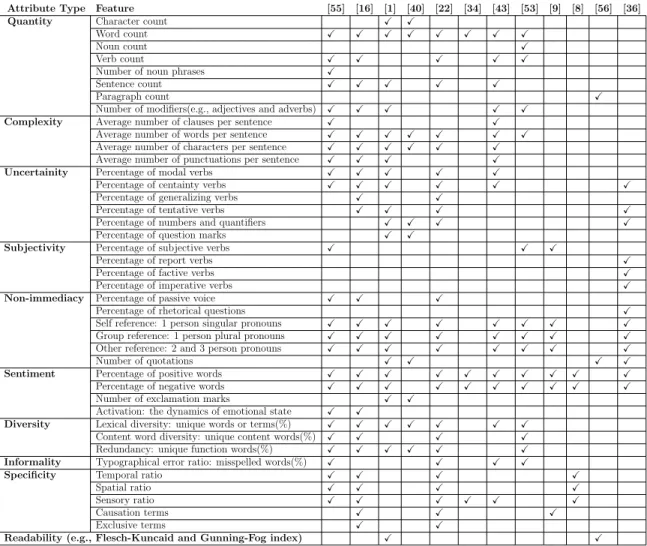
Attribute-based language features that characterize content style can be grouped into ten parallel dimensions: quantity, ambiguity, uncertainty, subjectivity, non-immediacy, sentiment, variety, informality, specificity, and readability [57]. Although attribute-based language features may be highly significant, explainable, and
pre-dictable, they are often ineffective compared to structure-based features in quantify-ing the style of deception. In particular, attributed features often require additional quantification or computational speeds, which can take time and attach greater im-portance to proper feature assessment and filtering for deception detection.
Structure-based language features
Structure-based language features define content style from (at least) four levels of language: (i) lexicon, (ii) syntax, (iii) semantic, and (iv) discourse. Also known as technique-oriented features are structure-related features since their quantification is largely based on advanced Natural Language Processing (NLP) techniques.
In particular, the key task at the level of the lexicon is to determine the fre-quency statistics of a letter(s), word(s), etc., which can be carried out accurately using n-gram models. At the level of syntax, shallow syntax tasks are performed by Part-Of-Speech (POS)-taggers which facilitate tagging and analysis of POS. Proba-bilistic Context-Free Grammars (PCFG) performs deep syntax level tasks with parse trees that allow for Context-Free Grammars (CFG) analysis. Linguistic Inquiry and Word Count (LIWC) is also used on the semantic level to provide semantic classes for semantic features.
2.2.2
Visual content-based
The advancement of multimedia technology facilitates the evolution of self-media news from text-based posts to picture or video multimedia posts, providing better storytelling, and attracting more reader’s attention. Unfortunately, this advantage is also taken by fake news which usually contains misrepresented or even tampered
images to attract and mislead readers for rapid dissemination. As a result, visual content has become an important part of fake news that can not be neglected [37].
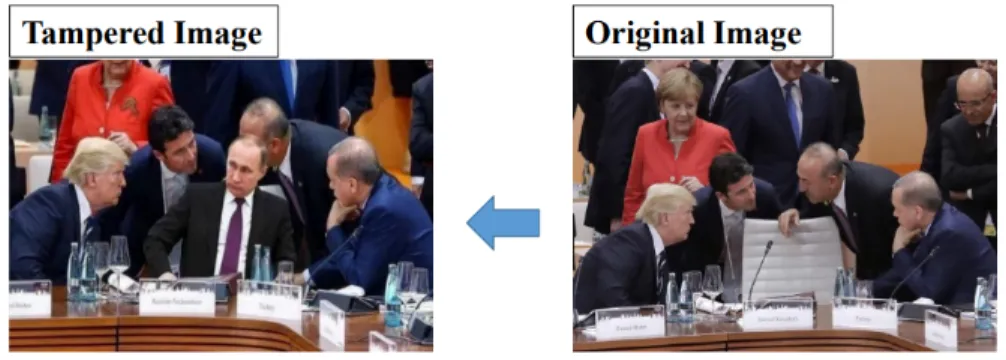
For example: In figure 2.3, A tampered image where Putin is spliced on the middle seat at G-20 to show that he is in the middle of an intense discussion between other world leaders.
Figure 2.3: Tampered images
Figure 2.4: Misleading images
The above example reflects that pairs of visual and textual information can give better insights into fake news detection. (i) Tweet: “two Vietnamese siblings as being captured during the Nepal 2015 earthquakes”. Whereas it is a real photo from the past re-posted as being associated with a current event.
(ii) Tweet: “the presence of sharks during Hurricane Sandy 2012”. Whereas deep analysis on the image concludes that it was spliced to show fake sharks in the image. (iii) Tweet: “picture of Solar Eclipse captured on March 20, 2015”. However, the
image is an artwork done so beautifully that it is hard to distinguish from reality. We can narrowly classify fake images into two groups: tampered images and mis-leading images. Tampered images mean fake news images that have been modified digitally as shown in the above figure, in our common sense, the same as fake im-ages. Misleading images refer to fake news images that have not experienced any manipulation, but as described in a figure the content is misleading. Generally, these misleading photos come from artworks or obsolete pictures that are released at an early event [37].
Fake images in the real world may have significantly different characteristics from real-news images at both physical and semantic levels. Fake-news images can be of low quality at the physical level, which can be clearly shown in the frequency do-main. In view of the fact that re-compressed and tampered images frequently display in the frequency domain periodicity which can be easily characterized by CNN which is capable of capturing spatial structural features. Fake images also display some dis-tinct features in the pixel domain (also known as spatial domain) at the semantic level.
2.2.3
Social context-based
Multiple factors, such as user aspect, post aspect and community aspect, maybe taken into consideration when posting news on social media. For example, the actions of individual users can be analyzed and their metadata used to figure out whether a user is at risk of trusting or sharing false information. For example, this metadata can be its center of focus, its number of followers, or something that relates to it.
and online user engagement. And the following three styles can be summarised: network-based features, distribution-based features, and temporal-based features.
• Network-based features: Network-based research intended to concentrate on a community of related online users in terms of various viewpoints, such as interest, topic, relations and behaviors. And network-dependent functions are selected and extracted based on a particular network and It can be used to research the specific characteristics of certain networks and the similarities and differences between different online accounts.
• Distribution-based technologiescan help capture the distinct diffusion pat-tern of online news. Typically a the propagation tree may be built to promote the classification of a piece of news distribution [10]. And the features as-sociated with the propagation tree include the degree of the root in a prop-agation tree, the maximum number of subtrees, the median / average de-gree and depth of the tree, and so on. Besides, some other features such as the number of retweets/reposts for the original tweet/post, the fraction of tweets/posts retweeted for an online account, the in-degree / out-degree of an online tweet/post [54].
• Temporary-based features: Temporary-based features can be used to define the posting activity of the online news producer in a time-series manner. They are a good attribute for detecting suspicious posting activities and can be used to show the false level of online news. Temporary-based features widely used include the distance between two posts, the frequency of posting, replying and commenting on a certain account, the day on which the original information is
posted/shared / commented, and the day on which the message was written.
2.3
Model Construction
In this section, we will discuss the details for several existing approaches of the model construction process. We categorise existing methods specifically based on their main sources of input such as: News Content Models and Social Context Models.
2.3.1
News content based
In this subsection, we focus on news content models which depend primarily on fea-tures of news content and established factual sources to identify fake news. Existing approaches can clearly be classified as knowledge-based and style-based approaches.
Knowledge-based
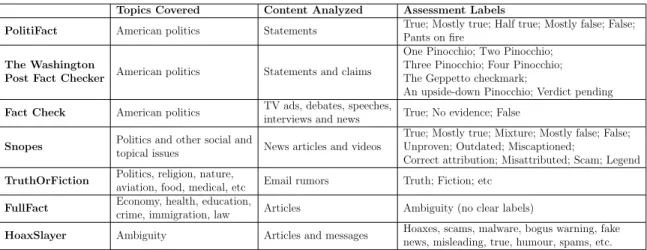
Since fake news attempts to spread false statements in news material, the best way to identify it is to test the truthfulness of major statements in a news article to assess the truthfulness of the news. Approaches based on knowledge seek to use external sources to verify reported statements in news reporting. Fact checking, initially de-veloped in journalism, seeks to test the validity of news by matching information derived from news information to be checked (e.g., its claims or statements) with known facts (e.g., true information) Increasing focus has been paid to fact-checking, and several attempts have been made to build a practical automated fact-checking program. Broadly speaking, manual fact-checking can be divided into (I) expert-based and (II) crowd-sourced fact-checking (III) computational oriented.
Topics Covered Content Analyzed Assessment Labels
PolitiFact American politics Statements True; Mostly true; Half true; Mostly false; False; Pants on fire
The Washington
Post Fact Checker American politics Statements and claims
One Pinocchio; Two Pinocchio; Three Pinocchio; Four Pinocchio; The Geppetto checkmark;
An upside-down Pinocchio; Verdict pending
Fact Check American politics TV ads, debates, speeches,
interviews and news True; No evidence; False
Snopes Politics and other social and
topical issues News articles and videos
True; Mostly true; Mixture; Mostly false; False; Unproven; Outdated; Miscaptioned;
Correct attribution; Misattributed; Scam; Legend
TruthOrFiction Politics, religion, nature,
aviation, food, medical, etc Email rumors Truth; Fiction; etc
FullFact Economy, health, education,
crime, immigration, law Articles Ambiguity (no clear labels)
HoaxSlayer Ambiguity Articles and messages Hoaxes, scams, malware, bogus warning, fake news, misleading, true, humour, spams, etc.
Table 2.1: A Comparison among Expert-based Fact-checking Websites
• Expert-based fact-checking: Expert-based fact-checking is based on domain-experts (i.e. fact-checkers) to verify the accuracy of the given news. Expert-based fact-checking is mostly carried out by a small group of highly reliable fact-checkers, is easy to handle, and contributes to reasonably accurate out-comes but is expensive and can not scale with the rise in the amount of news content to be reviewed.
Recently, several blogs have arisen to better serve the public by allowing for expert fact-checking. In Table 2.1 we mention and provide information about the well-known websites [57]. Some websites provide additional information, for example, PolitiFact offers “the PolitiFact score card”, which presents data on the distribution of validity of all claims relating to a particular subject (see an example on Donald Trump, 45 th US President on below figure)
Although the website does not include specific definitions for these categories, its knowledge can theoretically be used for comparative studies of fake news as ground-truth. However, expert fact-checking is a time-consuming and
intel-Figure 2.5: An illustration of fack-checking website
lectually challenging process which limits the potential for high efficiency and scalability.
• Crowd-sourced fact-checking
Crowd-sourced fact-checking is based on a broad community of ordinary indi-viduals who serve as fact-checkers (i.e., the collective intelligence). Compared with expert-based fact-checking, crowd-sourced fact-checking is more difficult to handle, less reliable and precise due to the fact-checker’s political bias and con-tradictory annotations and has greater (although insufficient) scalability.Crowd sourcing-oriented fact-checking takes advantage of the “crowd wisdom” to en-courage average people to annotate news content; these annotations are then aggregated to create an overall evaluation of the news veracity.
Thus, in crowd-sourced fact-checking, one also needs (i) filtering non-credible users, and (ii) resolving contradictory fact-checking findings, both criteria be-coming more important as the number of fact-checkers increases. Nevertheless, crowd-sourcing sites also encourage fact-checkers to provide more comprehen-sive input (e.g.their thoughts or positions), which can be discussed further in
fake news studies.
Like expert-based fact-checking, there is still early production of crowd-sourced fact-checking websites. An example is Fiskkit1, where users can upload posts,
provide sentence ratings inside posts and pick tags that better describe them.The sources given for the articles help (i) differentiate the content types (e.g., news versus non-news) and (ii) assess their credibility [57].The tags categorised into multiple dimensions allow one to analyse trends across fake and unfake news articles (for example, see Figure 2.5(b)).
Although there are not many crowd-sourced fact-checking websites, we believe that more crowd-sourced platforms or resources will emerge as major web-sites and social media have recognised the value of recognising fake news (e.g., Google, Facebook, Twitter, and Sina Weibo)
• Computational oriented
Computer-oriented fact-checking aims at offering an automated scalable frame-work for the detection of true and false statements. Previous computational-oriented fact-checking approaches seek to address two major issues: (i) recog-nising credible statements and (ii) distinguishing the veracity of statements of fact.To distinguish legitimate claims, factual arguments are extracted in news material, which express key statements and opinions, thus facilitating the sub-sequent fact-checking process [21]. To assess the truthfulness of a particular argument, fact-checking for specific statements relies primarily on outside re-sources. The open platform and the organised information network contain two common external outlets. Open web sources are used in terms of accuracy and frequency as standards that can be contrasted with particular statements.
As a structured network topology, knowledge graphs are extracted from the related open data, such as DBpedia and Google Relation Extraction Corpus. The purpose of fact-checking using a knowledge graph is to check if statements in news content can be inferred in the knowledge graph from actual facts [57].
Style-based
Fake news publishers also have malicious intent to disseminate and deceptive infor-mation and manipulate vast user populations, requiring different types of writing required to appeal to and convince a wide spectrum of customers that is not found in real news papers. Style-based strategies aim to identify fake news by identifying the news content manipulators in the writing format. There are primarily two traditional style-based approach categories: Deception-oriented and Objectivity-oriented.
• Deception-oriented stylometric methods catch the tricky statements or assertions from the substance of news. The inspiration for deception detection comes from forensic psychology (i.e., the Undeutsch Hypothesis)and numer-ous forensic techniques have been developed, including Criteria-based content analysis[49] and Scientific-based content analysis [30]. More recently, sophisti-cated models of natural language analysis are implemented from the following viewpoints to identify stages of deception: Deep syntax and rhetorical structure. Deep syntax models have been implemented using probabilistic context free grammars (PCFG) to turn sentences into rules defining the syntax structure.Different rules for detection of deception can be established based on the PCFG, such as unlexicalized/lexicalized development rules and grandparent rules[14]. The the-ory of rhetorical structure can be used to identify discrepancies between tricky
and true sentences.Deep network models such as convolutions neural networks (CNN) were also applied to assess the veracity of false news.
• Objectivity-oriented is a approaches capture style cues that could suggest a reduced objectivity of news content and thus the potential for misleading audiences, such as hyper-partisan types and yellow journalism. Hyper-partisan types reflect disproportionate actions against a single political group, which also coincides with a strong desire to produce false news.
Hyper-partisan articles can be identified using linguistic-based features. Yellow-journalism describes those articles that do not contain well-researched news, but rely instead on eye-catching headlines (i.e., click bait) with a tendency to exag-gerate, sensationalize, scaremonger, etc. News titles also summarise the main points of view of the article the author wishes to express, and thus inaccurate and deceptive clickbait titles can serve as a good indicator for identifying fake news articles
2.3.2
Social context based
Social media nature offers additional resources for researchers to supplement and improve the news content models. Social context models involve specific user so-cial commitments in the study, collected from a variety of perspectives this auxiliary knowledge.We may divide current social context modelling methods into two cate-gories: Stance-based, and Propagation-based.
Remember that very few current approaches to fake news identification have used model social context. Therefore, we also discuss related methods for detecting
ru-mours using social media, which have potential application for detecting fake news detection.
• Stance-based methods use the perspectives of users from related post mate-rial to infer the veracity of the original news articles. The stance of user posts can be interpreted either explicitly or implicitly. Explicit positions are direct expressions of emotion or belief, such as the reactions displayed in Facebook as “thumbs up” and “thumbs down”. Implicit views can be automatically ex-tracted from posts on social media [42].Stance detection is the task of deciding automatically from a post whether the user is in favour of, neutral towards or against any target person, event or idea.
• Propagation-based approaches to fake news detection trigger about the in-terrelationships between related social media posts to predict credibility of news.The basic idea is that a news event’s credibility is strongly tied to the legitimacy of related social media articles. For the propagation process both homogeneous and heterogeneous networks of legitimacy can be created.
Homogenous networks of reputation consist of a single category of entities, such as post or event. Heterogeneous networks of reputation include multiple types of entities, such as messages, sub-events, and events.
Chapter 3
Literature Review
In this section, we briefly discuss the work related to the proposed model. There are several activities involved in identifying false news, such as identifying rumours [24] and spam detection [39].We identify fake news as purposely fabricated news and can be checked as fake. The main challenge of fake news detection activity is how to identify news through features. Features can be derived from tweets, social context, and even attached images. Therefore, we evaluate existing work from the following two categories: single-modality based and multimodal based fake news detection.
3.1
Single Modality based Fake News Detection
3.1.1
Textual content based
Textual features are statistical or semantic features derived from the text content of messages, which were discussed in many fake news identification literature.Most previous research done at the news detection level depended heavily on features of text and user metadata. Textual feature extracts specific writing style [19] [15] [42] and emotional sensation [18] that commonly occurs in fake news content.
Attribute Type Feature [55] [16] [1] [40] [22] [34] [43] [53] [9] [8] [56] [36]
Quantity Character count X X
Word count X X X X X X X X
Noun count X
Verb count X X X X X
Number of noun phrases X
Sentence count X X X X X
Paragraph count X
Number of modifiers(e.g., adjectives and adverbs) X X X X X Complexity Average number of clauses per sentence X X
Average number of words per sentence X X X X X X X
Average number of characters per sentence X X X X X X
Average number of punctuations per sentence X X X X Uncertainity Percentage of modal verbs X X X X X
Percentage of centainty verbs X X X X X X
Percentage of generalizing verbs X X
Percentage of tentative verbs X X X X
Percentage of numbers and quantifiers X X X X
Percentage of question marks X X
Subjectivity Percentage of subjective verbs X X X
Percentage of report verbs X
Percentage of factive verbs X
Percentage of imperative verbs X Non-immediacy Percentage of passive voice X X X
Percentage of rhetorical questions X Self reference: 1 person singular pronouns X X X X X X X X
Group reference: 1 person plural pronouns X X X X X X X X
Other reference: 2 and 3 person pronouns X X X X X X X X
Number of quotations X X X X
Sentiment Percentage of positive words X X X X X X X X X X
Percentage of negative words X X X X X X X X X X
Number of exclamation marks X X
Activation: the dynamics of emotional state X X
Diversity Lexical diversity: unique words or terms(%) X X X X X X X
Content word diversity: unique content words(%) X X X X
Redundancy: unique function words(%) X X X X X X Informality Typographical error ratio: misspelled words(%) X X X X
Specificity Temporal ratio X X X X
Spatial ratio X X X X
Sensory ratio X X X X X X
Causation terms X X X
Exclusive terms X X
Readability (e.g., Flesch-Kuncaid and Gunning-Fog index) X X
Table 3.1: Attribute-based language features
Potthast et al. [19] demonstrated how to style analysis, network connection, and user reaction would contribute to fake news identification. Shu et al.[42] explained how the writing style of an author affects the views and opinions of people on reading these posts.In many fake news identification studies,emotion is considered a signifi-cant predictor and most of them use emotion primarily through user stances or simple statistical emotional features. In [15],they proposed a new dual emotion-based ap-proach to detect fake news where it can learn from the content,user comment and representation of emotions from both publishers and users.Kim et al. [29] proposed a convolutions neural network model to identify fake news which can distinguish
dif-ferent granularity of text features with convolution filters.
3.1.2
Visual content based
Visual features extracted from visual elements (picture and video) have been shown to be a salient indicator of fake news detection [25][42]. However, the value of multi-media content on social multi-media is being verified in very limited studies. Several visual and statistical features have recently been extracted for news prediction [25]. Fake images were recognized using a classification framework based on various user-level and tweet-level features [20]. Marra et al.[31]researched the efficiency of several fake image detectors toward image-to-image conversion using GANs. Though, these mod-els are still hand-crafted and complex to represent visual content.
Methods of image manipulation include: retouching, copy-paste, image splicing and digital fingerprint falsification:
• Retouching: Image retouching is based on adding a series of filter to the orig-inal image to improve it in accordance with pre-defined goals while retaining similar properties. It involves selecting the area to be retouched, and applying modifiers to produce the most visually appealing image [52]. This technique of deception is widely used in marketing, films and media [26]
For example, the covers and ads of fashion magazines usually go through some form of retouching to mask imperfections and thereby increase the degree of beauty in the photographs. The initial Figure 3.1b and retouched Figure 3.1a versions of a cover of a magazine called Nitro are shown in Figure 3.1. It dis-plays a picture retouching illustration in which the image of a model has been
digitally altered.
Figure 3.1: Manipulated cover of the Nitro magazine
• Copy-paste : The copy-paste technique involves copying a region into an im-age and pasting it from the same imim-age over another region to hide the quality of the image or duplicate regions. It can also require additional post-processing methods, such as scaling, rotation, and application of other filters. These extra procedures make the process of detecting manipulation more costly.
Figure 3.2a gives an example of that technique. The first picture Figure 3.2a displays a historic photograph taken on Iran in 2008 and it portrays the success-ful launch of four missiles as reported by the news agency of Iran (Sepah News). The initial photo posted later reveals that there were only three missiles fired in Figure 3.2b. The updated picture also demonstrates the use of post-processing techniques on the smoke that the missile expels to mask the manipulation.
Figure 3.2: Manipulated photo of the Iranian missile launch
• Image splicing : Photo splicing is the act of copying and pasting the area of a given photo into a different image. This technique is commonly used in photo-montages where it combines two or more images to offer the impression of being one image. Image splicing detection is a difficult task compared to previous manipulation techniques since it is not possible to search for duplicate regions since the manipulated region comes from a different picture.
Figure 3.3: Manipulated photo of temple
Figure 3.3 provides an example of the technique of splicing, and the two origi-nal images used in this process. The temple sign was cut from the first origiorigi-nal image, Figure 3.3b, and put in the second original image, Figure 3.3b, to create the end result Figure 3.3a.
• Digital Fingerprint Forgery : These techniques do not include altering the image itself, but altering the relevant information (digital fingerprint) that comes from the sensor that captured the image. During the image acquisition process many sources of imperfections and noise are added. Also when a uni-form and fully lighted photograph is taken, slight differences in intensity can be found between the individual pixels.
This occurs primarily for two reasons; firstly, there are random components such as readout noise or shot noise [4] and secondly due to pattern noise, which is a deterministic component of the sensor and stays approximately the same if many images are taken from the same scene. This pattern is useful for detect-ing an image’s source of origin, since every system would have a different noise pattern [27].
3.1.3
Social context based
In addition to features directly related to the news articles content, auxiliary informa-tion can be extracted from user-driven social engagements of news on social media. In [31] , they proposed a novel approach to detect fake news based on news content using a knowledge graph. Ke Wu et al. [35] aims to detect propagation patterns and sentiments using graph-kernel based method. However, social context features are noisy, unstructured and labor-intensive to collect [44].
3.2
Multi-modal based Fake News Detection
Even though all of the above mentioned single-modality approaches have been able to deliver promising results, the unstructured nature of social networking data is always a difficulty in the extraction of knowledge. And so, the researchers began experiment-ing with features derived from different modalities (i.e. text and image) to address this constraint.
Deep neural networks have been successfully applied to various tasks to learn feature representations from multiple aspects. Wang et.al [50] created an end-to-end framework based on Adversarial Neural Network, which can derive event invariant features and can detect fake news on the newly arrived events. Their model have two components: for a textual part, it took word vector embedding as input and created text representation using text-CNN [29]. Image representation from VGG-19 platform pre-trained on Image Net [44] was extracted. Both components were fused together using a fully connected neural network classifier into event discriminator and fake news detector. Their proposed architecture is shown below.
Shivangi et al. [45], introduced a model named SpotFake-A multimodal Frame-work for Fake News Detection. They used a language model like BERT to learn textual features and VGG-19 platform pre-trained on Image Net [44] to learn image features. Even though multi-modal based models do well in identifying fake news, consideration of secondary task with fake news detection problem decreases the effi-ciency performance.
Figure 3.5: SpotFake-A multimodal framework
Author Khattar et al.[28] built a model named MVAE: Multimodal Variational Auto-encoder for Fake News Detection. It uses a bimodal vector autoencoder com-bined with a conditional classifier for fake news identification tasks. The platform comprises of three main components, an encoder, a decoder, and a fake news de-tector element. The variable autoencoder is capable of learning probabilistic latent
variable models by maximizing the marginal likelihood of observed data. They used bi-directional LSTMs and VGG-19 to extract text and image representation respec-tively.
Chapter 4
Proposed Methodology
In this chapter, we give a brief overview and provide an elaborate description of the three components of the proposed model: the textual feature extractor , Visual fea-ture extractor and fake news detector. Subsequent subsections describe importance of these three components to detect fake news.
4.1
Proposed Architecture
Here we introduce our proposed framework of multimodal fake news detection. An overview of our method can be seen in figure 4.1 .The basic idea behind our work is to detect fake news from both the modalities of given tweets independently without considering any other sub-task.
4.2
Proposed Model Overview
Proposed model’s principal innovation is to use the power of natural language process-ing like sentiment analysis, segmentation process for feature extraction and optimizprocess-ing
Figure 4.1: Architecture of proposed model
it with a Cultural algorithm using normative and situational knowledge. Then, the representations from both modalities are fused together, which is finally used for clas-sification.The overall architecture of the proposed model is illustrated in figure 4.1 .
We divided our model into three main components.
• The first one is a textual feature extractor that uses Sentiment analysis to ex-tract meaningful content from textual data.
• The second component is Visual feature extractor which extracts visual features from the post using preprocessing techniques and Segmentation process.
• Feature representation from both components were passed through a Cultural algorithm to extract optimum features. The last component is a fake news de-tector that uses a classifier to detect fake news.
4.3
Textual Feature Extractor
The input to the textual feature extractor are the text of the post and it output is the features learnt from textual modality. The textual feature extractor can be broke down into two steps: Preprocessing and Sentiment process.
• Preprocessing step :Text data for applying machine learning algorithms on them need special preprocessing. Numerous techniques are commonly used to transform text data into a prepared-modeling form. The preprocessing steps we discuss below relate to the headlines as well as the news articles.
(1) Stop Word Removal : We begin with removing stop words from the available text data. Stops Words (most common words in a language that does not have much context) can be processed and filtered out of the text, because they are more frequent and provide less useful information. Stop words behave more like a linking part of the sentences, for instance conjunctions like “and”, “or” and “but”, prepositions like “of”,“in”, “from”, “to” etc., and articles like “a”,“an”,“the”.
Figure 4.2: Example for Stop Word removal
eliminating stop words as part of pre-processing data is a key first step in the processing of natural language. Above figure gives an example of stop word removal.
(2) Punctuation Removal : Natural language punctuation provides the sen-tence’s grammatical context. Punctuation like a comma may not add much value to the understanding of the sentence. Figure gives an example of the method of eliminating Punctuation.
Figure 4.3: Example for punctuation removal
(3) Stemming : Stemming is a technique in which prefixes and suffixes are eliminated from a word, ending with the stem.
Figure 4.4: Example Stemming
a specific base form using stemming. Example of stemming technique is shown in figure above.
• Sentiment process
In order to extract informative and meaningful features from the textual content, we employ Sentiment analysis. Sentiment analysis is also known as opinion mining which is used to understand the effective meaning of sentences and phrases. It as-signs classification levels to statements made by the authors; also known as polarity. It could be as basic as binary distinction forms such as positive and negative or some-times neutral. While sentiment analysis from the document goes beyond polarity, it could also involve evaluating the writer’s emotional state as furious, nervous, dis-tressed and excited. Some sentiment dictionaries exist to help in the achievement of this task such as [32] and [23].
In the context of our work, we use the text’s sentiment to the negative, positive and neutral polarities of a text message.Sentiment classification can be performed using lexicon-based approach.Under lexicon-based approaches, one may use either a dictionary or a corpus-based approach. Dictionary-based approach would use an existing dictionary, which consists of gathering opinion terms along with their pos-itive(+ve) or negative(-ve) power. The detailed steps of the sentiment analysis of text are summarized in algorithm 1. We believe that the sentiment of writing a news article may serve as a key element in characterizing the news as false or actual. It will also help to further increase accuracy and consider related feelings and sentiments.
Inputs : Text File τ , the sentiment lexicon x
Output: S = P, Ng, N and Strength S, where P: Positive, Ng:Negative,N:Neutral.
Initialization: SumP os and SumN eg = 0, where
SumP os: collects the polarity of positive tokens ti−smt inτ SumN eg: collects the polarity of negative tokens ti−smt in τ begin
foreach ti ∈τ do
Search for ti in x
if ti ∈P os−list then
SumPos ←SumP os+ti−smt end
else if ti ∈N eg−list then
SumNeg ←SumN eg+ti−smt end
end
if SumPos >|SumNeg| then Smt=P
S =SumPos/(SumPos+SumNeg)
end
else if SumPos <|SumNeg| then Smt=Ng S =SumNeg/(SumPos+SumNeg) end else Smt=N S =SumPos/(SumPos+SumNeg) end end
4.4
Visual Feature Extractor
The attached images of the news content are input to the visual feature extractor. In order to extract visual features efficiently, the proposed method first preprocess the image, apply image representation to segmentation process and lastly for optimal feature extraction and minimizing it’s cost it using the concept of Cultural algorithm.
• Preprocessing step: In our preprocessing step, I. We first resize all images to 200*200.
II. Convert image to gray scale.
III. Use Otsu’s binarization method for automatic image threshold. Threshold-ing creates binary images from gray-level ones by turnThreshold-ing all pixels below some threshold to zero and all pixels above that threshold to one.
Figure 4.5: Example of image preprocess
• Segmentation process: The segmentation of images is the method of parti-tioning a digital image into multiple segments (pixel sets, often known as image objects). The segmentation purpose is to simplify and/or change an image’s representation into something that is more relevant and simpler to evaluate.
Here, we use K-means for color based segment which give valuable clues of color, shape and texture of image. Discrete wavelet transform(DWT) analyses an image in different scales and orientations. And additional statistical features like Contrast, correlation, energy , homogeneity are used to extract meaningful content from the images.
Wavelet transform (WT) is an effective tool for extracting features from pic-tures because its multi-resolution analytical property enables image analysis at multiple scale rates.The DWT is a logical method for complex image disin-tegration.The discrete wavelet transformation (DWT) can provide special and discriminating representations that can measure crucial and interesting struc-tures such as edges and details for a few coefficients, with good resolution. It is also efficient in computational terms due to the limited amount of data it deals with. The final wavelet coefficients can be used as characteristics directly and can be derived from the wavelet domain directly, defining the anomalies in the image data. Basically, in some wavelet coefficients, the discrete wavelet transformation reduces the association between wave coefficients and provides compaction of the energy.
Figure 4.7: Process flow of Visual feature extractor
4.5
Optimization using a Cultural Algorithm
All the feature vector from text and images are passed through the Cultural algorithm for optimal feature selection. Cultural algorithms (CA) are a branch of evolutionary computation where there is a knowledge component that is called the belief space in addition to the population component. It was first introduced by Reynolds [38].Its use as an optimization algorithm to restrict optimization, combinatorial optimization, and continuous function optimization for a wide variety of non-limited domains.
images at the best cost. The goal of using CA here is find optimum feature subset
Figure 4.8: framework of Cultural Algorithm
that result in the best outcome for classification. Hence, a feature selection sub com-ponent is presented in which cultural algorithm is used as search strategy and SVM classifier is used as objective function. The pseudo code of the proposed model is presented in algorithm 2.
The process of proposed model is as below:
• At first, the initial population is generated based on acceptable points in prob-lem space. Also initial knowledge base is generated. Before starting the evolu-tion process, the initial populaevolu-tion is evaluated by fitness funcevolu-tion.
• In each iteration t, the next generation is generated by doing some operation on present population.
• The generated population is evaluated by fitness function.
• The belief space is updated based on fitness values of present population.
• The belief space influences the present population.
• Until the stopping criteria is not met, steps 2 to 6 is repeated.
begin
t=0;
Initialize Population POP(t); Initialize Belief Space BLF(t); Evaluate Population POP(t);
while termination condition achieved do
t=t+1;
Variation(POP(t) ←P OP(t−1)))
EvaluateP opulationP OP(t)
Adjust(BLF(t), Accept(P OP(t)));
Inf luence(P OP(t), BLF(t));end
End
end
Algorithm 2: Cultural algorithm pseudo code
Chromosome Representation
In proposed model each chromosome is a subset of features. So, the chromosome size (number of genes) is equal to number of features. Each chromosome is represented in binary format in which 1 means corresponding feature is selected and vice versa. As shown in figure 4.8, the number of genes is equal to number of features that and they are equal to n.
Population
A population is a set of chromosome. Also a population is called a generation during the evolutionary process. In figure 4.8 the population size is m. In evolutionary process the initial population is generated randomly and the next generations are obtained through some operations.
Figure 4.9: Chromosome representation
Fitness function
For scoring the chromosomes and sort them by their score, all of them are evaluated by fitness function to be determined how fit are them. In feature selection, fitness function is the objective function. This function determines that which chromosome has the best outcome on classification task. In proposed model SVM classifier is per-formed as fitness function. For each chromosome and based on the selected features, SVM classifier trains on train set and tests on test set. The classification error of each chromosome is the scores of it.
Knowledge
In proposed model, situational knowledge and normative knowledge is used in cultural algorithm. The best chromosome of each generation influences the current population as knowledge. After reproduction of the next generation, best chromosome of that population is saved as knowledge. So, the belief space is updated.
It has five knowledge components among which here we have used normative knowledge and situational knowledge. Domain knowledge points to concepts, rules and principles that shape the domain of the problem , which can also be considerable
in fake news detection problem in future.
• Normative knowledgeis knowledge represents a collection of desirable ranges of value which reside within the population space. This demonstrates acceptable behaviour for the individuals in the population.
• Situational knowledge refers to the beliefs pertaining to the vital individ-uals in the search space. It provides a set of important events(e.g. success-ful/unsuccessful) from an experience of specific individual. [12].
Operators
For reproducing new generation in order to maximize the fitness scores, some opera-tors such as crossover and mutation are used. At first, some of elite chromosomes with the highest fitness score are selected to go to the next generation directly. Afterward, some of remained chromosomes are selected to be changed by crossover. Crossover exchanges substring from pairs of chromosome to generate two new chromosomes. In this study, two-point crossover is employed. In knowledge-based crossover, a copy of the best chromosome is used to produce two new offspring. Then mutation is applied on the remained chromosomes. In mutation, selected genes are inverted. Mutation prevents the search process from falling into local maxima . So, after applying cul-tural operation on a generation, the new generation is produced.
In order to explore the training process of the model,on selecting optimal value at each iteration training cost has been plotted in figure 4.10. The capability of CA in storing and reusing knowledge can be used to improve the exploitation ability of the search algorithm
![Figure 1.1: An example of fake news which claims that the 2019 corona virus outbreak in China could be cured by cocaine consumption[13]](https://thumb-us.123doks.com/thumbv2/123dok_us/9064622.2804605/16.918.275.698.692.952/figure-example-claims-corona-outbreak-china-cocaine-consumption.webp)

![Figure 2.1: Fake news on social media: from characterization to detection [42]](https://thumb-us.123doks.com/thumbv2/123dok_us/9064622.2804605/24.918.166.842.226.437/figure-fake-news-social-media-characterization-detection.webp)