Informatics
at school -
Worldwide
An international exploratory study about
informatics as a subject at different school levels
2012
2
Content
Study Description ... 3 Introduction ... 3 Objectives ... 4 Terminology ... 4Limitation and Constraints ... 6
Methodology ... 8
Exploratory phase: ... 8
Analytical phase: ... 11
Results – Computer Science at school ... 12
Austria ... 13 Canada ... 14 Finland ... 15 France ... 16 Germany ... 17 Israel ... 18 Japan ... 19 Lithuania ... 20 Poland ... 21 Slovakia ... 22 Slovenia ... 23 Switzerland ... 24 The Netherlands ... 25 Tunesia ... 26
United States of America ... 27
Analysis of the information gathered ... 28
Education Systems ... 28 Obligation ... 31 Curriculum ... 31 Teacher training ... 33 On-going discussions ... 35 Terminology ... 35 Situation in the UK ... 36 Situation in the US ... 39 Situation in Israel ... 42 Situation in Germany ... 44
Learnings for Switzerland ... 46
Conclusions ... 49
About the authors ... 50
3
Study Description
Introduction
The Hasler Foundation (HF) is a Swiss organization that aims to promote the use of information and communications technology (ICT) for the well-being and benefit of Switzerland as an intellectual and industrial center. The Foundation plays an active role in promoting Switzerland’s leadership in science and technology use in the future.
The HF is currently funding projects that foster the use of CS (computer science) in different education levels, in order to push towards their goal of making CS a full core subject in all Swiss schools, and eventually to assist in promoting this goal worldwide. To this aim, a group of computer scientists and academic professionals have also initiated a specific project that aims to amass the strongest arguments supporting the belief that “CS should become a core subject,” and are currently engaged in summarizing the fundamental issues surrounding this topic.
In the frame of the above project, it quickly became apparent that an understanding of the current state of school CS and technology usage in other countries could provide useful insight and help frame the situation in Switzerland within the international context, and extend the scope of the argument beyond the national perspective.
Concerning the structure of this report, in this first chapter are described the evolution of the study’s goals as well some terminology conflicts and limitations. Chapter two is devoted to methodology while chapter three is dedicated to the information collected from select countries and as such, constitutes the main results of this study. In chapter three we also describe the analysis of this information focused on tendencies and common aspects encountered. Some specific examples are mentioned when needed. In chapter four initial conclusions from analyses made in chapter three are summarized, however, because this is a preliminary descriptive study, further steps to follow up on these findings are suggested.
Taking into account the framework under which the study was developed, the ultimate goal of this study was to identify the most important and valuable lessons Switzerland can learn from the experience of other countries.
4
Objectives
The initial question addressed by this study was to discern if Computer Sciences are an obligatory subject in the core curriculum at schools in a given country? Hence, the main goal was solely to spot the existence or nonexistence of CS as an obligatory subject in the core curriculum at different school levels. However, during the development of the study, new aspects emerged and increased in relevance, giving rise to novel questions and eventually leading to the establishment of new goals. In this way the observations uncovered a high degree of complexity underlying the initial question
The definition of ‘core curriculum’, the level of freedom given to the different actors involved in teaching practices (decision makers, teachers, governmental institutions, etc.), and educational systems that differed fundamentally from country to country were just some of the issues that arose as key topics through the process of investigation. Aside from the varied educational contexts and conditions, countries also faced a myriad of unique problems as they attempted to implement strategies to introduce CS at school level. Some of these problems drew attention to associated elements which we discovered carried a surprising level of importance to the main question. Among others, some of these associated factors include teacher training, historical approaches and the level of independence given to schools. Through this dynamic process, the final goals of the study were established and translated into a set of criteria for organizing the collected data. These criteria are described in more detail in chapter two.
The final goals of the project, following collection of all data, were:
• Understanding the context of the countries studied
• Establishing criteria for the organization of the information
• Identifying tendencies, common aspects and special cases of interest. Within the larger goals of the HF, the ultimate goals of this study were:
• Analyzing lessons to be learned by Switzerland
• Identifying potential synergies with other countries
Terminology
In a study that aims to comprise an international scope, terminology was one of the problems encountered. Not only because of the different languages in which the terms are translated, but also because of the concepts behind those terms. The usage of the same terms for different concepts or definitions is also an intrinsic characteristic of interdisciplinary fields. In this case, this area of study is
5 the intersection of Computer Scientists, Pedagogues, school teachers and decision makers.
Another added situation related with terminology is that outside the CS community there is very little awareness regarding the position of Computer Science (also known as informatics) as an academic subject. One of the most common sources of confusion arises from the use of ‘Informatics’ to denote both any activity where a computer is involved and, at the same time, Computer Sciences as a discipline or field of study. Unfortunately, this conflation is widely spread throughout different sectors involved in the field of ‘informatics at the school’. Therefore in this report it is not used the term Informatics.
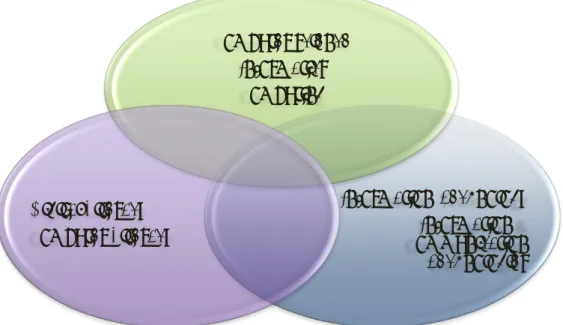
In this study three different approaches towards computer-based activities were identified, the definitions used to refer to each are shown in Fig 1.
Figure 1 Different approaches toward the term Informatics.
In the green circle are the terms related with Informatics as a science or discipline of study. The terms in the violet circle refer to the skills and competences needed to be a responsible user, meaning that one is not only able to use defined applications, but is also able to understand both pros and cons of this usage, as well as recognizing the rights and responsibilities concerning the use of computers and digital media in any sense. Last but not least, in the blue circle are two of the most famous terms used at schools: IT and ICT. Both are, in theory, related to the usage of different devices and applications to expand access to information and enhance the human communication process.
As is possible to appreciate in Figure 1, these three different views are very clearly separated in most situations, but are sometimes confused or fused. It is
Computer science
Informatics
Computing
Information Technology
Information &
Communication
Technologies
Digital Literacy
Computer Literacy
6 impossible to say which perspective is right, since this will always depend on the field of study where they are applied. Therefore, in this report, separate terms were needed which would clearly distinguish between each definition when used to describe a subject or curriculum.
The term ‘Informatics’ was substitute for the term ‘Computer sciences’ in order to stress the meaning of the term as a science or discipline of study. From this base, CS is considered in this study as the scientific and mathematical approach to computation, and specifically to the design of computing machines and processes. A computer scientist is a scientist who specializes in the theory of computation and the design of computers1
Unfortunately, digital literacy and IT or ICT are often mixed up with CS (which can also be referred to as informatics or computing) by decision makers, teachers, and as a consequence, also by students. From the decision makers perspective this might create the illusion that CS is already taught and integrated in school and as a result, actions to ‘improve the situation of CS at school’ often result in giving more importance to digital literacy or ICT.
. The analysis concerning whether a subject at a school can be related to CS or not was based entirely on the above described definition of CS.
For that reason and to facilitate understanding by policy makers and teachers, of the need for introducing or supporting CS at schools, an effort needs to be made to establish a common and clear definition of CS within the school community. This issue is also a key matter for proper development of the subject curriculum and teacher training.
From the students’ perspective, this mishmash of terminology induces an incorrect image of Computer science as a discipline of study decreasing their interest in it at higher educational levels.
Limitation and Constraints
Among other factors, the delay and sometimes inexistence of responses from persons contacted within selected countries as well as the variety of languages in which the information was encountered were some of the main problems slowing down the development of the study. It is also worthwhile to mention the limited amount of information available on this topic in English. Information was most often found in the native language of each country because it came either from educational ministry web sites and was, therefore, addressed to internal policy
7 makers or school administrators, or from the discussion notes of different associations related to the topic. Because of the local focus of the discussions and information, it is usually published on public local networks, and therefore, not usually translated into English.
Another circumstance to take into account, in order to understand the difficulties faced during the study, was the current effervescence of the topic. The last year gave rise to a large amount of declarations of intention, hot discussions, strong proposals made by governments and in general the air was palpable with the impulse to discuss CS at school. All this attention created a lot of reactions and made it difficult to distinguish between intentions and facts. In this concern, it is important to remark that the current study was focused exclusively on the current state of CS at schools; what is already implemented and how, while attempting to ignore the large collection of interesting intentions and discussions currently being put forth.
8
Methodology
The study was divided into two phases: exploration and analysis. In this chapter the steps of each of these phases will be described.
Exploratory phase:
Due to the developmental nature of this study, the exploratory phase is not restricted only to the collection of information, but also includes an iterative pre-analysis of this information. Throughout this phase the final goals of the study were progressively defined, giving rise to the final criteria for the organization of this information. Once the goals and criteria were defined, it was possible to select the countries to be analyzed, taking into account the availability of information related to the established criteria.
For collecting information the following strategies were used:
• Internet search. At a very early stage, broad Internet searches were
performed to provide initial indications about the availability of information in English.
• Networking and personal contacts. Another strategy included
contacting people linked to the topic in a specified country in order to get in touch with related networks. One of the most important sources of information was Prof. Valentine Dagiene from Lithuania, who is one the main organizers of the international Bebras contest2
• Social- network groups and associations. As a result of the initial
internet search, some important associations were encountered. Here is a list of those consulted:
.
o Ministries of Education (USA, Canada) o ACM, CSTA (USA)
o Gesellschaft für Informatik (Germany)
o Technische Universität Dresden, DIL (Germany) o OECD (International)
o Eurydice (EU)
o Carnegie Mellon University, CS department (USA) o Computing in the core (USA Association)
o National Academic Sciences (USA) o EDK (Switzerland)
9
• Some of these associations have a presence in social networks such as Facebook or Twitter, and these were also a source of very up-to-date information.
• International Workshop Attendance. The initial results of the
exploratory phase where shown in the “International Bebras Task Workshop”, carried out in Druskininkai, Lithuania on May 10-15, 2012.
• Surveys and Interviews. As a result of attending the International
Bebras workshop mentioned above, several opportunities arose to contact and interview other representatives. The face to face nature of the conference provided very good opportunities to make both formal and informal interviews which provided a better idea about the local situation of various countries more efficiently than email.
In total 64 documents were analyzed, including 1 international bibliographic collection courtesy of Prof. Françoise Tort from the École Normale Supérieure de Cachan.
The process of collecting information was carried out in parallel to an iterative process aimed at defining the goals and final criteria for the organization of the results, in order to maximize the use of both time and resources. The establishment of these criteria and the availability of information in English were used as the basis for selecting the countries to be studied.
The initial step was to define the following criteria for the information search:
• Presence of obligatory subjects. This was the only criteria used in the
very first search
• Definition of core subjects at the school. It was needed to analyze the
curriculum structure and the political influence of a core curriculum in each given country, in order to properly understand how the core subjects were defined and established.
• Structure of the educational system. An awareness of the differences
and similarities in the duration of compulsory education, requisites for accessing higher education and the division of educational paths (e.g. technical and academic threads) was required in order to establish a fair comparison between countries.
• Historical development of CS as a subject at school. The histories of
CS in different countries were surprisingly similar. Most countries included a subject centered on CS in the middle 60’s (already oriented towards programming and algorithms), then the focus switched to emphasize ICT (learning how to use office applications and information and
10 communication tools), and many are currently working on the integration of ICT into other subjects while eliminating it as a stand-alone subject. Poland is a clear exception to this rule, as they took advantage of the pre-existence of ICT as a subject and have focused their efforts towards transforming its content towards one that is more CS oriented.
The final criteria for organizing the results of the study were established at the end of the exploratory phase. They were as follows:
• Education systems
• Level of obligatory CS
• Curriculum
• Teacher Training
• On-going Discussions
The final step in the exploratory phase was to select the countries to be included in the final results. These countries are listed below, divided between whether they provided an interview and/or written documentation:
• Interviews and Documentation: o Japan o Canada o Poland o France o The Netherland o Finland o Lithuania o Israel o France o Switzerland • Only Documentation: o Austria o Germany o Slovakia o Slovenia o Tunisia o USA
It is worth mentioning here that, during the last year, a broad discussion concerning this topic has arisen in many different countries. As an example, in the UK (which is not included in the results of this study) an important document
11 was released which presents very strong argumentation for the implementation of CS at British schools. As explained in chapter 1, these new initiatives were not included in this study as this study is concerned solely with evaluating those countries where any representation of CS at school level and already implemented into the daily school curriculum currently exists.
Analytical phase:
The analytical phase was concentrated on defining a reasonable way of presenting the results to allow readers of the report to grasp the full picture of the CS situation in the schools of selected countries. To accomplish this, the data from each country are presented in individual tables sorted by the criteria developed during the investigation.
In this phase it was decided to address the analysis of the collected information, presented in the tables, towards a general description of tendencies and common aspects of the selected countries, pointing specific examples when needed. A similar approach was taken for drawing the conclusions presented in chapter four.
12
Results – Computer Science at school
The results are presented in a table, organized by country according to the following parameters:
• Decision makers. The amount of freedom for the implementation of the
curriculum change from country to country, depending on national or regional control. For example, it was observed that in countries with regional control of the schools, it is more difficult to make changes at the national level.
• Obligation.
o Mandatory. When CS is a subject that is established in the core curriculum.
o Integrated content in a mandatory subject. When some content of CS is only a part of mandatory subject content.
o Mandatory elective or integrated in a mandatory elective. When CS is included in a group of mandatory electives that students have to choose at some point in their studies or when CS content is included as part of the content of some of those electives.
o Non-mandatory elective or integrated in a non-mandatory elective. When CS is a subject that belongs to a group of electives, from which students are able to choose, but are not compelled to, or when CS is part of the content of one of those electives
• Curriculum, Standards, Models. Information about either the CS
curriculum or the models and standards used as referent for its development.
• Teachers’ training. There is not so much information about this theme, but
it is an important topic because of the low level of CS knowledge or expertise encountered in the in-service teachers as well as in the pre-service teachers’ training. In this report are shown and analyzed the CS teachers’ training programs and activities collected.
• Last Reforms. Some countries are on the way to enhance their current
situation concerning CS at schools, and some of them have done reforms in the last year which have not been implemented at the time of this report. This heading is used to indicate those that will be done in the near future.
• Strategies. In cases where it was possible to detect a given country’s
strategy for CS in schools, this strategy was pointed out. The table for each studied country is as follow:
13
Austria
Decision
makers National Regional General laws and curriculum Content of subjects (schools)
Obligation Mandatory Grade 9 Mandatory (Integrated content) Elective (Mandatory or integrated content) Elective
(Non-Mandatory) Grades 10 to 12 (in most of schools)
Curriculum, standards, models Curriculum includes an introduction to Software, Hardware, operating systems, Data privacy, and capabilities of computers.
ICT, IT at
school Grades 1-8 IT is included in other subjects
Teacher training
training programs
Discussions towards a flexible system with Bachelor and Master level training in schools of education, located at universities where the know-how of the subject and of didactics is situated and created.
on-line resources, and teachers'
networks http://www.gym1.at/schulinformatik/
Latest Reforms /Themes in
discussion There is a discussion about computational competencies of pupils 14 years of age and older
14
Canada
Decision makers
National
Regional Curriculum and schools strategies (provincies)
Obligation Mandatory Mandatory (Integrated content) Elective (Mandatory or integrated content) Grades 10 to 12 (Ontario and BC) Elective (Non-Mandatory)
Curriculum, standards, models
4 different courses designed in a progressive level. All of them have the following three parts: - Understanding computers
- Introduction to programming - Computers and society
ICT, IT at
school In process of being integrated to other subjects
Teacher training
training programs
There are programs at the University of
Waterloo (Ontario) in the format of Workshops given directly to teachers at schools. No
information about pre-service teaching education.
on-line resources, and teachers'
networks
Latest Reforms /Themes in discussion
Formerly, computing curriculum fell under "Mathematics" departments, now it falls under "Technology" departments.
Strategy At the University of Waterloo they aim to increase the interest of students in STEM by external extra-curricular activities
15
Finland
Decision makers
National Guidelines
Regional Content (teachers)
Obligation Mandatory Mandatory (Integrated content) Elective (Mandatory or integrated content) Elective
(Non-Mandatory) Grades 8 and 9 in many schools
Curriculum, standards, models
No National curriculum. Some Guidelines at national level:
- pupils learn to use different technical devices and programs
- pupils understand ethical questions concerning technology
- pupils can value technical questions for the future
ICT, IT at
school using ICT varies in upper secondary schools Teacher training training programs on-line resources, and teachers' networks
Latest Reforms /Themes in
discussion ICT should be used in some way in matriculation examination by the year 2014
Strategy
There is a strong support for the participation of students in informatics contests like IOI. Those who are successful are supported by receiving entrance to University studies.
16
France
Decision makers
National Curriculum and content
Regional Obligation Mandatory Mandatory (Integrated content) Elective (Mandatory or
integrated content) one option in High school sciences track Elective
(Non-Mandatory)
Curriculum, standards, models not available
ICT, IT at
school Currently reducing ICT from a technology course by integrating use of ICT in other subjects
Teacher training
training programs
For the creation of the Teachers training
program, the Swiss example has been followed (textbook authors and leaders in the cantons of Vaud, Fribourg and Solothurn were met)
on-line resources, and teachers' networks
Latest Reforms /Themes in discussion
In 2008, awareness was emerging in France for specific teaching of computing and information technology and communication throughout school.
At the start of 2012, two new specialties will be offered as part of high school reforms, one of them is "IT and digital sciences" (ISN).
Strategy
The Minister of Education announced (highschool reforms, 2009) the introduction of an option called "Computer Science and Digital" in the 'science terminal option' by school year 2012
17
Germany
Decision makers
National Core subjects
Regional learning plan, curriculum (states)
Obligati on
Mandatory Grades 7 and 8 (Sachsen), 6 to 12 (Bayern) Mandatory
(Integrated
content) Grade 7 to 10 (Sachsen)
Elective (Mandatory or integrated content) Grades 10/11 to 12 Elective (Non-Mandatory) Curriculum, standards, models Grades 7 to 10
Introduction to hardware and software, Terminology and assembly of computer, Foundation of ICT, Solving problems using computers
Grades 10 to 11
Basic Concepts of Information Technology, Project work using standard software, Computer science and society, Computer Networks, Structures and algorithms & their implementation, Structured data types, Modeling information table.
Grade 12
A topic must be selected from a list. All the topics are Computer Science related. (see section X for more information), Project work for software development (16 hours).
ICT, IT at
school
ICT and IT' are integrated under a concept called: "Informatische Grundbildung" in almost all Grades in Germany
Teacher training
training programs
Department of Didactics of computer science at the TUM contracted by the KMK for the development of the core computer science curriculum for teacher training (Prof. Dr. Peter Hubwieser, 2007) on-line resources, and teachers' networks http://www.schulministerium.nrw.de/BP/Lehrer/_Startseit e/Service/index.html http://www.lehrer-online.de/
Latest Reforms /Themes in discussion
In September 2004 GI presented an end-memorandum to initiate the debate for the introduction of CO as a
Mandatory subject at secondary school as part of the core subjects established at federal level. Regarding CS
teachers, they point out the need of provision of education in CS only from trained educated teaching staff.
Strategy Secondary teachers are subject specialists. New qualifications are acknowledges by the state if they meet the standards of the Standing Conference of KMK.
18
Israel
Decision
makers National Regional Curriculum / Content
Obligation Mandatory Mandatory (Integrated content) Elective (Mandatory or
integrated content) Grades 10 to 12 In technical schools Elective
(Non-Mandatory) Grades 10 to 12 in non technical schools
Curriculum, standards, models
Two different programs are needed, one for 3 units and one for 5. The first program is for students with only a general interest in CS (270hrs/year). The other program provides a deeper and broader education for those with more specific interest in CS in technical schools
(450hrs/year)
The programs are constructed from the following list of modules:
- Fundamentals 1 and 2 (2 units; 180 hours) - Advanced programming (1 unit; 90 hours) - Second paradigm (1 unit; 90 hours) - Applications (1 unit; 90 hours) - Theory (1 unit; 90 hours)
ICT, IT at
school
ICT is integrated in other subjects and the basics are taught in 'Fundamentals' units of CS
curriculum
Teacher training
training programs They share efforts with CSTA (USA) on-line resources,
and teachers'
networks
Latest Reforms /Themes in discussion
There is a large movement pushing for designated High School CS teacher preparation. They work together with the CSTA (USA), and have produced several papers in the last three years dealing with 'on-line' teacher training experiences and
proposals.
Strategy
There are only 4 obligatory subjects defined by the Ministry.(Hebrew, English, Bible, Mathematics, History).
All other subjects are elective, including geography and sciences like physics, biology, chemistry or CS.
19
Japan
Decision
makers National Regional Curriculum Electives (schools)
Obligation
Mandatory
Mandatory
(Integrated content) Grades 7 to 9 Elective (Mandatory
or integrated
content) Grades 10-13
Elective
(Non-Mandatory) Grades 10-13 (13 is an optional year)
Curriculum, standards, models
"Information Studies" 'cores courses' (1997): - IS-A: Practical Use of Computers (to make the best use of information)
- IS-B: Scientific Understanding of Information (CS and its surroundings)
-IS-C: Model Attitudes of Participation in our Information Society
ICT, IT at school
There are ICT courses from grade 1. At secondary school, these courses gradually add small pieces of CS content
Teacher training
training programs
There is no appropriated teachers training, and in order to apply for a position at any school,
normally teachers need to have a second subject licence.
on-line resources, and teachers'
networks
Latest Reforms /Themes in discussion
There is a new curriculum developed (2011) for "information studies", with content more related to informatics.
Strategy
Primary school (Grades 1-6): Information studies are a part of the Mandatory Integrated study subject.
Secondary school (Grades 7-9):
There is Mandatory content in one topic called "information", which is a part of the Mandatory subject "industrial Arts and home economics" Secondary school II (Grades 10-13):
"Information studies" was added as a Mandatory subject in 2003. (2 units of 74 or 90 in total). There are three core courses, students select one of them
"Special subjects" (optional) exist with strong informatics content. only 20 schools (out of >5000) offer them. Only 0.07% of students in Japan take them (2007 statistics)
For the matriculation exams, only 23 out of 756 Universities in Japan have "information Studies" as an optional subject to be evaluated.
20
Lithuania
Decision
makers National Regional Curriculum / Content
Obligation
Mandatory
Mandatory
(Integrated content) Grades 9 to 12 (Basic content) Elective
(Mandatory or
integrated content) Grades 11 and 12 (Advanced content) Elective
(Non-Mandatory)
Curriculum, standards, models
In general the "Basic curses" of IT are oriented to 'using computers', but introduce elements of algorithms and programming.
The "Advanced courses" go deeper in informatics topics. The newly elaborated curriculum covers three main areas:
- Information theory - Logic
- Algorithms
ICT, IT at
school
There are Mandatory IT courses in grades 5 and 6 (68hrs), oriented to computer use (including modeling with logo), and in grades 7 and 8 (34hrs). Plus additional hours of ICT "integrated into other disciplines"
Teacher training
training programs
In 2007, Requirements for teachers’ competences on information and communication technology (ICT) were formulated and approved by the Ministry of Education and Science. There is a General Computer Literacy Standard as well as requirements on creating programs for teacher traiing. Competency based perspective of teacher training.
on-line resources, and teachers'
networks
Latest Reforms /Themes in discussion
The first national exam on information technologies (programming) was launched in 2006. The exam consists of a set of tests (questions on IT and programming) and two practical programming tasks
Strategy
in 1986 "the basic of informatics and computing Techniques" course was introduced as obligatory for grades 11 and 12.
In 1991 the first curriculum for teaching
informatics in secondary schools was developed. Since 1999/2000 the compulsory courses for 9th and 10th grades were introduced (11th and 12th grades remain compulsory).
since 2005 IT as a separated subject was introduced to grades 5 and 6
21
Poland
Decision
makers National Regional General laws, curriculum, content School financing
Obligation
Mandatory
Grades 1-12 (ICT, CS)
Grades 4-6 (computer activities) Grades 7-9 (Gymnasium)
Grade 10 (High secondary School) Mandatory
(Integrated
content) Grades 1-3, All subjects (it is expected) Elective
(Mandatory or integrated content)
Informatics (high schools, grades 11-12) Matura in Informatics
Elective
(Non-Mandatory)
Curriculum, standards, models
- Primary schools – computer activities, at least 1h/week/3years.
- Low secondary schools – informatics, at least 2h/week/year; contains a section on algorithm, algorithmic thinking and solving problems with computers; although programming is not
included, an introduction to Logo is a part of the instruction in some schools
- High schools – informatics (understood as computer science), 3h/w/2years; an elective subject, taught only in some high schools; in high schools – students may take an external final examination (matura) in informatics.
ICT, IT at
school ICT is supposed to be integrated in the teaching practice in all subjects in schools
Teacher training
training programs
Several universities offer 'in-service' training programs for teachers.
Informatics teachers are prepared at special in-service courses, however they lack solid
background in computer science. on-line resources,
and teachers' networks
Portal Scholaris, run by the Ministry of Education, mainly as a repository of electronic materials for teachers
Latest Reforms /Themes in
discussion New curriculum, as described here, has been introduced in 2008.
Strategy
ICT mainly as a tool, not a separate subject. Informatics for all students (grades 7-9, 10) based on computational thinking.
Several textbooks for students and guidebooks for teachers, for all levels of instruction have been published.
22
Slovakia
Decision
makers National Regional General laws, curriculum, content
Obligation
Mandatory Grades 1-4 (Primary) Grades 5-9 (Secondary)
Grades 10-13 (Higher Secondary) Mandatory (Integrated content) Elective (Mandatory or integrated content) Elective (Non-Mandatory)
Curriculum, standards, models
There was a reform of elementary and secondary education focusing on standards and targets. Possibility to group subjects. Informatics became part of education group of mathematics. There are Five principles for the informatics education in all levels:
• Information around us
• Communication through digital technologies
• Procedures, problem solving, algorithmic thinking
• Principles of the functioning of digital technologies
• The information society
ICT, IT at
school ICT is supposed to be integrated in the teaching practice in all subjects in schools
Teacher training
training programs The teachers had initial difficulties with the application of technologies. No information about Teacher training. on-line resources,
and teachers' networks
Latest Reforms /Themes in
discussion New curriculum, as described here, has been introduced in 2008.
Strategy
ICT mainly as a tool, not a separate subject. Informatics for all students (grades 1-13) based on computational thinking.
Several textbooks for students and guidebooks for teachers, for all levels of instruction have been published.
23
Slovenia
Decision makers
National Curriculum
Regional School financing
Obligation
Mandatory Grade 10 (high school and gimnazium)
Mandatory
(Integrated content) Elective (Mandatory or
integrated content) Grades 11-13 Matura in Informatics Elective
(Non-Mandatory) Grades 7-9 Grades 11-13
Curriculum, standards, models
Non-Mandatory elective. - Grade 7: Editing Text.
- Grade 8: Computer Network. - Grade 9: Multimedia.
High school and gimnazium:
- Processing the data, computer networks and programming, plus algorithmic thinking and problem solving
- Students may take an external final examination (matura) in informatics.
ICT, IT at
school ICT is supposed to be integrated in the teaching practice in almost all subjects in schools
Teacher training
training programs
We have CS teachers who are prepared to use ICT and in primary school “Computer operator”, but they usually lack solid background in computer science.
No training programs for CS yet. on-line resources, and
teachers' networks
A repository of electronic materials (projects) for teachers and students, run by the Ministry of Education.
Latest Reforms /Themes in discussion
New curriculum, as described here, has been introduced in 2002 for primary school, 2008 for gimnazium.
Strategy
Informatics for all students as Mandatory (grades from 4 on) based on computational thinking. New training programs for CS teachers who are already teaching and are or are not primarily a CS teacher. Training programs are supported by the ministry of education and implement by the universities.
This year it will be the first one.
There is one textbook for primary school students and one for high school and gimnazium students.
24
Switzerland
Decision
makers National Regional General laws and curriculum Content of subjects (schools)
Obligation
Mandatory Mandatory
(Integrated content) Grades 1 to 9 (Integrated content in digital literacy) Elective
(Mandatory or integrated content)
Grades 9 to 12
(in all schools mandatory elective) Elective
(Non-Mandatory)
Curriculum, standards, models
Curriculum includes an introduction to Algorithm, Software, Hardware, operating systems, Data privacy, and capabilities of computers.
ICT, IT at
school Grades 1-12 ICT is included in other subjects
Teacher training
training programs
A system with Bachelor and Master level training in schools of education, located at universities where the know-how of the subject and of didactics is situated and created.
on-line resources, and teachers' networks
Latest Reforms /Themes in discussion
There is a discussion about a subject
“Informatische Bildung” in 1-8 and a discussion about a mandatory subject “informatics” in 9-12.
25
The Netherlands
Decision
makers National Regional Curriculum Schools ask for more autonomy
Obligation
Mandatory Primary school
Mandatory
(Integrated content) Elective (Mandatory
or integrated content) Grades 10-12 Elective
(Non-Mandatory)
Curriculum, standards, models
240hrs at post-secondary school
280hrs High school, college, gymnasium (pre-university)
The curriculum consists of the following themes: Theme A: Informatics in perspective
Theme B: Terminology and skills Theme C: Systems and their structures Theme D: Usage in a context
ICT, IT at
school There is a compulsory ICT course (Microsoft Office and other programs)
Teacher training
training programs
Most informatics teachers followed a specially organized two-year course of about 900 hours of study. This course was organized and executed by a Consortium of universities (of applied sciences), named CODI.
on-line resources, and teachers' networks
The three textbooks didn't offer a consistent solution for teachers, since each of them had different
approaches to the subject matter. Therefore, many teachers were forced to resort to writing their own teaching material
Latest Reforms /Themes in discussion
In 1998 the minstry of education made a reform, which put informatics as an optional subject at secondary schools (organized by teachers on an individual basis) and computer literacy at primary schools.
In 2008 the informatics curriculum was re-designed The Netherlands currently face the problem that a number of the Informatics teachers who are trained in basic Informatics principles by CODI are retired or will soon be retired.
Strategy
A discussion exists about whether informatics should be included in the national exam. The reasons in favor point out that a central examination would give more direction to content and form of the subject.
Secondly, it would give Informatics a less marginal position in the curriculum compared to other subjects. Since 2008, it is possible for students with a bachelor degree in Informatics to become a teacher in
Informatics after a further two years of university study to obtain a teaching certificate
26
Tunesia
Decision
makers National Regional Curriculum and content
Obligation Mandatory Grades 10 to 13 Mandatory (Integrated content) Elective (Mandatory or integrated content) Elective (Non-Mandatory)
Curriculum, standards, models
The entire curriculum Comprises: - Acquiring an Informatics Culture
- Identifying the components of an Informatics System
- working with ICT (creation and use)
- Exploiting the resources of a local Network and the Internet
- Working with algorithms and programming - Studying Data-bases
- Solving problems using structured programming languages
- Writing programs for sorting and searching
ICT, IT at
school ICT is integrated into different subjects at school Teacher
training
training programs There is an 'in-service' training program offered at the Ministry of education web-page on-line resources,
and teachers'
networks
Latest Reforms /Themes in
discussion last reform made in 2005, implemented during school year of 2006-2007
Strategy
Computer education was introduced in the Tunisian education system in 1990 (1992-1993 School year) as an optional subject in grades 12 and 13. Since 2003, the ministry has introduced it to grades 7, 8 and 9. In the reform of 2005, the subject became Mandatory for all sections of high school and college. Computer programs are more enriched and the course content is more suited to the specialty chosen by the student.
27
United States of America
Decision
makers National Regional Curriculum Content (teachers at school)
Obligation Mandatory Mandatory (Integrated content) Elective (Mandatory or integrated content) Elective (Non-Mandatory) Grades 9 to 12 Curriculum, standards, models
Level I(K-8 ) -> Foundations of CS
Level II (Grade 9 or 10) -> CS in the Modern world Level III (Grade 10 or 11) -> CS as analysis and design
Level IV (Grade 11 or 12) -> Topics in CS
ICT, IT at
school
Teacher training
training programs
State certification programs for computer science teachers (CST) are either non-existent or deeply flawed; and when they do exist, they are typically not connected to actual computer science content
knowledge. on-line resources,
and teachers' networks
In 2005 the Computer Sciences Teachers Association was created. Since then this association has
supported and promoted the teaching of computer science and other computing disciplines.
Latest Reforms /Themes in discussion
There is a deep and widespread confusion within the US related to content matters and terminology. It is not clear what should constitute and how to
differentiate technology education, literacy and fluency; information technology education; and computer science as an academic subject.
Strategy
Few states are ensuring computer science’s place in the secondary school graduation requirements rubric. In fact, only 9 out of 50 states allow computer
science courses to count as a required graduation credit for either mathematics or science.
Aware of the graduation requirements standards importance, the Council of Chief State School Officers and the National Governors Association, propose the Common Core State Standards Initiative
some states having computer science courses count as either a mathematics or science credit in
secondary education.
Studies revealed that teachers rank workshops and seminars as the most effective means for delivering professional development to them.
28
Analysis of the information gathered
In the second phase of the study, the criteria for the analysis of the information were defined as follows:
• Education systems
• Obligation
• Curriculum
• Teacher training
• On-going discussions
It is not the intention of this section to make an exhaustive analysis of the situation in each country. These parameters were analyzed in a global way, observing and describing tendencies and special aspects to remark. The results of this analysis are described in the next sections.
Education Systems
The International Standard Classification of Education was used as a system of standardization. It was applied to both the European and non-European countries included in the study (Canada, Israel, Japan, Tunisia and the USA), as a tool for understanding the similitudes and differences of the entire group of selected countries.
The ISCE consists of 5 levels (references), however this study is concentrated only on three of these levels, namely:
• Primary education: This level begins between 5 and 7 years of age, instruction is more general knowledge oriented. It is compulsory in all countries and generally lasts from four to six years.
• Lower secondary education: This level continues the basic programmes of the primary level, although teaching is typically more subject-oriented. Usually, the end of this level coincides with the end of compulsory education. Generally it lasts from 3 to 5 years.
• Upper secondary education: This level generally begins at the end of compulsory education. Entrance qualifications (end of compulsory education) and other minimum entry requirements are sometimes used. Instruction is often more subject-oriented than at lower secondary level. The typical duration varies from two to five years.
These levels are also grouped into two categories; Compulsory Education (CE), which is the minimum education level that children are obligated to obtain and Non-CE, which is the education that follows the CE and is optional for those who
29 want to continue toward a professional or vocational level. This Education Systems (ES) categorization plays an important role in both the definition of the core curriculum and the resources distribution to schools from the policy makers. Usually CE has more considerations and efforts than non-CE. It is worth noting that CE doesn’t mean standardized education to all students, it only refers to the school levels that are obligatory to complete.
In general terms, the goal of compulsory education is to provide pupils with a comprehensive level of basic literacy which will allow them to follow either an academic or occupational educational path, or even jump directly to into the workforce (depending on the ES model followed). This basic literacy is defined as the development of basics skills and knowledge that would enable literate citizens to play an active role in the society.
Non-compulsory or post-compulsory education has the goal of preparing pupils to either follow tertiary education or be ready to take on a specialized occupation. Therefore, post-compulsory education is commonly divided into general education schools and vocational upper secondary education and training. This level usually lasts between 3 and 4 years. In some countries, upper secondary school is itself divided into specialization tracks, which include in their curriculums small variations in the core subjects and electives, depending on the academic orientation of the track (Sciences and technology, Arts and human sciences, etc.).
The majority of the countries analysed in this study present a similar structure; where primary and low-secondary schools are grouped as CE, lasting between 9 or 10 years, with no other options for pupils (Figure 2).
Figure 2 Standard model
However, even though all the countries studied include primary and lower-secondary school in CE, there are other models such as the one shown in Figure 3, where upper-secondary school is also included in what is considered CE, lasting 12 years. Depending on the structured followed; students are completing the CE between 16 and 18 years old.
30 Figure 3 K-12 model
Finland presents another model called “single-structure comprehensive school” (Figure 4). It consists of one unique block of 10 years, where primary and lower secondary schools are grouped together into a unique stage. (For more information about the existent diversity among European education systems see http://www.eurydice.org)
Figure 4 comprehensive schools.
The study countries are grouped into different models as follows:
• General Education: Austria, France, Germany, Japan, Lithuania, Poland, Slovakia, Slovenia, Switzerland and Tunisia,
• K-12: Canada, Israel, the Netherlands and the USA
• Comprehensive school: Finland
Concerning certificates or diplomas, the end of compulsory general education provided a leaving certificate that allowed students access to upper secondary education and in the case of the K-12 model, the leaving certificate enables pupils to go directly to post-secondary education.
Obligation
To find out the obligation level of CS was the primary goal of this study, but after the first exploratory phase other topics were getting more relevance. In any case, in this section is depicted a first glace of the studied countries. In the following list are presented the countries related to each type of Obligation defined in the analytical phase, explained at the beginning of this chapter.
• Mandatory Subject: Austria, Tunisia, the Netherlands, Poland, Slovakia and Slovenia
• Integrated content in Mandatory Subject: Germany (some states) and Japan
• Mandatory Elective subject: Germany, Canada (Ontario), France, Lithuania, Israel, Japan, the Netherland, Poland and Switzerland
• Non-mandatory Elective subject: Finland, Austria, Japan, Israel and USA More information about the grades where these approaches were implemented can be found in the table presented in the first section of this chapter.
One special case to be mentioned is Germany, which is present in three of the four modalities, however, due to Germany’s strong federalism, the modality applied strongly varies from state to state within the country.
Other interesting examples include Austria, where CS is a mandatory subject at grade 9, and is included in the final examination at the end of non-compulsory education, and Tunisia, where CS is mandatory between grades 10 to 13, which are part of non-compulsory Education. The case of Tunisia follows the general tendency, which is to introduce CS as a mandatory elective subject at upper-secondary school (which is non-CE in almost all the countries studied), and sometimes this elective is only restricted to students following technical tracks.
Curriculum
This section presents an analysis of the content of subjects already implemented in schools in each of the studied countries.
Four main areas of content were identified as the ones all the curriculums touch in one way or another.
• Information Technology
o Working with Information and Communication Technologies3
3 Searching information, communication tools. In some countries, this topic includes integrating *
32 o Information processing and usage of the internet
• CS and Society
o Information society (Ethics and privacy issues) o Licenses, intellectual property
• HW & SW o Architectural elements o Identification of Components o Networks o Applications4 • Programming ** o Algorithms o Data structures o Programming languages o Data bases
o Solving Problems, algorithmic thinking5
Besides these four themes, several countries further separate their curriculum by level of complexity, such as basic and advanced (e.g. Lithuania and Israel). In some cases the content of the subjects is moving from ICT to CS as school level increases, while in other cases, the same topics increase their level of complexity with school level. In those cases where varies complexity level, there is a tendency to make the basic levels mandatory, or at least include this content as part of a mandatory subject, while the advanced training is more often proposed as non-mandatory elective.
***
Few countries mention different programming paradigms explicitly in the description of their CS subjects (functional, object oriented, descriptive language). For example, France mentions “descriptive languages” and Israel refers to “second paradigms”.
Another approach for including CS at school that was encountered was to bring students from different ages into contact with some applications of CS as: “Introduction to Robotics”. There is currently a large international movement that pretends to use robotics at school in order expose students to CS ideas and
the use of computers for the enhancement of other subjects
4 Office applications: word processors, spreadsheet, presentation programs, etc.
5 In some countries, solving problems with computers doesn’t imply teaching programming (e.g. Poland, where there is typically no programming taught at schools, with the exception of some schools where there is only an introduction to LOGO).
33 content, with the ultimate goal of motivating them to follow more scientific and technological careers.
In Germany there is a new term called Informatische Grundbildung, which includes not only ICT usage, but also the development of digital competences (defined as the competences that citizens should have in order to be able to use computers and digital devices effectively). This kind of content is integrated in almost all grades and states in Germany.
Usage of ICT is either integrated or on the way to being integrated within other subjects in all the countries studied. In those countries that still have a ICT as a standalone subject, the content is devoted mainly towards teaching how to use different office applications such as word processing, spreadsheets, etc.
It is interesting to mention that after analyzing the different curriculums, a correlation was found between the topics indicated above and the standards currently defined for curriculum development by both the Gesellschaft für
Informatics, and the US associations (ACM/CSTA).
Teacher training
It is important to remark that there is not much information available about teacher training programs or initiatives in most of the countries included in the study. The majority of on-line resources available for teacher training were published in the local language of the country and other information encountered was often oriented towards describing new approaches of CS teachers training, which have not yet been implemented, making it both less accessible and relevant to our external evaluation.
From the information gathered, not much information was encountered about content of curriculums for CS teacher training. Instead, three main topics were identified, namely: In-service Teachers training, the role of the University and demands from the community in general.
From the available information it became clear that current efforts are concentrated on training in-service teachers. These are the teachers that have already finished their studies and are currently working at schools. One possible reason for this inclination could be that there are not enough working hours currently devoted to CS at schools, hence it is not worth contracting new teachers to cover that demand.
34
• Workshops. Either at the school or as after-hour activities outside the
workplace
• Masters. In most cases, online or blended learning approaches were
provided to allow the completion of further education while teachers were still working.
• On-line Programs. Programs published in on-line networks also exist,
offering courses or activities, which can be developed by a teacher at any time.
By analyzing the information and current discussions surrounding this topic, the active participation of universities, mainly the CS departments, is remarkable. One of the potential reasons for these initiatives could be that these departments are directly suffering the consequences of the historical absence of CS training as they receive students with very low or even inexistent levels of CS knowledge. CS departments are also starting to require the active participation of Pedagogical departments in order to support the development of well-grounded curricula for CS teacher training.
The community interested in introducing CS at schools has also become aware of several key points necessary for a better implementation of teacher training. These deficits are mainly found in:
• Core Curriculums for pre-service and in-service teachers, Strong
curricula or models usable to ensure well-prepared CS teachers at schools are missing.
• Qualification standards for certification. There are no standardized
criteria for the qualification or certification of CS teachers.
• Teachers’ competencies. There are currently strong discussions about this
topic. One of the strongest points is that CS student competences have yet to be clearly defined. Without a clear definition of the CS student competences, it is difficult to define the competences that teachers should have.
The selection of teaching methods and didactical materials has different criteria from country to country. The tendency encountered was that there is an educational board, either national or regional, which makes a selection of approved teaching methods and textbooks. From this selection, teachers are free to choose those that better suit their preferences. There are other selection methods, such as in Finland, the Netherlands and France, where teachers have the freedom to select their own teaching material. The risk is that those teachers don’t have the appropriated criteria to do this selection properly.
On-going discussions
This chapter summarizes the situation of computer science education in secondary schools in the UK, the US, Israel, and Germany. The goal is to give an insight into the latest developments, problems and strategies adopted by these countries regarding computer science education in secondary schools. We will conclude this report with learnings for Switzerland.
Terminology
As terminology seems to give rise to major problems and misunderstandings, we would like to attempt a definition of important terms used in this paper. The main problem is, that outside the CS community hardly anybody is conscious of the breadth of computer science (or informatics) as an academic subject. For such persons it is already Informatics if it involves a computer (which again means mostly involving office programs and standard Internet applications). This confusion is unfortunately widely spread among decision makers, non specialist teachers and as a consequence, also among students.
ICT as used in school context
Information and Communication Technology: Used as well for computer and network infrastructure as for the study, understanding and use of this infrastructure, office programs, and common Internet services.
Computer Science / Informatics
We will mostly use the term computer science instead of informatics. However we consider the two terms to be equivalent.
Computer science covers the full fledged academic subject, including but not limited to algorithms, data representation, automations, communication protocols, hardware design, programming, compilers and so on. Knowing how to use a particular version of an office package is not considered to be broad enough to be called computer science or informatics.
Digital Literacy
Digital Literacy means the ability to use current office software and standard Internet communication across subjects.
36
Common problems with terminology
Unfortunately digital literacy is often confounded with computer science (or informatics) by decision makers, teachers and, as a consequence, also by students.
From the decision makers perspective this might create the illusion that CS is already taught and integrated in school. Actions to improve the situation of CS at school often result in giving more importance to digital literacy.
From the students perspective this induces a bad image of CS, since digital literacy courses are often found to be of little challenge.
Situation in the UK
This is mainly a summary of the report “Shut down or restart”6
The Royal Society
by the Royal Society, issued in January 2012. The report was executed in collaboration with schools, business and industry.
7
School systems
“is a self-governing Fellowship of many of the world’s most distinguished scientists” with the goal to “recognize, promote, and support excellence in science and to encourage the development and use of science for the benefit of humanity”. The report was initiated in August 2010, driven by “a high degree of concern” about “aspects of the current provision of education in Computing in the UK”.
The UK's four school systems (England, Northern Ireland, Scotland and Wales) are, for our purposes, similar enough to be described as one here. Today, school is mandatory up to about age 16, including 6 to 8 primary years and 4 secondary years which are terminated by a GCSE (General Certificate of Secondary Education), which is passed in one or two (in rare cases three) selected subjects.
“Students may then continue their secondary studies for a further two years (sixth form), leading most typically to A-level qualifications, although other qualifications and courses exist, including Business and Technology Education Council (BTEC) qualifications, the International Baccalaureate (IB) and the Cambridge Pre-U. The leaving age for compulsory education was raised to 18 by
37 the Education and Skills Act 2008. The change will take effect in 2013 for 16-year-olds and 2015 for 17-16-year-olds.”
Terminology
UK secondary schools have mandatory courses labeled “ICT” or even “computing”. However in practice, these courses are mostly about digital literacy and often taught by non-specialists. In their report they recommend not to use the term “ICT” anymore, since it is perceived negatively (boring, not challenging) by many students.
On pages 5 and 17 they explicitly give their definition of the terms “Computing”, “ICT”, “Computer Science”, “Information Technology” and “Digital Literacy”. They insist that part of the problem with CS education is the confusion of those terms and a reduction to digital literacy which is perceived as little challenging by students. They suggest this to be a reason why students choose not to take advanced CS courses. Another problem is that schools policy makers often do not distinguish between the different terms and fail to support computer science at their school.
Current situation of ICT and Computer Science
Situation in Secondary schools
Mandatory ICT courses exist at most schools. Those courses are mostly about digital literacy and often taught by non-specialists. As a consequence, these courses cast a bad image on advanced courses.
Schools report no problem when hiring teachers for open ICT or computer science positions. At the same time they report that their ICT and computer science teachers are poorly qualified. There is no clear indication for what causes this discrepancy, but terminology problems among decision makers at school's might be a part of it.
Many CS teachers report that using or even installing specialized software (like programming environments) is impossible or tiresome because of overly “secured” infrastructure and uncooperative system administrators.
Situation at Universities
Most universities in the UK offering studies in CS do not seem to value advanced CS courses taken in high-school. Many of them require or recommend Advanced Math but hardly recommend taking CS courses in high-school. A reason for this might be that the contents of CS courses vary considerably not only between schools, but also between teachers.
38
Strategies for change
Actors
Aside the Royal Society, in 2009 the “Computing at School Working Group”8
(CAS) has been founded. This group is a grass root movement of concerned people, mostly teachers and practitioners, counting now over 1000 members. They organize teacher training, assist in networking teachers and recently published a document with arguments for CS at school: “Computer Science as a school subject. Seizing the opportunity”9. They also give pertinent definitions
and explanations of what computer science is and why it is so important. The CAS also proposes a curriculum10
In a well noted speech at the BETT show (about learning-technology) in January 2012, Michael Gove, the Secretary of State for Education, held a widely noted speech in favor of computer science at school
(latest version of March 2012).
11
Main focus points
. He plans to withdraw the current ICT curriculum by September 2012 (as it has been identified as boring and dissuasive for further CS studies) and give the liberty to schools to implement their own CS curriculum. He explicitly mentioned the curriculum established by the CAS.
The Royal Society's report states the following main focus points:
A radical overhaul and rebranding. The use of the term ICT is discouraged and the focus should be shifted from Digital Literacy away to Computer Science as an academic subject. Provide a flexible IT-infrastructure in school, allowing for specialized hard- and software needed to teach challenging computer science courses.
Illustration 1: Viscous circle of ICT education in
the UK, see page 7 in the UK report.
39 Cracking the above viscous circle depicted in Illustration 1 at several points. Curriculum
The Royal Society's report does not include a curriculum but they list some important points about the current curriculum and the work to be done for a future one (UK Report, Appendix E, pages 94-95):
Make sure terminology is clear. Current ICT courses are in many cases too low level (mainly Digital Literacy), on the one hand due to the breadth of the current curriculum (teachers pick their favorite parts), on the other hand due to the fact that currently many ICT teachers do not have a background beyond office software. The CAS has recently proposed an updated curriculum and continues to improve it. Chances are good that many schools will base their new curricula on this proposal.
Teacher Training and Qualification
Schools report no problem recruiting teachers for open positions in ICT teaching. At the same time the schools also report that there are “many 'unqualified' teachers teaching ICT/Computing” (UK Report, see page 80).
There are discussions of introducing incentives to recruit computer science savvy teachers. The CAS also offers courses for teachers to brush up their knowledge in computer science.
Situation in the US
This section is mainly a summary of the US report “Running on empty”12,
published in 2010 by the ACM13 (Association for Computing Machinery) and the
CSTA14
School systems
(Computer Science Teachers Association).
“The ages for compulsory education vary by state. It begins from ages five to eight and ends from ages fourteen to eighteen.15
[...] In most public and private schools, education is divided into three levels: elementary school, middle school (sometimes called junior high school), and high school (sometimes referred to as secondary education). In almost all schools at these levels, children are divided