1
Aldaweesh et al.
The Effective Implementation of Total Quality Management and Leadership in Saudi Universities: A Review and Framework to Enhancing H.E. Strategy
The Effective Implementation of Total Quality Management
and Leadership in Saudi Universities: A Review and
Framework to Enhancing H.E. Strategy
Majed Aldaweesh, Information Systems Evaluation and Integration Network Group (ISEing) Brunel Business School, Brunel University, UK
Wafi Al-Karaghouli, Information Systems Evaluation and Integration Network Group (ISEing) Brunel Business School, Brunel University, UK [email protected]
David Gallear, Operations and Supply Chain Systems Network Group (OASIS) Brunel Business School, Brunel University, UK
Abstract:
The purpose of this paper is to investigate the implementation of Total Quality Management (TQM) and the best relevant leadership practice in order to improve quality and ranking of Saudi Arabian universities. Many universities and colleges around the world have applied TQM as a tool to enhance the quality of higher education. Due to the increase of recent competition in higher education industry (HE) (e.g., expansion of new universities and research centres in Saudi Arabia, Qatar and Bahrain), many Middle Eastern universities are trying their best to increase their efficiency and effectiveness in H.E.by adopting TQM principles. Data were collected from four major universities with regards to the ranking and establishment age, primarily through semi-structured interviews, which was supplemented by observations and document analysis. A framework is developed to mitigate and to address the adoption of both TQM and leadership in Saudi Arabian universities.
Key Words: Total Quality Management (TQM); Improvement; Leadership; Universities;
Saudi Arabia; Higher Education H.E.
2
Aldaweesh et al.
The Effective Implementation of Total Quality Management and Leadership in Saudi Universities: A Review and Framework to Enhancing H.E. Strategy
Introduction
Recent decades have witnessed a widespread acceptance of Total Quality Management (TQM) as a means of gaining and maintaining competitiveness in the global marketplace. Globalisation issues have triggered the move to ensure quality, and Higher Education Institutions (HEIs) have been quick to adopt quality models in order to survive in the increasingly global market. The rapid economical and educational development in the Kingdom of Saudi Arabia (KSA) has forced universities to implement modern management styles (Al-Karni, 1995 & 1999; Al-Naeem, 2002; KSA, 2013) to ensure continuous improvement and improve its outcomes. This includes the adoption of the Total Quality Management strategy (TQM), which acquired immense popularity in managerial science and gains a widespread attention in developed countries since the late of the twentieth century and especially in United States and Japan (Deming, 2000; Juran, 2003; Samson & Terziovski, 1999; Becket& Brookes, 2008; Murad & Rajesh, 2010). During twenty-first century, TQM has global popularities and importance in many organisations, manufacturing and services provider. At this time, TQM has been adopted not only in the industry but also extended to the higher education. TQM is the tool of improvement at the H.E including the USA and the UK universities (Aly & Akpovi, 2001; Becket & Brookes, 2008; Murad & Rajesh, 2010)
Consequently, higher education is making quality management the way they do their work, and more institutions of higher education are offering quality management courses and programs, because their leaders adopted this method.
However, despite the vast growth in the implementation of TQM in HEIs worldwide, there is no universal model for adopting TQM within a Higher Education context (Sarvan & Anafarta, 2005, p. 12). Indeed, Leadership is the main key and pillar of TQM implementations in higher education (Kanji, 2002). Also, it seems to be the most influential factor to influence the success of quality in higher education.
According to Kanji and Tambi (2002) leadership is the main key and pillar of TQM implementations in higher education. Also, it seems to be the most important factor to influence the success of the quality in higher education (Becket and Brookes, 2008). Hence, TQM and leadership cannot be treated separately and go hand in hand.
3
Aldaweesh et al.
The Effective Implementation of Total Quality Management and Leadership in Saudi Universities: A Review and Framework to Enhancing H.E. Strategy
The Importance of Study
Due to the increase of recent competition in different sectors including the higher education worldwide and in particular the Middle East region. Also, the increase in numbers of the Saudi students studying abroad which has reached up to 130,000 students (KSA, 2013). The Saudi universities are trying their best to improve their rankings and performances as well as to serve the community with the available resources. Also, to enable high quality qualified graduates to find jobs in both academia and industry. The study will provide a fresh insight of HE, as follows: • This paper investigates and examines the effect of TQM implementation and the leadership practice to improve the quality at universities in Saudi Arabia.
• The paper aims to offer practical and helpful indicators to aid the decision makers in Saudi Arabia universities to gain and sustain competitive advantage, and to ensure a high performance in higher education.
Research Problem
Saudi higher education needs to improve the quality of HE to meet the government strategy and investment in HE. This research is expected to find out how to establish best leadership practice and support the implementation of total quality management concepts in the Saudi Arabia universities, since TQM is the tool of improvement in H.E includes most of the USA and the UK universities (Aly & Akpovi, 2001; Becket & Brookes, 2008; Murad & Rajesh, 2010). Saudi universities try to implement this concept and tools to gain some advantages in this practice and also to improve its ranking. This study is conducted to provide an insight and in-depth by addressing the following questions:
• What is the impact of TQM concept implementation in Saudi Arabia universities to provide a competitive advantage?
4
Aldaweesh et al.
The Effective Implementation of Total Quality Management and Leadership in Saudi Universities: A Review and Framework to Enhancing H.E. Strategy
• What is the best TQM and leadership practice relevant to the Saudi H.E in order to improve the universities’ qualities and the universities’ rankings?
Motivation and Significance of the study
The study aims to provide a contribution to the existing knowledge on the higher education quality improvement and leadership practices, and in particular Saudi HE. Moreover, the data from this study will offer assistance to the Saudi Arabia universities in applying and utilizing the TQM concepts (or the lack of it) with the best leadership practice, which will help to improve their higher education (see figure 1). Especially with the increase numbers of Saudi students studying abroad and the poor H.E outcomes.
Aim and Objectives of the Research
The aim of this paper is to establish ways of improvement in higher education
particularly in Saudi Arabia by Implementing TQM and adopting the best leadership
style. The following are the objectives of the research:
•
To explore the relevant literature of TQM and leadership practices.
•
To identify and examine the factors and issues of both TQM and leadership styles
in relation to HE.
•
To investigate and discuss the level of awareness for the TQM concept and tools
in the Saudi Arabia universities, and to provide a deeper understanding of TQM’s
developments in Saudi universities.
•
To identify the relevant style of leadership to use to improve the quality in H.E.
•
To develop a framework to improve the Saudi universities by implementing TQM
5
Aldaweesh et al.
The Effective Implementation of Total Quality Management and Leadership in Saudi Universities: A Review and Framework to Enhancing H.E. Strategy
Figure 1: The Research Aim
Literature Review
The literature review will focus on the main topic of the study which is TQM in higher education and leadership practices and style.
The concept of TQM was developed by the American scholar Deming, after World War II for improving the production quality of goods and services (Williams, 1993). The concept was not taken seriously by the American companies until many of the Japanese companies adopted in the 50s to resurrect their post-war business and industry that adopt TQM to dominate the markets. By 1980, most of the American manufacturers had finally accepted the TQM and started to improve their quality to compete the Japanese and taking a share of global markets.
TQM is defined as both a philosophy and an approach with a set of guiding principles that present the foundation of continuous improving organisations (Juran, 2003). TQM practices have a
6
Aldaweesh et al.
The Effective Implementation of Total Quality Management and Leadership in Saudi Universities: A Review and Framework to Enhancing H.E. Strategy
positive impact on improving the organisational performance. The implementation of TQM has been utilised in most business settings. In relation to business excellence, TQM can improve the customer’s growth, profit, and value for stakeholders (Kanji, 2002).
The concept of TQM is applicable to both academics and industry which many educators believe that the Deming's concept of TQM provides guiding principles to improve the education quality (Mehrotra, 2013).
Similarly, it is worth mentioning that, the use of TQM is also utilised in academic settings, to provide direction to educational institutions. It was known to promote management-teacher-student involvement, which leads to the improvement of higher education (Mehrotra, 2013). Adopting TQM is being witnessed worldwide with different cultures viewing TQM philosophy differently. Quality of education is becoming important in the world of the competitive environment. TQM has been successfully adopted in Oregon State University (Coate, 1993) and California State University, University of California (Aly and Akpovi, 2001) also it was adopted in most of the UK universities ; e.g. South Bank University, University of Ulster, Aston University, and Wolverhampton University (Kanji & Tambi, 1999; Ahmad, 2008).
Many authors believe that TQM as a management philosophy could solve the problems within HEIs (Koch and Fisher, 1998; Cruickshank, 2003). HEIs adopt TQM in order to enhance their ability to attract and retain students by implementing processes to continually improve quality (Willis and Taylor, 1999; Sohail et al., 2003).
HEIs have to achieve high quality in order to compete and to attract more students and funds from the government (Kanji and Tambi, 1999). Universities have been driven by competition to examine the quality of their services (Tsinidou et al, 2010). Quality management is considered an important issue for any organisation wishing to generate a competitive advantage (Oakland, 2003); and because of the increasing awareness by top management that quality is a key strategic aspect and an important focus for all levels of the organisation. Educational institutions have similar pressures and have adopted TQM for the same reasons as business organisations (Kwan, 1996).
However, there have been other imperatives, one being the limited or decreasing financial resources or governmental funds available to HEIs (Owlia and Aspinwall, 1997; Sohail et al,
7
Aldaweesh et al.
The Effective Implementation of Total Quality Management and Leadership in Saudi Universities: A Review and Framework to Enhancing H.E. Strategy
2003; Ngware et al., 2006), which is that HEIs have approached TQM as a solution for the 'do more with less' paradox (Sarvan and Anafarta, 2005).
TQM have key elements and themes which need to be consider in order improving the quality, which are Leadership, Continuous improvement, Employee participation and empowerment and information management (Venkatraman, 2007).
Ahmed (2008) investigated the TQM implementation at some of the UK Universities; e.g., University of East London and the Aston University and found that TQM can be a powerful technique for unleashing employee creativity and potential, reducing bureaucracy and costs, and improving the speed of service and efficiency, if the right leadership style had been used.
A number of scholars (Deming, 1986; Garvin, 1993; McElwee, 1995; Stensaasen, 1995; Shutler,1999; Harris, 2005; Fullan, 2006; Bush, 2008; Levin and Fullan, 2008; Middlewood, 2010) have investigated the quality criteria in higher education and found that it is necessary for improving the education system, also argued that leadership is the key rule for adopting successful TQM (O'Mahony, 2012). The leadership emerges as a significant and powerful theme in the quality management literature. A variety of leadership characteristics is highlighted in the higher education literature, including responsiveness, integrity, courage and passion, the capacity to champion change and adopt a collaborative approach to gain the necessary support for quality management initiatives (Drew, 2006; Rosser et al., 2003).
Since the leadership is one of the important themes of TQM, and has a strong link to TQM practice (as both aim at improvements), we need to implement booth in the universities of Saudi Arabia. According to Cox (2001), there are two categories of leadership: 1) transformational and 2) transactional, which are linked to the TQM implementation. The difference between transactional and transformational leadership was firstly pointed out by Downton in 1973 (Barnett, McCormick & Conners, 2001). But, the distinguish between these two leadership styles becomes popular when Jame Burns (1978) reported in his book entitled “Leadership”. Burns defined leadership into ordinary leaders (Transactional), where leaders focus on the relationship between the leader and follower by adopting punishment and reward style, and extraordinary leaders (transformational) where leaders focus on the beliefs, needs and values of their followers, who transforms the followers and engage with them to achieve the goal (Avolio & Bass, 1995;
8
Aldaweesh et al.
The Effective Implementation of Total Quality Management and Leadership in Saudi Universities: A Review and Framework to Enhancing H.E. Strategy
Barnett, McCormick & Conners, 2001; Cox, 2001; Gellis, 2001; Griffin, 2003; Judge & Piccolo, 2004).
It is worthwhile mentioning that, Transformational leadership theory is the focus of this paper, as Deming (1986) who is one of the gurus of TQM, among many scholars, argue that transformational leadership is the visionary leadership, being one of the suitable type of leadership for TQM implementation which leads to improvement and success at universities (Bass & Avolio, 1994; Laohavichien, 1999; Cox, 2001; Gellis, 2001).
Conceptual Framework
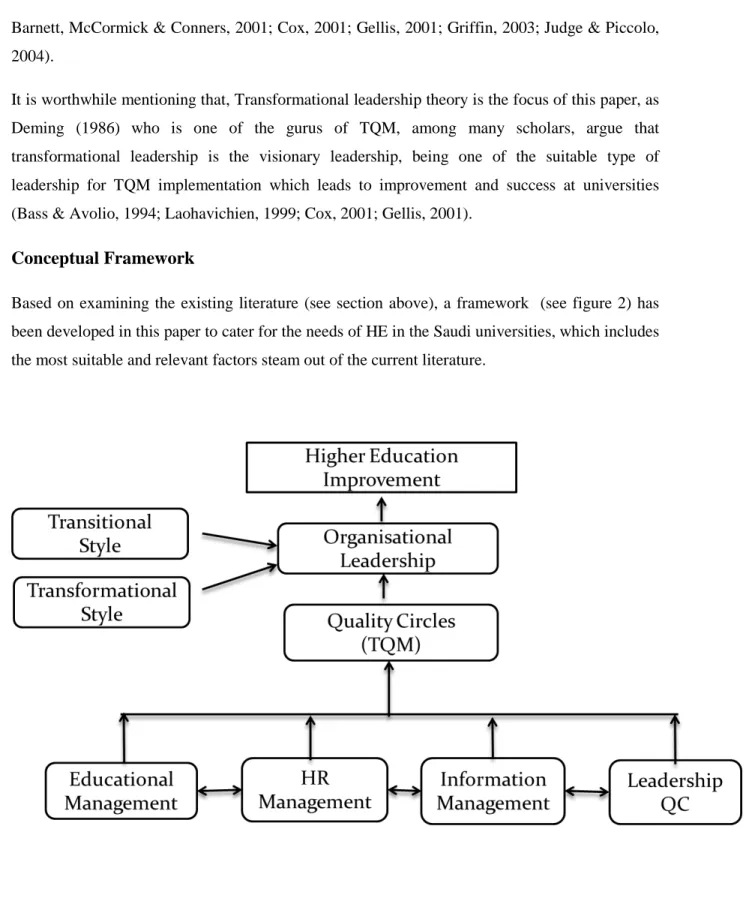
Based on examining the existing literature (see section above), a framework (see figure 2) has been developed in this paper to cater for the needs of HE in the Saudi universities, which includes the most suitable and relevant factors steam out of the current literature.
9
Aldaweesh et al.
The Effective Implementation of Total Quality Management and Leadership in Saudi Universities: A Review and Framework to Enhancing H.E. Strategy
Figure 2 includes three major themes and three sub-themes. Leadership emerges as a major theme in the TQM implementation. It should examine senior management’s commitment and involvement in creating and supporting a customer focus, clear goals and high expectations. Leadership system also would promote performance excellence for the HE. It should sit the rule and responsibilities for each member of staff toward the student’s satisfaction and create a partnership with parents, public communities and the government.
Information management element should manage the use of data and information to provide the fast response and the best analysis for the decision maker about the daily operational tasks. It should ensure all messages are clear for any situation, also accessible and reliable at all levels. Human resource management element will examine if the staff recruitment and development will meet the institution objectives to ensure the best performance, also to provide staff with the best quality work environment to ensure the staff satisfaction and participations.
Educational management will examine aspects of process management, including education design, learner-focused, education delivery, services and institution operations. It should examine how processes are creatively designed, effectively managed and continuously improved. This element should unsure continuous improvement and innovation in educational processes of the institution.
The leadership issue is very important and relevant to both QC and the overall organisation, because without adopting the right leadership style at the organisation, the implementation of TQM will not be effective. Leadership has many different styles to implement, but this paper will focus on only two leadership styles which are Transactional leadership and Transformational leadership. The paper will find out what is the best leadership practice and style for implementing TQM. This study will identify the different between both styles and will address the suitable style for effective TQM to improve the H.E.
10
Aldaweesh et al.
The Effective Implementation of Total Quality Management and Leadership in Saudi Universities: A Review and Framework to Enhancing H.E. Strategy
Methodology
As identified in the research aim, the intention for this study is to establish ways of improvement in the higher education and in particular Saudi Arabia H.E. In order to accomplish this, the paper adopts the qualitative approach and use an interpretive multiple case study (Yin, 2013), in order to achieve better understanding of the context of the research and the process being enacted (Morris and Wood, 1999, see Saunders et al., 2012; Velde et al., 2004). According to Yin (2013) case study is a suitable approach to the phenomenon under investigation and within its natural setting. Evidence from multiple cases is often considered more compelling than a single case, and the overall study will be regarded as more robust (Eisenhardt, 2007).Also It has been noted by Bardoel and Sohal (1999) that the use of case study strategy research to explore TQM issues has been gaining momentum. They pointed out two studies in which it was found that the case study strategy had particular applicability to the evaluation of TQM projects. These studies showed that this strategy provided the contextual detail that is often missing from other research strategies such as surveys.
Based on the above discussion, four case studies were selected to enable the researcher to enhance the external validity and offer more robust evidence. Two universities from the top ranking universities in Saudi Arabia and two from lower ranked universities (KSA, 2013), have been selected according to the age (year of establishment) of the universities, which in fact that more than 60 % of the universities in Saudi Arabia are newly established and less than ten years old (KSA, 2013). Having decided the four universities, the researcher faced huge challenges to get access to those universities and had to wait longer to get the approval from the Saudi higher education ministry, also the researcher had to travel to ten cities in Saudi Arabia in order to test and conduct the data and to open a dialogue with twelve universities in Saudi Arabia to participate in this research,
Data were primarily collected by semi-structured interviews. All interviews were conducted face-to-face and were tape recorded with the permission of the Interviewees. Most of the interviews were in English language but some are in Arabic which had to be translated into English. The interviews were taking place with the quality mangers from two hierarchical positions (the top management at the university level and the quality mangers at the faculty level at the university) in order to compare, contrast and gain multiple perspectives on the key factors that impact implementing TQM and the leadership practice at the universities. The interviews were transcribed
11
Aldaweesh et al.
The Effective Implementation of Total Quality Management and Leadership in Saudi Universities: A Review and Framework to Enhancing H.E. Strategy
and verified from audio to print for the close analysis. Other complementary data were collected through observations and documentary analysis. Data were coded using qualitative content analysis technique the Nvivo 8.0. which is a software program that designed to aid in such analysis of qualitative data, facilitate the coding, linking codes and text segments, documenting diversity in codes, searching, editing and re-organizing will be used (Miles and Huberman, 1994). The analysed data using the software package NVivo will help understanding the problem of this study.
The four universities (mixed public and privates) located in the kingdom of Saudi Arabia geographically (West, East, Centre and South of Saudi Arabia) two universities are well established and two are newly established universities. The sample was 38top management and middle management at the four universities with whom interviews were conducted in May-July 2013. The interviewees are mixed gender (male and female). The four universities are included in the recent ranking of the KSA (2013), two universities from the top and two from lower ranking. It is worth mentation that all the universities in Saudi Arabia have adoptedrecently the concept of TQM.
Conclusion
This research attempted to extend the body of knowledge for both TQM and Leadership also highlight the growing interest of implementing TQM in higher education, especially in Middle Eastern countries. A review of the key literature is presented which gives insight and direction about TQM implantation and leadership in H.E which helped in developing a conceptual framework for the Saudi H.E. Since the TQM is an effective tool to enhance the quality for better improvement. The data has been collected from four Saudi universities which are the limitation and primarily collected by semi-structured interviews. The future work will be analysing the data by using NVivo software to find out what is the suitable leadership style to lead the university to a successful TQM. The research will provide a roadmap for the decision makers of Saudi higher education to successful improve the TQM implementation by using the best style of leadership. As a result, the research findings will enhance the universities ranking and the quality of the graduates. Moreover, the university will adopt a new management system that creates competitive H.E environment.
12
Aldaweesh et al.
The Effective Implementation of Total Quality Management and Leadership in Saudi Universities: A Review and Framework to Enhancing H.E. Strategy
References
Al-Karni, A.S. (1999). “Higher Education In The Kingdom Of Saudi Arabia: Achievements And Challenges”, pp. 1-40. In: A Symposium on 'The Kingdom of Saudi Arabia in 100 Years,
Riyadh, 24-28 January, 1999. Riyadh. [In Arabic].
Al-Naeem, A. (2002). An investigation of the classroom climate in the college of education, King Faisal University. Saudi Arabia. PhD Thesis, University of Reading.
Aly, N. and Akpovi, J. (2001) “Total Quality Management In California Public Higher Education”, Quality Assurance in Education, Vol. 9, no.3, pp. 127-1319.
Bass, B.M., & Avolio, B. (1994). Improving organisational effectiveness through transformational leadership. Thousand Oaks, CA: SAGE.
Becket, N. and Brookes, M. (2008) “Quality Management Practice In Higher Education - What Quality Are We Actually Enhancing?”, Journal of Hospitality Leisure Sport and Tourism Education, vol. 7, no. 1, pp. 40-54.
Bush, T. (2008), “From Management To Leadership: Semantic Or Meaningful Change?”, Educational Management Administration & Leadership, Vol. 36, No 2, pp. 271-288. Burns, J.(1978) Leadership. NY: Harper & Row, Publishers.
Coate, E. (1993), “The Introduction Of Total Quality Management At Oregon State University”. Higher Education. Vol. 25, No. 3.
Das, A., Kumar, V. and Kumar, U. (2011) "The Role Of Leadership Competencies For Implementing Tqm: An Empirical Study In Thai Manufacturing Industry", International Journal of Quality and Reliability Management, Vol. 28, no.2, pp.195 - 219.
Deming, W.E. (2000), Out of the Crisis (2nd edition).Cambridge University Press, Cambridge, MA.
Deming, W.E. (2000), The New Economies for Industry, Government, Education, MIT Press, Cambridge, MA.
Drew, G. (2006), “Balancing Academic Advancement with Business Effectiveness?” International Journal of Knowledge, Culture and Change Management, 6, 117-125.
Fullan, M. (2008), “The Six Secrets Of Change: What The Best Leaders Do To Help Their Organizations Survive And Thrive”, Jossey-Bass, San Francisco.
Gellis, Z.D. (2001). “Social Work Perceptions Of Transformational And Transactional Leadership In Health Care”. Social Work Research, 25(1), pp. 17-25.
Gopal, K., Kanji, Abdul Malek & Bin, A. T. (1999):” Total Quality Management In UK Higher Education Institutions”, Total Quality Management, 10:1, 129-153
Gopal K. Kanji (2002):” Business excellence: make it happen”, Total Quality Management, 13(8), 1115-1124
Harris, A. (2005), “Leading from the Chalk-face: An overview of school leadership”, Leadership, Vol. 1, No 1, pp. 73-87.
Juran, J.M. (2003), Juran on Leadership for Quality – An Executive Handbook, Free Press, New York, NY.
13
Aldaweesh et al.
The Effective Implementation of Total Quality Management and Leadership in Saudi Universities: A Review and Framework to Enhancing H.E. Strategy
Kanji, G. (2002), Measuring business excellence. Routledge. London.
O'Mahony, K. and Garavan, T.N. (2012) "Implementing a Quality Management Framework in a Higher Education Organisation: A Case Study", Quality Assurance in Education, Vol. 20 Iss: 2
KSA (Kingdom of Saudi Arabia) (2013). Summary statistics on higher education in Saudi Arabia for 2012. Riyadh: Ministry of Higher Education. [In Arabic].
Levin, B. and Fullan, M. (2008), “Learning About System Renewal”, Educational Management Administration & Leadership, Vol. 36, No 2, pp. 289-303.
Mehrotra, D. (2013). Applying total quality management in academics,
http://www.isixsigma.com/library/content/c020626a.asp. access date 1/02/2013
Middlewood, D. (2010), “Managing People And Performance”, The principles of educational leadership & management,Second Edition, Sage Publication, London, pp. 132-150.
Miles, M. and Huberman, A. (1994) Qualitative Data Analysis: An Expanded Sourcebook. Thousand Oaks, CA: Sage Publications.
Murad, A. and Rajesh, S. (2010). “Implementation of Total Quality Management in Higher Education”, Asian Journal of Business Management, 2(1): pp. 9-16.
Osseo-Asare, A.E., Longbottom, D. & Chourides, P. (2007) “Managerial Leadership for Total Quality Management in UK Higher Education”, The TQM Magazine, 19, 541-560.
Rosser, V.J., Johnstrad, L.K. & Heek, R.H. (2003) “Academic Deans as Directors: Assessing their Effectiveness from Individual and Institutional Perspectives”, The Journal of Higher Education, 74, 1-25.
Samson, D. and Terziovski, M. (1999), “The Relationship between Total Quality Management Practices and Operational Performance”, Journal of Operations Management. Vol. 17, Issue 4, June, pp. 393-409
Saunders, M., Lewis, P. and Thornhill, A. (2012) Research Methods for Business Students, Harlow, 6th Edition, Pearson Education Limited.
Stensaasen, S. (1995), “The Application Of Deming’s Theory of Total Quality Management to Achieve Continuous Improvements in Education”, Total Quality Management, 6 (5-6), pp. 579-592.
Tsinidou, M., Gerogiannis, V. & Fitsilis, P. (2010) Evaluation of the factors that determine quality in higher education: an empirical study. Quality Assurance inEducation, 18(3), pp.227-244.
Velde, M. v. d.Jansen, P. & Anderson, N. (2004) Guide to Management Research Methods, Maiden, Blackwell Publishing Ltd.