This is an Open Access article distributed under the terms of the Creative Commons At-tribution Non-Commercial License (http://creativecommons.org/licenses/by-nc/3.0/) which permits unrestricted non-commercial use, distribution, and reproduction in any medium, provided the original work is properly cited.
*Corresponding author: Eun-Surk Yi
Department of Exercise Rehabilitation & Welfare, College of Health Science, Gachon University, 191 Hambakmoero, Yeonsu-gu, Incheon 461-701, Korea Tel: +82-32-820-4442, Fax: +82-32-820-4442, E-mail: [email protected] Received: April 16, 2014 / Accepted: April 21, 2014
A study on the development of the protocol of leisure
activity program for the elderly’s deviant prevention
Chan-Woo Ahn1, Eun-Surk Yi2,*, Dong-Kyun Park3, Hi-Wan Lee4, Kwang-Uk Lee5, Byeong-Seok Min6, Gun-Sang Cho7, Ik-Young Chang8
1Department of Physical Training Education, Gyeongin National University of Education, Anyang, Korea 2Department of Exercise Rehabilitation & Welfare, College of Health science, Gachon University, Incheon, Korea
3Department of Police Administration, International College of Culture and Information, Daegu Haany University, Gyeongsan, Korea 4Department of Welfare for the Elderly, College of Well-being, Daegu Haany University, Gyeongsan, Korea
5Department of Exercise & Health, College of Arts & Physical Education, Incheon National University, Incheon, Korea 6Department of Physical Education, Kyungdong University, Gosong-gun, Gangwon-do, Korea
7Department of Community Sports & Recreation, College of Arts & Athletics Division, Daelim University, Anyang, Korea 8School of Physical Education, Sport and Exercise Sciences, University of Otago P.O.Box 56, Dunedin, New Zealand
The purpose of this study is to provide planning methods for leisure ac-tivity program to prevent the elderly’s deviance, using the program com-ponents and protocol factors. This section discusses the results ob-tained through document analysis and Delphi technique. First, the com-ponents of leisure activity program were classified into five stages such as definition, condition analysis, program composition, application and evaluation. Second, the protocol factors in each stage of leisure activity program for the elderly’s deviant prevention were 19 main themes and 75 sub-themes respectively. In the stage of condition analysis, five main themes such as deviant prediction, individual, socio-demographic,
so-cial and cultural factors and 25 sub-themes were found. Program com-position included three main themes, facilities, instructor and program and 16 sub-themes and in the application stage, there were three key themes, facilities, instructor and program and 14 sub-themes. Lastly, the evaluation found four main themes such as deviant prevention, partici-pation in leisure activities, management and wellbeing and 16 sub-themes.
Keywords: Protocol, Leisure activity program, Elderly’s deviant preven-tion
INTRODUCTION
Since the beginning of the twenty-first century, Korean society has been facing the various challenges by the rapid elderly popula-tion growth. Among the issues, the rate of elderly’s crimes be-comes one of the most serious social problems. In 1996 there were 34,000 senior criminals, accounting for 1.8% of the total number of criminals 1,922,000, but it has been significantly increased to 4.3%, about 82,000 older criminals out of 1,932,000 in 2006. This data shows that while the total number of criminals only in-creased about 0.5%, the rate of senior crimes jumped nearly 200% (Jang, 2009). In addition, a type of crime becomes more violent crimes such as robbery, arson and murder.
In criminology, gerontology and sociology, the elderly’s crimes are at the heart of both theoretical and practical concerns (Ji, 2002; Lee et al., 2003). Many scholars have examined the research on the causes of older people’s delinquent behavior and pointed out that most delinquent behavior are predictable. Moreover, they have also indicated that the personal factors such as socio-demographic and environmental characteristics can lead to the elderly’s predict-able deviant behavior which can cause criminal behavior (Lee, 2006).
In recent, some scholars in Korea are interested in research on socio-psychological factors (stress, depression, alienation, isolation, role loss) which can bring about deviant behavior of the elderly and make an effort to solve those problems. Within the realm of http://dx.doi.org/10.12965/jer.140105
Original Article
their daily life (Chun et al., 2001; Ham, 2005; Yi, 2005). More specifically, scholars in sport and leisure have insisted the govern-ment should provide more facilities, better instructors and pro-grams not only to give more opportunities for elderly to partici-pate in leisure activity, but also to reduce various personal prob-lems such as depression, alienation, isolation and stress (Hwang, 2001; Hyun, 2003; Lee, 2006). However, there has been little re-search on deviant behavior for the elderly in many different areas of study.
As mentioned above, however, because many scholars have re-ported that sport and leisure activity may contribute to alleviating socio-psychological problems which may cause deviant behaviors, we may assume that the elderly’s participation in leisure activity may directly or indirectly affect their deviant behavior. Therefore, in conditions where the basic system for the elderly’s crime pre-vention does not exist, but does need, developing sport and leisure activity program can be a good alternative. It is because the cen-tral government has been running a lot of sport and leisure pro-grams through local facilities such as senior welfare centers and/or cultural centers and senior community centers. In addition, the National Health Insurance Service under local authorities has been also providing ‘outreach services’ which send fitness instruc-tors to small towns to encourage the elderly to participate in sport and leisure activity.
Along with exiting sport and leisure programs for the elderly, if both the central and local government agencies can provide spe-cial programs which may prevent deviant behaviors or crimes, it can contribute not only to reducing serious deviant behavior and crimes of the elderly, but also to establishing a long term plan to prevent crimes for the elderly. In other words, in the process of planning the programs to prevent the elderly’s deviant behavior, we must consider a lot of determinants such as the level of stress, alienation, depression, isolation, economic status, costs, region, type of participation, frequency of participation and how all deter-minants are interconnected with each other (Yi et al., 2005). However, there is a lack of knowledge about how to interconnect, and as a result we have had trouble applying scientific knowledge to field-related knowledge (Lee, 2003).
Therefore, drawing upon the concept, ‘the protocol’, this study aims to develop a leisure activity program which can contribute to preventing the elderly’s deviant behaviors and decreasing their crimes. This research may help improve programs for the elderly. Moreover, it may help better understand the needs of the elderly
The purpose of this study is to provide planning methods for leisure activity program to prevent the elderly’s deviance, using the program components and protocol factors. The specific ques-tions guiding the purpose are:
1) What are the program components to prevent the elderly’s deviance?
2) What are the protocol factors in each stage of leisure activity program to prevent the elderly’s deviance?
MATERIALS AND METHODS
Document analysis
This study analyzes the components of leisure activity program which can prevent the elderly’s deviance through expert meeting from May to July 2010.
First of all, in order to extract the components of leisure activity program which helps prevent deviance of the elderly, keywords such as ‘the elderly’s deviant behavior’ and/or ‘deviant prevention’ were searched from websites, the Research Information Service System (RISS www.riss.kr) and the Korean studies Information Service System (KISS kiss.kstudy.com).
In the first stage, we found 616 theses and 247 journals and fi-nally selected 88 journals and thesis based on the quality of jour-nals and theses. All 88 papers were downloaded, coded and ana-lyzed for this study.
Delphi technique 1) Expert panels selection
Delphi technique is a widely used and accepted method for gathering data from respondents within their domain of expertise. Therefore, the most important thing in a Delphi study is choosing the appropriate expert panels. For this research, all expert panels were selected with a purposive sampling and ten experts in the do-main of the elderly were selected from physical education, crimi-nology, gerontology and social work. They all have been working over five years in their field. While six experts from universities have published several articles on deviance, two experts from insti-tutions have conducted the research on the elderly and two experts from the senior welfare centers have taught a variety of leisure ac-tivity programs for the elderly.
2) Data collection
Ahn C-W, et al. • Protocol, leisure activity, deviant prevention and Korea pre-elderly
trained for skills, rules, objective of the survey, research plan and a Delphi technique by principal and co-investigators. In the case of the first questionnaire, surveyors asked for prior consent to experts by email and telephone, visited their working places to explain the objective of the survey and the procedures, let participants respond to the questionnaire using the self-administration method and col-lected the complete questionnaire from them. In the second and third investigation, we followed the same procedures. Each stage took 35 days on average.
To collect data, in the first survey, we used open-ended ques-tionnaire. After analyzing the collected data with expert panels, we developed a second and third questionnaire. During three surveys, the return rate of questionnaire was gradually decreased. However, it showed that the return rate of the last survey was 58% which was relatively higher than the average return rate of 30-40% shown in other research.
3) Data analysis
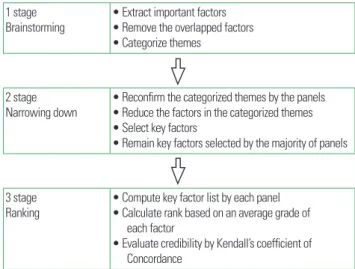
As seen in Fig. 1, data analysis constituted three different stag-es. In the first stage, often called the “brainstorming”, open-ended questions to solicit experts’ opinions were conducted, overlapped questions were removed and questions were categorized into each theme.
In the second stage, we sent categorized themes to be confirmed by the expert panels and extracted key factors based on the high frequency.
In the last stage, each panel computed key factor lists and re-searcher calculated rank based on an average grade of each factor. In order to access reliability between panels, this research used Kendall’s coefficient of concordance.
RESULTS
Analysis on components of leisure activity program for the el-derly’s deviance prevention
The purpose of this study is to develop leisure activity program for the elderly’s deviance prevention. In order to achieve the pur-pose, this study explored and found components of leisure activity program by reviewing both domestic and international journals and thesis.
Drawing upon the document analysis to identify components of leisure activity program, this study classified each stage of the protocol; 1) the definition stage of deviance, 2) the stage of condi-tion analysis, 3) the stage of program composicondi-tion, 4) the stage of program application and 5) the stage of program evaluation through the socio-historical contextual analysis.
In the first stage, we defined and classified the elderly’s deviance into four different types such as social, economic, psychological and physical deviance. In the next stage, condition analysis of lei-sure activity program included deviant prevention, socio-demo-graphic, individual, social, cultural factors. In both program com-position and application stage, facilities, instructor and program factors were classified as key factors. In the last evaluation stage, deviant prevention, participation in leisure activities, manage-ment and wellbeing were found as four key factors.
Analysis on the protocol factors of leisure activity program for the elderly’s deviance prevention
As mentioned in previous section, this study defined compo-nents of leisure activity program needed in each stage; 1) the defi-nition stage of deviance, 2) the stage of condition analysis, 3) the stage of program composition, 4) the stage of program application and 5) the stage of program evaluation through the socio-histori-cal contextual analysis.
In this section, we analyzed the protocol factors of leisure activi-ty program using Delphi technique. In the analysis processes, there were 342 protocol factors from the expert panels. Among the protocol factors, 75 factors were selected for the protocol of the elderly’s leisure activity program, which showed over 70% agree-ment among the expert panel.
As the first stage toward leisure activity programs for deviance prevention, we found a total of 23 protocol factors for the defini-tion on the types of deviance and finally classified them into four themes such as social, economic, psychological and physical devi-ance.
In the next step, 111 factors were identified as the protocol fac-1 stage
Brainstorming • Extract important factors • Remove the overlapped factors • Categorize themes
2 stage
Narrowing down • Reconfirm the categorized themes by the panels• Reduce the factors in the categorized themes • Select key factors
• Remain key factors selected by the majority of panels
3 stage Ranking
• Compute key factor list by each panel • Calculate rank based on an average grade of each factor
• Evaluate credibility by Kendall’s coefficient of Concordance
tors for condition analysis at the first stage. In the next stage, we categorized them into five main themes (deviance prediction, so-cio-demographic characteristics, individual characteristics, social characteristics, cultural characteristics) and 25 sub-themes (Table 1). In the third process, we extracted 93 factors composing leisure activity program and classified them into three main themes (fa-cilities, instructor and programs) and 16 sub-themes (Table 1).
In the application process, we found 69 factors at the first stage and extracted three main themes (facilities, instructor and pro-grams) and 14 sub themes at the second stage according to the importance (Table 1).
In the last step which evaluates the protocol for the elderly lei-sure activity program for deviance prevention, we found 46 factors and finalized four main themes (deviance prevention,
participa-tion in leisure activity, management and wellbeing) and 16 sub themes (Table 1).
DISCUSSION
This section discusses the results obtained through document analysis and Delphi technique. First, the components of leisure ac-tivity program were classified into five stages such as definition, condition analysis, program composition, application and evalua-tion. Second, the protocol factors in each stage of leisure activity program for the elderly’s deviant prevention were 19 main themes and 75 sub-themes respectively. More specifically, in the stage of the definition on the types of deviance social, economic, psycho-logical and physical deviance were developed. In the stage of con-Definition of deviance Social deviance Deviance by anti-social actions 1. 23 factors in the first stage
2. 4 factors in the second stage (agreement over 22 out of 30 expert panels: 73.3%)
Economic deviance Deviance by economic problems
Psychological deviance Deviance by psychological problems beyond its control Physical deviance Deviance by sexual dissatisfaction
Condition analysis Deviance prediction Depression, helplessness, stress, alienation, anger, moral judgment
1. 111 factors in the first stage 2. 25 factors in the second stage (agreement over 23 out of 30 expert panels: 76.7%)
Socio-demographic characteristics
Gender, age, education, the presence of a spouse, living with their off springs
Individual characteristics Medical history, physical condition, drinking, smoking Social characteristics Religion, club activity, sociality, past occupation,
economic level
Cultural characteristics Participation in leisure activity, frequency of leisure activity, type of leisure activity, desire of leisure activity, leisure specialization
Program components Facilities Accessibility, type of executing organization, convenience in use, safety, cost reasonableness
1. 93 factors in the first stage 2. 16 factors in the second stage (agreement over 21 out of 30 expert panels: 70%)
Instructor Gender, attitude, professionalism, communication skill Programs Contents, type, accompanying family members, frequency,
activity target, attraction, participation level
Application Facilities Convenient approximation, facility satisfaction, safety check 1. 69 factors in the first stage 2. 14 factors in the second stage (agreement over 23 out of 30 expert panels: 76.7%)
Instructor Skill check from instructor, instructors’ attitude, satisfaction with instructors, communication skill, cooperation between instructors and family members Programs Adherence of participation, adaptability of program,
satisfaction with program, activity target check, satisfaction with other participants, change in daily life Evaluation Deviance prevention Change in deviant desire, program satisfaction, change in
daily life, change in physical health, change in mental health
1. 46 factors in the first stage 2. 16 factors in the second stage (agreement over 25 out of 30 expert panels: 83.8%)
Participation in leisure activity Participation rate, cognitive satisfaction, affective satisfaction, participation satisfaction, friendship Management Cooperation between instructors and family members,
ability to cope with deviance, stabilization of activity Wellbeing Health maintenance, social stability, social activity
Ahn C-W, et al. • Protocol, leisure activity, deviant prevention and Korea pre-elderly
dition analysis, five main themes such as deviant prediction, indi-vidual, socio-demographic, social and cultural factors and 25 sub-themes were found. Program composition included three main themes, facilities, instructor and program and 16 sub-themes and in the application stage, there were three key themes, facilities, in-structor and program and 14 sub-themes. Lastly, the evaluation found four main themes such as deviant prevention, participation in leisure activities, management and wellbeing and 16 sub-themes.
Leisure activity program which used the protocol factors devel-oped in this study may play an important role in preventing dan-gers which can be caused by the elderly’s deviant behaviors. If lei-sure activity program with the protocol factors can be applied to senior citizens with deviant behavior and it can have a positive ef-fect on their behavior, it may contribute to solving social problems caused by the elderly. In addition, staff in local authorities who are responsible for the elderly have received a variety of trainings to promote their health (Lee et al., 2003). If they can be trained by leisure activity program for deviant prevention, it would provide a more efficient way to mediate the elderly’s deviant behaviors.
As mentioned before, while most previous studies on the elderly have focused primarily on how to promote the elderly’s health, there has been little research on the causal relationship of deviant behaviors. Therefore, if further research using this program can be carried out, it would provide a better understanding of what kinds of risk factors influence the elderly’s deviant behaviors and how the protocol factors are interconnected with other factor.
The results of this study should have implications for the elderly. First, five components (stages) of leisure activity program and 19 main protocol themes which were confirmed by ten expert panels may help design objective and rational leisure activity programs. Second, the protocol themes were developed by expert panels who work for the elderly, reflecting their opinions. Therefore, it may provide useful information to instructors who are working with the elderly in sport and/or cultural centers.
It is important to acknowledge the limitations of this study and future recommendations. First, given the nature of Delphi tech-nique, it should be noted that the results were obtained by the limited number of experts. Therefore, results cannot be general-ized. Moreover, Kendall’s coefficient of concordance was 0.32 which showed lower reliability between respondents. Second, in
the selection process of the protocol factors we did not present an objective standard. Therefore, future research needs to collect ex-tensive opinions from more various fields and present clear stan-dard in the selection process of the protocol factors.
CONFLICT OF INTEREST
No potential conflict of interest relevant to this article was re-ported.
ACKNOWLEDGMENTS
This work was supported by the National Research Foundation of Korea Grant funded by the Korean Government (NRF-2010-32A-G00026).
REFERENCES
Chun HJ, Kim JH, Kim KS. A study on the effect of therapeutic recreation program on psychological emotion of old women people. J Korean Physic Edu Asso Girls Women 2001;15(2):101-111.
Ham JE. A study on the current tendency of the researches into the elder-ly physical education. Korea Sport Res 2005;16(5):315-322.
Hwang MJ. Influence of a prescribed dance program on mental health of the elderly. J Korean Physic Edu Asso Girls Women 2001;15:217-229. Hyun OS. A Study on the management actual condition of people
com-munity center in Kyungnam local comcom-munity and the its activity alter-ative policy of welfare programs for the elderly. J Welfare Aged 2003; 20:235-270.
Jang JO. Elderly crime and its victimization. Korean Criminol Rev 2009; 20(1):215-255.
Ji KJ. The Characteristics of and the solutions to crimes committed by el-derly people. J Korea Gerontol Society 2002;21(3):1-14.
Lee HB, Jang IS. A basic study for recreation program of elderly. J Sport Leisure Studies 1996;5:231-239.
Lee HB. The fundamental study for organizing desirable leisure program of the old. J Korean Physic Educ Asso Girls Women 2006;19(2):207-222.
Yi ES. The relationship between the participant`s level of gateball activity and leisure attitude of the aged. Korean J Sociol Sport 2005;18(1):135-149.