C
hapter
10
Selectional Preferences
1
10.1
Introduction
Selectional preferences are a useful and versatile resource for a number of applica-tions, such as syntactic disambiguation (Hindle and Rooth, 1993), semantic role labeling (Gildea and Jurafsky, 2002), and word sense disambiguation (McCarthy and Carroll, 2003). The selectional preference of a verb can be defined as the semantic restrictions the verb imposes on its arguments (and thus the preference it has for particular semantic classes).2 A verb likedrink, for example, typically prefers animate subjects and drinkable objects. A selectional preference model keeps track of these semantic classes that verbs prefer for their argument slots.
Standard selectional preference models take the form of a mappingσ:(v,r,c)7→
a, that maps each selectional tuple(v,r,c)to a real numbera, representing the degree of preference of a verb vfor a classcwith respect to role r (Light and Greiff, 2002). Keeping track of single relationships, however, is not enough to build a sufficiently rich model of selectional preferences. Compare the following sentences:
(1) The skyscraper is playing coffee. (2) The turntable is playing the piano.
1The research presented in this chapter has been published as Van de Cruys (2009).
2Note that we will only consider the selectional preference of verbs, although the notion extends to other word classes as well (e.g. the selectional preference of nouns for certain adjectives).
140 10.2 Previous work
The first sentence is a clear violation of the selectional preferences ofplay, both for its subject and object slot: a skyscraper doesn’t play, nor is coffee something that can be played. Standard selectional preference models are able to capture this violation, since both(play, su, skyscraper)and(play, obj, coffee)will not be deemed very plausible by these models. The second sentence, however, is more complicated. The sentence still constitutes a violation of the selectional preferences (turntables are not able to play piano’s), but the violation is due to the ambiguity of the verbplay, and the individual preferences(play, su, turntable)and(play, obj, piano)are perfectly possible. The standard models will therefore not be able to capture this violation.
The framework presented here tries to overcome the limits of standard ap-proaches to selectional preference induction. By keeping track of three-way co-occurrences (the fact that a verb, a subject and a direct object appear togetherat the same time), we hope to build a richer model of selectional preferences that does justice to preference violations like the one in sentence (2).
10.2
Previous work
One of the first to automatically induce selectional preferences from corpora was Resnik Resnik (1996). Resnik generalizes among nouns by using WordNet noun synsets as clusters. He then calculates theselectional preference strengthof a specific verb in a particular relation by computing the Kullback-Leibler divergence between the cluster distribution of the verb and the aggregate cluster distribution:
Sv= X
c
p(c|v)logp(c|v)
p(c) (10.1)
Theselectional associationis then the contribution of a particular cluster to the verb’s preference strength:
Av,c=
p(c|v)logpp(c(|cv))
Sv
(10.2) The model’s generalization relies entirely on WordNet; there is no generaliza-tion among the verbs. Other notable approaches using WordNet for selecgeneraliza-tional preference induction are Abe and Li’s (1996) and Clark and Weir’s (2001).
The research presented in this chapter is related to previous work on clustering. Pereira et al. (1993) use an information-theoretic based clustering approach,
clustering nouns according to their distribution as direct objects among verbs, conditioned on a set of latent semantic classes.
p(v,n) =X
c
p(c,v,n) =X
c
p(c)p(v|c)p(n|c) (10.3) Their model is an asymmetric, one-sided clustering model: only the direct objects are clustered, there is no clustering among the verbs.
Rooth et al. (1999) use anem-based technique to induce a clustering based
on the co-occurrence frequencies of verbs with their subjects and direct objects. Their clustering model is the same as the one used by Pereira et al. (1993), but they embed the model in a formalem-clustering framework. Rooth et al.’s (1999)
clustering is two-sided: the verbs as well as the subjects/direct objects are clustered. We will use a similar model for evaluation purposes.
Recent approaches using distributional similarity methods for the induction of selectional preferences are the ones by Erk (2007), Bhagat et al. (2007) and Basili et al. (2007). Erk (2007) uses corpus-based similarity measures for the induction of selectional preferences. The selectional preferenceSrpfor an argument slotrof
a particular predicatepand a possible headwordw0is computed as the weighted sum of similarities betweenw0and the headwords seen as argument fillers for the predicate (Seen(rp));w trpis an appropriate weighting function.
Sr p(w0) = X w∈Seen(rp) sim(w0,w)·w tr p(w) (10.4)
Both Bhagat et al. (2007) and Basili et al. (2007) investigate the induction of selectional preferences in the context of textual entailment tasks.
This research differs from the approaches mentioned above by its use of multi-way data: where the approaches above limit themselves to two-multi-way co-occurrences, this research will focus on co-occurrences for multi-way data.
10.3
Methodology
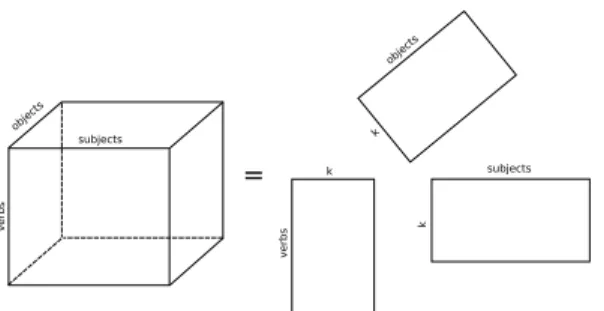
The non-negative tensor factorization model, presented in chapter 4, can straight-forwardly be applied to three-way co-occurrences ofverbs×subjects×direct objects. Thentfdecomposition for theverbs×subjects×direct objectsco-occurrences into
the three loadings matrices is represented graphically in figure 10.1.
In the resulting factorization, each verb, subject and direct object gets a load-ing value for each factor dimension in the correspondload-ing loadload-ings matrix. The
142 10.4 Results
Figure 10.1: Graphical representation of thentffor language data
original value for a particular(s,v,o)triple xsvocan then be reconstructed with
equation 10.5. xsvo= k X i=1 ssivviooi (10.5) To reconstruct the selectional preference value for the triple(man,bite,dog), for example, we look up the subject vector forman, the verb vector forbiteand the direct object vector fordog. Then, for each dimensioniin the model, we multiply theith value of the three vectors. The sum of these values is the final preference value.
10.4
Results
10.4.1 Setup
The approach described in the previous section has been applied to Dutch, using the Twente Nieuws Corpus (Ordelman, 2002), a 500mword corpus of Dutch newspaper
texts. The corpus has been parsed with the Dutch dependency parser Alpino (van Noord, 2006), and three-way co-occurrences of verbs with their respective subject and direct object relations have been extracted. As dimension sizes, the1kmost
frequent verbs were used, together with the10kmost frequent subjects and10k
most frequent direct objects, yielding a tensor of1k×10k×10k. The resulting
The tensor has been adapted with a straightforward extension of pointwise mu-tual information for three-way co-occurrences, following equation 10.6. Negative values are set to zero.3
pmi3(x,y,z) =log p(x,y,z)
p(x)p(y)p(z) (10.6)
The resulting matrix has been factorized intokdimensions (varying between 50 and 300) with thentfalgorithm described in section 4.3.2 on page 54.
10.4.2 Examples
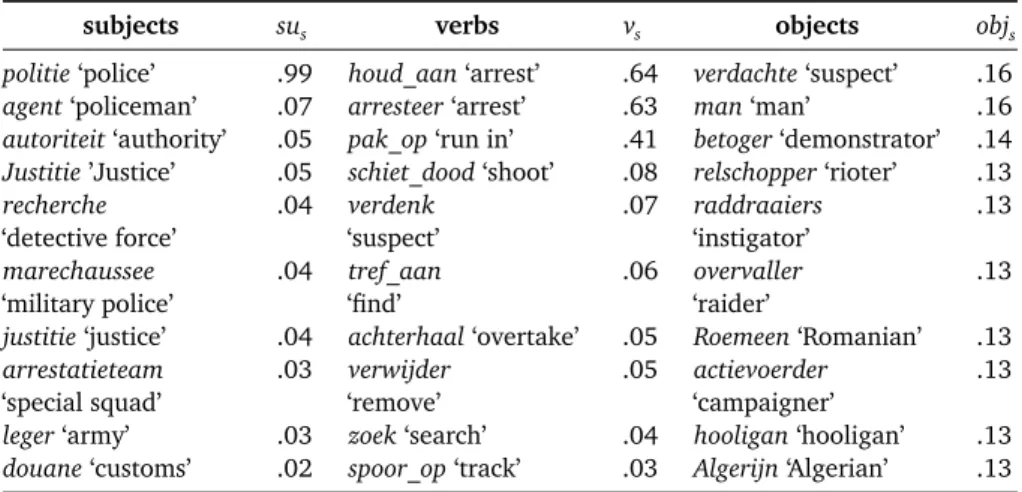
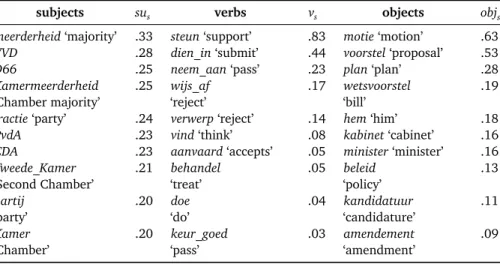
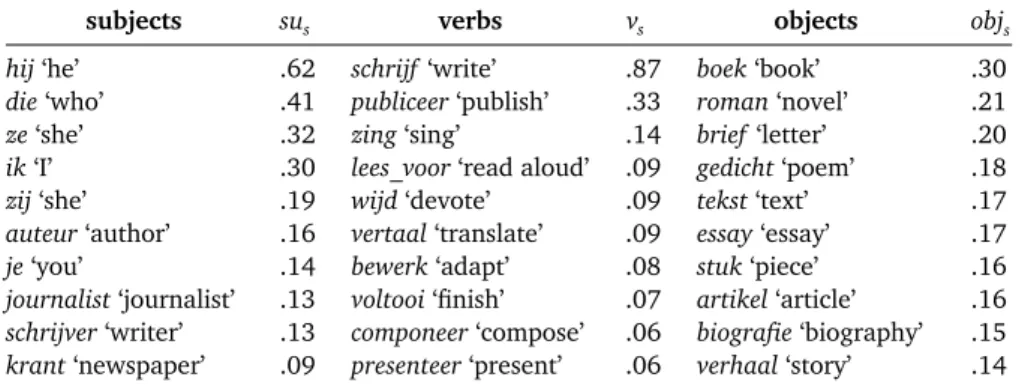
Tables 10.1 to 10.5 show example dimensions that have been found by the algo-rithm withk =100. Each example gives the top 10 subjects, verbs and direct objects for a particular dimension, together with the score for that particular dimension.
Table 10.1 shows the induction of a ‘police action’ frame, with police authorities as subjects, police actions as verbs and patients of the police actions as direct objects.
subjects sus verbs vs objects objs
politie‘police’ .99 houd_aan‘arrest’ .64 verdachte‘suspect’ .16
agent‘policeman’ .07 arresteer‘arrest’ .63 man‘man’ .16
autoriteit‘authority’ .05 pak_op‘run in’ .41 betoger‘demonstrator’ .14
Justitie’Justice’ .05 schiet_dood‘shoot’ .08 relschopper‘rioter’ .13
recherche ‘detective force’ .04 verdenk ‘suspect’ .07 raddraaiers ‘instigator’ .13 marechaussee ‘military police’ .04 tref_aan ‘find’ .06 overvaller ‘raider’ .13
justitie‘justice’ .04 achterhaal‘overtake’ .05 Roemeen‘Romanian’ .13
arrestatieteam ‘special squad’ .03 verwijder ‘remove’ .05 actievoerder ‘campaigner’ .13
leger‘army’ .03 zoek‘search’ .04 hooligan‘hooligan’ .13
douane‘customs’ .02 spoor_op‘track’ .03 Algerijn‘Algerian’ .13
Table 10.1: Top 10 subjects, verbs and direct objects for the ‘police action’ dimension
3This is not just an ad hoc conversion to enforce non-negativity. Negative values indicate a smaller co-occurrence probability than the expected number of co-occurrences. Setting those values to zero proves beneficial for similarity calculations (see e.g. Bullinaria and Levy (2007)).
144 10.4 Results
In table 10.2, a legislation dimension is induced, with legislative bodies as subjects,4legislative actions as verbs, and mostly law (proposals) as direct objects. Note that some direct objects (e.g. ‘minister’) also designate persons that can be the object of a legislative act.
subjects sus verbs vs objects objs
meerderheid‘majority’ .33 steun‘support’ .83 motie‘motion’ .63
VVD .28 dien_in‘submit’ .44 voorstel‘proposal’ .53
D66 .25 neem_aan‘pass’ .23 plan‘plan’ .28
Kamermeerderheid ‘Chamber majority’ .25 wijs_af ‘reject’ .17 wetsvoorstel ‘bill’ .19
fractie‘party’ .24 verwerp‘reject’ .14 hem‘him’ .18
PvdA .23 vind‘think’ .08 kabinet‘cabinet’ .16
CDA .23 aanvaard‘accepts’ .05 minister‘minister’ .16
Tweede_Kamer ‘Second Chamber’ .21 behandel ‘treat’ .05 beleid ‘policy’ .13 partij ‘party’ .20 doe ‘do’ .04 kandidatuur ‘candidature’ .11 Kamer ‘Chamber’ .20 keur_goed ‘pass’ .03 amendement ‘amendment’ .09
Table 10.2: Top 10 subjects, verbs and direct objects for the ‘legislation’ dimension Table 10.3 depicts a dimension of ‘war deployment’. The dimension contains military powers (countries, military organizations and leaders) that deploy (or remove) particular military forces.
Table 10.4 shows a ‘publishing’ dimension. The subjects contain writers (persons and bodies), which publish (in a broad sense) textual works.
Table 10.5, finally, is clearly an exhibition dimension, with verbs describing actions of display and trade that art institutions (subjects) can perform on works of art (objects).
These are not the only sensible dimensions that have been found by the algo-rithm. A quick qualitative evaluation indicates that about 44 dimensions contain similar, framelike semantics. In another 43 dimensions, the semantics are less clear-cut (single verbs or expressions account for one dimension, or different senses of a verb get mixed up). 13 dimensions are not so much based on semantic characteristics, but rather on syntax (e.g. fixed expressions and pronomina).
subjects sus verbs vs objects objs
regering‘government’ .26 stuur‘send’ .72 troep‘troop’ .82
VS‘US’ .26 trek_terug‘withdraw’ .67 militair‘soldier’ .42
Nederland ‘Netherlands’ .25 zet_in ‘deploy’ .14 soldaat ‘soldier’ .21
president‘president’ .23 lever‘supply’ .07 delegatie‘delegation’ .12
leger‘army’ .22 heb‘have’ .06 leger‘army’ .12
land‘country’ .20 haal_weg‘remove’ .03 waarnemer‘observer’ .08
NAVO ‘NATO’ .20 beschikbaar stel ‘make available’ .03 marinier ‘marine’ .08 Indonesië ‘Indonesia’ .19 zeg_toe ‘promise’ .03 grondtroepen ‘ground forces’ .08 Verenigde_Staten ‘United States’ .19 ruim_op ‘clear’ .02 gezant ‘envoy’ .07 Groot-Brittannië ‘Great Britain’ .18 bied_aan ‘offer’ .02 versterking ‘reinforcement’ .07
Table 10.3: Top 10 subjects, verbs and direct objects for the ‘war movement’ dimension
subjects sus verbs vs objects objs
hij‘he’ .62 schrijf‘write’ .87 boek‘book’ .30
die‘who’ .41 publiceer‘publish’ .33 roman‘novel’ .21
ze‘she’ .32 zing‘sing’ .14 brief‘letter’ .20
ik‘I’ .30 lees_voor‘read aloud’ .09 gedicht‘poem’ .18
zij‘she’ .19 wijd‘devote’ .09 tekst‘text’ .17
auteur‘author’ .16 vertaal‘translate’ .09 essay‘essay’ .17
je‘you’ .14 bewerk‘adapt’ .08 stuk‘piece’ .16
journalist‘journalist’ .13 voltooi‘finish’ .07 artikel‘article’ .16
schrijver‘writer’ .13 componeer‘compose’ .06 biografie‘biography’ .15
krant‘newspaper’ .09 presenteer‘present’ .06 verhaal‘story’ .14
Table 10.4: Top 10 subjects, verbs and direct objects for the ‘publishing’ dimension
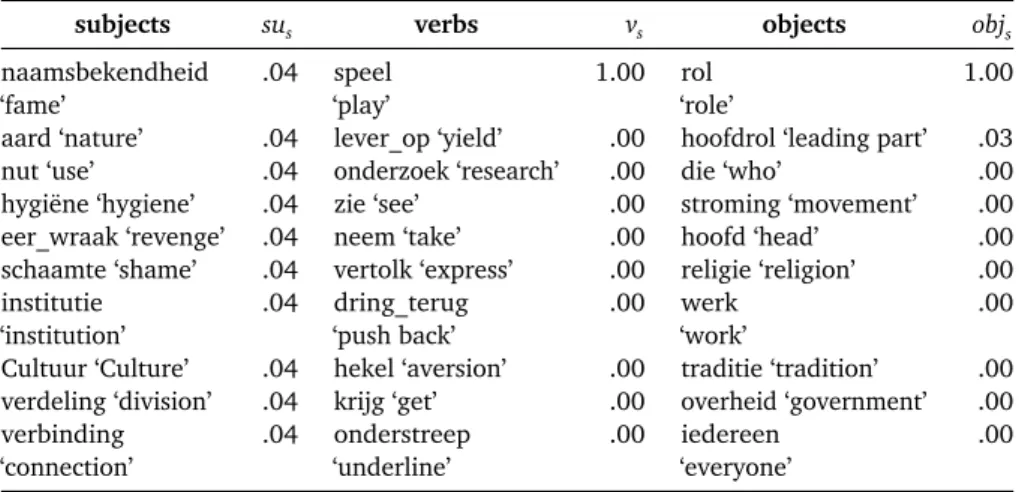
The qualitative evaluation indicates that quite some dimensions indeed do not contain framelike semantics, but those dimensions do contain information that may be useful for selectional preference induction. Such a dimension is shown in table 10.6. It shows an example dimension in which practically all of the dimension’s mass is attributed to one particular expression:een rol spelen‘to play a
146 10.4 Results
subjects sus verbs vs objects objs
tentoonstelling‘exhibition’ .50 toon‘display’ .72 schilderij‘painting’ .47
expositie‘exposition’ .49 omvat‘cover’ .63 werk‘work’ .46
galerie‘gallery’ .36 bevat‘contain’ .18 tekening‘drawing’ .36
collectie‘collection’ .29 presenteer‘present’ .17 foto‘picture’ .33
museum‘museum’ .27 laat‘let’ .07 sculptuur‘sculpture’ .25
oeuvre‘oeuvre’ .22 koop‘buy’ .07 aquarel‘aquarelle’ .20
Kunsthal .19 bezit‘own’ .06 object‘object’ .19
kunstenaar‘artist’ .15 zie‘see’ .05 beeld‘statue’ .12
dat‘that’ .12 koop_aan‘acquire’ .05 overzicht‘overview’ .12
hij‘he’ .10 in huis heb‘own’ .04 portret‘portrait’ .11
Table 10.5: Top 10 subjects, verbs and direct objects for the ‘exhibition’ dimension
role’. The subject slot is more spread out: different kind of things might play a role – each with a fairly low probability.
subjects sus verbs vs objects objs naamsbekendheid ‘fame’ .04 speel ‘play’ 1.00 rol ‘role’ 1.00 aard ‘nature’ .04 lever_op ‘yield’ .00 hoofdrol ‘leading part’ .03 nut ‘use’ .04 onderzoek ‘research’ .00 die ‘who’ .00 hygiëne ‘hygiene’ .04 zie ‘see’ .00 stroming ‘movement’ .00 eer_wraak ‘revenge’ .04 neem ‘take’ .00 hoofd ‘head’ .00 schaamte ‘shame’ .04 vertolk ‘express’ .00 religie ‘religion’ .00 institutie ‘institution’ .04 dring_terug ‘push back’ .00 werk ‘work’ .00 Cultuur ‘Culture’ .04 hekel ‘aversion’ .00 traditie ‘tradition’ .00 verdeling ‘division’ .04 krijg ‘get’ .00 overheid ‘government’ .00 verbinding ‘connection’ .04 onderstreep ‘underline’ .00 iedereen ‘everyone’ .00
Table 10.6: Top 10 subjects, verbs and direct objects for the ‘play a role’ dimension
10.4.3 Evaluation
The results of the ntf model have been quantitatively evaluated in a
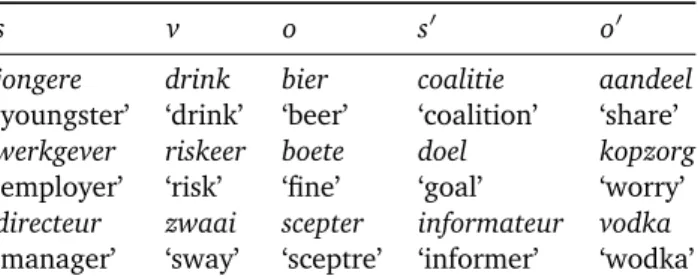
to evaluate the generalization capabilities of the algorithm. The task is to judge which subject (sors0) and direct object (ooro0) are more likely for a particular verbv, where(s,v,o)is a combination drawn from the corpus, ands0ando0are a subject and direct object randomly drawn from the corpus. A triple is considered correct if the algorithm prefers both s and o over their counterparts s0 and o0
(so the (s,v,o) triple – that appears in the test corpus – is preferred over the triples(s0,v,o0),(s0,v,o)and(s,v,o0)). Table 10.7 shows three examples from the pseudo-disambiguation task.
s v o s0 o0
jongere drink bier coalitie aandeel
‘youngster’ ‘drink’ ‘beer’ ‘coalition’ ‘share’
werkgever riskeer boete doel kopzorg
‘employer’ ‘risk’ ‘fine’ ‘goal’ ‘worry’
directeur zwaai scepter informateur vodka
‘manager’ ‘sway’ ‘sceptre’ ‘informer’ ‘wodka’
Table 10.7: Three examples from the pseudo-disambiguation evaluation task’s test set
Four different models have been evaluated. The first two models are tensor factorization models. The first model is thentfmodel, as described in section 4.3.2.
The second model is the originalparafac model (described in section 4.3.1),
without the non-negativity constraints.
The other two models are matrix factorization models. The third model is the non-negative matrix factorization (nmf) model, and the fourth model is the singular
value decomposition (svd). For these models, a matrix has been constructed that
contains the pairwise co-occurrence frequencies of verbs by subjects as well as direct objects. This gives a matrix of1kverbs by10ksubjects+10kdirect objects
(1k×20k). The matrix has been transformed using pointwise mutual information.
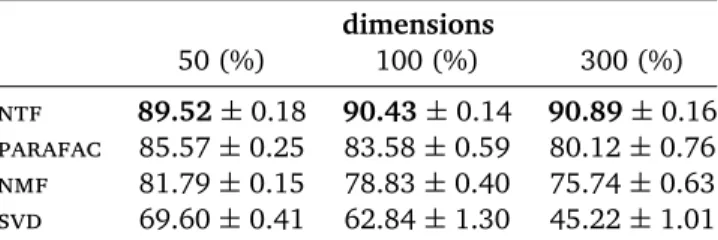
The models have been evaluated with 10-fold cross-validation. The corpus contains 298,540 different(s,v,o)co-occurrences. Those have been randomly divided into 10 equal parts. So in each fold, 268,686 co-occurrences have been used for training, and 29,854 have been used for testing. The accuracy results of the evaluation are given in table 10.8.
The results clearly indicate that thentfmodel outperforms all the other models.
148 10.5 Conclusion dimensions 50 (%) 100 (%) 300 (%) ntf 89.52±0.18 90.43±0.14 90.89±0.16 parafac 85.57±0.25 83.58±0.59 80.12±0.76 nmf 81.79±0.15 78.83±0.40 75.74±0.63 svd 69.60±0.41 62.84±1.30 45.22±1.01
Table 10.8: Results of the 10-fold cross-validation for thentf,parafac,nmfand svdmodel for 50, 100 and 300 dimensions (averages and standard deviation)
between the differentntfmodels are not very large – all attaining scores around
90%.
Theparafacresults indicate the fitness of tensor factorization for the induction
of three-way selectional preferences. Even without the constraint of non-negativity, the model outperforms the matrix factorization models, reaching a score of about 85%. The model deteriorates when more dimensions are used.
Both matrix factorization models perform worse than their tensor factorization counterparts. Thenmfstill scores reasonably well, indicating the positive effect of
the non-negativity constraint. The simplesvdmodel performs worst, reaching a
score of about 70% with 50 dimensions.
10.5
Conclusion
This chapter has presented a novel method that is able to investigate three-way co-occurrences. Other distributional methods deal almost exclusively with pairwise co-occurrences. The ability to keep track of multi-way co-occurrences opens up new possibilities and brings about interesting results. The method uses a factorization model – non-negative tensor factorization – that is suitable for three way data. The model is able to generalize among the data and overcome data sparseness.
The method has been applied to the problem of selectional preference induction. The results indicate that the algorithm is able to induce selectional preferences, leading to a broad kind of frame semantics. The quantitative evaluation shows that use of three-way data is clearly beneficial for the induction of three-way selectional preferences. The tensor models outperform the simple matrix models in the pseudo-disambiguation task. The results also indicate the positive effect of the non-negativity constraint: both models with non-negative constraints outperform their non-constrained counterparts. The results as well as the evaluation indicate
that the method presented here is a promising tool for the investigation ofnlp
topics.
There is, however, quite some room for future work. First of all, we want to further investigate the usefulness of the method for selectional preference induction. One of the most important extensions is the inclusion of other dependency relations in our model, apart from subjects and direct objects (thus making use of tensors with more than 3 modes).
Secondly, there is room for improvement and further research with regard to the tensor factorization model. The model presented here minimizes the sum of squared distance. This is, however, not the only objective function possible. Another possibility is the minimization of the Kullback-Leibler divergence. Minimizing the sum of squared distance assumes normally distributed data, and language phenomena are rarely normally distributed. Other objective functions – such as the minimization of the Kullback-Leibler divergence – might be able to capture the language structures much more adequately. We specifically want to stress this second line of future research as one of the most promising and exciting ones.
Finally, the model presented here is not only suitable for selectional preference induction. There are many problems innlpthat involve three-way co-occurrences.
In future work, we want to apply thentfmodel presented here to other problems
In this dissertation, we have investigated the extraction of semantic similarity using distributional similarity techniques. In the first part, we investigated what kind of information might be able to provide cues about the semantics of words, and we determined that the context of a word is able to inform us about its semantics. We established three different kinds of context – a document-based context, a window-based context, and a syntax-window-based context – and we provided a formalization of the notion of context, so that the semantics of a word can be formally computed. Next, we gave an overview of two dimensionality reduction algorithms – singular value decomposition and non-negative matrix factorization – two algorithms that reduce the vast number of overlapping feature dimensions to a limited number of generalized dimensions that might be able to capture inherent semantics character-istics present in the data. We also provided an overview of tensor algebra and the multilinear generalization of non-negative matrix factorization in tensor space – non-negative tensor factorization. Using tensor algebra, we are not limited to using co-occurrences in two modes; three-way methods allow us to analyze multi-way co-occurrences, which allow us to capture the semantic information present in the data in a more informed and thorough way.
In the second part of this dissertation, we provided a quantitative overview of three different groups of models of semantic similarity, constructed according to the three different notions of context. We experimented with different parameters, and determined what models and parameters yield the best results according to three different evaluation schemes. In the first two evaluation schemes – the evaluation of wordnet-based similarity and the evaluation of cluster quality – we evaluated
152
the models’ ability to extract tight, synonym-like similarity. In the third evaluation scheme – the evaluation of domain coherence – we evaluated the models’ ability to extract more loosely related, topical similarity. In all evaluations, we paid special attention to the effects of dimensionality reduction algorithms.
In the third part, we developed a number of applications that make use of the techniques (and the resulting semantic resources) presented in the first part. In the first application, we used an automatically induced lexico-semantic clustering to extract multi-word expressions based on their non-compositionality. In the second application, we described a technique that combines a syntactic context and a large window-based context in a factorization framework, in order to discriminate among the different senses of nouns. And in the third application, we explored three-way methods in combination with non-negative tensor factorization in order to induce three-way selectional preferences.
We are now able to answer the three research questions that were formulated in the introduction of this dissertation. In the evaluation part of this dissertation, we have shown that different notions of context lead to different kinds of similarity. We concluded that syntax-based models and window-based models with a small window are best suited for the extraction of tight, synonym-like similarity. This was indicated by their performance on the wordnet-based similarity evaluation and the evaluation of cluster quality. By nature, words that are tightly similar are also topically coherent, which was indicated by the good performance of these models on the third evaluation task. On the other hand, the document-based models and window-based models with large windows size – the models that did not perform well on the extraction of tight similarity – still performed reasonably well on the third evaluation task. We concluded that a tight context (syntax-based or small window-based) leads to tight, synonym-like similarity, whereas a broad context (document-based or large window-based) captures more loosely related topically similar words. We also showed that an automatically induced clustering based on syntactic context allows us to extract multi-word expressions based on their non-compositionality, and that a tight, syntactic context and a broad window-based context can be combined in a non-negative matrix factorization framework in order to discriminate the different senses of a noun.
The answer to our second research question is mixed. On the one hand, our quantitative evaluation indicated that dimensionality reduction algorithms do not bring about a large improvement in the extraction of semantic similarity. Dimensionality reduction was only beneficial for the document-based model. In the other models, dimensionality reduction did not improve or even hurt the performance. The performance of the non-negative matrix factorization models in the quantitative evaluation was particularly disappointing.
On the other hand, dimensionality reduction algorithms did prove beneficial in a number of applications. Non-negative matrix factorization allowed us to induce a number of semantic dimensions according to which context words and syntactic relations could be classified. These dimensions in turn allowed us to subtract dimensions related to a specific sense of a noun, so that other senses of the word become apparent. The multilinear generalization of non-negative matrix factorization – non-negative tensor factorization – was also beneficial for the induction of selectional preferences.
Which brings us to our third research question: we have demonstrated the usefulness of three-way methods for the induction of selectional preferences. The quantitative evaluation shows that the use of three-way data is beneficial for the induction of three-way selectional preferences. The tensor models outperform the simple matrix models in the pseudo-disambiguation task. The results also indicate the positive effect of the non-negativity constraint: both models with non-negative constraints outperform their non-constrained counterparts. The results indicate that three-way methods are a promising tool for the investigation ofnlptopics.
A
ppendix
A
Clustering Tasks
A.1
Concrete noun categorization
noun translation class6 class3 class2 kip chicken bird animal natural arend eagle bird animal natural eend duck bird animal natural zwaan swan bird animal natural uil owl bird animal natural pinguïn penguin bird animal natural pauw peacock bird animal natural hond dog groundAnimal animal natural olifant elephant groundAnimal animal natural koe cow groundAnimal animal natural kat cat groundAnimal animal natural leeuw lion groundAnimal animal natural varken pig groundAnimal animal natural slak snail groundAnimal animal natural schildpad turtle groundAnimal animal natural kers cherry fruitTree vegetable natural banaan banana fruitTree vegetable natural peer pear fruitTree vegetable natural ananas pineapple fruitTree vegetable natural
156 A.1 Concrete noun categorization
champignon mushroom green vegetable natural maïs corn green vegetable natural sla lettuce green vegetable natural aardappel potato green vegetable natural ui onion green vegetable natural fles bottle tool artifact artifact potlood pencil tool artifact artifact pen pen tool artifact artifact beker cup tool artifact artifact kom bowl tool artifact artifact schaar scissors tool artifact artifact ketel kettle tool artifact artifact mes knife tool artifact artifact schroevendraaier screwdriver tool artifact artifact hamer hammer tool artifact artifact lepel spoon tool artifact artifact beitel chisel tool artifact artifact telefoon telephone tool artifact artifact boot boat vehicle artifact artifact auto car vehicle artifact artifact schip ship vehicle artifact artifact vrachtwagen truck vehicle artifact artifact raket rocket vehicle artifact artifact motor motorcycle vehicle artifact artifact helikopter helicopter vehicle artifact artifact