APPENDIX 4
CONSTRUCTION ENVIRONMENTAL MANAGEMENT
FRAMEWORK
Construction Environmental
Management Framework
PERTH GROUNDWATER REPLENISHMENT SCHEME
Project Number:
CW00854
Document Number:
AQUA Document No. 9166974
Document History
Version Author(s) Reviewed by
1 M. Ee Harrison R. Duckworth
Reference
This document should be cited as:
Water Corporation (2013) Perth Groundwater Replenishment Scheme Project No C-W00854 Construction
53
SUMMARY OF SIGNIFICANT RISKS AND CONTROLS
Risk Project Specifics Controls Responsibilities Impacts Performance Indicators
Consequence Likelihood Risk
Introduce and/or spread of the plant pathogen, Phytophthora cinnamomi. Dieback
The project area is in a zone susceptible to Phytophthora dieback rainfall greater than 400 millimetres south of the 26th parallel of latitude 1. Weed Inspection Checklist 2. Hygiene inspection points will be
determined prior to start of works.
3. All vehicles and machinery clean on entry to site.
4. Mobile Plant kept within clearing corridor 5. Any imported fill to be
from a dieback free area or determined to be from a dieback free source 6. Awareness materials communicated to site personnel 1. Site Supervisor 5. Project Engineer 6. Environmental Scientist Loss of natural habitat/ biodiversity Potential local species extinction Raising of the water table (long term effect - salinity) No introduction or spread of the pathogen Phytophthora cinnamomi.
Catastrophic Rare HIGH
Interaction with heritage sites (European and Aboriginal) Indigenous Land Owners will be commissioned to supervise works during the later part of the Project where Aboriginal Heritage overlays the water main placement.
Responsibility – Project Management
1. Demarcation of heritage sites
2. Operator training and competency 3. Work to cease and
Project Manager notified should any skeletal material or artefacts be found. 1. Project Engineer/Environ mental Scientist Potential to clear or cause damage to Heritage sites Legal Non-Compliance Damage to stakeholder relationships No incidents resulting from intrusion/damage to heritage sites
Major Rare MODERATE
Acid Sulphate Soil Exposure
ASS were not
identified as being present in the project area
1. Acid Sulphate Soils & Dewatering
Management Plan 2. Geotechnical report
supplied by third party 3. Laboratory analysis Soil, groundwater and surface water contamination Death or injury to local flora and/or fauna Damage to corporate reputation No death or injury to flora and /or fauna
Minor Unlikely LOW
Above content is provided as an
example
for the purpose of this template. This table to be completed by
Contents
1. Overview ... 4 1.1 Project Outline ... 4 1.1.1 Project Background ... 4 1.1.2 Project Location ... 4 1.1.3 Project Infrastructure ... 61.2 Purpose of this CEMF ... 6
1.2.1 Environmental Requirements of the CEMF ... 6
1.3 Specifications ... 7
1.4 Implementation of Contingency Actions ... 7
1.5 Environment Policy ... 7
1.6 Training on the CEMF ... 7
2. Definitions ... 8
3. Abbreviations ... 10
4. Roles and Responsibilities ... 11
5. Flora and Vegetation Clearing Management Plan ... 13
5.1 Declared Rare and Priority Flora Species ... 14
5.2 Vegetation Communities and Condition ... 14
6. Fauna Management Plan ... 16
6.1. Declared Rare and Priority Fauna Species ... 16
7. Hygiene Management Plan ... 19
8. Dewatering Management Plan ... 20
9. Dust Management Plan ... 22
10. Fire Management Plan ... 23
11. Waste Management Plan ... 26
Page 3 of 53 Page 3 of 53
15.1. Definition of Environmental Incidents ... 36
15.2. Definition of Environmental Hazards ... 36
16. Compliance Management Plan ... 39
17. Community Complaints and Consultation Management Plan ... 41
18. Performance Review and Reporting Management Plan ... 42
19. References ... 44
List of Figures
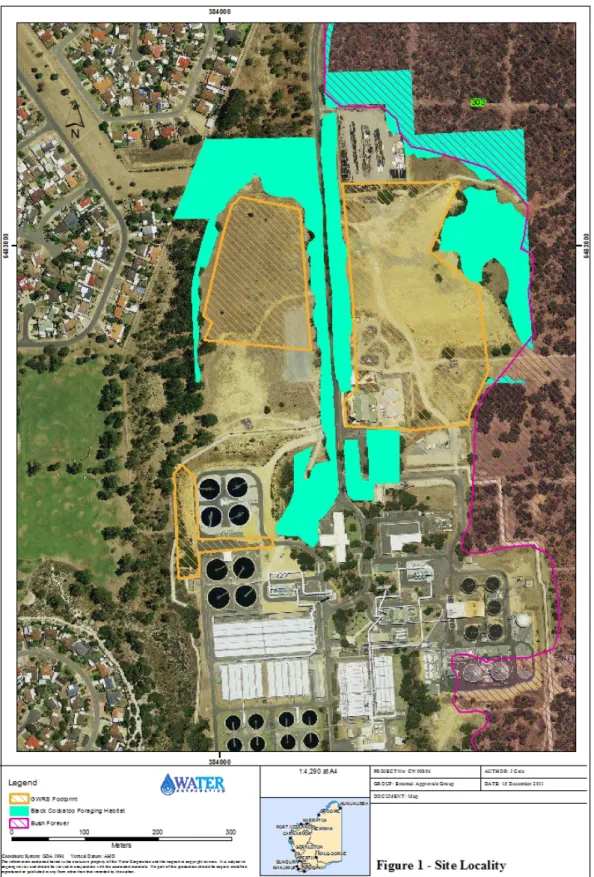
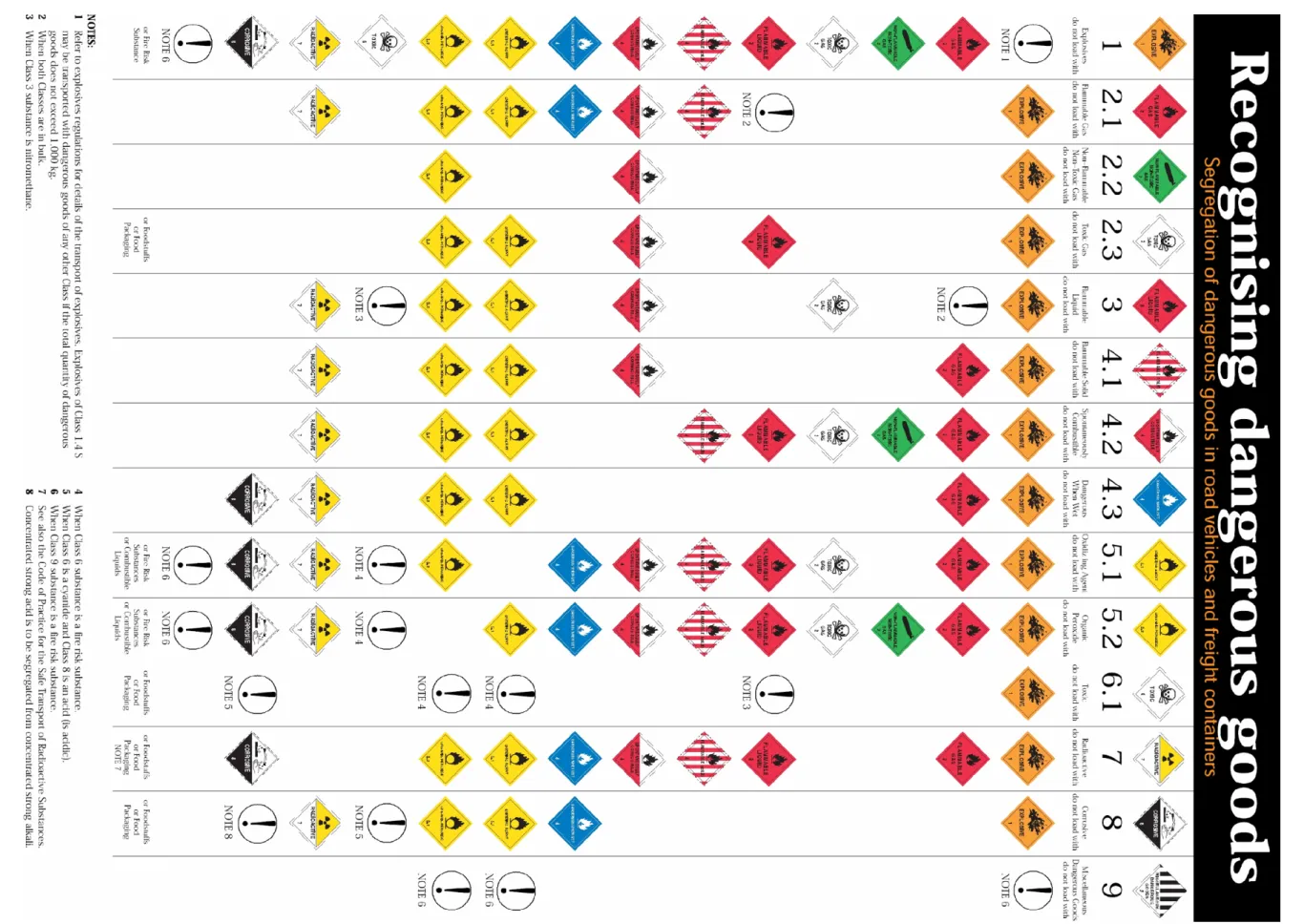
Figure 1: GWRS locality plan ... 5Figure 2 Guidance on Segregation of Dangerous Goods... 31
Figure 3 Water Corporation’s Incident Report Form ... 38
Figure 4 Compliance Assessment Process Flowchart ... 40
List of Tables
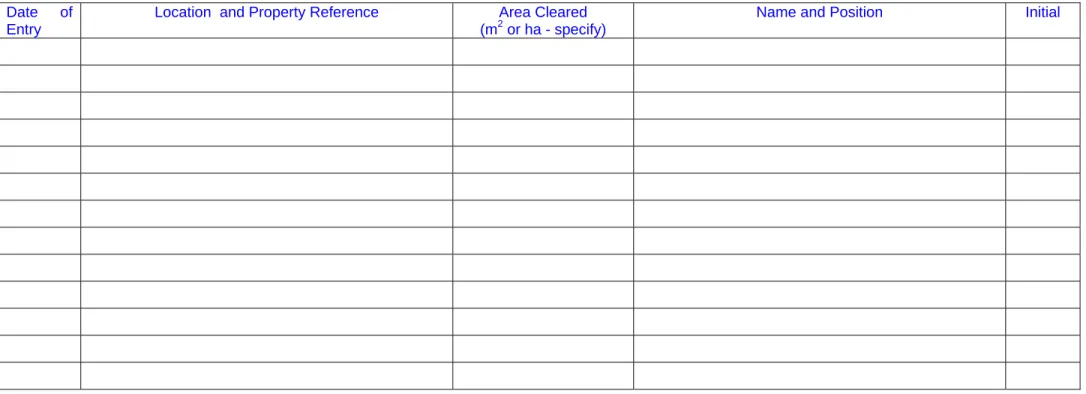
Table 1 Native Vegetation Clearing Log... 15Table 2 Vertebrate Fauna species located within the Project area. ... 17
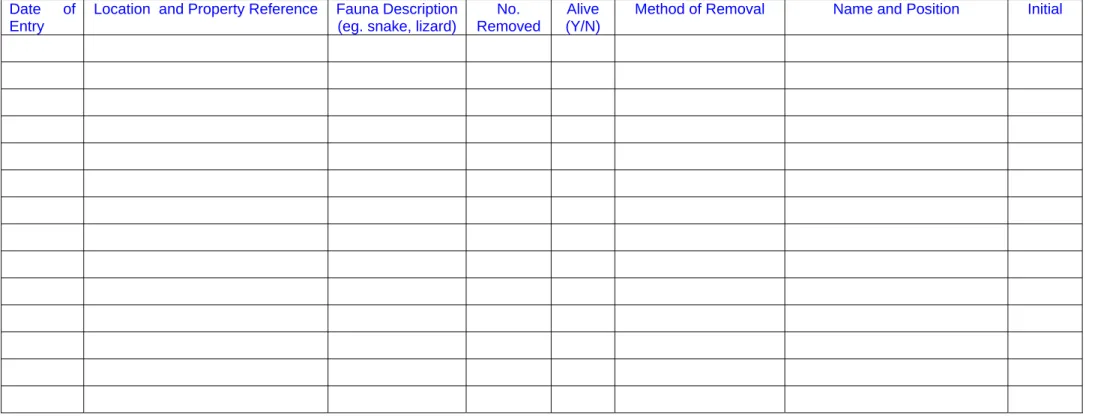
Table 3 Fauna Removal Log ... 18
Table 4 Water Discharge Monitoring Log ... 21
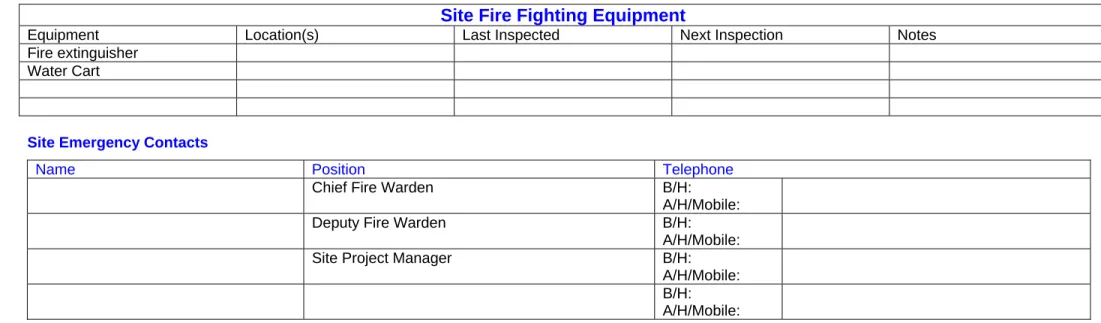
Table 5 Fire Management Log (2 pages) ... 24
Table 6 Noise Monitoring Log ... 29
Table 7 Dangerous Goods Manifest (4 pages) ... 32
Table 8 Water Corporations Environmental Incident Contact List ... 37
List of Appendices
APPENDIX 1 Water Corporation Environmental Policy ... 461.
Overview
1.1 Project Outline
1.1.1 Project Background
Following the conclusion of a successful Groundwater Replenishment Trial (“GWRT”), the Water Corporation is proposing to implement a 14 gigalitre per annum (“GLpa”) groundwater replenishment scheme (“GWRS”) as a climate independent water source for Perth, Western Australia. The GWRS seeks to build on the proven technology and stringent water quality management framework developed for the GWRT and increases the scope of the project to allow the recharge of 14GLpa from the existing capacity of 1.5GLpa.
The Water Corporation conducted the three year GWRT at the Beenyup Waste Water Treatment Plant (WWTP) site to assess the technical and social feasibility of an advanced water recycling process for producing water that is suitable for replenishing groundwater. The GWRT commenced construction in 2009 and began recharge to the Leederville aquifer on 10th November 2010 following a twelve month performance validation of the Advanced Water Recycling Plant (“AWRP”). The GWRT was successfully completed in December 2012. Since completing the GWRT, the Water Corporation has continued to operate the AWRP in accordance with operating licence L8379/2009/2 to provide a water source benefit and maintain regulatory and community confidence in groundwater replenishment.
1.1.2 Project Location
The extent of the proposed GWRS is shown in Figure 1 and is located adjacent to the Beenyup WWTP.
Page 5 of 53 Page 5 of 53
1.1.3 Project Infrastructure
Onsite works for will include:
Earthworks, roads, fencing, drainage.
Below ground structures intersecting the Beenyup Ocean Outfall, including a feed water pump station.
Above ground storage tanks for secondary treated wastewater and recycled water.
Building/s housing all process plant, electrical systems, chemical storages.
Buried pipelines, power cables and control interconnecting the above.
Admin and workshop buildings.
1.2 Purpose of this CEMF
This Construction Environmental Management Framework (CEMF) outlines the actions to be taken to minimise environmental impacts arising during construction. It is the primary objective that all environmental impacts during construction are avoided or minimised as far as practicable at all construction locations.
It is the purpose of this CEMF to:
1. Enable the successful contractor develop an appropriate Construction Environmental Management Plan (CEMP) for the works.
2. Ensure the CEMP addresses the statutory environmental requirements for the project (refer below).
3. Identify the actions to be undertaken to manage the environmental impacts of the construction works.
4. Ensure that the management actions are in accordance with accepted Water Corporation standards. Details of these documents are provided in the relevant sections of the CEMF and may be accessed through the Water Corporation web site.
5. Address community and government expectations of transparency and accountability by identifying the management actions and making this CEMF publicly available.
1.2.1 Environmental Requirements of the CEMF
This CEMF focuses on the management actions to be implemented during construction by construction staff. Consequently, background environmental information on the proposal has been intentionally limited.
The environmental issues addressed in this CEMF include:
Flora and vegetation;
Fauna;
Dewatering;
Surface water;
Page 7 of 53 Page 7 of 53
Noise;
Dangerous goods and chemicals;
Environmental incidents;
Community complaints and consultation; and
Performance monitoring, reporting and compliance with all aspects of the CEMF.
It is the intention of the Water Corporation that this CEMF is used as a basis for a project specific CEMP which will be developed with the assistance of the stakeholders listed for each management plan. Stakeholders will be consulted for specific matters within their spatial or statutory jurisdiction to enable the stakeholders to have an opportunity to provide input into the management actions governing the project.
1.3 Specifications
This CEMF and the materials and methodologies therein are correct as of the publication date. The following changes to materials and methodologies will not invalidate this plan:
1. Changes to materials that do not result in additional or different environmental impacts. 2. Minor changes to methodologies that do not result in lessened environmental monitoring
and/or additional or different environmental impact.
Changes to the materials or methodology that may result in reduced monitoring and/or cause a significant environmental impact will be referred to the relevant advisory agencies prior to implementation of the change.
1.4 Implementation of Contingency Actions
The CEMP that is to be prepared by the contractor is to outline a number of contingency actions that may be used in the event that the management actions proposed do not achieve the purpose stated in each management plan.
1.5 Environment Policy
This CEMF has been drafted to support the Water Corporation’s Environmental Policy as contained in Appendix 2.
1.6 Training on the CEMF
All staff involved in the construction of the GWRS will receive training on relevant management plans within this CEMF. The names of the people trained on this CEMF will be recorded in a CEMF Training Log along with the date and the specific plans for which that training was conducted.
2.
Definitions
The terms if used in this CEMF have the following meanings:
Bund means an embankment of earth or a wall constructed of brick, stone or concrete to form the perimeter of a compound that will prevent lateral movement of the material contained within the embankment or wall.
Declared Rare Flora means the flora protected under the Wildlife Conservation Act 1950 (WA) due to it being rare, in danger of extinction, or otherwise in need of special protection.
Elder means a mature person of Aboriginal decent with experience and knowledge on matters related to aboriginal culture, customs, traditions and/or heritage, as determined by the Aboriginal community.
Environmental Harm means the direct or indirect alteration of the environment as defined by the
Environmental Protection Act 1986 (WA).
Environmental Incident means any event or impact on the environment involving the Water Corporation and/or its contractor’s actions or assets that is capable of:
causing harm to the environment or any person or property;
causing pollution; and/or
coming to the attention of an environmental regulatory agency.
Excavator means a machine used for excavating soil or sediment material and may include a backhoe excavator, bulldozer, dredge or other similar equipment.
Ground Disturbing Activities means the disturbance of earth or waters involving machinery including clearing, excavation, backfilling and compacting, but excludes geotechnical investigations, surveying, fencing and rehabilitation works.
Fauna means animals.
Flora means plants.
Habitat Tree means a mature native tree containing hollows that may be suitable for habitat of native fauna.
Initial Ground Disturbing Activities means the disturbance of earth or waters involving machinery including clearing and excavation to a depth of 0.5m, but excludes geotechnical investigations, surveying, excavation in excess of 0.5m, backfilling, compacting, fencing and rehabilitation works.
Landowner means the person(s) or management body that lawfully owns or lawfully manages a specific parcel of land.
Native Vegetation means any local indigenous plant community containing throughout its growth the complement of native species and habitats normally associated with that vegetation type or having the potential to develop these characteristics. It includes vegetation with these characteristics that has been regenerated with human assistance following disturbance. It excludes plantations and vegetation that has been established for commercial purposes.
pHFmeans a field test of a water and soil paste to determine the presence of actual acid sulphate
soils.
Page 9 of 53 Page 9 of 53
Priority Flora means flora that is recognised by the DER as being under threat and in urgent need of further study; but is not yet declared rare flora under the Wildlife Conservation Act 1950 (WA). Priority Flora is divided into Priority 1, Priority 2, Priority 3 and Priority 4 listings, with Priority 1 being the flora most under threat.
Registered Site means a defined spatial area registered as having significance to Aboriginal persons under the Aboriginal Heritage Act 1972 (WA). The term excludes sites listed as “Stored Data” on the Department of Indigenous Affairs heritage database, which are not classified as sites under the Aboriginal Heritage Act 1972 (WA).
Superintendent’s Representative means the person nominated by the Superintendent from time to time in writing by and representing the Superintendent.
Watercourse means a river, creek, gully, brook or irrigation channel that contains or has contained water, but excludes wetlands.
Water level indicator means a round steel post with a flat marked gauge plate of white background and black 1cm increment gauge markings each with a total nominal length of 2.0m (refer Water Corporation Plan B055-18-1 for example).
Wetland means land that is permanently, seasonally or intermittently waterlogged or inundated with water, but excludes watercourses.
3. Abbreviations
The following abbreviations used in this CEMF have the following meanings:
Terms
CEMF Construction Environmental Management Framework CEMP Construction Environmental Management Plan DAF Department of Agriculture and Food (WA) DER Department of Environmental Regulation (WA) DFES Department of Fire and Emergency Services (WA) DIA Department of Indigenous Affairs (WA)
DMP Department of Minerals and Petroleum DoH Department of Health (WA)
DoW Department of Water (WA)
DPAW Department of Parks and Wildlife (WA)
DSEWPaC Department of the Sustainability, Environment, Water, Population and Community (C’th)
MRWA Main Roads Western Australia MSDS Materials Safety Data Sheet
NATA National Association of Testing Authorities SWALSC South West Aboriginal Land and Sea Council
Measurement Cm Centimetre m Metre m2 Square metre km Kilometre ha Hectare kg Kilograms kg/ha Kilograms per hectare mg/kg Milligrams per kilogram mg/L Milligrams per litre
ML Megalitre GL/y Gigalitres per year ML/y Megalitres per year o
C Temperature in degrees Celsius
dB Decibels of noise
Page 11 of 53
4. Roles and Responsibilities
Project Manager
Overall Environmental Responsibility: Integrate minimisation of environmental harm into project planning/management.
Separate Responsibilities:
Include the environment into all aspects of project planning, including the preparation of tenders;
Allocate project resources to handle environmental issues;
Ensure suppliers and contractors comply with environmental requirements;
Report on environmental issues to Project Manager and to ECSB Management;
Investigate and ensure that environmental incidents are recorded on the Corporate Incident Management System;
Review the performance of environmental management on a monthly basis; and
Ensure environmental inspection is conducted.
Supervising Foreperson
Overall Environmental Responsibility: Plan all works and activities on site to comply with the requirements of this integrated management plan.
Separate Responsibilities:
Assist and guide the respective workers to meet their environmental responsibilities;
Check the implementation of the environmental section of this integrated management plan;
Report to the Construction Engineer on environmental issues;
Monitor the rectification of incidents;
Provide technical advice to personnel and management in the review of work methods; and
Conduct a Site Start-up Meeting with the Site Personnel on site.
Site Supervisor
Overall Environmental Responsibility: Ensure that all works and activities on site are carried out within the environmental requirements of this integrated management plan.
Separate Responsibilities:
Overall Environmental Responsibility: Ensure that the Environmental Management section of this integrated management plan is implemented effectively;
Incorporate the Environmental Management section of this integrated management plan into project specific procedures, including JSAs, and toolbox meetings;
Implement appropriate action to address any environmental incidents;
Ensure suppliers and contractors comply with environmental requirements;
Halt construction activities in the event of inadequate environmental performance; and
Regularly liaise with the Construction Engineer and Supervising Foreman regarding environmental issues.
Site (Contractors) Environmental Scientist
Overall Environmental Responsibility: Ensure contractor is managing environment issues/impacts along with meeting their legal and other requirements.
Separate Responsibilities:
Liaise with Construction Engineer regarding the environmental aspects and impacts of the project;
Liaise with Clients Environment Representative regarding project specific environmental issues;
Draft integrated management plan in consultation with Construction Engineer;
Continuously review and update the integrated management plan in consultation with Construction Engineer;
Conduct environmental audit as per Contract Audit Schedule.
Ensure that the Environmental Management sectionof this integrated management plan is effectively established, implemented and maintained at the project level;
Be present on-site during any critical construction activities and provide support to the Contractor’s team to enable them to meet their environmental commitments;
Implement an appropriate environmental awareness training programme and ensure all site personnel complete the training program;
Ensure that environmental records and files are maintained;
Complete environmental checklists and report/liaise to the Site Supervisor;
Ensure community complaints and non-conformances are recorded and appropriately considered;
Investigate and report on any environmental incidents and ensure that appropriate action is taken;
Undertake environmental monitoring requirements as required by approvals, licenses and permits;
Prepare and collate documentation for Audit of compliance with CEMP, by Water Corporation Environment Branch’s Operations Section.
All Employees (and hired Plant Operators) - (Full time)
Overall Responsibility: Contribute to effective environmental management at the site for the life of the project, by implementing the environmental section of this integrated management plan within their area of responsibility.
Separate Responsibilities:
Comply with the relevant Act, Regulations, Codes of Practice and Standards;
Comply with the Environmental Policy & Procedures;
Comply with the Dieback Hygiene requirements as detailed in the Environmental – Significant Risks and Controls;
Do not clear, damage or burn any vegetation outside the area permitted to be cleared as detailed in the Clearing Permit;
Promptly report to management any environmental non-conformances and/or breaches; and
Participate in environmental awareness training as directed by management.
Water Corporation (Client) Environmental Scientist
Overall Environmental Responsibility: Ensure contractor is implementing environment management measures in accordance with the CEMP (developed with reference to this CEMF).
Separate Responsibilities:
Complete site inspections to verify contractor performance in accordance with the CEMP. Frequency of inspections to be determined with respect to project risk;
Page 13 of 53 Page 13 of 53
5. Flora and Vegetation Clearing Management Plan
Purpose
The construction works will require clearing of native vegetation. The construction area supports locally and regionally significant flora. Clearing will be carried out within defined clearing widths/areas to minimise construction impacts on flora and to reduce the area requiring rehabilitation.
Separate management actions are required for land clearing in agricultural land and native vegetation, with specific actions on retaining topsoil for seed and nutrient retention for the rehabilitation works. The clearing of land and trenching through wetlands also requires appropriate specific management actions.
Dust can be generated from land clearing activities and from cleared areas exposed to wind. Dust generation has the potential to be a physical and health hazard, and can adversely affect the amenity of the construction staff and the community.
The clearing required for the proposed works has been assessed and is to be conducted in accordance with the Water Corporation’s Statewide Clearing Permit. The conditions associated with the clearing permit must be complied with (see Appendix 3).
Objective
1. Minimise construction impacts on flora, more specifically to:
a. protect Declared Rare Flora, consistent with the provisions of the
Wildlife Conservation Act 1950 (WA);
b. protect Critically Endangered, Endangered and Vulnerable flora, consistent with the provisions of the Environment Protection and Biodiversity Conservation Act 1999 (Commonwealth);
c. minimise impacts on Priority Flora identified by the DER; and d. minimise impacts to flora and vegetation, and wetland function,
associated with identified wetlands of conservation significance or their buffers.
2. Remove topsoil during clearing as stated, and return it following installation of infrastructure.
3. Minimise and control dust generation.
Performance Indicators
Management
Compliance with the Water Corporation’s clearing permit CPS 185/4.
Compliance with the prescribed management actions.
Vegetation
Vegetation clearing is limited to within pre-determined clearing widths. The area of vegetation cleared must not exceed approved areas in the clearing permit.
Habitat trees will be marked prior to construction and retained where possible.
Protected flora and fauna will not be disturbed without approval under the
Wildlife Conservation Act 1950 (WA) and/or the Environment Protection and Biodiversity Conservation Act 1999 (C’th) (as appropriate).
Dust
Prevent dust from leaving the construction areas as much as practicable.
Aspect Description Responsibility Management
Actions This section to be completed by the Contractor. Contingency
Actions Contractor to list contingency actions proposed. Management
Standards
Gaining Approvals to Clear Native Vegetation Aqua No. 1607304
Rare Flora Aqua No. 367310
Related Plans
Fauna Management Plan
Dewatering.
Hygiene Management.
Environmental Incident Management.
Relevant Legislation
Wildlife Conservation Act 1950, and Regulations 1970 (WA).
Environmental Protection Act 1986, and Regulations 1987 (WA).
Conservation and Land Management Act 1984, and Regulations 2002
(WA).
Environment Protection and Biodiversity Conservation Act 1999 (C’th).
Advisory Agencies
DER
DAF
SEWPaC
5.1 Declared Rare and Priority Flora Species
Details of the outcome of the survey are provided within the report “Water Corporation Beenyup Stage 1 Biological Survey, January 2013” available to the successful contractor. No rare or priority flora or threatened ecological communities were recorded within the proposed project footprint. However, the proposed location is adjacent to Bush Forever Site 303, designated as Whitfords Avenue Bushland, Craigie/Padbury. The AWRP is proposed to be located west of the Bush Forever site with no development proposed within the Bush Forever site.
Good quality suitable foraging habitat is present within the mixed Banksia and Xanthorrhoea heathland habitat (Bush Forever site) (1.79 ha), as well as within the Pine plantation (0.37 ha), areas of Eucalypt woodland with scattered Xanthorrhoea (2.27 ha) and open Eucalyptus woodland with sparse Acacia/Melaleuca understorey (2.72 ha).
Check para format!! Ten potentially suitable breeding trees (DBH >500mm) were also identified from within the Project Area, with one of these Tuart trees observed to contain visible hollows. Carnaby’s Black‐Cockatoos have been recorded frequently within, and in close proximity to the Bush Forever site 303 and in close vicinity to the Project Area.
5.2 Vegetation Communities and Condition
The survey undertaken by Ecologia Environment states that the project area has been largely cleared and the remaining areas of native vegetation are in Poor or Very Poor condition due to the presence of invasive species and the lack of understorey. No areas are in Good Condition; 2% of the project area is in Poor Condition; 4.4% is Very Poor and 93.6% is Completely Degraded. The proposed infrastructure will be located mostly within the cleared and completely degraded areas.
Page 15 of 53
Table 1 Native Vegetation Clearing Log
Perth Groundwater Replenishment Scheme Project No C-W00854 Land Clearing and Trench Management
Native Vegetation Clearing Log
The purpose of the Native Vegetation Clearing Log is to record the area of native vegetation cleared. The area of native vegetation cleared will assist in determining the materials required for rehabilitation (tubestock, seed, staff). The Native Vegetation Clearing Log is to be completed by the Contractor on a weekly basis. Name ……… Page ……… of ……… Date of Entry
Location and Property Reference Area Cleared (m2 or ha - specify)
6. Fauna Management Plan
Purpose
The construction works will require clearing of native vegetation for the proposed infrastructure corridor. The construction area supports locally and regionally significant fauna, some of which are specifically protected under State and/or Commonwealth legislation. Clearing will be carried out in a manner to minimise construction impacts on fauna.
Excavated trenches have the potential to trap fauna, which may present an undesirable risk to the health of the fauna and/or contractors working within the trench.
Objective
Minimise construction impacts on fauna, more specifically to:
protect Specially Protected Fauna, consistent with the provisions of the
Wildlife Conservation Act 1950 (WA).
protect Critically Endangered, Endangered and Vulnerable fauna, consistent with the provisions of the Environment Protection and Biodiversity Conservation Act 1999 (C’th).
minimise impacts on Priority fauna identified by the DER.
minimise opportunities for fauna to become trapped in the excavated trenches.
response procedures for fauna that enter excavated trenches.
Performance Indicators
Compliance with the prescribed management actions.
Contacting the local DER office if fauna is injured or found trapped in the trench.
Habitat trees are marked prior to construction and retained where possible.
Aspect Description Responsibility
Management
Actions This section to be completed by the Contractor. Contingency
Actions Contractor to list contingency actions proposed. Management
Standards Interaction with WildlifeAqua No. 595494
Related Plans
Flora and Vegetation Clearing Management Plan
Dewatering and Acid Sulfate Soils.
Hygiene Management.
Watercourse Crossing Management.
Environmental Incident Management.
Rehabilitation Management.
Relevant Legislation
Wildlife Conservation Act 1950, and Regulations 1970 (WA).
Environmental Protection Act 1986, and Regulations 1987 (WA).
Conservation and Land Management Act 1984, and Regulations 2002
(WA).
Environment Protection and Biodiversity Conservation Act 1999 (C’th).
Advisory Agencies DER DPAW DAF SEWPaC
Page 17 of 53
from both direct sighting and indirect evidence such as scats and calls. These species included 4 mammals (1 native, 3 introduced), 23 birds, and 3 reptiles.
Table 3 Fauna Removal Log
Perth Groundwater Replenishment Scheme Project No C-W00854
Fauna Removal Log
The purpose of the Fauna Removal Log is to record the number, location and removal of fauna from within the trench. The Fauna Removal Log is to be completed by the Contractor on each day that fauna is removed from the trench.
Name ………
Page ……… of ………
Date of Entry
Location and Property Reference Fauna Description (eg. snake, lizard)
No. Removed
Alive (Y/N)
Page 19 of 53
7. Hygiene Management Plan
Purpose
The construction areas contain a range of weed species, which have the potential to compete with native flora. Dormant weed seeds can be contained in topsoil, which when disturbed by construction activities can cause the weed seeds to germinate. Weed species are often opportunistic and can quickly colonise cleared land.
Weeds are spread through the movement of soil from infected areas to uninfected areas. The construction areas will be surveyed prior to construction for evidence of significant weed infestations. Hygiene management actions need to be implemented during construction to prevent the potential spread of weeds.
Objective To minimise the spread of weeds from infested to uninfested land.
Performance Indicators
Compliance with the management actions (hygiene procedures) to minimise the spread of weeds.
Aspect Description Responsibility
Management Actions
This section to be completed by the Contractor.
List relevant conditions imposed by the regulator (EPA, DER) that must be complied with during the works.
Contingency
Actions Contractor to list contingency actions proposed. Management
Standards Weed Management Guideline Aqua No. 592093 Related
Plans
Flora and Vegetation Clearing Management
Watercourse Crossing Management
Relevant Legislation
Conservation and Land Management Act 1984, and Regulations 2002
(WA)
Agriculture and Related Resources Protection Act 1976 (WA)
Advisory Agencies
DER
DPAW
8. Dewatering Management Plan
Purpose
Although unlikely, the construction of the AWRP might require dewatering. Thus this needs to be taken into consideration when developing appropriate management actions.
Management of dewatering will be undertaken in a manner consistent with the risk based approach outlined in the Water Corporation Acid Sulfate Soil and Dewatering Management Strategy (Water Corporation 2007).
The nature and extent of dewatering implemented will be dependent on the method of construction and excavation employed by the successful contractor. Temporary, localised dewatering by spears and pumps will be required for excavations and installation of infrastructure in areas where the watertable is above the installation depth. Pipeline installation will occur during dry periods where practicable to reduce the need for dewatering, with the temporal extent of dewatering limited by the pipeline installation rate (at approximately 50 - 100m per day), with dewatering in any one area being completed within approximately 7 days.
Objective To minimise the environmental impacts of dewatering and discharge of water back
to the environment.
Performance Indicators
Compliance with the management actions to minimise the impacts of dewatering to the environment.
Aspect Description Responsibility
Management Actions
This section to be completed by the Contractor.
List relevant conditions imposed by the regulator (EPA, DER) that must be complied with during the works.
Contingency
Actions Contractor to list contingency actions proposed. Management
Standards Related Plans
Flora and Vegetation Clearing Management
Watercourse Crossing Management
Relevant Legislation
Environmental Protection Act 1986, and Regulations 1987 (WA).
Environmental Protection (Unauthorised Discharges) Regulations 2004
(WA)
Contaminated Sites Act 2003, and Regulations 2006 (WA).
Water Agencies (Powers) Act 1984 (WA).
Advisory Agencies
DER
Page 21 of 53
Table 4 Water Discharge Monitoring Log
Perth Groundwater Replenishment Scheme Project No C-W00854 Dewatering Management
Water Discharge Monitoring Log
The purpose of the Water Discharge Monitoring Log is to record the water quality of water discharge to land. The Water Discharge Monitoring Log is to be completed on each day of water discharge.
Name
………
Page ……… of ………
Date of Entry
Property Description and Sample Site (e.g. discharge, watercourse upstream or downstream)
Discharge Rate (L/min) Temp. (oC) pH Turbidity (visible)
9. Dust Management Plan
Purpose
All Work elements involving construction, movement of vehicles and plant, will involve temporarily increased dust levels. These activities may include:
Clearing vegetation;
Topsoil Stripping & Stockpiling;
Earthworks;
Excavation / levelling of the pads for construction;
Construction of water holding and sediment dams;
Wind movement across exposed/bare soil; and
Traffic entering and leaving the property.
Objective
Minimise the impact of dust emissions on adjacent properties.
Minimise smothering of adjacent native vegetation.
Minimise dust related OSH issues for contractors working on site.
Performance
Indicators Compliance with the management actions.
Aspect Description Responsibility
Management Actions
This section to be completed by the Contractor.
List relevant conditions imposed by the regulator (EPA, DER) that must be complied with during the works.
Contingency
Actions Contractor to list contingency actions proposed. Management
Standards Dust and Smoke - Air Quality Aqua No. 367389 Related
Plans
Flora and Vegetation Clearing Management
Traffic and Public Safety Management Plan
Relevant
Legislation Environmental Protection Act 1986, and Regulations 1987 (WA). Advisory
Page 23 of 53
10. Fire Management Plan
Purpose
The construction works include activities that may represent a fire risk. Such risks may arise from hot works (eg. welding and grinding), vehicle movements over dry vegetation, and incorrect disposal of matches or cigarettes. The Fire Management Plan will be particularly significant as construction works are likely to take place during the summer months. Fires have the potential to cause irreversible damage to the environment, property and human health or life.
Objectives Minimise the risk of preventable fires.
Respond to fires in an appropriate manner
Performance Indicators
Absence of fires generated during construction.
Response to fires in accordance with the management actions.
Aspect Description Responsibility
Management Actions
This section to be completed by the Contractor.
List relevant conditions imposed by the regulator (EPA, DER) that must be complied with during the works.
Contingency
Actions Contractor to list contingency actions proposed. Management
Standards Nil. Related
Plans
Flora and Vegetation Clearing Management Plan
Dangerous Goods and Explosives Management Plan
Relevant
Legislation Bush Fires Act 1954 (WA). Advisory
Agencies
DFES
Table 5 Fire Management Log (2 pages)
Perth Groundwater Replenishment Scheme Project No C-W00854 Page 1 of 2
Fire Management Log
The principal purpose of the log is to provide contractors and emergency service authorities with information about the quantity, type and location of fire fighting equipment and emergency contact personnel.
Contractor ……… Address of Premises ……… Date of Preparation ………
Site Fire Fighting Equipment
Equipment Location(s) Last Inspected Next Inspection Notes
Fire extinguisher
Water Cart
Site Emergency Contacts
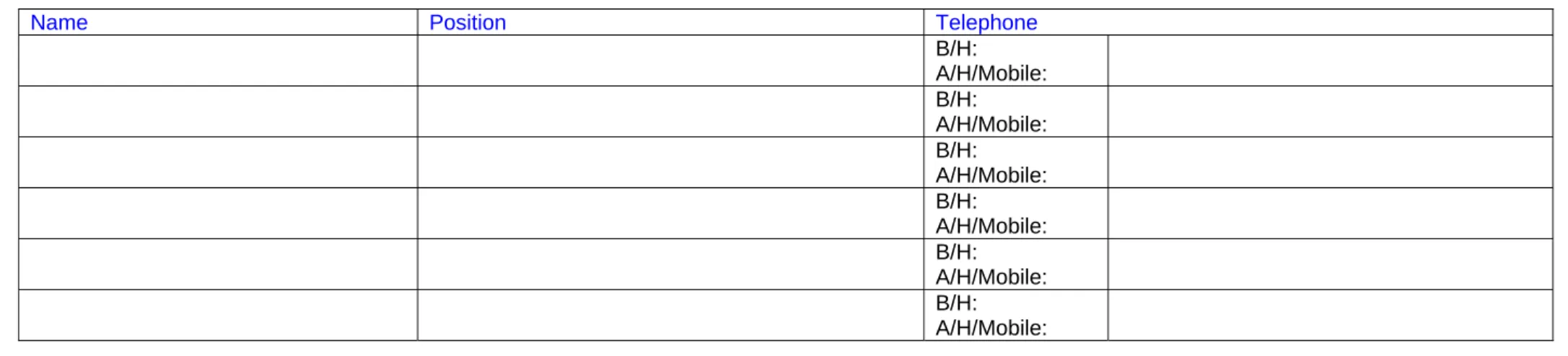
Name Position Telephone
Chief Fire Warden B/H:
A/H/Mobile:
Page 25 of 53
Perth Groundwater Replenishment Scheme Project No C-W00854 Fire Management Log
Page 2 of 2
Water Corp: Emergency Contacts
Water Corporation’s Emergency ContactsName Position Organisation Telephone
George Basanovic Corporate Incident Management Coordinator Water Corporation B/H:
A/H/Mobile:
9420 3247 0417 180 677
Chris Dolley Manager Occupational Health and Safety Water Corporation B/H:
A/H/Mobile:
9420 3347 0418 958 747
Sarah Carroll Project Manager Water Corporation B/H:
A/H/Mobile:
6330 6723 0407 983 826
Trevor Roffman OSH Consultant, Project Management Group Water Corporation B/H:
A/H/Mobile:
9420 2413 0419 919 736
Gordon Groth Environmental Compliance Manager Water Corporation B/H:
A/H/Mobile:
9420 2796 0409 941 758
External Emergency Contacts
Position Telephone
Fire and Emergency Services Authority B/H:
A/H/Mobile:
000
Police B/H:
A/H/Mobile:
000
Department of Minerals and Petroleum B/H: (08) 9358 8001
Department of Environment Regulation B/H:
A/H/Mobile:
6467 5000 1300 784 782
11. Waste Management Plan
Purpose
The construction works will produce a range of liquid and solid wastes. These wastes include but are not limited to:
Site office rubbish, paper, packaging and domestic wastes.
Spent welding rods, grinding wheels, visors and shot blast from welding operations.
Spoil and surplus rock from boring activities or backfilling.
Sewage from temporary toilets.
Used lubricating oils from machinery maintenance.
Inappropriate waste disposal has the potential to contaminate soil, surface water or groundwater and affect visual amenity. Wastes from construction must be disposed of in a lawful and environmentally acceptable manner.
Objectives
Reuse waste materials where possible
Recycle wastes where practicable
Dispose of construction wastes in an acceptable manner.
Performance
Indicators Compliance with the prescribed management actions.
Aspect Description Responsibility
Management Actions
This section to be completed by the Contractor.
List relevant conditions imposed by the regulator (EPA, DER) that must be complied with during the works.
Contingency
Actions Contractor to list contingency actions proposed. Management
Standards
Controlled Waste Guidelines Aqua No. 367285
Guideline for Controlled Waste Treatment or Disposal Sites
Related Plans
Dewatering and Acid Sulfate Soils Management Plan.
Flora and Vegetation Clearing Management Plan.
Relevant Legislation
Environmental Protection Act 1986, and Regulations 1987 (WA).
Environmental Protection (Controlled Waste) Regulations 2004 (WA).
Advisory
Page 27 of 53
12. Traffic and Public Safety Management Plan
Purpose
There will be increased vehicle movements for the cartage of materials and other equipment (excludes support vehicle movements) for the duration of the construction of the GWRS. Partial road closures may be required, and increased traffic volumes from construction vehicles will result in short-term impacts on local traffic movement. The Water Corporation will maintain ongoing consultation with the relevant Local Government Authorities (LGA) and Main Roads Western Australia (MRWA) throughout the construction period regarding the management of traffic and public safety.
Construction will occur within Water Corporation owned land, publicly accessible roads and road reserves, land vested to the LGA and crown land. The construction works involve deep earthworks, materials storage and handling, and heavy machinery and equipment that could pose a risk to members of the public if accessing the site.
Objectives
Manage construction vehicle traffic and local traffic.
Minimise construction impacts on local traffic movements.
Reduce the risk to public accessing the construction site.
Performance
Indicators Compliance with the prescribed management actions.
Aspect Description Responsibility
Management Actions
This section to be completed by the Contractor.
List relevant conditions imposed by the regulator (EPA, DER) that must be complied with during the works.
Contingency
Actions Contractor to list contingency actions proposed. Management
Standards Nil. Related
Plans Noise Management
Relevant Legislation
Local Government Act 1995 (WA)
Main Roads Act 1930 (WA)
Road Traffic Act 1974 (WA)
Advisory Agencies
MRWA
13. Noise Management Plan
Purpose
Construction works will generate noise that may interfere with the amenity of occupants of nearby properties. Noise from the construction works will be monitored to determine and manage the impacts of noise.
Noise in Western Australia is regulated under the Environmental Protection (Noise) Regulations 1997 (WA). Construction works (excluding blasting) are generally exempt from compliance with the assigned noise levels between the hours of 0700 and 1900 subject to a number of provisions (the provisions are contained within this plan). Despite this exemption, construction noise should still be managed and noise level objectives set to minimise noise impacts.
Objectives
Minimise noise pollution to surrounding land users..
Undertake noise monitoring.
Outline corrective actions to variances of noise objectives and limits.
Performance
Indicators Compliance with the prescribed management actions.
Aspect Description Responsibility
Management Actions
This section to be completed by the Contractor.
List relevant conditions imposed by the regulator (EPA, DER) that must be complied with during the works.
Contingency
Actions Contractor to list contingency actions proposed. Management
Standards Noise and Vibration Aqua No. 367306 Related
Plans
Fauna Management Plan.
Explosives and Dangerous Goods Management Plan
Vibration Management Plan
Relevant Legislation
Environmental Protection Act 1986 (WA)
Environmental Protection (Noise) Regulations 1997 (WA)
Advisory Agencies
DER
Page 29 of 53
Table 6 Noise Monitoring Log
Perth Groundwater Replenishment Scheme Project No C-W00854 Noise Management Plan
Noise Monitoring Log
The purpose of the Noise Monitoring Log is to record the levels of noise against the criteria. The Noise Monitoring Log is to be completed by the Contractor.
Name ………
Page ……… of ………
Date of Entry
Location of monitoring location (Lot number and
location description)
Construction activity description (general construction, blasting, etc)
Noise (dB)
Applicable Noise Criteria
Limit (dB)
14. Dangerous Goods Management
Purpose
Dangerous goods used and stored during construction works will include hydrocarbons (fuels & oils), and chemicals for advanced wastewater treatment (chlorine, acids). Spillages of dangerous goods have the potential to:
contaminate soil, surface water and groundwater;
impact personnel and public safety; and
create an ignition source.
Dangerous goods must be contained (bunded) to prevent spillages and ensure compliance with regulatory requirements.
Objectives
Compliant storage and containment of dangerous goods in accordance with regulatory requirements.
Compliant handling and disposal of dangerous goods.
Prevent contamination of the environment.
Performance
Indicators Compliance with the prescribed management actions.
Aspect Description Responsibility
Management Actions
This section to be completed by the Contractor.
List relevant conditions imposed by the regulator (EPA, DER) that must be complied with during the works.
Contingency
Actions Contractor to list contingency actions proposed. Management
Standards
Management of Environmental Hazards, Near Misses and Incidents Aqua No. 589090 Refer to Figure 7. Related Plans Incident Management Waste Management Relevant Legislation
Dangerous Goods Safety Act 2004 (WA)
Dangerous Goods Safety (General) Regulations 2007
Dangerous Goods Safety (Road and Rail Transport of Non-explosives) Regulations 2007
Dangerous Goods Safety (Storage and Handling of Non-explosives) Regulations 2007
Dangerous Goods Safety (Major Hazard Facilities) Regulations 2007
Dangerous Goods Safety (Explosives) Regulations 2007
Environmental Protection Act 1986 (WA)
Occupational Safety and Health Regulations 1996 (WA)
Advisory Agencies
DMP
DFES
Page 31 of 53
Figure 2 Guidance on Segregation of Dangerous Goods
Table 7 Dangerous Goods Manifest (4 pages)
Perth Groundwater Replenishment Scheme Project No C-W00854 Page 1 of 4
Dangerous Goods Log
The principal purpose of the manifest is to provide contractors and emergency service authorities with information about the quantity, type and location of dangerous goods stored.
Licensee ……… Address of Premises ……… Date of Preparation ………
Site Plan No.
………
Emergency Contacts
Name Position Telephone
B/H: A/H/Mobile: B/H: A/H/Mobile: B/H: A/H/Mobile: B/H: A/H/Mobile:
Page 33 of 53
Perth Groundwater Replenishment Scheme Project No C-W00854 Page 2 of 4
Water Corp: Dangerous Goods Emergency Contacts
Water Corporation’s Emergency ContactsName Position Organisation Telephone
George Basanovic Corporate Incident Management Coordinator Water Corporation B/H:
A/H/Mobile:
9420 3247 0417 180 677
Chris Dolley Manager Occupational Health and Safety Water Corporation B/H:
A/H/Mobile:
9420 3347 0418 958 747
Sarah Carroll Project Manager Water Corporation B/H:
A/H/Mobile:
6330 6723 0407 983 826
Trevor Roffman OSH Consultant, Project Management Group Water Corporation B/H:
A/H/Mobile:
9420 2413 0419 919 736
Gordon Groth Environmental Compliance Manager Water Corporation B/H:
A/H/Mobile:
9420 2796 0409 941 758
External Emergency Contacts
Position Telephone
Fire and Emergency Services Authority B/H:
A/H/Mobile:
000
Police B/H:
A/H/Mobile:
000
Department of Minerals and Petroleum B/H: 9358 8001
Department of Environment Regulation B/H:
A/H/Mobile:
6467 5000 1300 784 782
Perth Groundwater Replenishment Scheme Project No C-W00854
Page 3 of 4
Dangerous Goods - Maximum Permissible Quantities
Summary of Maximum Permissible Quantities - Licence under s45A of the Explosives and Dangerous Goods Act 1961 (WA) Bulk StorageTank Id No. Dangerous Goods Tank
Name Class Sub Risk(s) UN No. PG Type Capacity (L)
Package Storage Areas
Storage area Dangerous Goods Quantity (kg)
Name Class Sub Risk(s) UN No. PG Average Maximum
Other Packaged
Storage Area Class Sub Risk(s) Packaging Group Average Quantity (kg
or L)
Maximum Quantity (kg or L)
Page 35 of 53
Perth Groundwater Replenishment Scheme Project No C-W00854
Page 4 of 4
Dangerous Goods - Receipt/Removal Log
Date Received/Removed
Storage Location Type of Dangerous Good Maximum Permissible Quantity (kg) Quantity Received (kg) Quantity Removed (kg) Quantity Remaining in Storage (kg) Name of Person Receiving/ Removing
15. Environmental Incident and Hazard Management Plan
Purpose
Environmental incidents have the potential to occur on construction sites due to the scale and type of works being undertaken. Environmental incidents do not include matters where there is no impact on the environment or do not cause concern for external groups. For example, a routine variance to compliance with the CEMF and/or CEMP (routine variances will be dealt with under the Non-compliance Management Plan).
The Water Corporations Standard S110 Incident Management defines the manner in which the Principal responds to incidents. The response to environmental incidents relating to construction of the GWRS shall be managed and conducted as per Standard S110.
Objectives
Identify, manage and report on environmental incidents and hazards.
Identify management actions required for prevention of future environmental incidents and hazards.
Performance
Indicators Compliance with the prescribed management actions.
Aspect Description Responsibility
Management Actions
This section to be completed by the Contractor.
List relevant conditions imposed by the regulator (EPA, DER) that must be complied with during the works.
Contingency
Actions Contractor to list contingency actions proposed.
Management Standards
S110 Incident Management Aqua No. 367692
Environment Branch Incident Support Procedure Aqua No. 438168
Management of Environmental Hazards, Near Misses and Incidents Aqua No. 589090
Refer to Figure 9.
Related
Plans All plans are considered relevant. Relevant
Legislation All legislation identified within this CEMF. Advisory
Agencies All agencies consulted in the development of this CEMF.
15.1. Definition of Environmental Incidents
For the purposes of this CEMF, an Environmental Incident is:
Any event or impact on the environment involving actions or assets associated with the project that is capable of:
causing harm to the environment or any person;
causing pollution; and/or
coming to the attention of the public or an environmental regulatory agency.
Environmental incidents include matters such as:
Chemical spills (including hydrocarbons).
Fires.
Page 37 of 53
Any event involving actions or assets associated with the project that is capable of having the potential to cause harm to the environment or any person;
Environmental hazards include matters such as:
Bunding with holes.
Oil drums lying on their sides.
Discharges of fuel to a bund around a tank.
Table 8 Water Corporations Environmental Incident Contact List
Name Position Organisation Telephone
George Basanovic Corporate Incident
Management Coordinator Water Corporation B/H: A/H/Mobile: 9420 3247 0417 180 677
Sarah Carroll Project Manager Water
Corporation
B/H: A/H/Mobile
6330 6723 0407 983 826
Gordon Groth Environmental
Compliance Manager Water Corporation B/H: A/H/Mobile: 9420 2796 0409 941 758
Page 39 of 53
16. Compliance Management Plan
Purpose
The CEMF outlines the actions, criteria and objectives to be implemented or achieved during construction. If for any reason the actions, criteria or objectives are not implemented or achieved, a response process is required to correct those matters within an appropriate timeframe and with notification to appropriate personnel.
Objectives Identify, communicate and correct non-conformity with the management
actions contained in the CEMF and CEMP.
Performance Indicators
Compliance with the prescribed management actions.
Resolution of non-conformity with the management actions contained in the CEMP in accordance with the actions contained in this plan.
Aspect Description Responsibility
Management Actions
This section to be completed by the Contractor.
List relevant conditions imposed by the regulator (EPA, DER) that must be complied with during the works.
Contingency
Actions Contractor to list contingency actions proposed. Management
Standards
Drafting and Implementing Environmental Management Plans Aqua No. 425448 Refer to Figure 9 for guidance.
Related
Plans All plans are considered relevant. Relevant
Legislation All legislation identified within this CEMF. Advisory
Site personnel, Water Corporation or 3rd Party identifies possible
non-compliance
Possible non-compliance is reported to the on-site environmental scientist
Environmental scientist informs personnel responsible of possible
non-compliance
Possible non-compliance jointly investigated to confirm validity
Valid Invalid
Responsible personnel and site environmental scientist to determine corrective actions.
Improvement Notice (IN) issued.
Corrective actions implemented, and completion notified to the
on-site environmental scientist.
On-site environmental scientist confirms corrective actions have been implemented, and closes-out
the IN.
Completed IN lodged at the site office and forwarded to the site
management team.
Non valid status recorded by completion of the first part of Improvement Notice (records
Completed Improvement Notice lodged at the site office.
Are additional corrective actions
required? Yes
Page 41 of 53
17. Community
Complaints
and
Consultation Management Plan
Purpose
Construction works will occur within the Water Corporation’s prescribed premises. Impacts on the community during construction works are not expected. A community complaints process will be established to ensure that community complaints are managed effectively as necessary.
Objectives
Manage community expectations and address concerns.
Establish and maintain an effective community consultation programme.
Establish and maintain an effective complaint management programme.
Performance
Indicators Compliance with the prescribed management actions.
Aspect Description Responsibility
Management Actions
This section to be completed by the Contractor.
List relevant conditions imposed by the regulator (EPA, DER) that must be complied with during the works.
Contingency
Actions Contractor to list contingency actions proposed. Management
Standards
Community Engagement Guidelines Aqua No. 442000
Community Consultation Aqua No. 367296
Related
Plans All plans are considered relevant. Relevant
Legislation All legislation identified within this CEMF. Advisory
18. Performance Review and Reporting Management Plan
Purpose
This CEMP for the GWRS outlines a large number of management actions to be implemented during construction. These management actions will be audited to confirm that the management actions have been implemented. Auditing will be undertaken by the contractor, the principal or their assigned representatives and an External Auditor, and may also be undertaken by local and state regulatory agencies.
Where auditing identifies that the management actions contained in the CEMP have not been implemented or do not achieve a satisfactory environmental performance, the specified contingency actions will be undertaken. Where contingency actions are not specified or are considered unsuitable, the auditor will seek to identify alternative actions to achieve the intended environmental objective.
Objectives
Identify the schedule and context of audits against the management actions contained within this CEMP.
Confirm compliance with the management actions.
Identify potential improvements in environmental performance.
Undertake review of management plans to ensure relevance.
Report on environmental performance against all commitments and conditions.
Revise management actions and/or management plans in accordance with audit recommendations.
Performance
Indicators Compliance with the prescribed management actions.
Aspect Description Responsibility
Management Actions
This section to be completed by the Contractor. The following additional requirements must be included:
1st Party Audits - Contractor
The Contractor will undertake daily informal observations of compliance with the management actions contained in this CEMP. These audits need not be recorded – any corrective actions should be documented via meeting minutes etc. We need to keep track of these in some way.
2nd Party Audits – Principal
The Water Corporation will undertake assessments of compliance with the management actions contained in this CEMP each 3 consecutive months of construction or as specified in project work schedules. Reports generated from the audits will be provided to the Contractor.
3rd Party Audits – Principal’s External Auditor
The Principal will employ an External Auditor to undertake audits as necessary.
3rd Party Audits – DER
Page 43 of 53 State Government agencies interested in the project. The Principal will arrange the timing of such audits and inspections following requests from the local government authorities and other State Government agencies.
Additional Information
All audits by all parties should seek to indicate if the project has:
a. complied with the requirements as stipulated in the CEMF and CEMP; and
b. achieved satisfactory environmental performance.
Non-conformity will be deemed to have occurred if the requirements of this CEMF and CEMP have not been implemented and there is unsatisfactory environmental performance.
Both criteria are relevant, because although the CEMF and CEMP may not have been strictly followed, alternative (and more appropriate) actions to achieve the intended environmental outcome may have been implemented. Alternatively, compliance with the actions specified in the CEMP may not have achieved satisfactory environmental performance and require modification/corrective action.
It is expected that any audit by a 3rd party (other than the Principal’s External Auditor) will be limited to within the statutory jurisdiction of that party.
Contingency
Actions No contingency actions are considered necessary. Management
Standards Environmental Audit Procedure Aqua No. 559563 Related
Plans All plans are considered relevant. Relevant
Legislation All legislation identified within this CEMF. Advisory
19. References
The following documents were reviewed and/or cited in preparation of the CEMF:
Department of Conservation and Land Management (July 2005) Minimising Disease Risk in Wildlife Management: Standard operating procedures for fauna translocation, monitoring and euthanasia in the field.
Department of Environment (August 2003) General Guidance on Managing Acid Sulfate Soils. Department of Environment (October 2004) Acid Sulfate Soils Guideline Series – Treatment and
management of disturbed acid sulfate soils.
Department of Environmental Protection (1997) Environmental Protection (Noise) Regulations 1997: Summary of the Regulations.
Department of Industry and Resources (2003) Guidance Note S310 Rev 5: Guidelines for the Preparation of an Emergency Plan and Manifests.
Department of Water (April 2006) Water Quality Protection Note #13 – Dewatering of soils at construction sites.
Department of Water (June 2006) Draft Water Quality Protection Note #83 - Infrastructure corridors near sensitive water resources.
National Environment Protection Council (1999) National Environment Protection (Assessment of Site Contamination) Measure 1999: Schedule B(1) Guideline on the Investigation Levels for Soil and Groundwater.
National Environment Protection Council (1999) National Environment Protection (Assessment of Site Contamination) Measure 1999: Schedule B (7a) Guideline on Health-Based Investigation Levels.
Standards Australia (1981) Australian Standard AS 2436-1981 Guide to Noise Control on Construction, Maintenance and Demolition Sites.
Standards Australia (1994) Australian Standard AS 3780-1994 The storage and handling of corrosive substances.
Standards Australia (2002) Australian Standard AS1742.3-2002Manual of Uniform Traffic Control Devices - Part 3: Traffic control devices for works on roads.
Water Corporation (December 1999) Work Instruction:Water Storage – Reservoir – Alum Dosing. Water Corporation (January 2007) Guideline: Drafting and Implementation of Environmental
Management Plans.
Water Corporation (2007) Water Corporation Acid Sulphate Soil and Dewatering Management Strategy. AQUA Document No. 441876.
Page 45 of 53 Water Corporation (October 2004) SG110 Incident Management Corporate Planning Model.
Legislation referred to in this CEMF can be accessed via the Western Australian State Law Publisher website at http://www.slp.wa.gov.au or via the Australasian Legal Information Institute website at http://www.austlii.edu.au.
APPENDIX 1
Page 51 of 53
APPENDIX 2
Water Corporation Native Vegetation Clearing Permit