PII. S0161171204304400 http://ijmms.hindawi.com © Hindawi Publishing Corp.
GEOMETRICAL AND TOPOLOGICAL FOUNDATIONS
OF THEORETICAL PHYSICS: FROM GAUGE
THEORIES TO STRING PROGRAM
LUCIANO BOI
Received 20 April 2003 and in revised form 27 October 2003
We study the role of geometrical and topological concepts in the recent developments of the-oretical physics, notably in non-Abelian gauge theories and superstring theory, and further we show the great significance of these concepts for a deeper understanding of the dynam-ical laws of physics. This work aims to demonstrate that the global topologdynam-ical properties of the manifold’s model of spacetime play a major role in quantum field theory and that, therefore, several physical quantum effects arise from the nonlocal metrical and topological structure of this manifold. We mathematically argue the need for building new structures of space with different topology. This means, in particular, that the “hidden” symmetries of fundamental physics can be related to the phenomenon of topological change of certain classes of (presumably) nonsmooth manifolds.
2000 Mathematics Subject Classification: 14-xx, 55-xx, 81-xx, 83-xx.
superstring theory showed that spacetime symmetries and internal (quantum) sym-metries might be unified through the introduction of new structures of space with a different topology. This essentially means, in our view, that “hidden” symmetries of fundamental physics can be related to the phenomenon of topological change of a cer-tain class of (presumably) nonsmooth manifolds.
2. The geometrization of theoretical physics: from Cartan’s theory of gravitation to geometric quantum theories. This expository article, which summarizes the main subject of a book in progress on the same topic, is aimed at analyzing some of the most important mathematical developments and the conceptual significance of the ge-ometrization of theoretical physics, from the work of Cartan and Weyl to the recent non-Abelian gauge theories. The starting point of our reflections is the question of how to characterize the properties of space (topological and algebraic invariants, group struc-tures, symmetries and symmetry breaking) at the quantum level physics. More gener-ally, we will try to highlight some striking aspects of the mathematical developments inspired by the attempts to solve one of the central problems in twentieth century theoretical physics:how to combine general relativity and quantum field theory into a unitary theoretical description of the physical world. Another point, which is in all likelihood intimately connected to the above, is the question of how to determine the topological (global) structure of the universe, as well as the physical conditions for its early formation. Finally, we seek to outline some theoretical remarks which raised the recent developments in theoretical physics concerned by the above questions.
Moreover, these two questions lead to the fundamental issue of the nature of space and spacetime: is it a purely formal structure, or does it include a generative princi-ple for physical phenomena? What relation is there among the physical properties of microscopic and macroscopic matters, the kind of extended (or pointless) objects they yield, and features of space into which they are embedded? Generally, an answer to these fundamental questions and an explanation of thebasic aporiassuch as contin-uous/discrete, local/global, deterministic/nondeterministic, linear/nonlinear, depend on a satisfactory geometric theory whose concepts are somewhat different from the ones underlying the progress of physics at the beginning of this century (general rel-ativity and quantum mechanics). In particular, it seems necessary to build a geometry conceptually richer than Riemannian geometry. This has been partly achieved in the last two decades, and we can now see the possibility of unifying theory of gravita-tion with quantum mechanics. The enriched geometry plays a basic role in non-Abelian gauge theories and in superstring theory, for which a great variety of new mathematical structures has emerged.
This more general post-Riemannian geometry is based upon two very interesting ideas I would like now to stress:
(1) space has ten or eleven dimensions—according to which we deal with superstring theory or supergravity—rather than four, an assumption made more plausible by internal mathematical reasons as well as experimental physical evidence; (2) the structure of spacetime at the quantum level is not that of a differentiable
constructed from a complex (infinite-dimensional) Riemann surface and on which some fundamental mathematical objects are defined.
The latter hypothesis implies particularly that the global topological properties of the (Lorentzian or Riemannian) manifoldMplay a major role in quantum field theory and that, consequently, several (physical) quantum effects arise from the nonlocal metrical and topological structure ofM. It seems reasonable to think that general relativity and quantum theory are intrinsically incompatible and that, rather than merely developing technique, what is required is some fundamental breakthrough in our understanding of the relationship between spacetime structure and quantum process.
Concerning the first idea, one may add that, in fact, eleven-dimensional spacetime recommends itself as the habitat of the maximal supergravity theory. Remarkably, there is also a phenomenological argument for eleven as the minimal number of spacetime dimensions, which was pointed out by Witten. If the familiar SU (3)color×(SU (2)× U (1))electroweakgauge symmetry in four dimensions is to originate in isometries of a compact manifold inN“hidden” dimensions, then these extra dimensions must be at least seven in number. This follows from the observation that no manifold of dimension three or smaller can have more than six isometries, and thus the eight-parameter group SU (3)can most economically appear as the isometry group of the four-dimensional manifoldCP (2). Similarly anSU (2)×U (1)gauge symmetry in four dimensions is most economically obtained from the isometries of the three-dimensional manifoldS2×S1. Thus the gauge group of low energy physics is obtainable from the isometries of the seven-dimensional manifoldCP (2)×S2×S1. This is not an Einstein manifold, however, and as such, it is not relevant as the compactification of eleven-dimensional supergrav-ity. Fortunately coset spaces of typeSU (3)×SU (2)×(U (1)/SU (2))×U (1)×U (1)other thanCP (2)×S2×S1exist (S7for instance) and some of these are Einstein’s manifolds. Alas, because there is no supersymmetric Yang-Mills theory in eleven dimensions, the fermion spectrum is necessarily nonchiral.
One of the most remarkable discoveries in the last decades is that bosons and fermions can be placed in the same multiplet of a “supergroup” whose infinitesimal pa-rameters contain anticommuting elements [59]. Such a theory predicts a boson-fermion mass degeneracy that is not observed in nature and thus the supersymmetry must be broken. The Goldstone fermions associated with spontaneous breaking have the wrong property to be neutrinos and hence the symmetry needs to be implemented as a local gauge invariance with the Higgs-Kibble mechanism in action. On the other hand, the construction of a successful quantum theory of gravity seems to depend largely on our capacity to give an answer to the following questions: is there some profound break-down of spacetime continuum and quantum concepts at the Planck length (10−33cm)? Some of the current geometrical and physical works have this idea. In particular, the superstring theories lead to the guess that the usual structure of spacetime (to which we have been used since the general relativity) at the Planck length must be dropped out from physical thought.
equationsGµν−∆gµν=Tµν, the global topological properties of the manifold and global
metric features such as lightcone structure and the existence of event horizons. It is very difficult to judge how many of these classical concepts should be present, in some form or another, in a quantized theory. On the other hand, how much of the technical and conceptual structure of conventional quantum field theory do we expect to retain? For example, does the usual idea of a local quantum fieldφ(x)make any sense at all or should we decide from the outset that, at a Planck scale, spacetime structure is not that of a smooth manifold and therefore the local properties of fields become very unconventional? Similarly, what remains of the local commutativity of quantum fields in a theory where the lightcone is determined by the metric tensor, which is itself a dynamical variable? To sum up all that precedes, two questions then naturally arise.
(i) Which kind of mathematical framework could underly the quantum field theory? If it is a topological space, then the latter is not a smooth manifold.
(ii) If “something peculiar” happens to spacetime topology at Planck distances, the possibility arises that spaces should be considered not to be in any sense dif-ferentiable manifolds.
Attempts to solve the above problems have given rise to a fertile program of ge-ometrization which in turn has increasingly influenced theoretical physics, especially quantum field theory, gauge theory, and string theory, as well as branches of mathemat-ics, notably differential and algebraic geometry and topology. This idea of geometriza-tion, which is already present in Riemann’s work on abstract manifolds (endowed with metrics) and “Riemannian surfaces,” and in Poincaré’s work on the topology of differ-entiable manifolds and the geometrical theory of differential equations, has in our time taken on new directions and greater importance. However, in some fundamental work appeared in 1918–1930, E. Cartan and H. Weyl introduced some concepts and theo-ries which subsequently gave rise to many recent and important contributions to the comprehension of the relation between geometry and theoretical physics. These ideas included projective, affine, and conformal connections and fibre spaces. The global theory of connections over a differentiable fibre space was created by Ch. Ehresmann around 1940–1950. (On this subject, see [8]).
requires a nonflat and dynamic spacetime. This state of affairs seems, at least from a theoretical point of view, to be unsatisfactory. Stated differently, there is no “logical” or experimental compelling need to modify Einstein’s theory, but one can advance good heuristic arguments in favor of the Cartan idea.
(i) The geometrical independence of the metricgand linear connectionΓleads to the idea of treating these quantities as independent variables in the sense of a principle of least action. IfgandΓ are assumed to be compatible, then the freedom in the choice ofΓ reduces to that of the torsion tensorQ.
(ii) According to relativistic quantum theory, the Poincaré group—or the inhomoge-neous Lorentz group—is physically more significant than the Lorentz group itself. The Poincaré group has two fundamental invariants: mass and spin. The first of them is related to translations and to energy momentum. In Einstein’s theory, the density of energy momentum is source of curvature whereas spin has no such direct dynamical significance. In a sense, Einstein-Cartan theory restores—to some extent—the symme-try between mass and spin. It introduces also an unexpected “duality”: via Noether’s theorem, energy momentum is generated by translations whereas Einstein’s equation relates it to curvature, which is responsible for rotations of vectors undergoing parallel transport. Conversely, spin is generated by rotations, but torsion induces translations in the tangent space to a manifold (“Cartan displacement”). This duality can be traced to the fact that the Einstein-Cartan Lagrangian is linear in curvature.
(iii) There is an interesting analogy between the description of magnetic moments in electrodynamics and spin in the theory of gravitation. In a phenomenological de-scription of electromagnetism, the external magnetic field produced by a ferromagnet may be obtained in at least three ways: by considering a surface current equivalent to the actual distribution of microscopic currents and magnetic moments, by replacing the latter by a volume distribution of “Ampère currents,” or, finally, by introducing a smooth field of the magnetization vector. In the Einstein theory, there are analogues for the first two descriptions, whereas the Einstein-Cartan theory provides the third.
The Einstein-Cartan theory assumes, as a model of spacetime, a four-dimensional manifold with a linear connectionΓcompatible with a metric tensorg. The gravitational part of the Lagrangian,−gR, is formed from the curvature tensor ofΓ. The left-hand sides of the field equations are obtained by varying this Lagrangian with respect togand Q. Variation with respect togmay be replaced by that relative to the field of frames. The sources of gravitational field are described by expressions resulting either from phenomenology or by varying an action integral obtained by applying the principle of minimal gravitational coupling to a special-relativistic Lagrangian. The Einstein-Cartan equations are
Rµν−
1 2gµνR=
8π G c4T
µν
, (2.1)
Qθµν−δθµQσ νσ −δθνQσµσ=
8π G c3sθ
µν
. (2.2)
The Cartan equation (2.1) is trivial in the sense that if the spin density vanishes,sθ µν=
0, then so does torsion,Qθ
trivial: any linear connection can be deformed into a connection without torsion. The Einstein-Cartan theory may be physically relevant only when the density of energy is of the same order of magnitude as the spin density squared. For matter consisting of particles of massmand spinh/2, this will occur at densities of orderm2c4/Gh2.
3. Introduction to Kaluza-Klein theories. In another direction, there have been in the 1920s very interesting attempts by Theodor Kaluza then by Oskar Klein to unify the relativistic theory of gravitation with Maxwell’s theory by introducing a new geo-metrical framework within which electromagnetism could be coupled with gravity (at least theoretically). The Kaluza-Klein theories are purely geometrical in character and have been worked out in order to encompass two apparently inconsistent physical the-ories into a unitary theoretical explanation. Actually, even before Einstein’s general relativity, the physicist Gunnar Nordström in 1914 proceeded to unify his theory of gravitation (in which gravity was described by a scalar field coupled with the trace of the energy momentum tensor) with Maxwell’s theory in a most imaginative way. In-spired by Minkowski’s four-dimensional spacetime continuum, Nordström added yet another space dimension, thus obtaining a flat five-dimensional world. There he intro-duced an Abelian five-vector gauge field for which he wrote down the Maxwell equations including a conserved current. He then identified the fifth component of the five-vector potential with scalar gravity, whereas he identified the first four components of the five-vector potential with the Maxwell four-potential. With these interpretations he then noticed that in the cylindrical case (when all dynamical variables become inde-pendent of the fifth coordinate) the equations of his five-dimensional Maxwell theory reduced to those of the four-dimensional Maxwell-Nordström electromagnetic gravi-tational theory. It is then fair to say that higher-dimensional unification starts with Nordström, who assumed scalar gravity in our four-dimensional world to be a remnant of an Abelian gauge theory in a five-dimensional flat spacetime.
The next step was taken by the mathematician Theodor Kaluza in 1919 in the wake of Einstein’s general relativity. Kaluza proposed that one pass to an Einstein-type theory of gravity in five dimensions, from which ordinary four-dimensional Einstein gravity and Maxwell electromagnetism are to be obtained upon imposing a cylindrical constraint. More precisely, what this amounts to is starting with a five-dimensional manifoldM which is the product ofM4×S1of a four-dimensional spacetimeM4with a circleS1. The metricγmn(x, y)on the five-manifoldM(m, n=0,1,2,3,5) is a function of both
the coordinatesxµ (µ=0,1,2,3)onM4and y≡x5, the coordinate of the circleS1. It is convenient to replace the fifteen field variablesγmn(=γnm)by fifteen new field
variablesgµν=gνµ, Aµ, φaccording to the field redefinitions
γµν=gµν+e2κ2φAµAν,
γµ5=γ5µ=eκφAµ,
γ55=φ.
(3.1)
then the period is 2π ρ. Thus any field quantityF (x, y)(F being any of thegµν’s,Aµ’s,
φ’s, orγmn’s) admits a Fourier expansion
F (x, y)=
+∞
n=−∞
F(n)(x)einy/ρ. (3.2)
Kaluza assumed the five-dimensional dynamics to be governed by a gravitational Einstein-Hilbert action
I5= −16π G51 γ5R5d5x, (3.3)
withγ5=det(γmn),R5the five-dimensional curvature scalar, andG5a five-dimensional
counterpart of the gravitational constant. Using the Fourier expansions, the y-dependence becomes explicit so that the y-integration can be carried out. A four-dimensional action involving an infinity of fields—the Fourier componentsA(n)µ ,gµν(n)(x),
φ(n)—then emerges. At this point Kaluza imposed a “cylindricity” condition: he
trun-cated the action by dropping all harmonics withn≠0, retaining only the zero modes:
gµν(x, y)=g(µν0)(x), Aµ(x, y)=A(µ0)(x), φ(x, y)=φ(0)(x). (3.4)
The five-dimensional line element then takes the form
ds25≡γmndxmdxn=ds24+φ(0)(x)
dx5+eκA(µ0)(x)dxµ
2
, (3.5)
where
ds2
4≡gµν(0)(x)dxµdxν (3.6)
is the four-dimensional line element corresponding to the metricg(µν0)(x). The line
ele-ment (3.6) is invariant under the transformations
x5µ →x
µ
5, x →x+eκαxρ,
A(0)
µ →A(µ0)−∂µα
xρ,
φ(0) →φ(0),
g(0)
µν →gµν(0),
(3.7)
which we recognize as Abelian gauge transformations à la Weyl (seeSection 5). Here these transformations assume a geometrical meaning as shifts in the fifth coordinate by an amountα(xρ), which depends on ordinary four-spacetime. The Abelian gauge
symmetry in four dimensions originates in the isometries of the small circle in the fifth dimension.
transformations and Abelian gauge transformations. This four-dimensional action is, up to a surface term,
I4= g4(0)φ(0) − 1
16π G
R4(0)+ 16π Ge2κ2
φ(0)g(0)µρg(0)νσF(0) µνFρσ(0)
(3.8)
with
G= G5 2π ρ, g
(0)
4 =det
g(0) µν
, F(0)
µν =∂µA(ν0)−∂νA(µ0), (3.9)
andR(40)=scalar curvature calculated from the four-metricg
(0)
µν; (our metric convention
calls for a minus (plus) sign for a time (spacelike) dimension).
This action involves a graviton(g(µν0)), an Abelian gauge boson(A(µ0)), and a scalar
fieldφ(0). Kaluza arbitrarily setφ(0)=constant, in which caseI4turns into the
four-dimensional Einstein-Maxwell action. To be sure, one has to have φ(0)>0 in order
to have the proper relative sign of the Einstein and Maxwell terms, so that energy is positive. This in turn means that the fifth dimension must be spacelike; in fact, the extra dimensions must all be spacelike. In addition to the invariances under general coordinate transformations and gauge transformations, the action (3.8) also exhibits an invariance under global scale transformations:
gµν(0) →λ−1gµν(0),
A(µ0) →λ−3/2A(µ0),
φ(0) →λ2φ(0).
(3.10)
The field equations of the original five-dimensional theory have a solution in which the five-dimensional spacetime is the direct product of a circle with flat four-dimensional Minkowski spacetime. Then
gµν=ηµν, Aµ=0, φ=1 (3.11)
(ηµνis the four-dimensional Minkowski metric(−1,+1,+1,+1)). This solution serves as
a natural vacuum, and it spontaneously breaks the scale invariance (3.9). The massless φ(0)-field is the Nambu-Goldstone boson associated with this spontaneous symmetry
breaking. So the zero-mode spectrum includes spin 2 and spin 1 gauge fields and a spin 0 Nambu-Goldstone boson. In the full quantum theory the spin 0 boson is expected to acquire a mass. Of course, the full classical theory contains not only the zero modes, but also then≠0 harmonics (equation (3.2)). The action (3.3) determines their spins, masses, and couplings. They all have spin less than or equal to 2, and they are all massive. Thenth harmonics have mass
mn=|n|
ρ , (3.12)
these harmonics do carry electric charge
gn=
n(4√π G)
ρ . (3.13)
Remarkably, electric charge is quantized because the fifth dimension is compact. We see that the elementary charge is
e: 4 √
π G
ρ (3.14)
and the corresponding fine-structure constant is
α=4Gρ2. (3.15)
Ifαis to correspond to theU (1)subgroup of grand-unification group, thenα∼1/100 so that the circumference of the small circle l≡2π ρ∼100√G∼10−17GeV−1. The circle must be very small indeed; a size about 100 Planck lengths could hardly have been detected as yet. Nevertheless, this is large enough to call into question grand-unification in four-dimension: the scales at which the grand-grand-unification group is to reveal itself unbroken are close to the scales at which the extra dimensions would become manifest. To make all this applicable in a world with strong and electroweak interactions, one of course has to introduce more than one extra dimension.
Kaluza’s work has been unknown until when Oskar Klein, in 1926, rediscovered Kaluza’s theory. (Einstein delayed the publication of Kaluza’s paper for two years.) Klein noted the quantization of the electric charge and hoped Kaluza theory would under-lie quantum mechanics (seeSection 9). The relativistic generalization of Schrödinger’s equation was carried out independently by many authors: Schrödinger, Klein, Gordon, Fock, and others. This equation, now commonly known as the Klein-Gordon equation, was arrived at by both Klein and Fock starting from Kaluza’s theory: a zero-mass wave equation in five dimensions yields four-dimensional KleGordon equations for the in-dividual harmonics. It must be noted that this early work is viewed as a mathematical trick devoid of any physical significance. Nevertheless, this mathematical idea will prove very fruitful for the further developments of the theory, especially in supergravity and string theories. Oskar Klein comes closest to the modern point of view: he discusses the higher harmonics and the size of the small circle. Later Einstein and Bergman also adopted such a point of view. A purely mathematical approach (a projective interpreta-tion of the fifth coordinate) was developed by Veblen, Pauli, Jordan, and others. Jordan appears to have been the first to realize the importance of including the scalar field φ(0)into the new five-dimensional theory.
discussion of the Kaluza-Klein unification of gravity and Yang-Mills theories, includ-ing the correct form of the(4+N)-dimensional metric, first appeared in the work of Kerner. The first complete derivation of the four-dimensional gravitational plus Yang-Mills plus scalar theory from a (4+N)-dimensional Einstein-Hilbert action was finally given by Cho and Freund in 1975. The weakness of this higher-dimensional work was the absence of any good reason as to why any dimension would compactify, let alone the right number, so as to leave the ordinary four-dimensional “large” world. While the five-dimensional theory at least admitted the compactified fifth dimension along with Minkowski space as a solution to the five-dimensional equations of motion, even this was not true of the higher-dimensional theories. The essential reason for this is that the higher-dimensional manifolds that give rise to Yang-Mills theories have curvature. If a (4+N)-dimensional Einstein theory is to compactify into the direct product of four-dimensional spacetimeM4 and a compact internal space with isometries, the metric γmn(x, y)can be written as follows in the zero-mode approximation:
γmn(x, y)=
gµν(x)+γmn(y)ζαm(y)ζβn(y)Aαµ(x)A β
ν(x) γmn(y)ζαm(y)Aαµ(x)
γmn(y)ζβn(y)A β
ν(x) γmn(y)
.
(3.16)
The metricγmn(y)is that of the correspondingN-dimensional symmetric space and
the Killing vectorsζn
α(y)have upper indices running over the dimension of the
sym-metry group. If four-space is to be flat (and, actually, it cannot be flat!), the Ricci tensor Rmn=0 for the spacetime indices, and thereforeR+Λ=0. But thenRmn must
van-ish for the internal indices as well, and this cannot be the case if the internal space is curved.
Cremer and Scherk began to address this problem by pointing out that inclusion of additional Yang-Mills and scalar matter fields in the higher-dimensional theory would allow classical solutions in which spacetime is the direct product of Minkowski space and a compact internal space of constant curvature. This “spontaneous compactifica-tion” was achieved, however, by going beyond the pure Kaluza-Klein framework and including extra fields in just such a way as to induce the desired compactification. The program of seeking solutions to the combined Einstein-Yang-Mills equations in 4+D dimensions was generalized to a larger class of internal spaces by Luciani, Salam, Duff, and others. All this work on classical, higher-dimensional Kaluza-Klein theories pro-vided a springboard for the study of both Kaluza-Klein supergravity and the quantum dynamics of Kaluza-Klein theories.
Roughly, supergravity is an attempt to unify matter and force as different compo-nents of the same agency. This is a kind of supersymmetric theory in which, because of the fact that the numbers of Bose and Fermi degrees of freedom have to be equal in supersymmetric theory, Bose fields beyond gravity appear in eleven dimensions. In fact supersymmetry dictates that the missing Bose degrees of freedom be supplied in the form of a massless antisymmetric tensor field with three indicesAmnp which indeed
of gravity is thus fixed by supersymmetry. Furthermore, it is supersymmetry that de-termines the dimension of spacetime in eleven-dimensional supergravity. Force and matter uniquely determine each other; they are but different components of the same supermultiplet. In ten dimensions a similar argument can be made, but there we en-counter Yang-Mills supermultiplets whose gauge group is fixed, though not uniquely, by the requirement of anomaly cancellation. For superstring theories similar consider-ations apply. To find the possible vacuum of the eleven-dimensional theory, we look for a solution of the classical equations in which the eleven-dimensional world manifold M11is of the formM11=Md×M11−d, whereMd is the spacetime andM11−d the small
compact manifold. In the vacuum we require the spacetimeMdto be maximally
sym-metric. This then fixes the metric of Md(M11−d). The antisymmetric tensor potential
Amnphas its own gauge invariance under
Amnp(x, y)→Amnp(x, y)+∂mαnp(x, y)+∂nαpm(x, y)+∂pαmn(x, y) (3.17)
withαmn= −αnm. The corresponding gauge-invariant quantities are the field strengths
Fmnprgiven by the curl ofAmnp:
Fmnpr=∂mAnpr+∂nApr m+∂pAr mn+∂rAmnp. (3.18)
IfFor its dualF∗is to have a nonvanishing vacuum expectation value ond-dimensional spacetime without destroying the maximal symmetry, then eitherdor 11−dmust equal the number of indices ofF, that is,d=4 ord=7. In the cased=4, once one has fixed the maximally symmetric form of F, the simplest solutions are obtained by setting h(y)=1 andFmnpq=0. Then the field equations and Bianchi identities of
the possibility of a finite quantum theory of gravity, whereas the eleven-dimensional supergravity theory, while trivially finite at one loop, is questionable in this regard.
4. The role of topological concepts in physics. We return to the geometrization of mathematics and theoretical physics. It must be stressed that the geometrization move-ment appears today to be more influenced by this century’s concepts and methods, than by those of ordinary geometry and even the new non-Euclidean geometries devel-oped in the 19th century. A new family of geometrical and topological invariants (Betti numbers, Euler-Poincaré characteristic, Whitney-Stiefel characteristic classes, Pontrja-gin and Chern characteristic forms) is at the heart of twentieth-century mathematical progress, as well as at the foundation of recent physical theories, especially non-Abelian gauge theories. The introduction of these concepts and the development of a host of new notions and techniques in geometry and algebraic and differential topology in the 1940s—homology, cohomology, and homotopy (Whitney, Lefschetz, Hopf), fibre space, and characteristic classes (Ehresmann, Pontrjagin, Steenrod, Thom, Chern, Milnor), cat-egories (Eilenberg, MacLane)—mark the passage from the local to the global study of mathematical objects.
One of the great mathematical advances of this century was the introduction of char-acteristic classesby Whitney and Stiefel in 1935, andcharacteristic formsby Pontrjagin (over a real fibre space) and Simons and Chern (complex). Intuitively, these objects are geometrical and topological invariants that can be classified in different families even though they are all mutually related. Thus we say that we can topologically transform a surface (or a manifold) into another if they have the same characteristic invariants (and if the dimension of the space is compatible with the type of transformation). Two manifolds satisfying these conditions are said to be topologically equivalent. These invariants and their corresponding algebraic structures can be technically very compli-cated. The two invariants mentioned above globally characterize the two mathematical objects of fibre spaces and connections, which in turn imply several basic algebraic and geometric notions such as homology (homology group, intrinsic homology, singu-lar homology, algebraic homology, functors, etc.), cohomology classes, homotopy, and so forth. Two examples of homology and cohomology that are very important in con-temporary physics arebordismandcobordismas developed by R. Thom, and ordinary homologyH(X). In fact, several notions of classical field theory can be expressed by co-homology. The more recent quantum field theories, reinterpreted in the mathematical framework of gauge theory, show a remarkable presence of cohomological ideas, seen in some cases as a generalization of characteristic classes such as those of Euler-Poincaré. A very interesting example in our time is that of a non-Abelian cohomology space of Riemannian surfaces with boundary.
Definition 4.1. A (right) principal G-bundle consists of a triple(P , B, π ), where π:P→Bis a map and a continuous, free right actionP×G→P with respect to which πis invariant and so thatπinduces a homeomorphism between the quotient space of this action andB. Furthermore, there is an open covering{Uα}ofBover which all the
above data are isomorphic to the product data. That is to say, for eachα, there exists a commutative diagram
π−1U
α
π
ϕα
Uα×G
p1
Uα ≈ Uα,
(4.1)
whereϕαis a homeomorphism which is equivariant with respect to the rightG-action
andp1is the projection onto the first factor.
The spacePis called thetotal spaceof the principal bundle,πis called theprojection, andBis called thebase. The mapsϕαare calledlocal trivializations. Lastly,Gis called
thestructure group of the bundle. IfP andBare smooth manifolds, if the action ofG onPis a smooth action, and ifπis a smooth submersion, then the principal bundle is said to be asmooth principal bundle. In this case it follows automatically that one can choose the local trivializations so that theϕαare diffeomorphisms. Anisomorphismof
G-bundles with the same base is a homeomorphism between their total spaces, which is G-equivariant and which commutes with the projections to the base. A map between G-bundles over possibly different bases is aG-equivariant map between the total spaces. Such a map must be an isomorphism on each fibre and it induces a map between the base spaces. In order to consider a general example of principal bundle, letM be a smooth manifold. LetE be the frame space for the tangent bundle ofM. A point of E consists of a pointp∈M and a basis{v1, . . . , vn}for the tangent spaceT MptoM
atp. The topology, and indeed the smooth structure, ofE is induced in the obvious projection ofEtoMand an obvious action ofGL(n,R)onE. The action ofA=(aij)∈
GL(n,R)on the point(x,{v1, . . . , vn})gives the point(x,{w1, . . . , wn}), where
wj= n
i=1
aijvi. (4.2)
That is to say, the matrixAacts on the basis to produce a new basis for the same space; the expression for the new basis in terms of the old basis is given by the columns of the matrixA. This defines a right action ofGL(n,R)onE.
Letπ :P→B be a smooth principalG-bundle over ann-dimensional manifold. A connection for this bundle is an infinitesimal version of an equivariant family of cross sections. It is ann-dimensional distributionᏴ (i.e., smooth family ofn-dimensional linear subspaces of the tangent bundleT P ofP) which ishorizontalin the sense that the restriction ofDπ to each plane in the distribution is an isomorphism onto the corresponding tangent plane toBand which is invariant under theG-action. This dis-tribution induces an isomorphismT Pp≡T Ppv
T Bπ(p). Suppose thatΓis a connection
pathγ:[0,1]→P such thatγ(0)=e,π◦γ=γ, and ˜γ(t)is contained in the hori-zontal spaceᏴ˜γ(t). Given a smooth curve in the baseγ:[0,1]→B from b0 tob1, a
connection determines an isomorphism between the fibersπ−1(b0)→π1(b1), which is equivariant with respect to theG-actions on these fibers. Therefore a connection gives a manner to connect distinct fibers, albeit one needs a path in the base between the image points in the base. LetᏳbe the Lie algebra forG. Then there is a unique one-form ωMC∈Ω1(G;Ᏻ)which is invariant under left multiplication byGand whose value at
the identity element ofGis the identity linear map fromT Ge→Ᏻ. This form is called
theMaurer-Cartan form. It is often denoted byg−1dg. Its value on a tangent vector τ∈T Gg is equal tog−1·τ∈T Ge=Ᏻ.
Lemma4.2. A connection on a smooth principal bundleπ:P→Bis equivalent to a differential one-formω∈Ω1(P;Ᏻ)with the following properties.
(i) Under right multiplication byG, the formωtransforms via the adjoint represen-tation ofGonᏳ; that is,
ωpg(τ·g)=g−1ωp(τ)·g (4.3)
for anyp∈P, anyτ∈T Pp, and anyg∈G.
(ii) For anyp∈P, consider the embeddingRp:G→P given byRp(g)=p·g. Then
the pullbackRp∗(ω)=ωMC.
Suppose thatAis a connection on a principal bundleπ:P→B, and suppose that W→Bis a vector bundle associating to this principal bundle and a linear action ofGon a vector spaceV. We can use the connection to differentiate sections ofW, producing one-forms with values inW. This covariant differentiation is a linear operator
∇A:Ω0(B;W ) →Ω1(B;W ). (4.4)
The curvature arises as the obstruction to integrating the horizontal distribution of a connection over two-dimensional submanifolds of the base. LetP→Bbe a smooth principalG-bundle and let adP be the vector bundle associated toP and the adjoint action ofG on its Lie algebraᏳ. Suppose thatA is a connection onP, andᏴ⊂T P. We can integrateᏴalong paths inBto give a lifting of paths fromBtoP. If we try to perform the same construction over higher-dimensional subspaces ofB, then it is not always possible to lift—there is an obstruction which is the curvature of the connection. We fix a pointb∈Band two linearly independent tangent vectorsτ1,τ2atb. Consider a local coordinate system(x1, . . . , xk)centered at a pointb∈Bwith the property that
(∂/∂xi)|0=τifori=1,2. We consider a rectangle[0, ε]×[0, ε]in the(x1, x2)-subspace.
we can form log(g(ε))∈Ᏻ. We consider the element
KA(ε)= −
logg(ε)
ε2 . (4.5)
Lemma4.3. The element inggiven by
KA
p, τ1, τ2=lim
ε→0KA(ε) (4.6)
depends only onp,τ1,τ2. Furthermore, the point
p, KAe, τ1, τ2∈adP (4.7)
depends only onτ1,τ2, and is bilinear and skew-symmetric in these variables. It is given by evaluating a two-form onBwith values inadP, denoted byFA, on(τ1, τ2). This
two-formFAis called the curvature ofA.
We can use the curvature to define cohomology classes inB which measures the nontriviality of the bundle. These are calledcharacteristic classes. The first result we need in order to define characteristic classes from the curvature is the so-calledBianchi identity.
Lemma4.4(Bianchi identity). ∇AFA=0.
Suppose that
ϕ:Ᏻ ⊗···⊗ Ᏻ
ktimes
→R (4.8)
is a linear map which is symmetric and invariant under the simultaneous adjoint action ofGonᏳ; that is,
ϕF1, . . . , Fk=ϕg−1F1g, . . . , g−1Fkg. (4.9)
Then we can form
ϕFA, . . . , FA∈Ω2k(B;R). (4.10)
Lemma4.5. The formϕ(FA, . . . , FA)is closed. If another connectionAforPis chosen, then the difference
ϕFA, . . . , FA
−ϕFA, . . . , FA
(4.11)
is exact.
Applying this to the unitary group, we see that a basis for the complex-valued invariant polynomials is given by the coefficients of the characteristic polynomials. Thus, in this case, we have one characteristic class in each degree 2i. Correctly normalized, these are the Chern classes.
We further recall some fundamental geometric-differential facts regarding the no-tions of bordism and cobordism. For each topological spaceX, the commutative group Ω(X)can be defined as follows (Thom [51]). Continuous mappingsf:Y→Xfrom ori-ented and compact manifolds with boundaryY in Xare called chains. The sum and difference of chains are defined by disjoint union and change of orientation, respec-tively. The boundary offis its restriction to the boundary ofY. It is well known (thanks to a fundamental theorem of algebraic geometry) that the boundary of a boundary is empty:∂◦∂=0. A cycle is a chain whose source has no boundary. The equivalence classes of cycles form the groupΩ(X). TheThom ringis the bordism of a point. With the productY×X, one can see thatΩ(X)is a module overΩ, so thatΩacts onΩ(X). To every continuous mappingX1→X2is associated a linear transformation ofΩ(X1)into Ω(X2); we then have afunctor. The cobordism cohomologyΩ∗(X)is obtained by taking the homotopy classes of continuous mappings ofXinto a given space, in fact, a nested sequence of topological spaces, theThom spectrum. The cohomology (the theoryΩ∗) is
richer than the homology(Ω), dealing with rings having all sorts of operations. Cobor-dism is an equivalence relation on the set of submanifolds, sayNandNofM, which means that the cobordismZtransformsNintoN.M designates a compact oriented manifold withH1(M)=0. We say then that two submanifoldsN,Nare cobordant in Mif there is a compactZ=M×[0,1]so that∂Z=N×{0} ⊆N×{1}(see [35]).
Even these short considerations suffice to highlight some basic characteristics of co-homology that make it a good basis for building a richer and more sophisticated theory of the spatial continuum and of spacetime, with enormous theoretical implications for physics. Some of these characteristics are listed below (Bennequin [6]).
(1) Homology is constructed by quotienting a part of the data (cut and gluing). It stabilizes forms.
(2) It shows the close relationship that can exist between figures and numbers, es-pecially coefficients. We can reconstruct a new ringΩ from combinations of chains with rational(Q)or complex coefficients(C). This lets us “localize” and “complete,” respectively.
(3) The most remarkable property is probably the universality. There are many co-homologies that all give the same results. More exactly, different definitions lead to isomorphic (or related, at the very least) theories. This means that axiomatic construc-tions are permitted (Atiyah (1968)).
interpretation of other quantum gauge theories such as the quantum electrodynamics of Dirac, Feynman, and Schwinger.
5. The birth and development of gauge theory. A review of the origin and develop-ment of gauge theory is in order (for more details, see [37,67]). Two major geometrical advances of Weyl must be mentioned. In 1918–1919 he outlined what he called a “purely infinitesimal geometry” (for the history of this theory, see [44,49,57]), which should know a transfer principle for length measurements between infinitely close points only, and which should admit a conformal structure. The allusion is of course to Levi-Civita parallel displacement principle in a Riemannian manifold embedded in a sufficiently high-dimensional Euclidean space, locally given by
ξi=ξi−Γi jkξ
jdxk (5.1)
with thedxito be interpreted as the coordinate representation of a displacement vector
between two infinitesimally close points so that the direction vectorξiis transferred to
ξi. According to Weyl, one has to separate logically the concept of parallel displacement
from metrics and to introduce what he called anaffine connectionΓ on a (differentiable) manifold as a linear torsion-free connection. Thus, Weyl proposes a generalization of Riemannian geometry which seemed to be the most natural mathematical framework for the construction of a unified theory of gravitational and electromagnetic forces. This generalized Riemannian metric; aWeylian metricon a differentiable manifoldM is given by
(i) aconformal structureonM, that is, a class of (semi-) Riemannian metrics[g] in local coordinates given by gij(x)or gij(x)=λ(x)gij(x), with
multiplica-tion byλ(x) >0 (real-valued) representing what Weyl considered to begauge transformationof the representative of[g],
(ii) alength connectiononM, that is, a class of differential formsϕin local coor-dinates represented byϕidxi,ϕidxi−dlogλ(representing thegauge
transfor-mationof the representative ofj).
inside of the electron). Weyl showed that while Einstein’s gravity theory depended on a quadratic differential form
ds2=
ik
gikdxidxk, (5.2)
electromagnetism depended on a linear differential form
φ=
i
φidxi, 1≤i, k≤4, (5.3)
(which in today’s notation isAµdxµ) defined up to the gauge transformation
ds2 →λds2, φ →φ+dlogλ. (5.4)
Thus the idea of a nonintegrable scalar factor
e Q
pdφ (5.5)
was born. Weyl argued that the addition of a gradientd(logλ)todφ=φµdxµ does
not change the physical content of the theory, thus concluding that
Fµν=
∂φµ
∂xν−
∂φν
∂xµ
(5.6)
has “invariant significance.” He naturally then identifiedFµν with the electromagnetic
field and put
φµ=(constant)Aµ, (5.7)
whereAµ is the electromagnetic potential. Thus electromagnetism is conceptually
in-corporated into Weyl’s theory and, in particular, into the geometric idea of a noninte-grable scalar factor (see [9]).
not be an absolute quantity but should depend on its location in spacetime. A new con-nection would then be necessary in order to relate the lengths of vectors at different positions. This connection is associated with the idea of scale or “gauge” invariance. It is important to note that the true significance of Weyl’s proposal lies in the “local” property of gauge symmetry and not in the particular choice of the norm or “gauge” as a physical variable. Actually, the assumption of locality is an enormously powerful con-dition that determines not only the general structure but many of the specific features of gauge theory.
Thus, after Einstein has developed his theory of general relativity, in which a dy-namical role was given to geometry, Weyl conjectured that perhaps the scale length, indeed the scale of all dimensional quantities, would vary from point to point in space and in time. His motivation was to unify gravity and electromagnetism to find a geo-metrical origin for electrodynamics (see the good presentations of Moriyasu [36] and Gross [25]). He assumed that a translation in spacetime dxµ would be accompanied
by a change of scale or gauge, 1→1+Sµ(x)dxµ. The gauge function Sµ(x)would
determine the relative scale of lengths so that a certain function would transform as f (x)→f (x)+[∂µ+Sµ(x)]f (x)dxµ. The hope was to identify the connectionSµ with
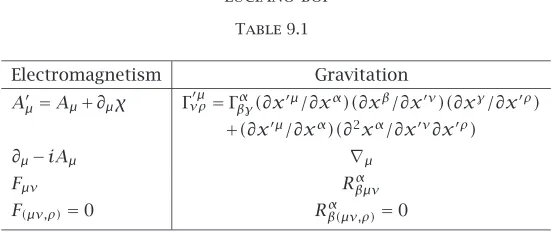
the vector potential of electrodynamics, thus unifying this theory with gravity. This did not work but only temporally! In fact, in 1927, after the development of quantum mechanics, Fock and London noticed that thepµ−eAµ, whenpµ is replaced with∂µ
by∂µ−(ie/hc)Aµ, looked very much like Weyl’s change of scale, but with a complex
coefficient for the connection. Two years later Weyl completed the discussion, showing how electrodynamics was invariant under the gauge transformation of the gauge field and of the wave functionΨof a charged particle,
Aµ →Aµ+∂µα, Ψ →eieα/hcΨ. (5.8)
The concept of gauge invariance, and therefore the principle of local gauge symmetry, was born. Accompanying the translation of charged particle, there is a phase change. The fact that the physics, at least at Planck scale, remain unchanged with respect to a gauge transformation lies at the heart of different forms of matter.
abstract structures known to mathematicians as connections in fibre bundles. The dis-covery of this equivalence has made it possible to understand why and how powerful mathematical concepts and structures are necessary and suitable for the description and explanation of physical reality.
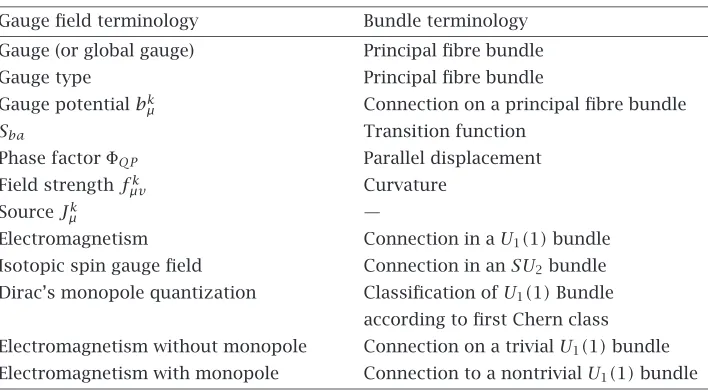
In a very important paper, Wu and Yang introduced the fundamental concept of nonintegrable—that is, path-dependent—phase factor as the basis of a description of electromagnetism [66]. Further this concept is made to correspond to the definition of a gauge field; to extend it to global problems, they analyzed, in relation with the original Dirac’s result, the field produced by a magnetic monopole. The monopole discussion leads to the recognition that in general the phase factor (and indeed the vector potential Aµ) can only be properly defined in each of many overlapping regions of spacetime. In
the overlap of any two regions, there exists a gauge transformation relating the phase factors defined for the two regions. The concept of monopole leads to the definition of global gauges and global gauge transformations. A surprising result is that the mono-pole types are quite different forSU2andSO3gauge fields and for electromagnetism. The mathematics of these results is the fiber bundle theory. Furthermore gauge fields, including in particular the electromagnetic field, are fiber bundles, and all gauge fields are thus based on geometry. So maybe all of the fundamental interactions of the phys-ical worlds could be based on these geometrphys-ical and topologphys-ical objects.
The exact formulation of the concept of a nonintegrable phase factor depends on the definition of global gauge transformations, that is, on the choice of the overlapping regions ofR(whereRis a region of spacetime, precisely, all spacetime minus the origin r=0) and of the potentialAµin this region. Through a certain kind of operations, called
distorsion, one arrives at a large number of possibilities, each with a particular choice of overlapping regions and with a particular choice of gauge transformation from the original(Aµ)a or(Aµ)b to the newAµ in each region. Each of such possibilities will
be called agauge(orglobal gauge). This definition is a natural generalization of the usual concept, extended to deal with the intricacies of the field of a magnetic monopole. Notice that the gauge transformation factor in the overlap betweenRaandRbdoes not
refer to any specificAµ. (The gauge transformation in the overlap of the two regions is
S=Sab=exp(−iα)=exp(2ige/hc)φ.) Thus two different gauges may share the same
characterizations (a) and (b). In the case of the monopole field, one can attach to the gauge any(Aµ)aand(Aµ)bprovided they are gauge-transformed into each other in the
region of overlap. Thus a gauge is a concept not tied to any specific vector potential. Wu and Yang called the process of distorsion leading from one gauge to another aglobal gauge transformation. It is also a concept not tied to any specific vector potential. The collection of gauges that can be globally gauge-transformed into each other will be said to belong to the same gauge type. The phase factor exp(ie/hcAµdxµ)(which is
nonintegrable, i.e., path-dependent) around a loop starts and ends at the same point in the same region. Thus it does not change under any global transformation, so that we have the following theorem for Abelian gauge fields.
Theorem5.1. The phase factor around any loop is invariant under a global gauge transformation.
Theorem5.2. The field strengthfµν is invariant under a global gauge transforma-tion.
Theorem 5.3. Between two gauge fields defined on the same gauge there exists a continuous interpolating gauge field defined on the same gauge.
Theorem5.4. Consider gaugeᏳDand define any gauge field on it. The total magnetic flux through a sphere around the originr =0is independent of the gauge field and depends on the gauge only:
fµνdxµdxν= −
ihc e
∂ ∂xµ
lnSab
dxµ, (5.9)
whereSis the gauge transformation defined by (5.8) for the gaugeᏳDin question, and
the integral is taken around any loop around the originr=0in the overlap betweenRa
andRb, such as the equation on a spherer=1.
As in the case of electromagnetism, in the non-Abelian gauge fields both the concept of a gauge and the concept of a global gauge transformation are not tied to any specific gauge potentials. The nonintegrable phase factor for a given path is now an element of the gauge group (see [41]). Since these phase factors do not in general commute with each other, Theorems5.1and5.2for the Abelian case need to be modified as follows.
Theorem5.5. Under a global gauge transformation, the phase factor around any
loop remains in the same class. The class does not depend on which point is taken as the starting point around the loop.
Theorem5.6. The field strengthfµνk is covariant under a global gauge transforma-tion.
Theorem 5.5defines theclass of a loop. This concept is a generalization of the phase factor for electromagnetism around a loop with the magnetic flux as the exponent. It is a gauge-invariant concept.
Rigorously the mathematical structure of gauge theory is that of a vector bundle E with structure groupG over a compact Riemannian manifold M. We assume that G∈O(m) and E carries an inner product compatible withG. LetE be the space of G-connections onE, and letᏳbe the space ofG-automorphisms ofE. ThenᏳacts on Eas before, and we have a quotient spaceB≡E/Ᏻ. To each connection∇ ∈Ethere is associated a curvature 2-formR∇, and at each pointx, we can take its norm
R∇2x≡
i<j
Re∇ i,ej
2
x, (5.10)
where{e1, . . . , en}is an orthonormal basis ofTxMand the norm ofR∇ei,ejis the usual one
on Hom(E, E)—namely,A, B ≡trace(At◦B). Given anyg∈Ᏻ, we recall thatRg(∇)=
g◦R∇◦g−1, so
Rg(∇)≡R∇ onM. (5.11)
Definition5.7. TheYang-Mills functionalis the mappingY M:E→R+given by
Y M(∇)≡12
M
R∇2. (5.12)
(Note that, by gauge invariance of the density (5.11), this functional descends to a func-tionalY M:B→R+.)
An important verified fact is that ifM is four-dimensional, thenY M isconformally invariant; that is, if we replace the metricds2onM by a new metricds2=f2ds2, for some positive functionf onM, then the Yang-Mills functional is unchanged. We think ofY Mas an “action integral” and seek its stationary points.
Definition5.8. A connection∇ ∈Eis called a Yang-Mills connection, and its cur-vatureR∇is called a Yang-Mills field if grad∇(Y M)=0.
Lemma5.9. The following are equivalent: (1) ∇is Yang-Mills,
(2) δ∇R∇=0,
(3) ∆(R∇)=0, where∆≡d∇δ∇+δ∇d∇.
The equationsδ∇R∇=0 are called theYang-Mills equations. The equivalent condition (3) states that the curvatureR∇ isharmonic(with respect to its own Laplacian). It is naturally appealing to a geometer to study connections with harmonic curvature. The subject has even more allure when one learns that the “classical fields” corresponding to basic forces of nature (the electromagnetic, weak, and strong interactions) can, and should, be formulated in these terms. A basic case is electromagnetic, whereG=U1and Eis a complex line bundle over a four-dimensional Lorentzian manifold. In relativistic terms, the six components of the curvature 2-formΩof a connection onErepresent the six components of the electromagnetic tensor. The equations
dΩ=0, δΩ=0 (5.13)
are exactly Maxwell’s field equations.
6. The geometric nature of gauge invariance: gauge theory and quantum mechan-ics. General relativity was discovered around 1916 by Einstein. Its complete mathe-matical formulation was due to his friend the mathematician Marcel Grassmann. Soon after, this theory was recognized a major scientific event. Hermann Weyl of course agreed with that. However he was still looking for a more complete formulation of Einstein’s theory. Thus, under the influence of general relativity, he aimed to a search for a unification of gravitation and electromagnetism. In other words, he asked him-self whether one could not find an extended geometry which would likewise allow to accommodate the only other force field known at the time, the electromagnetic field Fij=∂iAj−∂jAiwith its potentialAi, into the geometrical structure of spacetime. His
main idea was that of a local gauge invariance, which I will try to explain.
common source. One obtains a wholly determined principle of action which within the electricity-free field leads to your expression for gravitation. On the other hand, within a gravitation-free field, one gets an expression which, at first sight, is in agreement with Maxwell’s theory.” The response of Einstein came soon: “I received your paper. It is a stroke of genius (Genie-Streich) of the highest rank. Besides, I was not able so far to set-tle my objection concerning the measure standard. . . .(We translated both quotations from German).
The importance of the gauge invariance (Eichinvarianz) can be measured by what the theoretical physicist Abdus Salam wrote in Nobel conference of 1975: “One of the most revolutionary events in the history of science of the last century is the idea of gauge unification of the electromagnetic force with the weak nuclear forces” (Salam [42]); or by what the outstanding theoretical physicist T. W. B. Kibble wrote in 1982: “Revolutions are hard to recognize till they are past. This is surely true of the changes that have occurred in elementary particle physics over the last two decades. The development of gauge theories may well come to be seen as constituting one of the most fundamental revolutions of this century, rivaling the development of quantum mechanics itself. Yet so far its significance is not widely understood outside the ranks of specialists” (Kibble [28]).
Now we have to return back to Weyl. We said that the Weyl’s work was aimed at extending the physical significance of general relativity and consequently to propose a generalization of Riemannian geometry. According to Weyl, these generalizations may be possible by introducing the main idea that length of vectors, and not only direction, must depend on the path. In other words, length ceases to be an action-at-distance concept. Mathematically, the idea of local gauge invariance amounts to introducing a nonintegrable scale factor or a function, which should supply the fact that in Riemann-ian geometry the invarRiemann-iance of the length of each two vectors gets lost. So Weyl proposes a procedure for recalibrating the displacement of a vector at each point of spacetime, in order to leave the length as well as the direction of this vector locally unchanged. Furthermore, Weyl had the ingenious idea of associating the metric tensor with the strength of the electromagnetic field, and the scale vector with the electromagnetic potential.
The idea of Weyl runs as follows. The parallel transport of the two vectorsVandW fromxtox+dxand, consequently, around a closed contour is generalized. The angle between the two vectors is still kept fixed under parallel transport, but the assumption of the invariance of the length of both vectors is dropped. The length of a vector—in contrast to the angle between two of them—ceases to be an action-at-distance concept. How should one change the expression
δVk= −
k
ij
Vjdxi (6.1)
(which expresses the change of the components of a vectorVj(x), if displaced or
trans-ported parallely on a Riemannian manifoldMr ofr dimensions from the point with
bilinearity ofδVkinVjanddxi, thereby arriving at
δVk= −Γk
ijVjdxi (6.2)
with the so far unknown connection coefficientsΓk
ij. On the basis of the last expression,
we can define once more a covariant differentiation, which we still denote by∇i. Then
the change of a vector around the contour turns out to be
∇Vl= − 12∇AijFijkl
Vk, (6.3)
this time involving the curvature tensor, and we get
Fl
ijk=2∂iΓjkl +2Γiml Γjkm= −Fjikl . (6.4)
We thus see that in [61] Weyl enlarged the Riemannian spacetime of general relativity by an independent vector field of geometric origin—in modern terms, a one-form. This additional geometric object is intimately linked with the geometrical structure of space-time. In addition, the Weyl vector is the compensating potential for allowing invariance with respect to local recalibration of lengths, that is, with respect to conformal changes of the metric. One can furthermore generalize the Weyl geometry to the metric-affine geometry, which is based on a (symmetric) metric and an independent (nonsymmetric) linear connection. In Weyl geometry, one geometrical object, the metric tensor, stands for the gravitational potential, as in general relativity, whereas the other one, the lin-ear connection, was surmised to represent the electromagnetic potential known from Maxwell’s theory. Together with a suitable (gravitational and electromagnetic) field La-grangian, which turns out to be quadratic in the curvature of the underlying Weyl space-time, this builds up Weyl’s unified theory of 1918. The idea of gauge invariance, or the so-called principle of recalibration, which applies first to length of vectors in spacetime, transmuted to the concept of local gauge invariance of the phase of a wave function in 1929, and represents, in the last form, one of the underlying principles of all modern gauge theories, such as the Weinberg-Salam theory of electroweak interactions.
that was equivalent to knowing the structure of certain classes of (continuous) groups and their algebras. These three kinds of symmetry were introduced (under other names) into quantum physics in the 1930s by Weyl himself and by E. Wigner, but no one thought then of unifying the three kinds. In 1930, Dirac had detected the existence of a particle (positron) with a charge opposite to that of an electron, and Weyl then generalized to a universal essential equivalence between positive and negative electricity. This idea was reformulated in 1937 as the conjugate invariance of electrical charge. However, in 1957, Lee and Yang found that left-right symmetry (or conservation of parityP), which physicists had always found useful to accept, was not entirely satisfied by the laws of nature, particularly in weak interactions, which are responsible for radioac-tive (beta) disintegration. Since it could be verified theoretically and experimentally that this radioactivity gave a correct description of the neutrino, the conclusion was that the existence of the Weyl-Pauli theory (of the neutrino) violated left-right symme-try. This asymmetry seemed to be a consequence of duplication: massless particles (neutrinos) emitted in abetadisintegration existed in only one form (left), while the corresponding antiparticles (antineutrinos) could then only exist in the opposite form. Mathematically, this duplication could appear as the existence of two valid solutions for an equation. Some theoretical physicists interpret this phenomenon to speculate that the world did not have to be symmetrical with respect to every operation which left the laws of nature invariant: the loss of symmetry could be ascribed to the asym-metry of the whole universe. Such an explanation raises several questions. It is just as reasonable to believe that the loss of symmetry, as a characteristic of a transitory phase in which the laws of nature apply, could be explained by a richer, more general mathematical symmetry. Recent research in this field seems to be oriented toward this second outlook.
from the old coordinate. Those formulas must be applied simultaneously in the same way to all the points.
In quantum electrodynamics, the symmetry operation consists of a local phase change in the electron field, each such phase shift being accompanied by an inter-action with the electromagnetic field. Imagine an electron undergoing two consecutive phase shifts: the emission of a photon and then the absorption of one. If the sequence of the phase shifts was reversed, the final result would be the same. It follows that an unlimited series of phase shifts can be made, and the final result will simply be their algebraic sum, no matter what their sequence is. On the contrary, in the Yang-Mills theory, where the symmetry operation is a local rotation of the isotopic-spin arrow, the result of multiple transformations may be rather different. Suppose a hadron un-dergoing a gauge transformationAfollowed by a second transformationBmay have an isospin arrow in the orientation of a proton. The same hadron undergoesB; at the end of this sequence the isotopic-spin arrow is found in the orientation that corre-sponds to a proton. Now suppose the same transformation was applied to the same hadron but in the reverse sequence:Bfollowed byA. In general the final state will not be the same; the particle may be a neutron instead of a proton. Therefore, the net effect of the two transformations depends explicitly on the sequence in which they are ap-plied. Because of this distinction, quantum electrodynamics is called an Abelian theory and the Yang-Mills theory is called a non-Abelian one. Abelian groups are made up of transformations that, when applied one after another, have the commutative property; non-Abelian groups are not commutative (see [16]). (The terms are borrowed from the mathematical theory of groups created by the Norwegian mathematician N. H. Abel.) Like the Yang-Mills theory, the general theory of relativity is non-Abelian. Even the elec-tromagnetic interaction has been incorporated into a larger theory that is non-Abelian. For now, at least, it seems all the forces of nature are governed by non-Abelian gauge theories.
This important and surprising result (i.e., the asymmetry of certain fundamental laws of physics) spurred a vast new investigation, still active today, into spontaneous symmetry breaking. The central question now seems to be the connection between the symmetry breaking occurring in the behavior of certain elementary particles at a certain level of size and temperature, and the geometrical structure of space at that same level. More precisely, it has been hypothesized that a symmetry breaking occurs when there is a change (or degeneration) in the space structure, or, mathematically speaking, a jump from a group to a “poorer” group of the field or the interaction concerned. However, nothing prevents us from believing that if there is a richer group containing the two others as subgroups, the difficulty may be removed (see below for further considerations on this point).