THE USE & CONSEQUENCES OF
PERFORMANCE MANAGEMENT & CONTROL
SYSTEMS: A STUDY OF A PROFESSIONAL
SERVICES FIRM
By
Valentine Okechukwu Ururuka
B Sc. Accountancy (University o f N igeria Nsukka), M B A (Bayero U niversity Kano), M Sc. Accounting and Financial Management (Lancaster U niversity)
Thesis submitted to Lancaster University in fulfilment of the requirements
for
the degree of Doctor of Philosophy in Accounting and Finance
ProQuest Number: 11003424
All rights reserved
INFORMATION TO ALL USERS
The qu ality of this repro d u ctio n is d e p e n d e n t upon the q u ality of the copy subm itted.
In the unlikely e v e n t that the a u th o r did not send a c o m p le te m anuscript and there are missing pages, these will be note d . Also, if m aterial had to be rem oved,
a n o te will in d ica te the deletion.
uest
ProQuest 11003424
Published by ProQuest LLC(2018). C op yrig ht of the Dissertation is held by the Author.
All rights reserved.
This work is protected against unauthorized copying under Title 17, United States C o d e M icroform Edition © ProQuest LLC.
ProQuest LLC.
789 East Eisenhower Parkway P.O. Box 1346
THE USE & CONSEQUENCES OF PERFORMANCE
MANAGEMENT & CONTROL SYSTEMS: A STUDY OF A
PROFESSIONAL SERVICES FIRM
Thesis submitted to Lancaster University in fulfilment o f the requirements for the degree o f Doctor o f Philosophy in Accounting and Finance
Valentine Okechukwu Ururuka
B Sc. Accountancy (University o f Nigeria Nsukka), M BA (Bayero U niversity Kano), M Sc. Accounting and Financial Management (Lancaster University)
August 2007
Abstract
It has long been recognized that Performance Management and Control Systems (PMCSs)
impact positively on organizational efficiency and effectiveness by affecting the behaviour of
organizational participants. However, PMCSs also create tensions between achieving short
term and long-term objectives which often times lead to unintended negative consequences.
These effects o f PMCSs are much more attributed to their design than the way they are used.
This coupled with the undesirable PMCSs’ effects has led to several innovations that propose
complementing, and some proposing total replacement of, the traditional PMCS with a wider
range o f non-fmancial or operational measures.
This study investigates the way a PMCS, encompassing both financial and non-fmancial
measures, is used and the effect on work behaviour and performance. It examines the possible
influence o f hierarchical levels on the nature of measures employed in the PMCS, the way it is
used, as well as the effects of the PMCS. It also investigates other factors that affect the
consequences o f PMCS use, and the mechanisms by which these effects are transmitted.
behaviour and performance by examining the interplay o f the factors that affect PM CSs’
effects and the mechanisms by which these effects are transmitted.
The results o f the study show that PMCSs do have some positive effects on performance, but
also have albeit unintended positive effects on dysfunctional behaviour. It also shows that
hierarchical levels influence the nature of measures employed in PMCSs, the manner in which
they are used, as well as PMCSs’ effect on work effort. More financial measures tend to be
employed at higher hierarchical levels, while PMCSs tend to be used in more target-focused
manner at lower levels o f the organisation. However, the effects o f PMCSs do not vary at
different levels of the organisation except for the effect on work effort. Nonetheless, it was
also found that the way that a PMCS is used impacts work behaviour and performance much
more it seems than its design in terms o f the type or nature of PMCS measures. Furthermore,
the level o f goal difficulty, interactive use o f control systems, and supervisory trust were
found to affect the impact of PMCSs use on behaviour and performance. In addition, the
findings reveal goal commitment to be an important mechanism that mediates the effects of
PMCSs use. Also, the perception o f equity and fairness was found to be another mediator of
PMCS effects. Finally, the study reveals that the interplay o f interactive use o f control
systems and perceptions of equity and fairness significantly influence PM CSs’ effects on
dysfunctional behaviour; while the interplay between goal difficulty and goal commitment
Dedication
I wish to dedicate this work to the memory o f my late mum, Edna Uloma Ururuka.
Acknowledgements
Pursuing a PhD degree has been to date one o f the most challenging experiences in my life,
not least because o f the time commitment and strength to sustain the motivation to see it to' the
end during the many difficult moments. Finding the strength and motivation to successfully
complete this pursuit was only possible because o f the help, love and encouragement o f many
people to whom I am sincerely grateful. However, it is not possible to mention everyone's
name here, and I offer my advance and sincere apologies to those not explicitly mentioned..
Firstly, I am especially grateful to my dear wife, Charlotte; it would not have been possible to
complete this pursuit without your love, sacrifice, and encouragement. Thank you for being
there and giving so much.
Secondly, I am heavily indebted to my supervisors Prof David Otley and Dr Wendy Beekes
for their expert supervision, invaluable support, and the confidence shown in me. It has been
an honour to work with both o f you. I learnt a bit more than just doing research, thank you.
Thirdly, I am also indebted to many others at Lancaster University - PhD colleagues, faculty
members, and administrative staff of the Department o f Accounting and Finance, for their
friendship and generous help throughout the period o f my study. Particularly, I would like to
thank Sayjda Talib, Dr. Pelham Gore, Dr. Steve Young, Prof Mark Shackleton, Prof Ken
Peasnell, and Linda Airey.
I wish to acknowledge the financial support from the ORS Aw ard Scheme in conjunction with
Lancaster University Management School for sponsoring me as a PhD candidate. I also wish
to acknowledge financial support for this work provided by The Chartered Institute o f
Finally, I also wish to thank my dad and other friends and family for their understanding and
support. And to God who made all things possible, I am eternally grateful.
Declaration
The work reported in this thesis is mine. No part o f this work has been submitted to Lancaster
University or elsewhere for the award o f another degree or qualification.
Valentine Okechukwu Ururuka
August 2007
Table of Contents
Abstract i
Acknowledgements iv
Declaration vi
Table of Contents vii
List of Tables x
List of Figures xii
Abbreviations xiii
Chapter 1 Introduction 1
Chapter 2 Literature Review 8
2.1 M anagem ent Control System s: D efinitions, D esign & U se 8
2.2 Theoretical Framework o f Em pirical MCS Studies 12
2.3 RAPM & Performance Evaluative Styles (PE Ss) 13
2.4 Other Categorisation o f PES 18
2.5 C onsequences o f PES 22
2.6 M anagem ent Control Issues in Professional A ccounting Firms 24
2.7 Summary o f review 29
Chapter 3 Theory Development and Hypothesis Formulation 38
3.1 Identifying Focal and Criterion Variables 38
3.2 Theoretical M odels o f Relationship Exam ined 39
3.3 M odel D evelopm ent & Formulation o f H ypothesis - Overall E ffects M od el 43
3.3.1 PES and D ysfunctional Behaviour: 43
3.3.2 TF PES: Financial vs. N on-financial Targets 45
3.3.3 PES and Effort, & Performance 47
3.4 M oderated Direct Effect M odels: 49
3.4.1 PES and Goal D ifficulty 49
3.4.2 PES and Organisational Hierarchical Level 51
3.4.3 PES and Interactive U se o f Control System s 57
3.4 .4 PES and Organisational Com m itm ent 59
3.4.5 PES and Supervisory Trust 61
3.5 M ediating Effect & M ediated Moderation Effect M odels: 62 3.5.1 Intervening E ffects o f Equity and Fairness Perception 63 3.5.2 EFP M ediation o f Organisational Hierarchical L evel (O H L) M oderation E ffects 67 3.5.3 EFP M ediation o f Interactive use o f Control S ystem s (IC S) M oderation E ffects 68 3.5.4 EFP M ediation o f Supervisory Trust (ST ) M oderation Effects 69
3.5.5 Intervening E ffects o f Goal C om m itm ent 69
3.5.6 GC M ediation o f Goal D ifficu lty (G D ) M oderation E ffects 71
3.5.7 Intervening Effects o f Job Related T ension 72
3.5.8 JRT M ediation o f Interactive use o f Control S ystem s (IC S) M oderation E ffects 74
3.5.9 Intervening Effects o f Job Satisfaction 75
Chapter 4 Research Design & Methodology 82
4.1 Case Selection 82
4.2 The Process o f Gaining A cc ess & Case D escriptions 83 4.2.1 Bank A PLC (N ovem b er 2003 - January 2 0 0 4 ) 84 4.2 .2 Bank B Group (February 20 0 4 - March 2 0 0 4 ) 86 4.2.3 Bank C Pic; Bank D Pic; & E Pic (April 2 0 0 4 - June 2 0 0 4 ) 86
4.2 .4 Change o f Approach Strategy 88
4.2.5 3 More Banks, and the F PLC (June 2 0 0 4 - A ugust 2 0 0 4 ) 89 4.2 .6 G PLC (Septem ber 20 0 4 - N ovem ber 2 0 0 4 ) 89 4 .2 .7 A B C LLP (Septem ber 2 0 0 4 - Septem ber 2 0 0 5 ) 92
4.2 .8 About A B C LLP 96
4.2 .9 Summary and L essons Learnt 100
4.3 Data C ollection M ethod 102
4.3.1 Survey D evelopm ent - T w o Stage Process 102
4.3 .2 Web Surveys in M anagem ent A ccoun ting Research 105
4.3.3 Issues in Constructing a W eb Survey 106
4 .3 .4 D escription o f the W eb Survey 108
4.4 Construct D efinitions & M easurem ent 111
4.4.1 Effort & Job Dem and 112
4 .4 .2 Performance Evaluative Style 112
4.4.3 Organisational Hierarchical L evel 115
4 .4 .4 Equity & Fairness Perceptions 115
4.4.5 Goal C om m itm ent & Goal D ifficu lty 116
4 .4 .6 Performance: Actual Performance Rating & M anagerial Perform ance 118
4 .4 .7 Job Related Tension 119
4 .4 .8 D ysfunctional Behaviour - Q uality Threatening B ehaviour 120
4 .4 .9 Interactive U se o f Control System s 121
4.4 .1 0 Intention to Turnover 123
4.4.11 Job Satisfaction 123
4.4 .1 2 Organisational C om m itm ent 124
4.4.13 Supervisory Trust 125
4.4 .1 4 R elative Em phasis on Quantitative G oals & on Financial G oals 126
4.4.15 D em ographic and Other Information 127
C h a p te r 5 C o n c ep tu a lisa tio n and O p er a tio n a lisa tio n o f P E S 128
5.1 R eview o f PES C oncepts and Measures 128
5.2 Evaluation o f PES C oncepts and M easures 133
5.3 PES M easurement Instrument 136
5.4 Validation o f PES M easurement Instrument - U sin g SEM 139
5.5 O perationalising PES 143
C h a p te r 6 D ata A n a ly sis/H y p o th e sis T e stin g 149
6.1 R esponse Rate & D em ographic information 149
6.2 Validation o f Variable Constructs 155
6.2.1 Equity and Fairness Perception - EFP 156
6.2 .2 Goal Com m itm ent - GC 158
6.2.3 Interactive U se o f Control System s - ICS 160
6 .2 .4 Job Related T ension - JRT 162
6.2.5 O rganisational C om m itm ent - OC 165
6 .2 .6 Quality Threatening B ehaviour - QTB 166
6 .2 .7 Supervisory Trust - ST 168
6.3 A nalytical M odels for H ypothesis T esting 170
6.3.1 A nalytical Strategy for T esting D irect and M oderated E ffect H ypothesis 171 6 .3 .2 A nalytical Strategy for T esting M ediated Effect H ypothesis 172 6.3.3 A nalytical strategy - M ediated M oderation E ffects 174
6.4 R esults 178
6.4.1 D escriptive Statistics 178
6.4 .2 Tests o f H ypothesis 1 & 2 - Directs E ffects o f TF PES 180 6.4.3 Tests o f H ypothesis 3 -D ir e c t (Curvilinear) E ffects o f TF PES 183 6 .4 .4 Tests o f H ypothesis 4 - G D M oderation o f TF PES Direct E ffects 189 6.4.5 Tests o f H ypothesis 5 - OHL & Performance M easure Characteristics 197 6.4 .6 Tests o f H ypothesis 6 - OHL M oderation o f TF PES D irect E ffects 202 6 .4 .7 Tests o f H ypothesis 7 - ICS M oderation o f TF PES D irect E ffects 205 6.4.8 Tests o f H ypothesis 8 - OC M oderation o f TF PES Direct E ffects 209 6.4 .9 Tests o f H ypothesis 9 - ST Moderation o f TF PES D irect Effects 212 6.4 .1 0 Tests o f H ypothesis 10 - EFP M ediation o f TF PES Direct Effects 215 6.4.11 Tests o f H ypothesis 11 - EFP M ediates OHL M oderation o f TF PES E ffects 218 6.4 .1 2 Tests o f H ypothesis 12 - EFP M ediation o f ICS M oderation o f TF PES E ffects 220 6.4.13 Tests o f H ypothesis 13 - EFP M ediation o f ST M oderation o fT F PES E ffects 224 6.4 .1 4 Tests o f H ypothesis 14 - GC M ediation o f TF PES D irect E ffects 22 7 6.4.15 Tests o f H ypothesis 15 - GC M ediation o f G D M oderation o f TF PES E ffects 229 6 .4 .1 6 Tests o f H ypothesis 16 - JRT M ediation o f TF PES D irect Effects 234
6.4 .1 7 Tests o f H ypothesis 17 - JRT M ediation o f ICS M oderation o f TF PES E ffects 236 6.4.18 Tests o f H ypothesis 18 - JS M ediation o f TF PES D irect E ffects 238
6.5 Table Summary o f K ey Results 241
6.6 The R elative Importance o f Moderator V ariables 243 Chapter 7 Summary and Discussion of Findings, Conclusions, and Limitations 253
7.1 TF PES Impact on D ysfunctional Behaviour (Overall E ffects on Q uality Threatening
Behaviour, & Intention to Turnover) 254
7.2 Moderating and M ediating Influences on the Overall E ffect on QTB & IT 255 7.3 Interplay o f Moderating & M ediating Influences on P M C S ’ E ffect on QTB & IT 258
7.4 TF PES Impact on Effort (EFF) 259
7.5 TF PES Impact on Performance (Overall E ffects on M anagerial Performance & A ctual
Performance Rating) 261
7.6 M oderating and M ediating Influences on the Overall E ffect on MP 262
7.7 OHL as an A ntecedent o f TF PES 264
7.8 Other Findings - Gender D ifferences 265
7.9 K ey Contributions and C onclusions 266
7.10 Study Lim itations 269
7.11 R ecom m endations for Future Studies 272
Appendix 1: Sample Introductory Letter to Bank B 273
Appendix 2: Introductory Email to ABC LLP 274
Appendix 3: Screen Shots of the Survey Web Pages 275 Appendix 4: Descriptive Statistics and Correlation of Variables 298 Appendix 5: OHL Moderation o f TF PES Effect on Effort Relationship - 2 299
References 300
" 7
[image:11.558.73.512.47.731.2]List of Tables
Table 2-1 Summary o f MCS D efinitions & D escriptions 9
Table 2-2 - Summary o f PES Studies 31
Table 3-1 Summary o f hypothesis 78
Table 4-1 Target Focused PES - M easurement Items: N e w Instrument 113 Table 4-2 Target Focused PES - M easurement Items: Adapted from H op w ood ’s Instrument* 114 . Table 4-3 Equity and Fairness Perception - M easurem ent Items 116
Table 4-4 Goal Com m itm ent - M easurement Items 117
Table 4-5 Performance - M easurement Items 119
Table 4-6 Job Related Tension - M easurement Items 120
Table 4-7 Quality Threatening Behaviour - M easurement Items 121 Table 4-8 Interactive U se o f Control System s - M easurem ent Items 122 Table 4-9 Organisational C om m itm ent - M easurement Items 125
Table 4 -1 0 Supervisor Trust - Measurement Items 126
Table 4-11 D em ographic Information 127
Table 5-1 Frequency & Mean o f Importance Rankings o f Evaluative Criteria 147
Table 6-1 Survey Tim e Line & R esponse Rates 150
Table 6-2 Summary o f Key Dem ographic Information 152
Table 6-3 M aximum Likelihood Estimates: EFP M odels in Figures 6.1 & 6.2 158 Table 6-4 M aximum Likelihood Estimates: GC M odel in Figure 6.3 159 Table 6-5 M aximum L ikelihood Estimates: ICS M odels in Figures 6.4 & 6.5 161 Table 6-6 M axim um L ikelihood Estimates: JRT M odels in Figures 6.6 & 6.7 164 Table 6-7 M aximum Likelihood Estimates: OC M odel in Figure 6.8 165 Table 6-8 M aximum L ikelihood Estimates: QTB M odel in Figure 6.9 167 Table 6-9 M axim um Likelihood Estimates: ST M odels in Figures 6.6 & 6.7 170 Table 6-10 Interpretation o f R egression Slope Parameters 176 Table 6-11 D escriptive statistics o f K ey Variables 179 Table 6-12 Summary o f regression analysis: TF PES Predicting QTB & IT 180 Table 6-13 T-test o f D ifferences in QTB & IT M eans 182 Table 6-14 Summary o f hierarchical regressions: Linear & curvilinear TF PES predicting Effort 184 Table 6-15 Summary o f hierarchical regressions: Linear & curvilinear TF PES predicting A P & M P 189 Table 6-16 Summary o f regression analysis: TF PES, G D and their interaction predicting Q TB, IT,
EFF, A P & MP 190
Table 6-1 7 Summary o f O ne-w ay M A N O V A s. IV: OHL; D Vs: REQG, REFG; & TF1, TF2, TFH 198 Table 6-18 M ultiple Com parison o f D ifferences in REFG M ean scores b etw een OHLs 199 Table 6-19 Summary o f R egression A nalysis: OHL predicting REQG, REFG, & TF PES 202 Table 6-20 Summary o f R egression A nalysis: TF PES, OHL and their interaction predicting Q TB, IT,
EFF, MP, & A P 203
Table 6-21 Summary o f regression analysis: TF PES, ICS and their interaction predicting Q TB, IT,
EFF, A P & MP 207
Table 6-22 Summary o f regression analysis: TF PES, OC and their interaction predicting Q T B, IT,
EFF, A P & M P 210
Table 6-23 Summary o f regression analysis: TF PES, ST and their interaction predicting QTB & IT213 Table 6-24 Summary o f R egression A nalysis results: EFP M ediation o f TF PES direct effects. 217 Table 6-25 Summary o f R egression A nalysis results: EFP M ediation o f OHL M oderation o f TF PES
direct effects. 219
Table 6-26 Summary o f R egression A nalysis results: EFP M ediation o f ICS M oderation o f T F PES
direct effects. 221
Table 6-27 Summary o f R egression A nalysis results: EFP M ediation o f ST M oderation o f TF PES
direct effects 225
Table 6-28 Summary o f R egression A nalysis results: GC M ediation o f TF PES direct effects. 228 Table 6-29 Summary o f R egression A nalysis: GC M ediation o f G D M oderation o f TF PES effects. 230 Table 6-30 Summary o f R egression A nalysis results: JRT M ediation o f TF PES direct effects. 235 Table 6-31 Summary o f R egression A nalysis results: JRT M ediation o f ICS M oderation o f TF PES
direct effects. 2 3 7
Table 6-32 Summary o f R egression A nalysis results: JS M ediation o f TF PES direct effects. 239
Table 6-33 Sum mary o f Significant R esults 242
Table 6 -34 Summary o f Hierarchical M oderated R egression A nalysis (Q T B , IT, & EFF) 245 Table 6-35 Summary o f Hierarchical M oderated R egression A nalysis (M P and A P ) 250
List of Figures
Figure 3.1 Direct Effects M odel (M odel 1) 42
Figure 3.2 M ediated/Indirect E ffects M odel (M odel 3) 42
Figure 3.3 Moderated Effects M odel (M odel 2) 42
Figure 3.4 M ediated M oderation E ffects M odel (M odel 4 ) 42 Figure 3.5 M ediated M oderation E ffects M odel with m easured variables 65
Figure 5.1: PES - M O DEL 1 141
Figure 5.2: PES - M ODEL 2 142
Figure 5.3 Histogram & Summary Statistics o f Target Focused 1 (T F1) PES M easure 144 Figure 5.4 Histogram & Summary Statistics o f Target Focused 2 (T F2) PES M easure 145 Figure 5.5 Histogram & Summary Statistics: Target Focused Style - H op w ood 147 Figure 6.1 CFA M odel - Equity & Fairness Perception - M odel 1 157 Figure 6.2 CFA M odel - Equity & Fairness Perception - M odel 2 157
Figure 6.3 CFA M odel - Goal C om m itm ent (G C ) 159
Figure 6.4 CFA M odel - Interactive U se o f Control S ystem s - M od el 1 160 Figure 6.5 CFA M odel - Interactive U se o f Control S ystem s - M od el 2 162 Figure 6.6 CFA M odel - Job Relate Tension - M odel 1 163 Figure 6.7 CFA M odel - Job Relate Tension - M odel 2 163 Figure 6.8 C FA M odel - Organisational Com m itm ent 166 Figure 6.9 CFA M odel - Quality Threatening Behaviour 167 Figure 6.1 0 CFA M odel - Supervisory - M odel 1 169 Figure 6.11 CFA M odel - Supervisory Trust - M odel 2 169 Figure 6.12 Illustration o f M oderated m ediation & M ediated moderation 175 Figure 6.13 Graph o f the curvilinear relationship betw een TF1 PES and Effort 186 Figure 6.1 4 Graph o f the curvilinear relationship b etw een TF2 PES and A P 188 Figure 6.15 Goal D ifficulty M oderation o f the TF PES Effect on Intention to Turnover 193 Figure 6.16 Goal D ifficulty M oderation o f the TF PES E ffect on M anagerial Perform ance 194 Figure 6.1 7 Graphs o f REQG, REFG, & TF PES M eans for the 5 Hierarchical L evels 201 Figure 6.18 OHL Moderation o f the TF PES / Effort R elationship - 1 204 Figure 6.1 9 ICS Moderation o f the TF PES / Intention to Turnover R elationship 208 Figure 6 .2 0 OC M oderation o f the TF PES / Effort R elationship 211 Figure 6.21 ST M oderation o f the TF PES / Intention to Turnover R elationship 2 1 4 Figure 6.2 2 ICS M oderation o f TF PES E ffect on EFP 222
Figure 6.23 G D M oderation o f GC effect on M P 232
Abbreviations
Acronym Description
AP Actual Performance Rating
DV Dependent Variable
EFF Effort
EFP Equity & Fairness Perception
ET Employment Tenure
GC Goal Commitment
GD Goal Difficulty
GEN Gender
GT Grade Tenure
ICS Interactive Use O f Control Systems
IT Intention To Turnover
IV Independent Variable
JRT Job Related Tension
JS Job Satisfaction
LUMS Lancaster University Management School
MCS Management Control Systems
MDD Management Development Division
MP Managerial Performance
OC Organisational Commitment
OHL Organisational Hierarchical Level
PES Performance Evaluative Style
PMCS Performance Management and Control Systems
QTB Quality Threatening Behaviour
REFG Relative Emphasis On Financial Goals
REQG Relative Emphasis On Quantitative Goals
ST Supervisory Trust
TF Target Focused
TF PES Target Focused Performance Evaluative Style
TF1 Target Focused Style-Full (1st measure o f TF PES based on 6 items from
the new PES instrument)
TF2 Target Focused Style-Short (2nd measure of TF PES, based on 2 items
from the new PES instrument)
TFH Target Focused Style Hop wood (3 rd measure o f TF PES based on 3 items
Chapter 1 Introduction 1
Chapter 1 Introduction
This study is motivated by an interest in understanding how managers’ use o f management
control systems information - financial, quantitative non-financial, and other qualitative
information - aimed at achieving the organisation’s strategic plans influence behaviour and
performance. It also aims to understand the mechanisms by which style o f information use
affects behaviour and performance, and how these may be affected by organisational
hierarchical level (OHL) and by other factors identified from the literature.
The literature on the design and use o f management control systems (MCSs) for performance
evaluation and reward is extensive and still growing. Indjejikian (1999, p. 148) notes “while
different paradigms and methods have been used to study how managers are evaluated and
rewarded, the overriding verdict o f the academic literature is that performance evaluation and
compensation design are important issues worthy o f study.” Similarly, Covaleski et al. (2003,
p. 7) observe that:
The research questions formulated by the budgeting literature in the last several
decades are likely to remain important questions for future research. How do
budgeting practices affect employee motivation and performance, as well as
organisational performance? What role should budgets play in evaluating and
rewarding employees’ performance? What are the costs and benefits of different
levels o f budget-target difficulty and different methods o f setting the targets? How
does budgeting help or hinder in planning and coordinating activities in complex
organization, and what is its role in generating or resolving organizational conflict?
How does the answers to these questions change with changes in non-budgeting
variables such as environmental uncertainty, technology, and organizational strategy
and structure?
MCSs provide information for managerial planning and decision-making, and control of
Chapter 1 Introduction 2
However, it is not just the design of MCSs that effect control of organisational activities but
the manner in which they are used, especially in performance evaluation and reward. The
manner in which MCSs are used makes them effective or ineffective organisational control
tools. The style o f use o f MCSs for performance evaluation, termed here as performance
evaluative style (PES), has been studied generally from a contingency theory perspective with
two main streams o f interest providing background to this study - i.e. the budgetary control or
reliance on accounting performance measures (RAPM) stream, and the strategy-MCS fit
stream.
What has become known as the RAPM literature (e.g. Hopwood, 1972; Otley, 1978; Brownell
and Hirst, 1986; Hirst, 1981, 1983; Brownell, 1982a, 1982b, 1983; Govindarajan, 1984;
Brownell and Merchant, 1990) in general focuses on PES characterised by reliance on budgets
and accounting information in performance evaluation, and examines its impact on
performance and behaviour in various contexts like different task environments and
technologies. Some o f the studies also attempt to investigate the mechanisms that impact on
the relationship between RAPM and performance within these contexts e.g. participation in
target setting, leadership style etc.1 On the other hand, the strategy-MCS literature (e.g. Snow
and Hrebiniak, 1980; Govindarajan and Gupta, 1985; Simons, 1987, 1990; Covin, 1991)
expand the RAPM literature by investigating organisational strategy as a new contingent
variable; and thus considers the impact o f RAPM on performance within different strategies.
Though empirical evidence is inconclusive, the overall suggestion from these studies seem to
be the inappropriateness of accounting information (deemed incomplete) for performance
evaluation and reward in complex and uncertain conditions (Chenhall, 2003). In particular,
reliance on accounting/budgetary performance measures is deemed to lead to dysfunctional
behaviours and poor performance - though the empirical evidence for such effects is
inconclusive.
Chapter 1 Introduction 3
Because o f conflicting findings and methodological problems, this body o f studies has been
criticised by some as not yet providing a cumulative body o f knowledge nor an overall
framework for analysis o f relations o f contingent factors with MCSs (Chapman, 1997; Dent,
1990; Hartmann, 2000; Langfield-Smith, 1997; Otley, 1999).2 The major reason advanced for
the conflicting findings, aside methodological issues, is the assumption, with little or no
validation, that budgets and accounting data play a central role in the performance evaluation
and reward process o f the studied organisations (Otley and Fakiolas, 2000). Also, most of
these studies provided rather narrow specification o f PES, as based or not based on budgets,
mostly accounting data, despite possibilities o f broader PES specifications indicated by the
earlier pioneering studies (Briers and Hirst, 1990; Hartmann, 2000).
Furthermore, these studies provide limited evidence and guidance on how MCSs are used
concurrently at different hierarchical levels within an organisation as analyses are typically
conducted at the same hierarchical level within or across organisations. The contingent
variables studied may apply differently at different hierarchical levels within the same
organisation. Moreover, current applicability of the findings o f these studies are called into
question by recent changes in the business environment; for e.g. globalisation and rapid
advances in information technology, and changing control practices such as higher
prominence accorded non-fmancial performance measures in these changing competitive
business environments (Otley, 1994; Bums et al., 1999; Baines and Langfield-Smith, 2003). It
is needful therefore to re-examine PES and its effects on behaviour and performance in the
current business environment. In addition, these studies provide limited insights on the
process(es) by which PES affects behaviour and performance.
Chapter 1 Introduction 4
Consequently, the present study seeks to deal with the highlighted shortcomings in the
literature by addressing the following research questions within the context o f a specific
organisation:
1. What are the nature/ type o f performance measures predominantly used at different
levels in the organisation?
2. How are these used in evaluating and rewarding performance, i.e. w hat is the style of
use or performance evaluative style (PES)?
3. What are the behavioural and performance consequences o f the PES?
4. Does organisational hierarchical level (OHL) affect PES or its consequences? If so,
how?
5. What other factors/conditions .affect PES impact on behaviour and performance; w hat
are the mechanisms by which PES effects .are transmitted; .and do these factors and
mechanisms interplay to influence PES? If so, how?
The study was conducted in a professional accounting services firm. The majority o f previous
studies were conducted in manufacturing firms, thus this study expands the literature in
examining these questions in a service organisation. Moreover, accounting firms have
experienced significant changes in recent years in both their internal and external
environments which, from a contingency theory perspective, have implications for their
organisational structure and other organisational control mechanisms. For example, recent
corporate failures associated with accounting scandals and the direct involvement o f
professional accounting firms has brought increased public scrutiny, more regulatory
oversight, increased risk of litigation, and a negative public image o f the accounting
profession. Furthermore, the stream o f MCS literature focusing specifically on accounting
firms (e.g. Pierce and Sweeney, 2004; 2005) provides evidence of changes in the internal
environment of accounting firms that have implications for their control systems. For
Chapter 1 Introduction 5
increased use o f strategic or risk-based audit methodology; and the change in the audit review
process away from detailed review o f audit papers to interview based audit reviews. These
changes have been noted as impacting on audit firms control systems towards a more
interactive than diagnostic use of control system features (Pierce and Sweeney, 2005).
Given this context, it becomes even more interesting relating the findings o f the study to
previous studies. For example, previous studies did not find a target focused performance
evaluative style (TF PES) to have a significant effect on dysfunctional behaviour whilst
budget attainability did. Given the change in organisational structure, i.e. more devolution of
authority to staff at lower levels and a flatter reporting and performance evaluation structures,
does TF PES now impact significantly on dysfunctional behaviour than previously observed?
And given changes in organisational work processes, i.e. shift towards strategic-based audit
methodology and audit review by interview, does budget attainability now impact more
significantly on dysfunctional behaviour? Equally, does the shift in the control systems
towards more interactive use of controls as a more prominent feature o f accounting firms’
controls, not considered by previous studies, affect these relationships?
Providing answers to the research questions enumerated above will enhance our
understanding o f the way MCSs are used in performance evaluation, its consequences, and by
what mechanisms these consequences are transmitted. The study therefore aims to provide a
broader, more rigorous specification o f PES. It also seeks to provide further insight into how
PES emerges and how it works at different levels of the organisation. In addition, the study
aims to provide further evidence on PES’ impact on behaviour and performance and insight
into the mechanisms by which these effects are manifested. In so doing, this study will be
contributing to the theoretical development o f the subject and help to inform design o f future
empirical studies. Furthermore, findings o f the study will be o f practical importance to
designers and users o f MCSs in helping to inform better designs and use o f MCSs particularly
Chapter 1 Introduction 6
In summary, the results of the study indicate that MCSs do encourage dysfunctional behaviour
such as quality threatening behaviour (QTB), though unintended, while also promoting better
managerial performance. Organisational hierarchical levels (OHLs) were found to influence
the style o f MCS use and also impacts on MCS’ effect on work effort. It was found that more
quantitative financial measures are used at higher OHLs and more quantitative non-fmancial
measures at lower OHLs, and that MCSs are used in a more target-focused manner at lower
than at higher OHLs. Nonetheless, the study found that MCS used in a target focused style has
similar effects on dysfunctional behaviour and intention to turnover (IT), whether based
mainly on financial or non-financial measures. In addition, the level o f goal difficulty (GD),
interactive use o f control systems (ICS), and supervisory trust (ST) were found to be
important moderators o f the impact of MCSs use on dysfunctional behaviour and IT, while
GD was also found to be an important moderator o f M CSs’ impact on managerial
performance. Generally, high levels of ICS and ST diminish the positive impact o f MCSs use
on dysfunctional behaviour; while low' levels o f these tend to exacerbate the effects. In
addition, the impact of MCSs use on dysfunctional behaviour is worsened at high levels of
GD, while the positive effect on performance is boosted at low levels o f GD.
On the other hand, equity and fairness perception (EFP) and goal commitment (GC) were
found to be important mediators o f the consequences o f MCS use. Lower EFP magnifies
M CSs’ effects on dysfunctional behaviour as MCSs do not seem to promote EFP, while
higher levels o f GC suppress these effects because, in contrast, MCSs enhance GC. Finally,
the interplay o f ICS and EFP was found to influence the effects of MCSs use on dysfunctional
behaviour. MCSs’ effect on dysfunctional behaviour is worsened at low ICS because MCSs
reduce EFP significantly when there is low ICS which then leads to exhibition o f even greater
dysfunctional behaviour. Similarly, GD and GC interplay was found to influence the impact
o f MCS use on performance. Though MCSs’ positive effect on performance decreases as GD
C h a p t e r 1 I n tro d u c tio n 7
o f GD is high because GC suppresses the negative impact on performance. This is so because
MCSs boost GC regardless of the level of GD, and GC is turn boosts performance.
The rest o f the thesis is organised as follows. Discussion of the concepts examined in this
study and their relationships is provided both in the critical review o f related literature in
Chapter 2, and in the theory and hypothesis development in Chapter 3. The research design
and methodology is presented in Chapter 4, while detailed evaluation of performance
evaluative style, is provided in Chapter 5. Results o f the data analysis and tests of the
hypotheses are presented in Chapter 6. Finally, the summary and discussions o f the results and
the conclusions derived is presented in Chapter 7. Chapter 7 also highlights the limitations of
Chapter 2 Literature R eview 8
Chapter 2 Literature Review
This chapter reviews the literature on management control systems (MCSs) as information
systems used in performance evaluation and reward, covering also the consequences o f style
o f use o f MCSs and the mechanisms by which these consequences occur. The chapter starts
by looking at the different definitions o f MCSs and how these have influenced the empirical
study o f the subject. Then the foremost theoretical framework o f the empirical studies in this
area o f MCSs study is briefly reviewed. Finally, the existing gaps in the literature are
identified and discussed focusing on how this study seeks to fill these gaps.
2.1 M a n agem en t C ontrol System s: D efin itions, D esign & U se
MCSs, and more broadly organisational control, have been defined and described by various
authors; e.g. Anthony (1965), Hopwood (1974), Ouchi (1977; 1979), Simons (1995, 2000),
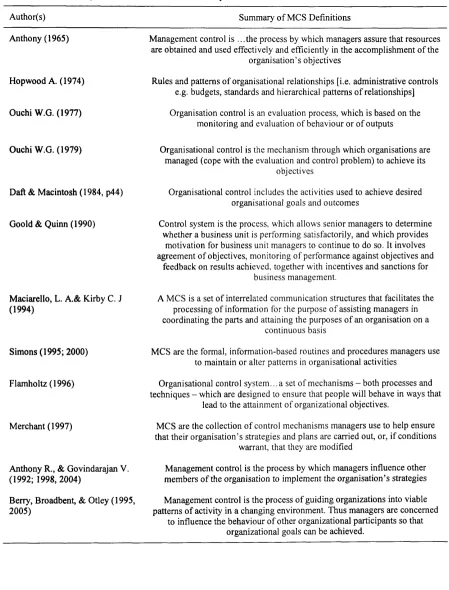
Anthony and Govindarajan (1998; 2004) - see Table 2-1 below for the summary o f these
definitions. Earlier definitions and empirical operationalisations of MCSs equate them with
the more formal forms o f organisational control (Anthony, 1965; Todd, 1977; Daft and
Macintosh, 1984; Simons, 1987; Anthony et al., 1992). However, MCS has also been depicted
as a subset o f organisational control systems/package (Otley, 1980; Emmanuel et al., 1990).
The common theme o f the definitions and descriptions of a MCS highlighted in Table 2-1 is
that a MCS represent those mechanisms (processes, practices and techniques, rules,
information systems, and patterns o f relationships) management uses to influence (i.e.
motivate, coordinate, monitor and reward) organisational members’ behaviour towards
attainment o f some organisational objective (strategies or operational goals). Inherent in these
definitions is a strong feature o f MCSs, i.e. a means o f assessing achievement of
Chapter 2 Literature R eview 9
the definitions is the direct consequence of MCSs, i.e. the impact on behaviour and
performance o f organisational members.
Table 2-1 Summary o f M CS D efinitions & D escriptions
Author(s) Summary o f MCS Definitions
Anthony (1965) Management control is ...the process by which managers assure that resources are obtained and used effectively and efficiently in the accomplishment o f the
organisation’s objectives
Hopwood A. (1974) Rules and patterns o f organisational relationships [i.e. administrative controls e.g. budgets, standards and hierarchical patterns o f relationships]
Ouchi W.G. (1977) Organisation control is an evaluation process, which is based on the monitoring and evaluation o f behaviour or o f outputs
Ouchi W.G. (1979) Organisational control is the mechanism through which organisations are managed (cope with the evaluation and control problem) to achieve its
objectives
Daft & Macintosh (1984, p44) Organisational control includes the activities used to achieve desired organisational goals and outcomes
Goold & Quinn (1990) Control system is the process, which allows senior managers to determine whether a business unit is performing satisfactorily, and which provides
motivation for business unit managers to continue to do so. It involves agreement o f objectives, monitoring o f performance against objectives and
feedback on results achieved, together with incentives and sanctions for business management.
Maciarello, L. A.& Kirby C. J A MCS is a set o f interrelated communication structures that facilitates the (1994) processing o f information for the purpose o f assisting managers in
coordinating the parts and attaining the purposes o f an organisation on a continuous basis
Simons (1995; 2000) MCS are the formal, information-based routines and procedures managers use to maintain or alter patterns in organisational activities
Flamholtz (1996) Organisational control system ... a set o f mechanisms - both processes and techniques - which are designed to ensure that people will behave in ways that
lead to the attainment o f organizational objectives.
Merchant (1997) MCS are the collection o f control mechanisms managers use to help ensure that their organisation’s strategies and plans are carried out, or, if conditions
warrant, that they are modified
Anthony R., & Govindarajan V. Management control is the process by which managers influence other (1992; 1998, 2004) members o f the organisation to implement the organisation’s strategies Berry, Broadbent, & Otley (1995, Management control is the process o f guiding organizations into viable 2005) patterns o f activity in a changing environment. Thus managers are concerned
[image:24.563.61.510.162.752.2]Chapter 2 Literature R eview 10
Empirical studies o f MCSs have been conducted primarily with reference to the technical
design or how specific management accounting techniques (MATs) are used particularly for
performance monitoring, evaluation and reward. Thus the organisation’s objectives are taken
as granted or defined generally in terms o f better performance or achievement o f performance
targets, usually budgetary targets. MCS design and use are somewhat different though related
concepts and most MCSs studies tend to focus on one or the other.
MCS design relates to the form of the formal control mechanisms that an organisation
establishes within its structure and information systems with the most ubiquitous being the
budgetary control system. Most empirical studies focusing on MCS design define it in terms
o f the predominant management accounting technique (MAT) that exists in an organisation,
or in terms o f the characteristics o f the information produced by these techniques, or
preferences for such information characteristics. Examples of MATs used to represent MCS
design include traditional budgets and budget variance analysis techniques; activity based
costing/budgeting; project management techniques; balanced scorecards; target costing
techniques; economic value added; and strategic planning techniques. Examples of
information characteristics also used to represent MCS design include internal and external
focus, broad and narrow scope, financial and non-fmancial, timeliness, aggregation and
integration (Larcker, 1981; Chenhall and Morris, 1986; Gul and Chia, 1994, Abemethy and
Lillis, 1995).
On the other hand, MCS use relates to how the formal control mechanisms are actually used
for its purported purposes distinct from its design or technical specifications. Empirical
studies focusing on MCS use define it in relation to the two main purposes of MCSs generally
acknowledged in the literature; i.e. decision making - involving planning and resource
allocation (Merchant, 1985c; Abemethy and Brownell, 1999); and control — involving
performance monitoring, evaluation and reward (Hopwood, 1972; Brownell, 1982a, 1982b;
Chapter 2 Literature R eview 11
descriptions and conceptualisations o f MCS use relate it to supervisory style or how MCS, in
particular budgets, were used by supervisors in managing subordinates performance, i.e. on
the control role (Argyris, 1952; Hofstede, 1968; Lowe and Shaw, 1968; Hopwood, 1972,
Otley, 1978). Consequently, majority o f MCSs studies focus on the control role with MCS
use defined in terms o f the manner and extent information from a MAT, particularly budgets,
are used in monitoring and evaluating performance, and in allocating rewards.
This study also focuses on the style o f use o f MCS information for performance evaluation
and reward termed here as Performance Evaluative Style (PES). In this study, however, MCS
information is not limited to any particular MAT but more broadly to the control systems
package, particularly the formal systems used for performance measurement and reward. This
broader package o f control systems for performance measurement and reward is termed here
as the performance management and control system (PMCS). The focus on MCS use is due
in part to the generally acknowledged assertion that the technical specification or design of a
MCS do not by itself effect control of organisational activities, rather it is the way in which
the MCS is used that much more determine its effectiveness in controlling organisational
activities. Second, MCS designs in practice seem to change much slower than style of MCS
use in response to changes in the business environment. For instance, Bums et al (1999) set
out to investigate the reasons behind the slow change in accounting practices and systems in
the UK in spite o f the profound changes in the business environment. However, they
surprisingly found considerable change in the way MAT is used rather than changes in MAT
employed per se. They attributed their surprising finding to several factors such as
globalisation, increasing competition, rapid changes in information technology, increasing
focus on core competencies, and changes in management structures which emphasize
decentralisation and team working. Otley (1994) had also hinted on the changing control
practices within organisations in response to the changing business environment, but lamented
that academic study lagged behind the developments in practice. This study therefore
Chapter 2 Literature R eview 12
2.2 T h eoretical F ram ew ork o f E m p irical M C S Studies
The foremost theoretical canopy of most MCS empirical studies has been contingency theory,
with some studies also employing other socio-psychological theories like goal and role theory
in developing their hypothesis or explaining their results.3 Chapman (1997) identified three
streams o f the contingency studies in management accounting viz.; the 4reliance on
accounting performance measures' (RAPM) stream; e.g. Hopwood (1972), Otley (1978),
Brownell (1982a,1983), Brownell and Hirst (1986), Hirst (1981, 1983), Brownell and
Merchant (1990); the ‘strategy and accounting control’ (STAC) stream e.g. Snow and
Hrebiniak (1980), Govindarajan and Gupta (1985), Govindarajan, 1988b; Simons (1987;
1990), Covin (1991); and the ‘centralisation o f control and accounting’ (CECA) stream e.g.
Bruns and Waterhouse (1975), Merchant (1981), Gordon and Miller (1976), Waterhouse and
Tiessen (1978).
The common theme o f the contingency studies is to explicate the conditions under which
particular MATs (e.g. budgets) and the style of use of information from such MATs more
positively impacts on an organisation’s performance considering its structure (the CECA
stream); the strategic focus (the STAC stream); and impact on work motivation and attitudes
o f its managers given its internal and external work environment (the RAPM stream).
However, this body o f studies has been criticised as not yet providing an overall framework
for analysing relations o f contingent factors with MCSs nor a cumulative body o f knowledge
because o f the conflicting findings and methodological problems (Chapman, 1997; Dent,
1990; Langfield-Smith, 1997; Otley, 1999). Nonetheless, the main premise o f these studies, in
particular the RAPM stream, seem to be the inappropriateness o f using mainly accounting
information (i.e. information from MATs like budgets) deemed incomplete for performance
evaluation and reward in complex and uncertain conditions. On this point, the RAPM and the
Chapter 2 Literature R eview 13
STAC streams are o f particular interest to this study because the central focus o f most o f the
studies in these two streams is on the control role o f MCSs, particularly as it relates to
performance evaluation and reward. In this context, MCS is often operationalised in terms o f
performance evaluative style (PES). Excellent reviews and critique of this body o f studies are
provided by Briers and Hirst (1990); Chapman (1997); Langfield-Smith (1997); Hartmann &
Moers (1999); Otley and Fakiolas (2000); Otley & Pollanen (2000); Vagneur and Peiperl
(2000); Hartmann (2000); and Chenhall (2003). Thus, in the following sections only a brief
critical review o f the literature is provided focusing rather on the central theme o f PES.
Nonetheless, a summary o f some o f these studies is provided at the end o f the chapter in Table
2-2 on page 31.
2.3 R A P M & P erform an ce E valu ative Styles (PE Ss)
The stream o f studies identified by Chapman (1997) as the RAPM studies can be traced
initially to the pioneering work o f Hopwood (1972) and Otley’s (1978) replication o f his
study. In his study, Hopwood contrasted two main performance evaluative styles (PESs),
based on how accounting information as contained in budgets were used in performance
evaluation, which he called the Budget Constrained (BC) style and the Profit Conscious (PC)
style.4 The BC style entailed seeing the budget as a firm management commitment with
performance measured and evaluated solely on the basis of meeting the budget without
consideration o f other pertinent factors. It reflected reliance on meeting the short term budget
targets as the main criteria in evaluating performance and the use of this criterion in a manner
intolerant o f deviations, i.e. a rigid use of budgets. In contrast, the PC style reflected a concern
for cost effectiveness i.e. use o f budgetary and non-budgetary criteria in performance
evaluation, and all used in a problem solving manner. In other words, the PC style did not
consider budgets as firm commitments but rather as communication and planning tools
C h a p t e r 2 L it e ra tu r e R e v i e w 14
wherein other relevant information affecting performance are considered when budgets are
used for performance evaluation, i.e. a flexible use of budgets. Hopwood also identified a
third PES where budgets were not important in performance measurement and evaluation
which he called the Non-Accounting (NA). However he did not analyse the NA style in detail.
It was much more a residual o f all other styles outside o f the two main styles. For the
empirical analysis o f his study, Hopwood also constructed a fourth style as an intermediate
point between the BC and PC styles, which he called the Budget Profit (BP) style. Hopwood’s
main argument was that the BC style of performance evaluation led to some dysfunctional
behaviour and thus was undesirable, whilst in contrast the PC style was less associated with
dysfunctional behaviour and thus should be used more by managers.
Otley (1978) replicated Hopwood’s study by selecting a radically different context which he
believed might be more conducive to heavy reliance on accounting performance measures,
and did not find the same results as Hopwood. In particular, he did not find the link between
the BC style and dysfunctional behaviour hypothesised by Hopwood. Many o f the RAPM
studies that followed later aimed to reconcile Hopwood’s and Otley’s results in terms o f other
contingent variables that may have impact on the results. However, many o f the results were
inconsistent between these studies due to several reasons including inconsistency between
theory and the methodology used in testing them. Even more importantly, many o f these
studies failed to capture Hopwood’s original PES specifications.5 In some studies, RAPM in
effect is equivalent to Hopwood’s Budget Constrained (BC) and the Profit Conscious (PC)
style combined, while taking the Non-accounting (NA) style as the opposite end o f RAPM.
Thus, other possible roles o f accounting information as captured by the PC style and other
intermediate styles are not explicitly recognised by these studies. They embedded a narrow
assumption o f the ‘rigid’ use o f accounting information. In a constantly changing
organisational context, the shortcomings o f casting the traditional role o f accounting
Chapter 2 Literature R eview 15
information as activity directing, and thus o f studies that hold accounting in this light, is aptly
captured by Otley (1994, pp.298, 299) thus:
The context and operation o f contemporary organisations requires flexibility,
adaptation and continuous learning to occur, but such characteristics are not
encouraged by traditional control systems. However, there is considerable amount o f
anecdotal evidence to suggest that practices within organisations have begun to take
account o f this changing environment. ...Management control ...is thus bound up
with both strategic decisions about positioning and operating decisions that ensure
the effective implementation o f such strategies. Unfortunately, academic study of
these control processes has lagged considerably behind developments in practice,
being rooted in an overly narrow and accounting-based framework.
Briers and Hirst (1990) in their review identified 3 dimensions on which variation in
Hopwood’s (1972) PES constructs were based as “ ...the range o f criteria used for
performance evaluation purposes; the flexibility with which variances from standards are
interpreted; and the manner in which short/long run concerns are handled.” These dimensions
seem to provide an articulate basis for specifying PES. However, Hopwood’s eventual
empirical specification o f PES was based on the ‘extent and manner’ budgets were used in
performance evaluation. The BC and PC styles made extensive use of budgets in performance
evaluation, but differed in the ‘manner’ in which the information was used, rigidly in the
former and flexibly in the latter. The NA style differed from these two in the extent of budget
use, with little or no use of budgets in performance evaluations (Otley and Fakiolas, 2000).
Nevertheless, Hopwood’s constructs do attempt to encapsulate accounting roles as both
activity directing/evaluative, and informing/problem-solving. Later RAPM studies measured
PESs only on the ‘extent’ dimension and thus conceptually combine the BC and PC styles as
one style - high budget emphasis (HBE) and, presumably, the NA style as low budget
emphasis (LBE). By this, their concepts o f PESs seem to only capture the activity
Chapter 2 Literature R eview 16
sectional studies with little or no detailed understudy o f any one organisation. Summarising
the noted differences in the concepts o f PESs between Hopwood and the RAPM stream in
general, Otley and Fakiolas (2000, p.509) identify opportunity for further research noting that:
Future studies o f the impact o f performance measurement and its use by superior
managers need to be sensitive to discovering the frameworks used for measurement
in the target organisations...rather than assuming that budgets and accounting data
play a central role in this process. Nevertheless, the methods used in studies on
RAPM and evaluative style appear to be generalisable into this arena with minor
adaptation. The door is open for researchers to build upon this foundation and make a
central contribution to the management literature.
In addition, it is equally important for future studies to be sensitive to the frameworks for
rewarding performance in their target organisations in order to enhance construct validity in
the specification and measurement o f PES. Since the PES construct hinge on the perceived
importance o f the performance measure(s) used, it is therefore important to capture the basis
o f the perceived importance in any construct of PES. Most frameworks o f MCSs design and
use suggest that performance measures are closely linked to rewards (e.g. Todd, 1977; Otley,
1999; Ittner and Larcker, 1998a). To enhance the understanding and measurement o f PES,
measurement instruments therefore need to link the evaluative criteria to the basis of both
extrinsic (e.g. incentive pay and promotion prospects) and intrinsic rewards. Given
Hopwood’s field research prior to developing his widely used measurement instrument, this
link may have underlined the measurement instrument for his sample. Given also the
hierarchical level at which he conducted his analysis, i.e. cost centre managers, it is quite
possible that the incentive structure was simple, e.g. standard merit increases, although he
does not report on it. The incentive structure for other hierarchical levels may be more
complex and thus not reflected at all or inappropriately captured by Hopwood’s instrument.
Hartmann (2000) also criticised previous studies that are supposed to be based on Hopwood’s
Chapter 2 Literature R eview 17
Thus, the uncritical use o f Hopwood’s instruments in analysing other hierarchical levels
without explicitly relating it to the incentive structure add to question - in the absence of any
other evidence - the validity of the PES constructs.
Briers and Hirst (1990) also note that Hopwood’s specifications o f PES need not occur in all
situations, and thus both the conceptualisation and measurement o f PES stand to be improved
upon. More importantly, Hopwood’s and the RAPM studies’ specifications o f PES does not
differentiate between the ‘accounting’ and the ‘target’ nature o f the information used in
performance evaluation. Thus, these studies may be confounding the effects on behaviour o f
the target nature o f budgetary information with its accounting nature (Hartmann, 2000). It is
important therefore, to ascertain which of these aspects o f information used in performance
evaluation trigger more dysfunctional behaviour.
Given the minimal attention to theoretical development of PES in these streams o f studies and
changes in the control practices o f contemporary organisations, it is argued here that the scope
o f investigating PES should broaden beyond just considering the use of budgetary information
(generally construed as financial/accounting information) to include all target related
information, both financial and non-financial, as well as qualitative information. There is
need, therefore, for PES constructs that broadly capture the roles o f targets, budgetary or
otherwise, in performance evaluation or more appropriately, the ‘manner’ in which the
information provided by the comparison o f actual with targeted performance is interpreted and
used in performance evaluation and reward. Thus, there is need for a measurement instrument
that reflect these concepts, and one general enough to be easily used in different settings and
levels o f analysis with minor adjustments to reflect the peculiarity o f the research setting.
Therefore, an extension o f the budgetary control literature would be to consider PES in terms
o f both the extent and manner that targets in general, financial or non-financial, linked to
rewards are used in performance evaluation. Such PES constructs would link better with other
Chapter 2 Literature R eview 18
provide a broader specification o f PES as argued above, and an appropriate PES measurement
instrument.
2.4
Other Categorisation of PES
Other categorisations of PES or style of use of MCS exist aside Hopwood’s and the RAPM
studies’ specifications. For instance, Anthony and Govindarajan (1998) conceive MCS as
essentially budgetary/financial control and provide a similar categorisation of style o f use of
MCS as essentially tight or loose budgetary control, although they state that “a company’s
position on this tight/loose continuum depends on the amount o f emphasis senior management
places on meeting or exceeding budgetary objectives in the short run” (p.438). At one end, a
tight control system is one in which performance is evaluated primarily on a manager’s ability
to met budget targets. Similar to Hopwood’s BC style, budget targets are seen as firm
commitments. At the other end in a loose control system, budget targets are not regarded as
firm commitments but seen and used as planning and communication tools. They note that
while tight budgetary control had two important benefits, preventing wastes/inefficiencies and
motivating search for improvement o f operations, it can produce several dysfunctional effects.
In a bid to address the dysfunctional consequences associated with the use of
budgetary/financial controls the practitioner led Beyond Budgeting (BB) group added to the
specification o f PES. First, they advocate that budgets and thus budgetary control should be
done away with, and that relative performance targets should be used in place o f preset budget
targets (Hope and Fraser, 2003a, 2003b; Hansen et al., 2003).6 Second, they advocate the use
o f various non-financial performance measures as well, and that performance evaluation
should be done with hindsight by taking account o f the actual operating and economic