International Journal of Emerging Technology and Advanced Engineering
Website: www.ijetae.com (ISSN 2250-2459, ISO 9001:2008 Certified Journal, Volume 3, Issue 11, November 2013)
572
Improving the Performance of ADHOC Network Using Hybrid
Method
Harshit Nigam1, Gaurav Nigam2, Shikhar Saxena3, Neeraj Verma4 1
S.P Memorial Institute Of Technology And Management (U.P) India. 2
Lord Krishna College Of Engineering, Ghaziabad, 3
Ericsson India Global Services Private Limited, 4
Kamla Nehru Institute Of Technology Sultanpur.
Abstract— In this paper We conclude that Hybrid method
is the most Significant method as compare to both the On demand and Table Driven to find the shortest route in minimum time as well. We all know that Wireless networks are an emerging new technology that allow user to access information and services electronically, Regardless of their geographic position. There fore to set up Devices at low cost is the main motto of the organisation. The most common wireless technologies use electromagnetic wireless telecommunications, such as radio. With radio waves distances can be short, such as a few meters for television or as far as thousands or even millions of kilometres for deep-space radio communications. It encompasses various types of fixed, mobile, and portable applications, including two-way radios, cellular telephones, personal digital assistants (PDAs), and wireless networking. Other examples of applications of radio wireless technology include GPS units, garage door openers, wireless computer mice, keyboards and headsets, headphones, radio receivers, satellite television, broadcast television and cordless telephones.
Keywords—Infrastructured Network, Infrastucture Less
Networks, Routing, Destination Sequenced Distance vector (DSDV), Ad hoc On Demand Distance Vector Routing (ADOV), Hybrid Method.
I. INTRODUCTION
Infrastructured Network consists of fixed base stations while communications take place using technique handoff. It connects with new base station and start communication when mobile goes out of range of one base station.Advantages over Ad-hoc networks [2]. (a) Efficiently utilize network resources. (b) single-hop routes, results in: - lower delay and loss and higher data rates Examples: Wireless LANs, paging systems, and cellular phone systems. Base station coordination in infrastructure-based networks provides a centralized control mechanism for transmission scheduling, dynamic resource allocation, power control, and handoff [1]. As such, it can more efficiently utilize network resources to meet the performance requirements of individual users.
Moreover, most networks with infrastructure are designed so that mobile terminals transmit directly to a base station, with no multihop routing through intermediate wireless nodes. In general these single-hop routes have lower delay and loss, higher data rates, and more flexibility than multihop routes. For these reasons, the performance of infrastructure-based wireless networks tends to be much better than in networks without infrastructure [2]. However, it is sometimes more expensive or simply not feasible or practical to deploy infrastructure, in which case ad hoc wireless networks are the best option despite their typically inferior performance.
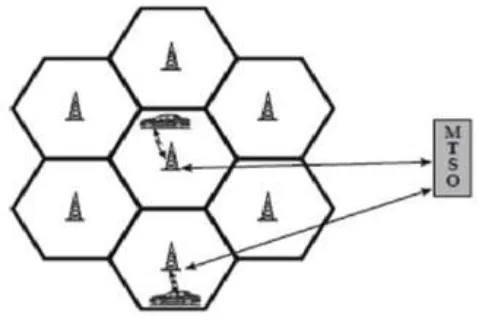
[image:1.612.335.574.453.614.2]Handover/Handoff is the process of automatically switching a call in progress from one traffic channel to another to neutralize the adverse effects of user movements [2]
Figure 1: Connections are transferred from one segment to another during motion.
International Journal of Emerging Technology and Advanced Engineering
Website: www.ijetae.com (ISSN 2250-2459, ISO 9001:2008 Certified Journal, Volume 3, Issue 11, November 2013)
573
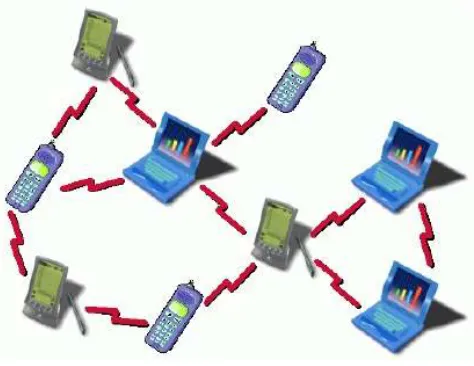
[image:2.612.51.288.476.659.2]Instead, each node participates in routing by forwarding data for other nodes, so the determination of which nodes forward data is made dynamically on the basis of network connectivity. In addition to the classic routing, ad hoc networks can use flooding for forwarding data [2]. An ad hoc network is made up of multiple "nodes" connected by "links."Links are influenced by the node's resources (e.g., transmitter power, computing power and memory) and behavioral properties (e.g., reliability), as well as link properties (e.g. length-of-link and signal loss, interference and noise). Since links can be connected or disconnected at any time, a functioning network must be able to cope with this dynamic restructuring, preferably in a way that is timely, efficient, reliable, robust, and scalable. Ad Hoc Mode does not require an access point; it's easier to set up, especially in a small or temporary network [6]. As the Ad Hoc topology changes, throughput and range will change, sometimes in unanticipated ways. New users will have an easier time learning wireless strengths and weaknesses with Infrastructure Mode, and therefore the NETGEAR Installation Guides focus on it. [3] In Ad Hoc Mode, chains of computers will connect to pass your data, if your computer is not directly in range. On the other hand, you do not have control over the path your data takes. The automatic configuration routines may send your data through several computers, causing significant network delays. In an Ad Hoc network with many computers, the amount of interference for all computers will go up, since each is trying to use the same frequency channel [7].
Figure 2: Wireless devices connected together
In case of overlapping/equal routes, the following elements are considered in order to decide which routes get installed into the routing table (sorted by priority):
1. Prefix-Length: where longer subnet masks are preferred (independent if it is within a routing protocol or over different routing protocol)
2. Metric: where a lower metric/cost is preferred (only valid within one and the same routing protocol) 3. Administrative distance: where a lower distance is
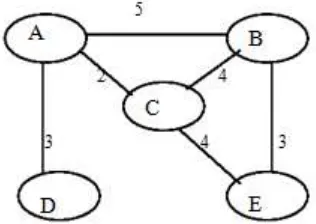
preferred (only valid between different routing protocols) It may face some problems: 1) Asymmetric links: link between A and B might be good but Reverse might not be true. Since topology changes rapidly thus snapshot available are valid for very small time only this is dynamic topology. In adhoc network routing table must reflect these changes. In figure 3 there are 2 paths from A to C there for Router A can choose shortest path it could be via C also depending on the weighted Edges [3].
Figure 3: Connection between all the nodes for communication
II.
ROUTINGInternational Journal of Emerging Technology and Advanced Engineering
Website: www.ijetae.com (ISSN 2250-2459, ISO 9001:2008 Certified Journal, Volume 3, Issue 11, November 2013)
574
III. DESTINATION-SEQUENCED DISTANCE-VECTOR
ROUTING (DSDV)
[image:3.612.88.246.269.381.2]It is a table-driven routing scheme for ad hoc mobile networks based on the Bellman-Ford algorithm. DSDV requires a regular update of its routing tables, which uses up battery power and a small amount of bandwidth even when the network is idle [4]. Whenever the topology of the network changes, a new sequence number is necessary before the network re-converges; thus, DSDV is not suitable for highly dynamic networks.
[image:3.612.328.558.423.605.2]Figure 4: Destination-Sequenced Distance-Vector Routing TABLE 1
Using the values of above parameters table is created
# In the modified table of A, value of E comes out to be 6. Whose Earlier value was infinite () as (6 < ) therefore its smaller value is taken.
IV. ADHOCON DEMAND DISTANCE VECTOR ROUTING
(AODV)
The Ad hoc On Demand Distance Vector (AODV) routing algorithm is a routing protocol designed for ad hoc mobile networks. AODV is capable of both unicast and multicast routing[10]. It is an on demand algorithm, meaning that it builds routes between nodes only as desired by source nodes. It maintains these routes as long as they are needed by the sources. AODV builds routes using a route request / route reply query cycle it broadcasts a route request (RREQ) packet across the network. Nodes receiving this packet update their information for the source node and set up backwards pointers to the source node in the route tables. In addition to the source node's IP address, current sequence number, and broadcast ID, the RREQ also contains the most recent sequence number for the destination of which the source node is aware. A node receiving the RREQ may send a route reply (RREP) if it is either the destination or if it has a route to the destination with corresponding sequence number greater than or equal to that contained in the RREQ. If this is the case, it unicasts a RREP back to the source [5]. Otherwise, it rebroadcasts the RREQ. AODV maintains routes for as long as the route is active.
[image:3.612.56.285.436.624.2]International Journal of Emerging Technology and Advanced Engineering
Website: www.ijetae.com (ISSN 2250-2459, ISO 9001:2008 Certified Journal, Volume 3, Issue 11, November 2013)
575
V. DIFFERENCE BETWEEN DSDVAND AODV
TABLE 4 Differences
VI. PROBLEMS WITH ROUTING IN MOBILE ADHOC
NETWORKS
1. Asymmetric links: Most of the wires networks reply on the symmetric links which are always fixed. But this is not the case with adhoc networks as the nodes are mobile and constantly changing their position within network. For Example node B send signal to node A but this does not tell anything about the quality of the connection in reverse direction.
2. Routing Overhead: in wireless network, nodes often change their location within network. So, some stable routes are generated in the routing table which leads to unnecessary routing overhead.
3. Interference: This is the major problem with adhoc networks as links come and go depending on the transmission characteristics, one transmission might interference with another one and node might over near transmission of other nodes and can corrupt the total transmission.
4. Dynamic Topology: This is also major problem with adhoc routing since the topology is not constant. The mobile node might more or medium characteristics might change. In Adhoc networks, routing table must some how reflect these changes in topology and routing algorithm have to be updated. For example in a fixed routing table updating takes place for every 30 sec. This updating frequency might be low for adhoc networks.
VII. HYBRID METHOD
In this method we use both Destination Sequenced Distance Vector Routing (DSDV) as well as Ad hoc On Demand Distance Vector Routing (AODV) Protocol.
Which is known as Ad hoc Destination Sequenced Distance Vector Routing (ADSDV)? In this method we will firstly choose the shortest path which is easier in Ad hoc On Demand Distance Vector Routing (AODV) Protocol and then we will maintain the table of that particular route using Destination Sequenced Distance Vector Routing (DSDV). This procedure is applied as the preference over both the technique to solve the problems Easily. This includes 3 steps such as:
Step 1:
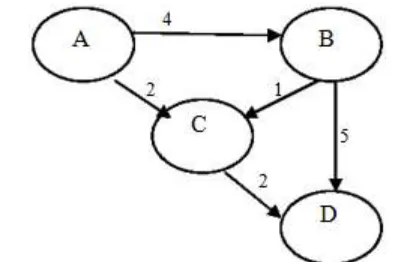
[image:4.612.340.539.484.615.2]Choosing shortest and appropriate path between 2 Vertices. For Example in fig 6.
International Journal of Emerging Technology and Advanced Engineering
Website: www.ijetae.com (ISSN 2250-2459, ISO 9001:2008 Certified Journal, Volume 3, Issue 11, November 2013)
[image:5.612.63.275.341.451.2]576
TABLE 5
Using the values of above parameters table is created
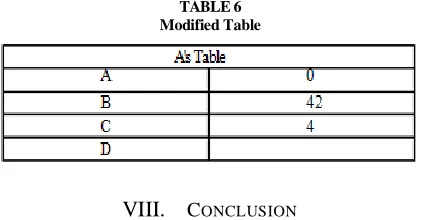
Use the Table between source and Destination only that is A and D. Now update the table using number of path present rather than comparing all the vertices. That is A- C-D is 4, A-B-C-D is 9, A-B-C-C-D is 7. (4 < 7 < 9) there for we will choose the distance between source and Destination is to be 4. Now new table arrive will be
TABLE 6 Modified Table
VIII. CONCLUSION
In this work, improved methodology for Destination- Sequenced Distance-Vector Routing as well as Ad hoc On Demand Distance Vector Routing (AODV) Protocol is discussed using Hybrid technology. This method offers improved value of performance parameters such as comparison and updation of tables as compared to Hybrid technique. During the analysis of its result it is also observed that no longer comparison is needed. It is much better than other available methods for Choosing and assigning path. Example shows better value of A's Table which alternatively results in reduced time and improved method over Ad hoc On Demand Distance Vector Routing (AODV) and Destination Sequenced Distance Vector Routing (DSDV).
Proposed method is also verified for three time's longer length; and observed that even for such long distance; error does not occur and offers negligible time in calculation.
REFERENCES
[1] Andrea Goldsmith, "Wireless Communications", Cambridge University Press, 2005.
[2] David Tse; Pramod Viswanath, "Fundamentals of Wireless Communication", Cambridge University Press, 2004.
[3] Samir R. Das, Charles E. Perkins, and Elizabeth M. Royer. "Performance Comparison of Two On-demand Routing Protocols for Ad Hoc Networks." Proceedings of the IEEE Conference on Computer Communications (INFOCOM), Tel Aviv, Israel, March 2000, p. 3-12.
[4] Samir R. Das, Charles E. Perkins, Elizabeth M. Royer and Mahesh K. Marina. "Performance Comparison of Two On-demand Routing Protocols for Ad hoc Networks." IEEE Personal Communications Magazine special issue on Ad hoc Networking, February 2001, p. 16- 28.
[5] Charles E. Perkins and Elizabeth M. Royer. "Ad hoc On-Demand Distance Vector Routing." Proceedings of the 2nd IEEE Workshop on Mobile Computing Systems and Applications, New Orleans, LA, February 1999, pp. 90-100.
[6] H. Balakrishnan, V. Padmanabhan, S. Seshan, and R. Katz. A comparison of mechanisms for improving TCP performance over wireless links. In Proceedings of ACM SIGCOMM'96, Stanford University, California, Aug. 1996.
[7] G. Holland and N. Vaidya. Analysis of TCP performance over mobile ad hoc networks. In Proceedings of ACM MobiCom'99, Aug. 1999.
[8] M. Marina and S. Das, "On-demand multipath distance vector routing in ad hoc networks," Proceedings of IEEE International Conference on Network Protocols (ICNP)'01, Nov. 2001.
[9] S. Vutukury and J. J. Garcia-Luna-Aceves, "MDVA: A distance- vector multipath routing protocol," Proceedings of IEEE INFOCOM'01, Apr. 2001.
International Journal of Emerging Technology and Advanced Engineering
Website: www.ijetae.com (ISSN 2250-2459, ISO 9001:2008 Certified Journal, Volume 3, Issue 11, November 2013)
577
AUTHOR'S PROFILEHarshit Nigam obtained B.TECH (HONOURS) in (Computer Science and Engineering ) from GBTU in 2011and Pusuing MTech (Computer Science )From United Institute of Technology Allahabad. He is working as a Lecturer in SP Memorial Institute of Technology H is area of interest includes Information Security and Graph Theory. He has more than2 years of experience .
Gaurav Nigam obtained In ECE and completed MTech (Microwave Engg) from SHIATS Allahabad. He guided arious project at Engineering Level. His area of interest Include Antena Communication System and Solid Statae Devices. He has 4 Years of Experience.
Shikhar Saxena obtained his B.Tech degree in Computer Science from KN Modi Engineering in the year 2009. Currentky he is working as solution Integartor in Ericsion India Serices Pvt Ltab.
Neeraj Verma was born in Uttar Pradesh, India. He graduated from Utter Pradesh Tech nical 2007. Now he is Assistant Professor in department of Computer Science and Engineering,
Institute Ka m la Nheru Of
Technology, Sultanpur. He has more than 2 year teaching experience in the area of interest.