Making
WILLIAM HINOJOSA
School of Computing, Science and Engineering
University of Salford, Salford, UK
CONTENTS
Contents i
List Of Figures vi
List Of Tables ix
Acknowledgements xi
Acronyms xiii
Glossary xiv
Abstract xxi
1. Introduction 1
1.1 Motivation...!
1.2 Research Goal...4
1.3 Summary of Contributions...4
1.4 Outline of Dissertation...^ 2. Knowledge Acquisition 9 2.1 Introduction...9
2.2 What Is Knowledge Acquisition?...10
2.3 Machine Learning... 11
2.3.1 Learning-Based Classification ...14
2.3.2 Problem-Based Classification ...18
2.5 Summary... 26
3. Reinforcement Learning 27 3.1 Introduction... 27
3.2 Reinforcement Learning and the Brain... ... ...28
3.3 Common Terms ...30
3.3.1 The Agent... ... ...30
3.3.2 The Policy... ... ...30
3.3.3 The Environment...31
3.3.4 The Reward ... ...32
3.4 Reinforcement Learning Taxonomy...32
3.5 Model-Based Methods...33
3.6 Model-Free Methods... ...34
3.6.1 Critic Only Methods... ...34
3.6.2 Actor Only Methods... ... ...35
3.6.3 Actor-Critic ... ...35
3.7 On-Policy / Off-Policy Methods... ...40
3.8 Reinforcement Learning Algorithms... 41
3.8.1 Temporal Difference ...41
3.9 Reinforcement Learning In Decision Making ...49
3. 10 Reinforcement Learning For Control ...51
3.1 1 Conclusions... --...---..--...-52
CONTENTS
4.1
4.2
4.2.1 Uncertainty Taxonomy...56
4.2.2 Sources of Uncertainty ...57
4.2.3 Dealing with Uncertainty ...59
4.3 Fuzzy Logic ...62
4.3.1 Fuzzy Inference Systems...65
4.4 Probabilistic Theory...66
4.5 Probabilistic Fuzzy Logic Systems...69
4.6 Learning Methods for Fuzzy Systems ...73
4.6.1 Neuro-Fuzzy Systems...74
4.6.2 Fuzzy Logic and Genetic Algorithms ...76
4.6.3 Fuzzy-Reinforcement Learning...79
4.7 Conclusions...80
4.8 Summary...81
5. GPFRL Generalized Probabilistic Fuzzy-Reinforcement Learning 82 5.1 Introduction...-...82
5.2 Structure...83
5.3 Probabilistic Fuzzy Inference ...84
5.4 Reinforcement Learning Process...88
5.4.1 Critic Learning ...89
5.4.2 Actor Learning ...91
5.6 Discussion...96
5.7 Summary... 100
6. Experiments 101 6.1 Introduction... 101
6.2 Decision Making Experiments... 102
6.2.1 Random Walk Problem ...102
6.2.2 Mobile Robot Obstacle Avoidance ...122
6.3 Control Experiments... 135
6.3.1 Cart-Pole Balancing Problem...135
6.3.2 DC Motor Control ...151
6.4 Summary... 163
7. Concluding Discussion 164 7.1 Introduction... 164
7.2 Contributions of This Work... 165
7.3 Observations... 167
7.4 Future Work... 168
7.4.1 Theoretical Suggestions ...169
7.4.2 Practical Suggestions... 170
7.5 Final Conclusions ...170
References 171
Appendix 182
Appendix A 183
CONTENTS
SARSA... 184
Q-Learning...186
GPFRL ... 188
Appendix B 191 Cart-Pole Problem 191 Main Program... 192
Reinforcement Learning Program... 196
Fuzzy Logic Program ...199
Cart-pole Model...202
Random Noise Generator...204
Mathematical Functions ...206
Appendix C 207 DC Motor Control Problem 207 DC Motor model...208
Motor-Mass System ...209
Reinforcement Learning Program...210
Fuzzy Logic Program ...212
Mathematical Functions ...214
ITAE/IAE Calculation...216
Figure 1.1: Flow of the dissertation... 8
Figure 2.1: Knowledge acquisition taxonomy... 11
Figure 2.2: Supervised learning scheme... 22
Figure 3.1: Sagital view of the human brain... 29
Figure 3.2: Reinforcement learning taxonomy... 33
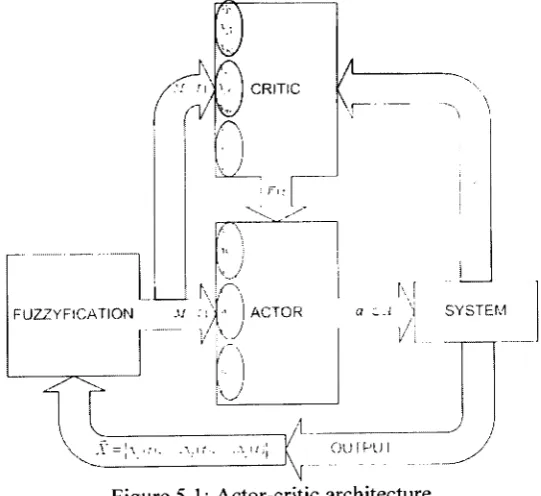
Figure 3.3: Actor-critic architecture... 36
Figure 4.1: Uncertainty taxonomy (Tannert et al., 2007). ... 57
Figure 4.2: Basic structure of a FIS... 65
Figure 4.3: Different configurations of neuro-fuzzy systems... 76
Figure 5.1: Actor-critic architecture... 84
Figure 5.2: GPFRL algorithm flowchart... 93
Figure 6.1: A 5x5 dimension grid world for a total of 25 states... 102
Figure 6.2: Static starting point learning rate comparison... 106
Figure 6.3: Standard deviation for 100 plays... 106
Figure 6.4: Static starting point utility value distributions for a) SARSA and b) Q- learning... 107
Figure 6.5: Static starting point GPFRL probabilities distribution... 107
LIST OF FIGURES
Figure 6.7: Random starting point, standard deviation comparison for 100 plays.
... no
Figure 6.8: Random starting point SARSA and Q-Learning utility value
distribution... 111
Figure 6.9: Random starting point GPFRL probabilities distribution... 111
Figure 6.10: Windy grid world... 114
Figure 6.11: Static starting point in the windy random walk... 116
Figure 6.12: Static starting point in the windy random walk... 118
Figure 6.13: SARSA utility value distribution for the windy grid world... 118
Figure 6.14: GPFRL probabilities distribution for the windy grid world... 119
Figure 6.15: Khepera III mobile robot... 124
Figure 6.16: Measured reflection value vs. Distance, extracted from (Prorok et al., 2010)... 126
Figure 6.17: Clustering of IR inputs into 4 regions... 127
Figure 6.18: Membership functions for the averaged inputs ... 128
Figure 6.19: IR sensor distribution in the Khepera III robot... 129
Figure 6.20: The controller structure... 130
Figure 6.21: Khepera III sensor reading for 30 seconds trial... 133
Figure 6.22: Internal reinforcement E(t)... 133
Figure 6.23: Cart-pole balancing system... 136
Figure 6.25: Actor learning rate, alpha, vs. number of failed runs... 145
Figure 6.26: Actor learning rate, alpha, vs. number of trials for learning... 146
Figure 6.27: Critic learning rate, beta, vs. number of failed trials... 146
Figure 6.28: Critic learning rate, beta, vs. number of trials for learning... 146
Figure 6.29: Cart position at the end of a successful learning run... 148
Figure 6.30: Pole angle at the end of a successful run... 148
Figure 6.31: Applied force at the end of a successful learning run... 148
Figure 6.32: Signal generated by the stochastic noise generator... 149
Figure 6.33: Motor with load attached... 151
Figure 6.34: Membership functions of the error input... 156
Figure 6.35: Membership functions for the rate of change of the error... 157
Figure 6.36: Screen capture of the developed software for the DC Motor example. ... 159
Figure 6.37: Trials for learning... 160
Figure 6.38: Motor error in steady state... 161
LIST OF TABLES
Table 3.1 Actor-critic algorithm ... 39
Table 3.2 Q-Learning on-policy TD control algorithm ... 47
Table 3.3 SARSA on-policy TD control algorithm ... 48
Table 5.1 GPFRL Algorithm ... 95
Table 6.1 Parameters used for the random walk experiment... 105
Table 6.2 Parameters used for the random walk experiment... 114
Table 6.3 Centre and standard deviation for all membership functions. ... 129
Table 6.4 Coefficient values for the RL algorithm... 132
Table 6.5 Cart-pole model parameters... 137
Table 6.6 Cart-pole membership function parameters... 139
Table 6.7 Parameters used for the cart-pole experiment... 140
Table 6.8 Probabilities of success of applying a positive force to the cart for each system state... 141
Table 6.9 Learning method comparison for the cart-pole balancing problem.... 144
Table 6.10 DC Motor Model Parameters... 152
Table 6.11 Membership function paremeters for error input... 157
ACKNOWLEDGEMENTS
This dissertation is the product of many years of enjoyable effort and is the result
of not only the hard work of one individual, but of many, each one being equally
important for its correct development.
To start with, I would like to thank my supervisor, Dr. Samia Nefti, for her
incredible productive collaboration, critics, guidance, and patience. I thank her for
generously sharing her talents, energy, and good advice.
I was especially lucky to have the collaboration Dr. Uzay K aymak from the
Econometric Institute, Erasmus School of Economics, Erasmus University at
Rotterdam, whose wise comments and advice greatly contributed to the
development of the theoretical part of this work.
I thank my family; my parents, who never stopped supporting me, I thank their
patience, commitment, support, and advice when I needed the most. Also, to my
beloved sister Johanna, for her constant support and affection. They always
believed in me and pushed me forward. Certainly, their love and support have
made me the person I am today.
Big thanks go to my beautiful partner Lucy, whose love and affection made all my
time here much more enjoyable. I thank her for teaching me what I needed to
know about this wonderful country, for supporting and understanding me and for
tolerating my irregular schedules and my frequent lateness. I am also thankful for
A special acknowledge goes to one of my closest and best friends, Alvaro
Vallejos, who greatly helped me in the completion of this dissertation. His expert
advice greatly helped me to quickly and effectively solve several MS Office crises
in different moments. I wouldn't have done it without his help... at least not with
such a nice format!
I will not forget that I've greatly enjoyed these last years because all my wonderful
friends and colleagues, who enriched my years at Salford University: Xavier Sole,
loannis Sarakoglou, Elmabruk Abulgasem, Ahmed Al-Dulaimy, May Bunne,
Nelson Costa, Antonio Espingardeiro, Indra Riady and Rosidah Sam. Thanks for
always being there, for the good times, for the moments of laughter, for all the
ideas we share and all the discussions we had. Their presence and constant
support transformed the studies that this project concludes into an unforgettable
experience. They all became a family in this journey.
Finally, I am grateful to all the members of the School of Computer Science and
Engineering who kindly helped me in many different ways, especially to Lynn
Crankshaw a nd Ruth Brec kill. Finall y 1 thank The Univ ersity of S alford for
ACRONYMS
AI Artificial Intelligence
DP Dynamic Programming
FIS Fuzzy Inference System
IR Infra-red
MC Monte Carlo Methods
MDP Markov Decision Process
NN Neural Networks
PFL Probabilistic Fuzzy Logic
POMDP Partially Observable Markov Decision Process
RL Reinforcement Learning
SARSA State-Action-Reward-State-Action
Actor-critic
Agent
Average-reward
methods
Discount factor
Refers to a class of agent architectures, where the actor
plays out a particular policy, while the critic learns to
evaluate actor's policy. Both the actor and critic are
simultaneously improving by bootstrapping on each
other.
A system that is embedded in an environment. The
controller or decision-making entity choosing actions
and learning to perform a task. Examples include mobile
robots, software agents, or industrial controllers.
A framework where the agent's goal is to maximize the
expected payoff per step. Average-reward methods are
appropriate in problems where the goal is to maximize
the long-term performance. They are usually much more
difficult to analyze than discounted algorithms.
A scalar value between 0 and 1 which determines the
present value of future rewards. If the discount factor is
0, the agent is concerned with maximizing immediate
rewards. As the discount factor approaches 1, the agent
takes more future rewards into account. Algorithms
which discount future rewards include Q-learning and
GLOSSARY
Discounting
Dynamic
programming
Environment
Episode
Function
approximation
Markov chain
Markov decision
problem
If rewards received in the far future are worth less than
rewards received sooner, they are des cribed as being
discounted. Humans and animals appear to discount
future rewards hyperbolically; exponential discounting
is common in engineering and finance.
A collection of calculation techniques for finding a
policy that maximises reward or minimises costs. Is a
class of solution methods for solving sequential decision
problems with a compositional cost structure.
The external system that an agent is "embedded" in, and
can perceive and act on.
A time segment of learning with task dependent starting
and ending conditions.
Refers to the problem of inducing a function from
training examples. Standard approximates include
decision trees, neural networks, and nearest-neighbour
methods.
A model for a random process that evolves over time
such that the states (like locations in a maze) occupied in
the future are independent of the states in the past given
the current state.
A model for a controlled random process in which an
agent's choice of action determines the probabilities of
costs) that need to be maximised (or minimised).
Essentially, the outcome of applying an action to a state
depends only on the current action and state (and not on
preceding actions or states)
Model The agent's view of the environment, which maps state-
action pairs to probability distributions over states. Note
that not every reinforcement learning agent uses a model
of its environment. Basically it's a mathematical
description of the environment.
Model-based These compute value functions using a model of the
algorithms system dynamics. Adaptive Real-time DP (ARTDP) is a
well-known example of a model-based algorithm.
Model-free These directly learn a value function without requiring
algorithms knowledge of the c onsequences of doin g actions. Q
-learning is the best known example of a model-free
algorithm.
Monte Carlo A class of methods for learning value functions, which
methods estimates the value of a state by running many trials
starting a t th at state , th en a verages th e tot al r ewards
received on those trials.
Policy The decision-making function of the agent, which
represents a mapping from situations to actions. Can be
considered a deterministic or stochastic scheme for
choosing an action at every state or location.
GLOSSARY
Policy improvement
Policy iteration
POMDP
Return
Reward
Sensor
State
Temporal
difference
algorithms
Forming a new policy that is better than the current one.
Alternating steps of policy evaluation and policy
improvement to converge to an optimal policy.
Partially observable Markov decision problem. State
information is available only through a set of
observations.
The cumulative (discounted) reward for an entire
episode.
An immediate, possibly stochastic, payoff that results
from performing an action in a state represented by a
numerical signal to the learning agent indicating task
progress or completion or the degree to which a state or
action is desirable. Reward f unctions can be use d to
specify a wide range of planning goals
Agents perceive the state of their environment using
sensors, which can refer to physical transducers, such as
ultrasound, or simulated feature-detectors.
This can be viewed as a summary of the past history of
the system, which determines its future evolution.
A class of learning methods, based on the idea of
comparing temporally successive predictions. Possibly
the single most fundamental idea in all of reinforcement
Temporal
difference
prediction error
Unsupervised
learning
Value function
Value iteration
A measure of the inconsistency between estimates of the
value function at two successive states. This prediction
error can be used to improve the predictions and also to
choose good actions.
The area of machine learning in which an agent learns
from interaction with its environment, rather than from a
knowledgeable teacher that specifies the action the agent
should take in any given state.
Is a mapping from states to real numbers, where the
value of a state represents the long-term reward
achieved starting from that state, and executing a
particular policy. The key distinguishing feature of RL
methods is that they learn policies indirectly, by instead
learning value functions. RL methods can be contrasted
with direct optimization methods, such as genetic
algorithms (GA), which attempt to search the policy
space directly. A function def ined ov er states, which
gives an estimate of the total (possibly discounted)
reward expected in the future, starting from each state,
and following a particular policy.
A single iteration of policy evaluation followed by
' Whether or not you think you can do something, you are probably right"
ABSTRACT
This dissertation focuses on the problem of uncertainty handling during learning
by agents dealing in stochastic environments by means of reinforcement learning.
Most previous investigations in reinforcement learning have proposed algorithms
to deal with the learning performance issues but neglecting the uncertainty present
in stochastic environments.
Reinforcement learning is a valuable learning method when a system requires a
selection of actions whose consequences emerge over long periods for which
input-output data are not available. In most combinations of fuzzy systems with
reinforcement learning, the environment is considered deterministic. However, for
many cases, the consequence of an action may be uncertain or stochastic in nature.
This work proposes a novel reinforcement learning approach combined with the
universal function approximation capability of fuzzy systems within a
probabilistic fuzzy logic theory framework, where the information from the
environment is not interpreted in a deterministic way as in classic approaches but
rather, in a statistical way that considers a probability distribution of long term
consequences.
The generalized probabilistic fuzzy reinforcement learning (GPFRL) method,
presented in this dissertation, is a modified version of the actor-critic learning
architecture where the learning is enhanced by the introduction of a probability
measure into the learning structure where an incremental gradient descent weight-
Experiments were performed on simulated and real environments based on a
travel planning spoken dialogue system. Experimental results provided evidence
to support the following claims: first, the GPFRL have shown a robust
performance when used in control optimization tasks. Second, its learning speed
outperforms most of other similar methods. Third, GPFRL agents are feasible and
Chapter 1
Introduction
1.1
Motivation
Learning algorithms can tackle problems where pre-programmed solutions are
difficult or impossible to design. Depending on the level of available information,
learning agents can apply one or more types of learning. According to the
connectionist learning approach (Hinton, 1989), these algorithms are mainly of
three kinds: supervised, unsupervised and reinforced learning. Unsupervised
learning is suitable when target information is not available and the agent tries to
form a model based on clustering or association amongst data. Supervised
learning is much more powerful, but it requires the knowledge of output patterns
corresponding to input data. However, in dynamic environments, where the
outcome of an action is not immediately known and is subject to change, correct
target data may not be available at the moment of learning, which implies that
supervised approaches cannot be applied. In these environments, reward
information, whose availability can be only sparse, may be the best signal that an
more a ppropriate meth od than supe rvised or u nsupervised meth ods w hen the
systems require a selection of actions whose consequences emerge over long
periods for which input-output data are not available (Berenji and Khedkar, 1992).
A RL problem can be defined as a decision process where the agent learns how to
select an action based on feedback from the environment. It can be said that the
agent learns a policy that maps states of the environment into actions. Often, the
RL agent must learn a value function, which is an estimate of the appropriateness
of a control action given the observed state. In many applications, the value
function that needs to be learned can be rather complex. It is then usual to use
general function approximation methods, such as neural networks and fuzzy
systems for approximating the value function. This approach has been the start of
extensive research on fuzzy and neural reinforcement learning algorithms, and is
the focus of this dissertation.
In most combinations of fuzzy systems and reinforcement learning, the
environment is considered deterministic, where the rewards are known and the
consequences of an action are well defined. In many problems, however, the
consequence of an action may be uncertain or stochastic in nature. In that case, the
agent deals with environments where the exact nature of the choices is unknown,
or it is difficult to foresee the consequences or outcomes of events with certainty.
Furthermore, an agent cannot simply assume what the world is like and take an
action a ccording to tho se a ssumptions. Instead, it nee ds to consider multiple
possible contingencies and their likelihood. In order to handle this key problem,
instead of predicting how the system will respond to a certain action, a more
appropriate approach is to predict a system probability of response (Berg et al.,
2004).
In this dissertation, it is proposed a novel reinforcement learning approach that
CHAPTER 1: INTRODUCTION
probability theory. The proposed algorithm, seeks to exploit the advantages of
both fuzzy inference systems and probabilistic theory to capture the probabilistic
uncertainty of real world stochastic environments. This will allow the agent to
choose an action based on a probabilistic distribution able to minimize negative
outcomes (or maximize positive reinforcements) of future events.
The proposed generalized probabilistic fuzzy reinforcement learning (GPFRL)
method is a modified version of the actor-critic learning architecture, where
uncertainty handling is enhanced by the introduction of a probabilistic term into
the actor and the critic learning. The addition of the probabilistic terms enables the
actor to effectively define an input-output mapping by learning the probabilities of
success of performing each of the possible output actions. In addition, the final
output of the system is evaluated considering a weighted average of all possible
actions and their probabilities.
The introduction of the probabilistic stage in the system adds robustness against
uncertainties and allows the possibility of setting a level of acceptance for each
action, providing flexibility to the system while incorporating the capability of
supporting multiple outputs. In the present work, the transition function of the
classic actor-critic is replaced by a probability distribution function. This is an
important modification, which enables us to capture the uncertainty in the world,
when the world is either complex or stochastic. By using a fuzzy set approach, the
system is able to accept multiple continuous inputs and to generate continuous
actions, rather than discrete actions as in traditional RL schemes. This dissertation
will show that the proposed GPFRL is not only able to handle the uncertainty in
the input states, but also has a superior performance in comparison with similar
1.2
Research Goal
The root of the proposed RL method is based on the introduction of probabilistic
theory, in order to take advantage of its uncertainty handling capabilities, enabling
agents to take decisions under the uncertainties inherent to stochastic
environments, while keeping or improving the learning performance of similar
existing methods.
Many of these past studies concentrated on increasing the learning speed and to
test this, they assumed a predetermined kinematic structure, thus those studies
were not generalized enough to be applied to other models and did not consider
the uncertainty of real physical environments. The fundamental approach used
here is to incorporate probabilistic theory to avoid deterministic actions, which,
according to the literature review, is predominantly encouraging in order to
achieve the best performance under uncertainty.
The development of this research pursued a bottom-up strategy, in which, the core
functionalities of the typical actor-critic reinforcement learning method were
created while introducing probabilistic theory, then, optimised through the
gradient descent method, and finally tested in four different platforms.
1.3
Summary of Contributions
It will be seen later that the GPFRL framework is a modified version of the actor-
critic technique. This by itself is not a new concept, but GPFRL is unique in
several other aspects. The following contribution is derived from the work
described in this dissertation:
A Generalized Probabilistic Fuzzy Reinforcement Learning method intended for
CHAPTER 1: INTRODUCTION
interactions with the environment. This method tackles 3 issues in control systems
and decision making processes.
Uncertainty in the outcome of actions is handled by a
probabilistic approach.
Learning from interaction, where system model is not readily
available is handled by using reinforcement learning.
Uncertainty in the inputs, which is handled by using a fuzzy
logic control method.
The developed algorithm exhibits a comparatively fast learning speed and
flexibility as it can be used for several different systems, where control or decision
making under uncertainty is paramount. This concept has been tested through 4
different experiments:
The random walk.
The cart-pole balancing problem.
A DC motor control.
A real time experimental investigation of obstacle avoidance for
a Khepera III mobile robot.
1.4
Outline of Dissertation
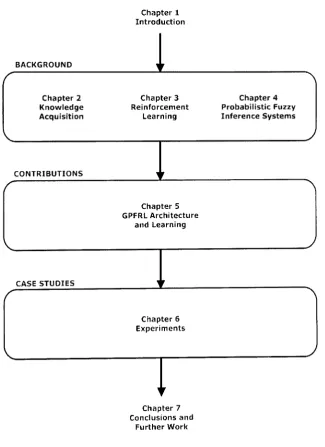
The logical structure and flow of the dissertation is summarised by Figure 1.1.
• Chapter 2 Reviews some basic concepts on knowledge acquisition and machine learning defining the main advantages
and difficulties on its use.
• Chapter 3 Introduces the reinforcement learning problem and its biological origin, defining some commonly used terms within
the reinforcement learning literature then, it presents a survey of
different kind of reinforcement learning methods and analyses
some commonly used algorithms for reinforcement learning.
Finally it presents the use of reinforcement learning in the fields
of decision making and control.
• Chapter 4 Analyses the importance of uncertainty handling; reviews the concepts of fuzzy inference systems, then, it
introduces the reader to probabilistic theory and its application
to fuzzy logic. Finally, it presents an overview of fuzzy logic
learning in general.
• Chapter 5 Presents an overview of the complete GPFRL architecture and proposes a novel probabilistic reinforcement
learning method.
• Chapter 6 In this chapter, we perform some experiments employing the proposed GPFRL architecture. Four experiments
are presented in this dissertation: a random walk on a 2-
dimensional grid world, a control of a classic cart-pole
balancing problem, GPFRL as a DC motor controller and finally
the proposed GPFRL is implemented in a Khepera III mobile
CHAPTER 1: INTRODUCTION
• Chapter 7 This chapter recalls the contributions of this work; it then states some observations and proposes some possible
extensions and directions for future research.
Four appendices complement the chapters above as follows: first, appendix A
contains the code used for the random walk example. Second, appendix B
contains the code used for the cart-pole example. Appendix C contains the code
used for the DC motor example. Finally, appendix D, contains the code used to
Chapter 1 Introduction
BACKGROUND
Chapter 2 Knowledge Acquisition
Chapter 3 Reinforcement
Learning
Chapter 4 Probabilistic Fuzzy Inference Systems
CONTRIBUTIONS
Chapter 5 GPFRL Architecture
and Learning
CASE STUDIES
Chapter 6 Experiments
I
Chapter 7 Conclusions andFurther Work
[image:31.531.106.432.131.579.2]Chapter 2
Knowledge Acquisition
2.1
Introduction
In its early beginnings, knowledge acquisition was seen as the transfer of
expertise in problem solving from a human expert to a knowledge-based system.
Since manual methods for this process were found to be very difficult and time
consuming, knowledge acquisition was considered the bottleneck to building
expert systems. To solve this problem, several different approaches like machine
learning and data mining have been developed. This dissertation concerns an
extension to a particular knowledge acquisition and knowledge based systems
technique called reinforcement learning.
The rest of this chapter is organized as follows; section two will provide a review
of the concepts of knowledge acquisition, section three presents an in-depth
review of machine learning concepts and some of the most well-known
algorithms used for machine learning, and finally section four and five presents
situate the approach in this dissertation rather than provide a detailed review of
the very wide range of research that falls under knowledge acquisition field.
2.2
What Is Knowledge Acquisition?
In computer science knowledge acquisition can be defined as the transfer and
transformation of potential problem solving expertise from some knowledge
source to a program (Kohonen, 1988).
Knowledge acquisition has been recognised as a bottleneck in the development of
knowledge based systems due to the difficulty in capturing the knowledge from
the experts; that is externalising and making explicit the tacit knowledge,
normally implicit inside the expert's head.
Knowledge acquisition techniques can be grouped into three categories: manual,
semi-automated (interactive) and automated (machine learning and data mining).
For the manual and semi-automated category, the expert must only answer simple
questions (cases); so that the more data is labelled by the expert, the better the
obtained results (Liu and Li, 2005). However, one problem of this approach is that
we do not know in advance how many cases we will need to ask in order to get an
accurate model and asking thousands of cases to the expert is usually impractical.
Therefore, an automatic way to infer an appropriate behaviour is highly desired.
Automated methods provide an automatic way to learn behaviours from data
(machine learning) or to extract patterns from it (data mining). Data mining is a
branch of computer science and artificial intelligence. It can be defined as the
process of extracting patterns from data and it can be seen as an increasingly
important tool by modern business to transform data into business intelligence
CHAPTER 2: KNOWLEDGE ACQUISITION
practices, such as marketing, surveillance, fraud detection, and scientific
discovery.
The main difference between these two methods is that data mining can be
defined as a process of applying several different methods like neural networks,
clustering, genetic algorithms, decision trees and support vector machines to data
with the intention of uncovering hidden patterns (Kantardzie, 2002), whilst
machine learning is the study of computer algorithms that improve automatically
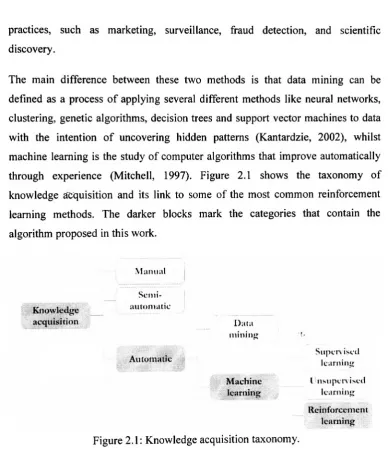
through experience (Mitchell, 1997). Figure 2.1 shows the taxonomy of
knowledge acquisition and its link to some of the most common reinforcement
learning methods. The darker blocks mark the categories that contain the
algorithm proposed in this work.
••-•: Manual j
Semi- automatic
Data mining
x: Machine
[image:34.531.71.460.105.567.2]learning
Figure 2.1: Knowledge acquisition taxonomy.
Supcn isctl
l.ins«pcrvi?,ed learning
Reinforcement learning
2.3
Machine Learning
Learning, like intelligence, covers su ch a broad range of processes that it is
difficult to define precisely, such as knowledge acquisition, understanding and
skill acquisition by study, instruction or experience and even modification of a
should be clear what is meant by learning. In (Hebb, 1949) learning is defined as
the ability to perform new tasks or perform old tasks better (faster, more
accurately, etc.) as a result of changes produced by the learning process.
Furthermore, when this learning is achieved by a machine, rather than a person, it
is called machine learning.
This learning c apability is an inherent characteristic of human bein gs, which
enable us to acquire "ability" or "expertise" so we can improve our performance
while executing repetitive tasks. Similarly, machine learning usually refers to the
changes in systems that perform certain tasks. Such tasks can involve recognition,
diagnosis, planning, robot control, prediction, etc. These system changes can be
either enhancements to already performing systems or synthesis of new systems.
It can be said then, that a machine has learned whenever its structure, program, or
data has been changed, based on its inputs and/or in response to external
information, so that there is an improvement in its expected future performance.
In other words, ma chine lea rning inv olves dev eloping c omputer s ystems that
automatically improve their performance over a specific task, through experience.
Now that we have defined what machine learning is, the next question to ask is,
why should machines have to learn? There are several reasons why machine
learning is important. An important reason, especially for the fields of human
psychology is that the achievement of learning in machines might help us
understand how animals and humans learn. But for the engineering fields some of
the reasons presented by (An et al., 1988) are:
Some tasks cannot be defined well except by example; that is,
we might be able to specify input/output pairs but not a concise
relationship between inputs and desired outputs. Machine
learning methods can be used to adjust their internal structure to
CHAPTER 2: KNOWLEDGE ACQUISITION
It is possible that hidden among large piles of data are important
relationships and correlations. Machine learning methods can
often be used to extract these relationships.
Some machines might not work well when certain
characteristics of the working environment are not completely
known at design time. Machine learning methods can be used
for on-the-job improvement of existing machine designs.
The amount of knowledge available about certain tasks might be
too large for explicit encoding by humans. Machines that learn
this knowledge gradually might be able to capture more of it
than humans would want to write down.
Under stochastic environments, machines that can adapt to a changing environment would reduce the need for constant
redesign.
New knowledge about tasks is constantly being discovered by
humans. Continuing redesign of AI systems to conform to new
knowledge is impractical, but machine learning methods might
be able to track much of it.
It is important to highlight that, the techniques of machine learning do not interact
directly with a human expert, but instead with data descriptions of the problem to
be solved. For example; supervised learning, the most common machine learning paradigm, involves presenting a computer program with a "training set" of
example problem descriptions, together with the known solution in each case. The
machine learning program is then able to infer a pattern to the example/solution
In the next two subsections, two different ways to classify machine learning
algorithms are presented.
2.3.1 Learning-Based Classification
There are many ways to classify the machine learning paradigms. (Langley, 1995)
classifies the learning paradigms according to the way they learn in five
categories: inductive learning (e.g., acquiring concepts from sets of positive and
negative examples); instance-based; analytical learning (e.g., explanation-based
learning and certain forms of analogical and case-based learning); connectionist
learning methods and evolutionary algorithms.
2.3.1.1
Inductive Learning
Inductive learning seeks to find a general description of a concept from a set of
known examples and counterexamples. It is assumed that the known examples
have to be representative of the whole space of possibilities. Given an encoding of
the known background knowledge and a set of examples represented as a logical
database of facts, an inductive learning system will derive a hypothesised logic
program which entails all the positive and none of the negative examples. The
resulting description distinguishes not only between the known examples of the
concept (a recall task), but can also be used to make predictions about unknown
examples.
Inductive learning employs condition-action rules, decision trees, or similar
logical knowledge structures, where the information about classes or predictions
is stored in the rule actions sides of the rules or the leaves of the tree. Learning
algorithms in the rule-induction framework usually carry out a greedy search
through the space of decision trees or rule sets, using statistical evaluation
CHAPTER 2: KNOWLEDGE ACQUISITION
Some examples of inductive learning include:
Approximate identification (PAC-learning) (Valiant, 1984).
Boosting (Schapire, 1990).
TDIDT (Top-Down Induction of Decision Trees) (Quinlan,
1986).
2.3.1.2
Instance-Based Learning
Represents knowledge in terms of specific cases or experiences and relies on
flexible matching methods to retrieve these cases and apply them to new
situations. Instead of performing explicit generalization, it compares new problem
instances with instances seen in training, which have been stored in memory.
Some examples of Instance-based learning include:
K-nearest neighbor algorithm (Fix and Hodges, 1951).
Locally weighted regression (Cleveland, 1979).
2.3.1.3
Analytic Learning
Analytic learning represents knowledge as rules in a logical form (as inference
rules) usually by employing a performance system that uses search to solve multi-
step problems. This knowledge is acquired by applying background knowledge
(from rigorous expert explanations) to very few examples (often only one). Some
issues with analytic learning are:
The background knowledge and complex structure necessary to
store explanations make analytic learning systems infeasible for
Analytic learning systems are domain-knowledge intensive, thus
requiring a complete and correct problem-space description.
One of the best well-known examples of analytic learning is:
Explanation-based learners (EBL) (Mitchell et al., 1986).
2.3.1.4
Connectionist Learning
In connectionist learning the knowledge is represented as a multi-layer network of
threshold units that spreads activation from input nodes through internal units to
output nodes. Many proponents of connectionist learning believe that this form of
learning is the nearest to that of the human brain. In connectionist learning, the
weights on the links determine how much activation is passed on in each case.
The activations of output nodes can be translated into numeric predictions or
discrete decision about the class of the input. This connectionist paradigm aims at
massively parallel models that consist of a large number of simple and uniform
processing elements interconnected with extensive links, that is, artificial neural
networks and their various generalisations. In many connectionists' models,
representations are distributed through a large number of processing elements.
This parallel nature makes connectionist learning algorithms good at flexible and
robust processing. The most well-known algorithm of this group is:
Back propagation (Rumelhart et al., 1986).
The back propagation algorithm uses two-layer networks in which every node in a
layer receives,,an, input from every node in the preceding layer. The term back
propagation refers to the procedure for updating weights across the layers.
Starting from the final output, the difference b etween the a ctual a nd des ired
CHAPTER 2: KNOWLEDGE ACQUISITION
nodes, in turn, do the same to their inputs, with the resulting effect that weight
changes are propagated backwards through the network.
2.3.1.5
Evolutionary Learning
Evolutionary learning is defined as any kind of learning task which employs as its
search engine a technique belonging to the evolutionary computation field
(Michalewicz, 1996). Evolutionary learning is a set of optimisation tools inspired
by natural evolution, were a population of candidate solutions (individuals) are
transformed (evolved) through a certain number of iterations of a cycle,
containing an almost blind recombination of the information contained in the
individuals and a selection stage that directs the search towards the individuals
considered good by a given evaluation function. In this scheme, the characteristics
of an individual which is fit (and therefore good at competing for resources) are
more likely to be passed to the next generation than the characteristics of an unfit
individual.
One of the most representative algorithms of this group is generic algorithms
(GA). Genetic algorithms attempt to find solutions to problems by mimicking this
evolutionary process (Holland, 1992). GAs supports a population of individuals,
each one representing a possible solution to the problem of interest. Although
proponents of genetic algorithms recognise that the approach does not always
deliver the optimal solution to a problem, they argue that the approach can deliver
a "good" solution "acceptably" quickly.
Some evolutionary learning techniques include:
Genetic algorithms (Holland, 1992).
Genetic programming (Barricelli, 1954).
2.3.2 Problem-Based Classification
A better classification, using a more general problem-based point of view suggests
three main categories, supervised learning, unsupervised learning and
reinforcement learning.
2.3.2.1
Supervised Learning
Supervised learning is a machine learning technique for function approximation
obtained from 'training data. A supervised learning problem is one where we are
supplied with data as a set of input/output pairs, assumed to have been sampled
from an unknown function and we wish to reconstruct the function that generates
the data.
Supervised learning networks learn by being presented with pre-classified training
data (i.e. input and target output pairs). This type of learning requires a "trainer"
or "supervisor", who supplies the input-output training pairs. The learning agent
adapts its parameters using some algorithms in order to generate the desired
output patterns from a given input pattern and it achieves this by generalizing
from the presented data to unseen situations in a "reasonable" way. This is
equivalent to having a supervisor who can tell the agent how the output should
have been, so that the learning agent can learn from the "example". Most
supervised learning techniques attempt to increase the accuracy of their function
approximation through generalization: for "similar" inputs, the outputs are
assumed "similar".
In general, the goal of the supervised learning is to estimate a function g(-v),
given a set of points (x,g(.x)). The basic problem of supervised learning deals
with predicting the response variables from the independent variables. In essence,
CHAPTER 2: KNOWLEDGE ACQUISITION
observed value Y, of the output, is the supervisor. The goal is to train the learner,
using the training set based on N samples of the pair (Y,X), so that it can
predict the value 7(,v) from a future observation x. The output of the function
can be a continuous value (regression), or can predict a class of the input object
(classification). Figure 2.2 shows a basic scheme of general supervised learning
algorithms.
The four more important issues to consider in supervised learning are:
• Bias-variance trade-off. The performance of an estimator 9" of a parameter 9 is measured by its mean square error (MSE)
that is shown to be: MSE = Var(d'} + Bias(9'^~. Although the
lack of bias is an attractive feature of an estimator, it does not
guarantee the lowest possible value of the mean square error.
This minimum value is attained when a proper trade-off is found
between the bias of the estimator, and its variance. So as to
make the value of the above expression smallest. As a matter of
fact, it is commonly observed that introducing a certain amount
of bias into an otherwise unbiased estimator can lead to a
significant reduction of its variance, so much so that
the MSE will be reduced and therefore the performance of the
estimator will be improved.
• Function complexity and amount of training data. If the true function is simple, then an "inflexible" learning algorithm with
high bias and low variance will be able to learn it from a small
amount of data. But if the true function is highly complex, then
training data and by using a "flexible" learning algorithm with
low bias and high variance.
• Dimensionality of the input space. If the input states vectors have are of a large dimension, the learning problem can be
difficult even if the true function only depends on a small
number of those features. This is because the many "extra"
dimensions can confuse the learning algorithm and cause it to
have high variance. Hence, high input dimensionality typically
requires tuning the classifier to have low variance and high bias.
• Noise in the output values. If the desired output values are often incorrect, then the learning algorithm should not attempt to
find a function that exactly matches the training examples. This
is another case where it is usually best to employ a high bias,
low variance classifier.
The proposed GPFRL method tackles all this shortcomings in several different
ways. The model bias is one of the main reasons why reinforcement learning
algorithms often need so many trials to successfully learn a task. Although there is
no general solution to this problem this problem can be tackled by learning
probabilistic models in order to reduce model bias, by incorporating the model's
uncertainty into planning and policy learning as has been proposed by (Deisenroth
and Rasmussen, 2010) who proposed that in order to reduce model bias, it is
required a probabilistic model to faithfully describe the uncertainty of the model
in regions of the state space that have not been encountered before. Moreover, this
model uncertainty is required to be taken into account during the policy
evaluation. (Deisenroth and Rasmussen, 2010) implemented the probabilistic
model using a Gaussian process, which also allows for closed form approximate
CHAPTER 2: KNOWLEDGE ACQUISITION
The function complexity and amount of training data issue is a non important
issue in reinforcement learning methods as training data is not required.
Reinforcement learning algorithms can be considered "flexible" as they are able to
learn complex true functions with low bias and high variance.
To enhance the generalization ability of average reward reinforcement in
continuous state space, this dissertation proposes an improved algorithm based on
fuzzy inference system. In reinforcement learning, agent accesses to knowledge
through the interaction with the environment. The reward signal from the
environment carries out comprehensive appraisal of the effect of the action, which
is operated by the agent. However, when the learning environment is complex and
continuous, it will increase the difficulty of learning process and reduce the
learning efficiency. In response to these disadvantages, we use fuzzy inference
system as the approximator to generalize the continuous state space.
A final issue is whether the environment is noisy or deterministic. Noise may
appear, for example, in the rules which govern transitions from state to state, and
in the final reward signal given at the terminal states. Fuzzy inference systems are
intrinsically able to reduce the effect of the noise in the input and output values as
it is discussed in (Saade, 2011). Most of the ordinary adaptive controllers are
based on a special noise prediction and estimation, and if the nature of the noise
changes or its statistical characteristics altered then these controllers will have
poor performance, while on-line learning controllers, such as the one proposed in
this dissertation, can self-adapt themselves to such changes and still maintain high
performance.
Over the last decade, supervised learning has been the focus of research of many
computer scientists, with several different methods developed. Some of the most
remarkable of these methods are back propagation, artificial neural networks,
Training Data
Input Desired Output-.
Network
I arR«:t
^^
Weight Error
Trainiri!|* Algorithm (optimization
me (hod)
[image:45.531.124.408.120.384.2]Objective Function
Figure 2.2: Supervised learning scheme.
2.3.2.2
Unsupervised Learning
In absence of supervisors, the desired output for a given input instance is unknown; therefore the supervisor has to adapt its parameters by itself. In this case, such type of learning is called "unsupervised learning". In unsupervised learning, the goal is harder because there are no pre-determined categorizations.
l
CHAPTER 2: KNOWLEDGE ACQUISITION
If we consider a learning agent an input sequence jc,, x 2 , x,,..., where x, is the
sensory input at time t. This input, or data, could correspond to any kind of
sensory input, an image from a camera, a sound, etc. The machine simply receives
inputs x,, x 2 , x,,... but obtains neither supervised target outputs, nor rewards
from its environment. Despite that the machine never receives any feedback from
its environment, it is possible to develop a formal framework for unsupervised
learning based on the notion that the machine's goal is to build representations of
the input that can be used for decision making, predicting future inputs, efficiently
communicating the inputs to another machine, etc.
Some unsupervised learning issues include:
Objective function not a s obv ious a s in supe rvised lea rning.
Usually try to maximize likelihood (measure of data
compression).
Local minima (non convex objective).
Uses infe rence as subr outine (ca n b e slow - no worse than
discriminative learning).
Some of the forms of unsupervised learning methods include clustering which is
the assignment of a set of observations into subsets (clusters) so that observations
in the same cluster are similar in some way and blind source separation based on
Independent Component Analysis (ICA) (Comon, 1994).
Some examples of unsupervised learning algorithms include:
A Kohonen map, or self-organizing feature map (Kohonen,
1988).
2.3.2.3
Reinforcement Learning
In reinforcement learning, the learning agent does not explicitly know the input-
output instances; instead it receives feedback from its environment. This feedback
signal helps the learning agent to decide whether the selected action will receive a
reward or a punishment based on its performance. The learning agent thus adapts
its parameters based on the rewards or punishments of its actions.
Reinforcement learning is a current and important topic of research, where efforts
are placed in the design and study of RL algorithms that can make an efficient use
of the available information while having good computational scalability.
Reinforcement learning differs from supervised learning in two important aspects;
First, supervised learning is learning from examples provided by a knowledgeable
external supervisor, whilst reinforcement learning is defined not by characterizing
learning algorithms, but by characterizing a learning problem (Sutton and Barto,
1998) so that the agent never sees examples of correct or incorrect behaviour.
Instead, it receives only positive and negative rewards for the actions it tries.
Supervised learning is an important kind of learning, but alone it is not adequate
for learning from interaction. In interactive problems it is often impractical to
obtain examples of desired behaviour that are both correct and representative of
all the situations in which the agent has to act. In some cases, like uncharted
territories, an agent must be able to learn from its own experience. Second, the
exploration-exploitation dilemma is of important consideration in reinforcement
learning whilst the entire issue of balancing exploration and exploitation does not
even arise in supervised learning.
When compared to unsupervised learning, the main difference is that in
unsupervised learning the learner receives no feedback from the world at all,
whilst the reinforcement learning agent receives information regarding the success
CHAPTER 2: KNOWLEDGE ACQUISITION
differentiate the input data, in order to classify it, in reinforcement learning, the
agents learn input-output mappings through repeated interactions with the
environment.
2.4
Conclusions
The concept of knowledge is still a not well defined one. Research has yet to
conclude the underlying mechanism in the human or animal brain that enables us
to learn. Learning has been defined as the process of acquiring a skill or
knowledge in the case of humans. The concept of learning itself is no different if
applied to a machine. Many learning methods of machine learning are inspired in
biological mechanisms of our brains.
Problem-based classification of machine learning algorithms can be further
divided into tree subcategories. Supervised learning is basically learning from
examples, where sets of input-output pairs are presented to the learner, which then
through some algorithm like the back propagation algorithm, a function is
approximated in order to generalize future inputs. In unsupervised learning, the
learning agent doesn't receive any feedback whatsoever from the environment,
yet, it is able to recognize features of the input sets, and classify it. Finally, in
reinforcement learning, the learning agent receives sparse information from the
environment, regarding a state of success or failure as a result of a previous
action.
Reinforcement learning can overcome some important limitations of supervised
learning present in cases where "example sets" are not readily available, instead it
uses a reinforcement signal in order to find an optimal policy either for a decision
making or a control action. Learning by reinforcement is much more difficult than
(reinforcement signal) in contrast with supervised learning, where the information
consists on a complete set of input-output examples. In many cases the
information required to create input-output sets for training might not be
available/accessible.
2.5
Summary
This chapter presented a brief review on knowledge acquisition, its definition and
classification, highlighting and precisely locating the scope of this work. It was
presented two types of classifications for knowledge acquisition; a learning based
classification and a problem-based classification. Additionally a brief overview of
different learning methods has been provided. The next chapter will describe in
more detail the reinforcement learning problem, and will provide an introduction
Chapter 3
Reinforcement Learning
3.1
Introduction
Reinforcement learning is an important aspect of much learning in most animal species. In the context of machine learning, reinforcement learning refers to a set of different methods oriented to solve a specific group of problems. Such problems consists on determining or approximating an optimal policy through repeated interactions with the environment (i.e., based on a sample of experiences of the form state-action-next state-reward). In many cases, like in uncharted scenarios, an agent will benefit the most in learning from its own experience
(Sutton and Barto, 1998).
review of some of the most well-known methods is presented. Sections nine and
ten describe the use of RL methods for decision making and control and finally,
section eleven summarizes the contents of this chapter.
3.2
Reinforcement Learning and the Brain
In nature it is observable that humans and animals can learn novel behaviours
under a wide variety of environments; the animal brain seems to have certain
mechanisms that enable us to learn behaviours based on past experiences
(Blackmore, ;2006). In psychological theory, reinforcement is a term used in
operant conditioning and behaviour analysis for the delivery of a stimulus
(immediately or shortly) after a response, that results in an increase or decrease in
the probability of that response. Recently reinforcement learning models have
been applied to a wide range of neurobiological and behavioural data. Specifically
the computational function of neuro-modulators such as dopamine, acetylcholine,
and serotonin have been addressed using the reinforcement learning framework
(Niv, 2009). More specifically, it has being proposed by (Doya, 2002) that:
Dopamine signals reward prediction error.
Serotonin controls the time scale of prediction of future rewards.
Noradrenalin controls the width of exploration.
Acetylcholine controls the rate of memory updates.
From all these mentioned neuro-modulators, dopamine is the most studied,
perhaps due to its implication in certain brain conditions such as Parkinson's
disease, schizophrenia, and drug addiction as well as its function in reward
learning and working memory. The link between dopamine and RL was made in
CHAPTER 3: REINFORCEMENT LEARNING
signal. Recent research (Schultz et al., 1997) discovered that the firing rate of
dopamine neurons in the ventral tegmental area and substantia nigra (Figure 3.1),
appear to mimic the error function in the temporal difference algorithm (section 3.6.1).
Striatum
Siibstantia nigra
[image:52.531.114.418.211.454.2]Ventral cgrncrital area
Figure 3.1: Sagital view of the human brain.
When the amount of actual reward is larger than animal's expectation of reward
this dopamine neurons fire in the midbrain, therefore it appears that dopamine
neurons can be considered to code the reward prediction error. In the reinforcement learning algorithm, the reward prediction error has an essential role
to learn the optimal behaviour. Therefore, its being hypothesized that a reinforcement learning algorithm is implemented in the basal-cortico circuit of the
brain (Doya, 2002).
Despite that some systems, like reinforcement learning as outlined above, can be
used to describe many phenomena found in animal behaviour, the question