Journal of Chemical and Pharmaceutical Research, 2014, 6(6):1290-1295
Research Article
CODEN(USA) : JCPRC5
ISSN : 0975-7384
Online collaborative learning environment based on workflow technology
Xisan Wei*, Bo Hang
and Geping Chen
College of Mathematics & Computer Science, Hubei University of Arts and Science, No.296 Long Zhong Road, Xiangyan, China
_____________________________________________________________________________________________
ABSTRACT
This paper is mainly aimed to realize the functions of managing and monitoring the process of teaching business by applying workflow technology to the system of teaching platform. A process flow in collaborative system has been designed, built and execute. Management System change into the mode for business process-oriented from the mode for the function, which makes it have the function of business process management. Workflow technology service provides the technology platform, well contributed to the implementation of cooperative learning. It can improve the ability of communication between learners and teachers which can contribute to collaborative learning.
Keywords: Workflow, Teaching platform, Collaborative, Education, Management System
_____________________________________________________________________________________________
INTRODUCTION
Collaborative teaching platform provides clients with full theories and practical systems by enterprise projects which is standard and practical. And its feature can imitate the open process of enterprise so that teachers can put books into the system out of limit of time and space. Besides, teachers can assign homework or task, make and publish the network courses conveniently. Most importantly, the learner can be free to choose what they want to study. And it also includes lots of exercises which can be tested by computers. Teachers can publish plans and tasks which have the deadline to hand in freely according to it. They can correct homework when they receive them. The system will figure up the number of learners who did not hand in homework automatically. Besides, teachers can make use of the technology of workflow to answer questions online or remind learners when they are off-time and make the collaborative teaching come true [1].
Aim of study redesign teaching and co-operative platform using the principle of workflow. So it could make the Management System change into the mode for business process-oriented from the mode for the function, which makes it have the function of business process management.
EXPERIMENTAL SECTION
Concept of workflow
Secondly, we should keep the definition of the whole or part of process active [3]. Finally, we can achieve our goals by instance of the interface and processing the external resources required to interact.
The workflow system is made of workflow model, workflow engine and interface of client-side. The workflow model is the foundation of designing the whole workflow engine, which is the summarization and abstract of the process of business [4].
The workflow engine is responsible for the implementation of business processes. It is also responsible for monitoring, the external application call, task distribution, task status control, data transfer, event triggers and notification reminders. The workflow engine explains the implementation process instance. It is mainly java process which is executed in the background [5].
The workflow engine must provide client-side with package routing algorithms. And the engine routing mechanism plays a key role in whether the process execute efficiently. And it can call automatically application types such as java and Web Service.
Workflow is introduced into collaborative teaching
Collaborative teaching is the teaching model based on the face-to-face teaching style. The Individual teaching style and collaborative learning, aimed to improve learners’ ability of cognizance and healthy feelings. And its theme is about learning, so learners can form the good habit of studying by competing, discussing and interacting. And the model of collaborative teaching has four styles which are competition, cooperation, partnership and role playing.
For example, learners will act as the analyst, auditor and Regulators and so on during the software training, which can develop learners’ ability of software development.
Collaborative teaching provides a development platform which includes some learners. And learners can join in the actual project groups to experience roles of different jobs and study the process of software development in enterprise so that they can adapt to it after graduated.
Process of teaching and learning should have “flow” Features
During the common teaching, most of work is solved by some regular process. Such as planning lab classes, giving a mark and presenting students’ grade [6]. These fixed or similar business processes in a formal way of the computer can handle that, this formal representation called the process model or workflow process definition model.
Technology of workflow is applied to the teaching management efficient.
Nowadays, instructional theory thinks that it can improve the efficiency of learning if students can study together better. Besides, it has many advantages, for instance, it can improve learners’ communication skills and team work spirit, and the workflow technology can improve the teaching management system greatly.
It can make the right plans by studying tasks, support the idea that learners can study at their own pace, support the information management and knowledge sharing, encourage students and teachers to work together and provide the function of monitoring person and teams. And traditional teaching management system usually gives learners courses and exercises when it begins, while the teaching management system based on workflow technology can decide to transfer further learning data by the completion of the learning tasks.
According to the rules of teaching activities, we use the workflow to define the process. All the process will be sent to workflow engine after being dealt with. And workflow engine will decide what to do next by the business process in advance .And all the tasks will be submitted to performer’s desktop timely and exactly.
Workflow running model
Figure 1: The general workflow running model
Workflow management system runs by business process rules, at the same time, it has the ability of controlling process. All the tasks are sent to everyone’s desktop by workflow engines which follow the time limit of dealing with the tasks. Then faculties and learners deal with their own business according to the menu of tasks in desktop. And faculties can choose preferentially the task which is near the deadline by the menu, aimed to void some tasks to be delayed.
Workflow management system will record the processing procedure, which lays the foundation for inquiring, examining and evaluating. For example, each course will be divided into some chapters and learner will finish each chapter [7-8]. Learners can choose the way of studying by the basic process or by themselves and can achieve help from teachers, classmates and systems by the records of each chapter.
In the teaching platform design, we create one point of the process of knowledge nodes, by order, parallel, branch, loop connecting the different processes into a process.
It can define, built and execute the process of teaching business, and can realize the functions of managing and monitoring them by applying workflow technology to the system of teaching platform. And it could make the Management Information System (MIS) change into the mode for business process-oriented from the mode for the function, which makes it have the function of business process management.
Instance which workflow is applied to collaborative teaching platform
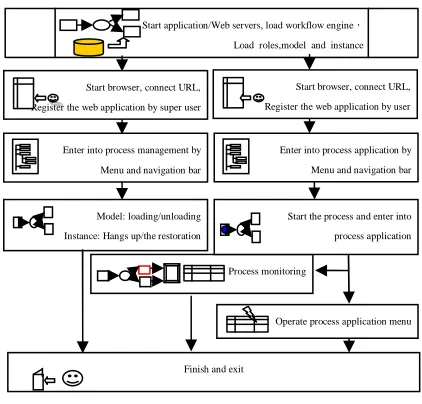
Now, the designs of workflow in collaborative teaching platform are analysed in Figure. 2.
Role
Workflow type definition
Activity Streaming data
Invoked Application
Transition
Finish and exit
Start application/Web servers, load workflow engine,
Load roles,model and instance
Model: loading/unloading Instance: Hangs up/the restoration Enter into process management by
Menu and navigation bar
Enter into process application by Menu and navigation bar
Process monitoring
Start the process and enter into process application
Operate process application menu Start browser, connect URL,
Register the web application by super user
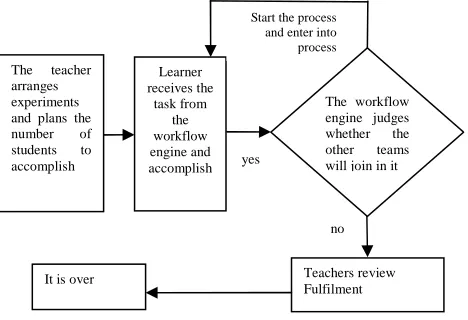
[image:3.595.214.425.80.282.2]Process is dealt with and designed logically are shown in Figure 3. Firstly, teachers can set a group. Learners can submit a business to others in the group; others will correct the business and add some knowledge. He or she can submit it to the next. Finally, this business will be sent to the teacher [8]. Of course, learners will also finish their cooperation work by themselves in no order. So it can improve and communication for learners on the remote network.
Figure 3: The logic design of workflow teaching platform
Design of logic element
Stage 1:
The logic element which stands for business: Form Task, Tool Task, Sub flow Task.
The logic element which stands for workflow Start Node, Activity, Synchronizer, End Node, Transition, Loop.
Stage 2:
Data object of the process: Data Field
Synchronizer node stands for the counting of workflow engine, for example, workflow needs to deal with some logical problems and these problems are: sequential, branching, converged and cyclical.
Tasks are logic of subsystem of collaborative teaching, while Activity, Synchronizer, Start Node, End Node, Transition, Loop are logic of subsystem of workflow, meanwhile, Transition, Loop are applied to transfer the right of controlling between subsystem of collaborative teaching and subsystem of workflow [9].
RESULTS AND DISCUSSION
Definitions of roles are given as tabulated in Table 1. The first operation is using by the workflow teaching platform in the background.
Table 1: Definition of workflow system roles in teaching platform
Simulation model variable Meaning Role User (Find Bug) User Tom Role Developer (Fix Bug) User Jack Jee Role Tester (Test Fix) User George
Table 2: Code of workflow system running status in teaching platform
Code of status Name of status bit Description of status bit 00 Begin When recording the new data, It will save the default state, if the state
01 Be submitted Only the initial state(00) and the returned state(97) can only be submitted for review, and after the official launch of the workflow, it can be considered to trial
97 Rollback Only the person who create the returned documents can logically deleted and re-trial
98 Delete logically
When the documents are returned, if the documents were invalid in this document complete, executable tombstone, which is a process status bit is set to bit 98, in principle, should be controlled to return after the tombstone, the other state should not execute tombstone.
Final approval by the documents, making the end of the process, approval workflow engine is no The teacher
arranges experiments and plans the number of students to accomplish Learner receives the task from the workflow engine and accomplish
The workflow engine judges whether the other teams will join in it
Teachers review Fulfilment It is over
no
Start the process and enter into
process
Status bit of workflow system running are given as tabulated in Table 2. This marked the status of the workflow system process.
The system of teaching platform which is finished supports collaborative learning and creates the functional model of business system, such as personnel management, process controlling, reporting forms, managing the rights and communication. And it can produce the functional models quickly by setting some parameters, so avoid developing it again because the system is different [10-11].
In this teaching platform, to cooperation between the teachers and students, students and students, teachers lead the team to overcome the difficulties together to complete the task. Based on the overall process management, can quickly and easily access a particular teachers' current teaching in the teaching process all the data associated with the task, the competent department can regulate, students can view the current learned knowledge, makes the teaching efficiency was improved. Collaborative learning is a kind of constructivism learning mode. The key is under the condition of a certain technology, establish a learning community. Through the common activities, generate common knowledge. Workflow technology service provides the technology platform, well contributed to the implementation of cooperative learning.
CONCLUSION
Managers only need to use the mouse to choose or fill in data by using the visual tools. At the same time, managers can use the typical process or part of configuration which is user-defined to some typical teaching processes, which is simple, quickly and meeting the demand of different teaching processes [12].
The model of collaborative learning shows individual learning based on workflow technology, which is open, sharing and interactive [13]. And it can improve the ability of communication between learners or between learners and teachers by combining electronic messages, which can contribute to collaborative learning and resource sharing. From now on, our system will improve from the following points: the workflow model which is faced to business perfect. It deal simply with complicated problems; make it more flexible, which can adapt to the stronger business process.
Acknowledgment
This work is partially supported by the National Nature Science Foundation of China (No. 61201247) ,Nature Science Foundation of Hubei Province (No. 2011CDB322) and Hubei University of Arts and Science of Teaching Research Project (JY2013066).
REFERENCES
[1]Wenfeng Jiang, Journal of Shandong Institute of Light Industry, Natural Science Edition., 2008,4(22), 82-85. [2]Kumar S, Gankotiya AK, Dutta K, “a comparative study of moodle with other e-learning systems”. 3rd
International Conference on Electronics Computer Technology (ICECT), Kanyakumari, India, 2011, 414-418.
[3]Georg Peters, Roger Tagg, International Journal of Computational Intelligence Systems., 2009,2(4), 332-342. [4]Luiz A. Pereira, Melo, Rubens N, “A Workflow-Based Architecture for e-Learning in the Grid.” IEEE
International Symposium on Cluster Computing and the Grid (CCGrid2004). Chicago, Illinois, USA, 2004,
208-216.
[5]Pythagoras Karampiperis, Demetrios Sampson. “Colin Towards Next Generation Activity-based Web-based Educational Systems,” Proceedings of the Fifth IEEE International Conference on Advanced Learning Technologies,
Kaohsiung, Taiwan,2005, 868-872.
[6]Sancristobal E, Castro M, Harward J, Baley P, DeLong K, Hardison J, “Integration view of Web Labs and Learning Management Systems.” IEEE Conference on Education Engineering (EDUCON). Madrid, Spain, 2010,1409-1413.
[7]Georgios Tsoulouhas, Dimitrios Georgiou, Alexandros Karakos, International Journal of Emerging
Technologies in Learning (iJET). 2012,7( 2), 43-49.
[8]Nigel McKelvey, Kevin Curran, International Journal of Evaluation and Research in Education, 2012, 33-40. [9]Maria Graca Rasteiro, Maria Graca Carvalho, Abel Ferreira, Cristina B Gaudencio, Jose Granjo. International
[12]H. Rehatschek, G. Hölzl, A. Hruska: "The seamless integration of virtualized lessons with a fully automated workflow into the LMS VMC/Moodle of the Medical University of Graz". Online Pro-ceedings of the
MoodleMoot 2011 conference, Vienna, Austria, 2011, 24 - 25.
[13]Felhi, Faîçal, Akaichi, Jalel, International Journal of Advanced Computer Science and Applications,