ScholarWorks @ Georgia State University
ScholarWorks @ Georgia State University
Psychology Theses Department of Psychology
Summer 7-14-2011
The Investigation of Prosocial Behavior in a Tool Task by
The Investigation of Prosocial Behavior in a Tool Task by
Capuchin Monkeys (Cebus Apella)
Capuchin Monkeys (Cebus Apella)
Audrey E. Parrish
Georgia State University
Follow this and additional works at: https://scholarworks.gsu.edu/psych_theses Part of the Psychology Commons
Recommended Citation Recommended Citation
Parrish, Audrey E., "The Investigation of Prosocial Behavior in a Tool Task by Capuchin Monkeys (Cebus Apella)." Thesis, Georgia State University, 2011.
https://scholarworks.gsu.edu/psych_theses/86
TOOL TASK BY CAPUCHIN MONKEYS (CEBUS APELLA)
by
AUDREY E. PARRISH
Under the Direction of Sarah F. Brosnan
ABSTRACT
active prosocial behavior is present amongst primates other than cooperative breeders.
THE INVESTIGATION OF PROSOCIAL BEHAVIOR IN A TOOL TASK BY CAPUCHIN MONKEYS (CEBUS APELLA)
By
AUDREY E. PARRISH
A Thesis Submitted in Partial Fulfillment of the Requirements for the Degree of
Master of Arts
in the College of Arts and Sciences Georgia State University
Copyright by Audrey E. Parrish
TOOL TASK BY CAPUCHIN MONKEYS (CEBUS APELLA)
By
AUDREY E. PARRISH
Committee Chair: Sarah F. Brosnan
Committee: Michael J. Owren Rebecca A. Williamson
Electronic Version Approved:
ACKNOWLEDGMENTS
TABLE OF CONTENTS
ACKNOWLEDGEMENTS iv
LIST OF TABLES vi
LIST OF FIGURES vii
CHAPTER
1. INTRODUCTION 1
Prosocial Behavior 3
Prosocial Behavior in Nonhuman Primates 6
Current Study 13
Test Paradigm 16
H y p o t h e s e s a n d P r e d i c t i o n s 17
2. METHODS 19
Subjects 19
Experimental Setup and Apparatus 19
General Procedure 21
Statistical Analyses 25
3. RESULTS 26
Group-level Analyses 26
Individual-level Analyses 28
Reciprocity 30
4. DISCUSSION 31
Conclusions 37
LIST OF TABLES
Table 1. Operational definitions of behavioral responses. 23
Table 2. Description of conditions and tasks. 24
Table 3. Individual results from the general loglinear analysis. Adjusted residual values are for total numbers of active tool transfer, so cells with asterisks indicate significantly higher totals of tool transfer than expected and negative values indicate significantly lower totals than expected.
30
Table 4. Results for the bivariate correlation analyzing effects of reciprocity in the Altruistic condition. Reciprocity did not have a significant effect for any of the monkey pairs.
LIST OF FIGURES
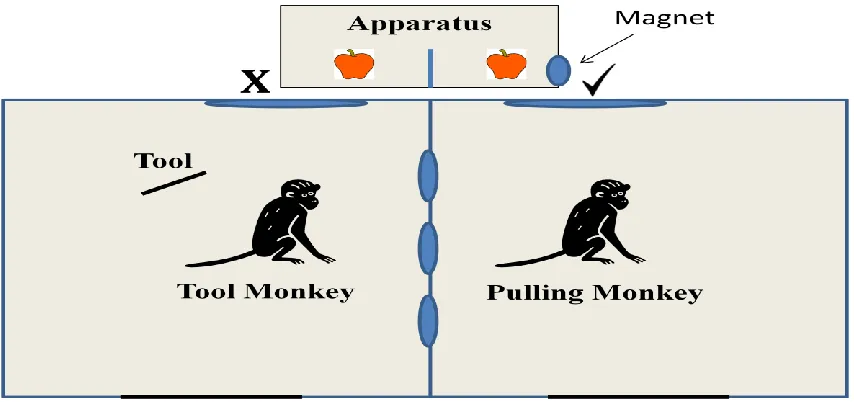
Figure 1. Experimental Setup. The “ ” indicates the only place a tool can be used to pull in the tray due to the location of the magnetized strip, while the “X” indicates where a tool cannot be used. In the Cooperative condition (shown here), both individuals received food from the apparatus. In the Altruistic condition, only the Pulling Monkey received food from the apparatus while the Tool Monkey received nothing.
21
Figure 2. Percentage of tool and food transfers which were active (pale gray bars) and passive (black bars) in the Baseline task of the Cooperative and Altruistic conditions.
27
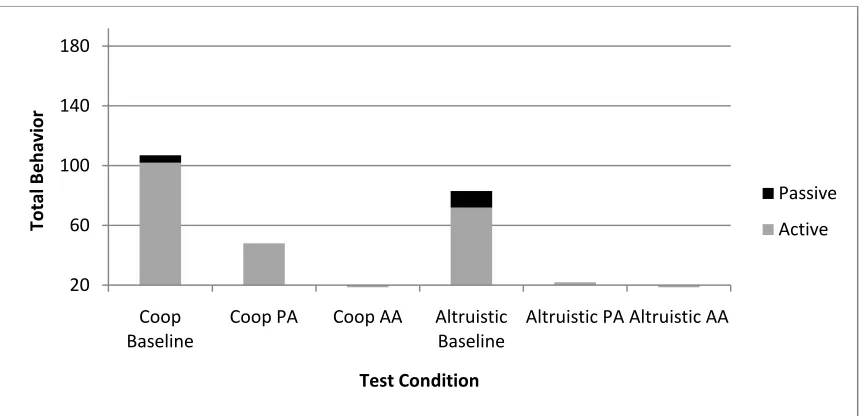
Figure 3. Total number of active and passive tool transfers across the different payoff conditions for every task.
28
Figure 4. Active tool transfer for both the Cooperative and Altruistic conditions across all tasks (e.g., Baseline, Partner-Absent, Apparatus-Absent) for each individual monkey.
CHAPTER 1 INTRODUCTION
Humans are exceptional in both their willingness to and frequency with which they help one another, and they show prosocial behavior early in ontogeny (Eisenberg, Fabes, & Spinrad, 2006; Liszkowski, Carpenter, Striano, & Tomasello, 2006; Warneken & Tomasello, 2006). Some theorists even consider humans uniquely prosocial, positing that humans are the only species that will assist each other, even strangers, without the possibility of gaining immediate benefits for themselves (Fehr & Fischbacher, 2003; Henrich et al., 2005; Richerson & Boyd, 2005). Prosocial behavior functions to aid one or more individuals with or without cost to the actor (Jaeggi,
Burkart, and van Schaik, 2010). Specifically, it promotes social behaviors which will directly or indirectly increase an individual‟s fitness. It is an umbrella term than encompasses cooperation,
altruism, sharing, and consoling. In order to better understand the evolution of prosocial behavior, researchers have turned their focus to nonhuman primates (hereafter primates), humans‟ closest living relatives. Although some consider humans as uniquely helpful,
comparative research indicates that humans are not alone in their prosocial tendencies; primates exhibit prosocial behavior among their own social groups in the form of grooming, coalition formation, consolation, and food sharing (e.g., Boesch & Boesch-Achermann, 2000; de Waal, 1996; Goodall, 1986; Preston & de Waal, 2002). Thus, answering the question of how and why prosocial behavior became so prominent in our species requires a comparative evolutionary approach that focuses on our closest living relatives, the primates.
a number of studies examining prosocial behavior in an experimental setting. Many of these experimental studies investigating prosocial behavior have yielded conflicting results (further discussed below). One potential reason for the contradictory findings is the difficulty in
capturing a natural behavior in a laboratory setting with unnatural tasks and rewards that lack the ecological relevance (Boesch, 2007). Most studies have been conducted with a heavy reliance on interacting with an experimenter, reliance on token-mediated variables or testing in the direct context of food, a highly valued resource for all animal species. Any or all of these could potentially explain the inconsistency among results. Thus, there is a need for paradigms that make use of more relevant behaviors for the species at question while removing potentially confounding variables. The current study addressed this problem by using an experimental paradigm that assessed prosocial behavior in a cooperative species by exploiting a naturally occurring behavior.
The goal of the current study was to systematically examine prosocial behavior among capuchin monkeys using a tool-use paradigm that allowed me to investigate this behavior outside of the immediate context of food. Capuchin monkeys exhibit prosocial behavior (de Waal, Leimgruber, & Greenberg, 2008; Lakshminarayanan & Santos, 2008) and are cooperative (Mendres & de Waal, 2000; de Waal & Davis, 2003), even in the context of food, yet the
and in the wild (Fragaszy, Visalberghi, & Fedigan, 2004; Visalberghi et al., 2009). Thus, I was able to assess capuchins‟ sharing of tools in comparison to previous work on prosocial behavior
in the species, furthering our knowledge of the conditions under which prosocial behavior occurs.
Prosocial Behavior
Prosocial behavior is defined as any behavior in which one individual provides services to another (Jaeggi, Burkart, & van Schaik, 2010), including in the contexts of cooperation, reciprocity, and altruism, and regardless of cost incurred (or not) by the actor. Prosocial behavior presumably functions to increase long-term positive interactions between individuals, for
On the other hand, prosocial behavior does vary, both across species and across contexts. The life history pattern of some primates, such as cooperative breeders may favor prosocial behaviors. An example of this is species in which multiple individuals work together to raise the young, known as cooperative breeders. This includes several primates, including humans, and callithrichid monkeys, such as marmosets and tamarins. Cooperative breeding may favor prosocial behaviors, because of the interdependence between paired individuals (Burkart, Fehr, Efferson, & van Schaik, 2007; Hrdy, 2005). The foraging patterns of other primates may also influence their level of prosociality; several species are known for cooperative-like hunting and meat sharing, which may lead to increased prosocial behavior (Pan troglodytes; Boesch, 1994; Cebus apella; Perry & Rose, 1994; Rose, 1997). The foraging patterns of chimpanzees and
capuchins are particularly notable as few species hunt cooperatively and fewer share food outside of mother-offspring parings (Feistner & McGrew, 1989). It has been proposed that cooperative hunting among chimpanzees and capuchins is indicative of a convergent
evolutionary basis for food sharing between these two species (Rose, 1997). Food sharing may also promote prosocial behavior in other contexts besides foraging (e.g., alliances, coalition formation, cooperative hunting, and consolation). Finally, evidence of prosocial behavior among non-cooperative breeding, non food-sharing species suggests prosocial behavior may have emerged under different contexts yet to be determined (long tailed macaques; Massen, Berg, Spruijt, & Sterck, 2010). Thus, prosocial behavior is clearly influenced by the social and ecological context, making it more likely to evolve in species that rely on each other for food, defense, or reproduction.
proposed explanation (see below). Aside from theoretical issues, there are also issues with experimental setup. None of the studies in the discipline are consistent in design (except series within the same lab, which even so may vary); there are differences in reward type and
distribution, cage sizes, how pairs are chosen, human involvement, and the ecological relevance of tasks, making cross-study comparisons difficult. Thus, it is extremely difficult to determine which results are due to experimental differences, and which vary due to differences in the social ecology and environment of the species in question. Finally, few species have been tested on prosocial paradigms. With only a few exceptions, studies have involved food sharing paradigms utilizing cooperative breeders, chimpanzees, and capuchins, presumably because these designs are relevant to a natural situation for prosociality in some species. In particular, capuchin monkeys have been studied for several reasons. First, they are known to form coalitions and alliances and engage in cooperative-like hunting in the wild (Perry & Rose, 1994). They also have a high degree of social tolerance towards both juveniles and adults and share both edible and inedible items within dominant/subordinate dyads (Fragaszy, Feuerstein, & Mitra, 1997; Izawa, 1989; Janson, 1988). Capuchins may even show allomaternal behavior, including both care and even nursing of other females‟ offspring, which could indicate that they converge on
Prosocial Behavior in Nonhuman Primates
The classic study in the field of prosocial behavior, conducted by Nissen and Crawford (1932), provided the first experimental evidence on cooperative behavior among captive
chimpanzees. This study was pivotal because it launched the research area of prosocial behavior as we know it today and provided a model for subsequent research. The study paired two
chimpanzees, separated by a set of steel bars, and one individual was given tokens, food items, or both. The second individual was positioned next to a food vender into which it could insert the tokens to obtain a reward if it first received the tokens from its partner. Token transfer occurred almost twice as often as did food transfer. The authors proposed that food sharing was highly dependent upon the previously established social relationships between the pairs and, unlike other social behaviors seen among chimpanzees (e.g., consolation, grooming, and coalitions), food sharing seemed to involve a sacrifice. This study not only provided the earliest evidence of prosocial behavior in chimpanzees, it also demonstrated a possible reluctance for active food share among primates and the potential problem with using food-sharing as the sole measure of prosocial behavior.
Following this early evidence of cooperation among captive chimpanzees, there was little research into prosocial behavior for the next 40 years. Starting in the early 1960s, researchers turned their attention to prosocial behavior once again. In what was the first of a number of similar studies, Masserman and Terris (1964) assessed altruistic tendencies in rhesus monkeys by putting them in a situation in which two monkeys were paired in adjacent boxes, which
unpleasant shock. These results may indicate that the monkeys behaved altruistically by responding to their partner‟s welfare, indicated by a reluctance to administer the shock.
However, these results may also indicate that the monkeys were averse to the behavior of the partner who received the shock (e.g., unpleasant screaming, fear response), which led to negative reinforcement for shocking and hence altruistic-like behavior. In two related studies, a food-sharing paradigm was adopted to measure prosocial behavior among macaques (Boren, 1966; Colman, Liebold, & Boren, 1969) In these studies, each individual in a pair was responsible for feeding the other by pressing a lever. In the beginning, the monkeys delivered food to a partner in an initial condition in which they, too, received a reward for lever pressing. However, lever-pressing behavior quickly dropped off if only the partner was rewarded (to the point that the partner would have eventually starved if not for intervention by the researchers). Unfortunately, this study potentially reinforced non-social behavior by eliminating the subject‟s reward payoffs. The second study removed this possibility, but found the same results (Colman, Liebold, & Boren, 1969). Although these studies were inconclusive in their findings of prosocial behavior among macaques, the final study represents a shift towards food-sharing paradigms, which continue to be used in studies today.
The first of these more recent studies utilized chimpanzees, and was the model upon which the majority of prosocial studies to date have been based (it is also similar to the Colman et al., 1969 paradigm). In this study (Silk et al., 2005), subjects were given a choice between two reward distributions, one of which rewarded only them and one of which rewarded both
chimpanzees paid attention to each other‟s outcomes; subjects were indifferent between the two
reward distributions (Silk et al., 2005). This result led the authors to posit that prosocial behavior may have evolved after apes and humans split. Similar lack of evidence for prosociality was reported for a different group of chimpanzees using a very similar paradigm that was developed independently (Jensen, Hare, Call, & Tomasello, 2006). Given the criticism that the subjects may have been so interested in their outcomes that they did not focus on their partners‟ rewards, Silk and colleagues repeated the study using a design in which the actor could reward themselves and then their partner, but this, too, failed to find evidence of prosocial behavior (Vonk et al., 2008).
Finally, again using those same chimpanzees, Brosnan et al. (2009) added a reciprocal
component, but still found that subjects were indifferent to their partner‟s outcomes, despite the
potential benefit to themselves. Taken as a whole, these studies suggest a clear lack of prosocial behavior among one of humans‟ closest phylogenetic relatives, chimpanzees.
There is actually better evidence in favor of prosocial behavior in food-sharing paradigms among monkeys than chimpanzees. As mentioned earlier, some of the best evidence exists for cooperatively breeding species. Burkart and colleagues (2007) found that common marmosets (Callithix jacchus), a cooperatively breeding New World species, engaged in prosocial behavior towards both related (siblings) and unrelated (pair-mates) conspecifics even in unsolicited situations. The authors proposed that prosocial behavior is rare or absent except in cooperative breeders. In a study of another callithrichid, the cottontop tamarin, researchers found evidence for prosocial behavior in a food-sharing task with a minimal role for positive reciprocity (Cronin, Schroeder, & Snowdon, 2010). However, separate studies of the cottontop tamarin have failed to find evidence of prosocial behavior in the majority of cases (Cronin, Kurian, & Snowdon, 2005; Cronin, Schroeder, Rothwell, Silk, & Snowdon, 2009; Stevens, 2010). Differences in
experimental design could explain these conflicting results (Cronin et al., 2009), as could differences in behavior between the callithrichid species.
Despite not being cooperative breeders, prosocial behavior has been found in a number of similar capuchin studies. Lakshminarayanan and Santos (2008) reported that capuchin monkeys consistently demonstrated prosocial behavior, delivering a higher-valued reward to their
better food reward), but prosociality ceased as inequity increased (Brosnan, Houser, Leimgruber, Xiao, Chen, & de Waal, 2010).
There is also evidence for prosocial behavior from studies other than those utilizing the typical food-sharing paradigm. Capuchin monkeys have been observed to share rewards more readily if obtained through cooperative means than obtained individually (de Waal & Berger, 2000). Capuchins also helped a partner more often if sharing occurred in the preceding trial, suggesting a causal connection between sharing a reward and willingness to help. In a separate study, de Waal and colleagues found capuchin monkeys‟ decisions about cooperation took into
account several factors in the environment, including the presence and identity of the potential partner and the likelihood for competition over the spoils (de Waal & Davis, 2003). Finally, capuchin monkeys are sensitive to others‟ labor in a cooperative task, actively providing food to a partner who previously helped them to complete a task while failing to provide food to their partner in an unequal labor condition (Takimoto & Fujita, 2011).
On the other hand, in a study very similar to the one described above, researchers found that chimpanzees actively helped both unfamiliar humans and conspecifics gain access to food even in the absence of a reward (Warneken, Hare, Melis, Hanus, & Tomasello, 2007). These results with chimpanzees are consistent with behavior seen among human infants in a separate study conducted by the same experimenters, but there were cross-species differences, with human infants helping faster and before they were cued (Warneken & Tomasello, 2006). Despite the conflicting evidence among these helping tasks and the abovementioned food-sharing
studies, one study food sharing and helping may blend in some cases, rather than being two entirely discrete behavioral situations. Chimpanzees helped conspecifics obtain out-of-reach food and non-food items; however, the chimpanzees were one-step removed from the food items. The chimpanzees were not required to relinquish food to a partner but rather just give them access to a room containing food, and, therefore, food-sharing was not the sole measure of prosocial behavior (Melis, Warneken, Jensen, Schneider, Call, & Tomasello, 2011). This study highlights how a successful paradigm might combine an indirect food context with a helping task to elicit prosocial behavior in an experimental setting.
Although many of these experimental studies demonstrate inconsistency among results of prosocial behavior in primates, there are several possible explanations besides the
aforementioned experimental inconsistencies. Several theories have emerged to potentially explain why chimpanzees are not responding prosocially in these studies while the behavior is seen in humans and even some monkeys. One potential reason for these contradictory results is the experimental design; it is difficult to observe a natural behavior in a lab setting with
stronger in non-food related tasks (de Waal et al., 2008; Warneken & Tomasello, 2006;
Yamamoto & Tanaka, 2009b). This is possibly because food is extremely salient to primates and consequently, there may be a lack of inhibitory control in the direct presences of food items (Warneken & Tomasello, 2006). The combined salience of food items, along with lowered inhibition, would cause primates to react to the mere presence of food without considering other factors, such as partner‟s needs. Measuring prosocial behavior solely based on the amount of
food sharing seen among primates may result in a failure to detect prosocial behavior that may actually be present in a non-food context.
Rearing conditions are also posited to interfere with prosocial behavior in primates, especially chimpanzees. Warneken and colleagues (2006, 2007) reported that enculturated chimpanzees experienced a high degree of human interaction, and theorized that this interaction may have influenced the presence or degree of prosocial behavior observed. Thus, these results may have reflected the species‟ potential ability, rather than their typical behavior (Jaeggi et al., 2010). A third hypothesis is that communication, for instance through begging, is important in motivating prosociality among primates (Barnes et al., 2008; Warneken & Tomasello, 2006; Warneken et al., 2007; Yamamoto & Tanaka, 2009). On the other hand, prosocial behavior is often lacking even in the presence of communication attempts (Jensen et al., 2006; Vonk et al., 2008).
Finally, it is possible that the artificialities of the experimental environment affect responses. There are at least two possibilities related to this hypothesis. First, the inability to choose one‟s own social partner in an experimental setup may be a potentially limiting factor.
Tomasello, 2008), and it is likely that the longstanding relationship of the two individuals can take precedence over any experimental manipulation. Finally, many experiments use
straightforward and somewhat inflexible choices such as „always cooperate‟ or „never cooperate‟, preferences that are artificial and may not account for species‟ or individuals‟
differences (e.g., “Tit for Tat”; Axelrod & Hamilton, 1981; see Brosnan & Bshary, 2010, for a discussion of this problem). Despite the problems with experimental design, these paradigms remain the premier method for exploring mechanism and causal (as opposed to correlational) relationships. Thus, design is of utmost importance in this area of research.
This review of the literature on prosocial behavior to date highlights that the behavior is extremely sensitive to contextual demands and is likely multi-factorial, meaning that more than one of these hypotheses may explain prosocial behavior in different contexts and species. For instance, it appears that prosocial behavior could have emerged several times in the order Primates, including in the contexts of cooperative breeding, food sharing, and others yet to be determined, for instance species like the long-tailed macaques and others that do not fit these hypotheses must be responding to other pressures that promote prosociality. It is likely that rather that occurring in some species but not others (i.e., presence or absence); prosocial
behavior among primates exists on a continuum, with graded responses amongst the majority of species. Moreover, prosocial behavior is highly context dependent. Thus, a paradigm is needed that makes use of an evolutionarily important context that also affords advantages to individuals who cooperate and behave prosocially.
Current Study
in prosocial tests (e.g., unnatural tasks, token-mediated variables, human experimenters, direct food sharing). The task was designed so that one monkey had possession of a tool that it could not use, while its partner needed the tool to obtain an out-of-reach food reward. The use of a non-food as the object to be transferred offers an advantage over previous paradigms that rely more directly on food sharing. The task also afforded an assessment of how prosocial behavior was affected by different payoff structures. In order to answer this question, food distribution was manipulated so that in one payoff condition, both monkeys worked together for a mutual reward (i.e., cooperation) and in a second payoff condition, one monkey helped its partner at a cost to itself (i.e., altruism). A comparison of the cooperative and altruistic conditions was important to determine whether capuchin monkeys simply transferred a tool to a conspecific in order to gain their own direct rewards or to help their partner, as well as to determine how their behavior changes in different contexts. There was a possibility for individuals to alternate roles across sessions, so despite the fact that the study was not designed explicitly to test reciprocity, I also examined the effects of reciprocity across sessions on maintaining prosocial behavior in the condition with the altruistic payoff.
In the „Cooperative‟ payoff condition, one individual needed to provide a tool to a second individual who could then obtain a food reward for both monkeys. Thus, the Cooperative
individuals who are involved in the cooperative interaction, emphasizing function rather than mechanism. Note, too, that cooperation in this task was likely motivated by pseudo-reciprocity. This is a phenomenon in which only one individual makes the initial investment. The partner then „reciprocates‟ because it is in the partner‟s best interest to do so, not because the partner is
motivated to cooperate; therefore, there is no incentive to defect by either partner, and both benefit (Connor, 1986; Bshary & Bergmuller, 2008). Pseudo-reciprocity is one of the simplest types of cooperation because it does not require complex cognitive mechanisms (or even recognition that the actor is cooperating) and may be motivated by selfish means (Dugatkin, 1997).
In the „Altruistic‟ payoff condition, one individual could provide a tool to a second individual, who could then obtain a food reward for itself only. Thus, the condition was mildly costly to the tool provider, who did not receive a reward. Altruism here is defined as any behavior that benefits another individual at any cost to the self (Axelrod & Hamilton, 1981). Altruistic behavior, despite the current cost, may be selected for when there is a chance for beneficial interactions in the future, and may begin a beneficial relationship that will lead to long-term benefits (Axelrod & Hamilton, 1981; Trivers, 1971). Again, note that this definition of altruism is purely functional, and implies nothing about the subjects‟ cognitive abilities, their intentions with respect to bringing food to their partner, or their understanding of the behavior as „altruistic‟, helpful, etc.
Given that the monkeys interacted repeatedly over time in the current study, there was the chance for long-term reciprocation, although this was not a major goal of the study and so no within-session options were included. Reciprocity is defined as a situation in which one
(Axelrod & Hamilton, 1981; Trivers, 1971), and it is offered as one proposed explanation for the evolution of prosocial behavior among unrelated individuals (Dugatkin, 1997). In order for prosocial behavior to persist, individuals must on average receive either direct or indirect benefits for a cooperative action or reciprocate the altruistic act in the future.
Test Paradigm
The present task was designed to exploit tool-use among capuchins to investigate prosocial behavior where monkeys had to share tools to obtain rewards. Secondarily, subjects could also share food. To date, only a few studies have systematically examined both food and tool sharing among primates. In the first, active cooperative tool use occurred among captive hamadryas baboons (Papio hamadryas) in which one individual needed a tool that it could not reach through solitary means (Beck, 1973). Active tool transfer occurred only between two individuals and was unidirectional; the female always delivered the tool to the male, who then shared the food reward he obtained. Perhaps the best example of tool and food transfer involves language-trained chimpanzees who requested and provided needed tools from a conspecific using lexigrams (symbol-based language training system) and in return, shared food obtained using the tool with their partner (Savage-Rumbaugh, Rumbaugh, & Boysen, 1978). Although it did require training, the chimpanzees excelled at the task, providing perhaps the best evidence of targeted helping of conspecifics among non-humans.
Only one study has addressed tool and food sharing among capuchin monkeys.
between groups, rather than within group, making it difficult to determine the effects of social rank, age, or sex on sharing or assess individual variation. Moreover, food transfer occurred even in the absence of tools, suggesting that food exchange was not contingent upon tool exchange. Finally, there were no control groups in this study; it is unclear whether the same individuals were sharing both the tools and food, or whether sharing of the food and tools were contingent upon one another (de Waal, 2000). Intriguingly, however, the majority of tool transfers (73%) were a result of active „giving,‟ while nearly all food transfers (96%) were a result of „reaching‟ and occurred with protest, possibly indicating a different mechanism for the two types of transfers (e.g., food items versus non-food items).
Hypotheses and Predictions
The goal of this study was to investigate how differences in payoff structure affected prosocial behavior in a tool use task in capuchin monkeys. A secondary goal was to assess whether reciprocity across sessions played a role in maintaining or amplifying prosocial behavior by forced role reversal. To assess whether monkeys understood the study, two control tasks were included along with the Baseline task. First, was a Partner-Absent control task to determine whether capuchins understood the role of their partner and second was an Apparatus-Absent control task to determine whether the capuchins understood that there was no point in passing the tool if there was not food in front of either monkeys.
CHAPTER 2 METHODS Subjects
The subjects included eight brown capuchins (Cebus apella; five adult males, three adult females) from two social groups at the Language Research Center of Georgia State University in Atlanta, Georgia. Each social group had access to indoor/outdoor space, climbing structures and material enrichment. The primates were kept at free-feeding weight and received a diet including primate chow, fruit, and vegetables in the morning and afternoon. Fresh water was supplied ad libitum. No subject was tested twice in the same day.
Subjects lived in a social group and undoubtedly traded foods and objects back and forth. However, subjects were never trained to exchange objects with each other, nor had there been previous studies in which trading objects with each other could improve either individuals‟ outcomes. Subjects also had never participated in a tool use study nor had any formal tool use experience prior to the present study. To ensure all primates were capable of using the tool, each monkey was tested individually in a training phase with the tool prior to the trials. All subjects reached criterion for successful tool use, which is outlined below. All animals were paired with conspecifics from their respective social groups only.
Experimental Setup and Apparatus
additional step of transfer. The capuchins were paired with others from their social group in same-sex pairings. Same-sex pairs were used due to differences in affiliation and sharing behavior between males and females, and to reduce the effects of females‟ estrous cycles on male‟s behavior (de Waal, 1997; van Schaik, 1989; Wrangham, 1980). The pairings stayed the
same throughout the study; each pair was tested in both the Cooperative and Altruistic
conditions. Pairs were adjacent to one another in the testing cage, separated by a mesh partition through which they could see each other, vocalize, and transfer both food and tools. Subjects not involved in the current testing session were separated from the testing area to ensure that they did not gain additional information during the course of another subjects‟ test, and to minimize
interference.
Each pair consisted of a „Tool Monkey,‟ who had a tool that it could not use, and a „Pulling Monkey,‟ who needed a tool that it did not have. Each individual in a pair was tested in
both roles throughout the experiment. To successfully obtain food from the apparatus, the Tool Monkey needed to transfer the tool (actively or passively; defined below) through a partition to the Pulling Monkey, who could then pull in the tray containing food rewards. In the Cooperative condition, the tray was mutually beneficial in that both monkeys received equal food rewards. In the Altruistic condition, the tray was baited so that only the Pulling Monkey received food.
other‟s food. The partition was added to force the capuchins to transfer items (e.g., food or tool)
[image:31.612.73.500.184.385.2]via the middle partition separating the monkeys in the testing enclosure and prohibit any possibility of stealing of each other‟s food and tools. The apparatus was positioned directly in front of the pair (although only one could pull; see Figure 1).
Figure 1. Experimental Setup. The “ ” indicates the only place a tool can be used to pull in the
tray due to the location of the magnetized strip, while the “X” indicates where a tool cannot be used. In the Cooperative condition (shown here), both individuals received food from the
apparatus. In the Altruistic condition, only the Pulling Monkey received food from the apparatus while the Tool Monkey received nothing.
General Procedure
Before the experiment began, all monkeys were trained to manipulate the apparatus using the tool. During this training phase, only one monkey was in the testing cage and was supplied with the tool and given access to the baited apparatus. The monkey had access to both the Tool Monkey‟s side and the Pulling Monkey‟s side of the enclosure. A session consisted of six trials,
Each monkey underwent training until it reached the baseline criterion of successfully manipulating the tool and apparatus in at least four out of the last five trials. Monkeys only advanced to the tool tasks once they reached criterion. If an individual did not reach criterion after three sessions (15 trials), additional training commenced. Only one subject required additional training, and he required only three sessions. During the first session, the tool was positioned directly on the magnet and handed to the monkey. In the second session, the first trial began with the tool directly on the magnet and then in sequential trials, the tool was positioned further away. The third session began with the tool close to the magnet and then the tool was progressively moved further away until the monkey was able to manipulate the tool on its own. This monkey‟s additional training ended with this third session, when he could successfully manipulate the apparatus using the tool in at least four out of five consecutive trials in a session with no help from the experimenter.
An experimental trial began when the experimenter showed both monkeys the baited magnetized food tray apparatus. The tray was then pushed out of reach of both monkeys so that it could only be successfully manipulated by the Pulling Monkey using the tool. Each reward consisted of a quarter of an apple, diced (in the cooperative condition, both monkeys always got the same food and the same number of pieces), chosen because it is a potentially shareable food item (de Waal & Berger, 2000). After the tray was baited, both monkeys were shown the tool, which was then given to the Tool Monkey by the experimenter. The experimenter then walked away from the testing area. For 75% of test sessions, the experimenter wore a tinted face shield to avoid any possible cuing of the monkey‟s behavior.
was implemented to determine whether the monkeys understood the role of their partners in this study. In this task, the tool was only functional when the Pulling Monkey was present to
manipulate it, and therefore should not be transferred in this task. The Apparatus-Absent task was implemented to determine whether the monkeys understood that there was no purpose in passing the tool when there was not any food in front of either monkeys. In this task, the tool was only functional if the apparatus was present, and therefore the tool should not be transferred in this task. During this task, the apparatus with the food tray was not present in the testing room, so the monkeys could not see the apparatus at all.
The capuchin monkeys‟ behavior was coded for several different responses. We
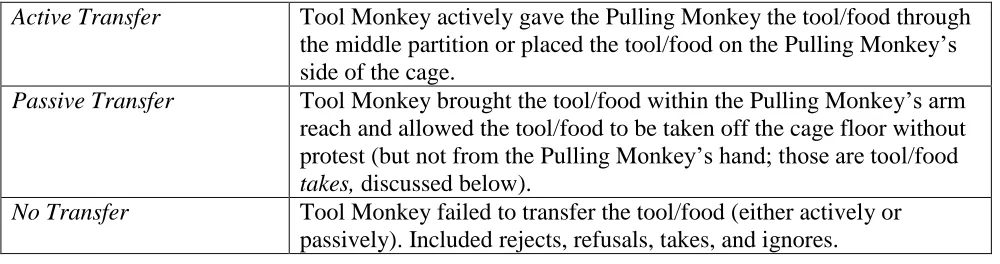
categorized the Tool Monkey‟s responses in to one of three mutually exclusive behaviors: „active tool transfer,‟ „passive tool transfer‟ and „no tool transfer.‟ Active transfer included instances in
[image:33.612.58.558.568.700.2]which the Tool Monkey physically handed the tool/food to its partner. Passive transfer included any instances in which the Tool Monkey allowed the tool/food to be taken by its partner without protest. No transfers included instances in which the Tool Monkey failed to transfer the tool/food to its partner at all. See Table 1 for operational definitions of the possible behavioral responses. Only the first instance of tool transfer was coded. In both conditions, any instances of food sharing were also recorded along with transfer modality.
Table 1. Operational definitions of behavioral responses.
Active Transfer Tool Monkey actively gave the Pulling Monkey the tool/food through the middle partition or placed the tool/food on the Pulling Monkey‟s side of the cage.
Passive Transfer Tool Monkey brought the tool/food within the Pulling Monkey‟s arm reach and allowed the tool/food to be taken off the cage floor without protest (but not from the Pulling Monkey‟s hand; those are tool/food takes, discussed below).
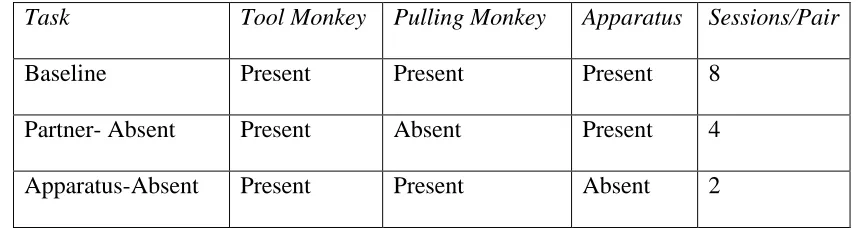
Testing consisted of 28 sessions per pair, including 14 Altruistic sessions and 14
[image:34.612.87.518.347.462.2]Cooperative sessions. Of the 14 sessions of each payoff structure, each individual was the Tool Monkey in four sessions of the Baseline task, two sessions of the Partner-Absent task, and one session of the Apparatus-Absent task (i.e., each monkey was the Tool Monkey in 7/14 sessions). Each session consisted of six trials. The order in which each task was presented was randomized (i.e., Baseline, Partner-Absent, or Apparatus-Absent) along with which monkey played which role. Condition (Altruistic or Cooperative) was counterbalanced so that half of the pairs were randomly selected to start with the Cooperative condition, and then complete the Altruistic condition. The remaining two pairs completed the conditions in the reverse order.
Table 2. Description of conditions and tasks.
Task Tool Monkey Pulling Monkey Apparatus Sessions/Pair
Baseline Present Present Present 8
Partner- Absent Present Absent Present 4 Apparatus-Absent Present Present Absent 2
Each trial was four minutes in length, including food-consumption time. After each trial ended, the experimenter retrieved the tool and the tray was re-set and re-baited to begin the next trial. All trials were videotaped using a Canon digital video camera and later coded according to the ethogram shown in Table 1. Twenty percent of all pairs‟ trials were coded by a second individual and inter-rater reliability was calculated using the Kappa coefficient (κ= 0.923, p < .001).
capuchins were stealing each other‟s food and the tool from the tray. These sessions were not
included in the analyses. Statistical Analyses
Non-parametric tests were used due to the small sample sizes in the experiment. To assess the monkeys‟ performance in the prosocial tool task, I first performed group-level analyses using a Friedman‟s test to look for effects between conditions. All paired comparisons
CHAPTER 3 RESULTS Group-level Analyses
Monkeys successfully transferred the tool to the Pulling Monkey in both payoff
conditions; Tool Monkeys transferred tools in 56% of sessions in the Cooperative condition and 44% of sessions in the Altruistic condition. I also looked at whether transfers, when they
Figure 2. Percentage of tool and food transfers which were active (pale gray bars) and passive (black bars) in the Baseline task of the Cooperative and Altruistic conditions.
Considering only tool transfer, subjects transferred the tool more often overall in the Cooperative payoff condition than in the Altruistic payoff condition (combining Baseline, Partner-Absent, and Apparatus-Absent; z= -1.96, p = .05). Transfer rates across the different tasks within each payoff condition were also analyzed. In the Altruistic condition, subjects‟ transfer rates varied across tasks, with more total transfers in the Baseline task than in either Partner-Absent or Apparatus-Absent control tasks (overall Friedman‟s χ2 (2) = 8.86, p = 0.012; comparing Partner-Absent to Baseline: z= -2.11, p = .035; comparing Apparatus-Absent to Baseline: z= -2.21, p = .027). Considering active and passive transfers separately in the Altruistic condition, there was not a difference for active transfers (χ2 (2) = 4.96, p = 0.084), although there were more passive transfers in the Altruistic-Baseline task than in the Apparatus-Absent control task (χ2 (2) = 4.00, p = 0.046). On the other hand, there were no significant differences across the tasks in the Cooperative payoff condition for total, active, or passive transfers (total: χ2 (2) = 1.75, p = 0.42; active: χ2 (2) = 1.75, p = 0.42; passive: χ2 (2) = .00, p = 1.00).
0% 20% 40% 60% 80% 100%
Tool Transfer in Cooperative Task
Tool Transfer in Altruistic Task
Food Transfer in Cooperative Task
Figure 3. Total number of active and passive tool transfers across the different payoff conditions for every task.
Individual-level Analyses
Despite the fields‟ typical use of group-level analyses and inferential statistics, individual
variation can be illuminating. Thus, I ran a general loglinear analysis on each individual‟s data to determine whether a monkey performed non-randomly in some conditions when compared to its overall performance across all conditions (see Table 3 and Figure 3). I compared the total number of sessions in which there were active transfers to those sessions in which no transfer occurred for each of the six possible payoff combinations. Active transfers were only chosen, as I was most interested in intentional, active prosocial behavior. Adjusted residuals for the general loglinear are listed as R2 throughout. A value greater than 2.0 represents a significant difference between expected and actual performance (Bakeman & Robinson, 1994).
20 60 100 140 180
Coop Baseline
Coop PA Coop AA Altruistic Baseline
Altruistic PA Altruistic AA
Total
B
eh
av
ior
Test Condition
Passive
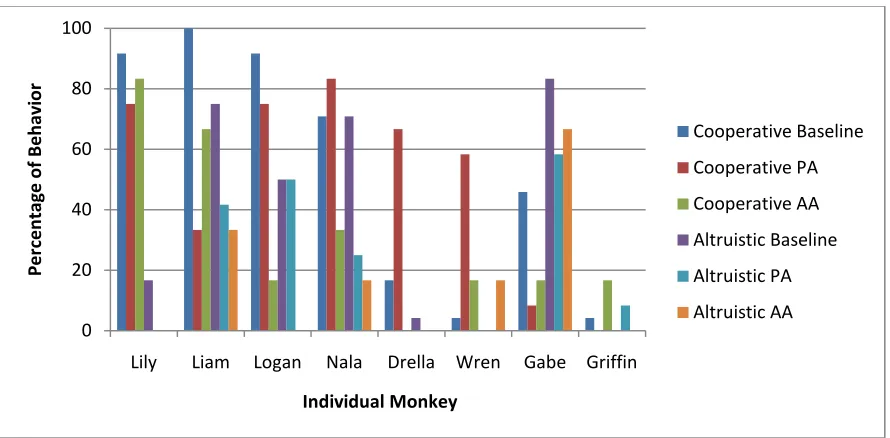
Figure 4. Active tool transfer for both the Cooperative and Altruistic conditions across all tasks (e.g., Baseline, Partner-Absent, Apparatus-Absent) for each individual monkey.
Seven of eight capuchins showed non-random behavior across the six payoff/task conditions (see statistics in Table 3, column 3). Considering only these seven, three showed sensitivity to payoff distribution with increased tool transfer in the Cooperative-Baseline task as compared to their overall behavior (Liam, Logan, Lily), while only one showed increased tool transfer in the Altruistic-Baseline task (Gabe). Several monkeys preferentially withheld the tool in the Altruistic payoff condition in either all three tasks (Lily), both control tasks (Nala), or only the Baseline (Wren). Other monkeys showed more sensitivity to the control conditions,
preferentially withholding the tool when their partner was absent (Liam) or when the apparatus was absent (Logan) in both payoff conditions. Thus, despite the difference in the groups‟ mean behavior between the Cooperative and Altruistic payoff conditions, I found that some individuals did well on each while others show evidence of understanding the task constraints. These data reiterate the need for individual level analyses to accompany grouped data.
0 20 40 60 80 100
Lily Liam Logan Nala Drella Wren Gabe Griffin
Table 3. Individual results for the general loglinear analysis. Adjusted residual values are for total numbers of active tool transfer, so cells with asterisks indicate significantly higher totals of tool transfer than expected and negative values indicate significantly lower totals than expected.
Adjusted Residual Values
Monkey χ2 p Coop
Baseline Coop PA Coop AA Altruistic Baseline Altruistic PA Altruistic AA
Liam 25.54 <.001* 3.99* -2.77* -0.07 0.89 -2.1* -1.88 Logan 26.24 <.001* 3.8* 1.18 -2.22* -1.12 -0.73 -3.08* Nala 17.59 <.05* 1.34 1.82 -1.36 1.34 -2.63* -2.22* Gabe 22.49 <.001* -0.59 -3.53* -1.85 3.53* 0.4 0.7 Wren 31.16 <.001* -1.39 5.36* 0.37 -2.13* -1.38 0.37 Lily 50.93 < .001* 5.11* 2.05* 1.82 -3.59* -3.57* -2.42*
Griffin 5.36 0.37 0.19 -0.72 1.79 -1.12 0.96 -0.49
Drella 30.81 <.001* 0.19 5.3* -1.09 -1.81 -1.6 -1.09
Reciprocity
I performed a bivariate correlation on each pair of monkeys that transferred the tool at least one time in the Altruistic condition (e.g., Liam – Logan, Nala – Gabe). There was no effect of turn taking on either pair‟s performance (see Table 4).
Table 4. Results for the bivariate correlation analyzing effects of reciprocity in the Altruistic condition. Reciprocity did not have a significant effect for any of the monkey pairs.
Monkey Pair Pearson correlation P N
Liam - Logan -.316 .684 4
Nala – Gabe .106 .894 4
Wren – Lily --- --- 4
[image:40.612.107.495.527.672.2]CHAPTER 4 DISCUSSION
In this study, capuchin monkeys manipulated both their physical and social environments to obtain a reward they would have otherwise been unable to acquire. Moreover, in contrast to typical food sharing behavior, the monkeys actively transferred a tool to a conspecific in the vast majority of trials, providing some of the first evidence of extensive active prosocial behavior in primates other than cooperative breeders (Jaeggi et al., 2010). Strikingly, this behavior contrasted with their food-transfer behavior in the same study, indicating that foods and non-foods-even non-foods that can be used to acquire foods-are treated very differently by this species (c.f. Warneken & Tomasello, 2006). Finally, some capuchin monkeys took into account either their partner‟s presence, the presence of the apparatus, and/or the food distribution. Notably,
capuchins shared more in the Cooperative payoff condition, where they stood to gain directly, than in the Altruistic payoff condition. Moreover, the monkeys treated the different tasks
These results expand the understanding of prosocial behavior in nonhuman primates in several key ways. First, the large majority of tool transfers-more than 90%- were found to be active, including in situations in which there was no possibility of an immediate, direct reward (e.g. the Altruistic payoff condition). In contrast with tool transfer, food transfers were passive in nature 100% of the time. These results are consistent with the existing literature. First, in the only other study of capuchin monkeys to involve non-food transfer, Westergaard and Suomi (1997) found that the monkeys were more likely to actively transfer tools and passively transfer food items in an intergroup cooperative task. Second, while capuchins have shared food in virtually every food-sharing study, all studies have found predominantly passive sharing as we did here (Brosnan et al., 2010; de Waal, 1997; de Waal 2000; de Waal & Berger, 2000; de Waal et al., 2008; Lakshminarayanan & Santos, 2008). In fact, Warneken and colleagues (2006) have argued that for chimpanzees, food is a zero-sum and sparks cooperation, not sharing. Although capuchins share far more than do chimpanzees in similar prosociality studies (Brosnan et al., 2010; de Waal & Berger, 200; de Waal & Davis, 2003; Lakshminarayanan & Santos, 2008, Takimoto & Fujita, 2011), current results indicate that, even for these monkeys, food may be a challenging resource to share. Thus, these results provide support for the hypothesis that primates are more inclined to transfer non-food items than food items because foods are highly salient and animals tend to be less inhibited in the direct presence of food (de Waal at al., 2008; Jaeggi et al., 2010; Nissen & Crawford, 1932; Warneken & Tomasello, 2006; Yamamoto & Tanaka, 2009).
shows that active sharing is seen in the capuchin monkey under some circumstances. Thus, we may need to expand our understanding of the conditions that select for prosocial behavior, or consider the possibility that there are multiple contributing factors. A second, related, point is that food sharing may not be the best, or at least is not the only, indicator of prosocial behavior. Some experiments examining helping behavior have also found evidence of prosocial behavior in the absence of food-related tasks (Barnes et al., 2008; Melis et al., 2011; Skerry, Sheskin, & Santos, 2011; Warneken & Tomasello, 2006; Warneken et al., 2007), and the current paradigm highlights an additional approach that may be used to answer the same question.
The current results also show that the monkeys are sensitive to both payoff structure and partner‟s presence in prosocial tasks, but especially in those without direct food rewards to the
actor (e.g., the Altruistic payoff condition). Other results have shown that monkeys are sensitive to conditions that may affect their own payoffs. For instance, capuchins‟ food-sharing increases after individuals help each other (de Waal & Berger, 2000), they cooperate more for dispersed than clumped or monopolizeable food sources (de Waal & Davis, 2008), they cooperate more when their partner behaves fairly, and share more when the rewards are equitable (Brosnan et al., 2006). Other studies have shown that capuchins are sensitive to the presences of a partner, for instance choosing options that bring their partner food more when it is present than absent (Brosnan et al, 2010). Here, we add to these previous findings by showing that in conditions in which capuchins cannot directly benefit, they are sensitive to both partner‟s presence and tool functionality by only providing a tool when both partner and apparatus are available.
Cooperative payoff condition, a direct payoff was possible and located immediately in front of the monkey. Thus, the immediacy of the reward and the lack of inhibitory control in the presence of food may have altered the monkey‟s behavior. This possibly indicates that the capuchin‟s interest in getting the food over-rode their attention to the apparatus and partner in the Cooperative payoff condition, when they, too, received food (see above). On the one hand, without any immediate reward, subjects may have had the time to consider whether to pull in the Altruistic payoff condition. Related to this, the capuchins that transferred the tool in the
Cooperative payoff condition may have been motivated by selfish goals and utilized their
partners as „pseudo-tools‟ or „secondary tools‟ in the process of reward maximization. The use of a partner as a secondary tool is interesting in that this exploitation may indicate problem-solving using the different contextual factors of a situation, including the partner itself. On the other hand, a selfish use of the partner was not present in the Altruistic condition; subjects may have been more sensitive to the contextual factors.
The individual variation seen amongst the capuchin monkeys indicated that responses in this task are highly variable. Despite overall statistically significant results, not all monkeys behaved in similar ways. Individual differences in performance may be due to several factors that cannot be distinguished here, and that are not necessarily mutually exclusive. First, some individuals may not have understood the task, and others may have paid varying levels of
attention to partner‟s presence and food distribution. Second, the individual testing history of the
pairs of monkeys may have affected performance in this task. For instance, one pair consisted of a dominant female and a subordinate female. The dominant female behaved aggressively
towards her partner, taking the tool before the subordinate female had a chance to respond. Such interactions may have affected the available options for some individuals. Finally, have there may have been test-order effects. For instance, one male (Gabe) engaged in significantly more active tool transfer than expected in the Altruistic Baseline condition, which he completed as his second condition. Despite this, the three other monkeys who used this test order showed no such pattern. Overall, the monkeys were sensitive to both payoff and, in the Altruistic payoff
condition, task-type. Another issue to note is the relatively low cost of tool transfer in this study, which may have influenced the likelihood of some subject‟s willingness to transfer their tool to a nearby partner.
As a secondary analysis, I also measured whether reciprocity enhanced tool transfer among the capuchin pairs in the Altruistic condition. Not surprisingly, given the previous work (Brosnan et al., 2009; Melis, Hare, & Tomasello, 2008; Yamamoto & Tanaka, 2009a), there was no evidence that individuals changed their rate of tool transfer based on partner behavior in the previous session. It is important to note that this study was not designed to study reciprocity, and the paradigm could be manipulated so that the task is more appropriate for the question. Thus, these results are consistent with previous findings, but should not be considered conclusive. A future study could specifically investigate the role of reciprocity in prosocial behavior among capuchin monkeys and other cooperative primates by manipulating time (i.e., decrease time between role reversals) and partner identity (i.e., re-pair individuals with new conspecifics).
because the food rewards were less immediately accessible. Previous work has found similar differences in primates‟ behavior in the context of foods versus non-foods. For instance,
chimpanzees are more prosocial in non-food helping tasks than in prosocial food-sharing tasks (Melis et al., 2011 Warneken & Tomasello, 2006, Warneken et al., 2007). Moreover, when given a choice between two piles of food, chimpanzees are unable to point to a smaller food quantity, despite numerous trials and despite the chosen pile actually being given to the chimpanzee‟s partner. However, researchers found that when foods are replaced with symbols, the
chimpanzees rapidly learn to point to the smaller of the two quantities (Boysen & Bernston, 1995). The fact that foods and non-foods are treated so differently may indicate a second mechanism for prosocial behavior with respect to non-foods, rather than an extension of the food-sharing mechanism. Although the current results are unable to determine whether there is in fact a second mechanism, these results reveal a new way of investigating prosocial behavior. This more relevant approach allows researchers to ask increasingly complex questions regarding prosocial behavior and other research areas of comparative cognition, such as planning or inhibition. The inclusion of potentially confounding variables (e.g., heavy reliance on human interaction, direct food sharing, and token-mediated variables) may change-by either
Conclusions
The present experiment was designed to exploit a naturally occurring capuchin behavior, tool use, to better understand their prosocial behavior. This study required monkeys to assess multiple aspects of the task environment and then make responses flexibly based on that
environment. Some capuchin monkeys were responsive to this task even though it required joint action to successfully complete (i.e., maximize reward intake), and they attended to both the physical and social factors of their environment. Even more exciting, some monkeys modified their behavior to maximize returns even if it meant cooperating with a conspecific through active object transfer. Capuchins paid attention to both the payoffs involved and, in the Altruistic task, the presence or absence of the partner and apparatus. Moreover, the majority of tool transfers were active while food transfers were passive, as is typically found. These results indicate very different behaviors between food and non-food items in this species, and highlight the need for novel test paradigms to gain a fuller understanding of its behavior.
Although human prosocial behavior is sometimes considered unique, at least some forms are present in other primate species. Currently the presence of prosocial behavior in other
primates is contentious, and in particular, how prosocial behavior in other primates compares to that in humans. This is due to conflicting results in experimental studies. Of course, while these may indicate differences in behavior, we cannot yet rule out inconsistencies in experimental design or the widespread use of tasks that the primates have difficulty understanding. In particular, the use of food has been implicated as a factor that dramatically affects primates‟ behavior. My results indicate that there may be more consistency amongst primates than
REFERENCES
Axelrod, R., & Hamilton, W. D. (1981). The evolution of cooperation. Science, 211(1390-1396). Bakeman, R. & Robinson, B. F. (1994).Understanding Log-Linear Analysis with ILOG: An
Interactive Approach. Erlbaum. Hillsdale, NJ.
Barnes J. L., Hill T., Langer M., Martinez M., Santos L. R. (2008). Helping behaviour
and regard for others in capuchin monkeys (Cebus apella). Biology Letters, 4: 638–640. Beck, B. B. (1973). Cooperative tool use by captive hamadryas baboons. Science, 182, 594-597. Boesch, C. (1994). Cooperative hunting in wild chimpanzees. Animal Behaviour, 48, 653-667.
Boesch, C. (2007) What makes us human (Homo sapiens)? The challenge of cognitive
cross-species comparison. Journal of Comparative Psychology, 121:227–40.
Boesch, C., & Boesch-Achermann, H. (2000). The chimpanzees of the Tai forest. Oxford: Oxford University.
Boren, J. J. (1966). An experimental social relation between two monkeys. Journal of the Experimental Analysis of Behavior, 9, 691-700.
Boysen, S. T., & Berntson, G. G. (1995). Responses to quantity: perceptual versus cognitive mechanisms in chimpanzees (Pan Troglodytes). Journal of Experimental Psychology: Animal Behavior Processes, 21, 82-86.
Brosnan, S. F., & Bshary, R. (2010). Cooperation and deception: from evolution to mechanisms. Philosophical Transactions of the Royal Society, Series B., 365, 2593–2598.
Brosnan S. F., Parrish A. E., Beran M. J., Flemming T., Heimbauer L., Talbot C. F., Lambeth S. P., Schapiro S. J., Wilson B. J. (2011). Responses to the Assurance game in monkeys, apes,
and humans using equivalent procedures. Proceedings of the National Academy of Science, 108, 3442-3447.
Brosnan, S. F, Talbot, C. F., Ahlgren, M., Lambeth, S. P., & Schapiro, S. J. (2010). Mechanisms underlying responses to inequitable outcomes in chimpanzees, Pan troglodytes. Animal Behaviour, 79, 1229-1237.
Brosnan, S. F., Salwiczek, L., & Bshary, R. (2010). The interplay of cognition and
cooperation. Philosophical Transactions of the Royal Society, Series B., 365, 2699–2710. Brosnan, S. F., Houser, D., Leimgruber, K., Xiao, E., Chen, T., & de Waal, F. B. M. (2010).
Competing demands of prosociality and equity in monkeys. Evolution and Human Behavior, 31, 279-288.
Bshary, R., & Bergmuller, R. (2008). Distinguishing four fundamental approaches to the evolution of helping. Journal of Evolutionary Biology, 21, 405–420.
Burkart, J. M., Fehr, E., Efferson, C., & Schaik, C. v. (2007). Other-regarding preferences in a nonhuman primate: common marmosets provision food altruistically. Proceedings of the National Academy of Sciences, 104, 19762-19766.
Burkart, J. M., Hrdy, S. B., & van Schaik, C. P. (2009). Cooperative breeding and human cognitive evolution. Evolutionary Anthropology, 18, 175–186.
Colman, A. D., Liebold, K. E., & Boren, J. J. (1969). A method for studying altruism in monkeys. Psychological Record, 19, 401–5.
Cronin, K. A., Kurian, A. V., & Snowdon, C. T. (2005). Cooperative problem solving in a cooperatively breeding species (Saguinus oedipus). Animal Behaviour, 69, 133-142. Cronin, K. A., Schroeder, K. K. E., Rothwell, E. S., Silk, J. B., & Snowdon, C.T. (2009).
Cooperatively breeding cotton-top tamarins (Saguinus oedipus) do not donate rewards to their long-term mates. Journal of Comparative Psychology, 123, 231–241.
Cronin, K. A., Schroeder, K. K. E., & Snowdon, C. T. (2010). Prosocial behaviour emerges independently of reciprocity in cotton-top tamarins. Philosophical Transactions of the Royal Society, Series B., 277, 3845–3851.
de Waal, F. B. M. (1996). Good natured. Cambridge: Harvard University Press. de Waal, F. B. M. (1997). Food transfers through mesh in brown capuchins. Journal of
Comparative Psychology, 111, 370-378.
de Waal, F. B. M. (2000). Attitudinal reciprocity in food sharing among brown capuchin monkeys. Animal Behaviour, 60, 253-261.
de Waal, F. B. M., & Berger, M. L. (2000). Payment for labour in monkeys. Nature, 404, 563. de Waal, F. B. M., & Davis, J. M. (2003). Capuchin cognitive ecology: cooperation based on
projected returns. Neurapsychologia, 41, 221-228.
de Waal, F. B. M., Leimgruber, K., & Greenberg, A. R. (2008). Giving is self-rewarding for monkeys. Proceedings of the National Academy of Science, 105, 13685-13689. Duffy, K. G., Wrangham, R. W., & Silk, J. B. (2007). Male chimpanzees exchange political
support for mating opportunities. Current Biology, 17, R586.
Eisenberg, N., Fabes, R. A., & Spinrad, T. L. (Eds.). (2006). Prosocial development. (Vol. 3). Hoboken: Wiley.
Fehr, E., & Fischbacher, U. (2003). The nature of human altruism. Nature, 425, 785-791.
Feistner, A. T. C., & McGrew, W. C. (Eds.). (1989). Food sharing in primates: a critical review. New Dehli: Today and Tomorrow's Press
Fragaszy, D. M., Feuerstein, J. M., & Mitra, D. (1997). Transfer of foods from adult to infants in tufted capuchins (Cebus apella). Journal of Comparative Psychology, 111, 194–200. Fragaszy, D. M., Visalberghi, E., & Fedigan, L. M. (2004). The Complete Capuchin: The
Biology of the Genus Cebu. New York: Cambridge University.
Goodall, J. (1986). The chimpanzees of Gombe: patterns of behavior Cambridge, MA: Harvard University.
Hattori, Y., Kuroshima, H., & Fujita, K. (2005). Cooperative problem solving by tufted capuchin monkeys (Cebus apella): Spontaneous division of labor, communication, and reciprocal altruism. Journal of Comparative Psychology, 119, 335-342.
Henrich, J., Boyd, R., Bowles, S., Fehr, C. C. E., Gintis, H., & McElreath, R. (2005). "Economic man" in cross-cultural perspective: behavioral experiments in 15 small-scale societies. Behavioral and Brain Sciences, 28, 795-855.
Hockings, K. J., Humle, T., Anderson, J. R., Biro, D., & Sousa, C. (2007). Chimpanzees share forbidden fruit. Plos ONE, 2, e886.
Hrdy, S. (2005). Comes the child before the man: how cooperative breeding and prolonged
post-weaning dependence shaped human potentials. In Hunter-Gatherer Childhoods, ed. B. S.
Hewlett & M. E. Lamb, pp. 65-91. Piscataway: Transactions.
Izawa, K. (1989). Frog-eating behavior of wild black-capped capuchin (Cebus apella). Primates, 19, 633-642.
Jaeggi, A. V., Burkart, J. M., & van Schaik, C. (2010). On the psychology of cooperation in humans and other primates: Combining the natural history and experimental evidence of prosociality. Philosophical Transactions of the Royal Society, Series B.365, 2723–2735. Janson, C. H. (1988). Food competition in brown capuchin monkeys (Cebus apella):
Quantitative effects of group size and tree productivity. Behaviour, 105, 53-76.
Jensen, K., Hare, B., Call, J., & Tomasello, M. (2006). What's in it for me? Self-regard precludes altruism and spite in chimpanzees. Proceedings of the Royal Society of London B, 279, 1013-1021.
Kosfeld M., Heinrichs M., Zak P. J., Fischbacher U., & Fehr E. (2005). Oxytocin increases trust in humans. Nature, 435:673– 676.
Lakshminarayanan, V. R., & Santos, L. R. (2008). Capuchin monkeys are sensitive to other's welfare. Current Biology, 18, R2.
Langford, D. J., Crager, S. E., Shehzad, Z., Smith, S. B., Sotocinal, S. G, Levenstadt, J. S., Chanda, M. L., Levitin, D. J., & Mogil, J. S. (2006). Social modulation of pain as evidence for empathy in mice. Science, 312, 1967-1970.
Liszkowski, U., Carpenter, M., Striano, T., & Tomasello, M. (2006). Twelve- and 18-month-olds point to provide information for others. Journal of Cognitive Development, 7, 173-187. Massen, J. J. M., Berg, L. M. v. d., Spruijt, B. M., & Sterck, E. H. M. (2010). Generous
leaders and selfish underdogs: pro-sociality in despotic macaques. PLoS ONE, 5, e9734.
American Journal of Psychiatry, 121, 584–85.
McGrew, W. C. (1992). Chimpanzee material culture: implications for human evolution. New York: Cambridge University.
Melis, A. P., Hare, B., & Tomasello, M. (2006). Engineering cooperation in chimpanzees: tolerance constraints on cooperation. Animal Behaviour, 72, 275-286.
Melis, A. P., Hare, B., & Tomasello, M. (2008). Do chimpanzees reciprocate received favours? Animal Behaviour, 76, 951-962.
Melis, A. P., Warneken, F., Jensen, K., Schneider, A. C., Call, J., & Tomasello, M. (2011). Chimpanzees help conspecifics obtain food and non-food items. Proceedings of the Royal Society of London B, 278, 1405-1413.
Mendres, K A., & de Waal, F. B. M. (2000). Capuchins do cooperate: the advantage of an intuitive task. Animal Behaviour, 60, 523-529.
Mitani, J. C., & Watts, D. P. (2001). Why do chimpanzees hunt and share meat? Animal Behaviour, 61, 915-925.
Moore, J. (1984). The evolution of reciprocal sharing. Ethology and Sociobiology, 5, 5–14. Nissen, H. W., & Crawford, M. P. (1932). A preliminary study of food-sharing behavior in
young chimpanzees. Journal of Comparative Psychology, 22, 383-419.
Noe R., van Schaik C. P., van Hooff J. A. R. A. M. (1991). The market effect: an explanation for pay-off asymmetries among collaborating animals. Ethology, 87, 97–118
Perry, S., & Rose, L. M. (1994). Begging and transfer of coati meat by white-faced capuchin monkeys, Cebus capucinus. Primates, 35, 409-415.
Richerson, P. J., & Boyd, R. (2005). Not by genes alone. Chicago: University of Chicago. Rose, L. M. (1997). Vertebrate predation and food-sharing in Cebus and Pan. International
Journal of Primatology, 18(5), 727-765.
Rutte, C., & Taborsky, M. (2007). Generalized Reciprocity in Rats. PLoS Biology, 5, e196. Savage-Rumbaugh, E. S., Rumbaugh, D. M., & Boysen, S. T. (1978). Linguistically mediated
tool use and exchange by chimpanzees (Pan troglodytes). Behavioral and Brain Sciences, 4, 539-554.
Schino, G. & Aureli, F. (2010) .The relative roles of kinship and reciprocity in explaining primate altruism. Ecology Letters, 13, 45–50.
Seyfarth, R. M. (1977). A model of social grooming among adult female monkeys. Journal of Theoretical Biology, 65, 671–698
Skerry, A. E., Sheskin, M., & Santos, L. R. (2011). Capuchin monkeys are not prosocial in an instrumental helping task. Animal Cognition, DOI: 10.1007/s10071-011-0399-0 Silk, J. B., Brosnan, S. F., Vonk, J., Henrich, J., Povinelli, D. J., Richardson, A. S., Lamberth, S.
P., & Schapiro S.J. (2005). Chimpanzees are indifferent to the welfare of unrelated group members. Nature, 437, 1357-1359.
Stevens, J. R. (2010). Donor payoffs and other-regarding preferences in cotton-top tamarins (Saguinus oedipus). Animal Cognition, 13, 663-670.
Takimoto, A. & Fujita, K. (2011). I acknowledge your help: capuchin monkeys‟ sensitivity to others‟ labor. Animal Cognition, DOI: 10.1007/s10071-011-0406-5.
van Schaik, C. P. (1989) The ecology of social relationships amongst female primates. In: Comparative socioecology: The behavioral ecology of humans and other mammals, ed.
V. Standen & R. Foley, pp. 195–218. Blackwell.
Visalberghi, E., Addessi, E., Truppa, V., Spagnoletti, N., Ottoni, E. B., Izar, P. &
Fragaszy, D. M. (2009). Selection of effective stone tools by wild bearded capuchin Monkey. Current Biology, 19, 213–217.
Vonk, J., Brosnan, S. F., Silk, J. B., Henrich, J., Richardson, A. S., Lambeth, S. P., Schapiro, S. J., & Povinelli, D. J. (2008). Chimpanzees do not take advantage of very low cost opportunities to deliver food to unrelated group members. Animal Behaviour, 75, 1757-1770.
Warneken, F., Hare, B., Melis, A. P., Hanus, D., & Tomasello, M. (2007). Spontaneous Altruism by Chimpanzees and Young Children. PLoS Biology, 5, 1414-1420.
Warneken, F., & Tomasello, M. (2006). Altruistic helping in human infants and young chimpanzees. Science, 311, 1301-1303.
Warneken, F., & Tomasello, M. (2009). Varieties of altruism in children and chimpanzees. Trends in Cognitive Sciences, 13, 397-402.
Westergaard, G. C, & Fragaszy, D. M. (1987). The manufacture and use of tools by capuchin monkeys (Cebus apella). Journal of Comparative Psychology, 101, 159-168.
Westergaard, G. C., & Suomi, S. J. (1997). Transfer of tools and food between groups of tufted capuchin monkeys (Cebus apella). American Journal of Primatology, 43, 33-41.