http://www.scirp.org/journal/cmb ISSN Online: 2165-3453
ISSN Print: 2165-3445
Loop Structures and Barrier Elements from
D.
melanogaster
87
А
7 Heat Shock Locus
Mikhail V. Glazkov
*, Anna N. Shabarina
Koltzov Institute of Developmental Biology, Russian Academy of Sciences, Moscow, Russia
Abstract
The three-dimensional organization of the genome is closely related to its function-ing. Interactions between parts of the genome located at large distances from each other have been detected within the chromosomes of different organisms, which led to the discovery of topologically associated domains (TADs). Methods that reveal such interactions between chromosomal loci imply detection of both protein-protein and protein-DNA interactions. We investigated the possibility of involvement of the direct DNA-DNA interactions in the structural and functional organization of Drosophila melanogaster chromosomal 87A7 locus, containing genes hsp70Aa and hsp70Ab, with the sequence analysis method. Our results indicate that the func-tional organization of 87A7 locus may involve different elements: chromosomal DNA fragments that attach chromosomes to the nuclear envelope, short polypurine/ polypyrimidine tracts, insulators and their proteins. The combination of interactions of these elements may cause different functional states of 87A7 locus.
Keywords
hsp70 Genes, DNA-DNA Interactions, Insulators, Nuclear Envelope, TADs
1. Introduction
In recent years, great interest is attracted to interactions of different genomic regions of interphase chromosomes, which are located at large distances from each other (based on the linear dimensions of the chromosomal DNA) [1][2][3][4][5]. Physically sepa-rated chromosomal loci more frequently communicate with each other within certain domains, which are called “topological domains” [2] or “topologically associated do-mains”—TADs [6] with chromatin looping out of DNA region located in between. These domains persist in interphase chromosomes of different cell types; they are evo-lutionarily conserved on syntenic chromosomal regions of different organisms. The av-How to cite this paper: Glazkov, M.V. and
Shabarina, A.N. (2016) Loop Structures and Barrier Elements from D. melanogaster 87А7 Heat Shock Locus. Computational Molecular Bioscience, 6, 53-65.
http://dx.doi.org/10.4236/cmb.2016.64005
Received: October 13, 2016 Accepted: December 2, 2016 Published: December 5, 2016
Copyright © 2016 by authors and Scientific Research Publishing Inc. This work is licensed under the Creative Commons Attribution International License (CC BY 4.0).
erage size of topological domains was originally designated as 800 kb in the chromo-somes of mouse and human embryonic stem cells [2]. Later [4] with the help of the Hi-C method with higher resolution (1 kb), the average size of these domains in human chromosomes was reduced to 185 kb. Similar domains with an average length of 60 kb are discovered in D. melanogaster chromosomes [3].
TADs were identified using various modifications of the 3C-method (Chromosome Conformation Capture). Formaldehyde fixation of protein-protein and protein-DNA interactions is one of the first steps of the method [1][2][3][4][5] as well as salt and EDTA treatment of cell nucleus that may distort the picture of the existing interactions. It is not surprising therefore that substantial part of the identified interactions refers to the enhancer-promoter interactions (related to the pattern of expressed genes), and in-teractions with the participation of insulator proteins.
However, one cannot exclude the involvement of direct DNA-DNA interactions in the structural and functional organization of chromosomes [7][8]. Short polypurine/ polypyrimidine tracts (9 - 10 bp), capable of forming the triple-helix DNA structure (H-form DNA) are possible participants of this process. Triplex DNA structures are revealed by immunocytochemistry in different types of chromosomes (interphase, me-taphase, meiotic, polytene), they are usually detected in the intergenic regions and in-trons of different genes. Polypurine/polypyrimidine 9 - 10 bp long but no longer tracts are of very weak recombinogenity (for details see [8]). When complementary polypu-rine and polypyrimidine tracts are located at a distance from each other, their interac-tion (formainterac-tion of the H-form DNA) leads to looping out of nucleotide chain located in between. This was shown in in vitro experiments using both synthetic oligonucleotides
[9][10][11], and the human alpha-1-antitrypsin gene [12], and while bioinformatic essays [7] [8]. It should be noted that the protein-coding and non-coding sequences (satellite DNA and repeats of LINE and SINE type) can form loop structures with fun-damentally similar mechanism [8].
The question that still needs to be elucidated is how the “borders” between the adja-cent TADs (including the nucleotide sequences of the chromosome regions) are orga-nized [5]. However, based on the definition of TADs (see above) the “border” is the one to ensure cooperation between genomic regions inside the domain and to prevent (re-duce the probability of) cross-domain interactions. This assumption applies to the function of insulators as well.
our transgenic experiments, possess extremely conserved motif (AAAGA)n. DNA mo-tifs (GAGA), responsible for the attachment to the nuclear envelope, were revealed within the LADs (Lamina Associated Domains) [19]. However, it should be noted that represented consensus contains AAAGA motifs as well. The most common feature of these two types of DNA motifs is the presence of polypurine tandem copies.
TADs are not detected both in mitotic chromosomes [20] and in the inactivated X-chromosome [6]. Perhaps one reason for identifying no TADs in mitotic chromo-somes is the absence of the one of the components involved in the formation of TADs’ borders at metaphase stage. That component turns to be the nuclear envelope/nuclear lamina, the one to attach interphase chromosomes at various sites. Concerning inacti-vated (compactisied) X-chromosome, identifying no TADs may be of the same cause as the compaction of chromosomes is accompanied by a change in the pattern of its inte-raction with the nuclear envelope/nuclear lamina.
Despite the identification of TADs in many organisms and many studies in this field, much remains unclear. The data on TADs give mostly a general idea about the interactions between the different sections of DNA. A detailed study of the nucleotide sequences, transcription, epigenetic status as well as higher levels of chromatin or-ganization can help to create a complete picture of the processes taking place in the genome.
This study is devoted to D. melanogaster heat shock genes (hsp70) locus. These genes encode proteins of hsp70 family performing the protective functions of the cell, pre-venting denaturation and aggregation of proteins. It is known that heat shock genes are expressed regardless of the surrounding chromatin [21]. We explored the question of a possible mechanism for the establishment of an independent expression domain of heat shock genes at the level of the loop chromatin organization with the involvement of: neDNA (nucleotide motifs—nuclear envelope attachment “markers” (AAAGA)n and (GAGA)n), short “complementary” polypurine/polypyrimidine tracts as well as insula-tors of the locus (scs/scs’-elements) and their proteins (BEAF32 and Zw5)). This paper presents an analysis of the nucleotide sequences of the locus and the attempt to com-pare it with the available experimental data.
2. Materials and Methods
D. melanogaster chromosomal locus 87А7 contains hsp70Aa and hsp70Ab genes (3R: 11,904,163 .. 12,006,544), length 102,382 bp (FlyBase, release 6,0).
Search for nucleotide sequences able to form three-chain DNA structures was per-formed according to the following criteria: polypurine/polypyrimidine tracts should be potentially able to form T(A.T), A(AT), C(GC), and G(GC) triplexes not less than 9 bp long. To simplify the simulation the search for complementary polypurine/polypyrimidine tracts was led on the same DNA strand [7][8]. We used NCBI resources, flybase.org, including Drosophila Sequence Coordinates Converter
3. Results
3.1. General Characteristics of the Region
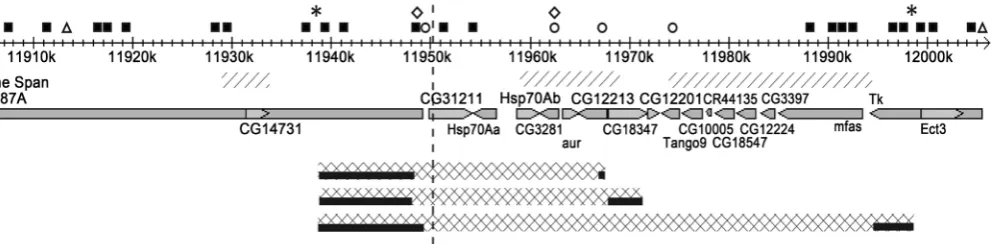
The chromosomal segment of D. melanogaster chromosome 3 (3R: 11,904,163 .. 12,006,544) is 102,382 bp in length with 17 genes located within (from CG14731 gene to Ect3 gene) (Figure 1). The research revealed 152 polypyrimidine (Y) tracts and 186 polypurine (R) tracts no less than 9 bp long in the region (maximum size of identified tracts is 27 bp). Among them 120 polypyrimidine tracts and 135 polypurine tracts are potentially able to interact with each other with looping out of DNA located in be-tween. Most of the tracts can possibly interact with a numerous complementary tracts located in various sites of analyzed region on chromosome 3.
Scale and representation of genes is taken from flybase. Arrows show the direction of transcription. Localization of the functional areas identified in hsp70 genes locus is showed with figures: black squares—poly-A/T tracts; triangles—insulators class II (Su(Hw)); circles—insulators class I (CP190, BEAF32, CTCF); asterisks—(AAAGA)2 tracts; rhombi—scs/scs’-elements. The border between physical domains is marked with vertical dashed lines. Diagonal hatching represents the areas of frequent intra-domain interactions. Diagonal cells denote regions that are found within the loop for hsp70 genes/one loop for the whole locus and black rectangles denote the bases of these loop structures respectively.
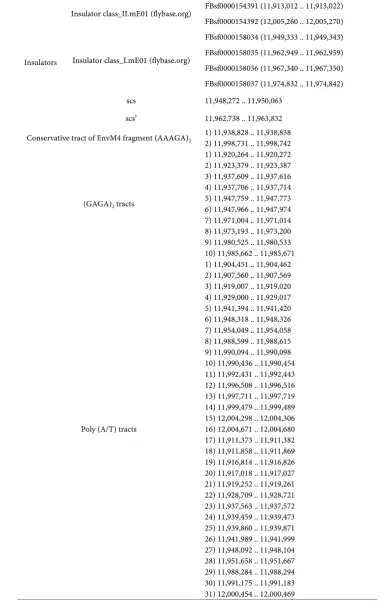
[image:4.595.58.554.562.684.2]The insulators of hsp70 genes locus are localized in the area: the region of scs- element overlaps with the promoter of CG31211 gene (3R: 11,948,272 .. 11,950,063) and includes Y82-Y84 and R108-R110 tracts, which have 31 complementary tract in the test region. Another insulator, scs’-element, is located in the area (3R: 11,962,738 .. 11,963,832) overlapping with the promoters of CG3281 and aurora genes. This region includes tracts R123, R124, and there is only one polypyrimidine tract complementary to R124 (data not shown). Flybase.org resource shows the localization of two types of recognition sites for the insulator proteins at the locus. The first are for the insulators class II.mE01 (contain recognition sites for Su(Hw) protein): insulator_II_2339 and in-sulator_II_2340. The second type of sites are for insulators class I.mE01 (contain recogni-tion sites for two of three insulator proteins—CP190, BEAF32 and CTCF): insula-tor_I_3071, insulator_I_3072, insulator_I_3073, insulator_I_3074 (Table 1, Figure 1).
Table 1. Sequence analysis results for the D. melanogaster hsp70genes locus (3R: 11,904,163 .. 12,006,544; 102382 bp).
Insulators
Insulator class_II.mE01 (flybase.org) FBsf0000154391 (11,913,012 .. 11,913,022) FBsf0000154392 (12,005,260 .. 12,005,270)
Insulator class_I.mE01 (flybase.org)
FBsf0000158034 (11,949,333 .. 11,949,343) FBsf0000158035 (11,962,949 .. 11,962,959) FBsf0000158036 (11,967,340 .. 11,967,350) FBsf0000158037 (11,974,832 .. 11,974,842)
scs 11,948,272 .. 11,950,063
scs’ 11,962,738 .. 11,963,832
Conservative tract of EnvM4 fragment (AAAGA)2 1) 11,938,828 .. 11,938,838 2) 11,998,731 .. 11,998,742
(GAGA)2 tracts
1) 11,920,264 .. 11,920,272 2) 11,923,379 .. 11,923,387 3) 11,937,609 .. 11,937,616 4) 11,937,706 .. 11,937,714 5) 11,947,759 .. 11,947,773 6) 11,947,966 .. 11,947,974 7) 11,971,004 .. 11,971,014 8) 11,973,193 .. 11,973,200 9) 11,980,525 .. 11,980,533 10) 11,985,662 .. 11,985,671
Poly (A/T) tracts
Continued
Sites with the potential to form single looped
structure (with the help of triple-stranded DNA) (11,938,828 .. 11,949,416) .. ( 11,994,767 .. 11,998,654)
Sites with the potential to form genes hsp70 loop (with the help of triple-stranded DNA)
(11,938,916 .. 11,948,717) .. ( 11,967,091 .. 11,967,605) (11,938,828 .. 11,948,218) .. ( 11,968,206 .. 11,971,622) TADs localization [3]
Localization of physical domains (modelling)
Domain ID 748 11,821,528 .. 11,950,027 (Null) Domain ID 749 11,950,028 .. 12,219,527 (Null) Areas of intra-domain
interactions (±5 kb) (experimental data)
11,929,278 .. 11,934,278 11,959,278 .. 11,969,278 11,974,278 .. 11,994,278
The sequence analysis of the region revealed a large number of single GAGA and AAAGA tracts, but not dimers that are only 10 and 2, respectively (Table 1, Figure 1). The size of the chromosomal region flanked by the dimers of conservative AAAGA tract is about 60 kb (Table 1, Figure 1). It should be noted that the area of the locus bounded with (AAAGA)2 tracts on both sides lies within an area bounded on both sides with the insulator protein Su (Hw) binding sites. In turn, the binding sites for insulator proteins CP190, BEAF32 and CTCF are located within the area bounded by the tracks (AAAGA)2. Most of the (GAGA)2 tracts are also located in the same region.
The formation of the DNA loop structures (bending of the DNA molecule) is facili-tated by poly-A and poly-T tracts [22]. Furthermore, it is shown that poly-A and poly-T rich DNA regions selectively interact with nuclear envelopes in vitro [23], enrich ge-nomic regions that interact with nuclear lamina [24]. Sequence analysis of the locus has revealed 31 poly-A/T tracts in the region (Table 1, Figure 1). Interestingly, (AAAGA)2 sites are enriched with poly-A/T tracts (Figure 1).
Accordingly, the detailed analysis of the possibilities for loop structures forming was carried out in the region flanked by (AAAGA)2 tracts on both sides. A number of 55 polypyrimidine tracts capable of interacting with 189 polypurine tracts were found in the region.
3.2. The Whole Area between (AAAGA)
2: Tracts Can Form a Single Loop
Structure
poly-A and poly-T (Table 1, Figure 1).
3.3.
hsp
70 Genes Can Be Localized in The Loop Structures of Small Size
Genes hsp70Aa and hsp70Ab can be organized in a loop of a smaller size (about 30 kb). The two looped structures can be formed potentially. The first loop composition: 6 tracts localized between genes CG14731 and CG31211 (11,938,916 .. 11,948,717) are complementary to 4 tracts in the CG12213 gene (11,967,091 .. 11,967,605). In this case, genes CG31211, hsp70Aa, hsp70Ab, CG3281, and aurora are found within the loop. The second loop composition: 11 tracts localized between genes CG14731 and CG31211 (11,938,828 .. 11,948,218) are complementary to 5 tracts in the CG18347 gene (11,968,206 .. 11,971,622). Thereby the genes CG31211, hsp70Aa, hsp70Ab, CG3281, aurora, and CG12213 enter the loop. Since the tracts between the CG14731 and CG31211 genes largely overlap, either one or the other loop can be realized potentially (Figure 1).
Interestingly, polypurine/polypyrimidine tracts located in the 5’-region of the locus also overlap when forming a single loop structure and smaller loops of the analyzed chromosome segment (Figure 1). It means that the formation of a smaller loop (isola-tion of genes hsp70Aa and hsp70Ab) is accompanied by the destruc(isola-tion of a larger loop, and vice versa, the formation of a “big” loop may be accompanied by the destruc-tion of the “smaller” loop. Perhaps the destrucdestruc-tion of the large loop appears as puffing on the cytological level. Simultaneously scs- and scs’-elements are physically placed in-side the area of decondensed chromatin. This consequence of our simulation corres-ponds with some experimental data. First, while heat shock scs- and scs’-elements are identified within the puff, but not at the borders of condensed and decondensed chro-matin [25]. Second, conservative AAAGA tracts were found at the band/interband border on D. melanogaster polythene chromosomes using FISH-analysis (unpublished data).
3.4. A Possible Mechanism for
hsp
70 Gene Independent Expression
Domain Formation
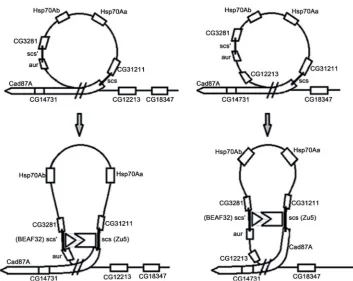
It can be assumed that the formation of a domain of active hsp70 genes is implemented in 2 steps. At the first stage the loop is formed with the participation of polypurine/ polypyrimidine tracts (the formation of two types of loops is possible). BEAF32 and Zw5 proteins of scs/scs’-elements participate at the second stage (Figure 2).
Step 1. While formation of the first loop (see above), CG31211, hsp70Aa, hsp70Ab, CG3281, and aurora genes are found within the loop. When forming the second loop (see above), CG31211, hsp70Aa, hsp70Ab, CG3281, aurora, and CG12213 genes enter the loop. Since the tracts between the CG14731 and CG31211 genes largely overlap, ei-ther one or the oei-ther loop can be realized potentially.
Figure 2. Schematic representation of the two variants of loop structures for hsp70genes that can be formed with the participation of triple-stranded DNA.
in vitro and vivo [26]. A loop within the loop is formed (Figure 2). This results in CG31211, CG3281, and aurora genes’ inactivation because BEAF32 protein binding site, which specifically binds to scs’-element, overlaps with DREF transcription factor binding site in promoters of CG3281 and aurora genes [27]. Similar reason may proba-bly underlie CG31211 gene inactivation, as scs-element specifically binded by Zw5 pro-tein overlaps with the promoter of the gene. Thus, in the first loop formed with polypu-rine/polypyrimidine tracts only hsp70Aa and hsp70Ab genes can be in the active state. In the second loop formed with polypurine/polypyrimidine tracts inactivation of CG31211, CG3281, and aurora genes can be reached by the same means. Isolation of gene CG12213 from hsp70Aa and hsp70Ab genes may be due to the fact that it is situated between the bases of the loops formed by a) triplex DNA structures, b) BEAF32 and Zw5 proteins (Figure 2).
3.5. Loops and TADs of 87
А
7 Locus
the big loop, the formation of which involves conservative tracts (AAAGA)n.
4. Discussion
4.1. Chromosomal Domain of 87A7 Locus
The results of our study show that the short polypurine/polypyrimidine tracts may be involved in the loop organization of D. melanogaster chromosomal locus for hsp70 genes. Tracts (AAAGA)2 appeared to be the most significant nucleotide sequences to determine the domain at 87A7 locus. These tandem tracts are of extremely high evolu-tionary conservation, are localized mainly in the intergenic regions [16] of the genomes of various organisms (including D. melanogaster) and at the borders of the band/inter- band on polythene chromosomes of Drosophila (unpublished data).
The entire locus region located between two (AAAGA)2 tracts can be arranged into loops with the help of complementary polypurine/polypyrimidine tracts (Figure 1,
Figure 2). Moreover, this area has the potential to form a large number of smaller loops with the participation of complementary polypurine/polypyrimidine tracts. For its size (approximately 60 kb) and a large number of potential intra-domain interactions (135 of 186 polypurine tracts have complementary polypyrimidine tracts (72.6%), in turn, 120 of 152 polypyrimidine tracts have complementary polypurine tracts (78.9%)), these domains may correspond to TADs of Drosophila chromosomes. We assume that TAD may correspond to the area of interphase chromosome located between the two sites that anchor interphase chromosomes to the nuclear envelope (in this particular case— between two evolutionarily conserved dimers AAAGA).
The comparison of our data (Table 1 and Figure 1) with the data of Sexton et al. [3]
shows that there are two physical domains in the investigated locus, the boundary be-tween which is localized within the region of “small” loops (“functional” domain of hsp70 genes). Both physical domains, comprising locus 87А7, have the “inactive do-main” status. Explanation of this is the fact that Drosophila embryonic cells used for the experiment [3] have inactive heat shock genes, i.e. in the compact state, which may limit their interaction with the neighboring regions. In addition, the compact state of this region can inhibit interactions of flanking areas. It should be noted that chroma-tin architecture of a specific locus as well as its functional state, can be tissue- and stage-specific, therefore, this specificity should be taken into account when interpreting results.
4.2. Functional Domain for
hsp
70 Genes
A large number of differentially expressed genes is localized between conservative (AAAGA)2 tracts of 87A7 locus (Figure 1). In the formation of the functional domain of hsp70 genes about 30 kb long the short polypurine/polypyrimidine tracts as well as insulators (scs/scs’-elements), and their proteins (BEAF32, Zw5), may be involved. Perhaps, the “big” loop (60 kb) and “small” loop (30 kb) are the alternative states of chromatin in 87A7 locus, because polypurine/polypyrimidine tracts involved in the formation of both loops overlap with each other in the 5’-region of the locus.
It is not excluded that the insulators most fully perform the functional domain for-mation within these chromosomal domains and their “work” outside these domains may be impeded. This assumption is confirmed by our experimental data with double- gene transgenic system (Drosophila yellow and white genes). We have shown that neDNA fragments (EnvM4) when flanking the two reporter genes are able to protect them from the PEV in the host chromosomes of D. melanogaster. The maximum pro-tective effect was observed in the presence of insulator Wari located in the 3’-region of white gene. When neDNA flank only one of the reporter genes (white + Wari), this very gene is protected against PEV to a greater extent than other gene (yellow) not flanked by neDNA fragments [13][28].
Results of analysis for 87A7 locus loop chromatin organization can logically explain some experimental facts. Firstly, scs/scs’-elements are not able to protect the transgene from PEV when integrated into heterochromatin [29]. This may be due to the fact that transgenic systems are artificial, and may not contain the required set of chromosomal elements in the structure, ensuring the formation of a transgene independent expres-sion domain. In addition, sites of integration are not native for the transgene and can-not contain, for example, complementary polypurine/polypyrimidine tracts necessary for the formation of the loop structures. Thus, according to the simulation for loop or-ganization of chromatin locus 87A7 results, chromosomal binding sites with the nuc-lear envelope, short complementary polypurine/polypyrimidine tracts as well as scs/ scs’-insulators and their proteins (Zw5, BEAF32)—the total of 3 elements may be in-volved in the formation of the independent expression domain of hsp70 genes. In the case of experimental transgenic system (yellow and white genes), only 2 elements— chromosome to nuclear envelope attachment sites and insulator Wari—are involved in the formation of the independent transgenes’ expression domain [13][14][28].
(transcriptional activator) proteins have a lot of interaction sites on the chromosome of Drosophila, and approximately in 50% of cases they overlap [30][31]. Their competi-tive relationships for the DNA binding sites have been shown as well [27]. Perhaps, the overlapping of insulator protein and transcriptional activator protein sites of the adja-cent genes is one of the functional mechanisms of gene hsp70 isolation. The mechanism might be based on the relationship between the insulator protein and the transcription activator protein in the same way as “repressor-activator” attitude.
5. Conclusion
On the model of D. melanogaster chromosomal 87A7 locus, it was demonstrated that various elements could be involved in the structural and functional organization of chromosomes. They are short polypurine/polypyrimidine tracts, insulators and their proteins, regions that attach chromosomes to the nuclear envelope, i.e. not only DNA- protein but DNA-DNA interactions as well. Combinatorics of the interaction of these elements can determine alternative states of chromosomal locus and genes belonging to this locus. Moreover, the same structural and functional status of chromosomal locus can be accomplished by several embodiments of DNA-DNA interactions that may un-derlie self-regulation of the locus and in a wider sense—“stability” of the genetic sys-tem.
Support
This work was supported by a grant from Subprogramme “Gene pools of wildlife and its preservation” of Presidium RAS Programme for Basic Research “Biodiversity of natural systems”.
References
[1] Dekker, J., Rippe, K., Dekker, M. and Kleckner, N. (2002) Capturing Chromosome Con-formation. Science, 295, 1306-1311. https://doi.org/10.1126/science.1067799
[2] Dixon, J.R., Selvaraj, S., Yue, F., Kim, A., Li, Y., Shen, Y., Hu, M., Liu, J.S. and Ren, B. (2012) Topological Domains in Mammalian Genomes Identified by Analysis of Chromatin Interactions. Nature, 485, 376-380. https://doi.org/10.1038/nature11082
[3] Sexton, T., Yaffe, E., Kenigsberg, E., Bantignies, F., Leblanc, D., Hoichman, M., Parrinello, H., Tanay, A. and Cavalli, G. (2012) Three-Dimensional Folding and Functional Organiza-tion Principles of the Drosophila Genome. Cell, 148, 458-472.
https://doi.org/10.1016/j.cell.2012.01.010
[4] Rao, S.S.P., Huntley, M.H., Durand, N.C., Stamenova, E.K., Bochkov, I.D., Robinson, J.T., Sanborn, A.L., Machol, I., Omer, A.D., Lander, E.S. and Lieberman, A.E. (2014) A 3D Map of the Resolution Reveals Principles of Chromatin Looping. Cell, 159, 1665-1680.
https://doi.org/10.1016/j.cell.2014.11.021
[5] Dekker, J. and Heard, E. (2015) Structural and Functional Diversity of Topologically Asso-ciating Domains. FEBS Letters, 589, 2877-2884.
https://doi.org/10.1016/j.febslet.2015.08.044
Heard, E. (2012) Spatial Portioning of the Regulatory Landscape of the X-Inactivation Cen-tre. Nature, 485, 381-385. https://doi.org/10.1038/nature11049
[7] Glazkov, M.V. (1999) Compactization of Chromosomal Loci of Eukaryotic Genes: Triplex DNA Structures (a Model). Molecular Biology, 33, 511-515.
[8] Glazkov, M.V. (2011) Loop Organization of Eukaryotic Chromosomes and Triple-Stranded DNA Structures. Molecular Biology, 45, 263-274.
https://doi.org/10.1134/S0026893310061020
[9] Hampel, K.J., Ashley, C. and Lee, J.S. (1994) Kilobase-Range Communication between Po-lypurine-polypyrimidine Tracts in Linear Plasmids Mediated by Triplex Formation: A Braided Knot between Two Linear Duplexes. Biochemistry, 32, 5674-5681.
https://doi.org/10.1021/bi00185a002
[10] Lee, J.S., Latimer, L.J.P., Haug, B.L., Pulleyblank, D.E., Skinner, D.M. and Burkholder, G.D. (1989) Triplex DNA in Plasmids and Chromosomes. Gene, 82, 191-199.
https://doi.org/10.1016/0378-1119(89)90044-9
[11] Lee, J.S., Ashley, C., Hampel, K.J., Bradley, R. and Scraba, D.G. (1995) A Stable Interaction between Separated Pyrimidine Purine Tracts in Circular DNA. Journal of Molecular Biolo-gy, 252, 283-288.
[12] Chudinov, O.S. and Glazkov, M.V. (2002) In Vitro Formation of Triple-Stranded DNA Structures in the Human α1-Antitrypsin Gene. Molecular Biology, 36, 100-104.
https://doi.org/10.1023/A:1014262926878
[13] Shabarina, A.N., Glazkov, M.V. and Shostak, N.G. (2010) The Role of Chromosomal Re-gions Anchored to the Nuclear Envelope in the Functional Organization of Chromosomes. Russian Journal of Genetics, 46, 1042-1044. https://doi.org/10.1134/S1022795410090061 [14] Shabarina, A.N. and Glazkov, M.V. (2012) Nuclear Envelope Attachment Sites of
Inter-phase Chromosomes: Barrier Elements but Not Insulators. Russian Journal of Genetics, 48, 864-867. https://doi.org/10.1134/S1022795412080066
[15] Glazkov, M.V., Drozd, S.F. and Poltaraus, A.B. (1999) Comparative Analysis of Nucleotide Sequences of Chromosomal DNA Isolated from Nuclear Envelopes and Cores of Ro-sette-Like Structures of Murine Interphase Chromosomes. Russian Journal of Genetics, 35, 208-213.
[16] Shabarina, A.N., Prilepa, E.I. and Glazkov, M.V. (2006) Unusual Nucleotide Sequence of a DNA Fragment Isolated from Nuclear Envelopes of Mouse Hepatocytes. Russian Journal of Genetics, 42, 715-722. https://doi.org/10.1134/S1022795406070027
[17] Onishchenko, G.E and Chentsov, Iu.S. (1974) Granular Layer of the Peripheral Chromatin in the Interphase Nucleus. I. Ultrastructure. Tsitologiia, 16, 675-678.
[18] Tsanev, R. and Tsaneva, I. (1986) Molecular Organization of Chromatin as Revealed by Electron Microscopy. Methods and Achievements in Experimental Pathology, 12, 63-104. [19] Zullo, J.M., Demarco, I.A., Piqué-Regi, R., Gaffney, D.J., Epstein, C.B., Spooner, C.J.,
Lu-perchio, T.R., Bernstein, B.E., Pritchard, J.K., Reddy, K.L. and Singh, H. (2012) DNA Se-quence-Dependent Compartmentalization and Silencing of Chromatin at the Nuclear La-mina. Cell, 149, 1474-1487. https://doi.org/10.1016/j.cell.2012.04.035
[20] Naumova, N., Imakaev, M., Fudenberg, G., Zhan, Y., Laioie, B.R., Mirny, L.A. and Dekker, J. (2013) Organization of the Mitotic Chromosome. Science, 342, 948-953.
https://doi.org/10.1126/science.1236083
[22] Moreau, J., Matyash-Smirniaguina, L. and Scherrer, K. (1981) Systematic Punctuation of Eukaryotic DNA by AT-Rich Sequences. Proceedings of the National Academy of Sciences of the United States of America, 78, 1341-1345. https://doi.org/10.1073/pnas.78.3.1341 [23] Comings, D.E. and Wallack, A.S. (1978) DNA-Binding Properties of Nuclear Matrix
Pro-teins. Journal of Cell Science, 38, 233-246.
[24] Meuleman, W., Peric-Hupkes, D., Kind, J., Beaudry, J.-B., Pagie, L., Kellis, M., Reinders, M., Wessels, L. and van Steensel, B. (2013) Constitutive Nuclear Lamina-Genome Interac-tions are Highly Conserved and Associated with A/T-Rich Sequence. Genome Research, 23, 270-280. http://www.genome.org/cgi/doi/10.1101/gr.141028.112
https://doi.org/10.1101/gr.141028.112
[25] Kuhn, E.J., Hart, C.M. and Geyer, P.K. (2004) Studies of the Role of Drosophila Scs and Scs’ Insulators in Defining Boundaries of a Chromosome Puff. Molecular and Cellular Biology, 24, 1470-1480.
[26] Blanton, J., Gaszner, M. and Schedl, P. (2003) Protein:Protein Interactions and the Pairing of Boundary Elements in Vivo. Genes & Development, 17, 664-675.
[27] Hart, C.M., Cuvier, O. and Laemmli, U.K. (1999) Evidence for an Antagonistic Relationship between the Boundary Element-Associated Factor BEAF and the Transcription Factor DREF. Chromosoma, 108, 375-383. https://doi.org/10.1007/s004120050389
[28] Shabarina, A.N. and Glazkov, M.V. (2013) Barrier Elements of Chromatin Domains and Nuclear Envelope. Russian Journal of Genetics, 49, 23-28.
https://doi.org/10.1134/S1022795413010122
[29] Kellum, R. and Schedl, P. (1991) A Position-Effect Assay for Boundaries of Higher Order Chromosomal Domains. Cell, 64, 941-950. https://doi.org/10.1016/0092-8674(91)90318-S [30] Jiang, N., Emberly, E., Cuvier, O. and Hart, C.M. (2009) Genome-Wide Mapping of
Boun-dary Element-Associated Factor (BEAF) Binding Sites in Drosophila melanogaster Links BEAF to Transcription. Molecular and Cellular Biology, 29, 3556-3568.
[31] Negre, N., Brown, C.D., Shah, P.K., Kheradpour, P., Morrison, C.A., Henikoff, J.G., Feng, X., Ahmad, K., Russell, S., White, R.A.H., Stein, L., Henikoff, S., Kellis, M. and White, K.P. (2010) Comprehensive Map of Insulator Elements for the Drosophila Genome. PLoS Ge-netics, 6, e1000814. https://doi.org/10.1371/journal.pgen.1000814
List of Abbreviations
Submit or recommend next manuscript to SCIRP and we will provide best service for you:
Accepting pre-submission inquiries through Email, Facebook, LinkedIn, Twitter, etc. A wide selection of journals (inclusive of 9 subjects, more than 200 journals)
Providing 24-hour high-quality service User-friendly online submission system Fair and swift peer-review system
Efficient typesetting and proofreading procedure
Display of the result of downloads and visits, as well as the number of cited articles Maximum dissemination of your research work