ISSN 2250-3153
Dual-Layer Video Encryption Using RSA and ECC
Algorithm
Prity Kumari1 , Upendra Kumar2, Shyam Krishna Singh3
1
Magadh University, Bodh Gaya, India
2
Birla Institute of Technology, Patna Campus, Patna, India,
3
A. N. College, Patna, India
Abstract- Cryptography is the study of techniques for ensuring
the secrecy and authentication of the information. In this paper use two algorithm RSA and ECC cryptography to encrypt and decrypt the video file. Elliptic Curve Cryptography recently gained a lot of attention in industry. The principal attraction of ECC compared to RSA is that it offers equal security for a smaller bit size, thereby reducing processing overhead .In RSA we firstly generate key pair and secondly encryption decryption algorithm to encrypt and decrypt the video then apply ECC algorithm to encrypt/decrypt of encrypted/decrypted RSA video. It gives more and more security to our video file. Elliptic curve arithmetic can be used to develop a variety of elliptic curve cryptographic (ECC) schemes including key exchange, encryption and digital signature.The mathematic background of ECC is more complex than other cryptographic systems just as Geometry, abstract algebra, number theory. ECC provides greater security and more efficient performance than the first generation public key techniques (RSA and Diffie-Hellman), Mobile systems, Systems required high security level (such as 256 bit AES).
Index Terms- Video encryption/decryption; RSA ; ECC
I. INTRODUCTION
lliptic Curve Cryptography (ECC)[1] and RSA is an approach to public key cryptography. Elliptic curves (EC) were suggested for cryptography by Victor Miller and Neal Koblitz in 1985 in the form of Elliptic Curve Cryptography (ECC) and RSA system was invented by three scholars Ron Rivest, Adi Shamir, Len Adleman and hence it is called RSA cryptography. The most popular public-key algorithm over the past twenty years has been RSA. The security of RSA comes from the difficulty of factoring large numbers. The public and private keys are functions of a pair of large prime numbers. These numbers may be 100 or 200 digits or even larger. Recovering the message from the public key and the encrypted message is thought to be equivalent to factoring the product of the two prime numbers.
Recently, however, with the advent of faster computers, RSA has become susceptible to brute force attacks. A brute force attack on an encryption system such as RSA means that every possible combination is tried until the correct solution to the problem is achieved. Therefore, new systems are needed to maintain the security of private information. One new method for
encryption to solve this problem is called elliptic curve encryption.
ECC based on the algebraic structure of elliptic curves over finite fields. With smaller key sizes and lower processing requirements than other public key cryptosystems, elliptic curve cryptography lends itself well to sending information securely over the internet where bandwidth and processing capabilities are limited. Ensuring the timely and reliable access to make use of information.ECC offers security with smaller key sizes, faster computation, lower power consumption as well as memory and band width saving .This is especially useful for mobile devices, wireless pagers which are limited in bandwidth, memory and low Power and network connectivity. The mobile apps such as multimedia messages, whatsapp are new standards in mobiles era used for communication.
Elliptic Curve Cryptography (ECC) [2,3,6,7] makes use of the elliptic curve in which the variables and coefficients are all restricted to elements of the finites fields [10]. Two families of elliptic curves are used in cryptographic applications: Prime curves [9,15] over Fp and binary curves F2m. For a prime curve over Fp, we use a cubic equation in which the variables and the coefficients all take on values in the set of integers from 0 through p-1 and the calculations are performed with respect to modulo p. Elliptic Curve Cryptography provides an excellent solution not only for the data encryption but also for the secure key transport between two communicating parties [16], and authentic session key establishment protocols [6,11,13]. Moreover, because of the apparent hardness of the underlying elliptic curve discrete logarithm problem (ECDLP), ECC systems are also well suited for applications that need long-term security requirements.
curve [5].
II. RELATED WORK
In today’s modern day where we depend on video transmission for news and media, protecting digital video from attacks during transmission is of prime importance. Due to the large size of digital videos, they are usually compressed and then transmitted using formats like MPEG.
The Naïve Algorithm is the simplest way to encrypt every byte in the whole MPEG stream using standard encryption schemes like DES or AES. The idea of the Naïve algorithm is to treat the MPEG bit-stream as text data and does not use any special structure [17,18]. It ensures the security as no known can effectively break the AES or the triple DES encryption if a sufficiently large key space is used [14].
Quiao and Nahresdt introduced a new algorithm called Video Encryption Algorithm (VEA) [17]. It is based on the statistical properties of the MPEG video standard and symmetric key algorithm which reduces the amount of data encrypted [14]. VEA divides the input video stream into two chunks (a1, a2, a3, a4, a5, a2n-1, a2n). These chunks are further divided in to data segments into even list (a2, a4, a6…a2n) and odd list (a1, a3, a5..a2n-1). After this, an encryption key is applied to the even list, E (a2, a4, a6…a2n), where E denotes the Encryption function used. The resultant encoded list is XORed with the odd list and the concatenated result is the final cipher text. As a result, the VEA is protected from known-only plain text attack as each frame will have a different key [14].
Four new algorithms were introduced by Bhargava, Shi and Wang [19,20]. The algorithms are Algorithm 1, Algorithm 2 (VEA), Algorithm 3 (MVEA), and Algorithm 4 (RVEA). Algorithm 1 uses the permutation of the Huffman code words in I-frames, combining encryption and compression in a single step. A secret permutation p is used which is used to permute standard MPEG Huffman code word list.
The AEGIS technique was developed by Maples and Spanos [21,22]. It only encrypts the I-frame of the MPEG stream. The sequence header is also encrypted which makes the MPEG video stream unrecognizable. The MPEG bit-stream is further hidden by encrypting the IOS end code. The DES encryption is used for the entire process.
III. PROPOSED SYSTEM
RSA encryption, named for the surnames of the inventors, relies on multiplication and exponentiation being much faster
Generation of RSA Key Pair
Each person or a party who desires to participate in communication using encryption needs to generate a pair of keys, namely public key and private key. The process followed in the generation of keys is described below −
• Generate the RSA modulus (n)
o Select two large primes, p and q.
o Calculate n=p*q. For strong unbreakable encryption, let n be a large number, typically a minimum of 512 bits.
o Totient of n=(n)=(p)*(q)=(p-1)(q-1) • Find Derived Number (e)
o Number e must be greater than 1 and less than (p − 1)(q − 1).
o There must be no common factor for e and (p −
1)(q − 1) except for 1. In other words two numbers e and (p – 1)(q – 1) are co-prime. • Form the public key
o The pair of numbers (n, e) forms the RSA public key and is made public.
o Interestingly, though n is part of the public key, difficulty in factorizing a large prime number ensures that attacker cannot find in finite time the two primes (p & q) used to obtain n. This is strength of RSA.
• Generate the private key
o Private Key d is calculated from p, q, and e. For given n and e, there is unique number d.
o Number d is the inverse of e modulo (p - 1)(q – 1). This means that d is the number less than (p - 1)(q - 1) such that when multiplied by e, it is equal to 1 modulo (p - 1)(q - 1).
o This relationship is written mathematically as follows −
Ed= 1 mod (p-1)(q-1)
The pair of number (n,d) forms the RSA private key.
The Extended Euclidean Algorithm takes p, q, and e as input and gives d as output.
• RSA Encryption
C = Pe mod n, where C is ciphertext and P is plaintext. • RSA Decryption
P = Cd mod n
ISSN 2250-3153
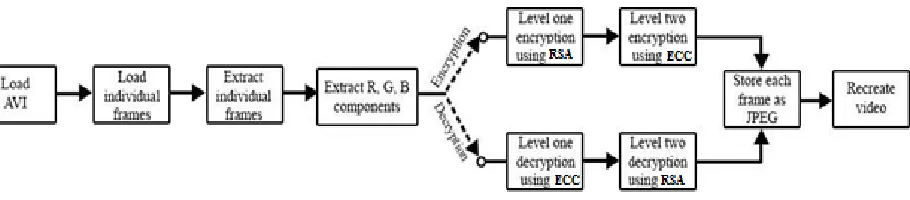
Fig. 1 Process of Encryption and Decryption
In the public key elliptic curve cryptosystems, we assume that entity A wants to send a message m to entity B securely. Order of a point on the curve can be defined as a value n such that nP = P+P+..+P.. n times = O (infinity)[9].
Key generation:
Both the entities in the cryptosystem agree upon a,b,p,G,n which are called ‘Domain Parameters’ of ECC[3]. G is called generator point and n is the order of G. Now A generates a random number nA < n as his private Key and calculates his public key PA = nAG . B generates a random number nB < n as his private Key and calculates his public key PB = nBG.
Key Exchange:
Entity A computes his Shared Key by Computing K = nBPA Entity B computes his Shared Key by Computing K = nAPB The two above keys have same value because:
nA*PB = nA* (nB*G)= nB*(nA *G)= nB * PA
Encryption:
A sends Cm = 2 ciphertext points those are { kG, Pm + k PB)}. Where G - generator Point
Pm - plaintext point on the curve k - a random number chosen by A PB - public key of B
Decryption:
Pm + kPB - nB(kG) = Pm + k(nB)G - nB(kG) = Pm
IV. VIDEO ENCRYPTION/DECRYPTION
Steps of encryption
(1) The AVI file is loaded into the system.
(2) The frames of the file loaded, is extracted one by one.
(3) After the extraction process, the frames are loaded.
(4) The loaded frames are then segregated into their RGB components and the encryption takes place on the individual color components of the frame.
(5) The RGB frames are encrypted individually using the ECC algorithm.
(6) To initiate the RSA process, accept an input string from the user. The sum of the ASCII values of each character of the string
input by the user is stored as x. Two large consecutive prime numbers are selected which are immediately next to x and pass them on as inputs to the RSA algorithm.
(7) Key distribution takes place.
(a) The public key is sent from the sender to the receiver.
(b) The receiver then sends a message M to the sender.
(c) The message M is first converted into an integer m, such that
0 < m < n by using an agreed-upon reversible protocol known as
a padding scheme.
(d) The cipher text c is calculated corresponding to CRSA=
Me(mod n).
(8)To initiate the ECC process, accept the value of CRSA.
(9) Encode this value to a point on the elliptic curve.
Koblitz’s Method for Encoding Plaintext [12]:
Step1: Pick an elliptic curve Ep(a,b).
Step 2: Let us say that E has N points on it.
Step 3: Let us say that our alphabet consists of the digits 0,1,2,3,4,5,6,7,8,9 and the letters A,B,C,. . . , X,Y,Z coded as 10,11,. . . , 35.
Step 4: This converts our message into a series of numbers between 0 and 35.
Step 5: Now choose an auxiliary base parameter, for example k = 20. (both parties should agree upon this)
Step 6: For each number CRSAk (say), take x=CRSAk + 1 and try to solve for y.
Step 7: If you can't do it, then try x = CRSAk +2 and then x =
CRSAk +3 until you can solve for y.
Step 8: In practice, you will find such a y before you hit x =
CRSAk + k - 1. Then take the point
(12) Steps 3 to 9 for all frames are repeated for all the frames.
(13) The result is obtained after utilizing all the stored frames to create a video file with each stored encrypted image as an individual frame of the video.
Steps of decryption
(1) The encrypted AVI video file is loaded into the system.
(2) The frames are extracted one by one.
(3) Each frame is loaded in the system.
(4) The RGB components are then extracted from the loaded frames.
(5) The RGB components are decrypted using ECC.
Consider each point (x,y) and set CRSA to be the greatest integer less than (x-1)/k. Then the point (x,y) decodes as the symbol
CECC .
(6)After decryption by ECC, the ECC components are then decrypted using RSA.
(7) The sender recovers m from CECC by using the private key exponent via computing m = CECCd (mod n).
(8) Each decrypted RGB component is then combined as a JPG file (with a frame number in the filename).
(9) Steps 3 to 7 are repeated for all frames.
(10) The result is obtained after utilizing all the stored frames to create a video file with each stored decrypted image as an individual frame of the video.
Example:
Let us take p and q values are very small. Practically, these values are very high.
• Let two primes be p = 7 and q = 13. Thus, modulus n = pq = 7 x 13 = 91.
• Select e = 5, which is a valid choice since there is no number that is common factor of 5 and (p − 1)(q − 1) = 6 × 12 = 72, except for 1.
• The pair of numbers (n, e) = (91, 5) forms the public key and can be made available to anyone whom we wish to be able to send us encrypted messages.
• Input p = 7, q = 13, and e = 5 to the Extended Euclidean Algorithm. The output will be d = 29. (5.d=1 mod 72, starting with 2 until will reach 5k mod 72=1. Doing so
• Plaintext P = 10, we get ciphertext CRSA – CRSA = 105 mod 91 = 82
• Say the parameters of curve are: p = 751, a = -1, b = 188, n = 727.
• x=mk+1 i.e. 82*20+1=1641cannot solve it for a y such that y2 mod p = x3 + ax+ b mod p, where m = CRSA .
• So go for x=mk+2 , x=1642 , no y exists. x=mk+3, x=1643, no y exists. x=mk+4, x=1644, no y exists. x=mk+5, x=1645, no y exists.
• x=mk+6 so x=1646 can solve it for y and y=1692.
• Now the point (1646,1692) is point is encrypted and decrypted as a message.
• To decode just compute PECC = (x-1)/k i.e. (1646-1)/20=1645/20 i.e. 82.25.
• Return 82 as ECC plaintext PECC (greatest integer less than (x-1)/k ,that is 82.
• After decrypting m to PECC it again decrypt by RSA decoder i.e.
PRSA = 8229 mod 91 = 10 = original plaintext.
• The number 10 is now decoded to character ‘A’.
V. RESULT AND ANALYSIS
ISSN 2250-3153
[image:5.612.59.280.53.301.2]
(a)
(b) (c) (d)Fig. 2 Video Encryption and Decryption
VI. HOW IS IT BETTER IN EXISTING WORK
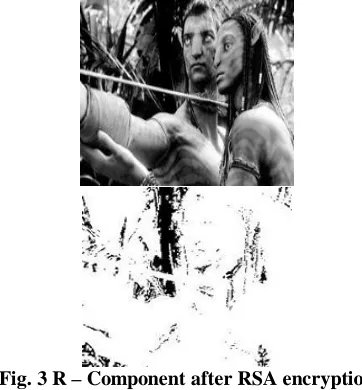
Upon implementing RSA encryption for the video, the encrypted video turned out to visually resemble the original video, we can see it clearly in figure 3 below that the encrypted image bears some similarities to the original image. For highly sensitive data it is imperative that the encrypted video should not bear any visual resemblance to the original video. Hence, we try to remove any resemblance whatsoever from the encrypted video to the original video, to do this we propose the use of two levels of encryption.
Fig. 3 R – Component after RSA encryption
our proposed system the first level encryption is obtained by RSA algorithm sequence whereas, level 2 encryption is obtained by using ECC algorithm. The result of combining these two levels is shown in below figure.
[image:5.612.74.255.462.657.2]
Fig 4 : Comparison of image before and after 2 levels of encryption
From above figure 4 we can see that there is no resemblance between the original and encrypted image, which is essential to provide maximum security.
VII. CONCLUSION
We have proposed a new method of dual layer encryption methodology which enables to achieve zero visual resemblance and high security. This is achieved by applying the techniques individually rather than encrypting and decrypting all the frames in one go. The dual layer approach presents a promising approach to achieving a highly secure way of video encryption while not being very computationally intensive and time consuming.
REFERENCES
[1] Certicom, Standards for Efficient Cryptography, SEC 1: Elliptic Curve Cryptography, Version 1.0, September 2000, Available at http://www.secg.org/download/aid-385/sec1_final.pdf
[2] Anna M. Johnston, Peter S. Gemmell, “Authenticated key exchange Provably Secure Against the Man-in-Middle Attack”, Journal of Cryptology (2002) Vol. number 2 pages 139-148.
[3] Antoines Joux, “A one round protocol for Tripartite Diffie-Hellman”, Journal of Cryptology, 2004, Volume 17, Number 4,pages 263-276. [4] Alfred J. Menezes, Paul C. van Oorschot and Scott A. Vanstone, Handbook
of Applied Cryptography, CRC Press, 1996.
[5] William Stallings, Cryptography and Network Security, Principles and Practice. ed.,Prentice Hall, New Jersey,2003.
[6] Asrjen K. Lenstra and Eric R. Verheul, “Selecting Cryptographic key size”, Journal of Cryptology, 2001, Volume-14, Number 4, pages 255-293. [7] A. Chandrasekhar et.al. “Some Algebraic Curves in public Key crypto
systems”, International Journal of Ultra Scientists and Physical Sciences, 2007.
[8] R. Schoof. Elliptic Curves Over Finite Fields and the Computation of Square Roots mod p. Mathematics of Computation, Vol. 44, No. 170, pp.483-494, April 85.
[9] Darrel Hankerson, Alfered Menezes, Scott Vanstone, “A Gide to elliptic curve Cryptography”, Springer, 2004.
[14] M. Abomhara, Omar Zakaria, Othman O. Khalifa, “An Overview of Video Encryption Techniques”, International Journal of Computer Theory and Engineering. Vol.2, 103-110, 2010.
[15] Rosing M. “Implementing elliptic curve cryptography”, Greenwich, CT: Manning publications, 1999.
[16] Ch. Suneetha, D. Sravana Kumar and A. Chandrasekhar, “Secure key transport in symmetric cryptographic protocols using elliptic curves over finite fields”, International Journal of Computer Applications, , Vol. 36, No. 1 November 2011
[17] S. Aly, “A light-weight encrypting for real time video transmission”, CTI Symposium Conference, DePaul University, Chicago, USA, 2003. [18] C.P. Wu, C.C.J. Kuo, “Design of integrated multimedia compression and
encryption systems”, IEEE Trans. Multimedia. Vol. 7, 828-839, 2005. [19] C. Shi and B. Bhargava, “A Fast MPEG Video Encryption Algorithm”,
Proceedings of the 6th International Multimedia Conference, Bristol, UK, 81-88, 1998.
Video in Distributed Multimedia Applications”, Conference on Computers and Communications, 72-78, 1996.
AUTHORS
First Author – Prity Kumari, Magadh University, Bodh Gaya, India
Second Author – Upendra Kumar, Birla Institute of Technology, Patna Campus, Patna, India