Kin-States and Kin Majorities from the Bottom-Up:
Developing a Model of Nested Integration in Crimea &
Moldova
Eleanor Knott
a thesis presented for the degree of Doctor of Philosophy
Department of Government London School of Economics
Abstract
With the increasing importance and prevalence of kin-state policies, this thesis identifies three gaps in existing kin-state research. Theoretically, existing literature focuses on how kin relations can induce or reduce conflict between states, overlooking the dynamics of interaction between kin-states and kin communities. Conceptually, existing literature focuses on kin communities as minorities, overlooking kin majorities. Methodologically, existing literature focuses on top-down institutional and state-level analyses of kin-state relations, overlooking bottom-up agency-centred perspectives.
To address these gaps, the thesis develops a model of nested integration, to analyse relations been kin-states and kin majorities from a bottom-up perspective. Nested integration does not challenge the borders separating kin-state from kin communities, but affects the meaning of this border. The thesis examines the comparative explanatory power of this model of nested integration by generating evidence about the meanings of kin identification and engagement with different kin-state practices, through a cross-case comparison of Crimea vis-à-vis Russia and Moldova vis-à-vis Romania. These cases are selected from a wider kin majority typology as two contrasting examples of kin-state policies: Romanian citizenship in Moldova and Russian quasi-citizenship Compatriot policy in Crimea.
Declaration
I certify that the thesis I have presented for examination for the MPhil/PhD degree of the London School of Economics and Political Science is solely my own work.
The copyright of this thesis rests with the author. Quotation from it is permitted, provided that full acknowledgement is made. This thesis may not be reproduced without my prior written consent. All maps, tables and figures are the author’s own.
I warrant that this authorisation does not, to the best of my belief, infringe the rights of any third party. I declare that my thesis consists of 101,904 words.
I can confirm that my thesis was copy edited for conventions of language, spelling and grammar by Judith Knott.
Parts of this thesis have been published as journal articles:
- Knott, Eleanor (2015a) ‘Generating Data: Studying Identity Politics From a Bottom-Up Per-spective in Crimea and Moldova’, East European Politics and Societies, 29(2): 467-486, doi: 10.1177/0888325415584047 (Sections 1.5 and 1.3 in Chapter 1);
Acknowledgements
I thank my supervisor, Denisa Kostovicova, for her support and direction, enabling me to write a the-sis covering issues that have mattered to me since its inception, while pushing me to conduct research more rigorously and systematically, and for the guidance in navigating how to tell a story that quickly became a ‘history of the past’. Thanks also to my advisor, John Breuilly, for his insights about nation-alism, his historical perspective and his probing about the relevance of the everyday for politics.
Significant thanks goes to my respondents, friends and hosts in Crimea and Moldova, who remain nameless. You are much more than the subjects of this research.
I am grateful also to the Economics and Social Research Council for funding this research and the fieldwork, and to conference funding from the LSE Travel Fund and Government Department at LSE, which allowed me to present this research internationally.
I am grateful to my mentors and colleagues at the Association for the Study of Ethnicity and Na-tionalism (ASEN) and doctoral seminar in naNa-tionalism studies. I thank John Hutchinson for keeping the debate on nationalism studies lively. I am indebted for the opportunities that being involved with ASEN has provided, both participating in, and organising, its annual conference and seminars.
I thank those who contributed valuable insights which helped to develop the arguments in the thesis, in reading and commenting on the papers drafted from it, in particular Jon Fox, Paul Goode, Angela Kachuyevski, Jan Kubik and Gerard Toal.
I am thankful also to those who have been critical in my education previous to the PhD: Gerry Kearns and Andy Tucker, as a Geography undergraduate at Jesus College, Cambridge, who kept me cloistered from positivism and immersed in culture and geopolitics, and Dennis Deletant, Svetlana McMillin and Richard Mole, at SSEES. I’m grateful also to those who intercepted earlier at Simon Balle School, most prominently Mike Moss and Andrea Robins, who taught me how to argue.
Writing a thesis was made much easier by my friends, inside and outside academia. Specifically, I thank those from the Government Department at LSE who I worked alongside in 4.21, in particular the 2010 MRes cohort: Kenneth Bunker, Gisela Calderon, Pınar Dinc, Ed Gareth Poole, Randi Solhjell, Slo-bodan Tomic, Robert van Geffen, Marta Wojciechowska; and beyond: Stefan Bauchowitz, Eri Bertsou, Mollie Gerver Jose Olivas Osuna, Laura Robbins-Wright, Fabrizio Scrollini and Anahi Wiedenbrug.
I’m grateful also to Aoife for putting up with me as a flatmate for the entirety of the PhD. And to Russ, for providing support, inspiration, provocation and belief, and for being an enduring participant in discussions, from the ridiculous to the ontological.
Lastly, I thank my parents for their help and support, in particular during the last stages, to my mum, the tireless proof reader and soundboard, and my dad, for the early and ongoing political discussions, foreign, domestic and chess-related. This thesis is dedicated to my parents, and to my diverse sets of grandparents, who all provoked my interest in geography, politics and being apochemuchka(a person who asks too many questions).
“The earth does not particularly care whether Celts or Slavs inhabited Bohemia, whether Romanians or Russians occupy Bessarabia.”
Contents
List of Figures 6
List of Tables 8
1 Introducing Kin Majorities and Nested Integration from the Bottom-up 15
1.1 Why Study Kin Majorities from Below? . . . 15
1.2 A Kin Majority Typology . . . 17
1.3 A Bottom-up Approach to Identities and Institutions . . . 22
1.4 Main Arguments . . . 25
1.5 Methodology and Research Design . . . 26
1.6 Thesis Outline . . . 35
2 Theorising Nested Integration for Kin Majorities 38 2.1 Existing Approaches to Kin-State Relations . . . 38
2.2 A Nested Approach for Kin Majorities . . . 43
2.3 Conceptualising Kin-State Meanings . . . 46
2.4 Conceptualising Kin-State Practices . . . 50
2.5 Conclusion: A Model of Nested Integration to Examine Diverse Kin-State Practices . . 52
3 Crimea and Moldova as Kin Majorities 55 3.1 Historical Background: Russia and Crimea . . . 56
3.2 Historical Background: Romania and Moldova . . . 63
3.3 Institutional Background: Russia’s Kin-State Policies in Crimea . . . 69
3.4 Institutional Background: Romanian Kin-state Policies in Moldova . . . 78
3.5 Conclusion: A Framework to Analyse Kin-state Practices . . . 89
4 Kin Majority Identification: What Does it Mean to be Russian in Crimea? 91 4.1 Identity Politics in Post-Soviet Crimea . . . 91
4.2 Discriminated Russians . . . 98
4.3 Ethnic Russians . . . 102
4.4 Political Ukrainians . . . 106
4.5 Crimeans . . . 109
4.6 Ethnic Ukrainians . . . 112
4.7 Conclusion . . . 115
5 Russian Kin-state Practices in Crimea: the Bottom-up Perspective 119 5.1 Existing Approaches to Russian Kin-State Practices . . . 120
CONTENTS
5.3 Associational Practices: Compatriot Organisations . . . 127
5.4 Membership Practices: Russian Citizenship . . . 132
5.5 Recognition Practices: Compatriot Practices . . . 136
5.6 Educational Practices . . . 141
5.7 Conclusion . . . 145
6 Kin Majority Identification: What Does it Mean to be Romanian in Moldova? 148 6.1 Identity Politics in Post-Soviet Moldova . . . 149
6.2 Organic Romanians . . . 152
6.3 Cultural Romanians . . . 158
6.4 Ambivalent Romanians . . . 161
6.5 Moldovans . . . 164
6.6 Linguistic Moldovans . . . 168
6.7 Conclusion . . . 171
7 Romanian Kin-state Practices in Moldova: the Bottom-up Perspective 174 7.1 Existing Approaches to Romanian Kin-State Practices . . . 175
7.2 Entitlements to Romanian Kin-State Practices . . . 177
7.3 Educational Practices: Romanian Scholarships . . . 181
7.4 Membership Practices: Redobândire . . . 185
7.5 Participation Practices: Extra-Territorial Voting . . . 198
7.6 Conclusion . . . 202
8 Examining the Model of Nested Integration of Kin Majorities from Below 205 8.1 Revisiting The Model of Nested Integration . . . 206
8.2 Meanings: How do Kin Majorities Identify with Kin-States? . . . 208
8.3 How do Kin Majorities Engage with Kin-State Practices? . . . 211
8.4 Comparing the Evidence of Nested Integration from the Bottom-Up . . . 215
8.5 A Model of Nested Integration? . . . 232
9 Conclusion 236 9.1 Thesis Review . . . 237
9.2 Thesis Contribution . . . 239
9.3 Future Research . . . 249
9.4 Conclusion . . . 251
Appendices 253
A Interview Guide 254
B Interviews & Correspondence 255
C Crimean Respondents 256
D Moldovan Respondents 258
E Coding Frameworks 260
List of Figures
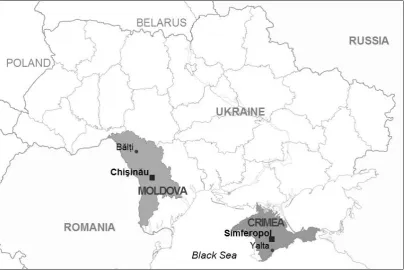
1 Map of Cases . . . 12
2 Historical Map of Crimea, Ukraine and Russia . . . 13
3 Historical Map of Moldova and Romania . . . 14
1.1 Iterative versus Inductive and Deductive Logics . . . 30
1.2 The Iterative Research Process . . . 31
1.3 Coding Process . . . 35
2.1 Overlapping Versus Nested Integration . . . 44
3.1 Crimean Ethnicity According to Censuses (1897-2001) . . . 58
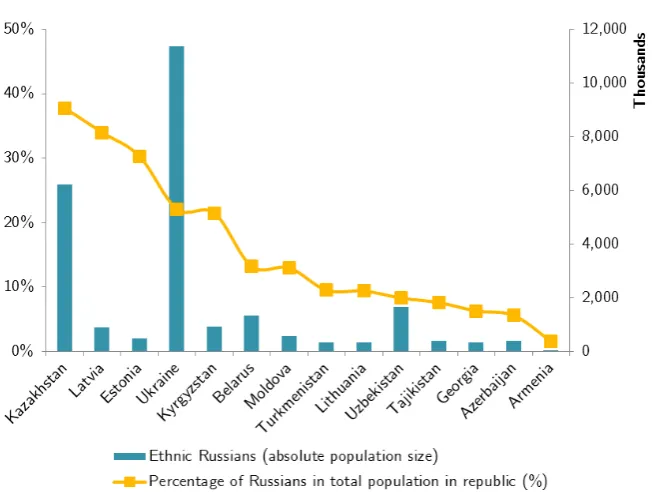
3.2 Ethnic Composition of the Population of the USSR in 1991 (by SSR) . . . 59
3.3 Support for Ukrainian Independence from Soviet Union in December 1991 Referendum 60 3.4 Election Results for Crimean parliament (1994-2010) . . . 62
3.5 Ethnicity According to Moldovan Censuses (1897-2004) . . . 64
3.6 Ethnicity in Greater Romania by region (1930 census) . . . 65
3.7 Moldova’s Post-Soviet Elections (1990-2014) . . . 69
3.8 Quota Places for CIS Citizens and Compatriots Abroad to Study at Higher Education Institutions in Russia (2010) . . . 72
3.9 The Hierarchy of Compatriot Councils . . . 73
3.10 Size of Romanian Communities Abroad (According to Romania) . . . 79
3.11 Romanian Aid Allocation (2007-2013) . . . 80
3.12 Acquisition of Romanian Citizenship . . . 80
3.13 Acquisition of citizenship by Moldovans in EU/EEA States (1991-2012) . . . 83
3.14 Number of Applications Solved (Article 11, 2005-2014) . . . 83
3.15 Number Eligible Versus Number Participating in Moldova in Romanian Elections (2009-2014) . . . 85
3.16 Eugen Tomac Campaign Sticker –“Bessarabia, Citizenship is Your Right!” . . . 85
3.17 Romania’s Educational Provision (With and Without Bursaries) . . . 87
4.1 Language and Ethnicity in Crimea According to 2001 Ukrainian Census . . . 92
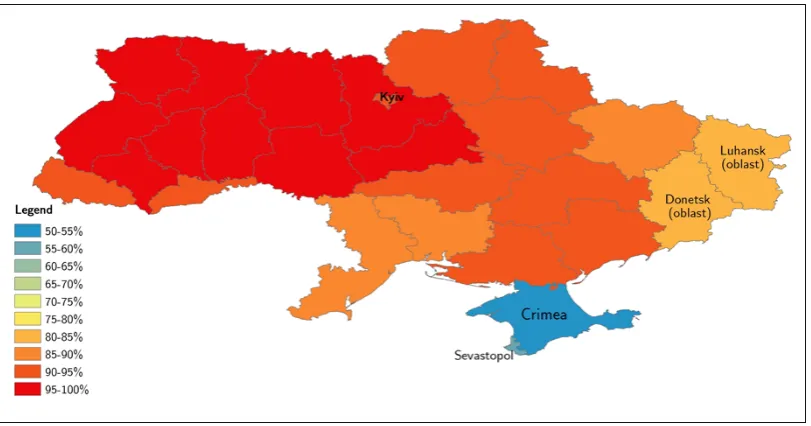
4.2 Russian Language Use in Ukraine According to 2001 Ukrainian Census . . . 96
4.3 Russian Ethnicity in Ukraine According to 2001 Ukrainian Census . . . 96
4.4 Gender Profile of Respondents in Crimea . . . 97
4.5 Age Profile of Respondents in Crimea . . . 97
LIST OF FIGURES
6.1 Ethnicity and Language in Moldova according to 2004 Census . . . 151
6.2 Gender Profile of Respondents in Moldova . . . 153
6.3 Age Profile of Respondents in Moldova . . . 153
6.4 Historic Regions of Romania . . . 156
7.1 Number Acquiring Citizenship (all kinds) by State (1991-2012) . . . 175
7.2 Status of Reacquisition of Romanian Citizenship by Respondent Category . . . 187
List of Tables
1.1 Research Questions . . . 17
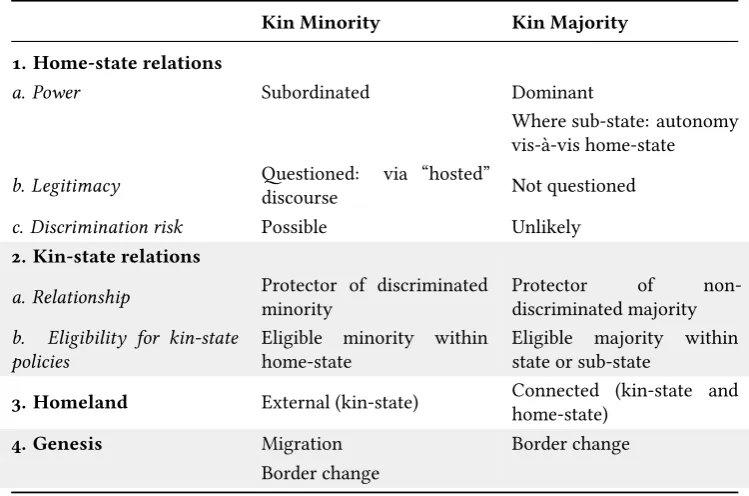
1.2 Conceptualising Differences Between Kin Majorities and Kin Minorities . . . 18
1.3 The Cases of the Kin Majority Typology . . . 21
1.4 Rational, Institutional and Bottom-up Approaches to Political Science . . . 24
1.5 Similarities and Differences for a Cross-Case Comparison of Moldova and Crimea . . . 27
1.6 Examples of Kin-State Citizenship and Quasi-Citizenship Policies . . . 28
1.7 Types of Respondents Interviewed in Moldova and Crimea . . . 32
2.1 Positioning the Thesis vis-à-vis Existing Theories . . . 39
2.2 Cultural and Political Incorporation . . . 45
2.3 Conceptualising Kin-State Practices . . . 54
3.1 Territorial Changes . . . 55
3.2 Number of Applications Registered and Processed for Reacquisition of Romanian Citi-zenship (2002-15 August 2011) . . . 81
3.3 Data on Romanian citizenship certificates issued by the National Citizenship Authority for Article 11 (2010-2014) . . . 82
3.4 Typology of Kin-State Practices . . . 90
4.1 Inductively Derived Identification Categories in Crimean Case . . . 94
4.2 Agreement and Disagreement Between the Identification Categories in Crimean case . 118 5.1 Identification Categories for the Crimean Case (from Chapter 4) . . . 123
5.2 Membership Practices in Crimea by Category . . . 135
5.3 Recognition practices in Crimea by Category . . . 140
6.1 Inductively Derived Identification Categories in Moldovan Case . . . 154
6.2 Agreement and Disagreement Between the Identification Categories in Moldovan case 173 7.1 Inductively Derived Identification Categories for Moldovan case (from Chapter 6) . . . 178
7.2 Unpacking Practices and Motivations by Inductive Categories . . . 197
7.3 Extra-territorial Voting Practices by Respondent Category . . . 202
8.1 Research Questions . . . 207
8.2 The Original Model of Nested Integration . . . 208
8.3 Explaining the Identification Categories . . . 210
LIST OF TABLES
8.5 Territorial and Geopolitical Aspirations for Crimean Case . . . 221
8.6 Mapping Nested Integration Respondents in Crimean Case . . . 222
8.7 Territorial and Geopolitical for the Moldovan Case . . . 229
8.8 Mapping Nested Integration Respondents in Moldovan Case . . . 230
9.1 Empirical Contributions . . . 240
9.2 Theoretical Contributions . . . 243
9.3 Examples of Ethnic Enclaves . . . 250
C.1 List of Respondents from Crimean Case . . . 257
D.1 List of Respondents from Moldovan Case . . . 259
E.1 Crimea: Coding for Meanings . . . 261
E.2 Crimea: Coding for Practices . . . 261
E.3 Moldova: Coding for Meanings . . . 261
Common Abbreviations
BiH Bosnia Herzegovina CEE Central and Eastern Europe
CIS Commonwealth of Independent States CoE Council of Europe
EHCR European Court of Human Rights ELF Ethno-Linguistic Fractionalization Index
EU European Union
FSU Former Soviet Union
GONGO Governmentally-Organised Non-Governmental organisation MAR Minorities at Risk
MASSR Moldovan Autonomous Soviet Socialist Republic (1924-1940) MFA Ministry of Foreign Affairs
MSSR Moldovan Soviet Socialist Republic NATO North Atlantic Treaty Organisation
OSCE Organization for Security and Co-operation in Europe RSFSR Russian Soviet Federal Socialist Republic
RS Republika Srpska SSR Soviet Socialist Republic
UkrSSR Ukrainian Soviet Socialist Republic USSR Union of Soviet Socialist Republics
WWII World War Two (also known as Great Patriotic War)
Abbreviations of Political Parties & Organisations
Crimea
RE Russkoe Edinstvo(Russian Unity) PoR Partiia Regionov(Party of Regions)
KPU Komunistichna Partiia Ukraini(Communist Party of Ukraine) BYut Blok Yuliyi Timoshenko(Bloc Yulia Timoshenko)
RCC Russkii Kulturnii Tsentr(Russian Cultural Centre, Crimea) ROC Russkaia Obshchina Kryma(Russian Community of Crimea) BSF Black Sea Fleet (Chernomorskii Flot)
Russia
Rossotrudnichestvo Federal Agency for the Commonwealth of Independent States, Compatriots Living Abroad and International Humanitarian Cooperation
Moldova
AIE Alianţa pentru Integrare Europeană(Alliance for European Integration) PCRM Partidul Comuniştilor din Republica Moldova(Communist Party of Moldova) PDM Partidul Democrat din Moldova(Democrat Party of Moldova)
PF Frontul Popular din Moldova(Popular Front of Moldova) PL Partidul Liberal(Liberal Party of Moldova)
PLDM Partidul Liberal Democrat din Moldova(Liberal Democrat Party of Moldova) PNL Partidul Național Liberal(National Liberal Party, Moldova)
PSRM Partidul Socialiştilor din Republica Moldova(Socialist Party of Moldova)
Romania
ANC Autorităţii Naţionale pentru Cetăţenie(National Authority for Citizenship) DPRRP Departamentul Politici pentru Relaţia cu Românii de Pretutindeni(Department for
Relations with Romanians abroad)
ICR Institutul Cultural Român(Romanian Cultural Institute) P-DL Partidul Democrat-Liberal(Liberal Democrat Party) PMP Partidul Mişcarea Populară(People’s Movement Party) PNL Partidul Național Liberal(National Liberal Party, Romania) PSD Partidul Social Democrat(Social Democratic Party)
Transliteration and Language
For Russian and Ukrainian the “Library of Congress, ALA-LC Romanization Tables: Transliteration Schemes for Non-Roman Scripts” are used (и/i, й/i, ы/y, я/ia, ю/iu in Russian, і/i, ї/ï in Ukrainian), except where there are more common forms used (e.g. Yeltsin, not E’tsin, Simferopol, not Simferopol’, Sevastopol, not Sevastopol’, oblast not oblast’).
Romanian is given as written, including ligatures.
Chapter 1
Introducing Kin Majorities and Nested
Integration from the Bottom-up
“Except for those rare cases where it accompanies a formal approach,
ethnographic research boring deeply into a particular country is viewed as ‘soft,’ ‘unscientific,’ and inappropriate for scholarship in a truly serious [political science] department.”
Diamond (2002:3)
“Imagine you woke up one morning and discovered you were in a different
country—not physically transported there; in fact you had awakened in the same place, along with the same neighbours. But the name of your country has changed, you’re supposed to salute a different flag, your loyalty is supposed to be for a different president.”
Zevelev (2001:vii)
1.1 Why Study Kin Majorities from Below?
1.1. WHY STUDY KIN MAJORITIES FROM BELOW?
remain special to external states, by virtue of co-ethnic bonds. Moreover, there is an interesting varia-tion in how different states behave—how the same state behaves towards co-ethnic communities across different states and how these relations came to exist and be institutionalised—via the proliferation of citizenship and quasi-citizenship policies. Understanding kin-state relations is crucial to studies of nationalism and of state insecurity, citizenship policy, and extra-territorial political practices, such as voting, which affect both domestic policy agendas and electoral outcomes.
This thesis identifies three gaps (theoretical, conceptual and methodological) in existing approaches to kin-state politics. Theoretically, previous approaches have considered kin-state relations only in terms of how they can induce or reduce/neutralise conflict. Theantagonistic approach, suggested by Brubaker (1996) and developed by Fearon and Laitin (2003), van Houten (1998), and D. J. Smith (2002), argues that kin-state relations are conflict-inducing by advancing competing territorial claims and forms of nationalism, between the home-state and kin-state, over a shared community. By contrast, the
fuzzyapproach, theorised by Batt (2002) and Fowler (2004), argues kin-state relations can be conflict-neutral. Here, kin-state policies, such as quasi-citizenship, are not necessarily contested by home-states; instead, kin-states and home-states agree to share these “fuzzy” citizenries. Both approaches overlook the dynamics of interaction between kin communities, kin-states and home-states.
The thesis contributes to this theoretical gap by exploring the dynamics of interaction exhibited by kin communities, to contribute a better understanding of kin-state policies and the impact of these policies on kin-state relations. It proposes a model of nested integration which argues that kin-state policies can advance a type of nested integration, which cannot be explained by theantagonistic or
fuzzy approaches. Instead, this type of integration involves the nesting of a kin community within the kin-state, while not undermining the kin majority’s relations with, and affiliation to, their home-state. This nested integration does not challenge the existence of borders separating kin-state from kin communities; rather these state policies change the meaning of the border separating the kin-state from the kin majority by allowing greater interaction and integration “over and above” sovereign borders (Kovács 2006:442; Csergő and Goldgeier 2004, 2001).
The central question of this research is therefore: how far is the interaction of kin majorities with kin-states explained by the model of nested integration? This question is supplemented by second-order conceptual and third-order empirical questions (Table 1.1). These questions indicate how the research is broken down conceptually, to analyse the dynamics of interaction, in terms of meanings and prac-tices, and empirically, in the two kin majority cases of this research (Crimea and Moldova), to examine evidence of nested integration, conceptualised as the presence of both political and cultural incorpora-tion.
1.2. A KIN MAJORITY TYPOLOGY
Table 1.1:Research Questions
1.Research Question How far is the interaction of kin majorities with kin-states explainedby the model of nested integration?
a) What do the meanings of kin identification demonstrate about the dynamics of interaction between kin majorities and kin-states?
2. Conceptual Questions b) What does engagement with kin-state practices demonstrate about
the dynamics of interaction between kin majorities and kin-states? a)Meanings: How do kin majorities (in Crimea and Moldova) identify with kin-states (Russia and Romania)?
3. Empirical Questions b)Practices: How do these kin majorities engage with kin-state
prac-tices?
However, this idea of nesting also offers a novel way to understand relations between kin minorities and kin-states, by the ability to become nested within kin-states while retaining ties of loyalty to home-state, as well as the opportunity to observe whether this nesting is occurring.
Methodologically, this thesis critiques the dominance of top-down state-centred analysis of kin-state relations, ignoring the agency of members of kin communities. To fill this methodological gap, the thesis takes a bottom-up, meaning-centred interpretivist approach. This goes beyond previous inter-state approaches to explore, from the perspective of members of kin majorities, how and why they engage with kin-states. This is broken down conceptually to analyse meanings, how kin majorities identify, and practices, how kin majorities engage with kin-state practices such as citizenship and quasi-citizenship.
1.2 A Kin Majority Typology
This research argues that kin majorities require specific attention, contending that kin majorities ex-hibit different relations with their home-state and kin-state, from kin minorities. To address this lack of kin majority focus, the thesis establishes a kin majority typology, as a universe of cases, to which the two cases examined in this thesis, Moldova and Crimea, have a wider conceptual relevance.
1.2.1 Why are Kin Majorities Different from Kin Minorities?
Previous kin-state literature focuses on kin minorities, rather than majorities. While this literature forms an important conceptual backbone of the research, kin majorities need to be studied in their own right because, asmajorities, kin majorities are different from kin minorities, vis-à-vis home-state and kin-state relations, in terms of their genesis and conception of homeland (Table 1.2).
Home-State Power
1.2. A KIN MAJORITY TYPOLOGY
Table 1.2:Conceptualising Differences Between Kin Majorities and Kin Minorities
Kin Minority Kin Majority
1. Home-state relations
a. Power Subordinated Dominant
Where sub-state: autonomy vis-à-vis home-state
b. Legitimacy Questioned:discourse via “hosted” Not questioned
c. Discrimination risk Possible Unlikely
2. Kin-state relations
a. Relationship Protector of discriminatedminority Protectordiscriminated majorityof non-b. Eligibility for kin-state
policies
Eligible minority within home-state
Eligible majority within state or sub-state
3. Homeland External (kin-state) Connected (kin-state andhome-state)
4. Genesis Migration Border change
Border change
the kin majority comprise a majority of the sub-state, but not the state, they still possess territorial autonomy which permits de facto (if not de jure) power to create institutions which protect key areas of cultural capital, such as language.
Home-State Legitimacy
For kin minorities the home-state is often framed as a “host state” (e.g. Russian communities in Estonia and Latvia), where minorities are framed as illegitimate components of the contemporary state, belong-ing to a different state (kin-state) and with uncertain rights to remain within their home-state (Pogonyi et al. 2010; M. G. Marshall 1993:197). Even where rights to remain are less questioned (e.g. Hungar-ians in Romania and Slovakia), their relationship with the state is still inferior, requiring minorities to learn the home-state language and campaign for native language education (Deets and Stroschein 2005). By contrast, kin majorities comprise the historic majority of the state/sub-state in which they reside, and have access to power resources which entrench their language as the functional language of the state/sub-state.
Discrimination Risk Within Home-State
1.2. A KIN MAJORITY TYPOLOGY
However kin majorities do not face these kinds of restrictions, as legitimate members of the state/sub-state and holders of citizenship; hence kin majorities can participate in daily life, and local institutions, in their language.
Kin-State Relationship
Where kin minorities are “minorities at risk”, kin-states are important, if not legitimate, lobbyists for greater protection of their kin minorities at risk from discrimination.¹ The Council of Europe argued too that kin-states offered the possibility of better protection for minorities and thus legitimised the right of kin-states to interact with kin minorities abroad (Udrea 2014; Venice Commission 2001). However, these minority protection arguments, underpinning how and why it is legitimate for an external state to claim interests in the citizens of another state, cannot be levied in the case of kin majorities. They do not need the resources of protection provided by the kin-state because they provide the resources to be self-sufficient, politically and culturally, as the dominant majority within their state/sub-state. Rather in kin majority cases, other ethnic groups, comprising minorities, can be at higher risk, for example their linguistic rights being impinged (e.g. Crimean Tatars in Crimea, Bosnian Muslims in Republika Srpska, Serbians in Kosovo).
Eligibility for Kin-State Policies
Whereas kin minorities comprise an eligible minority for kin-state policies within the home-state, kin majorities comprise an eligible majority. This allows for greater and deeper kin-state interaction, be-tween kin majority and kin-state, by granting a more dominant constituent within the state/sub-state access to, and use of kin-state policies, than peripheral kin minorities. Thus, the implications of kin ma-jorities acquiring, using kin-state rights and becoming more integrated with the kin-state are different, the potential for destabilisation is greater, and this requires specific attention.
Genesis
Kin majorities often arose from moving borders rather than moving people, whereas kin minorities can arise, or be augmented, either by voluntary or coerced migration (ethnic Russians in Baltic states, Koreans in China and Japan) or by border changes (ethnic Hungarians in Romania). The migratory genesis helps to reinforce the sense of home-states “hosting” these kin minorities who are, in turn, conceived as diaspora, at least by the home-state, which imagines they have an external homeland (kin-state) to which they can “return” (Laitin 1998; Safran 1991). Kin minorities are often associated with a particular regime, e.g. ethnic Russians as illegitimate occupiers in Baltic states and associated with the Soviet regime and Soviet-era migration (Melvin 1995). This reinforces the discourse that home-states are, even generously,hostingcommunities that do not belong to the home-state, even if they conceive of themselves as “beached”, arising from their detachment from a central state (e.g. collapse of Soviet Union). Kin majorities do not share these experiences, either of migration or the framing of hosting,
1.2. A KIN MAJORITY TYPOLOGY
as they generally arise from border shifts and experiences of ongoing territorial flux, reinforcing their sense of legitimacy at home.
Homeland
This experience of border genesis, as opposed to migratory genesis, results in a different framing of homelands. While kin minorities have “external” homelands as Brubaker (1996) argues (and elaborated in Chapter 2), kin majorities have connected homelands disconnected by territorial flux. Hence, kin majorities conceive of their state/sub-state as both their homeland and as part of the wider kin-state homeland.
*
Kin majorities therefore present an unexplored and interesting puzzle: they do not need the same kin-state support, as kin minorities, because, as local majorities, they are less exposed to home-state discrimination and more empowered. Yet kin-states act in similar, if not more ardent, ways towards kin majorities, rendering them eligible, en masse, for kin-state policies, and access to rights and benefits.
Hence kin majorities require analysis, because they pose different questions vis-à-vis kin-state and home-state relations, not least because of majority eligibility for kin-state policies. In turn, this indi-cates the potential for a majority, within the home-state, to interact with a kin-state, posing, different and unexplored implications for kin majority/kin-state relations.
1.2.2 The Kin Majority Typology
Building on the need to investigate kin majorities, this section constructs a kin majority typology according to three criteria which define the universe of cases:
1. Status as a demographic majority,
2. Co-ethnicity claimed by external kin-state, 3. Eligibility for kin-state policies.
Firstly, to be a kin majority, the case must comprise a demographic majority in a state or sub-state, i.e. they must be a local majority and this must be territorially bounded within a polity. Ethnic Russians comprise large territorial concentrations in several post-Soviet states (Estonia, Latvia, Kazakhstan); however, they are not politico-territorially defined, i.e. the community does not possess autonomy, while in Transnistria ethnic Russians do not comprise (narrowly) a local majority.²
Secondly, the majority must be claimed as co-ethnic by an external kin-state. The majority does not necessarily have to identify co-ethnically with the kin-state, where the external kin-state can claim co-ethnicity even if these claims are resisted or contested by local communities. For example, Bulgaria claims that the majority of Macedonia are, by virtue of being ethnically Macedonian, “Bulgarian by origin”. This is resisted by the Macedonian government and society (Pogany 2006; Smilov and Jileva
1.2. A KIN MAJORITY TYPOLOGY
Table 1.3: The Cases of the Kin Majority Typology
Case Kin Majority (%)Kin Majority Kin-State Kin-StatePolicies
Autonomous Moldova Romanian/Moldovan 77%³ Romania Citizenship
and
sovereign Macedonia
Macedonian/
Bulgarian 65% Bulgaria Citizenship
state Kosovo⁴ varAlbanian/ Koso- 92% Albania Citizenship
Autonomous
sub-state Crimea⁵ Russian 59% Russia
Quasi-citizenship
but not sovereign
Republika
Srpska Serbia ≈96% Serbia Citizenship
De facto state
Nagorno-Karabakh Armenian 95% Armenia
Quasi-citizenship⁶
2010; Özgür-Baklacioglu 2006); yet Bulgaria facilitates the right of Macedonians to acquire Bulgarian citizenship on this basis (Neofotistos 2009). This is evident also in the cases of Romania (vis-à-vis Moldova) and Albania (vis-à-vis Kosovo) though, by comparison, Albania is more reserved, providing social and cultural benefits including university places to its (claimed) ethnic Albanian kin, while not, directly, facilitating full citizenship (Krasniqi 2010). In these cases, the kin-state collapses two ethnic categories by claiming co-ethnicity to legitimise their right to act as a kin-state.
Thirdly, the majority must be eligible for external policies provided by the kin-state (whether citi-zenship or quasi-citiciti-zenship). The Åland Islands (Swedish ethnic majority in Finland) and South Tyrol (ethnic German majority in Northern Italy, Austria as a kin-state) could otherwise be considered kin majority cases; however, their kin-states (Sweden and Austria) do not advance kin-state policies (e.g. citizenship or quasi-citizenship).
These three criteria define the kin majority typology and universe of cases (Table 1.3), while recog-nising there are differences within these cases, such as presence/absence of conflict and degree of sovereignty/autonomy. This typology gives a wider frame of reference where the insights derived from this thesis, such as the model of nested integration, have external validity beyond the specificities of the cross-case comparison, by allowing for typological theorising (George and Bennett 2005:233).
The insights from this analysis of kin majorities may also have external validity for kin minorities, in terms of their use of kin-state policies and the potential for nested integration. However it is im-portant to study kin majorities in their own right, as this thesis does, given they are eligible en masse for kin-state policies, posing an interesting puzzle in terms of their interaction with their kin-state and relationship with their home-state.
³74% ethnically Moldovan, 2% ethnically Romanian (National Bureau of Statistics 2004)
⁴Kosovo functions as a largely autonomous and sovereign state recognised by most of UN member states (110/193, 57%) and EU member-states (23/28, 82%) as of May 2015.
1.3. A BOTTOM-UP APPROACH TO IDENTITIES AND INSTITUTIONS
1.3 A Bottom-up Approach to Identities and Institutions
“To explain an action, we cannot merely correlate it with an isolated attitude. Rather, we must interpret it as part of a web of beliefs.”
Bevir and Rhodes (2006:70-71)
Understanding the agency of kin communities, and particularly kin majorities, requires a bottom-up methodology. This agency-centred approach allows for direct analysis of how members of kin majori-ties identify and engage with institutions provided by the kin-state, to understand how individuals negotiate and experience these kin-state relations.
The desire to understand the everyday informalities of political practices and meanings, and to collect data to fit this goal, is part of a broader political science debate to understand more about how political practicesactuallywork by gathering data that captures the meanings of these informal-ities (Ekiert and Ziblatt 2013:102-03). What motivates scholars to conduct bottom-up “people-” and “agency-centred” approaches is that, as a “neglected political arena”, our understanding is based on un-tested assumptions of actors’ preferences and identities constructed from above (Kostovicova and Glasius 2011:14). Bottom-up approaches allow researchers to go further into the “gray zone” and “back-stage of politics” by exploring the “lived experience” of (politically relevant) identities and institutions (Auyero 2007; Joseph and Auyero 2007:1), where respondents are treated “not as objects, but as agents” (Schwartz-Shea and Yanow 2012:46) and where the agency of individuals, their meanings, actions, and interactions, are important and politically-relevant.
Bottom-up approaches have produced rich research exploring the informality of politics in diverse sub-fields. In post-Communist political studies, scholars argue this approach is fundamental for un-derstanding both the informalities surrounding the politics of transition and post-transition, such as networks of power (sistema) and economies of favours (blat) in Russia (Ledeneva 2013), transitional social movements (Kubik 2010), the politics of clans (Schatz 2004) and land policy (Allina-Pisano 2009). Beyond post-Communist politics, scholars have used bottom-up studies to demonstrate the impor-tance of analysing the symbolism of political practices within authoritarian systems (Wedeen 1999), and democratisation from a bottom-up perspective (Wood 2001). These studies highlight the diversity and necessity of studying informal practices and the lived experiences of state-society relations but demonstrate also how this perspective has not been applied to kin-state relations.
This thesis uses an interpretive logic and an “ethnographic sensibility” (Kubik 2013:63) to analyse the lived experience of identities and institutions. This builds on the ethnographic approach, namely a “close-up, on-the-ground observation of people and institutions in real time and space” (Wacquant 2003:5), and “thick description” (Geertz 1973), to advocate for a bottom-up immersive approach to political science problems which tries to “detect how and why agents on the scene act, think and feel the way they do” (Wacquant 2003:5).⁷ This bottom-up approach does not have to focus on non-elite
1.3. A BOTTOM-UP APPROACH TO IDENTITIES AND INSTITUTIONS
actors, as this research does, but requires a more immersive and meaning-focused approach (Bayard de Volo and Schatz 2004), to “move beyond official rhetoric” and explore how this “resonates […] in everyday contexts by everyday actors” (Blee and Currier 2007:158). Here the researcher has to become involved in everyday situations and analyse problems from the perspective of “what actors are thinking and doing” (Hammersley and Atkinson 2007:2, 237).
Interpretivists argue existing political science tools, whether rational choice or institutional per-spectives, do not provide the right tools to analyse the “gray zone” of politics (Table 1.4, see Auyero 2007). Rational choice theory (RCT), as a deductive actor-centred approach, begins with a “rationality assumption” that “human activity is goal oriented and instrumental and that individual and institu-tional actors try to maximise their goal achievement” (Tsebelis 1990:6). This ontology of strategic goal maximisation is the “dominant”, even hegemonic, “paradigm for explaining political phenomena” in political science (McDoom 2012:128; Diamond 2002). Even “non-rational” behaviour, such as “impul-sive” actions, RCT scholars argue, can be still be modelled from a rationality perspective (Tsebelis 1990:21). Interpretive approaches reject RCT’s normative assumptions about actors’ behaviour: re-search may produce data that suggests actors may or may not act based on goal maximisation, but goal maximisation remains a question rather than an underlying assumption.
Interpretive, bottom-up approaches deviate also from structural political science approaches. His-torical institutionalism analyses how institutional changes affect political outcomes, typically via small-n case studies, to map out causal mechasmall-nisms over time (Piersosmall-n asmall-nd Skocpol 2002).⁹ This thesis sym-pathises with historical institutionalism’s favour of case studies, whereas the macro-scale econometric analyses, common to RCT, give a distilled and generalised cross-national picture that obscures impor-tant within-case dynamics.
However, bottom-up approaches differ because as a constructivist approach they emphasise the importance of ideas, reflexivity, contingency and agency, and agency-structure interactions, where agency and structure are mutually constitutive of the other, and constituted by “collective meanings” (Wendt 1992:407; Kratochwil 2008; R. B. Hall 2002; Green 2002). Constructivists do not subscribe to the “scientific realism” of positivist approaches, such as RCT, where there is “one true description of how things are” (Kratochwil 2008:86). Rather constructivism emphasises the plurality of interpretations, recognising the subjectivity of experiences, meanings and interpretations and the underpinning idea that reality is socially constructed (Kratochwil 2008:86), as opposed to a measurable, objective reality, as positivists do. Secondly, bottom-up approaches try to understand the everyday perspective, to analyse the ideas, understandings and preferences of actors, whose impact on political outcomes is usually minimalized (Kubik 2013; Bayard de Volo and Schatz 2004).
The object of interest of bottom-up approaches are issues hidden within the “gray zone” (Auyero 2007), such as how power “actually works” (Ledeneva 2013) and, for this research, what identities and policies mean in everyday informal contexts. While positivist political science focuses on a particular type of inferred or mechanistic causality, where intervening variables can be identified, measured and used to explain a particular outcome (dependent variable), causality in interpretive work is different.
using ethnographic approaches have since been published (see Cramer Walsh 2012, Parkinson 2013).
1.4. MAIN ARGUMENTS
This exposes interpretivism to criticism that it is a “highly abstract and nonempirical” endeavour (Ra-gin 1989:35). However, this misunderstands what interpretivists try to achieve, where the object of analysis for interpretation is meaning, and the understanding and explanation of context-rich complex systems. Rather causality is constitutive: focusing on “actors’ understandings of their own contexts” and how this affects the “interactions they pursue” (Schwartz-Shea and Yanow 2012:52-53). This allows the researcher to deal with issues of endogeneity and to disentangle interaction effects (Hall 2003). This research observes how kin identification (meanings) is associated with engagement with kin-state prac-tices (e.g. citizenship pracprac-tices), to determine what these meanings and pracprac-tices indicate about nested integration within the kin-state.
There are, however, problems with using political ethnography as a methodology, where this form of data collection is often considered beyond the “permissible limits of political science” (Gagnon 2008). The assumption is that ethnographic methods cannot meet positivist political science criteria, of ver-ifiability, reliability and replicability, outlined by G. King et al. (1994), because, unless triangulated with other data sources, the data provided by respondents is unverifiable and hence unreliable (Kvale 1996; Elliott 2005). However verifiability, reliability and replicability are inappropriate measures of rigour for interpretive research (Small 2009). The challenge is to design bottom-up political research that can maintain standards of rigour and to determine what rigour means within qualitative research, aside from “applying words” of more positivistic approaches “without adopting their meaning” (Small 2009:10). Rather, interpretive standards should focus on issues such as trustworthiness and reflexiv-ity, to make the researcher aware of how their personal and disciplinary characteristics affects data collection and analysis (Schwartz-Shea and Yanow 2012).
1.4 Main Arguments
This chapter argued three gaps exist in kin-state literature. Theoretically, kin-state research focused onantagonisticorfuzzyexplanations but overlooked the nature of interaction, existing between these poles of conflict and harmony, between kin communities and kin-states. The chapter proposed that a model of nested integration could help to better explore these dynamics. This model suggests that kin-state policies do not challenge the existence of the border separating kin-state from kin majority, but question the meaning of the border, as an obstacle between kin-state and home-state, by advancing interaction over and above sovereign borders. Conceptually, the chapter argued research had ignored the phenomenon of kin majorities, identified as an important and unexplored phenomenon, eligible en masse for kin-state policies without demonstrating a need for kin-state protection, as kin minorities might. Methodologically, the chapter argued kin-state research had focused on state-level explanations, between kin-states and home-states, leaving aside the agency of members of kin communities, and in particular kin majorities.
1.5. METHODOLOGY AND RESEARCH DESIGN
circumvent the focus of inter-state analyses of kin-state relations in favour of a bottom-up approach.
In terms of meanings, the thesis examines the complexity of kin identification, looking beyond mutually exclusive census categories (e.g. Russian or Ukrainian, Romania or Moldovan). The thesis is interested in exploring not onlyhowpeople identify butwhythey identify in certain ways, as well ashowthey position themselves vis-à-vis the kin-state and home-state. The thesis unpacks the mate-rials, symbols and “legitimising myths” individuals use to embed their identification (see A. D. Smith 1998:183) and define boundaries between themselves and others. This everyday nationalism approach allows a bottom-up assessment of ethnicity in relation to political experiences, given the dynamic po-litical and territorial realities in both cases.
The thesis also systematises this everyday bottom-up data, by constructing inductively derived identification categories that demonstrate the complexities of identification, and the areas of agreement and disagreement, within respondents for both cases. This systematisation of meanings offers a way to consider the relationship between meanings, and strength of co-ethnic identification and identification with the kin-state, and engagement with kin-state practices. The thesis expects that those identifying more strongly co-ethnically and with the kin-state will be more likely to engage with kin-state prac-tices. A second expectation is that, instrumentally, respondents would be more likely to engage with Romanian citizenship than Russian quasi-citizenship practices, because Romanian citizenship offers more significant rights and benefits than Russian practices (elaborated in Chapter 3).
However, as the thesis shows, the situation is more complex than an instrumental explanation would argue (e.g. engagement with kin-state practices is motivated only, or even primarily, by the rights and benefits offered by the kin-state). Rather, there are other key dynamics affecting engagement, including the availability and accessibility of these rights (i.e. how far kin-states facilitate access and how far home-states restrict access) and the justification of these rights and benefits (i.e. how, and how far, they are legitimise and normalised).
Using these observations of meanings and practices across both cases, the thesis considers the model of nested integration in light of the empirical evidence, developed in Chapter 2, to consider how far relations between the kin majority and kin-state are consistent with a post-territorial relationship “over and above” sovereign borders. As an iterative project, the thesis also revises the model of nested integration based on empirical observations. While the thesis conceived of nested integration as ev-idenced by cultural and political incorporation (Chapter 2), the thesis incorporates the observations from the thesis to argue nested integration should consider the internal fracturing within kin majori-ties, by using the identification categories in considering the model, and including an analysis of social and geopolitical dependence. Thus kin-states have both a political and cultural function, vis-à-vis kin majorities, a social function (by providing access to public goods and alternative forms of security) and a geopolitical function, through region-building narratives and alliances (Europeanization, Eurasian-ism).
1.5 Methodology and Research Design
1.5. METHODOLOGY AND RESEARCH DESIGN
Table 1.5: Similarities and Differences for a Cross-Case Comparison of Moldova and Crimea
Similarities Differences
History (until 1991) 1. Type of policy available – i.e. citizenship (Romania)vs. quasi-citizenship (Russia)⇒point of comparison
Institutions (until 1991) 2. Sovereign status – i.e. state vs. sub-state (not point ofcomparison)
Selected from kin majority typology
1.5.1 Case Selection
This thesis is a cross-case comparison of two kin majority cases, Moldova and Crimea, as a “purposive selection” of two cases (Gerring 2008) from a larger population (the kin majority typology, Table 1.3). While cherry-picking cases based on their importance has been criticised elsewhere (George and Ben-nett 2005; Fearon and Laitin 2008), it would be equally inappropriate to select cases randomly for small-n research because the cases would be less representative and insightful. It is more useful to se-lect cases which have sufficient leverage and interest for the research question (Seawright and Gerring 2008; Gerring 2008), and have a basis of comparison, whereby the cases are similar except for a critical difference (the element of comparison).
Here the cases are chosen to compare the type of kin-state policy: quasi-citizenship in Crimea, citizenship in Moldova. This builds on Mill’s method of difference (i.e. selecting similar cases with one element of difference), which, alongside Mill’s method of similarity, remains the dominant approach for comparative research design for small-N empirical research (George and Bennett 2005). The cases are similar in terms of shared histories and institutions (until 1991), are both cases of the kin majority typology, while they are different in terms of the policy made available by the kin-state (citizenship versus quasi-citizenship, Table 1.5). Both cases are domestically complex and potentially unstable (Cis-cel 2010) and situated in internationally “strategically important”, and increasingly competitive, space between the EU and Russia (Sasse 2007:1; Korosteleva 2010), performing as “objects of keen geopolitical competition” between the EU neighbourhood¹⁰ and Russian near abroad (Lukyanov 2009:57; Dragneva and Wolczuk 2012; Bordachev et al. 2014).¹¹
Typically, the method of difference is applied to positivist research where cases differ on a single independent variable but exhibit a common dependent variable. However, this thesis is not variable-centred, but meaning-variable-centred, and there is also a second element of difference, in terms of their sovereign status: Moldova is a sovereign state, while Crimea is an autonomous but non-sovereign re-public within Ukraine (Table 1.5).¹² However, in asking “of what is this a case?” (Lund 2014), the cases are compared as kin majorities rather than as polities with differing sovereign status. In real-world comparisons, is it hard to find a “perfect pair” of cases to compare (Tilly 1984:80).¹³ Brubaker (2000)
¹⁰The states of both the EU neighbourhood and Russian near abroad: Moldova, Ukraine, Belarus, Georgia, Armenia, Azer-baijan.
¹¹Indeed, the relevance of these cases has been heightened by events in Ukraine since 2014
1.5. METHODOLOGY AND RESEARCH DESIGN
Table 1.6:Examples of Kin-State Citizenship and Quasi-Citizenship Policies
Citizenship Romania, Hungary, Bulgaria, Croatia, Lithuania, Serbia, China
Quasi-Citizenship
Hungary (Status Law), Poland (Karta Polaka), Russia (Compatriot Policy), Slovakia, Slovenia, South Korea (Overseas Korean Act), India (Person of Indian Origin, Non-Resident Indian)
describes his comparison of Russian post-Soviet and the post-Weimar German diasporas as “large and unruly”, because his comparison could not control for the geographical and temporal differences be-tween cases, yet defends the validity and analytical insights derived from such a complex comparison. Secondly, that Crimea and Moldova differ in terms of sovereign status is less important given that, as a bottom-up study, it compares the lived experience of different institutions and identities, where the different state structures do not interfere with the point of comparison.
Both cases were purposefully selected from the post-Soviet area, as a region of prevalent kin-state engagement. Analysing the kin majority typology (Table 1.3) and available kin-state policies (Table 1.6), the post-Communist/Soviet specificity of these policies is evident. There are other examples of states using such policies, such as Korea. Yet these policies are concentrated in post-Communist Europe and Eurasia, in spaces which span areas of free (EU/Schengen zone) and restricted movement (Tóth 2006; Zaiotti 2007), where kin-states can provide the gateway of membership to these spaces of free move-ment. These interactions of kin-states, home-states and their concentration in post-Communist/post-Soviet space, makes their comparison a relevant and important endeavour, from a conceptual, empirical and geopolitical perspective.
Area studies and comparative politics are often constructed as competing approaches, because area studies inhibits the generation of generalisable knowledge and theories (G. King et al. 1994; Blanksten 1959) and because there is little rationale to compare cases merely because of “geographical proximity” (Rustow 1968:45).¹⁴ However the cases of the research are not compared because of proximity, but because of common historical and political experiences, governed by the same, highly centralised state until 1991 (Darden 2009). After 1991, both experienced dealing with Soviet “detritus”, namely of state and nation-building in the wake of Soviet collapse (Laitin 1998:10). These cases share also experiences of territorial flux, alongside ongoing territorial questions vis-à-vis their kin-states in the post-Soviet period (Chapter 3). As Lijphart (1971:689) argues, context-similar comparison “offers the possibility of establishing crucial controls”. Hence, the thesis defends this area-based cross-case comparison. Practi-cally, area-based comparisons are also more feasible in terms of language skills, which itself permits a deeper, more immersive engagement with the cases than cross-regional comparisons (C. King 1999:41; Diamond 2002).
In terms of the number of cases, trade-offs between breadth and depth of analysis are inevitable. The “small-N problem” can pose “insuperable obstacles” for theory building, because data can be limited in terms of representativeness and external validity (Rueschemeyer 2003:305; G. King et al. 1994). Most interpretivist research uses a single-n approach (i.e. a single in-depth case study) (e.g. Brubaker
1.5. METHODOLOGY AND RESEARCH DESIGN
et al. 2006; Wedeen 2008, 1999), specifying the uniqueness of context. They eschew the “value of any comparison” (Ross 1997:67; Roth and Mehta 2002; Yanow 2013), where comparison is seen as a positivist exercise or at least one dominated by positivist scholars (Yanow 2013).
However the insights from a bottom-up perspective can still be incorporated into a comparative research agenda (see Brubaker et al. 2006), where comparison helps to draw out each case’s idiosyn-crasies and offers a greater scope for theory building, by understanding what might be the drivers of certain interactions based on the cases’ similarities and differences (Chabal and Daloz 2006). Hence the deliberate paired comparison widens the scope and relevance, empirical and theoretical, of the analy-sis. This facilitates theorising about the relationship between kin-states and kin majorities, applicable to other cases within the kin majority typology. Comparison can add value to bottom-up approaches, by aligning observations of micro-processes with a broader macro-dynamic framework of researching kin-state policies, as well as other topics of interest to interpretivists, and political science, such as J. Dawson (2014) who compares cultures of democracy from the bottom-up in Bulgaria and Serbia.
Lastly, the cases are delineated by specific territorial and conceptual limits. For both cases, the research focuses on the ethno-linguistic majority and intra-relations between the majority and its kin-state. It considers neither the position of ethnic minorities nor inter-ethnic relations, despite the sizeable number of ethnic minorities in both cases.¹⁵ The aim of the research is to understand how kin majorities relate to their kin-states and how this is affected by kin-state policies; to investigate inter-ethnic relations in relation to dual citizenship would be separate piece research. Only those who aligned themselves with the kin majority identification (e.g. Russian/Ukrainian, Romanian/Moldovan) are considered, leaving out those who primarily identified with minority ethnic groups (e.g. Ukrainian or Russian in Moldova, or Crimean Tatar in Crimea). The research deliberately avoids two specific is-sues: the question of Transnistria in Moldova and the position of Sevastopol/Black Sea Fleet in Crimea. These issues, including citizenship acquisition in Transnistria or Gagauzia,¹⁶ acquisition of Russian or Ukrainian citizenship in Moldova, or military relations between Crimea, Ukraine and Russia, would merit separate research projects (see Chamberlain-Creanga and Allin 2010).¹⁷
1.5.2 From Theory to Practice: An Iterative Approach to Research
The logic of this thesis is described as iterative to the extent that it sits between inductive (moving from observations to theory) and deductive approaches (moving from theory to observations) (Figure 1.1). The thesis argues, following Hendriks (2007:281), that while interpretive research has the reputation of being inductive, in fact, “most interpretive research” contains, alongside induction, “some element of deduction” (see also Schwartz-Shea and Yanow 2012). Thus I argue that the research sits between these logics by shifting throughout the research process between theory and evidence (Mahoney 2010:134; see also Layder 1998), by acknowledging the role and importance of prior knowledge, experience and literature, for informing and guiding the initial research design and the importance of evidence for ¹⁵In Moldova, ethnic minorities include ethnic Ukrainians, ethnic Russians and ethnic Gagauz; in Crimea ethnic minorities include Crimean-Tatar minority and ethnic Ukrainians.
¹⁶Transnistria seceded from Moldova in 1990, sparking a civil conflict in Moldova (1992-1993) and an intractable, though frozen, secessionist conflict (since 1993). Gagauzia (as a territory comprised of ethnic Gagauz) also attempted secession, causing a brief conflict, though since has been governed within Moldova.
1.5. METHODOLOGY AND RESEARCH DESIGN
Figure 1.1:Iterative versus Inductive and Deductive Logics
refining these theoretical ideas throughout the research process (Hendriks 2007:291). As Kapiszewski et al. (2015:15-22) argue, such an iterative approach in political science fieldwork, even beyond explic-itly interpretive projects, is both a “ubiquitous” and “essential” practice to the “generation of political knowledge and development of theory”, and the refinement of that theory, as researchers analyse and learn from the field.
Thus, I argue the overall logic of this thesis is neither inductive nor deductive, but an iterative combination of the two which guided the kinds of data sought and refined the theoretical argument of the thesis. For example, as Figure 1.2 shows, a theoretical framework was devised before fieldwork, building on pre-existing knowledge of the literature and fieldwork sites, which helped deductively to establish the model of nested integration. During fieldwork, this framework provided an outline of the kind of data needed to examine this model in the field, e.g. evidence of political and cultural in-corporation. However I was also open, from an inductive perspective, to new and unexpected insights from the field that could be incorporated into the ideas of the thesis and help to refine the theory of nested integration between the two stages of data collection and analysis, and the final production of the thesis, which is explicit (in Chapter 8) in how the model of nested integration is refined using inductive insights from the thesis.
1.5.3 Data Collection and Fieldwork
Following preliminary fieldwork in both cases (2010, 2011),¹⁸ I conducted fieldwork in each site (Chişinău in Moldova and Simferopol in Crimea) twice for a month (2012-2013). I conducted infor-mal semi-structured interviews with local people (55 in Moldova, 53 in Crimea) lasting 30-90 minutes, depending on respondents’ availability. In addition to the main fieldwork sites, several interviews were conducted in second cities (Bălți in Moldova, Yalta in Crimea) to consider how ideas from the main fieldwork (Chişinău, Simferopol) sites travelled.
In both cases, I combined informal semi-structured interviews with observations of everyday ac-tivities, such as protests and festivals, conversations and participation in everyday life. I drew insights from conversations in households in both Crimea and Moldova, whether about the families’ life his-tories and generational differences in perspectives about identity or, in the Moldovan case, about ac-quisition of Romanian citizenship. These experiences underlined the salience of certain issues and the
1.5. METHODOLOGY AND RESEARCH DESIGN
Figure 1.2:The Iterative Research Process
irrelevance of other issues from the perspective of these households. I recorded these insights daily in fieldwork notes.
Semi-structured interviews provided the bulk of the data analysed in the thesis, allowing for a systematic analysis attuned to specific thematic areas of interest (meanings and practices), and en-gagement with a broader variety of actors (e.g. across the political spectrum). These interviews were, depending on respondents’ wishes, either taped or recorded via notes and transcribed promptly. In accordance with the immersive and everyday approach, I conducted interviews and conversations in whatever language respondents felt most comfortable.¹⁹
I used semi-structured interviews because they provide richer and more flexible insights than sur-veys, which require a deductive logic to structure inflexible questions, thereby restricting interaction between researcher and respondent (Chabal and Daloz 2006:15-16). Interviews also supply more con-sistent insights than focus groups (group interviews), where the researcher interacts with the experi-ences and opinions of a group, rather than individuals. While I interviewed individuals occasionally in groups,²⁰ I wanted to interview respondents as individuals rather than as collectives, so that individuals could be distinguished within the same interview (e.g. in terms of their identification and practices), and their personal experiences captured, which would have been harder in larger focus groups (Hol-lander 2004).
In the interviews, I was consistent across cases and respondents in the methods used, the themes of the questions asked and the types of respondents I approached. While ensuring respondents were in-formed about the research process and guidelines, I was intentionally vaguer, without being deceptive, about what my specific interests were, when contacting respondents and introducing the research, to minimise my influence on their answers. Using an interview guide, I followed a consistent thematic structure but adapted it or asked further questions depending on a respondent’s position (Appendix A). I used a conversational style so that the respondent felt at ease where the interview flowed across dif-ferent topics of interest, without obviously using the interview guide. I began with icebreaker topics, such as asking about respondents’ profession and opinions on politics and culture, before broaching the specific areas of interest: how respondents conceptualized their identity, and ethnicity, and how
¹⁹In Crimea, most interviews were conducted in Russian, while in Moldova interviews were conducted in English and Romanian, and also in Russian where this was most convenient.
1.5. METHODOLOGY AND RESEARCH DESIGN
Table 1.7:Types of Respondents Interviewed in Moldova and Crimea
Crimea Moldova
Young people (18-35 years)
Youth wings of main political parties Student and youth organisations Students and young people
Youth wings of main political parties Student and youth organisations Students and young people
>35 years Members of other organisations
Other ordinary citizens
Members of other organisations Other ordinary citizens
they used kin-state policies. These icebreaker/general questions were useful to determine whether re-spondents would discuss (or not), without prompting, the specific areas that I was interested in, such as language rights and inter-ethnic relations, to situate respondents in terms of the importance that they ascribed to these issues.
Research Ethics
I gave respondents written information about the research (in Russian or Romanian), the rationale for the interview and the way in which I would use their data. I established their consent to participate in the research before the interview commenced. I avoided signed consent forms, as this might be counter-productive in a post-Soviet context where signing a form is associated with an official procedure that might have negative repercussions, which could have made interviewing respondents, and building a rapport, harder.
Research Transparency
A comparative-interpretive approach requires consistency and transparency, in terms of explaining how evidence is generated and analysed, across the different stages of research (Yanow and Schwarz-Shea 2012), as well as the ontological foundations of the research (Cramer 2015).²¹ Consistency checks are important both in terms of how the research is conducted, such as interview guides and respondent selection rationales, and analysed. The use of cross-case coding frameworks, for example, allows data to be more manageable, comparable, and accountable. I aspire therefore to be transparent in the way I present the data, analysis and the choices that I made, that are intrinsic to data collection and analysis, as well as maintain “enough of the scaffolding” in discussing the data and its richness in the empirical chapters (Pachirat 2015:29), so that while biases cannot be eliminated they can at least be accounted for and evaluated by peers (Elman and Kapiszewski 2014).
Respondent Selection
Selecting respondents is crucial in framing the research (see Goldstein 2002). However, due to the intensive nature of this thesis, the number of desired respondents was too small to warrant a random
1.5. METHODOLOGY AND RESEARCH DESIGN
selection. The research does not claim to be representative of the wider population (i.e. <0.002% of population in Crimea or Moldova), because the size of respondents is neither large enough nor suffi-ciently random.²² However, after Small (2009), “representativeness” is not a valid criterion for ensuring the rigour of small-n interpretive research where it is preferable to engage with a breadth of “multiple perspectives” and “contradictory narratives” (Schwartz-Shea and Yanow 2012:51). I engaged with a di-verse range of ordinary citizens residing in the main urban centre of each case, in particular the young post-Soviet generation, without the claim that these were representative of all residents within each case (Adams 2009). Respondents were sought from the political spheres, such as the youth wings of political parties, to get a broad overview of the political spectrum; youth and student organisations not directly involved in politics; as well as those not affiliated to organisations, via university networks and contacts (Table 1.7).
The research did not begin as a deliberate study of the post-Soviet generation, but it became evident that these individuals were both more accessible (via the Internet) and more approachable from an outsider perspective. This is not to say that older respondents were inaccessible, comprising a minority of respondents. Yet in both cases, jokes about being a “spy” were more common among older (Soviet) generation respondents. It was therefore easier to build a trustful rapport with my peers, the younger post-Soviet generation, in these cases, and to maintain contact within and beyond the field (e.g. via email and social media).
The idea was not to engage with expert opinions, because everyday meanings and practices of kin-state engagement were the object of analysis. In terms of identity characteristics, respondents were not chosen based on their ethnicity or citizenship status, as this was unknown until I asked them during the interview. A large number of potential respondents were contacted either by phone or email, either by cold calling (i.e. contacting without recommendations based on Internet sources of organisations) or snowballing (i.e. using previous respondents’ recommendations), with these potential respondents becoming actual respondents when they responded and interviews arranged.
As an interpretivist interview-based project, the data collected could not, nor was it intended, to be triangulated with other data sources (e.g. written texts), as is common to verify the validity of in-terviews collected from expert informants (Davies 2001; McNabb 2004). Contra to positivist political science approaches, interpretivists do not evaluate their research according to the validity of data, in terms of accuracy and objectivity; rather the goal is to gather and analyse meaning-focused (i.e. sub-jective) while ensuring trustworthiness (Schwartz-Shea and Yanow 2012), rather than fact-focused (i.e. objective) data from elites (c.f. Aberbach and Rockman 2002). Thus the point is not to validate infor-mation across respondents, but to treat respondents as if their “story” is “how they would like to be perceived by the relevant audiences” (Gagnon 2006:26). However researchers should not take infor-mation at face value, where I tried to encourage respondents to narrate themselves around different ideas and explain not just what and how, they identified, but alsowhy. The focus of the research is also to gain insights from respondents that show their overlapping, contrasting and challenging ex-periences (Schwartz-Shea and Yanow 2012). This richness of explanation, context and respondents’ diverse experiences is the real contribution of interpretive methods (Coffey and Atkinson 1996).