Proposal for a Future Internet Business Model and
Regulatory Acts in a Technological Convergence
Environment Supporting Continuity of QoS
Ana P. G. Serra1, Arthur F. A. Battaglia2, Moacyr Martucci Jr.3
Polytechnic School University of São Paulo-USP, São Paulo, Brazil
Email: [email protected], [email protected], [email protected]
Received February 2013
ABSTRACT
The communications development requires interaction between converging heterogeneous technology environment, with quality and continuity of services to remain competitive. The full implementation of the Future Internet concept implies in the necessity to operate among heterogeneous technology platforms with continuity of QoS (Quality of Ser-vice), what leads to the necessity of an innovative business model to support it and new technical mechanisms of vertic-al handover to ensure the QoS continuity required and expected by finvertic-al users but, mainly, perceived by them. An in-novative business model that requires inin-novative QoS continuity mechanisms must consider technical and commercial interoperation among many telecommunication services providers, nationally and internationally based. This interaction demands clear rules to be followed by every player along the telecommunication services chain, i.e., it demands a set of regulation acts to guide them and allow their viability.
Keywords: Technological Convergence; Business Model; QoS; Regulatory Acts; Continuity of Services; Handover; Future Internet
1. Introduction
The sector of communications, for some years, has un-dergone significant changes requiring interaction between converging heterogeneous technology environment, with quality and continuity of services to remain competitive, because this market requires constantly more technolo-gical resources available.
Certainly one of the main propellant engines that boost the constant technological advances is the telecommuni-cation services segment, which develops directed to the services consumers market. This paper considers the con-sumer market as formed by both kinds of final users: people and enterprises. This is the market that requires, constantly, that more and more telecommunication ser- vices will be made available.
The full implementation of the Future Internet concept implies in the necessity to operate among heterogeneous technology platforms with continuity of services and QoS (Quality of Service), what leads to the necessity of an in-novative business model to support it and new technical mechanisms of vertical handover (or handoff) to ensure the QoS continuity required and expected by final users but, mainly, perceived by them. A satisfied user with the set of services contracted from a telecommunication ser-
vices provider will become loyal to it, ensuring the en- terprise market share and propitiating you commercial activity continuity. In this sense, the continuity of QoS perceived by users is a commercial strategic element.
QoS is defined in this paper (regarding to the percep-tion of the end user in an environment of technological convergence) as the quality that should be presented to the user by mobile services and interactive multimedia content provided by service providers in an environment of technological convergence.
The mechanism of vertical handover aims to allow mobility to the users ensuring the continuity of QoS per-ceived by them along all their displacement. This me- chanism needs to be characterized as a global solution,
i.e., the mechanism must be generic and technology in-dependent, allowing its adoption in any network envi-ronment taking advantage of the capillary already availa-ble from legacy networks.
along the telecommunication services chain, i.e., it de-mands a set of regulation acts to guide them and allow their viability.
The objective of this paper is to propose a business model and a set of items to be considered for regulation acts.
2. Technological Convergence
In this paper technological convergence is conceptualized of a broadly under the aspect of information systems such as the integrated use of heterogeneous technologies for provision of mobile services and interactive multimedia contents that allows the end user has access to their in-formation, applications, knowledge and services anywhere, over any network access, anytime and using any device [1].
The concept of technological convergence is often con-fused with the concept of interoperability. The big dif-ference between interoperability and convergence is that interoperability is the ability to work together with other systems and standalone applications, based on accepted standards and used in the market which aimsto end sys-tems integration. While convergence is to adjust the same service to different media and heterogeneous technolo-gies, allowing end users to access their information and services anywhere, anytime, any network, any device, through an user interface consistent with adequate quality of service and transparent to the user. This requires fun- damentally the ability to mobility, portability of applica- tions and content, interconnection and interoperability between systems, platforms and operators [1].
Technological convergence is composed of factors that are beyond the focus on technology. Technological con-vergence is composed of three basic factors: 1) technol-ogy; 2) business and 3) service [2]. Since the relationship between these three factors is essential because technol-ogy is a facilitator to provide services to end users, the company is the entity/provider that produces, distributes and/or management services according to market demand and business rules of the company, and the service is the solution to meet end users. The three factors are consi-dered important, although the first two are more easily reached, if the latter is not available with quality, the first two do not make sense.
Other factors deemed important in the technological convergence, as shown in Figure 1.
The standards establish rules and technology standards are affected by the market, by business and by technolo-gical innovation, which drives the creation of rules and well-defined standards for their use, creating the need for regulatory acts for its implementation.
3. Proposed Business Model
In Proceedings of the 2010 ITU-T Kaleidoscope Aca-
Figure 1. Factors that comprise the technological conver-gence.
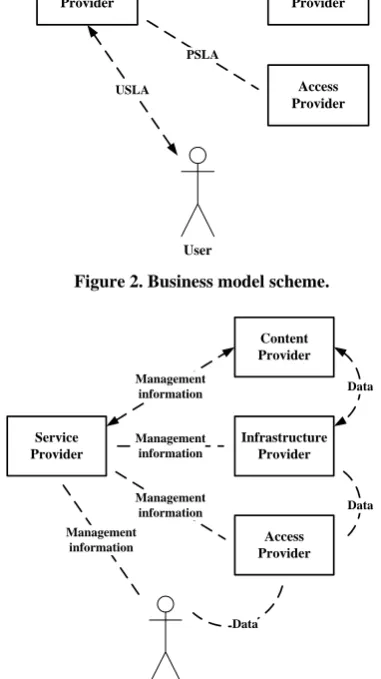
demic Conference, Sakurai [3] proposed a business mod-el based on convergent networks for a user moving within a heterogeneous convergent environment. His proposal is to create a kind of enterprise designated by Service Pro-vider, with the function of monitor the QoS level of the other Providers: Access, Infrastructure and Content. In this model the end user shall relate only to the Service Provider which, in turn, relates to the Access, Infrastruc-ture and Content Providers. The user requests the servic-es dservic-esired to the Service Provider, which selects which of other Providers have the best condition to meet the re-quired service with the quality desired by the user at that moment. The operation of Access, Infrastructure and Con-tent Providers becomes transparent to him, that is, be-comes imperceptible to the user.
This model establishes the way for a formal relation-ship among the four kinds of Providers involved. The rela-tionship between the final user and the Service Provider occurs through an USLA (User Service Level Agreement) and between the Service Provider and each one of the other Providers the relationship occurs through a PSLA (Provider Service Level Agreement). This model is shown in Figure 2. Figure 3 shows the logical connections of data flows related to the business model.
The user’s mobile device is logically connected to two providers: Access and Service (the physical connection occurs only through the Access Provider).
USLA is a formal agreement between the end user and the Service Provider. Its goal is to define the types of services and levels of QoS that the Service Provider un-dertakes to provide, in addition to legal provisions.
PSLA is a formal agreement between the Service Pro-vider and each of the Access, Infrastructure and Content Providers establishing technical and commercial parame-ters, besides the QoS level between them for each service
Market
Service Enterprise
(Business Rules)
Standards
Technology
(Innovation)
affects
affects affects influences
generate
Figure 2. Business model scheme.
Figure 3. Logical connections among the actors involved.
engaged.
4. Continuity of QoS through the Vertical
Handover Mechanism
The term handover (or handoff) was intended initially to mobile telephony, designating the mechanism for chang-ing the flow of information between cells durchang-ing a user displacement without interrupting the connection and seamlessly to him. For an environment of technological convergence is no longer possible to understand the han-dover only as a mechanism of change in the flow of in-formation only to cell phone, or to a network with ho-mogeneous characteristics. The handover also constitute a mechanism for changing flow of information between heterogeneous networks, or in other words, between dif-ferent technologies. An example of this can be found in
[4], where is cited the transfer of information between the cellular network and digital TV, allowing users to enjoy mobile TV service.
The handover is divided into two categories: horizon-tal and vertical.
Horizontal handover occurs when the flow of informa-tion is moved between two homogeneous wireless net-works, for example, changing the flow of information be-tween Radio Base Stations - RBSs in a cell phone trans-mission.
Vertical handover occurs when the flow of information is moved between heterogeneous networks. The goal be-ing pursued is that this handover process occurs in order to ensure continuity of service quality to the user seam-lessly.
To ensure continuity of service quality is necessary, for Telecommunication Service Providers, maximize the com-bined use of available resources in heterogeneous net-works, such as: WLANs (Wireless Local Area Network), UMTS (Universal Mobile Telecommunications Systems), VANETs (Vehicular ad hoc Network), WiMax (World-wide Interoperability for Microwave Access) and MA-NETs (Mobile ad hoc Networks) [5].
The need to trigger a vertical handover mechanism can occur both from the physical displacement of the user and from the need for reconfiguration of links between Providers.
As an example, in the case that the user is positioned in a particular physical location, and accessing a service of his/her choice, the Service Provider selects the best combination of links between Access, Infrastructure and Content Providers to meet user demand.
If the Infrastructure Provider becomes unavailable (for failure by overload hits or for any other reason), for in-stance, the Service Provider will detect this situation and provide the switching of the flow of information to anoth-er Infrastructure Providanoth-er which, at that instant, fulfills the conditions necessary to replace the first Infrastructure Provider in all its functions.
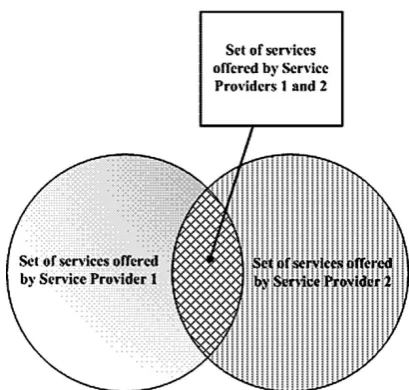
Regarding the relationship between the user and the Service Provider, and in a situation of free market com-petition, a user can hire USLAs with more than one Ser-vice Provider to obtain the desired range of serSer-vices. In this situation, it may occur that the user has hired the same service from two different Service Providers. This situation, in which two different Service Providers are contracted by a single user, can be represented by a un-iverse of two intersecting sets, as illustrated in Figure 4.
When a requested service only belong to the domain administered by Service Provider 1 or, on the other hand, belong only to the domain administered by Service Pro-vider 2, there is no conflict on the decision to which Ser-vice Provider fit the mission of triggering the vertical handover. Some parameters involved in the algorithms
Service Provider
Access Provider Infrastructure
Provider Content Provider
PSLA
PSLA
PSLA
User
USLA
Service Provider
Access Provider Infrastructure
Provider Content Provider
Management information
Management information
Management information
User
Data
Data
Data Management
[image:3.595.71.262.155.495.2]Figure 4. Universe of services offered by Service Providers 1 and 2.
for the traditional decision making processes in handover are: received signal strength, connection time on the net-work, available bandwidth, power consumption, cost, safety, delay and jitter.
The decision-making process, however, must be en-hanced to provide continuity of QoS. Besides the para-meters listed in the preceding paragraph, other conditions must be considered, such as those specified in the client USLA and the PSLAs agreed between Providers. In a USLA will be defined, for example, the limits of accept-able service unavailability agreed between the user and the Service Provider for each service contract. This deci-sion process involves algorithms that seek to make the right decision to switch the flow of information at the right time, which implies a set of multiple criteria to be considered.
When a handover is necessary, and its attainment af-fect the common universe of Providers managed by Ser-vice Providers 1 and 2, the decision process should con-sider one more variable in the decision-making algorithm: the Service Provider which offers the best option for the handover, understanding as best one that offers better tech-nical/commercial conditions for the continuity of service quality and the achievement of stipulated parameters in USLAs, according to user choice policy, based on a pre-diction algorithm for QoS.
For decision making it is necessary for Service Pro-viders 1 and 2 to exchange information to define the best routing option to execute the handover maintaining con-tinuity and quality of service. Among Service Providers there must be agreements that set the standards for this type of interaction: the Handover Decision Service Pro-viders Agreement - SPHDA [6]. Join a SPHDA implies acceptance of a technical/trade partnership between the two Service Providers involved and hence the access
per-mission of a Service Provider to the management infor-mation database from the other, and vice versa. A man-agement information database is the repository of all tech-nical occurrences in networks under the administration of the Service Provider. The reasoning developed for two Service Providers can be extended to any number of Ser-vice Providers.
5. Regulatory Acts
Regulatory acts establish guidelines for application of technical and business procedures aiming the continuity of QoS contracted by the end user. All the documents mentioned before (USLA, PSLA and SPHDA) must have their content regulated. The items that must be consi-dered for an official regulation are shown hereafter.
The USLA is characterized by a set of technical in-formation but, also, by the list of services the user wants to hire:
• specification of the desired services;
• specification of the maximum cost acceptable for each service;
• specification of the level of availability for each hired service;
• specification of the security level for each hired ser-vice;
• specification of the response time for each hired ser-vice and
• specification of other technical parameters as: band-width, loss rate, jitter and transmission velocity. • The PSLA is characterized by a set of business and
technical information that keeps certain resemblance to the SHPDA:
• standardization of the type of management informa-tion;
• standardization of the structure and formatting of man-agement information;
• agreement allowing the Service Provider to capture and send management information to the Access, In-frastructure and Content Providers through mobile agents;
• standardization of types of mobile agents that will be used to exchange the management information among providers;
• agreement on the availability of the management in-formation database and
• access to predict the pricing between providers for each service to be executed.
• The SPHDA is characterized by a set of business and technical information that takes part of the decision process to define which of the Service Providers, hired by the same user, will trigger the handover:
• standardization of identification and authentication codes for access to databases of management infor-mation;
• standardization of the type of management informa-tion;
• standardization of the structure and formatting of management information;
• standardization of requests for access to a database of management information;
• agreement to management information access through mobile agents;
• standardization of types of mobile agents that will be used to exchange the management information among Providers;
• agreement on the maximum response time for each request for access to a database of management in- formation;
• agreement on the availability of the management in- formation database and access to predict the pricing between providers due to the handover to be executed.
6. Conclusion
Open standards such as 3GPP and NGN pave the way for the development of telecommunications services provid-ing a further development of the market for telecommu-nications services offering services with better quality. Besides the 3GPP and NGN there is a need, however, for the adoption of other additional standards as function of technological changes and behavioral patterns of the
us-ers. These standards need regulatory acts for its imple-mentation.
REFERENCES
[1] A. P. G. Serra, “Method for Identifying Parameters of Quality of Services Applied to Mobile and Interactive Services,” Ph.D. Thesis, Escola Politécnica da Universi-dade de São Paulo, Brazil, 2007.
[2] S. Shepard, “Telecommunications Convergence: How to Profit from the Convergence of Technologies, Services and Companies,” McGraw-Hill,New York, 2000, 371 p.
[3] C. A. Sakurai, M. Martucci Jr. and A. H. Hirakawa, “Tele- communication Business Model for Converged Networks Focusing Final Users,” Proceedings of 2010 ITU-R Ka-leidoscope Academic Conference, pp. 241-248.
[4] R. Corjava, “QoS Analysis in Overlay Bluetooth WiFi Networks with Profile Based Vertical Handover,” IEEE Transactions on Mobile Computing. Vol. 5, No. 12, 2006, pp. 1679-1690.
[5] S. Lee, K. Sriram, K. Kim, Y. Kim and N. Golmie, “Ver- tical Handoff Decision Algorithms for Providing Opti-mized Performance in Heterogeneous Wireless Networks,” IEEE Transactions on Vehicular Technology, Vol. 58, No. 2, 2009.